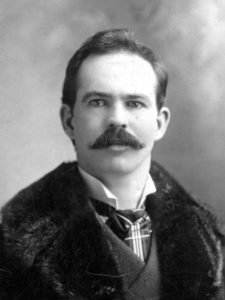
The election of Donald “Dan” Bain to the International Hockey Hall of Fame was announced by its president John B. Gavin, on October 21, 1949. This was not the only honor Bain was to receive. He was inducted into the Hockey Hall of Fame in 1945, the Canada’s Sports Hall of Fame, 1987, Manitoba Sports Hall of Fame and Museum and the Manitoba Hockey Hall of Fame, both in 1981.
Donald Henderson Bain was born February 14, 1874 in Belleville Ontario, Canada, the sixth child born to Scottish immigrant parents, James Henderson Bain and Helen Miller. The family moved from Belleville to Winnipeg Manitoba when Bain was a young child, where he attended school and earned a degree from Manitoba College.
Dan Bain was competitive and highly skilled in many sports.
His first taste of victory was in 1887, at the age of 13, winning the Manitoba
roller skating championship, skating a 3-mile race. He continued his
championship ways by winning the Manitoba provincial gymnastics competition at
age 17, and three Manitoba cycling competitions at age 20. He was also a strong
Lacrosse player in the province. He was
to have said, “I couldn’t see any sense in participating in a game unless
I was good. I kept at a sport just long enough to nab a championship, then I’d
try something else.” He did try
something else, hockey.
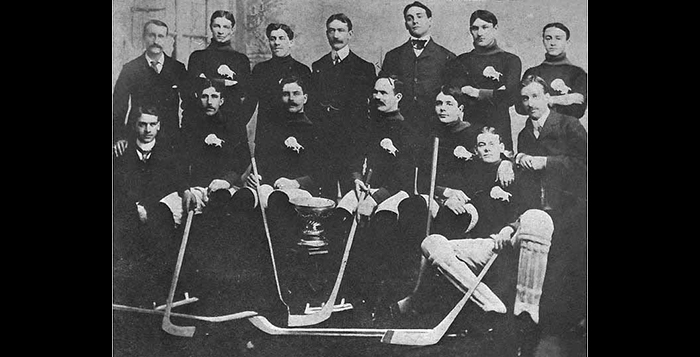
In 1895, the Winnipeg Victorias of the Manitoba Hockey
League, placed an ad seeking new players. Bain answered it. Despite a short tryout, using a broken hockey
stick held together with wire, he made the team. Bain showed himself a strong player in Center
and soon established himself as a leader of the team. On February 14, 1896 the Winnipeg Victorias
played the Montreal Victorias for the Stanley Cup. Bain led them to victory by scoring the
winning goal in the 2-0 game earning Winnipeg the Cup. The Winnipeg win was the first time a team
outside Quebec had won the Stanley Cup. The team returned to Winnipeg
victorious. Upon their return to
Winnipeg they were greeted by fans and then the team led in an open sleigh parade
In December of 1896, the Victorias faced Montreal again for
the Stanley Cup. Montreal took the Cup
back with a 6-5 win over Winnipeg, despite Bain’s scoring two goals. The game was described by local press as one
of the greatest sporting events in the history of Winnipeg. As team captain and manager, Bain and the
Victorias faced Montreal again in 1898, playing before record 7,000 fans. In 1899 the Victorias challenged Montreal
again for the Stanley Cup, but were unsuccessful. A year later, the Victorias met the Montreal
Shamrocks. Despite Bain scoring four goals in three games, the Shamrocks
defeated the Victorias 11-10 in the total goal series.
In 1901, the Victorias once again faced the powerful
Montreal Shamrocks in a two-game series.
Bain was the hero of the series by scoring a goal in overtime to take
the series. Bain was the first person to
score a Cup-winning goal in overtime. It
was also in 1901, Bain earned the nickname “masked man” from the press, as he
wore a simple wooden mask to protect his broken nose.
Bain retired from hockey in 1902 but did not stay out of sports. He was the Canadian trapshooting champion in 1903. A devoted figure skater, he earned over 20 titles, the last one at age 56. He also earned medals in snowshoeing and lacrosse. Bain remained active in competitive sports until 1930.
In addition to sport, Bain was a well-known businessman, community leader and philanthropist. He owned a successful grocery brokers business with several offices. He was one of the founders of the Winnipeg Winter Club, member of the Freemasons, and served as lifetime governor of Winnipeg General Hospital. Dan Bain died in Winnipeg on August 15, 1962. At the time of his death his estate was valued at more than $1 million Canadian, over $8.3 million Canadian today. He left his estate mostly to charity and his employees. He was buried in the cemetery of St. John’s Cathedral in Winnipeg.
Additional Sources:
“Two members added to the Hall of Fame,” The Ottawa Citizen, Friday, October 21, 1949, p. 66.
Hockey Hall of Fame. “Montreal Victorias 1897–98”.HHOF.com.
Hockey Hall of Fame, “Dan Bain Biography“. HHOF.com.
“Ross One of Two New Men Elected to Hall of Fame,”Saskatoon Star-Phoenix. Saskatoon, Saskatchewan, Saturday, October 22, 1949, p. 18.
Michael McKinley, Hockey: A People’s History (Toronto: McClelland & Stewart, 2006), pp. 21–22.
The 19th National Hockey League All-Star game, scheduled to launch the 1965-66 season, was set to take place on October 20, 1965. The Montreal Canadiens, winners of the 1965 Stanley Cup, would take on the All-Star team at the Montreal Forum. However, as the date loomed, the game was at risk of being without many of its “all stars.” The problem? Contracts.
On the eve of the game those players who hadn’t signed a contract for the season with their teams were considered ineligible to take the ice. The players who had been selected for the All-Star team but who were ineligible included: Bobby Hull and Stan Mikita, of the Chicago Black Hawks; Roger Crozier, of the Detroit Red Wings; and Bobby Baun, Tim Horton, Bob Pulford, and Dave Keon, of the Toronto Maple Leafs. Also unlikely from the Toronto Maple Leafs was Carl Brewer.
All-Star coach, and head coach of the Black Hawks, Billy
Reay was uncertain of the lineup with face-off fast approaching.
“Hull was reported asking for an unprecedented $100,000
contract following his brilliant first half-season last year and a big comeback
in the semi-final playoffs,” wrote Dick Bacon of The Ottawa Journal.
Crozier, a goaltender, signed his contract the day before the game was to be played. As it turned out, Reay had to use his own Glenn Hall of the Hawks between the pipes when the game actually took place, as Crozier got sick after the pre-game warm-ups.
In the nick of time, the National Hockey League’s governors made the decision to allow everyone, signed or unsigned, to play in the game. There were still a few missing stars. Black Hawk Mikita was not on the roster. And Brewer, of the Leafs, had taken the hockey world by surprise on Monday, the 18th, when he announced his retirement.
“Carl Brewer has decided to quit hockey and hopes to be
placed on the voluntary retired list of the National Hockey League,” announce The
Gazette of Montreal.
“Hockey’s a great game, but I’ve decided to retire for
personal reasons. That’s all I care to say,” said Brewer.
Brewer, a defenseman, was replaced on the All-Star roster by Marcel Pronovost, who had spent the previous 14 seasons with the Detroit Red Wings, but in the fall of 1965 played for the Leafs.
The game got underway, as scheduled, at 8 P.M., in front of more than 14,000 fans at the Montreal Forum. It was a record-breaking 7th All-Star game appearance for the Canadiens as the reigning Stanley Cup champions.
Toe Blake, coach of the Canadiens, used both his goaltenders—Gump Worsley and Charlie Hodge—in tandem, swapping them out roughly every five minutes.
After a scoreless, but penalty-filled, first period, Montreal’s Jean Béliveau and Jacques Laperriere scored the first two goals within 11 minutes of play in the second period. Not to be outdone, the All-Stars Norm Ullman scored at 12:40 and Hull knotted things up at 16:35. Gordie Howe, scored at 19:19, to give the All-Stars a 3-2 lead.
In the third period, Johnny Bucyk, scored the All-Stars’ fourth goal at 10:01, giving his team a two-goal lead. With less than one and a half minutes left in the game, Howe, unassisted, scored a shorthanded goal, giving the All-Stars a 5-2 lead. The final score was All-Stars 5, Montreal 2.
“The All-Stars counted four of their five goals against Charlie Hodge, who alternated at five-minute intervals throughout the contest with Lorne (Gump) Worsley.” reported The Vancouver Sun the following day.
With his two goals and two assists, Howe—“Mr. Hockey”—was named
the MVP of the game.
Perhaps the win going to the All-Stars should have been
anticipated.
“Since the game was inaugurated in 1947 as a source of revenue for the players pension fund, the All-Stars hold an 8-5 edge over the Stanley Cup champions, with three games tied. On two other occasions the format was changed to have the first All-Stars play the second All-Stares. Both these games ended in deadlocks,” reported Dick Bacon in The Ottawa Journal before the game got underway.
Maybe, in an effort to no longer run into the problems of unsigned All-Stars in the future, the 1965 All-Star game was the final one played before the actual NHL season got underway.
Additional Sources:
“Hull Top All-Stars, 5-2,” The Boston Globe (Boston, Massachusetts), Thursday, October, 21, 1965, p. 52.
Dick Bacon, “All Stars Face Prospect of Playing Without Stars,” The Ottowa Journal (Ottawa, Ontario), Wednesday, October 20, 1965, p. 20.
“Carl Brewer Quits Hockey,” The Gazette (Montreal, Quebec), Tuesday, October 19, 1965, p. 31.
Forwards Grant Mulvey and Patrick Marleau were born two days shy of 23 years apart, on September 17, 1956 and September 15, 1979, respectively. That was just the beginning of what they had in common, seeming to live parallel lives in different generations. On October 19, 1974, Mulvey became the youngest player (since World War II) to score his first NHL goal. On the same date 23 years later (October 19, 1997), Marleau became the second-youngest to score his first.
Both youngsters had been drafted in the first round with the Chicago Blackhawks selecting Mulvey 16th overall and the San Jose Sharks picking Marleau 2nd overall. Marleau’s birthday was actually the cutoff for draft eligibility for his class. The two players would each spend the vast majority of their NHL careers with these teams. After missing most of the 1982-83 season with a knee injury, Mulvey was claimed on waivers by the New Jersey Devils in 1983 and played his final 12 NHL games there. Marleau’s career has lasted over twice as long and continues. He signed with the Toronto Maple Leafs as a free agent in 2017 but returned to the Sharks after two seasons.
Even the numbers each wore for their teams were similar. Mulvey always wore No. 22. After starting with No. 14, Marleau switched to No. 12 in 2001.
Both of them scored their first rookie goals in away games in which each had three shots on goal. Chicago and San Jose each scored three goals total. However, the Blackhawks won their game 3-1, while the Sharks lost theirs 5-3.
Mulvey’s milestone was scored at St. Louis’s Arena for a crowd of 18,512. Having scored his first assist two days earlier, he netted his first goal at 5:15 into the game. According to the Chicago Tribune’s recap, “He was stopped once by Johnston on a bullet from the right, then the carom ricocheted toward the right wing corner. Mulvey centered it, and while linemates Dennis Hull and Pit Martin were swiping, the disk hopped in off St. Louis’ Gary Unger. It was unassisted.” The St. Louis Post-Dispatch called it a “fluke goal credited to Chicago’s No. 1 amateur draft choice.” The paper explained, “Mulvey was attempting a centering pass out of the corner when the Blues’ Garry Unger, seeking to intercept the puck, instead deflected it into the top corner of the net and Mulvey had his first NHL goal.” This was Chicago’s second goal, and the Blues only managed one goal. That made Mulvey’s the game-winner.
Marleau’s goal took place before 14,103 attendees at Phoenix’s America West Arena. As the youngest player in the NHL at the time, he scored at the opposite end of his game, at 19:34 of the final period. He made a “snap shot from the slot with 25.6 seconds remaining” that Nikolai Khabibulin could not block. The Sharks had a 2-1 lead until 8:05 of the second period, when the Coyotes rallied to score three goals in two and a half minutes. Coach Darryl Sutter replaced veteran goalie Mike Vernon for Kelly Hrudey, but the Sharks failed to score again until Marleau’s game-ender. As Marleau said, “I was excited, but the first thing I did was look up at the clock to see how much time we had left.”
The record for youngest player to score his first NHL goal is somewhat complicated. The youngest seven were rookies during 1942 and 1943 when the NHL had lost older players to military service. The next four youths on the list still include both Mulvey and Marleau. On October 3, 2013, Aleksander Barkov scored at the age of 18 years and 31 days. Following him by just a day, at age 18 years and 32 days, Mulvey is tied with Jordan Staal, who scored his on October 12, 2006. That makes Marleau technically the eleventh in the list at the age of 18 years and 34 days when he scored his first NHL goal.
The Boston Bruins would be the first to say that there were parts of their game on Thursday night that could have been better. The players who don the sweaters with the Spoked-B take a lot of pride in bringing their very best as individual players each and every night. Thursday night some of them were certainly struggling. However that does not mean that they won’t do well this season. In fact in the seven games they have played, they are 5-1-1, which speaks to the team as a whole.
The difference between one of them having a bad day at the office and one of us is that we don’t have 17,000 plus people yelling at us at our office and another couple hundred thousand critiquing our every move and decision on social media. We don’t have the bright lights of the television cameras staring us down while the media dissect what we did our didn’t do. Oh sure, they signed up for that, but there perhaps needs to be a moment where everyone steps back, takes a breath and views the game in a rational manner.
Right now David Pastrnak is the anointed one. In the past two games alone he has notched six goals on nine shots. That’s impressive no doubt, and he will certainly try to continue the things that are allowing him to score so frequently.
“I think [Pastrnak’s] a goal-scorer in this league, he’s proven that. He’s getting a few breaks around the net, but he’s finishing his opportunities. But he’s around the net, right? So it’s a good lesson. Get there. He’s not only scoring one way, he’s certainly finding some pucks on the elbow on the power play, but that’s by design. But some of the other ones, he’s getting to the net, finding loose pucks, recovering pucks. He’s getting rewarded for his work,” said Bruins head coach Bruce Cassidy.
Does the team think they can go far with just their first line putting up points? Of course not. They know they have to find a way to get the other three lines scoring. Right now the second line is temporarily missing David Krejci who is suffering from a lower-body injury. This means someone is being put on that line until Krejci’s return. It should be understandable that it might take those linemates a little while to get their timing down and perfect their communication.
Despite being outshot significantly in the first period and having some sloppy play in the second and third periods, the Bruins led twice in the game. And when the Tampa Bay Lightning’sKevin Shattenkirk did get the go-ahead goal with less than five minutes remaining in regulation, the Bruins didn’t fold. They continued to play their game, showing the resilience they are known for—which resulted in Pastrnak knotting it up with just 3:05 remaining in regulation. That forced the game to overtime, guaranteeing the Bruins at least one point in a game that could just have easily denied them any points.
In the past the Bruins power play has been anything but. On Thursday night they were producing at 50% while on the man-advantage. That won’t carry them all the way to a Stanley Cup Final, but it showed how they have come to address some of their issues on the power play. Not all of the issues, as Tampa had a couple too many short-handed bids, but it speaks to Boston learning from their mistakes.
When asked about the game, Torey Krug suggested that the team’s hockey IQ was a bit low at the moment. However, when playing in the NHL the opposition will take advantage of those mistakes, and Tampa made them pay.
“There’s parts of the game that were good. We started defending better as the game went on, not good enough in the first period. Leaky through the middle of the ice off the rush, stuff that we address, we’ll see that Saturday and Tuesday with Toronto. Players are going to have to start identifying that, these strengths, they happened too often tonight, they got through the middle. Now, our power play, as much as it scored, gave up some shorties, so that’s a different animal we’ve got to be mindful of, managing the puck in certain situations. But five-on-five, a couple of goals there — we just need to be cleaner. Defending the rush. I think every goal — yeah, every goal came off the rush. I think our defensive zone coverage has always been good, our guys are good with structure there, but it’s managing the puck in the neutral zone. On the breakouts, we’re better I thought. And rush goals. It hurts,” Coach Cassidy stated.
The Bruins players and coaching staff will look at the breakdowns and begin to work on ways to prevent them from happening. While it’s impossible to play an absolutely perfect game—hockey, after all, is a game where the opposition capitalizes on mistakes—the Bruins will look for ways to minimize those mistakes.
While every game is definitely important and the goal is to get the two points, there will be games when that just doesn’t happen. Getting the point that they did should be recognized as an accomplishment and a sign of their fortitude. And as long as they have that, then they will improve.
In 60 minutes and 69 shots, not a single goal was scored between the Los Angeles Kings and New York Islanders on October 18, 1977, when Nassau Coliseum played host to 12,254 hockey fans. Both Rogie Vachon and Glenn Resch earned shutouts, and the Islanders franchise experienced their first 0-0 tie.
Vachon began his NHL career in 1966, and while with the Montreal Canadiens, they won the Stanley Cup championships in 1968 and 1969. After the first, Vachon received the Vezina Trophy. On November 4, 1971, Montreal traded him to Los Angeles in return for fellow-goalie Denis DeJordy (among others). With the Kings, Vachon almost always had above a .900 save percentage.
At the age of 32, Vachon had one of his best games, making 41 saves. This was his second shutout of the season, 30th with the Kings, and 43rd shutout of his career. “It’s hard to explain those kinds of games,” he said. “Mentally, I could see all the shots coming. I felt great during the warmups and then they put pressure on me right away. Maybe it was a good thing. It woke me up. They send down the puck and then throw two guys at you.” According to NY Daily News, “He kicked, dove, blocked, twisted and brought off all manner of super acrobatics.” Vachon noted, “Usually you get some rest but they kept coming and coming for 60 minutes.”
After killing off a four-minute penalty midway through the third period, the New Yorkers actually gave Vachon a standing ovation. “For a minute, I didn’t know what was happening. It felt wonderful. I couldn’t believe it.” His coach, Ron Stewert, praised, “In all my years in the NHL I have never seen a better example of goaltending. And if I live to be 100, I don’t think I ever will.”
Before the start of the next season, Vachon signed with Detroit, who traded him to Boston in mid-1980. After playing his final NHL season in 1981-82, Vachon occasionally coached games for the Kings. His career total for shutouts came to 51. He was inducted into the Hockey Hall of Fame in 2016.
On the other end of the rink, Resch had less to keep him busy. He had begun his NHL career with the Islanders after he was traded with DeJordy (and others) from Montreal on June 6, 1972. He, too, consistently had a save percentage over .900. Considering his team fared better overall in the 1970s, Resch’s save percentage and goals against average were better than Vachon’s.
That night, he made 28 saves for his 15th career shutout. Still, his attention seemed instead on his counterpart. Resch remarked, “I had a lot of chances to stand and watch the way Rogie positions himself in the net and moves around. This game was pretty much the best I ever saw him play.” He continued, “It began to look as though we just weren’t going to score. And I sensed that Rogie had the feeling that nothing was going to get by him.” Resch’s coach, Al Arbour, agreed saying, “We’ve got a long way to go. When Rogie gets hot he gets hot … But we just weren’t jumping on rebounds, and some of our players were handling the puck like it was a hot potato.”
Resch remained with the Islanders, winning the Stanley Cup in 1980. In March 1981, they traded him to Colorado, and he moved with that franchise to New Jersey in 1982. That was the year Resch won the Bill Masterton Memorial Trophy. The Devils traded him to Philadelphia in March 1986, and the next season was his last. He ended his career with 26 shutouts, all but one of which were with the Islanders.
At that early stage in the 1977-78 season, Los Angeles had the only undefeated team in the NHL (if preseason counted) while the Islanders sat in the Patrick Division cellar. By the end, the Islanders ranked third (with 111 points) and the Kings tenth (with 77 points) in the NHL. Neither made it very far in the playoffs.
Two of the NHL’s greatest defensive players, No. 77 Paul Coffey and No. 33 Patrick Roy, broke records on October 17 exactly nine years apart. In 1991, Coffey became the highest-scoring defenseman by earning the most assists and points of any defenseman in NHL history. In 2000, Roy became the winningest goalie by breaking a record thought to be unbreakable.
1991
At the end of the previous season, Coffey (with the Pittsburgh Penguins) had just won his fourth and final Stanley Cup championship. He had already earned the James Norris Memorial Trophy twice and would go on to win a third a few seasons later.
That October 17th, Pittsburgh’s Civic Arena hosted 14,808 fans, who were able to see their team beat the New York Islanders 8-5. The Penguins had lost a 4-1 lead to fall behind 5-4 after two periods before rallying in the third period.
At 5:31 into the game, Coffey assisted Kevin Stevens to break Denis Potvin’s record for most regular-season assists by an NHL defenseman. Coffey followed his 743rd assist with his 744th, on the game-tying goal. According to the game recap, “Coffey missed the net with a shot from the left point, but left winger Bob Errey collected the puck and beat goalie Glenn Healy from above the right circle at 4:47 of the third period.” Coffey joked, “I was telling Bob after the game, that was the only play I had. I had to shoot wide and have him pick it up and come around and score.” Errey had already scored the first goal of the game and went on to score the last, earning his first hat trick on an empty-netter.
The two assists brought Coffey up to 1,053 career points. This surpassed Potvin’s record for highest-scoring defenseman. How coincidental that Coffey topped these records playing against the only team Potvin played for before retiring in 1988. Coffey remained one goal behind Potvin’s record of 310, but he scored goals on October 24 and November 8.
After the second assist, Coffey received a standing ovation and officials halted play. Penguins GM Craig Patrick presented him with a plaque. “That was an incredibly classy thing on the part of Craig and the Penguins,” commented Coffey. He tried to put his feelings into words by saying, “It’s kind of hard to believe, coming from a small town (Weston, Ontario) and putting those kinds of numbers up. Passing two great hockey players in Bobby Orr and, of course, Denis Potvin. It’s a nice feeling.” His coach, Scotty Bowman, added, “He’s the best skater I’ve seen. And he’s a consummate pro. … I know what Paul does for the other players. There’s not much you can add to a record like that. All those points. It’s hard to believe.”
On his high from celebrating his accomplishments, Coffey said, “And I can’t thank the fans enough. I’ve said it before and I’ll say it again – I hope to finish my career here in Pittsburgh. I hope to put up a lot more points in the black and gold.” Instead, only four months later, Pittsburgh traded Coffey to the Los Angeles Kings. After only 60 games there, L.A. traded him to Detroit, who traded him to Hartford, who traded him to Philadelphia, who traded him to Chicago, who traded him to Carolina. For his last hurrah, Coffey signed with the Boston Bruins in 2000.
At the time of this record-breaking, 30-year-old Coffey was just over halfway through his NHL career. As teammate Errey commented that night, “Amazing, isn’t it. And with the way he stays in shape, the way he skates, he may get another 1,000 points. Think of that. It’s not beyond the realm.” Coffey did not retire until shortly before his 40th birthday in 2001. At that time, he had 396 goals, 1,135 assists (an additional 391 above his record) and 1,531 points (an additional 478 above his record). These were second only to Ray Bourque’s numbers, after Bourque passed Coffey on October 25, 2000. Coffey was inducted into the Hockey Hall of Fame in 2004.
2000
Roy may not have known it at the time, but in October 2000, he was at the start of a very rewarding season and his third-to-last (of 19) in the NHL.
On Saturday, October 14th, Roy tied Terry Sawchuk’s record of 447 victories. Sawchuk had held the record for 30 years, leading many to believe that it would never be broken. The very next game, on Tuesday, October 17th, Roy succeeded in setting a new record. He only needed 847 games to win 448, whereas Sawchuk had needed 968 games for his.
The record-setting game was held at Washington’s MCI Center for an audience of 13,335. The Capitals had not won all season, but they made the Colorado Avalanche work for this special victory. Although Colorado started off leading 2-0, Washington came back for a 3-2 lead until Captain Joe Sakic knotted the game at 3:27 of the third period. Neither team managed to score, so the game went into overtime. About halfway through the five-minute session, the Avalanche had the four-on-three advantage (with Richard Zednik in the box for cross checking) when Peter Forsberg scored the game-winner. With 30 saves of his own, opposing goalie Olie Kolzig complimented, “My hat’s off to Patrick. He’s one of my idols.”
Immediately following the goal, Roy “skated out of the net and jumped several times, waving his arms.” He had made 27 saves to hold off their opponents and had a .900 save percentage. He commented, “I was honest when I said I wanted to enjoy it and didn’t feel any pressure.” Claiming that he was really thinking more about the current season and thanking his teammates, Roy explained, “In a couple years, when I retire, or even tomorrow, when I lay down and have time to think about, then I’ll have an idea of what it means. But right now, we’re on a winning streak, and it’s fun, and everyone can enjoy it.” However, he did recognize, “But this has a special place. It doesn’t take one year; it takes a career to do this.” His cut out his net so that it could be sent to the Hockey Hall of Fame (where Roy would be inducted in 2006).
Roy’s accomplishments received recognition from the top. NHL Commissioner Gary Bettman stated, “Patrick Roy’s passion to play is surpassed only by his passion to win. This remarkable achievement is a testimony to his consistency, his durability, his pride, his skill and, perhaps, most of all, his nightly determination to meet the highest standards of goaltending excellence, his own.” Even Canadian Prime Minister Jean Chretien called to congratulate Roy.
Although the record was celebrated on October 17, the NHL later found that Sawchuk had been erroneously credited for two wins, making his record actually 445 victories. Roy had surpassed that with the Avalanche win five nights earlier, his 446th. Roy’s record lasted until 2009.
At the end of the 2000-01 season, Roy won his fourth Stanley Cup championship and his third Conn Smythe Trophy as playoff MVP. He had already earned the Vezina Trophy three times, and the following season, he would receive his fifth William M. Jennings Trophy. When he retired in 2003, he held the records for most regular-season victories (551) and most playoff victories (151). In regular-season wins, he was surpassed by Martin Brodeur (with 691 wins in 1,266 games), but Roy remains the tops in playoffs.
Additional Sources:
Tom McMillan “Coffey sets scoring mark in Penguins’ 8-5 victory,” Pittsburgh Post-Gazette, 18 Oct. 1991, pp. 19 and 23-24.
Dave Molinari, “Coffey top defenseman on points, assists charts,” Pittsburgh Press, 18 Oct. 1991, p. D2.
Sandra McKee, “Working overtime, Roy gets record,” Baltimore Sun, 18 Oct. 2000, pp. 1D-2D.
“Historic night for Roy,” Montreal Gazette, 18 Oct. 2000, p. E3.
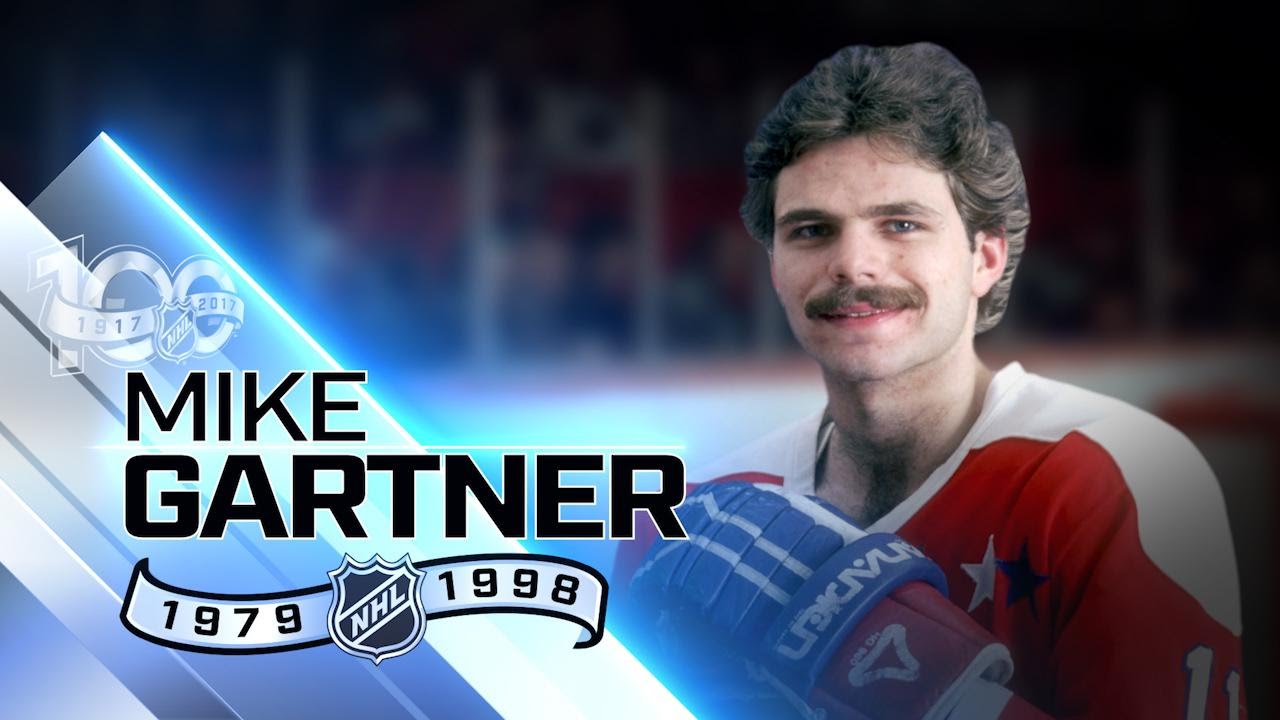
Mike Gartner was a speed demon with a hell of a shot. In mid-October, his shots resulted in important goals for his career. As a rookie, on October 16, 1979, he scored his first NHL goal with the Washington Capitals. Two days shy of its 12th anniversary, on October 14, 1991, he netted his 500th goal with the New York Rangers (in a game against the Capitals). He ended his career in 1998 with 708 regular-season goals.
Having turned pro at 18, Gartner signed with the Cincinnati Stingers in the final year of the WHA. When the leagues merged in 1979, the Washington Capitals drafted Gartner fourth overall. He played his first NHL game on October 11 and was credited with an assist. He went pointless during the next two games.
In his fourth NHL game and second game at the Capital Centre in Landover, Maryland, Gartner scored his first of many NHL goals. Only 5,386 fans were in attendance to witness the moment. It ended up being a high-scoring night. When Gartner scored at 19:15 of the first period, it was the sixth goal of a game that ended 8-6 in favor of the Capitals over the Los Angeles Kings. All (but one) scorers for Washington tallied their first of the season, and three of their goals were during power plays.
The coaches of the two teams held opposing views on the reason for the high scores. Gartner’s coach, Danny Belisle commented, “I thought both goalies played well under the circumstances. It was a wide open game. It could have been 13-12 without the goalies. We really needed that one.” Whereas, Kings Coach Bob Berry claimed, “We didn’t get the kind of goal tending we’ve got to get if we’re going to be in the playoffs even. Let’s not kid ourselves, you can blame the defense and the forwards for not back-checking, but that’s not the case. We’ve got to get better goaltending if we’re going to be successful.”
For Gartner, it could not just be one goalie having a bad start to the season. His rookie season ended with 36 goals and 68 points, leading in both for his team. Gartner later said, “When I went there, hockey was in no way the number one sport. In fact, it wasn’t number two, three or four either! Yet, it was a great experience for me. I was given all sorts of opportunities to play, and because I was, I turned into a guy who could put the puck in the net.” He did that so well, he remained the Capitals’ leader in goals (397) and points (789).
Washington traded Gartner to the Minnesota North Stars in March 1989. Almost exactly a year later, Minnesota traded him to the Rangers. At the beginning of his second full season in New York, Gartner became the 16th NHLer to reach the 500-goal milestone. He was the first to tally his 500th in a Rangers uniform, and his was the first scored in that Madison Square Garden. (Gordie Howe had scored his 500th at the old Garden on March 14, 1962.)
Gartner did not wait long to score, beating Mike Liut only 3:27 into the game. During a Rangers penalty kill, Capitals defenseman Calle Johansson earned a trip to the penalty box when he tackled Darren Turcotte. The teams played four-on-four for 49 seconds until the Rangers had the advantage. According to the game recap, Mark Messier “accepted a cross-ice pass from James Patrick and steamed up the left side while Gartner sneaked up the right. The Capitals always use Rod Langway on their left defense when Gartner is on the ice … But Langway was late getting into the play when Messier flipped a pass over Iafrate’s stick. The puck and Gartner arrived at the goalmouth at the same instant, and Gartner drilled the puck from barely five feet to Liut’s left.” Gartner returned to his bench to be congratulated by his teammates.
Unfortunately, though Gartner’s goal started the night off right, the Rangers fell to the Capitals 5-3. His first team had beaten his current team, which had lost three in a row. However, the season turned into a good one for both Gartner and the Rangers. Having scored his 500th goal, Gartner became the first to also earn his 500th assist and 1000th point all in the same season. The Rangers went on to win the Presidents’ Trophy that year. Though they only played two rounds in the playoffs, Gartner led their scoring with 16 points.
In a case of terrible timing, Gartner was traded in March 1994, just before the Rangers finally won the Stanley Cup again. As he said later, “To be with the team for a number of years before that and see it build to that point and then get traded and watch that same team that I’d been playing with go on to win the Stanley Cup was obviously a tough thing to watch.” He went his entire career without a championship, but he was inducted into the Hockey Hall of Fame in 2001.
The goals came so quickly, the commentators could hardly keep up and the goalies certainly didn’t. On October 15, 1983, the Chicago Blackhawks and the Toronto Maple Leafs matched a record they set in 1977 and set two NHL speed scoring records that still stand.
The game was held at Maple Leaf Gardens for 16,382 fans, and the home team won 10-8. The total between the teams (18 goals) matched Chicago’s record for most goals scored in one game by both teams. Crazy enough, these two teams originally had set the record at Chicago Stadium on February 20, 1977, when Toronto also won 10-8. This was only three goals short of the NHL record of 21 goals in one game set back in 1920.
It did not take long before the scoreboard saw action. Only 43 seconds into the game, Toronto led things off. They scored again at 1:01 making the score 2-0 in about a minute. As the first period progressed, the Blackhawks were able to tie only to watch Toronto sink two more in the last five minutes.
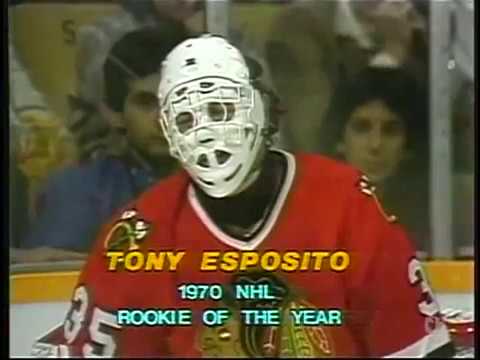
Clearly, Chicago’s goalie was struggling. At 40, Tony Esposito was the oldest player in the NHL at the time. However, as Coach Orval Tessier noted, “I don’t think Tony had a great night, but pointing the finger at one guy when a whole group of guys didn’t have a great night, either, isn’t the answer. In the first period we had 16 turnovers in our own zone.”
In the second period, both teams rallied at the same time. Setting two NHL records, they scored five goals within the span of 1:24. This beat the record for the fastest five goals by two teams (1:39) that had been set by the Maple Leafs and the Detroit Red Wings back in 1944. In the process, they had four goals in 53 seconds which broke the previous record (1:01) for four fastest as well. As commentator Gary Dornhoefer exclaimed, “Our statistician is going out of his mind.”
The free-for-all started about three minutes after Toronto’s Mike Palmateer blocked Rick Paterson’s penalty shot. As with the rest of the game, Toronto started the party. At 16:49, Gaston Gingras scored a “power-play goal from just inside the Hawk blue line.” Between 17:12 and 17:42, in exactly 30 seconds, the Blackhawks scored three goals. The first and third were the second and third goals of the night for Denis Savard, earning him a hat trick. Finally, only 31 seconds later at 18;13, the Leafs brought the score up to 8-6. In the midst of this, Dornhoefer remarked, “It’s been a wild one here in Toronto. They’re going for goals tonight. You like scoring, you got it.”
For the third time that night, Toronto scored the first goal of the period. Chicago came back with two more goals to bring themselves within a chance of at least tying. Unfortunately for them, it instead came down to poor Esposito. In the final seconds, he was caught too far out of his zone and threw his stick in a desperate attempt to stop the puck shot by Greg Terrion. Although Terrion missed the empty net, he made good on the resulting penalty shot.
Earlier, commentator Bob Cole had remarked, “But it’s no sense even talking about defense. We haven’t seen any all night.” Similarly, the Chicago Tribune called it “a hockey game so sloppy it could have passed for a mud-wrestling match.” Coach Tessier remarked, “We could talk about this game until tomorrow morning and still come up with plays we’ve never seen before. I told them it’s a game we had best forget in a hurry. You lose 2-1 or 10-8 it’s still a loss. Defensively, we made a ton of mistakes.”
Surprisingly, by the end of the regular season, the Blackhawks (with 68 points) finished ahead of the Maple Leafs (with 61 points), despite only winning five away games.
Thanks to indoor rinks and refrigeration, ice hockey can be played in southern climates. Still, it wasn’t until October 14, 1972, that the southeastern United States opened its first arena for its earliest NHL franchise. Having begun their inaugural season on the road, the Atlanta Flames played their home-opener following the opening ceremony held at the Omni Coliseum.
Atlanta was granted a franchise on November 9, 1971 in an effort to expand the NHL’s reach out of competition with the coming World Hockey Association (WHA). The Omni Sports Group led the franchise and began constructing a suitable arena. They hired architects Thompson, Ventulett & Stainback, Inc., who created a unique design that ended up costing about $18 million.
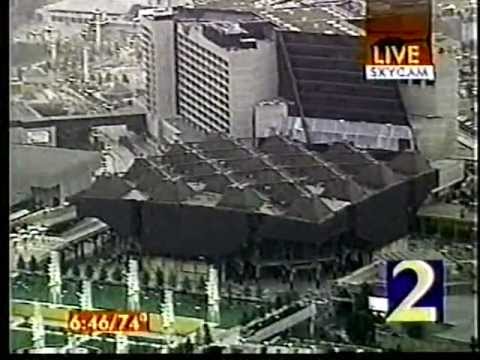
To Atlanta residents, the exterior looked like a “rusty egg carton.” Pods helped hold the structure up, and the rusty brown-orange walls were supposed to oxidize to a deep purple after a year or two. Omni Group President Bill Putnam called it “the most magnificent sports arena in the world.” Jay North (Dennis the Menace) complimented, “Compared to this, the Forum in Los Angeles is a cow pasture.”
The Omni still needed some interior work by opening night. Bob Kent, president of the Omni, told the press that they were still working on some last-minute items – like painting, laying carpets, finishing concession stands, installing seats, and installing the giant scoreboard. One worker joked, “They might have to pass out the seat bottoms and a screwdriver to everybody as they come in.” According to Kent, “We’ve got seats, lights, roof and ice. All the rest will soon be completed.”
For the opening ceremony and game, a sell-out crowd of 15,268 packed the Omni. Gov. Jimmy Carter, Atlanta Mayor Sam Massell, and NHL President Clarence Campbell all participated in the dedication, using a long red carpet laid on the ice. Mayor Massell told the crowd that having the NHL and arena there was “a milestone for Atlanta” and “completes our membership among the capitals of major league sports.” Gov. Carter encouraged, “I know all of us will become big hockey fans.”
That certainly appeared prophetic. The crowd was enthusiastic about the interior of the rink and about the sport. “That yelling was something,” commented one of the new Flames, Ray Comeau. “The crowd reaction definitely plays a part in how you play. When those people are behind you, yelling for a goal and yelling for you to win, it has to make a guy play harder.” Flames Coach Bernie Geoffrion remarked, “Let’s face it, the people come to see exciting hockey, so that’s what we try to give them.”
Play was somewhat slowed by the poor ice. Comeau explained, “It’s no big deal, though, because all new rinks have the same problem. Once we play a few games, the ice will be cleaner and the puck will slide better.” Campbell agreed, “They had this trouble in New York and they had it in Buffalo when they opened their rink. It will wear off after a few games. Besides, you can’t expect everything to be perfect, can you?”
The game was something of a rematch as the Flames had lost (5-3) to the Sabres in Buffalo earlier in the week. It seemed that the Flames intended to switch things up when they scored on the first shot fired in the Omni. As the Atlanta Constitution described the play, “Ernie Hicke swept in, took a pass from Noel Price and stuck it into the nets past a groping Roger Crozier.” The power-play goal occurred little more than two minutes into the game. Almost 14 minutes later, Buffalo tallied its only goal when Jim Lorentz “took a pass from Gil Perreault, shuffled it through Flame defenseman Bob Paradise’s feet, picked it up on the other side and neatly scored.”
Things heated up again in the third period as the Sabres tried to gain the lead. In one period, they sent 17 shots on net, which equaled Atlanta’s total for the game. Flames goalie Phil Myre “turned back shot after shot in a torrid third period.” Coach Geoffrion praised, “Let’s be honest, he saved the game for us. Phil played one hell of a game.” Myre was more concerned about the team and fans. “I just wish we could have won. You do what you have to do. Playing before the home crowd for the first time is always something special, so you like to give them a win. That’s the one thing that bothers me.” In that, his coach agreed. “I thought we’d take this one for sure. Playing before our fans for the first time was something special. All the players felt the same way.”
The teams remained tied 1-1. “They out-shot us pretty bad, 31-17, and that hurt us,” analyzed Geoffrion. “But the main thing is we didn’t lose. Even those ties count for points in the standing. I just wish we could have given those people a better performance. They really went for us, eh? It was great. Except for not winning.” With the tie, the Flames had three points and a record of 1-3-1.
Additional Sources:
Ron Taylor and Maurice Fliess, “‘Beautifuls’ Hail Sold-Out Omni,” Atlanta Constitution, 15 Oct. 1972, pp. 1A and 12A.
Jim Huber, “Flames Tie Christens Omni,” Atlanta Constitution, 15 Oct. 1972, pp. 1D and 12D.
Furman Bisher, “Refrigerated Mystery,” Atlanta Constitution, 15 Oct. 1972, pp. 1D and 12D.
Tony Petrella, “Fans Great, but Ice Greater,” Atlanta Constitution, 15 Oct. 1972, p. 12D.
Jim Stewart, “Omni Doors Open To Atlanta Tonight,” Atlanta Constitution, 14 Oct. 1972, pp. 1A and 12A.
Tony Petrella, “Flames,” Atlanta Constitution, 14 Oct. 1972, p. 1D.
It may not have been a franchise, but it was an NHL game. Saskatoon, Saskatchewan happily took what it could get. On October 13, 1992, Saskatoon hosted the first neutral-site, regularly-scheduled, regular-season game in NHL history.
Saskatoon had almost had its own NHL franchise. Back in January 1983, the owner of the St. Louis Blues sold the team to a Saskatoon group (Batoni-Hunter Enterprises, Ltd.) whose owner (Bill Hunter) had co-founded the World Hockey Association (WHA) in 1972. Hunter planned to build an 18,000-seat arena for a town of 160,000. In May 1983, the NHL rejected the sale (by a 15-3 vote) over concerns of Saskatoon being self-sustaining with that population. Among other reactions, the Blues ended up being the only team to ever skip the Entry Draft. NHL President John Ziegler promised, “The NHL would do everything it could to keep the Blues in St. Louis under a new Blues franchise.” Someone sent Ziegler and Gil Stein (then the NHL’s chief legal counsel) a plaque stating, “The NHL will not be taking the noon balloon to Saskatoon.”
However, nearly a decade later when Stein became the last NHL president in 1992, the NHL did go to Saskatoon. Under Stein’s direction, the NHL decided to implement an NHL Across North America tour in which teams would play in neutral sites. The NHL gave three reasons for the tour: to generate revenue, to nurture hockey in expansion-candidate areas, and to bring hockey to the people. Stein explained, “I’ve made it very clear that the foremost priority is to grow in areas to help us get back on network television in the United States. Our focus will have to be on the densely populated television markets.”
A not-quite-capacity crowd of 8,783 hockey fans filled Saskatchewan Place for a taste of the NHL. The arena’s general manager, Ken Wood, commented that the cold, snowy weather led to “a lot of farmers coming in and buying last-minute tickets.” He summed up, “I know the NHL is really happy with what we got.” They were probably happier that they drew 60 accredited media to attend.
Overnight, Saskatchewan Place had had to convert from a WWF event that Monday night to an NHL-quality ice rink in time for Tuesday morning practices. As the staff added advertisement stickers, they accidentally sealed up one of the penalty boxes leading someone to joke, “No penalties for the home team.”
The “home” team was represented by the Minnesota North Stars, whose coach, Bob Gainey, held a 10 am practice. Their opponents, the Calgary Flames, were led in a practice at 11:30 am by Coach Dave King. Minnesota had at least two players who had skated in Saskatoon. Richard Matvichuk, who played for the Saskatoon Blades the previous season, simply said, “It feels weird being here.” Left wing Brian Propp commented, “It’s been since juniors that I played here in Saskatoon and I’ve never been in this building. But it’s exciting to be here. My family usually comes to Winnipeg or Calgary but it’s a pretty long drive.” For the Flames, King had coached the Saskatoon Huskies and also had various players with Saskatchewan connections.
The two teams gave the Saskatoon audience a close-scoring game despite few shots on goal. Propp started the scoring when he “tipped in a corner feed from Ulf Dahlen at 1:55.” Calgary tied towards the end of the first period. The Flames scored the only two goals in the second, but the North Stars came back with two goals in the third. Calgary beat Minnesota 4-3 with Mike Vernon making 24 saves for the Flames and Jon Casey blocking only 14 for the Stars.
Coach Gainey noted, “We did a pretty good job on defence. I think we needed a little stronger goaltending. We needed a couple of more big saves.” While Coach King explained, “In the first period, we had the puck all alone behind their defence three times, ourselves and the goalie, and didn’t get a shot on goal. The other thing that’s a little deceptive is that we probably had five or six of our best scoring chances in which no shots resulted. We either overpassed the puck or shot into a block.”
Saskatoon also was scheduled to host NHL games on January 18, February 23, and March 11, 1993. The neutral-site tours only continued throughout the 1992-93 and 1993-94 seasons.
Additional Sources:
Doug McConachie, “Fans enjoy ‘awesome’ NHL game at SaskPlace,” Saskatoon Star-Phoenix, 14 Oct. 1992, p. A1.
Theresa Kirkpatrick, “The day the NHL came to Saskatoon,” Saskatoon Star-Phoenix, 14 Oct. 1992, p. A16.
Vance Oliver, “Flames keep shots down in 4-3 win,” Saskatoon Star-Phoenix, 14 Oct. 1992, p. C1.
Ken Juba, “Better late than never for noon balloon to Saskatoon” and “Calgary coach King of Saskatoon roads,” Saskatoon Star-Phoenix, 14 Oct. 1992, p. C1-C2.



 Prev
Prev