Healthy, fit, and of the right age, many pro hockey players left their teams to serve during World War II. The NHL sometimes struggled to fill their rosters. At the start of the 1943-44 season, the Chicago Blackhawks pinned their hopes on young 19-year-old Hec Highton to mind their net. Meanwhile, the New York Rangers went the other direction when 42-year-old Coach Frank Boucher returned to active playing after being retired for six years. On November 6, 1943, for the first time, a forward over 40 scored on a goalie under 20.
Frank Boucher, born at Ottawa, Ontario, October 7, 1901, was the third of three brothers who skated professionally. He began his NHL career in 1921 when he signed with the Ottawa Senators. However, the following year, they sold him to the Vancouver Maroons of the Pacific Coast Hockey Association (PCHA). After four seasons out west, Vancouver traded Boucher to the New York Rangers, where he remained. He first retired during the 1937-38 season and almost immediately began coaching the Rangers. As they struggled during the war, Boucher laced up his skates once more.
Meanwhile, Hec Highton was not even alive until Boucher was already skating for Vancouver. Born at Medicine Hat, Alberta, December 10, 1923, Highton made his NHL debut on Halloween in 1943. The sold-out crowd of 17,124 (including 500 service men guests) was the largest ever for an opening night. Unfortunately, Chicago fell to the visiting Maple Leafs 4-1. According to the Tribune, “Altho nervousness played its part in Highton’s pro debut, three goals were the result of rebounds, the terror of all net minders. . . . The consensus of opinion among the Hawks’ players is that Highton, with a couple of breaks in the Hawks’ favor, would have won the game.” Apparently, “Manager Paul Thompson praised the work” of the rookie.
The two faced each other at Madison Square Garden for a sell-out crowd of 15,857, the largest the Garden had seen in two seasons. As the New York Daily News put it, the game was a “ding-dong battle, thrice tied.” The Chicago Tribune gave credit to Boucher who “personally led the way to two deadlocks.”
After the first period went scoreless, the teams alternated scoring in the second. Chicago got the first, but New York tied. Half a minute after Chicago pulled ahead again, “old man Boucher sneaked near the Hawks’ net and converted a short jab after passes from McDonald and Gooden.” Just 17 seconds into the third period, Chicago scored again. Then, as the Daily News described the scene, “Boucher led a rink-length dash that ended against the Hawk backboards, but he passed behind the cage before being pinned. McDonald picked it up, circled to the far corner of the cage and when the goalie came in to meet him, he shoved the disk a few feet to Gooden who slid it home from three feet out to make it 3-3.” The Tribune summarized, “Boucher scored the second Ranger goal and helped on the third with an expert pass.”
However, Highton’s Blackhawks got the last laugh. With just over five minutes remaining, Doug Bently notched the game-winner. Chicago had their first win of the season, and in his third NHL appearance, Highton had his first NHL victory. The Rangers’ home opener had turned into their fourth-straight loss.
Neither Highton nor Boucher stayed in the NHL beyond that season. In his 24 NHL games, Highton had a record of 10-14-0. Chicago traded him to Providence’s AHL team on January 7, 1944. He spent four more seasons in the AHL and then three in the PCHL. Boucher played a total of 15 games that season, scoring four goals and ten assists. He returned to coaching and remained thus with the Rangers until 1949 and for part of the 1953-54 season. Until 1968, Boucher held the record as the oldest position player to skate in the NHL.
Additional Sources:
“Hawks Step Up Scoring Drills for Canadiens,” Chicago Tribune, 2 Nov. 1943, p. 26.
Hy Turkin, “Hawks Trim Rangers, 4-3,” New York Daily News, 7 Nov. 1943, p. 90.
“Hawks Whip Rangers, 4-3; First Victory,” Chicago Tribune, 7 Nov. 1943, part 2, p. 5.
Depending on the team asked, the big hero or villain of the first weekend in November 1955 was Jean Beliveau. Either way, he was aided and abetted by the referees whose calls gave the Montreal Canadiens the opportunities to show off the strength of their power play. On Saturday, November 5, Beliveau scored all four of the Canadiens’ goals, including three during one power play. That Sunday, he scored the tying goal during a power play and was not called for being inside the crease at the time. To say that the opponents, the Boston Bruins, were furious would be an understatement.
That weekend featured back-to-back matchups between the Habs and the Bruins. The first game was held at Montreal’s Forum for 13,799, and the second game was held at Boston Garden for 13,634 (their largest crowd in nearly two years). In both games, Boston took the lead early leaving Montreal to catch up.
At the time, the Canadiens had a very strong power play. Typically, Coach Toe Blake used five future Hall-of-Famers: Beliveau, Bert Olmstead, Maurice Richard, Doug Harvey, and Tom Johnson. They took full advantage of the rule that players had to serve their full penalties no matter how many goals were scored.
On Saturday, the Bruins scored within the second minute of play. Late in the period, referee Jerry Olinski sent both Richard and Ken Mosdell to the box for tripping. Boston’s Doug Mohns used the two-man advantage to score unassisted. However, with only ten seconds left in the first period, the tables turned. Boston’s Cal Gardner received a two-minute penalty which continued into the second period. Only 16 seconds into that period, Hal Laycoe was called for hooking (or, according to Boston, “for nothing”).
That was when Beliveau began his blitz, scoring a hat trick in 44 seconds. All three goals were scored by 1:26 into the second period. Beliveau’s was the second-fastest hat trick after Bill Mosienko scored his within 21 seconds on March 23, 1952. His left wing, Bert Olmstead, also had the second-fastest three assists. Having taken the lead, the Montreal fans “held up the game by littering the ice with programs, newspapers, coins and other debris.”
As if that was not bad enough, Beliveau poured salt in the wound by scoring a fourth goal at 15:53 of the third period. According to the recap, “This time he picked up Boom Boom Geoffrion’s rebound and beat Terry Sawchuk, whose view of the puck was screened by players in front of him.” Olmstead got credit for another assist. This line had scored all of Montreal’s goals to bring them a 4-2 victory.
On Sunday, the Bruins again wasted little time in scoring. Again, the Habs did not score until the second period. Maurice Richard tallied at 1:13, and rookie Claude Provost scored his first NHL goal at 19:35. During the first half of the third period, Boston pulled ahead 3-2.
Again, it came down to a penalty. At 17:46, referee Jack Mehlenbacher sent Mohns off for tripping. According to Boston Coach Milt Schmidt, who had had enough by that point, “Doug Harvey stepped on Mohns’ stick and went down. Dougie didn’t even have his stick. He had lost it. He only called the penalty when he heard the crowd roar.” Leo Labine, who had scored earlier, remarked, “Mehlenbacher couldn’t even see the play. He was right in front of our bench when the play happened, and there must have been a half a dozen players between him and the play.”
Montreal’s power play again went to work. With little over a minute remaining, Beliveau tied up the game. Sawchuk was incensed, explaining, “Beliveau was standing in the crease with not one but both feet. Richard’s shot hit him on the foot and then hit me. I dropped to the ice to grab it and sprawled across the cage. But Beliveau knocked it over me with his stick and then got out of the crease like a burglar.” Being inside the crease violated Rule 62, but Beliveau claimed, “Somebody pushed me.” According to the Boston Globe, no one was within ten feet of him at the time.
As expected, the Bruins reacted poorly. Sawchuk went after the official and had to be restrained by his teammates. As the Globe reported, “Milt Schmidt was so mad after the game that he kicked over the big trash can in the Bruins’ dressing room.” The Bruins felt “robbed” in both games. Lynn Patrick commented, “We should have had four points. Instead they got three and we wound up with only one.”
The bitterness did not end there. After the Canadiens went on to win the Stanley Cup, the Bruins’ management led the charge for changing the penalty-serving rule. In early June 1956, Montreal cast the only nay vote when the NHL (and their affiliate leagues) changed the rule to allow those with minor penalties to be released from the box if the other team scored. Although “The Canadiens Rule” reduced Montreal’s power-play goals, they still went on to win four more consecutive championships. With them, Beliveau later won five more times for a total of ten.
Additional Sources:
Mike Commito, Hockey 365: Daily Stories from the Ice (Toronto: Dundurn, 2018), kindle version.
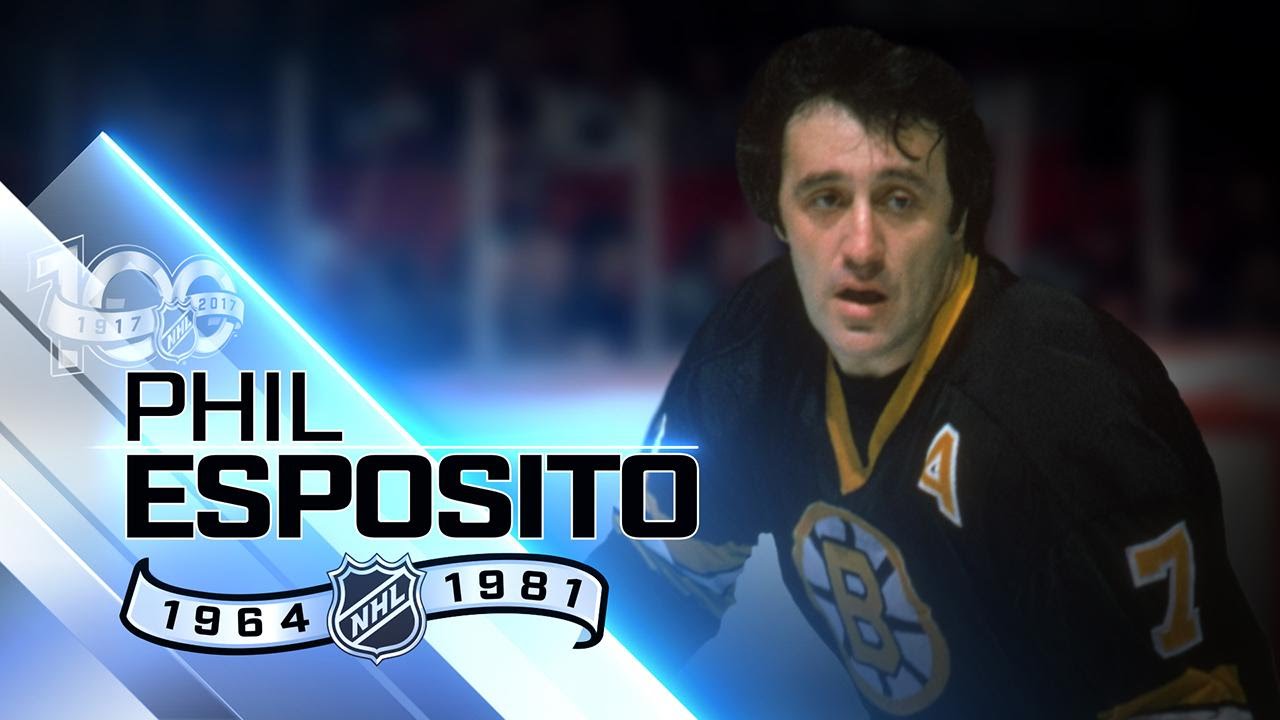
On the surface, Bill Gadsby and Phil Esposito do not seem to have much in common. They were born nearly two decades apart, and the former was a defenseman and the latter a center. However, they each played for three NHL teams, beginning with the Chicago Blackhawks and later spending roughly the same amount of time playing for the New York Rangers. And on November 4, Gadsby scored his 500th point in 1962 while Esposito scored his 600th goal in 1977.
Gadsby signed with Chicago in 1946, and in November 1954, he was traded to the Rangers. New York traded him to Detroit in February 1960, but the deal fell through when the others involved refused to report. The trade went through in June 1961 instead, so Gadsby was in his second season playing for the Red Wings when he reached 500 points.
On November 4, 1962, Gadsby’s final team was hosting his first team at Olympia before 12,706 fans. At the beginning of the game, he bore part of the blame for Chicago’s only goal. He received the first penalty of the game at 5:30, and just as it was ending, Bobby Hull scored. Gadsby was also called for the second penalty of the game, at 11:55 that period. The score would not change until the third period.
When Gadsby became the first NHL defenseman to reach 500 points, he did so with a timely assist. Parker MacDonald scored two power play goals only 50 seconds apart to tie then beat Chicago. Both of them were assisted by Gordie Howe. Between them, “Al MacNeil was called for interference and the Wings went into power play formation again. Gadsby fed the puck in to MacDonald at the corner and Parker backhanded it into the net with the point moving him into a tie for the NHL scoring lead.” Rookie Alex Faulkner, the “slick little center from Newfoundland, took the puck away from Hawk defenseman Wayne Hillman in front of the net and jabbed it past Glenn Hall” for an unassisted insurance goal. The Red Wings had tallied three goals in just 2.5 minutes to remain unbeaten thus far that season.
The following season, Esposito began his NHL career with Chicago, where he only stayed until 1967. His career exploded after being traded to the Boston Bruins, so hockey fans were stunned when he was part of a major package deal with their rivals, the Rangers. With the trade taking place on November 7, 1975, he was approaching his second anniversary in New York when he scored his milestone goal.
On November 4, 1977, the Rangers visited the Pacific Coliseum to play the Vancouver Canucks for 15,000 people. They had to delay for 15 minutes when the Zamboni broke down and another needed to come clear the ice. The Rangers ended up winning 5-1 to break a three-game losing streak.
This game also began with a power-play goal in the first period. Esposito scored at 12:17 when “Steve Vickers fed him the puck from the corner.” Joking later, Esposito admitted, “I flubbed it good. It was a change of pace shot, off the tow of my stick, like a knuckleballer. But what the hell, I’ve flubbed a lot of goals in my time. And I’ve taken them all.” The goalie who let it in, Cesare Maniago, said the same. “It came off the toe of his stick. I know he likes to shoot right away and I anticipated a bit and leaned forward a little, but the shot went high.”
Esposito was only the third to score 600 goals, following Gordie Howe (786 goals) and Bobby Hull (604 goals). That meant he only needed four more goals to tie Hull, and 35-year-old Esposito thought it would happen because “I’ll still be around at least until I’m 39 because I’ve got three more years and an option on my contract.” Esposito thought, “I’ll probably get another telegram from Bobby. He sent me one the last time I broke one of his records.” Hazy in his memories of other milestone goals, Esposito commented, “I remember my first one. That was against Terry Sawchuk and Bobby Hull and Reg Fleming got assists. I just remember the first one and the last one – and not much in between.”
After reaching the milestone, Gadsby played for Detroit until 1966. He then coached the Red Wings for the 1968-69 season and two games of the following season. Similarly, Esposito skated with the Rangers until 1981 and then coached them for the 1986-87 season and two games of the 1988-89 season. He was their general manager for three years before founding the Tampa Bay Lightning in 1992. Gadsby and Esposito were inducted into the Hockey Hall of Fame in 1970 and 1984, respectively.
Additional Sources:
Jack Berry, “Wings Explode For 3 Goals, Stay Unbeaten,” Detroit Free Press, 5 Nov. 1962, pp. 1D and 4D.
Jack Leonard, “Phil Esposito scores 600th career goal,” Vancouver Province, 5 Nov. 1977, pp. 1 and 13.
Arv Olson, “First the Zamboni then the Canucks,” Vancouver Sun, 5 Nov. 1977, pp. B1 and B5.
“Rangers Romp, 5-1; Espo 600th,” New York Daily News, 5 Nov. 1977, p. 27.
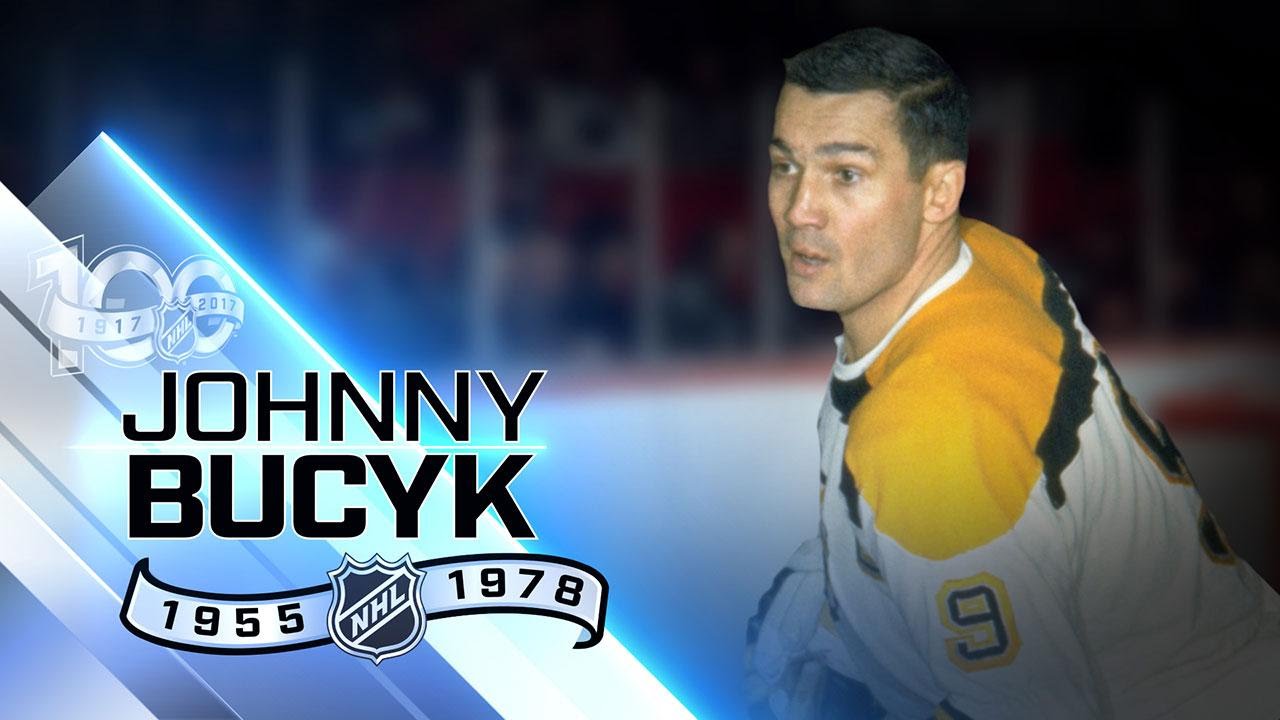
Johnny Bucyk was a left wing with serious scoring power. Spending all but the first two seasons of his 23-year career with the Boston Bruins, he only had a handful of seasons in which he dipped below 20 goals or 50 points. On November 3, 1974, Captain Bucyk scored his 1,154th point to surpass Bobby Hull as the highest-scoring left wing in NHL history.
Boston Garden hosted an audience of 15,003 to see them run the Minnesota North Stars out of the rink. For the first seven minutes, the odds seemed in Minnesota’s favor, thanks to their goalie, Cesare Maniago. According to Boston coach Don Cherry, “In the first 10 minutes, we could have had seven goals. It was our best effort of the season but Maniago was unbelievable in those first minutes.” Phil Esposito agreed, “You couldn’t say we ran into an easy goaltender, really. Maniago started out as if he’d never let one in. but we kept coming back.”
Bucyk assisted on the very first goal of the game, at 7:04 of the first period. He helped Wayne Cashman, who “passed from behind the net and Gregg Sheppard fired a short shot.” Cashman had been switched from his left wing position on Esposito’s line to fill in as right wing on Sheppard’s because Bobby Schmautz had a broken metacarpal bone in his right thumb. This point allowed Bucyk to tie Hull’s left wing record of 1,153 points.
From that point on, according to the Minneapolis newspapers, “it was lights out for the North Stars. Or, red lights on for the Bruins.” After another Boston goal, Minnesota had their only score of the game. The Bruins roared back with two more goals.
The substituted Cashman notched the final goal of the first period at 14:54, thanks to assists by Bucyk and Sheppard. According to the Boston Globe, “Cashman knocked one under Maniago on a pass from Bucyk.” With this second assist, Bucyk officially passed Hull’s record to become the highest-scoring left wing and sixth in the NHL’s career scoring.
With one goal in the second period and four in the third, Boston won 10-1. Interestingly, every single goal was scored by a different player. Cherry claimed he could not remember another instance of reaching double digits without any duplications, so the Boston Globe thought it must be an NHL record for goal distribution in one game. Funny enough, the night before, Cherry had been upset at having broken their six-game winning streak and remarked, “It’s very simple. We just have to have more than one man (Phil Esposito) scoring for us.” Naturally, after this victory, he crowed, “That’s the kind of team I thought Boston was when I started here. You saw the real Bruins for the first time.”
For the poor North Stars, the Minnesota news claimed they suffered the most one-sided or worst margin of defeat in their history. What’s more, they still had yet to win a single game at Boston Garden. Against the North Stars, the Bruins had a 16-0-4 record at the Garden and a 27-4-9 record overall.
Approximately a year later, Bucyk scored his 500th goal, as the seventh to reach the milestone. His fellow left wingers (including Cashman) gave him a gold medal engraved with the number 500. Bucyk was touched, saying, “It’s not from the League or from the team, but from the four guys who were fighting for my job. I’ll never forget that gesture.”
When Bucyk retired in 1978, he had earned 1,369 regular-season points from 556 goals and 813 assists. These totals are enough to keep him in 25th place in the NHL’s all-time rankings in each category. He has more assists than any left wing in NHL history. In points scored by left wings, he is only topped by Luc Robitaille. Bucyk’s goals place him sixth among NHL left wings. Among the Bruins, Bucyk ranks first in goals (545) and second in assists (794) and points (1,339).
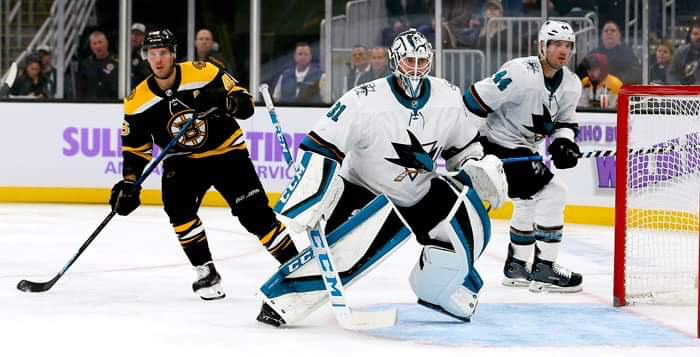
It was announced in the afternoon before the Boston Bruins were to take on the San Jose Sharks on Tuesday, October 29, 219, that David Krejci had been activated from his injured reserve status. His last game had been against the Anaheim Ducks when they came to Boston for a matinee game on Monday, October 14th.
Would Krejci have any rust? How would that affect his play? What would his chemistry be with his linemates and would he be used on the power play if the Bruins got any man-advantage time?
Looking at the numbers after the game, it was difficult to believe that Krejci had missed any games. He took 23 shifts throughout the game with a total of 19:19 TOI—and 4:57 of that was helping on the second power play unit. He was 50% in the faceoff circle, and more importantly he notched a goal and an assist on the night.
Once again David Pastrnak had gotten the Bruins on the board first, when the Bruins went on the power play 6:19 into the opening frame, and it will probably be a traumatic shock to everyone if his streak ends because he seems to be so focused and confident. However, secondary scoring is what makes a team unstoppable. The Bruins had begun to see some of that recently, but it was still obvious that Krejci’s absence was felt.
No one would have expected him to score on his first game back, but that’s exactly what he did. With the Bruins on another power play with 3:35 remaining in the first period, Krejci worked himself to the left circle, where Pastrnak’s one-timers have been finding the net, and 1:26 into that third power play he put Boston up 2-0. And you could tell they were feeling confident in the game.
“Well, [a power play goal] builds momentum. Skill guys feel good about themselves when they score, I don’t think they care if it’s five-on-five or power play. They want to touch the puck, they want to finish. How it effects the other team, typically they’re going to have to be a little more disciplined, a little more careful about what penalties they take, there’s that effect. I think at home when it’s on, it looks good so you get the fans into the game. So there’s a lot of positives, our guys feed off of that. They like watching good plays too, so they get excited for them. It’s typically the first group but tonight I thought the second unit did their part too, throwing it around,” said Bruins head coach Bruce Cassidy after the game.
That confidence continued to show even when Brent Burns cut the Bruins lead in half 1:31 into the second period—also on the power play—for San Jose. Four minutes after Burns’ goal, the Bruins found themselves back up by two, and once again Krejci figured into it. From almost an identical spot in the left circle, he slapped the puck to Charlie Coyle who was right on the doorstep of Martin Jones’ crease, waiting to put the puck in the net, which is exactly what happened.
Krejci’s ability to see the ice and know where to put the puck was on display in that sequence. There was absolutely nothing Jones could do to prevent that goal. And his knowing that he wanted to pass the puck to Coyle showed the lightning quick calculations he was making as the play was unfolding.
“No, it was kind of a bit more on my backhand and everyone knows I’m a pass first. I knew Chuckie [Coyle] was back there so, so just tried to make a really hard pass and it worked this time,” Krejci described his assist.
Two points with the goal and the assist, a total of three shots on goal. He looked like he hadn’t missed a beat.
After the game though he gave an honest assessment of his performance in the game.
“You know there was some shifts that I felt good, but there was some shifts that I had the puck on my stick and I lost it it, you know, no one was around me and I just lost it. But that’s understandable,” Krejci shared. “My game is, I always want to have the puck on my stick, so, I’m sure that will come soon. I had the puck on my stick today, but lots of times I lost it so, that will come…control the puck. I’m not worried about that so just keep plugging away.”
And Coach Cassidy was certainly pleased to see Krejci hit the ice in full force.
“Yeah. You don’t know what’s going to happen, there’s a little catch-up involved and I’m sure he’ll go through that. Good thing for him is he’ll get a few more days now to sort of get his legs back under him and the schedule’s a little bit favorable for a guy coming back that way. Good for him. Listen, we need him going. We know that, and it’s good to get off on the right foot tonight,” Coach Cassidy said. “I think he can drive a line when he’s going. And we didn’t expect him to do that necessarily tonight, he’s missed time, but that’s what we want out of David. He’s a pro, he’s been around, he’s a Stanley Cup champion. Like, we need him to pull that line along. He’s got a constant in [Jake] DeBrusk and then whoever’s on that other side, drive the line. That’s what we want him to do, because there’s going to be nights that Bergy [Patrice Bergeron], that line is going to get neutralized. It doesn’t look that way right now, but we know it’s going to happen. So then you need some other guys going — now you get Coyle, now, that’s two games in a row he’s been all over the puck. So all of a sudden, you’ve got three lines that are a threat to score. And you’ve got your fourth line that you know is going to give you quality minutes, so things are shaping up up front.”
Krejci gets a couple of days to ease back into the season, as the Bruins don’t play again until Saturday night. And that extra non-game time will only help him to continue to build up his stamina on the ice during his shifts.
With Krejci back and the Bruins now getting scoring from the top nine and energy from their fourth line, the opposition is going to find a formidable team dressed in black and gold. And as was evident Tuesday night, Krejci is a critical element in that formula.
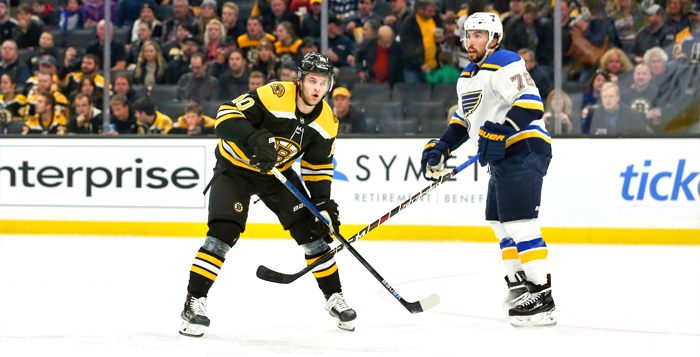
Yes, it was the first time that the Boston Bruins and the St. Louis Blues took to the ice in competition since the Blues won the Stanley Cup four months ago on the TD Garden ice. The media wanted a playoff rematch. The fans wanted it. Blues fans throughout the game were tweeting about remembrances of raising the Cup or dismissing the Bruins lead in the game as not that important. The Bruins fans were taking delight in Tuukka Rask’s ability to shutout the Stanley Cup Champions.
That’s one of the greatest things about hockey. With the new
season, the climb to the top begins anew. Every team that can beat the Blues
this season will enjoy it a little more. But the most important takeaway for
either of the teams Saturday night was to get a win and the all important two
points. With the parity of the NHL, every point won means a better chance of
going to the playoffs. And every point lost could mean a mad scramble attempt
to push for a wild card spot as the season is winding down in April.
There were differences for both teams’ rosters. For the Bruins, the ongoing absence of David Krejci has opened up a spot for Anders Bjork, as Charlie Coyle has been moved into Krejci’s center spot and Brett Ritchie moved up to the right wing on that second line. Meanwhile Bjork has been slotted at left wing on the third line with Par Lindholm at center and Danton Heinen moved from the left to the right wing. For the Blues, Vladimir Tarasenko didn’t play Saturday night and the Blues had added Justin Faulk via trade in the offseason. The Blues also no longer have Pat Maroon.
Yes, there was a lot of physicality in the opening few
minutes. Zdeno Chara’s massive hit on Oskar Sundqvist 32 seconds into the game
sent a message from the Bruins captain to his team that they would play hard
and force the Blues to earn their space on the ice. There were hits from both
sides in the first period and twice the teams played four-on-four in the first seven
minutes.
Boston was able to capitalize on their first power play, as David Pastrnak continued his scoring streak, earning his 11th goal of the season and extending his point streak to 11 goals and 7 assists for 18 points in eight games. Meanwhile, the Blues were unable to find the back of the net during their four power play opportunities, despite having spent almost 1:50 of their third man advantage in the Bruins end.
While Pastrnak scored on the one-timer from the right circle on the power play in the first period, Bjork’s one-timer from the left circle, off the pass from Matt Grzelcyk, in the middle of the second period definitely was an important moment in the game. Adding that even-strength goal was not only an important moment for Bjork, who ended his NHL 19-game scoring drought, but the reaction on the bench spoke not only to their happiness for Bjork, but a sense of conviction that they were going to continue to instill their will in the game.
“We talked [this morning] about our D getting involved. That’s a good example of when your D can join the rush as a second layer when you have a good breakout and it’s clean and that allows them to make some plays. And Anders, that was a bomb. It was a good shot. It’s something I don’t know if he had a couple of years ago, that one-timer. I thought he was good hunting pucks; I thought he was good on the walls. He got stripped a couple times in the D zone by heavy teams, so that’s the education part for him now. He’s against men every night, especially a team like that, but I thought he held his own,” said Bruins head coach Bruce Cassidy.
For Bjork, who had some tough times the past two seasons with injuries, it was clear that his time down in Providence to start this season was a good move. His ability to score while with the Providence Bruins undoubtedly gave him some confidence that helped him in Saturday night’s game.
And when the Bruins weren’t putting pucks on net—which happened for stretches in the second and third periods—Rask was tracking the puck and denying chances that the Blues did get.
Sure, there are some games that are circled on the calendar, and this was likely one of them, but in the end neither team talked about it being a rematch, Instead the Blues talked about needing to fix their mistakes and not giving up a valuable two points. The Bruins were pleased with some of their efforts, but also recognized some areas in which they too could improve.
Likewise, both teams need to put this game behind them as the Blues will be in Detroit on Sunday to play the struggling Red Wings at 5:00pm ET and the Bruins head to the Big Apple to take on the New York Rangers on Sunday evening at 7:00pm ET. Both teams are focused on the next game and won’t even think about each other again until the Bruins travel to St. Louis in April.
Harry Oliver was born on October 26, 1898 in Selkirk, Manitoba, Canada, to Stephan and Annie Oliver. Standing at just five feet eight inches tall with a weight of 146 pounds, he earned the nickname of PeeWee.
Oliver was a self-taught hockey player, as he said, “We
just went out and played, sometimes on an outdoor rink, but mostly on the
river.” He began playing organized hockey, both junior and senior with the
Selkirk Fisherman. He was part of the
team that won the Manitoba Hockey League in 1919. Following the win, the
Fisherman then went on to play the Hamilton Tigers for the Allan Cup, but lost
the two-game series.
Oliver began his professional career when he moved to
Calgary to play the 1919-20 season with the Calgary Canadians with the Big-4
League. In the 1920-21 season he joined
the Calgary Tigers of the newly formed Western Canada Hockey League. He
established himself as a star player using his speed and accurate shooting in
the WCHL. During the 1923-24 season, he helped the Tigers in winning the WCHL
championship. They went on to challenge the Montreal Canadiens for the Stanley
Cup, but lost. In 1924 and 1925, he was named to the first team All-Star team.
In 1926, the Boston Bruins bought his rights. Part of the Boston Fog Line, with Bill Carson
and Percy Galbraith, Oliver led the team in goals during his first three
seasons with the Bruins. During a game
against the Chicago Black Hawks in Boston on January 11, 1927, Oliver became
the first Boston Bruin to notch four goals in a single game—a feat recently
accomplished by David Pastrnak on October 14, 2019 against the Anaheim Ducks,
who became the 25th player in the franchise’s history to do so.
In 1929, during game three of the Stanley Cup Final against
the New York Rangers, Oliver scored goals in the first and third period,
leading to the Bruins 3-1 win over the Rangers.
Headlines in the Boston Globe stated, “Oliver, Boston’s Star”. Boston went on to win the Cup.
The Bruins sold Oliver to the New York Americans in 1934. He remained with the Americans for three years,
retiring at the end of the 1936-37 season.
During his professional career, Oliver amassed 218 goals and
144 assists. He was inducted to the
Hockey Hall of Fame in 1967 and is an honored member of the Manitoba Hall of
Fame.
Harry Oliver died June 16, 1985, aged 86, in Selkirk
Manitoba.
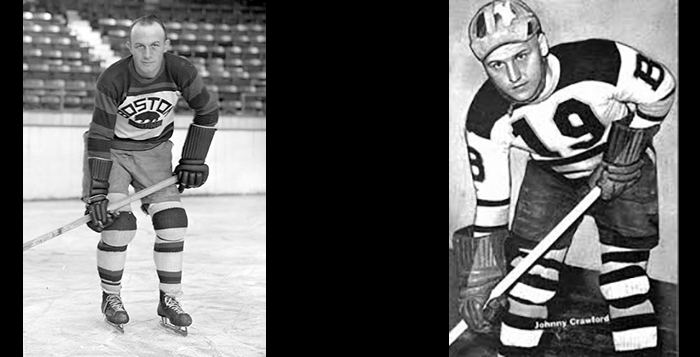
John Shea Crawford, was born on October 26, 1916 in Dublin, Ontario, to David Crawford and Annie Shea. Although the press always referred to him as Jack, he preferred to be called John or Johnny.
John “Jack” Crawford began playing hockey for Ontario Hockey
Association Junior B team, the Saint Michael’s Buzzers in the 1933-34
season. Crawford was part of the team
that brought the Buzzers their first ever Sutherland Cup as All-Toronto Junior
B Champions. In 1934, he was on the OHA Junior
A Team, the Saint Michaels Majors. The
1935-36 season Crawford played nine games for the OHA West Toronto Nationals,
he then played 15 games for the TIHL League, Toronto McColl-Frontenacs, and was
back with the Nationals to play in the playoffs, helping them to win the
Memorial Cup as the Canadian Hockey League Champions. Crawford then played for the Kirkland Lake
Blue Devils for 1936-37 season.
Crawford began his professional hockey career playing for
the Providence Reds for the 1938-1939 season. He played 46 games for the Reds,
suiting up twice for the Boston Bruins.
Crawford played 12 years for the Bruins, his entire professional career,
which saw him part of two Stanley Cup teams, in 1939 and 1941. During the 1939 Stanley Cup Final facing the
Toronto Maple Leafs, Crawford scored in game 3 at 8:14 in the third period,
helping the Bruins win the game 3-1. Crawford
was also a member of the All-Star teams of 1943 and 1946.
John “Jack” Crawford retired from the Boston Bruins at the
end of the 1950 season. He then joined
the American Hockey League Hershey Bears for two years as a player coach. In his professional hockey career, Crawford
played 547 games with 38 goals and 140 assists in the regular season.
Crawford focused on coaching after retiring from playing. He coached 659 games in the American Hockey
League, making him number ten on the all-time coaching list. He spent five of
his ten seasons as a coach in the AHL with the Providence Reds serving as bench
boss in 340 games. He was general manager of the Eastern Hockey League, Cape
Cod Cubs in 1972-1973.
John “Jack Crawford died on January 19, 1973, leaving his
wife Marjorie and three children.
Additional Sources:
Stanley Woodward, “Boston Scores Four Goals in Minute and a Half of First Period,” Boston Herald (Boston, Massachusetts), Wednesday, January 12, 1927, p. 15.
“Harry Oliver and Alex Smith Sold By Boston Bruins to N.Y. Americans in Straight Deal Price Unannounced,” Boston Herald (Boston, Massachusetts), Wednesday, October 17, 1934, p. 29.
The United States Amateur Hockey Association was formed on October 25, 1920. The announcement was made in Philadelphia after a meeting, held at the Ice Palace, of hockey representatives from prominent hockey centers across the United States. Those attending the meeting decided that more supervision was needed over the sport and that such would be in the best interest of the game. Thus, a separate governing body should be formed in the United State, solely devoted to hockey.
“A resolution was adopted that the United States Amateur
Hockey association will not admit to membership any team directly or indirectly
controlled by rink owners: that every club admitted to membership must be
self-governing, control its own finances and be in a position, when called
upon, to give an accounting of same,” reported The Pittsburgh Press.
Prior to the formation of the USAHA, the International
Skating Union (ISU) oversaw hockey in the United States. The ISU had agreements with the Amateur Athletic
Union (AAU) and the Canadian Amateur Hockey Association (CAHA). The ISU was asked to approve the five-city
plan and to recommend that the AAU recognize the new organization as the
governing body for hockey in the U.S., as the ISU would turn over control of
the sport to the new association. With the approval of the AAU, the ISU passed
the resolution and as a result the USAHA was affiliated with both groups. This
allowed the newly formed USAHA to play teams from both the AAU and the
CAHA.
Officers were elected: President, W.S. Haddock of Pittsburgh, Vice Presidents, George V.
Brown of Boston and J. Edward Fitzgerald
of St. Paul, secretary, Roy D. Schooley of Pittsburgh. The executive committee consisted of one
representative from each city in the association.
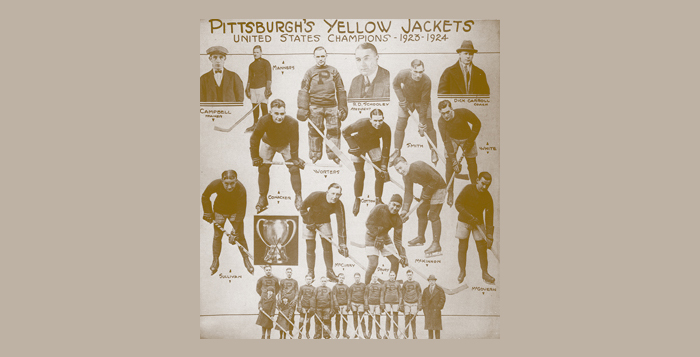
Initially, the new association was made up of eight teams, representing Boston, Philadelphia, Pittsburg (Pittsburgh Yellow Jackets), Cleveland, New York City, and three from Minnesota: Duluth, Eveleth and St. Paul. Additional clubs were added later in the year from Boston (Boston Athletic Association), Milwaukee, Minneapolis, and Pittsburg (Fort Pitt Hornets). Teams in Calumet, Houghton and Sault Ste. Marie, Michigan transferred from the American Amateur Hockey Association.
The USAHA was divided into three divisions during the first
two seasons, the East, Midwest and Northwest.
In 1922, the USAHA operated using two divisions, Eastern and Western. Canadian players dominated the association, apart
from upper Michigan. Team rosters were
small with only seven to nine players. It wasn’t uncommon for a player to get
no relief during a game and there wasn’t any goalie back up. Extra players
often had to suit up to fill in for an injured goalie.
Issues plagued the USAHA: inconsistent referees, lack of
suitable ice (as several teams relied on natural ice which forced teams to play
on neutral ice outside their hometowns), and sizes of arenas which limited
attendance in smaller cities.
The 1924-25 season was the last for the USAHA. Ongoing disagreements
between the USAHA and CAHA went unresolved, leading to the cancellation of the
articles of alliance between the USAHA and the CAHA.
“The agreement between the two factions had not worked out
to the entire satisfaction of the Canadian officials, other practices allegedly
performed by the U.S.H.A, were contratry <sic> to the good working spirit
of the amateur rules,” wrote The Winnipeg Tribune.
But perhaps the final straw between the two organizations
may have been comments from the U.S. organization that were directed to the
Canadian group.
“The ruling regarding international hockey came after a
letter had been read from the United States Amateur Hockey Association, in
which it was stated that the United States body could run its own affairs
independent of Canadian teams,” reported The Vancouver Sun.
Ultimately the USAHA was disbanded partway through the
1924-25 season. The Western Division reorganized and became the Central Hockey
League, then the American Amateur Hockey Association in 1926. The Pittsburgh
Yellow Jackets joined the National Hockey League.
Many future members of the Hockey Hall of Fame played in the USAHA. Hall of Famers include, Charlie Gardener, Nell Stewart, Moose Goheen, Ching Johnson, Tiny Thompson and Cooney Weiland, to name a few. Other players in the association went on to have long and successful careers in the NHL, AHA ad AHL.
Additional Sources:
“New Amateur Hockey Association Formed,” Philadelphia Inquirer (Philadelphia, Pennsylvania), Tuesday, October 26, 1920, p. 14.
“Amateur Hockey Circuit is Formed; Haddock New Head,” The Pittsburgh Press, Tuesday, October 26, 1920, p. 36.
“Five Club Hockey League,” New-York Daily Tribune (New York, New York), Tuesday, October 26, 1920, p, 13.
“Five Cities Comprise Amateur Hockey Asso.,” Patriot (Harrisburg, Pennsylvania), Tuesday, October 26, 1920, p, 11.
“S.P. “Silver” Quilty Re-elected Leader,” Winnipeg Tribune (Winnipeg, Manitoba), March 25, 1925. p. 12.
“Hockey War Declared,” Seattle Daily Times (Seattle, Washington), Wednesday, March 25, 1925, p. 19.
Roger A. Godin, Before the Stars: Early Major League Hockey and the St. Paul Athletic Club Team (St. Paul, Minn.: Minnesota Historical Society Press, 2005), p.166-167.
Frederick Alexander Shero, was born on October 23, 1925, in Winnipeg, Manitoba, Canada, to Russian immigrant parents, Alexander Shero and Emilia Folz. Growing up in the North End of Winnipeg, he took up boxing at age thirteen and held the Bantamweight boxing championship. At seventeen years of age he was signed by the New York Rangers. Although his father signed his contract, Fred was warned by his father that “hockey players were looking for work when they are age 30”. He spent his time in the minors between the New York Rovers and the Brooklyn Crescents in the Eastern Amateur Hockey League. During World War II, Shero served in the Royal Canadian Navy and played for the Winnipeg Navy HMCS Chippawa senior hockey team.
Upon his return from service, Shero rejoined the Rangers and played in the minor league for two years, before getting called up to the NHL. He made his NHL debut on October 16, 1947, the 1947-48 season opener at the Montreal Forum, against the Stanley Cup Champions, the Montreal Canadiens. Shero divided his time that season, between the St. Paul Saints of the United States Hockey League and the New York Rangers. It was during his time with the Saints, that Shero would earn his nickname “The Fog.” Many accredited the nickname to his eccentricity and how he appeared to always be lost in fog of thought. Another theory is the nickname came about when one night in 1948, when the fog was so thick in the arena in St. Paul Minnesota, due to the high humidity, Shero was the only player who claimed to be able to see the puck.
Shero became a regular with the Rangers during the 1948-49 season, which included post-season action. The following year had career highs of 67 games played and with assists (8) and points (10). The Rangers qualified for post season play, taking the fourth position and made it to the Stanley Cup Final, facing and upsetting the Montreal Canadiens in the first round. The Rangers played the Detroit Red Wings in the finals but lost the seventh game to them in double overtime on April 23, 1950. This was the last NHL game Shero played.
Shero was traded to the American Hockey League (AHL) Cleveland Barons on May 14, 1951. The Barons won the Calder Cup in 1953-1954 and Shero was named a Second Team All-Star for the AHL, in 1954. He then moved to the Western Hockey League, with the Winnipeg Warriors for the 1955-56 season. During his first season, the Warriors won the WHL championship with Shero as captain. He stayed with the Warriors for one more season before moving to the Quebec Hockey League (QHL), playing for the Shawinigan Cataractes in 1957. It was during the 1957-58 season with the Cataractes, that Shero began coaching, serving as player/coach he helped them win the QHL championship. Shero retired from play in 1958.
Shero coached in the minor league for thirteen years. A winning coach, he earned six first place wins, five second and two thirds in several leagues. Including leading his former team the Saints to the International (IHL) Championship, and the Turner Cup in 1960 and 1961. In 1970 he led the Buffalo Barons to win the Calder Cup in the AHL. That same year he was honored with the Louis A.R. Pieri Memorial Award, as AHL coach of the year.
In 1971, Ed Snider brought in Shero as coach of the Philadelphia Flyers. In his first season, 1971-72, as coach, the Flyers finished in a disappointing 5th place, having missed the playoffs for the second time in three years. The 1972-73 season, Shero had two firsts for a coach. The first was incorporating the systems he had used in the minor leagues up at the NHL level and the second was hiring the first full-time assistant coach in the league, Mike Nykoluk. Shero with the help of Nykoluk, saw the Flyers franchise have their first winning season. In 1973-74 the Flyers won the Stanley Cup and Shera was named coach of the year and presented with the Jack Adams Trophy. The Flyers won the Cup again in the 1974-75 season and almost repeated as Cup winner in 1975-76 but lost to the Montreal Canadiens.
One of Shero’s proudest moments occurred on January 11, 1976, when the Flyers defeated CSKA Moscow 4-1, at the Philadelphia Spectrum. Spero traveled twice to the then Soviet Union, to observe how their teams practiced and played. He adjusted several of their practices to fit the NHL.
“Yes, we are the world champions,” proclaimed Shero after the victory. “If they had won, they would have been the world champions. We beat a helluva machine. Ninety-nine per cent of the National Hockey League didn’t think we could do it.”
For his success with the Flyers, Sharo was rewarded by being name All-Star coach of the Campbell Conference, for the years 1975, 1976, 1977 and 1978.
In 1979, Shero went on to coach the New York Rangers, with the Rangers agreeing to give the Flyers $100,000 and a first-round draft pick. During his first season as coach, the team went to the Stanley Cup Final. The Rangers lost the series four games to one, to the powerful Montreal team. During his second season with Rangers they again made it to the playoffs, defeating the Atlanta Flames before facing the Flyers to whom they lost in round two. Shera resigned from the Rangers in 1980. His final coaching position was for the Hebro Tilburg Trappers of Tilburg, The Netherlands for the 1987-88 season. In 1990, he returned to the Flyers as Community Relations Advisor.
In hockey, Fred “the Fog” Shero will always be remembered for his pioneering coaching style and the ability to think outside the current norms. His legacy is firmly held in place with his 2013 induction into the Hockey Hall of Fame in the Builder category. His other Hall of Fame inductions include: the Manitoba Hockey Hall of Fame in 1985, the Flyers Hall of Fame in 1990, the Manitoba Sports Hall of Fame and Museum in 1999, and the Philadelphia Sports Hall of Fame in 2008.
In his personal life he was something of a renaissance man, he played the violin, loved reading, was a fan of Charles Dickens and Shakespeare, and bragged he was the first New York Ranger member to hold a New York Public Library card. At one point after the Flyers Cup win, he considered retiring from hockey to attend law school. While he remained in coaching, he did take correspondences courses in law.
Fred Shero died of cancer, November 24, 1990, aged 65, in Camden City, Camden New Jersey. He was survived by his wife Marietta and two sons.
Additional Sources:
John M. McFarlane, Some Canadian Naval Ice Hockey Stars and Personalities, 2012 (Updated 2015), nauticapedia.ca.
Winnipeg Navy H.M.C.S. Chippawa all-time player list, Hockeydb.com.
Gerald Eskenazi, The New York Times, Rangers Obtain Shero as Coach, June 2, 1978, section A, p. 15.
“Fred Sharo quits Rangers,” Reno Evening Gazette, Saturday, November 22, 1980, p. 2B.
When the Boston Bruins drafted David Pastrnak in the 2014 NHL Entry Draft, they knew they were getting a skilled scorer. And he has never disappointed. Even when he has hit a dry spell, he’s continued to work hard. He may have experienced a typical sophomore slump during the 2015/16 season, but his most recent three seasons have seen him finding the the back of the twine with consistency:
2016/17: 34 goals, 36 assists for 70 points in 75 games played (regular season)
2017/18: 35 goals, 45 assists for 80 points in 82 games played (regular season)
2018/19: 38 goals, 43 assists for 81 points in 66 games played (regular season)
He experienced a hand injury during the second half of last season, and when he returned his play wasn’t at the level everyone had come to expect, and that unfortunately plagued him into the postseason.
However, that is clearly no longer a concern. He’s eating his Wheaties—well technically if it’s a matinee game, then it’s breakfast before a game and for him that’s “classic eggs and pancakes.” Which was what he told the media he had before last Monday’s game against the Anaheim Ducks in which he scored four goals. He followed that up three days later with two goals and an assist against the Tampa Bay Lightning. Saturday’s game in Toronto he added another goal and an assist.
He was named as the NHL First Star of the week ending October 20.
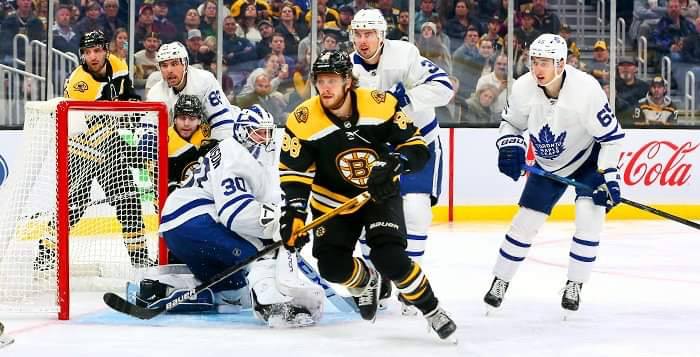
As things got underway in Boston Tuesday night as the Bruins welcomed the Toronto Maple Leafs, They undoubtedly wanted a stronger game than the 4-3 overtime loss on Saturday. It looked like perhaps the Leafs were planning to control the game. However, a lengthy and gritty play in front of the Leafs backup goalie, Michael Hutchinson, saw what looked to be the first goal of the game off of Pastrnak’s stick.
It was not to be. Toronto’s head coach Mike Babcock challenged the goal as offsides. The goal was reversed, as Patrice Bergeron had been deemed offside approximately 30 seconds earlier when the Bruins had initially entered the Leafs end. But offside is offside and the goal was overturned.
The Bruins are never happy when that happens, but it often motivates them to try all the harder, and such was the response in Tuesday’s game. Where they had been outshot in the period up to that point, they began to tilt the ice in their favor at least in shots.
While on the power play after Andreas Johnsson was sent off for a hooking penalty, at 16:26 of the first the Bruins were once again on the score board less than a minute into the man advantage when Pastrnak was able to take a pass from Brad Marchand, drag it through his legs and backhand it on Hutchinson in a highlight reel goal.
Marchand and Pastrnak would trade places on the Bruins second goal of the game, where Marchand got the goal and Pastrnak the assist.
“Everything catches my eye with [Pastrnak] lately. He’s just on it, he’s on pucks, he’s strong, his conditioning seems great. He’s playing a lot of minutes, hard minutes against good players every night. Play-making ability, he’s making plays as well, getting his shot off. I think last year he was fighting the puck a little bit in the playoffs, for whatever reason. I think it was rust to be honest with you, a few times late in the year. He’s spot on this year,” said Bruins head coach Bruce Cassidy. “I think he’s stronger on the puck so he can be a little more creative. Maybe when he first broke in, he tried some of those moves, he’d get — not hit, but, you know, a piece of him, and he wasn’t able to hang on to it, so it’d come back the other way. Now, he can turn out of some of those, absorb some of the hit and still make the play. So some of it’s just physical strength, he’s able to have the puck longer. Confidence, obviously, right now he’s confident with his moves. Like that spin move to the front of the net, so that has a little bit to do with it. Right now, when you’re feeling it, you tend to make a lot of right decisions. When you’re not feeling it, seems like every decision you make isn’t good, when there’s some level of risk-reward, so that’s part of it. Probably comfort in the league helps, he’s had record success. Put all those things together and I think he’s valued the other part of the game too, when to not put your teammates in a bad spot, more maturity.”
The season is just nine games in for the Bruins, and in the last seven, Pastrnak has amassed ten goals and seven assists for 17 points.
In addition to the confidence that is noticeable in his movement on the ice and that strength and maturity that Coach Cassidy described, what isn’t there is an arrogance that he is somehow better than the team. That speaks to his linemates and also to some of that maturity and knowledge of what it takes to succeed in the NHL.
He’s on a streak and it will be interesting to see how that continues when the Bruins take on the St. Louis Blues on Saturday. The two teams as of Tuesday night had each played nine games, with the Bruins having a 6-1-2 record while the Blues record is currently 4-2-3, though St. Louis does play the Los Angeles Kings on Thursday in St. Louis before heading to Boston.



 Prev
Prev