One November weekend in 1955, all Original Six teams played home-and-home series. On Saturday, all three home teams won. Then on Sunday, November 20, when the visitors turned hosts, all three games ended in 1-1 ties.
On Saturday, the New York Rangers played the Montreal Canadiens at the Forum. They had the largest crowd of the night with 13,808. The scoring started with penalties for both teams that resulted in a goal by rookie center Bronco Horvath. However, that would be the Rangers’ only goal as they only managed 13 shots on Jacques Plante. The latter half of the first period saw goals by Maurice Richard at 12:09, Bernie Geoffrion at 15:00, and the Rocket’s brother Henri at 16:25. Claude Provost (at 5:28) and Tom Johnson (at 15:24) controlled the second period. Finally, the Rocket scored again at 16:58 of the third. The Canadiens had 32 shots on Gump Worsley to win 6-1. In 36 games at Montreal since 1950, the Rangers had only one victory.
For Sunday’s game, the Canadiens visited Madison Square Garden. Their sellout crowd of 15,358 was the highest all weekend. Still, the home team could not manage more than one goal on Plante, just like in their previous five matchups. That goal was scored by Wally Hergesheimer at 17:51 of the first period. The Canadiens answered when Doug Harvey tied at 16:40 of the second. Both teams had a negative incident. Montreal star Bernie Geoffrion crashed into the boards behind the net after a clean check by Lou Fontinato and reinjured his shoulder bad enough to be out for 3-5 weeks. The Rangers’ bench was penalized when Coach Phil Watson “sassed” referee Frank Udvari after a double penalty was called. With the tie, Montreal continued an 11-game unbeaten streak at 6-0-5.
At Maple Leaf Gardens, the Toronto Maple Leafs hosted the Boston Bruins on Saturday. The 12,771 fans watched anxiously as the Bruins made a valiant attempt at a comeback. The Leafs had taken a two-goal lead in the first period thanks to goals by Earl Balfour (at 4:32) and George Armstrong (at 11:13). Balfour notched another at 7:31 of the second. In the latter half of the third period, the Bruins finally rallied. As the Boston Globe reported, “Murray Costello and Don McKenney beat Harry Lumley within two minutes of each other” (at 11:09 and 13:00 respectively) but to no avail. The 3-2 victory snapped Toronto’s six-game losing streak.
On Sunday, 10,697 fans turned up for the rematch at Boston Garden, the Bruins’ third game in three nights. They got off to a great start when Leo LaBine scored a power play goal only 87 seconds into the game. It was not until 14:01 of the second period that the Leafs tied when Tod Sloan also took advantage of a power play. Terry Sawchuk made 28 saves, and Harry Lumley had two more.
The third game on Saturday involved the Chicago Blackhawks playing the Detroit Red Wings at Olympia for 13,250 fans. A former Wing turned Hawk, John Wilson, scored first on a power play at 6:07 into the game. The remainder of the game belonged to Detroit as they outshot Chicago 41-15. Gordie Howe scored twice, at 10:24 of the second period and at 3:54 of the third. He then assisted Dutch Reibel on a goal at 4:56. Alex Delvecchio finished things off at 17:52. This was only Detroit’s second win in 14 games.
When they switched to Chicago, they had the smallest audience of the weekend at 8,430. The Blackhawks (like the Bruins) played their third game in three nights. Their rookie Hec Lalande netted his first NHL goal at 11:12 of the first period. Then at 17:53, Real Chevrefils, who had been traded to the Wings over the summer, nabbed his first goal with Detroit. Al Rollins had 35 saves for Chicago, while Glenn Hall had 21. With that, Detroit already had nine ties in 15 games. Four of those stalemates were against Chicago. To the press, it looked like the Red Wings might be on their way to setting a franchise or even NHL record for most ties in one season.
With the addition of the three ties, the NHL had a total of 17 stalemates in 58 games, averaging 30%. Because of the ties, the NHL standings did not change. Montreal led with 28 points followed by New York with 20. Boston and Chicago were tied at 18 with Detroit trailing by one point. Toronto was in the cellar at 15 points.
By the end of the 1955-56 season, the Canadiens had remained far ahead with 100 points (45-15-10) and hoisted the Stanley Cup. The Red Wings lost the Final and held second with 76 points (30-24-16). They did not break any records for ties after all. Having dropped to third, the Rangers finished with 74 points (32-28-10). Instead of Chicago, it was the Maple Leafs (24-33-13) and Bruins (23-34-13) close in points with 61 and 59, only one game difference. Finally, the Blackhawks came in last with 50 points (19-39-12), half of what the leaders earned.
McKinnon was born on July 15, 1902, one year, one month, and one day after Day, who was born June 14, 1901. Unsurprisingly then, Day began his NHL career with Toronto in 1924, while McKinnon began his with the Montreal Canadiens in 1925. The following season, McKinnon began playing for the Pittsburgh Pirates, and the one after that, Toronto’s franchise became the Maple Leafs.
When they played each other on November 19, 1929, Day struck gold first. Almost immediately, Pittsburgh had to serve a penalty giving Toronto the power play. Only 50 seconds into the game, “Day scored the first shot on a lone effort, and the second was rolled up when Day made a perfect pass to Blair, who shot it through Joe Miller for the tally.” Half a period later, at 12:10, McKinnon, as the Pittsburgh Press summarized, “gave the Pirates their whirlwind start and allowed them to overcome the early lead.” On a pass from Frank Frederickson, he “sent a 40-foot shot high and hard into the goal.”
In the second session, Day again led things off, scoring at 2:24 during a power play. About three minutes later, McKinnon matched him when he “drove through alone and scored on the rebound of his own shot.” McKinnon launched what the Ottawa Journal considered “probably the wildest scoring bout that the Pittsburgh team has ever indulged in. Their rally started when two penalties cut the Toronto team short.” Only 45 seconds after McKinnon’s goal, Harold Darragh joined him. McKinnon grabbed the lead with an unassisted goal after about 30 seconds. Over a minute and a half later, Frederickson increased the count to four goals in three minutes. McKinnon netted his fourth and final goal of the night at 13:05. Of his performance, one newspaper stated, “McKinnon flashed a variety of form in his great exhibition.” His teammate Hib Milks closed out the period with three minutes remaining.
The third period continued the Pirates’ scoring streak. Milks earned his hat trick (with Frederickson scoring in between) by 10:30. Then Day made a valiant attempt to catch up. According to the recap, “Drury received a penalty and while he was off the Leafs scored twice, both by Day on passes from Bailey.” Day’s goals were only 55 seconds apart. Having scored four goals (all assisted by Ace Bailey), Day’s two penalties towards the end of the game contributed to Toronto’s failure to score any further goals.
The Pirates crushed the Maple Leafs 10-5. According to the Pittsburgh Post-Gazette, the game was more exciting than “a rodeo, grid setto, a fistic encounter, and a wrestly match combined.” The Ottawa Citizen noted, “The game was a wide-open affair from beginning to end, with the new code of rules being seen at its best as a goal-scoring vehicle.” These new rules had been set on September 28, when forward passing in all zones was first allowed. Their intentions were to open up scoring opportunities, and within the first five games played that season, the NHL had a total of 42 goals. Of course, 15 of them had been scored in this one game. To combat this free-for-all scoring, the NHL closed a loophole in the forward-passing rules by creating the offside rule on December 16.
After his four-goal night, McKinnon finished the season with a total of ten goals. His entire NHL career lasted 208 games, during which he only scored 28 goals. Meanwhile, Day had scored four goals and assisted on the only other Toronto goal. By the end of the season, he had only scored three other goals. Remaining with Toronto until 1937, Day spent his final NHL season playing for the New York Americans. He retired with 86 goals in 586 games.
Additional Sources:
Mike Commito, Hockey 365: Daily Stories from the Ice (Toronto: Dundurn, 2018), kindle edition.
“Toronto Ice Team Loses to Pirates,” Pittsburgh Press, 20 Nov. 1929, p. 32.
“Scores Pile Up in Hockey,” Pittsburgh Press, 20 Nov. 1929, p. 34.
“Corsairs Smash Toronto Attack With Ten Goals,” Ottawa Citizen, 20 Nov. 1929, p. 10.
“Pirates Go On Big Scoring Rampage And Trounce Toronto Leafs By 10-5,” Ottawa Journal, 20 Nov. 1929, p. 21.
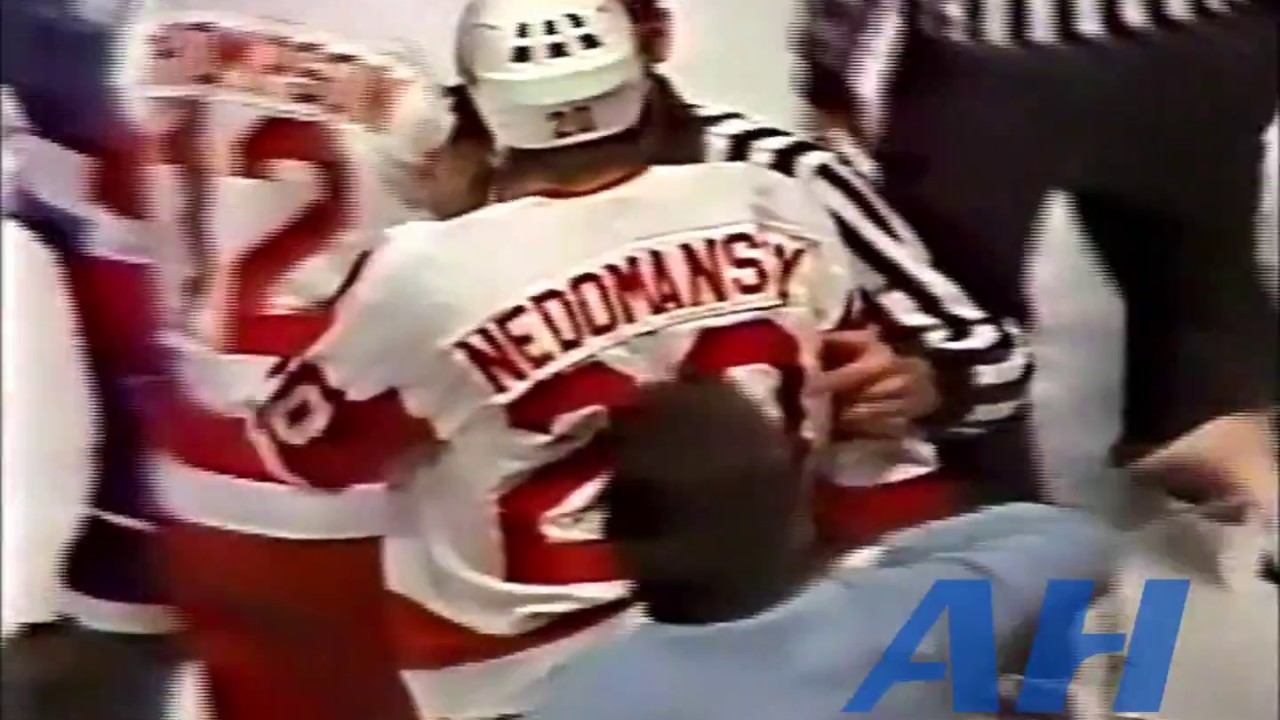
On the 51st anniversary of the Detroit franchise’s first NHL game, November 18, 1977, the Red Wings put 33-year-old center Vaclav Nedomansky on the ice for his NHL debut. Three years earlier, he left Czechoslovakia (now the Czech Republic) as the first professional ice hockey player to defect from behind Europe’s Iron Curtain.
Nedomansky had a highly successful hockey career back in Czechoslovakia. He played for Slovan Bratislava for 12 seasons beginning in 1962. In that Czech Elite Hockey League, he led the scoring in three seasons, including his last. Of his nine appearances at the IIHF World Ice Hockey Championships, Czechoslovakia medaled every year but 1967. In 1974, he was the top forward of the tournament. At the Olympics, his scoring helped his national team take home silver in 1968 and bronze in 1972.
Unfortunately, political tensions grew and civil liberties disappeared as the Soviet Union occupied Czechoslovakia in 1968. Five years later, Nedomansky left for Switzerland then Canada. He later commented, “One of the happiest moments was when I immigrated to Canada. That way, I was a free man. I could develop not only as a hockey player, but as a person.” Although Nedomansky was stripped of his Czech citizenship as punishment, he became a Canadian citizen and later obtained dual U.S. citizenship.
In North America, Nedomansky signed with the Toronto Toros of the World Hockey Association (WHA). He had been scouted by the NHL’s Atlanta Flames, and GM Cliff Fletcher traveled to Czechoslovakia to speak with him. After Nedomansky defected, Fletcher approached him again. However, Nedomansky felt concerned about racial tensions he heard Atlanta experienced and chose Toronto instead. He moved south when the franchise relocated to become the Birmingham Bulls in 1976.
It seemed that the Bulls, like many WHA teams, ran into some financial difficulty and disposed of some higher salaries. On Tuesday, November 15, 1977, in a rare inter-league trade, they sent Nedomansky and Tim Sheehy, two known scorers, to the Detroit Red Wings (in return for the loan of Dave Hanson and Steve Durbano). Nedomansky told the press, “I appreciate it. It’s a nice chance for me, but it’s very surprising. My family is in Toronto and this will be a nice chance to have them closer to me. It’s only a four-hour drive from Detroit.” His new coach, Bobby Kromm, looked forward to it, too. “Ned is going to be a big asset, especially on the power play. I don’t know of a centerman in the league who can step over the blue line and shoot the puck like he can.”
That Friday, Nedomansky finally played in an NHL game. Coincidentally, the Red Wings were hosted by the Atlanta Flames at the Omni Coliseum. The home team took an early lead. Shortly after Tom Lysiak put the first tally on the scoreboard, Bill Clement scored his 99th and 100th goals back-to-back. Atlanta led 3-0 at the first period intermission.
Just over seven minutes into the second period, Detroit had “clicked on two power play goals off the usually reliable Flames penalty killers.” A couple minutes later, Atlanta put in another. Within the next couple minutes, Detroit scored a third goal. As the recap reported, “Newcomer Vaclav Nedomansky, the big Czech centerman obtained this week in a trade, assisted on all three goals in his debut and was a standout on the power play.” Unfortunately, Detroit could not find the back of the net again, and the Flames won 5-3. Of the eight goals that night, five were power-play goals.
Nedomansky remained with the Red Wings for four seasons. In September 1982, he signed with the New York Rangers because he admired Herb Brooks’ work with the U.S. Olympic team. “I went to New York because of (Herb Brooks). I went into that training camp without a contract just to play for him and make the team. I listened to him more and liked him very much.” That October, he was claimed on waivers by the St. Louis Blues. After a couple months, the Blues complied with Nedomansky’s request to be returned.
When Nedomansky’s NHL career ended with the 1982-83 season, he had played in 421 NHL games. His scoring added up to 122 goals and 156 assists for 278 points.
In honor of his paving the way for other central and eastern European hockey players to play hockey in North America and his prolific scoring, Nedomansky has just been inducted into the Hockey Hall of Fame’s Class of 2019.
Additional Sources:
“Rekindled Flames Burn Wings, 5-3,” Detroit Free Press, 19 Nov. 1977, p. 1C.
Al Smith, “Flames Clip Red Wings, 5-3,” Atlanta Constitution, 19 Nov. 1977, pp. 1C and 7C.
Tom Henderson, “Wings Trade For 2 Proven Goal Scorers,” Detroit Free Press, 19 Nov. 1977, pp. 1D and 4D.
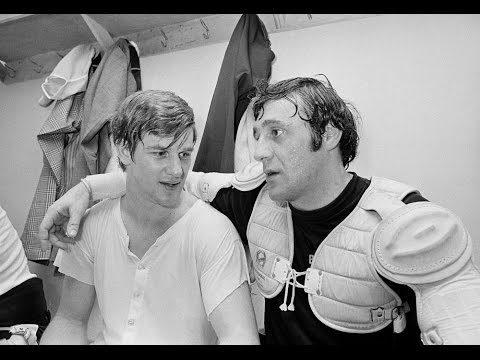
Everyone wants teammates like these. Eleven years apart on November 17, Bobby Orr and Bryan Trottier each tallied four assists. In 1973, Orr’s teammate Phil Esposito also became the fastest to reach 20 goals in one season. Then in 1984, Mike Bossy tied Esposito’s record for hat tricks, partly thanks to Trottier’s help.
Unsurprisingly, all the scoring happened during big blowouts. In 1973, the Boston Bruins hosted the Detroit Red Wings at Boston Garden, and the home team blanked them 8-0. For the 1984 game, the New York Islanders’ Nassau Coliseum hosted fellow New Yorkers, the Rangers, only to crush them 10-4. The earlier game was witnessed by 15,003 fans and the second by 16,002.
To score eight goals, the Bruins had seven scorers and but for a deflection would have had eight. Coach Bep Guidolin claimed the scoring distribution “looks better with every game.” It was a shutout for goalie Gilles Gilbert. Esposito started things off at 7:32 of the first period. This was his 20th goal in 18 games, making him the quickest to score as many up to that point.
As the Bruins proceeded to tally three goals in the second period and four in the third, Orr assisted on two goals in each period. He helped Andre Savard at 5:11 and Fred O’Donnell at 9:31. After the break, he and Esposito assisted Ken Hodge at 4:04. For the second-to-last goal of the night, Orr sent a 50-foot shot that deflected off Savard to score. Savard told the press, “I didn’t change it. Bobby did and I don’t know that it went off me.” It was better that Orr was credited with an assist instead of a goal because it gave him 456 total, the most ever by an NHL defenseman. Amazingly, this was his 458th game.
Orr ended his career with 645 assists. He is currently ranked 11th out of defensemen in terms of having the most career assists.
Come 1984, Esposito held the career hat trick record with 32. Bossy scored his first goal of the night 5:29 into the game. As the New York Daily news reported, “Bossy, in a wide open slot, gratefully backhanded the rebound of a Dennis Potvin point blast. Bryan Trottier, who had two first period assists, began the sequence by beating Pierre Larouche in a faceoff to [goalie] Hanlon’s left.” Less than a minute later, Bossy assisted on Greg Gilbert’s goal. Before the period ended, at 16:00, “Trottier intercepted a clearing attempt and hit Gillies, who gave a backhand pass that sprung Potvin to his second goal in as many games.” The Islanders went into the break up 4-1.
Trottier was credited with his third assist of the night at 5:31 of the second period, on Paul Boutilier’s goal. For the second time that game, the Islanders had scored four goals in one period. It was their seventh time that season that they had managed that feat. At the end of the session, the Rangers pulled goalie Glen Hanlon and replaced him with John Vanbiesbrouck.
The third period belonged to Bossy. Just 3:52 in, Bossy scored his second with a power-play slap shot. After two goals by the Rangers desperately trying to catch up, Bossy nailed the lid on the coffin at 17:44 with an assist from Trottier. Other than Bossy, seven of his teammates had scored to bring the total to ten goals, giving goalie Bill Smith his fourth straight victory.
Bossy went on to break the hat trick record by tallying his 33rd on February 7, 1985. After his final hat trick, scored on March 8, 1987, he had 39 total. That puts him third on the all-time list, but he scored his in only 10 seasons. Esposito remains in fifth for hat tricks after his 18-season career.
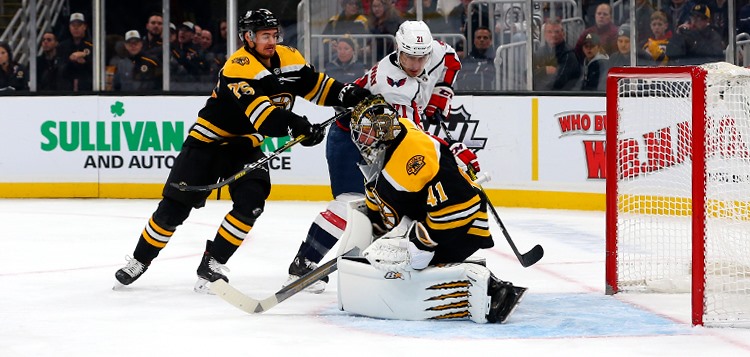
After ending their four-game losing skid with the 4-2 win over the Toronto Maple Leafs on Friday night while on the road, the Boston Bruins were right back at it in Boston on Saturday, playing host to the Washington Capitals. The Bruins record against the Caps in the last couple of seasons has been against the players in black and gold even when their best players are dressed, so there were some doubts going into Saturday night’s game with Boston missing some of their key players, having called up yet another of their AHL Providence Bruins, Paul Carey, when it was clear that Patrice Bergeron would not be playing.
The Bruins are not a team though that uses the lack of
veterans in the lineup as any type of excuse—not even when they are playing the
top team in the league.
“But when injuries happen—and we’ve got a few right now—we need guys to step up and take that challenge. That’s a great test against one of the best teams in the league, if not the best team right now. That’s all you can do in those situations. If going through that adversity a little bit, that helps us, that helps other guys carry more responsibility, build confidence, so that’s got to be our mindset,” said Charlie Coyle.
Charlie Coyle
Coyle, upon learning of Bergeron’s inability to play Saturday
expected to be moved to the second line center position with David Krejci being
moved up to center the first line between Brad Marchand and David Pastrnak. He
was a respectable 43 percent and took the most faceoffs of any of the Bruins—winning
six of fourteen. But more importantly, with some strong “havoc” as he called it
by his left winger Anders Bjork, and his right winger Danton Heinen finding a
seam, Coyle managed to put the Bruins on the scoreboard first.
Throughout the game the Capitals prevented the Bruins from getting very many shots on net. Each of the three periods saw Washington with double digit shots (18, 12, 11) while the Bruins were limited to half as many (9, 6, 6).
Despite this disparity, there were some strong plays by the Bruins, and some absolute heroics from Bruins goaltender Jaroslav Halak when the Bruins made mistakes. The Capitals were able to tie the score roughly three minutes after Coyle’s goal. During the second period, Pastrnak put the Bruins up 2-1, which was where things stood until the game was down to the final 59 seconds of regulation.
With Braden Holtby on the bench for the extra attacker, and the Bruins unable to simply ice the puck as they might have been able to on a power play, T.J. Oshie knotted the score and once again the Bruins couldn’t close the game out in overtime. Coyle got the only goal for the Bruins when things went to the shootout, but right now the shootout is definitely not a friend to Boston. This time it did have to go five rounds before Jakub Vrana potted a highlight reel worthy goal to give the Capitals the extra point.
Make no mistake, the Bruins were not satisfied with their
play, nor with their ongoing struggles in the shootout.
“You want two points. You take all the points you can get,
but you want to be able to shut the door there when you’ve got the lead like that
that late in the game and especially for your goaltender who’s played so well.
You want to end things on the right note for him. He kept us in the game. It’s
tough to get points in this league, it is, but when we’re on top like that, we
have to come away with two. I think that’s the mindset that we have to have,”
Coyle said.
The Bruins room after the game was subdued. They understand that they need to do better, and that they have to do it regardless of who is in the lineup. However, when you consider that the Bruins have seven players on IR right now: David Backes, Jake DeBrusk, Karson Kuhlman, Zach Senyshyn, Torey Krug, Kevan Miller, and John Moore, plus the current day-to-day injuries of Brett Ritchie and now Patrice Bergeron, almost half of Saturday night’ roster was comprised of call ups from Providence.
Taking on the top team in the league, being outshot 44-23 in three regulation periods plus overtime and walking away with a point is still a positive and speaks to the depth that the Bruins have. The team sits first in the Atlantic Division through 20 games, having 29 points and a +18 goal differential. They should neither be counted out nor dismissed.
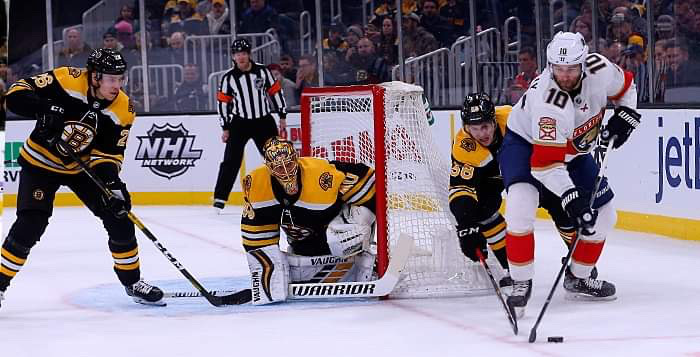
After struggling to come out strong in the first period the past few games, the Boston Bruins looked much better at the start of the game Tuesday night when they played host to their division rivals, the Florida Panthers. While the Bruins were unable to score in the opening period, they were able to put pucks on the Panthers’ goaltender Sergei Bobrovsky and were about limiting the chances that Florida had in the other end. It was good to see the Bruins starting the game on time.
It was the second period that was especially impressive—with the Bruins not having been very strong in the middle frame this season. It began with David Pastrnak who lulled Bobrovsky into thinking he was going to pass the puck to Brad Marchand. With what appeared to be almost a blind shot on net, Pastrnak got the Bruins on the score board first 11:55 into the second period. Joakim Nordstrom followed up 2:07 later to make it 2-0.
While the Bruins were on their first power play of the game—with the Panthers Dryden Hunt sent off for a somewhat soft holding call, Anders Bjork notched the third of the game and his third for the season at 17:15 of the second. And just as it looked like the Bruins would be going into the second intermission up 3-0, Zdeno Chara potted a rebound off a David Krejci shot to give the Bruins an impressive 4-0 lead.
Not surprisingly, when the Panthers returned in the final frame, Bobrovsky was sitting on the bench and backup goalie Sam Montembeault was between the pipes. Less than a minute into the third period, Aaron Ekblad got Florida on the board. And then things began to get a bit more physical. Just 1:08 into the third period, Vincent Trochek elbowed Pastrnak, who went down—though he wasn’t seriously injured, and Marchand went over to let Trochek know that such a hit wasn’t acceptable. Trochek got two minutes for the elbowing and two minutes for roughing. Marchand got a double minor for roughing. For some unknown reason the teams played five on five with none of those penalties posted on the board.
Chris Wagner joined Marchand in the box 2:41 later and this time Panthers Frank Vatrano put the puck past Tuukka Rask to cut the Bruins’ lead to just two goals. Another penalty, this time called on Sean Kuraly at 8:32 saw Florida’s Mike Hoffman score on the power play, and the ice was clearly tilted in favor of the visitors. With 1:39 remaining in regulation, Keith Yandle got the tying goal at even-strength and everyone was wondering what had happened to the Bruins.
When things couldn’t be decided in overtime, it definitely wasn’t looking good for the Bruins who this season were zero for seven in the shootout. They are now zero for eight and with that the Florida Panthers came back from a four-goal deficit, for the first time in franchise history, to win the game.
So just where did it all go wrong for Boston?
“Just things got compounded. We lose a stick on the first goal; we don’t recover. It’s a poor angle shot but a good shot, so you’ve got to get your game back together. We take some penalties. It seemed like we took a lot of marginal penalties tonight; we didn’t kill them. Same thing in Detroit, we had those issues. Not great penalties we took – guys throwing pucks into the middle of the ice, so we’re going to have to sit down and address the penalty kill in those situations, how we broke down and get better in that area,” described Bruins head coach Bruce Cassidy.
“Now, all of a sudden, [the Panthers] got life, and they’re coming. Their goalie, to me, made terrific… one save after another down there, so you get your chance to sort of, you know, because they’re opening up, we’re getting a chance to extend our lead or calm things down. There’s two ways to calm things down: you’re going to score a goal because they’re coming at you and gambling all over the ice, or you’re going to defend better, and we did neither. Having said that, I do give their goalie a lot of credit for coming in cold. I mean, we missed open nets on the power play, he made some great saves, we hit a crossbar. So now doubt creeps into your mind, like is this really happening,” Coach Cassidy continued.
“But this is a team that’s closed out games for years, and the
last goal to me – put everything else aside – is disappointing. We get beat
one-on-one off the rush, winger circling out of the scoring area knowing the
game is on the line. You could sit here and argue that the guy’s holding
Bergy’s [Patrice Bergeron] stick and can’t clear the puck at the end, but
structurally we were bad on that last goal. That’s the disappointing part to
me. That’s when we’re usually rock solid,” Coach Cassidy finished.
And make no mistake, Coach Cassidy is concerned that his
team that is known for being so strong in the third period was anything but on
Tuesday night. He didn’t hold back on any aspect of his team’s performance, or
lack thereof.
As for the players, they know what they did.
“I think that we just didn’t buy into the way we were playing in the first two periods. We came in between that second period and were saying that we needed to put together a full 60, but we really didn’t do that,” said Brandon Carlo. “I think it’s just something within ourselves that we need to regroup after this game especially. That was the message sent tonight. I think we can take it in a positive aspect and move on from it and continue forward with playing the way that we started off this year.”
“Obviously, we all realize that that was not our 60-minute game. I think that we know we lost a point and, like I said, it’s on us. I think at that point we have to be able to defend it and just play strong till the end,” said a subdued Chara.
The Bruins have a couple of days to look at video and regroup. There will be some work put into the penalty kill and perhaps some adjustments in other areas during the next practices. They will then travel to Toronto to take on the Toronto Maple Leafs on Friday before returning home to host the Washington Capitals on Saturday. These will be two important tests for the Bruins to see if they can reset their game to what it was at the beginning of the season
The Boston Bruins had been playing Wayne Cashman, Phil
Esposito and Ken Hodge as a line for years. In fact, during the 1970-71 season,
they set NHL records for most points by a line (336) and most goals (140).
Going into their game against the Atlanta Flames on Sunday, November 11, 1974, Bruins head coach Don Cherry had split up his tremendous trio slotting Cashman onto another line to replace a player who was injured.
In a surprise turn of events, Bruins superstar Bobby Orr was
actually outskated in the first period by Flames Tom Lysiak, who put the
visitors on the scoreboard first, where things remained until the middle frame,
when Orr got a shorthanded goal to tie things up 1:24 into the second period as
the Bruins were killing a carryover holding penalty called on Carol Vadnais.
“Orr skated the length of the ice in a slow, weaving drive,
drew Flames goalie Dan Bouchard down to his left, circled the net, and slid the
puck under a diving Bob Leiter,” reported The Post-Standard of Syracuse
the next day.
“On that shorthanded goal of his which tied up the game in
the second period, he drew the goalie and both defensemen over to him and he
swung around the net. Then he comes out the other side and has the whole net to
shoot at and nobody near him,” Cherry described. “I’ve been in hockey for 21
years and I’ve never seen anything like him. He always does something new to
amaze me.”
When the Bruins got a go-ahead goal from Don Marcotte,
unassisted, less than two minutes later, it looked like things were going to go
well for the home team, but the Flames weren’t going away. With 7:08 remaining
in the second period Bryan Hextall knotted the game up. Lysiak notched his
second of the game with 1:12 remaining in the second. And as the teams went
into the locker rooms for the second intermission, the home team was trailing
the Flames 3-2.
It was during the third period that Coach Cherry elected to reunite his talented trio and with them back together, scoring resumed in favor of those wearing black and gold. Just 1:07 into the final period, Lysiak was whistled for a hold and six seconds into the power play Esposito put the puck in the Flames net for his 15th goal on the season, assisted by Vadnais and Orr. Six minutes later Flames forward Tim Ecclestone, who had an assist on Hextall’s goal back in the second, was sent to the box for a tripping call. This time it would take the Bruins 47 seconds to find the twine behind Bouchard. The go-ahead goal and game-winning goal came from Cashman, assisted by Esposito and Vadnais. As the buzzer signaled the end of the game, the Buins had edged out the Flames in Boston.
“I made the move because Esposito wasn’t getting enough good
shots without [Cashman],” Cherry said. “I wondered afterwards why I hadn’t thought
about making that move in the first period.”
By the end of the 1974-75 regular season, Esposito had 61 goals and 66 assists in 79 games for 127 points. Cashman ended up with 11 goals and 22 assists for 33 points in 42 games. While Hodge notched 23 goals and added 43 assists for 66 points in 72 games. The line combined for 95 goals and 131 assists for 226 points.
It was less than a year later though when the hockey world was shocked, as were the players, when on November 7, 1975, Esposito and Vadnais were traded to the New York Rangers in return for Brad Park and Jean Ratelle, along with Joe Zanussi—who played for the Rangers AHL team.
“I was crushed. Trades are part of the game. You have to accept it,” said Esposito after playing his first game as a Ranger. “I was shocked and I’m sure Ratelle, Park and Vadnais were, too. But there’s no bitterness.”
Additional Sources:
“Power Plays Key in 4-3 Bruins’ Victory,” The Brattleboro Reformer (Brattleboro, Vermont), Monday, November 11, 1974, p. 9.
“Espo tallies two for Rangers; terms first performance fair,” The Lowell Sun (Lowell, Massachusetts), Saturday, November 8, 1975, p. 6.
By the 1996-97 season, only one NHL player skated without a helmet, Craig MacTavish. In August 1979, the NHL had ruled that everyone had to wear a helmet but exempted players who signed NHL contracts before June 1, 1979. MacTavish was drafted in 1978, so he was grandfathered. Although he attempted to wear a helmet earlier in his career, he ditched it claiming, “It was just a comfort thing for me.” Thus, when he scored his final NHL goal on November 9, 1996, it was the last scored without a helmet.
As of the 1978 NHL Amateur Draft, MacTavish skated for the Boston Bruins until February 1, 1985. That fateful day, he signed as a free agent with the Edmonton Oilers. Not only did he win the Stanley Cup championship three times with them, but his place on the team earned his place in future franchises. On March 21, 1994, Mike Keenan brought him on board the New York Rangers to join several other former-Oilers, just in time to win the Stanley Cup. That summer, he signed with the Philadelphia Flyers, but Keenan again traded for him on March 15, 1996. He finished out his skating career there with the St. Louis Blues.
In his final season, MacTavish started out with two goals and four assists. The second goal was scored on November 8 (against the Canucks in Vancouver). He would score his final NHL goal on November 9 and his final NHL assist on November 16. Both of these happened against the Calgary Flames.
On November 9, Calgary’s Canadian Airline Saddledome hosted a crowd of 16, 786. Unfortunately for the home fans, it took nearly half a period before the Flames even managed a shot on net. The Blues had the only goal for the first two periods.
In the third period, the teams alternated scoring. According to the recap, the Flames tied and quickly fell behind again when “Todd Hlushko and Craig MacTavish, a pair of checking specialists, traded goals less than four minutes apart.” MacTavish “got in behind defenceman Cale Hulse, tipped in a Rob Pearson pass at 6:34, restoring the Blues’ one-goal lead.” At 10:12, Calgary’s Theoren Fleury made the best of a four-on-three advantage when he “corralled a rebound with his foot, kicked it to his stick and lifted the puck into the net as he was falling.” Finally, at 16:09, Brett Hull notched the game-winner “on the power play when he lifted one of his trademark wrist shots past Rick Tabaracci who was without his goalie stick, coincidentally, because he lost it while sprawling to stop another Hull shot that hit the post.”
Of course, at the time, no one knew that game would feature the final helmetless goal. Ironically, Flames coach Pierre Page expressed his displeasure with his own team by saying, “It’s about time we got our hard hats on and really worked hard.”
That season, MacTavish would go on to play his last regular-season game on April 9 and his only postseason game on April 20. At 38, after 17 seasons, he retired on 29 April 1997. As the St. Louis Post-Dispatch reported, “Craig MacTavish’s retirement ends an era in the NHL. He was the last player in the league who did not wear a helmet.” He had 213 goals and 267 assists for 480 points in 1093 games.
After his playing career, MacTavish became an assistant coach of the Rangers, his former team. In October 1997, the Post-Dispatch highlighted that the “helmetless wonder . . . is still learning to watch for flying pucks. He was recently skulled in the melon by a stray pass.” MacTavish told the press, “I didn’t get much sympathy from the guys. They were doubled over in laughter. Guys were tossing me their helmets.” From 2000 until 2009, MacTavish served as head coach of another former team, the Edmonton Oilers.
Additional Sources:
Mike Commito, Hockey 365: Daily Stories from the Ice (Toronto: Dundurn, 2018), kindle version.
Dave Luecking, “Hull’s Third-Period Goal Snuffs Out Flames 3-2,” St. Louis Post-Dispatch, 10 Nov. 1996, pp. F1 and F13.
Mike Board, “Flames wait too long to answer wakeup call,” Calgary Herald, 10 Nov. 1996, p. B1.
“Game Story,” Calgary Herald, 10 Nov. 1996, p. B2.
Dave Luecking, “MacTavish Retires; Who Else Will Be An Ex-Blue In ’97-98?” St. Louis Post-Dispatch, 30 April 1997, p. 2D.
“Road to Nowhere,” St. Louis Post-Dispatch, 15 Oct. 1997, p. 3D.
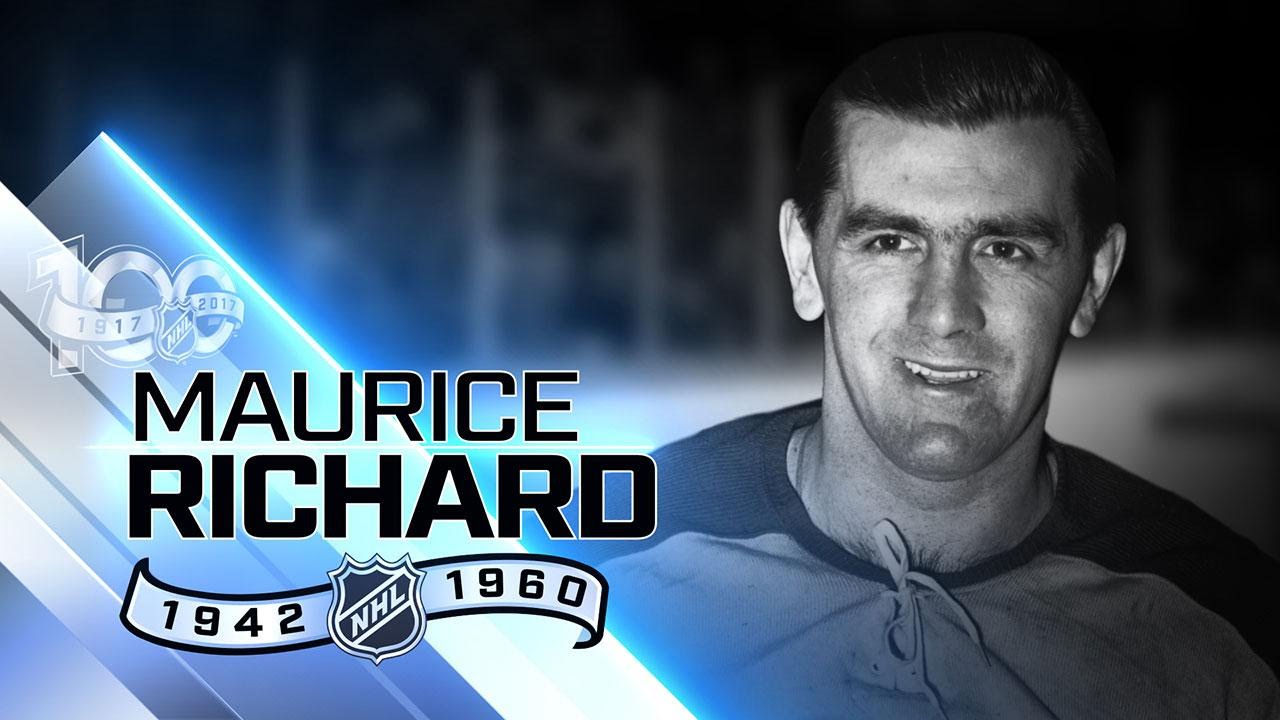
For good reason, the Maurice Richard Trophy has been given annually to the NHL’s leading goal-scorer. Maurice Richard earned a reputation for scoring goals, starting from his very first NHL goal on November 8, 1942 through his record-breaking 325th goal scored exactly ten years later. Both games were played at Montreal’s Forum, home of his Canadiens. He scored a goal and an assist for Elmer Lach in each game.
In 1942, at the age of 21, Richard scored an assist in his first game with the Montreal Canadians and then a goal and an assist in his second. It was the start of a very productive NHL career.
Montreal hosted the New York Rangers for a crowd of about 10,000. On November 7, the Rangers had hosted and won 4-3. A day later, the Canadiens had their revenge (and then some) with a 10-4 victory. Most of the scoring was done by Buddy O’Connor and Gordie Drillon, who each tallied six points. O’Connor set a record with four assists in one period.
The first goal of the night was scored by Elmer Lach, with Richard’s assistance. Nearly a year later, the two would be put together (with Toe Blake) on the famous “Punch Line.” Their chemistry showed as of 3:07 of the first period of Richard’s second NHL game.
The Habs led 4-1 at 9:11 of the second period when Richard netted his initial goal. Although new to the team, the press raved about his “electrifying end-to-end rush” that became the feature play of the night and earned his place as a star of the game. Per the Montreal Gazette’s description, “Richard picked up the puck near his own goalmouth, broke fast and came up the centre of the ice under a full head of steam, swerved around the Rangers’ defence and coasted in on Steve Buzinski. His backhand shot lodged in the upper corner of the net, completely fooling the goalie. It was an end-to-end effort reminiscent of the feats of Howie Morenz, and the full house accorded the youngster a roar of acclaim that lasted for minutes.”
Ten years later, on November 8, 1952, the Forum hosted the Chicago Blackhawks for a crowd of 14,562, “who shook the building with their shouts and pelted debris down on the ice.” Montreal won 6-4 thanks to The Rocket’s two second-period points. The teams were tied at the end of the first period, and in the second, Chicago scored only to see Montreal match a little over a minute later.
At 9:29 of the second session, Elmer Lach scored his 200th goal with an assist from Richard. The Rocket “took a pass from Doug Harvey and battled his way in close so that all Evergreen Elmer had to do was slap it into the net.” At that, reported the Gazette, “There was a big uproar as the crowd acclaimed Elmer’s entry into the 200-goal club. Richard commented, “I’m glad Elmer got his 200th goal. It’s been an honor and privilege to play with him all these years.”
However, the Gazette crowed, “It had hardly quieted down when The Rocket notched his own record-breaker 50 seconds later.” At 10:01, “Butch Bouchard fed him the puck and he fired a backhander from fairly well out, which Al Rollins got a piece of but allowed to trickle through.”
Richard had scored his 325th goal to surpass Nels Stewart for the all-time goal leader. Stewart had retired in 1940 with 324 goals. He wired Richard before the game ended, stating, “Congratulations on breaking the record. Hope you will hold it for many seasons. Best of luck to you, Frank Selke, Dick Irvin and the rest of the boys through the season.” Overwhelmed, The Rocket remarked, “It was the greatest thrill of my hockey career, but I’m glad it’s over. Too much pressure.”
Play paused for the celebration. According to the Gazette, “When the red light flashed it was the signal for the ovation which the fans had been waiting to give The Rocket through three previous games. A great shout went up, flash bulbs went off, and play was halted while The Rocket recovered the puck and took it over to Dick Irvin on Canadiens’ bench. His teammates pounded him gleefully on the back.”
Selke explained that the record-breaking puck would be decorated with an image of Queen Elizabeth and Prince Philip based on a photo of them attending a Canadiens game the previous season. The other side would feature Richard and the record date. Once decorated, the puck would be sent to Queen Elizabeth.
The Rocket retired in 1960 holding the goal-scoring record with 544 goals. On November 10, 1963, eleven years and two days after Richard originally broke the record, Gordie Howe surpassed Richard by scoring 545. Richard remains 31st in the all-time list of goal-scorers.
Additional Sources:
“Canadiens Swamp Rangers, 10-4, at Forum to Gain Split Over Week-end,” Montreal Gazette, 9 Nov. 1942, pp. 16-17.
Dink Carroll, “Forum Rafters Shake as Rocket Bags Record Goal,” Montreal Gazette, 10 Nov. 1952, p. 20.
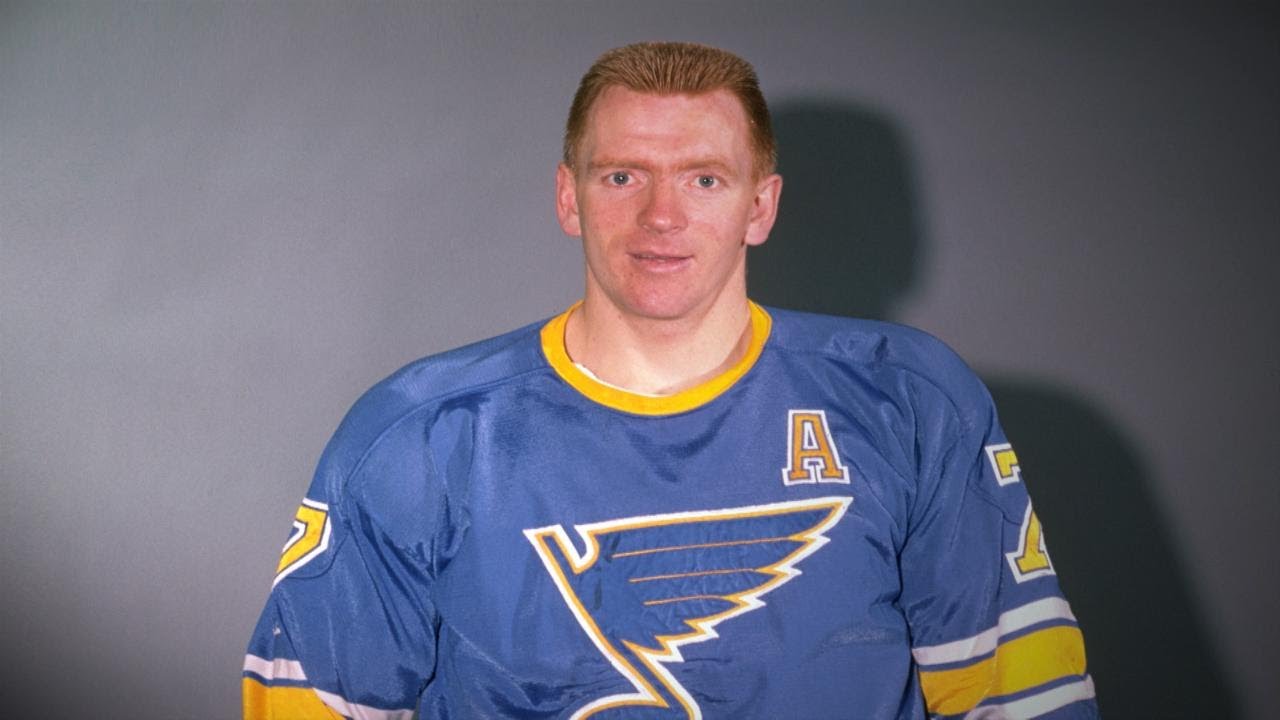
Gordon Berenson, the “Red Baron” of the St. Louis Blues, became a shooting ace on November 7, 1968. The center who had never scored an NHL hat trick suddenly scored two, in the same game. This made him the runner-up for the record for most goals scored in a single game. Since Berenson scored four of them in the second period, he tied the record for most goals scored in a single period.
Berenson’s feat took place exactly one month and one day before his 30th birthday. He had started his NHL career with Montreal during the 1961-62 season. After the Canadiens traded him to the New York Rangers in June 1966, he skated with them for about a year and a half.
On November 29, 1967, in one of his first acts as GM and coach, Scotty Bowman traded to bring him to St. Louis. Berenson acknowledged Bowman saying, “I owe him a lot. He’s had enough faith in me to let me play. And by playing, I’ve gained confidence in myself.” After Berenson’s six-goal game, Bowman praised, “He’s the best forward in the West Division. He plays defensive hockey and he’s a class guy, too. I think he’s getting better all the time. He showed moves like this in practice for years and now he’s getting free in the games.”
The game took place at Philadelphia’s Spectrum for 9,164 Flyers fans. A delayed flight meant that they did not arrive in Philadelphia until 2:40 in the afternoon, which meant they had to rush through eating their “pre-game steaks” and checking in to the hotel. Berenson and his roommate “shaved in the dark before the game” because their room had “only one small light bulb.” While St. Louis’s team did not arrive happy, they left much happier. Both expansion teams established in 1967, the 8-0 score gave the Blues their highest single-night goal total and the Flyers their worst-ever defeat.
Doing the math, Berenson scored six of the Blues’ eight goals, three quarters of the total. He did so with ten shots on goal, one third of the 30 shots made by the team. Berenson netted the first five goals of the game, on five consecutive shots. He then cleaned up with the final goal of the game.
With the first goal, at 16:42 into the game. Berenson skated the puck from zone to zone “and shifted goalie Doug Favell out of position before lifting a high backhand shot into the cage.” At that point, he was merely relieved to get out of his rut. “All I could think was, ‘Thank God I can still score.’” From that point on, he had goalie Favell totally confused. By the end, Berenson was stunned. “I just couldn’t believe the puck was going in that often, but every time I looked up the light was on.”
During the latter half of the second period, a span of 9:09, Berenson scored four goals. After the first two of these, he had his first hat trick. He commented, “I picked up the puck then. After all, who expects to get more than three goals in a game?” With the addition of the latter two, he tied the record for most goals scored in a single period. He was the ninth NHLer to accomplish this act. Since then, eight others have succeeded in meeting the record. It took over 12 years before anyone matched Berenson, and that was Wayne Gretzky in 1981. The most recent match, by Patrick Marleau, was in January 2017.
The final goal, Berenson scored at 14:04 of the third period. Although they cheered for the home team, the Philadelphia fans gave him a standing ovation in recognition. They also began chanting, “Go, Red, go” and “We want Red.” “That was real sportsmanlike of the fans,” said Berenson. “I think I’ve been cheered in an opposing rink before but it never was anything like that.” He also remarked, “I couldn’t believe that the crowd actually wanted me to score more. But let me tell you. It was one of the greatest thrills of my life.”
Back in January 1920, Joe Malone of the Quebec Bulldogs managed to score seven goals in one game. After that, five skaters (including Malone, Newsy Lalonde, brothers Corb and Cy Denneny, and Syd Howe) scored six goals in one game before Berenson matched them. There had been nearly a quarter of a century between Howe’s 1944 game and Berenson’s in 1968. Since then, only Darryl Sittler (in 1976) has managed six goals in one game.
Holding back his enthusiasm, Berenson chalked up his success as part luck. “I think that just about duplicates the thrill of paddling a wilderness river. Everything went right. It’s like planting trees. Some years you plant 12 and five or six come up; some years you plant 12 and none come up. Tonight everything was going in.” He then said, “This is really something. I’ve never even had a hat trick before in the NHL. Tonight I was just in the right place and the shots went in the right place.”
Berenson even added an assist to his point total. On the second of two goals not scored by him, he helped Camille Henry tally his 270th goal. Henry remarked, “I’m quite happy to take a back seat tonight. I once scored six goals in the American League, but that’s not like the NHL. Red deserves every headline he gets.” This bumped Henry up to 13th for the all-time goal scorers list. Naturally, Berenson was happy with his own performance, but he said, “It’s a great thrill, but to tell the truth, I think I’d just as soon have had seven assists, instead of six goals and one assist.”
While the Blues were busy scoring, their goalie, 39-year-old Jacques Plante earned his 65th shutout. With 26 saves, Plante remarked, “It was an easy shutout. What made it easy was the way Red was going. His early goals gave me a cushion and I just sat on it.” Plante had been Montreal’s goalie back when Berenson was just starting out there. According to Plante, “He’s our Super-Star so we sort of expect these things from him. He’s big, he’s fast, he has the quick moves. And, when he’s on, no goalie is going to stop him.” Poor Favell had just returned after resting his aching back for five games when he let in Berenson’s six goals and the two others.
At the end of the 1968-69 season, Berenson finished in the top ten for goals, assists, points, goals created, goals per game, and points per game. In February 1971, St. Louis traded him to the Detroit Red Wings, where he remained until he was traded back to St. Louis in December 1974. Berenson’s NHL playing career ended at the end of the 1977-78 season. He then coached the Blues for three seasons.





 Prev
Prev