Pavel Bure and Brendan Shanahan each had a one-night-only special for sold-out crowds (of 18,200) at Madison Square Garden. Both of them scored their only hat trick while wearing a New York Rangers jersey on December 3, in 2002 and 2006 respectively. What’s more, these were the final hat tricks of their impressive NHL careers.
2002
Drafted in 1989, Bure earned the Calder Trophy in 1991-92 at the start of his seven seasons with the Vancouver Canucks. He then skated for the Florida Panthers, taking home the Maurice Richard Trophy in 2000 and 2001. They traded Bure to the Rangers on March 18, 2002, where due to knee injuries, he would end his NHL playing career almost exactly a year later (and about two weeks before his 32nd birthday).
As one of his last hurrahs, Bure’s final hat trick led the Rangers to a 5-3 victory over the Columbus Blue Jackets. After New York and Columbus each got on the scoreboard, Bure scored at 9:17 and 19:37 of the first period. The Blue Jackets scored at the beginning of each of the following periods to knot the score.
Thanks to Bure, the Rangers tallied twice more before the end. At 10:47, Eric Lindros broke the tie after “what looked like a textbook interference penalty.” The New York Daily News continued, “That unpenalized pancake block freed Bure for a dash to the net that produced the rebound Lindros flipped home.” Coach Bryan Trottier called that the play of the game praising, “I thought Pav had just a boatful of jump and hunger.” To close out the night, at 18:06, Bure made his ninth shot on goal count “as gorgeous a goal as you’ll see – a flying conversion of two-on-one rush with Nedved that caused a trickle and then rain of hats to fall to the Garden ice.”
Up until the game before, Bure had experienced a goal-scoring slump with only two goals to show for 15 games. Coach Trottier had remarked, “Pav has to pick it up.” He then switched Bure from Lindros’s line to one with center Petr Nedved and wing Ronald Petrovicky and noticed an immediate improvement. Trottier commented, “The three of them are working well together and we want it to continue and it will continue.” Nedved assisted on all three of Bure’s goals, while Petrovicky helped with the first two. All three of them were named the stars of the game.
2006
Shanahan had been playing in the NHL since he was drafted in 1987. He played for the New Jersey Devils until signing with the St. Louis Blues in 1991. They traded him to the Hartford Whalers in 1995. After little more than a season, Shanahan joined the Detroit Red Wings just in time to win back-to-back championships in 1997 and 1998. They won again in 2002 before Shanahan signed with the Rangers on July 9, 2006. He spent two seasons with the Rangers before returned to the Devils for his final half season.
His three-goal game with the Rangers did not end as well as Bure’s. In the first period, the New York Islanders scored four goals on just eight shots. This prompted Rangers goalie Henrik Lundqvist to recommend swapping goaltenders. He explained, “You want to win and help the team. And I felt like I wasn’t having a really good game tonight.” Lundqvist had only been pulled once before, exactly one year earlier. Although Kevin Weekes took over, the Rangers couldn’t make a full comeback.
Shanahan’s attempt to rally the Rangers began with him scoring at 6:45 and 17:28 of the first period. The first was a shorthanded goal, and the second was just 1:03 after Jaromir Jagr made the Rangers’ second goal of the game. At 7:01 of the third period, Shanahan completed his hat trick and the Rangers’ scoring successes. Like Bure had four years earlier, Shanahan had made good on one third of his nine shots on goal.
Unfortunately for the Rangers, the Islanders had Viktor Kozlov on the ice. He had scored one of the first-period goals before matching all of Shanahan’s goals. As the New York Daily News noted, he “single-handedly snuffed out two Brendan Shanahan-led comeback attempts.” His tallies came at 18:41 of the second period and then at 13:52 and 18:24 of the third. Thanks to him, the Islanders won 7-4. Naturally, Kozlov was a star of the game along with Shanahan.
With the Rangers hat trick, Bure had a total of 20 regular-season hat tricks. He is currently tied for 15th in the list of most NHL hat tricks. Meanwhile, Shanahan’s Rangers hat trick gave him a career total of 18, tying him for 21st in the NHL. Both players have been inducted into the Hockey Hall of Fame – Bure in 2012 and Shanahan following in 2013.
Additional Sources:
John Dellapina, “Bure, Blueshirts rip Jackets,” New York Daily News, 4 Dec. 2002, pp. 63 and 66.
As with the NHL, its predecessor, the National Hockey Association (NHA) formed because a league changed to leave out a former member. On November 25, 1909, the Eastern Canada Hockey Association (ECHA) dissolved because the Quebec Bulldogs, Ottawa Senators, and Montreal Shamrocks did not want to use the smaller and inconveniently-located Jubilee Arena built by the owner of the Montreal Wanderers. The three left out the Wanderers to form the Canadian Hockey Association (CHA).
Rather than fold or leave the professional level, the Wanderers formed their own pro league. As the Montreal Gazette noted, “The exclusion of Wanderers from the combination of the clubs formed last week has already started a war that before the end of the season may result in a big shake up in the hockey situation in Eastern Canada.” On December 2, 1909, they announced the formation of the new National Hockey Association of Canada Limited.
As the Wanderers officials (led by GM Jimmy Gardner) left the meeting that dissolved the ECHA (at the Windsor Hotel in Montreal), they came across Ambrose O’Brien, owner of the Renfrew Creamery Kings. They wanted to join the pro league because they had been excluded from challenging for the Stanley Cup. However, the CHA also rejected the Renfrew application. Thus, the two spurned teams decided to start a rival league.
Wanting to avoid the publicity of meeting at a hotel, they held a private meeting at 300 St. James Street, Dominion Office & Store Fitting Company, Ltd., in Montreal’s downtown business district. In addition to Gardner and O’Brien, attendees included representatives from Cobalt and Haileybury in Ontario. The Wanderers’ Fred C. Strachan presided, and the secretary of the Montreal Baseball Club, Eddie McCafferty, served as secretary.
According to the by-laws they established, the franchises could not sell within their first year and afterwards, 2/3 vote was needed before transfers were allowed. Right away, three of the four clubs at the meeting paid bonds of $1,000 each, and the fourth paid the following morning. The NHA’s original franchises thus included the Montreal Wanderers, the Renfrew Creamery Kings, the Cobalt Silver Kings, and the Haileybury Comets. They also set aside a franchise for Toronto that they intended to have join them the following season once they had rink accommodations.
The press speculated that perhaps the Montreal Nationals, an Ottawa franchise (backed by the Lacrosse club), and another CHA club jumping ship might join the NHA by the time the schedule was set. Instead of the Nationals, when they met to set the schedule on December 4, the NHA formed a new French-Canadian team from Montreal, Les Canadiens. Both the CHA and the NHA then set their schedules with five teams in each league.
Although the season began on December 30, the five franchises in Montreal alone soon took their toll. The CHA games had poor attendance, so discussions began about merging the leagues. As of January 15, 1910, the Montreal Shamrocks and the Ottawa Senators left the sinking CHA to join the NHA, and the rest of the CHA folded.
The slate was cleared, and the season began anew with just the NHA. The team at the heart of the controversy, the Wanderers, finished the shortened season 11-1-0 and then won the Stanley Cup challenge. Their main rivals, the Ottawa Senators, trailed by just four points with a record of 9-3-0, and they would win the Stanley Cup the following season. Of the seven franchises that played in the NHA’s first season, the Canadiens brought up the rear with a mere four points and a record of 2-10-0. However, they would be the only team to survive from the NHA through the formation of the NHL and beyond the Original Six era.
Additional Sources:
“Clubs Unite to Form New League,” Montreal Gazette, 3 Dec. 1909, p. 2.
A band of brothers played in two games held on December 1, 1940 that did not end well for New York teams. At Chicago Stadium, two sets of brothers played for the winning Blackhawks and two others for the losing New York Rangers. Meanwhile, at Madison Square Garden, the New York Americans gave up the game and then some as the Boston Bruins scored seven goals in the final period. In that game, one set of brothers played against each other.
Chicago Stadium hosted 16,208 to watch the Blackhawks win their first home game of the season, 4-1, against the defending champions no less. At the time, Chicago’s roster included Doug Bentley and his younger brother Max as well as Bill Carse and his younger brother Bob. Both older brothers played left wing while the younger brothers were centers.
At 4:25 of the first period, rookie Max Bentley scored the first goal on a lateral pass when he “came racing down the center lane. One lightning swish and Max blinded Goalie Dave Kerr with the first tally.” His brother was credited with an assist. About 10 and a half minutes later, Bill Carse came in fast to grab a perfect pass from George Allen. According to the recap, “Goalie Kerr dropped to the mouth of the cage, but the power of gravity wasn’t strong enough. Before Dave hit the ice, the puck had scooted under him and into the nets.”
The second period saw attempts from both Doug Bentley and Bob Carse as well as from three of the four brothers playing for the Rangers. Center Neil Colville and his younger brother, right winger Mac Colville, had shots on goal that were blocked. Left winger Lynn Patrick had two attempts that were turned back, while his younger brother Muzz helped the Rangers’ defense.
In the third period, the Rangers managed their only goal of the game at 9:37. Chicago had the last word though when Bill Thoms scored in the final 14 seconds.
The Chicago game did not wrap up until after 10,896 fans left Madison Square Garden sorely disappointed in the Americans having lost 10-3.
The Boston Bruins took a firm lead with ex-Amerk Eddie Wiseman scoring a hat trick (between 3:10 of the first period and 7:13 of the second). All three goals were assisted by linemate Bill Cowley, with their left wing, Roy Conacher, also assisting on the middle one. Later called the Three Gun Line, they were all known scoring snipers.
Trailing 3-0, the Americans made the second period their own by scoring thrice to tie the score. The middle one was netted by right winger Charlie Conacher, Roy’s older brother. At some point after Charlie’s goal and before his teammate’s shorthanded tying goal, “Roy Conacher dumped his brother Charley heavily and Charley took a playful swing at him.”
For the final session, New York basically hung their goalie, Earl Robertson, out to dry. As the Boston Globe relayed, “At the rate of a goal every two minutes Boston went on a scoring rampage.” In the Bruins’ seven unanswered goals, the Three Gun Line accounted for the final three. Cowley scored at 11:44 and 13:29, while Roy Conacher netted the one between (at 13:09 with Cowley’s help) and assisted on the last. With two goals and four assists, Cowley set a Bruins record at six points.
When the 1940-41 season ended, the Rangers’ top five scorers included the three brothers who were forwards. Lynn Patrick and Neil Colville would go on to become members of the Hockey Hall of Fame. For Chicago, Doug Bentley was the only brother to rank in the top five scorers. He and his brother Max have both been inducted into the Hockey Hall of Fame. Unsurprisingly, the Bruins’ top three scorers were made up of the Three Gun Line, with Roy Conacher in third. He and his brother Charlie (who ranked fifth in the Americans’ scorers) are members of the Hockey Hall of Fame. Cowley led the NHL in assists (47) and points (64) to earn the Hart Memorial Trophy.
Team-wise, the Bruins led the pack with 67 points (27-8-13) and won the Stanley Cup Final. The Rangers came in fourth with 50 points (21-19-8), and Chicago followed with 39 points (16-25-7). The Americans were the cellar dwellers with 27 points (8-29-11).
Additional Sources:
Hy Turkin, “Bruins Rip A’s, 10-3; Tally 7 in 3d Period,” and “Hawks Wallop Rangers, 4-1,” New York Daily News, 2 Dec. 1940, p. 49.
Edward Burns, “Hawks Win First on Home Ice, 4-1; Chill Rangers,” Chicago Tribune, 2 Dec. 1940, p. 23.
“Bruins Crush Amerks, 10-3,” Boston Globe, 2 Dec. 1940, p. 9.
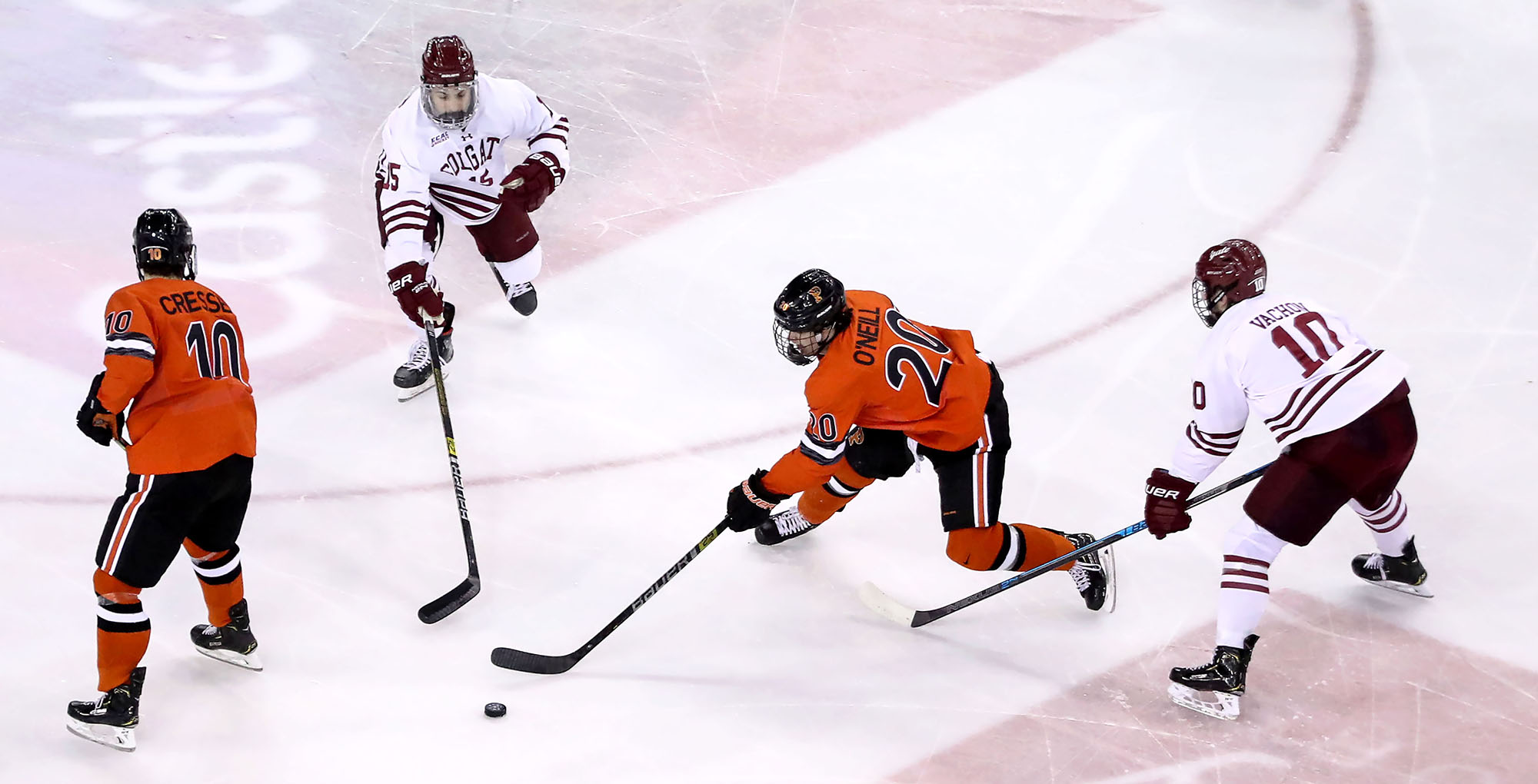
Let’s face it, if you were a director of a hockey movie and you were trying to come up with scenes that showed goal scoring, edge-of-your-seat plays, near misses, intense competition, and a close game, you would need only look to the championship tilt between the Northeastern University Huskies and the Colgate University Raiders that took place in Belfast on Saturday night in the final game of the 2019 Friendship Four.
And like any good movie, these two teams have a backstory to go along with their present. Northeastern and Colgate were two of the original teams to participate in the inaugural Friendship Four in 2015. They lost their Friday games to the University of Massachusetts-Lowell River Hawks and Brown University respectively and found themselves playing in the consolation game that Saturday afternoon. Northeastern took that game with an astounding 7-1 score, but more importantly it turned their 2015-16 season around. They arrived in Belfast with a 2-10-2 record, but after the tournament they finished the season with a 22-14-5 record.
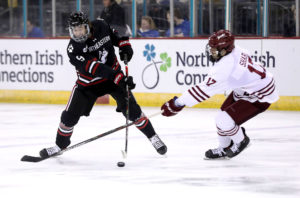
Huskies’ Jayden Struble celebrates scoring against the Colgate Raiders (Photo by William Cherry/Presseye)
Given how strong Colgate had been in their preliminary match against the Princeton University Tigers on Friday, it seemed unlikely at the first puck drop that the Huskies would achieve a blowout such as they had in 2015. After some feeling out by both teams of their opponent, Northeastern notched the first goal of the game at 7:43, when Jayden Struble potted his second goal of the season. Twelve seconds later, before anyone could even announce or report Struble’s goal, Matt DeMelis gave the Huskies their second goal of the period. But the Huskies weren’t slowing down. While Liam Watson-Brawn sat in the box for Colgate, called for a tripping, Tyler Madden put his 12th goal of the season behind Colgate’s goaltender Andrew Farrier, just 43 seconds later. The Huskies scored three goals in 55 seconds on their first three shots of the game—the only three shots they got in the opening period.
Colgate’s head coach, Don Vaughan, used his timeout to refocus his players, which worked. Three minutes later it was Colgate who was celebrating, as John Snodgrass put the Raiders on the board. Northeastern carried their two-goal lead into the first intermission.
Raiders’ Ben Sharf with Huskies’ Riley Hughes (Photo by William Cherry/Presseye)
What still looked like a solid lead for the Huskies turned into anything but when just one minute into the middle frame Ben Sharf—who scored two goals in Colgate’s win over Princeton on Friday—put the Raiders within one.
“Talking about the game, I think it was up and down for sure. I mean, we started off good, and they took it to us, I would say, for close to a whole period. But I mean, we’re going to be in games like that all year when it’s 4-3, 3-2, 2-1, so we kind of just bought into that. And we’re not gonna be beating teams by seven, eight goals. And it was a classic championship game,” said Huskies captain Ryan Shea after the game.
While the animosity and the intensity increased in the second period, Huskies goaltender Craig Pantano continued to keep the Raiders at bay and his team in the lead, albeit just by a goal, into the second intermission.
The third period saw John Picking sent to the box at 2:06 for a tripping penalty, offering Colgate their fourth opportunity on the power play in the game. Certainly not what Northeastern wanted with such a tenuous lead. However, as was seen the night before, Colgate has struggled on the power play so far this season, and once again they could not convert.
Colgate Raiders and Northeastern Huskies playing in Friendship Four Championship (Photo by William Cherry/Presseye)
Then came an onslaught of penalties called on Colgate. The
first, an interference on Josh McKechney was whistled at 6:54. With 20 second
remaining on McKechney’s penalty, the Raiders went down another player, Watson-Brawn
took his second of the game, this time a slashing. Colgate weathered the short
five-on-three situation keeping Northeastern from doing any damage. The Raiders
then had a brief shift, as in 31 seconds, down just Watson-Brawn before they
again found themselves back killing a five-on-three. This time it would be for 61
seconds, if they survived, when Nick Austin went off for a trip.
Colgate managed to kill off everything, which certainly had
the potential to tilt the ice in their favor, but the experience of the upper classmen
and the coaching staff on the Northeastern bench helped keep the relatively
young team on task.
“Well, that was an opportunity for us to put the game away,
and we didn’t. And as a coaching staff you think when you don’t get that goal,
you know, that the penalties are gonna balance themselves out somewhat towards
the end of the night. And you know when you don’t score on a five-on-three, I
think we had a minute nine, the first five-on-three was only 22 seconds, the
last one was a minute nine, you know that’s not usually a good omen in terms of
success. But hats off to our guys. We just talked to them about staying in the
moment, staying present, and just keep grinding away, and that’s what they did,”
said Huskies head coach Jim Madigan.
As Coach Madigan predicted, there was some balancing out of
penalties, when the Huskies were called first at 12:58 for a slashing that sent
Collin Murphy to the box. Once again Colgate couldn’t convert.
The clock continued to count down, but nothing would be easy in this game. Northeastern was back on the penalty kill with just 2:22 remaining in regulation Struble who started the scoring in the first would sit for possibly two minutes of the time remaining, offering the Raiders one more opportunity to tie things up and force the game to overtime. Perhaps one of the things that may have helped Northeastern at this point was Coach Vaughan’s decision not to pull Farrier until his power play unit was set up. As a result, there was only 59 seconds remaining on the clock before Farrier headed to the bench.
Three seconds later Ryan Shea had netted a shorthanded, empty-netter, for the Huskies, putting them up 4-2. That goal would become even more important. Just four seconds after the Huskies returned to full strength, Colgate again got themselves within one. Farrier was again out of his net giving Colgate the extra attacker when Bobby McMann rifled one past Pantano with 12 seconds remaining on the clock.
The clock ran out, the buzzer sounded, and if you were the
director you would cue the cheering crowds, the cheering Northeastern hockey
players, and undoubtedly would have panned over the faces of the crestfallen
players from Colgate.
Six years ago Boston’s mayor, Marty Walsh, announced his support of the Odyssey Trust’s intention to have a college hockey tournament in Belfast, Northern Ireland similar to the annual Beanpot, which originally had many thinking that Mayor Walsh wanted to export the Beanpot tournament. He didn’t. However, it took five years of the tournament for an actual college from Boston to win the Friendship Four, which has been nicknamed the Belpot. And it happened with Marty Walsh watching in Belfast.
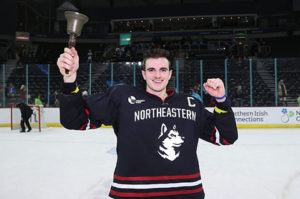
Ryan Shea with the prestigious Belpot trophy (Photo by William Cherry/Presseye)
“I think it was great. I mean, it’s pretty cool. Usually you
lift up a trophy. Over here you’re ringing one. So, I thought it was cool. I
thought Coach was kind of joking when he said, ‘Yeah, they’re gonna give you a
bell, and you ring it at center ice.’ And it honestly gave me chills when I
started ringing it. I saw everyone in the stands, hands up, and then my whole
team going nuts. I like it. I like the idea of the bell,” Ryan Shea said of his
getting to ring the 100-year-old school bell.
The game had everything imaginable. And while Northeastern didn’t come into this tournament with the record of 2015, they are undoubtedly planning to embrace this experience and apply it to the rest of their season. Afterall, the Beanpot is only about two months away.
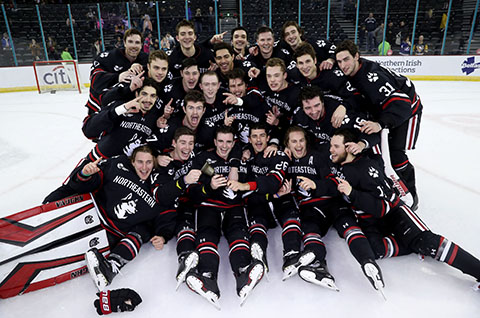
Northeastern Huskies players after defeating Colgate Raiders to lift the prestigious Belpot trophy during Saturday evenings Friendship Four Championship game at the SSE Arena, Belfast. (Photo by William Cherry/Presseye)
Ralph Cox, Ambassador of the Friendship Four Tournament which is now in its fifth season, finally got the opportunity to see his alma mater, the University of New Hampshire Wildcats participate. The former Team USA member has been involved in the tournament since its inception and ranks that involvement as one of his greatest achievements. While he would certainly have preferred to see the Wildcats taking the ice on Saturday night in the championship game, instead he watched them take on the Princeton University Tigers in Saturday afternoon’s consolation game.
The game was a low-key affair for the bulk of the first period before the UNH Wildcats got on the score board when Liam Blackburn notched his first goal of the season at 15:09, assisted by Eric MacAdams and Robby Griffin. It was actually a bit of a surprise that it took that long because they had been outshooting the Tigers six to one halfway through the opening frame. The Princeton Tigers responded on their second shot when Christian O’Neill tied the game at 18:12 and the teams went into the first intermission tied.
The second period saw a bit more physicality though surprisingly fewer penalties. The first period saw Princeton called for a slashing (Mark Paolini) and a tripping (Spencer Kersten) while Charlie Kelleher was whistled for a boarding. During the second period while Kalle Ericksson sat in the box for the Wildcats for an interference call, Princeton put themselves up by one from the stick of Derek Topatigh. Princeton was unable to convert on the second penalty which was called on UNH’s Joseph Cipollone for tripping. However, as the period came to a close, Princeton was up by a goal despite continuing to be outshot.
The third period was the Wildcats period though. They didn’t panic about being down a goal and while Topatigh sat in the box for a slashing call on the Tigers, UNH’s Blackburn got his second of the season and of the game to knot the game up at 8:21. That power play goal definitely gave the Wildcats some added energy because just 1:07 later Filip Engaras put the Wildcats on top, where they held on until the end of the game.
Watching the teams play, for them it was the honor of
getting the win and getting the points by the end and for Ralph Cox it was the
chance to watch his Wildcats come from behind and take the win.
Hopefully in addition to the hockey games, both the University
of New Hampshire Wildcats and the Princeton University Tigers enjoyed their
entire experience while in Belfast and that those experiences remain with the
players well after the win or loss in Saturday’s game.
For the Colgate University Raiders, this was their second time to experience the Friendship Four tournament, at least for their head coach Don Vaughan and his staff. For the players the entire event was a new experience. Princeton University Tigers were experiencing the tournament for the first time.
Like the earlier game between the Northeastern University Huskies and the University of New Hampshire Wildcats, the first period saw a bit of feeling out between the two teams. Unlike the previous game, the Raiders and the Tigers came into their ECAC divisional game with a bit of hockey memory, having just played each other in the U.S. the previous Friday, November 22, 2019, to a tie game, where they split the points. While the Friendship Four game was important to see who would be continuing on to the championship game, it also meant two important points in their divisional standings. And, because the game was part of the tournament, there could be no tie. Someone would be getting the two points.
The Raiders head coach, Don Vaughan, felt that the size of
the sheet of ice—which is international size—may have had something to do with
the teams’ hesitant play at the start of the game.
“You know, we were just trying to figure each other out,
even though we played last week. I think the biggest issue was just the ice
surface. There’s just so much more room than we’re used to, so we’re trying to
figure out, you know, how much risk we could take, you know, guys just kind of
finding their comfort zone. And I think both teams were doing that, so once we
figured that out, I think the game got better and I think there were more
chances. So, it was more just an issue of the ice surface.” Coach Vaughan, who
is in his 27th year as bench boss of the Raiders, said.
Many times, the teams who have come over to play in the
Friendship Four have had to adjust to the larger ice surface and just what they
could get away with.
“The challenge is each guy finding their comfort zone.
Everybody’s got a different skill set. Some guys are gonna be able to recover
from making a risky play, and some guys are not. So, it’s just a matter of them
figuring out, you know, where that extra ice is, when they can take a chance
and when they can’t. And I think that was sort of what the whole first period
was about,” Coach Vaughan elaborated.
Princeton’s Spencer Kersten celebrates scoring against Colgate (Photo by William Cherry/Presseye)
As the clock was clicking down on that opening period, with just 13 seconds remaining, Colgate, while on the power play, got the first goal of the game. While Princeton’s Jordan Fogarty was sitting in the box for boarding, Colgate got their power play going, carrying them into the first intermission with momentum. Scoring any goal in that final minute of a period can be deflating to the team scored on, and perhaps Colgate was hoping to see such a response from the Tigers when the second period got under way.
“Well, it was late in the period so that was a bit of a plus for us. I thought scoring late like that can give you a little bit of a momentum. It was just great to get a power play goal. It’s an area of our game that hasn’t been great this year. So, we’re gaining some confidence there with our group too. So, late in the period and on the power play was a bit of a bonus for us,” said Coach Vaughan.
Princeton came out hard and less than 90 seconds into the middle frame they had tied things up. Freshman Spencer Kersten notched his second goal of the season, with assists from his linemates Liam Gorman and Liam Grande. Tied up it looked like it could prove to be a much tighter game than the earlier Hockey East game had become.
Colgate’s Ben Sharf celebrates (Photo by William Cherry/Presseye)
Exactly three minutes later the Raiders regained the lead, when senior Ben Sharf started an impressive play with a solid hit which then found him on a breakaway and a chance to score.
“Well, after the hit I was like, ‘Whoa, I didn’t expect
that.’ And then it was like I look back and I’m on a breakaway. Also, I was
just like all this happened so fast. And after I missed, I was furious cause I
actually missed two last game as well. So, it was nice to just stick around the
net and get a rebound and put it in,” Sharf described.
It was certainly a catalyst for the game for the Raiders. It
was clear that they were now focused and intent on taking the game to a win. Coming
into Friday night’s game, Sharf had played in all prior 14 games, notching two
goals, and four assists for six points.
But Sharf wasn’t done yet. During the third period, with 7:33 remaining in regulation, and Princeton hoping to get the game tied up, Sharf gave Colgate some breathing room, scoring his second of the game. And with that Princeton elected to replace Aiden Porter, who was really the only reason that the Tigers were still in the game, with Jeremie Forget.
Colgate’s Ben Sharf scoring against Princeton during (Photo by William Cherry/Presseye)
“As a senior, too, and someone that his first year didn’t
play a whole lot for us, [Sharf] has worked his way right into a lineup and playing
a very important role with our team right now. So, I couldn’t be happier for
Ben. As a senior, the way he’s playing, he’s taken a leadership role on our
team even though he’s not wearing a letter. Yeah, just so happy for him, and
that’s what you saw tonight was a player that’s worked himself into that
position,” said Coach Vaughan.
Despite the goaltending change and Princeton’s pulling their
goalie with a minute remaining in the game, they were unable to do anything, falling
to Colgate 3-1. Princeton will take on the UNH Wildcats Saturday afternoon in the
consolation game.
For Colgate it is their second time facing the Northeastern Huskies
in the Friendship Four. Last time though, in 2015 at the inaugural tournament, the
two teams were themselves playing in the consolation game. This time they are
playing for the championship. Saturday night should be an opportunity to see some
great hockey.
Though the game was being played close to 3,000 miles away from Boston, home to the Huskies who were the home team in the tilt, there were two very important Hockey East divisional points on the line in addition to the winner going to the Championship game to be played Saturday night.
The first period showed that both teams were perhaps adjusting to the travel, despite having been in Northern Ireland since the beginning of the week. Although for some of the players it could also have been the raucous cheering from the many school children in attendance from some of the schools that they visited, which was a new experience.
It wasn’t until the second period that there was any scoring and it came off the stick of the Huskies’ captain, Ryan Shea, who came into the tournament with ten points from ten assists, seven of which he notched in November. He was still looking for his first goal on the season, so he was happy to garner that one. His shot from the slot opened up the scoring, with an assist from Matt Filipe.
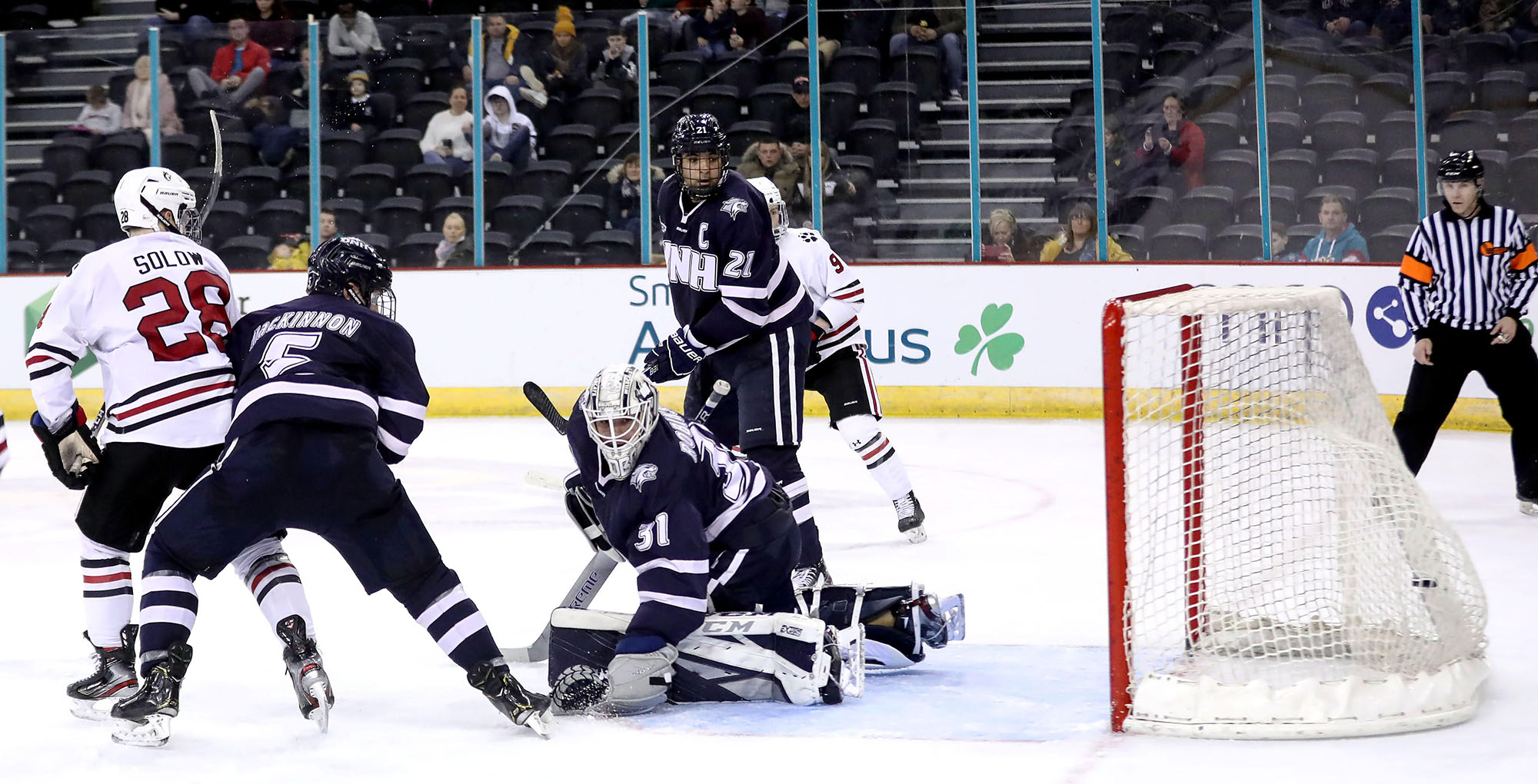
Twelve minutes later the Huskies were up by two goals. Once again Ryan Shea was involved from the high slot. He was originally credited with the goal, and then it was discovered that it was deflected by Zach Solow, though that wasn’t updated on the reports at press time. However, for the Huskies it meant a little breathing room as they went into the second intermission up by two goals.
“I think I played, that was probably one of my better games
this year. I got the first goal out of the way. It was kinda hanging over my
head for a little bit. So, thank god that happened. But I think I came to play
tomorrow, I mean today. I just got to bring the same [ethic] tomorrow,” Shea
said after the game.
Northeastern’s Ryan Shea celebrates scoring against UNH Wildcats (Photo by William Cherry/Presseye)
“Ryan’s been good all year long, and he’s had more
opportunities this year to get into offensive situations. And you know, he had
a goal and two assists there. Initially we thought he had the two, but Zach
Solow had deflected one. But he‘s been a stalwart first defensively for three
years. You know, getting the opportunity this year to contribute offensively.
And he’s doing a good job for us, five-on-five and power play,’ said Huskie’s
head coach Jim Madigan.
Despite having been outshot by the Wildcats in the first two
periods and expecting a major push from UNH going into the third, it was
actually the Huskies who outshot the Wildcats in the third 10-6. UNH did
struggle in the third staying out of the penalty box, garnering eight penalties
throughout the box, with five of those coming in the second and third periods.
And it’s hard to get much traction to try and change the game when always
having to play down a man.
In the third period, at almost exactly the same time as in the second, Northeastern notched their third goal at 6:46 of the final frame putting them up 3-0. This time the goal came from TJ Walsh with assists from John Picking and Ryan Shea, who had his second three-point game in the month.
The Huskies weren’t done though. Picking potted his own goal of the game at 10:07 giving Northeastern an impressive lead. And goaltender Craig Pantano continued to play impressively between the pipes to deny the Wildcats any chance of getting on the score board through the final minutes.
“I think we played the right way. You know, we were managing
pucks well. We were protecting pucks. You know, the guys really bought into
what we wanted to do. Blocked shots and just played the right way,” said
Picking. “[UNH] came out pretty hard, but we knew that was gonna happen. You
know, there’s a lot at stake with the tournament. So, we weathered the storm
and then got back to work.”
Huskies head coach commented on the start of the game and
how his players were able to buckle down and get at what was important.
“I thought first period we did a few good things and we were
a little inconsistent in the first. And you know, guys just trying to get their
legs and whatnot. And then you know, in the second and third period, I thought
we were really good. You know, in terms of anything being said in between first
intermission, was just like, ‘We got our legs now guys, you know, let’s continue
to pressure the puck.’ I didn’t think we were consistent in pressuring the puck
in the first period, and then in the second and third period, we did a real
good job doing that,” Coach Madigan said.
For the Wildcats, despite having outshot the Huskies in the
first two periods, it was anything but a good game for them.
“Our participation, I’m not sure it was there. Now credit to
Northeastern. They outplayed us. We were disappointed. I don’t know what else
to say other than that. Not happy with any part of our game today,” said
Wildcats head coach Mike Souza about his team. “I just thought we had an
unwillingness to hold onto the puck, to make plays. I mean we’ve been up and
down at that. Last week we were good with it, managed the puck. And you know,
they’re opportunistic. They’ve got skilled players, and if you let Madden and
Shea and some of these guys handle the puck, they’re gonna make plays and they
did.”
Of course, both teams must reset for tomorrow’s matchups
which were determined in the second game, when the Colgate Raiders beat the
Princeton Tigers 3-1. The UNH Wildcats will take on Princeton in the
consolation game in the afternoon and then Northeastern will face Colgate for
the championship game.
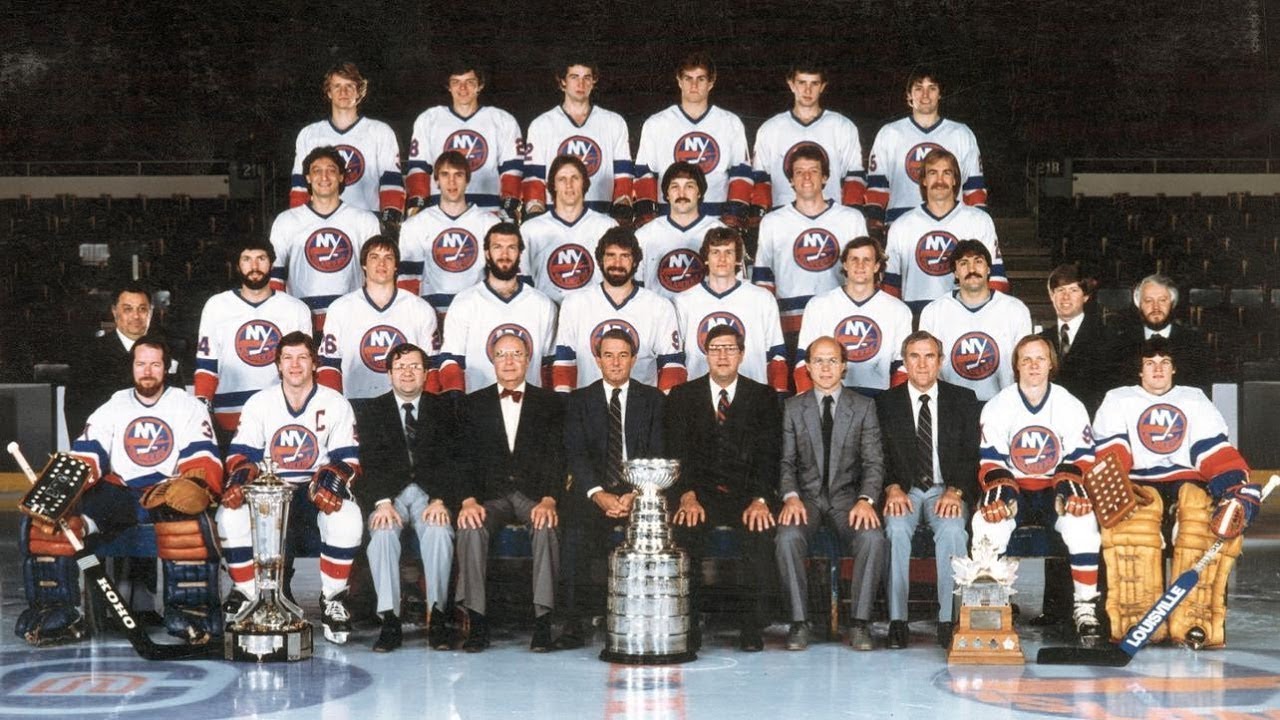
November 23, 1982 was a night for the goal-scorers, not the goaltenders. The Minnesota North Stars had two hat tricks, scored by Steve Payne and Neal Broten. Their hosts, the New York Islanders, had superstars Mike Bossy and Bryan Trottier leading the pack with four points apiece. Islanders goalie Billy Smith was pulled in favor of Rollie Melanson while Stars goalie Gilles Meloche stuck it out as the teams tied 8-8. This matched the Islanders’ record for highest-scoring tie, 8-8, from when they hosted the Edmonton Oilers on March 3, 1981.
This game of crazy eights was played at Nassau Coliseum before 15,105 spectators. Going into the game, the North Stars felt a bit more confident considering their Meloche shutout the Islanders 2-0 just 12 days beforehand. Whereas, the Islanders had just lost 7-3, having to switch out goalies. Minnesota Coach Glen Sonmor naturally kept Meloche in net, but New York Coach Al Arbour surprisingly also kept Smith as the starter. When the game ended, Meloche grumbled, “After the last time we played them, who would have expected something like this?”
In the first period, each team scored three goals. Bossy and Trottier led off, assisting each other. At 4:29, “Bryan Trottier picked it up in the right circle and hit Mike Bossy with a pass in the slot. Bossy backhanded a shot past Meloche from about 20 feet as he skated from right to left.” Little over half a minute later, at 5:03, “Bossy took one stride and then found Trottier approaching the blue line. He made a quick pass, and Trottier skated in to fire a shot past Meloche from the edge of the left circle.”
Then it was time for Payne and Broten to begin their tricks, alternating their scoring. At 7:47, “Payne’s goal came on a deflection of Dan Mandich’s shot from just inside the blue line. Mandich flipped a backhander toward the net, and Payne, standing about 15 feet out in the slot to Smith’s right, tapped the puck in midair and it floated into the net.” Later, “Broten went around Gordie Lane on the right side to beat Smith with a 10-footer at 15:11, and then Payne connected again [with 23 seconds left], this a rebound of Bobby Smith’s wrap-around attempt, to tie it at 3-3.”
Broten began the second period by breaking the tie. According to the recap, at 1:51, “He went around Nystrom as he crossed the blue line and then beat Smith with a 25-footer just inside the left circle.” After his teammate widened the lead, Bossy helped John Tonelli score at 10:06. The Islanders tied up after another two and a half minutes.
At the start of the final period (at :42 and 3:43, respectively), Payne and Broten finished their tricks. In the North Stars’ 16-year history, they had only once before had two hat tricks in one game. On March 21, 1979, Payne and Mike Fidler scored thrice each in a 7-3 victory over Philadelphia. As Broten saw it, “First it looked like they were going to blow us away. And then it looked like we were going to blow them away. I guess the game couldn’t have ended any other way, unless it might have been 10-10 or 12-12.” For Payne, “The less said about a game like this, the better. Eight goals ought to be enough to win and tonight it was barely enough to tie. After we got out of the first period 3-3, I thought it would tighten up. … I just couldn’t believe it. It got crazier and crazier.”
Indeed, at 9:36, Bossy and Trottier assisted Denis Potvin. Nearly a minute and a half later, Trottier scored his own goal. Finally, at 14:32, Minnesota’s Tim Young netted the final goal.
The goalies were relieved when the scoring spree ended. Having let in 5 goals on 21 shots in 25:33 (a .762 save percentage), Smith was yanked from the net. Melanson let in 3 goals but made 18 saves (for a .857 save percentage).
Meloche played the entire game without any backup, letting in 8 goals in just 27 shots (for a .724 save percentage). This was the same goalie who gave up 12 goals in the Rangers-Golden Seals game back in 1971. “Did you guys come in to ask me real questions or just to laugh at me,” Meloche asked the press. “I guess I should feel fortunate to give up eight goals and we still got out of here with a point.” Coach Sonmor remarked, “Gilles is the guy I feel sorriest for. He’s worked so hard to get his average under 3 and then we get involved in a game like this. We just didn’t give him much support.” Meloche explained, “It was one of those nights in which the puck just kept hitting sticks, skates, posts and just kept going in the net. And it wasn’t just at our end.”
The North Stars and the Islanders kept things pretty even all season. After the game, they were leading the standings with 30 points for the former and 31 points for the latter. At the end of the 1982-83 season, both ranked second in their respective divisions. They both had 96 points, making them tied for sixth and seventh in the NHL standings. While Minnesota lost their division finals, the Islanders went on to win their fourth consecutive Stanley Cup championship.
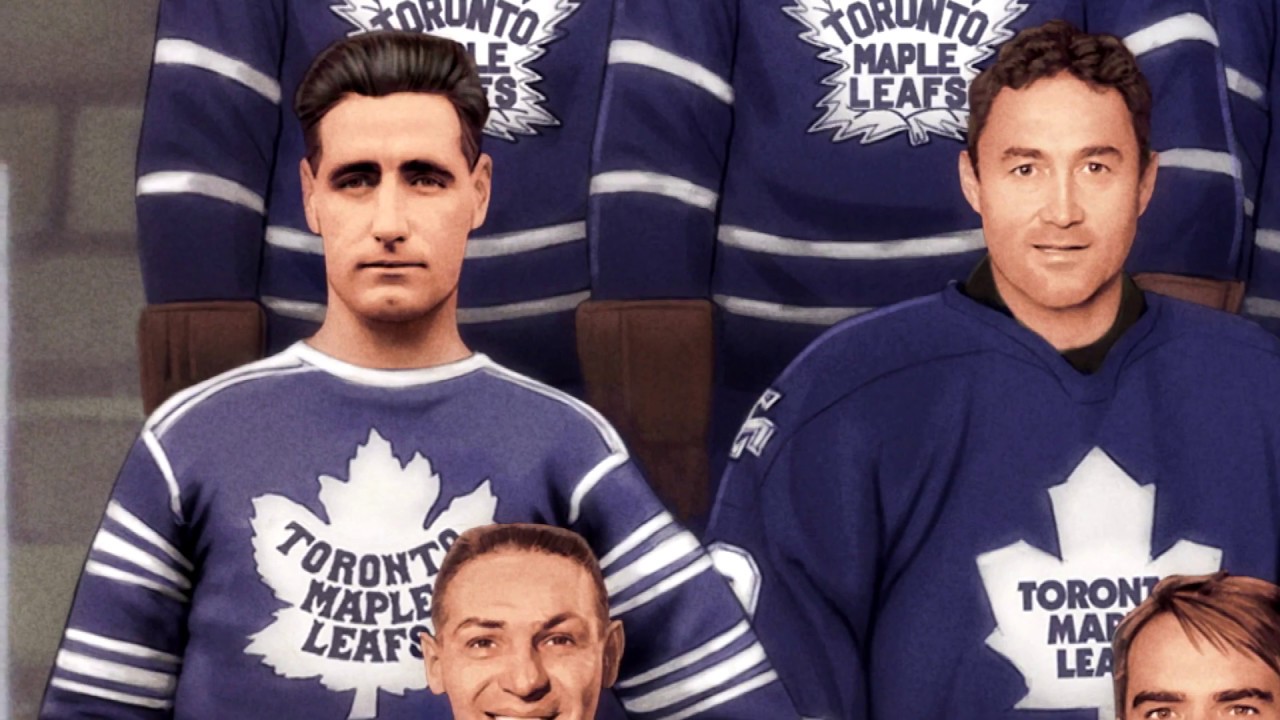
Every goalie wishes to start the season like Lorne Chabot and Benny Grant did in 1930-31. They led the Toronto Maple Leafs through five consecutive shutouts. Chabot’s three straight shutouts made him the first NHL goalie to accomplish such a feat. It was not until November 25 that anyone scored against Toronto.
The Maple Leafs were already predicted to perform well during the 1930-31 season. In an exhibition game held at Windsor on November 7, they blanked the International League’s Bulldogs 5-0. The Windsor Star complimented, “Sensational goal-tending by Lorne Chabot, fighting to keep his regular job in the Toronto cage, turned back the very best plays that the Windsorites could engineer.”
To start the NHL regular season, on November 13, Toronto’s Arena Gardens hosted a crowd of 8,000. After 70 minutes of hockey, the Maple Leafs (led by Chabot) maintained a scoreless deadlock with the New York Americans.
Two days later, Toronto hosted the Philadelphia Quakers. “The opposing goalies both saved brilliantly in the early test,” noted the Philadelphia Inquirer. “The Quakers began to drift through the Leaf defense as the second period got under way, but Grant was too good.” Amidst the fist-fighting and paper throwing by the spectators, the Leafs won 4-0.
The Leafs played their first road game on November 18 at the Montreal Maroons’ home opener. The 9,500 in attendance mostly were not happy with Toronto’s 3-0 victory and were really unhappy that this was the Maroons’ third-straight shutout loss. The Montreal Gazette commented that “there was always the long, lanky figure of Chabot in the way. Sometimes Chabot was saved by miracles as desperate Maroons swarmed about him in teeming numbers, and sometimes the miracles he himself performed saved the day – but in one way or another he was always just a jump ahead of Maroons’ best efforts.”
In the rematch with the Americans in New York on November 20, 6,000 booed as the score refused to change. After another 70 minutes, the teams again ended 0-0. The only difference was that Grant was in the net instead of Chabot. The New York Daily News disliked the outcome. “Either the goalies are becoming too expert, the defenses too tight or the rules of the game need a little more revision.”
Returning home, on November 22, Toronto beat the Ottawa Senators 2-0. According to the recap, “Finally, just as the timekeepers were reaching for the bell, Ottawa sent five men up around the Toronto goal. Chabot saved brilliantly time after time.” Instead of letting in a goal, his teammate Charlie Conacher scored with just three seconds remaining. With that, the Leafs had started the season with five shutouts and had an unbeaten streak that included two exhibition games.
At the end of the 1930-31 season, Chabot had a record of 21-8-8 and Grant had just 1-5-1. Chabot added three more shutouts. Toronto (with 53 points) finished second in the Canadian Division and third in the NHL but lost in the quarter-finals. However, they went on to win their first Stanley Cup (as the Maple Leafs) the following season, when Chabot had a record of 21-16-6, and Grant improved to 2-2-1.
Dick Gibson, “Leafs Flash Best Form in Drubbing Bulldogs, 5-0,” Windsor Star, 8 Nov. 1930, p. 19.
“Toronto Leafs and Americans Battle to Scoreless Tie,” Montreal Gazette, 14 Nov. 1930, p. 18.
“Americans Hold Leafs to Goalless Tie,” Ottawa Citizen, 14 Nov. 1930, p. 11. “Quakers Lose, 4-0, in Battle of Fists,” Philadelphia Inquirer, 16 Nov. 1930, p. 5.
Marc T. McNeil, “Maroons Blanked in Local Opener by Toronto, 3-0,” Montreal Gazette, 19 Nov. 1930, p. 18.
“Leafs Still on Winning Streak Blank Maroons at Montreal,” Ottawa Journal, 19 Nov. 1930, p. 18.
Pat Robinson, “What! No Scoring Again!” New York Daily News, 21 Nov. 1930, pp. 72 and 79.
“Ottawa Senators Lose in Toronto 2 to 0,” Ottawa Citizen, 24 Nov. 1930, p. 11.
“Leafs Blank Ottawas 2 to 0 and Continue Winning Streak,” Ottawa Journal, 24 Nov. 1930, p. 16.
“Leafs Maintain Shutout Record,” Montreal Gazette, 24 Nov. 1930, p. 20.
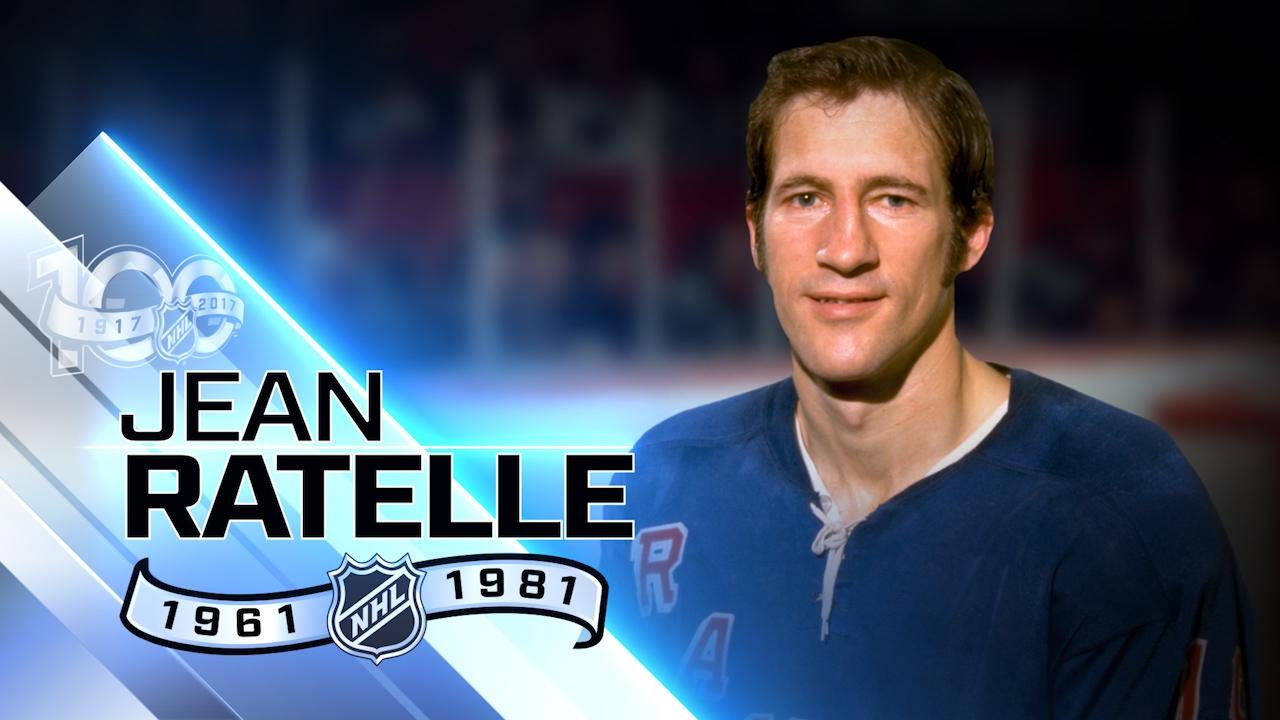
The NHL “is going to have to start billing games involving an expansion club as exhibitions,” crowed the New York Daily News after the New York Rangers trounced the California Golden Seals 12-1 on November 21, 1971. Part of that blow-out included record-breaking scoring in one period. The biggest individual scorer of the night was center Jean Ratelle with four goals and an assist.
Madison Square Garden hosted the game, so 17,250 local fans had the treat of watching the Rangers score and continue scoring. Ratelle started the night off right with the opening goal at 4:11. Almost 11 minutes later, he assisted linemate Vic Hadfield with the next. In the middle period, Ratelle followed Ted Irvine with another goal.
The Rangers led 4-0 when the Golden Seals finally had a shot. At 17:52, Norm Ferguson “hit something in the net and ricocheted out. Goal judge Lee Stark, because he wasn’t sure the puck had gone in, rightfully refrained from lighting his lamp.” The Daily News continued, “The Seals beefed to Skov and, after consulting linesmen John D’Amico and Ray Scapanello, he sustained the visitors’ plea. The Rangers then launched an appeal, but Skov wouldn’t buy it. The close-circuit TV re-run showed the puck did go in, a happening that cost Ranger goalie Gilles Villemure a shutout.”
After the intermission, New York made that goal nothing but a distant memory. Again, Ratelle took control. He scored just 41 seconds into the third period and again at 3:40, after Irvine’s second. In less than four minutes, the Rangers had tallied another three goals. With that, Ratelle had the “most productive game of his career.” Hadfield had assisted on two of his goals, and linemate Rod Gilbert had assisted on three. Combined, the GAG Line had 11 points, the most in one game by any Rangers line. With 94 points in 19 games, they were outpacing the record-breaking scoring Phil Esposito’s line set for the Boston Bruins the previous season.
While that was the end of Ratelle’s five points in five shots on net, his team was far from finished. Gene Carr found the back of the net at 6:44 and 12:37. Between them, at 11:03, rookie Pierre Jarry tallied his first NHL goal. At the point of tears, California’s 20-year-old rookie goalie, Gilles Meloche, was finally pulled. His replacement, 26-year-old Lyle Carter, had only eight seconds before Jarry scored his second NHL goal. Jarry’s back-to-back goals set a new speed record for the Rangers, beating the one Phil Goyette had set in 1967. Bill Fairbairn capped off the game with just over half a minute remaining.
The eight goals scored in the third period made for a total of 23 points, a new NHL record for most points in one period. Previously, the Detroit Red Wings had set the record at 22 points back on January 23, 1944, and the Boston Bruins had matched that on March 16, 1969. The record still stands but has been matched by the Buffalo Sabres on two occasions, December 21, 1975 and March 19, 1981.
The remainder of the 1971-72 season mostly went well for Ratelle and the GAG Line. Not for nothing were they called the Goal-A-Game Line. As Ratelle said at the time, “We’re like perfectly meshed gears. We have a pretty good idea of where each guy is going to be on any given play.”
Ratelle led the scoring through February 20, 1972, when he became the first Ranger to score 100 points in a season. On March 1, when playing the Golden Seals again, Ratelle broke his ankle and was not able to rejoin the team until the Stanley Cup Final. Fortunately, Hadfield kept the Rangers going by becoming their first player to have 50 goals in a season. In the NHL scoring rankings that season, Ratelle finished third, Hadfield fourth, and Gilbert fifth as the GAG Line became the best in the league with 312 points total. Even though his injury prevented Ratelle from winning the Art Ross Trophy or the Hart Memorial Trophy, he did receive the Lester B. Pearson Award (now the Ted Lindsay Award).




 Prev
Prev