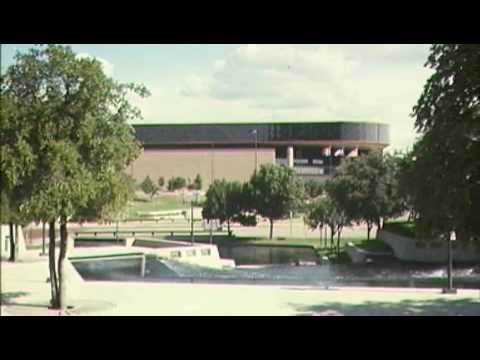
Deep in the heart of Texas, Dallas has had a community of hockey fans since 1941. In 1992, the NHL began a series of neutral-site, regular-season games as part of a strike settlement. Dallas was chosen to host the tenth such game, on December 15, 1992. As it happened, a few days earlier, the NHL had given a franchise to Anaheim, paving the way for the Minnesota North Stars to look elsewhere to relocate. They ultimately chose Dallas as the best location and moved the Stars there in 1993.
Dallas hosted minor league hockey teams during much of the 1940s to the early 1990s. The Dallas Texans played for the American Hockey Association from 1941 to 1949 (but for a cancelled season due to World War II). Travel costs proved too much to keep the franchise going. The Dallas Blackhawks, affiliated with the Chicago Blackhawks, played for the Central Hockey League (CHL) from 1967 to 1982. Finally, beginning in 1992, the Dallas Freeze played just two seasons as part of the CHL. That same year, the city was chosen to host a regular-season NHL game.
As part of the 1992 collective bargaining agreement, the NHL set up a series of 24 regular-season games to be played in 16 cities that did not have their own NHL franchise. They would continue the neutral-site series into the 1993-94 season for a total of 50 games. Each NHL team would play two games per season at a neutral location. Therefore, the season was upped to 84 games.
The purpose of these games was to raise interest in hockey in new areas. It gave the NHL the chance to see how each city might fare with an NHL franchise of their own. Four of the neutral-site cities received teams – Dallas and Phoenix obtained relocated franchises while Atlanta and Miami received expansion teams. Columbus, Ohio earned itself a franchise being located halfway between Cleveland and Cincinnati, which had both hosted neutral-site games.
When Dallas first hosted the NHL, 11,251 hockey fans turned out at Reunion Arena to watch the St. Louis Blues and New York Islanders. The arena needed more than 5,000 more to reach capacity, so the amount of tickets sold was lower than hoped. However, promotor Brad Thomas explained, “Considering that it’s 10 days before Christmas, we had to charge regular NHL prices and we have two teams who aren’t big contenders, I’m happy with the crowd.” Looking back at the neutral-site games, the average attendance was 11,196, so Dallas was above average.
Although Dallas had its own CHL team at the time, there were still two minor issues before the NHL game. First, they did not have any air-conditioning in the arena. Second, Islanders goalie Glenn Healy was expected to practice without a net. In thinking back, he said, “I can recall going out for warmup and sticking my head between the panes of glass at the back of the rink and saying, ‘We need the nets out for warmup!’ … [A local asked,] ‘You need the nets for warmup?! Not just the game?’ ‘Yeah, they’re going to warm up and shoot on me. It would be nice to have a net.’”
Still, the Blues and Islanders gave Dallas an exciting game. Every time the Islanders took the lead, the Blues answered so that they each scored once per period.
Brett Hull had scored for the Blues in the second period, but as the third period wound down, he missed over six minutes of the game after he was “blasted into the boards by Islander defenseman Darius Kasparaitis.” He went down with an injured back, but referee Paul Stewart didn’t call a penalty. Hull commented, “All of a sudden I’m going face first into the boards. Its’ an absolute joke. We haven’t had a well officiated game in a month. One of these days somebody’s going to get hurt badly. They (the officials) are deciding the hockey game, not the players.” The crowd was not happy either since they leaned for the Blues thanks to picking up their radio broadcasts. When Brendan Shanahan tried to retaliate, he hit the glass hard enough to stop the game for them to repair it. Then Kevin Miller retaliated against Kasparaitis and got a penalty. While the Blues were shorthanded, their Nelson Emerson tied the score to send the game into overtime.
In overtime, Healy held off the Blues long enough for his teammate Pierre Turgeon to slide a pass to Derek King. At 2:33, King got the puck past Curtis Joseph to win the game for the Islanders. According to King, “I thought the fans were enthusiastic, even though they weren’t cheering for us. Dallas seems like a nice city. I thought the people did a pretty good job supporting the game.” He was not alone in thinking that. His coach, Al Arbour, told the press, “I think that Dallas would be a good future market. I’m somewhat disappointed the crowd wasn’t any bigger but they cheered and seemed to enjoy the game.”
The owner of the Minnesota North Stars, Norm Green, came to the same conclusion. The NHL had held its winter meeting at the Breakers Hotel & Resort in Palm Beach on December 10. They decided to award expansion franchises to Anaheim (to bring in Disney money and marketing) and South Florida. Green had just about finalized a lease agreement with Arrowhead Pond in Anaheim to move the Stars. Instead, and confirming an agreement dating back to 1990, the NHL told Green he could move anywhere else without paying any transfer fees. They sent Jim Lites of the expansion committee to relay the news. Green responded that he would wait until January 15 to see if any proposals from Twin Cities arenas would keep the Stars in Minnesota. According to Lites, “We went on a road show together, and Dallas was the best option out there. He essentially went back to Minnesota, packed his bags, and began making plans to go to Texas.” The decision to relocate the Stars to Dallas was announced on March 10, 1993.
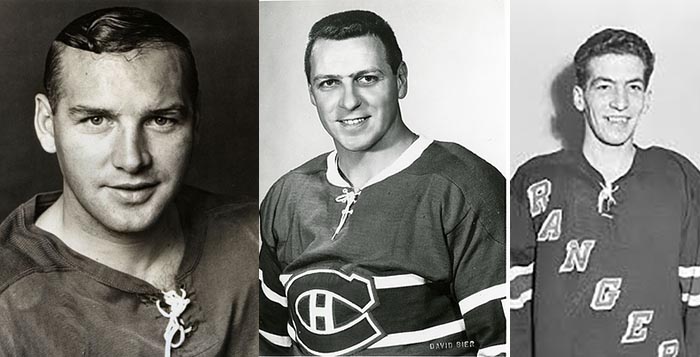
There are some games that if you happen to miss the first couple of minutes it’s no big deal. When the New York Rangers visited the Montreal Canadiens playing before 12,818 at the Montreal Forum on December 12, 1963, if you missed the first 90 seconds you missed a lot.
Going into the game, the Canadiens were missing three of
their regulars: Bill Hicke and John Ferguson, along with rookie defenseman
Jacques Laperriere—who had suffered a broken bone in his left foot when the
Canadiens took on the Chicago Blackhawks at Chicago Arena on Sunday, December
8, 1963. In place of Laperriere, the Canadiens slotted in rookie Bryan Watson
who was making his first NHL appearance.
“The first three goals, two by Canadiens six seconds apart
and one by the Blues 12 seconds later, may have set some kind of record. They
came in the space of a minute and 16 seconds after the opening whistle and 18
seconds apart,” said Pat Curran of The
Gazette.
Indeed, it was a
record—the fastest two goals scored by two teams.
Within 58 seconds of the initial puck drop Montreal found themselves up 1-0 when Dave Balon was able to put in a rebound from Ralph Backstrom’s shot, scoring on his former team. Six seconds later Gilles Tremblay “drilled a 25-footer through Villemure,” to give the Canadiens a two-goal lead at 1:04 of the first. The Rangers responded 12 seconds later, when Camille Henry got his tenth of the season, assisted by Rod Gilbert and Phil Goyette.
The fans in attendance would have to be patient after that flurry of goals, though the Habs would be up 5-1 by the end of the opening period. At 8:15, while Rangers’ Jim Neilson was off in the sin bin for high sticking, Jean Beliveau gave Montreal a 3-1 lead with a power play goal. Just a little more than six minutes later at 14:33, Tremblay notched his second of the game and the period, this time a power play goal, assisted by Beliveau and Bernie Geoffrion. Geoffrion would add another marker for the Bleu, blanc et rouge at 19:09 with assists from Jean-Guy Talbot and Bobby Rousseau.
It seemed like the
game was a given for the home team going into the first intermission, as they led
5-1 at that point.
During the second, there
was but a single goal scored, and this one was for the “blueshirts,” when Vic
Hadfield gave the Rangers their second of the game. “Hadfield deflected
McKenney’s shot from the side [past] Hodge at 15:58,” reported the Daily News.
Things still looked
good for the Canadiens who had a three-goal lead going into the third frame and
added another off forward Red Berenson, with assists from Henri Richard and
Rousseau at 3:38. However, the Rangers weren’t done, refusing to roll over and
quit. Rod Gilbert notched two for New York in the third. His first came at 7:52,
assisted by Goyette, and he followed that up at 11:27 with another, this time
the helpers went to Don McKenney and Jim Neilson. With 8:33 remaining in
regulation the Rangers were within two goals of a tie.
The Canadiens’
bench boss, Toe Blake, wasn’t too pleased with his team, despite their pulling
out the 6-4 win at the final horn.
“They thought they
were going to fill the net with goals behind that young netminder and got point
hungry,” said Blake.
His reference was
to rookie goaltender Gilles Villemure, who was playing in just his fifth NHL
game. He’d been brought up from the Baltimore Clippers while the Rangers
regular goalie, Jacques Plante, was recovering after having injured his
shoulder. Villemure made his debut against the Boston Bruins on November 20,
1963. His first three starts he had managed to help his team to three ties,
however, a lack of support by New York’s defensemen when the Rangers lost to
the Chicago Blackhawks at Madison Square Garden the night before the Rangers
were to play in Montreal had resulted in his first loss. He’d let in six goals
that night too.
“The Blueshirts defense was at its worst, which is pretty awful. The result was the most one-sided beating the Blues have taken at home this year and the first loss for Gilles Villemure, the rookie goalie who is serving as stand-in for injured Jacques Plante. Until last night, Villemure had tended well enough to get three ties,” reported Joe Trimble in the Daily News.
It was perhaps this
performance that had Blake’s Montreal players seeing goals a plenty as a likelihood,
especially after they went up 5-1 in the first. The Canadiens’ vice president,
Ken Reardon, gave the credit for the win to their goaltender, Charlie Hodge. “If
it hadn’t been for Goalie Charlie Hodge, the score might have been 6-5 New York
in the second period.”
Reardon’s comments
made it sound like the Rangers had vastly outshot the Canadiens, but the shots
were relatively close, with the Rangers edging Montreal 40-39.
Additional Sources:
Pat Curran, “Habs Outlast Rangers 6-4, Almost Collapse After 5-1 Lead,” The Gazette (Montreal, Quebec), Friday, December 13, 1963, p. 22.
“Canadiens Clobber Rangers, 6-4,” Daily News (New York, New York), Friday, December 13, 1963, p. 23C.
Joe Trimble, “Hawks 6-2 Blues; Stan: 3,” Daily News (New York, New York), Thursday, December 12, 1963, p. 107.
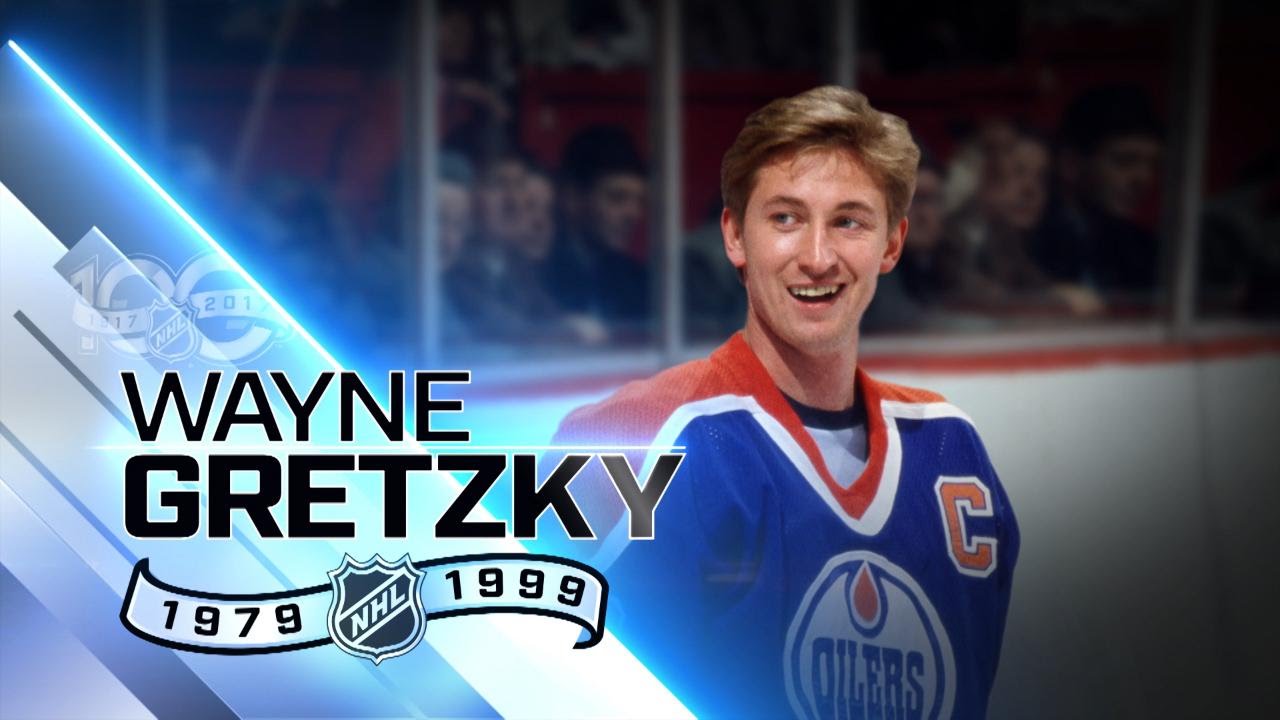
When it comes to hockey, there isn’t much that Wayne Gretzky didn’t accomplish in his career. There is a reason that all the NHL teams retired his no. 99 in 2000. He holds or shares 61 records.
“The Great One” was born January 26, 1961 in Brantford, Ontario. He began his career with the Indianapolis Racers of the World Hockey Association before being traded to the Edmonton Oilers. The Oilers were one of the teams from the WHA that entered the NHL after the WHA folded.
At the age of 25, during a game between the Oilers and the Winnipeg Jets that took place at Winnipeg Arena, December 10, 1986, Gretzky became the first NHL player to notch his 40th career hat trick. Gretzky began the scoring for his Oilers just 30 seconds into the first period—a shorthanded goal. That was his third shorthanded goal of the season. He got his second goal of the game, to put the Oilers up 2-0 at 7:56 of the same period. His second goal was a 30-foot screen shot.
“Rookie goalie Daniel Berthiaume, who’s tag-teamed with Pokey
Reddick this National Hockey League season, needed an elephant gun not a glove
to stop Gretzky’s boogie-woogie,” described Jim Matheson of the Edmonton
Journal.
By the end of the opening twenty, the Oilers were leading
3-0, though Gretzky had nothing to do with that third goal of the opening frame.
Glenn Anderson notched his 17th goal of the season, unassisted at 8:21, on the
Oilers sixth shot of the game.
Gretzky potted his third goal of the game 1:47 into the
second period, garnering his 27th goal of the season along with becoming the
first player to achieve 40 hat tricks.
“Wayne Gretzky let the Winnipeg Jets know he is still boss
of the Smythe Division. In an early showdown for division honors, the
smooth-skating star of the Edmonton Oilers had a hat trick in less than 22
minutes Wednesday night at Winnipeg and led the Oilers to a 7-4 victory,”
reported The Los Angeles Times.
“I’ve hit 50 in 50 games twice. I’d like to get it a third
time. I might not have another chance,” said Gretzky after the game.
Going into the game against Winnipeg, Gretzky was on a bit
of a goal scoring tear having 10 goals in his previous 12 games. He wasn’t
attributing it to his skill either, instead he said that it was due to a recent
set of sticks.
“There’s a little bit bigger curve. I’ve been firing the
puck harder. The puck just seems to be jumping off the stick more,” he said.
In addition to reaching the impressive 40th hat trick, with that third goal in the game, Gretzky also earned his 508th career NHL goal putting him in 12th place in the all-time list putting him ahead of Jean Beliveau who had reached 507 goals in his career 1,125 NHL games.
Gretzky would finish his NHL career with having achieved 50 hat tricks, which still stands as the NHL record.
Additional Sources:
Jim Matheson, “Gretzky show in high gear,” Edmonton Journal (Edmonton, Alberta), Thursday, December 11, 1986, p. E-1.
“Gretzky Hat Trick Lets Jets Know He Is Still the Boss,” The Los Angeles Times (Los Angeles, California), Thursday, December 11, 1986, Part III, p. 19 .
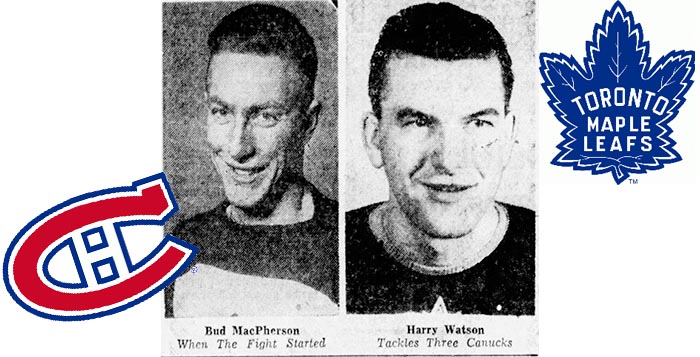
It is no secret that hockey is a physical sport. And there have been plenty of situations in which tempers flare, mitts are dropped, and a couple of players square off. While not seen as often in the current generation of hockey, which tries to stop the fisticuffs before they start, there have been some brawls in the past. Such was the case between the Montreal Canadiens and the Toronto Maple Leafs in a good old-fashioned rivalry that saw the simmer go to a full boil on December 9, 1953 at the Maple Leaf Gardens.
The first two periods saw the traditional calls of any
hockey game: holding, interference, a few hookings and trippings. Both teams
were assessed five penalties each in the opening 40 minutes of the game.
Through it all, the Toronto Maple Leafs were able to
capitalize twice on the man advantage, the first gave George Armstrong his
eighth goal of the season, unassisted, at 4:56 of the first, while Montreal’s
Bud MacPherson cooled his blades in the bin for holding. The Leafs notched
their second goal, this time credited to Ted Kennedy, with an assist from Sid
Smith, just 45 seconds into the second period. Smith would go on to give the
Leafs a three-goal lead on the power play at 16:36 of the second assisted by
Jim Morrison and Kennedy.
Despite having equal opportunities on the man advantage, the
Canadiens simply could not solve Harry Lumley, though both Maurice Richard and
Bernie Geoffrion did their best, having several opportunities each.
The third period looked like it would be much of the same. Leafs’ Armstrong was whistled for a slashing 37 seconds into the final period. Nine minutes later his teammate Danny Lewicki got called for a holding. At 11:05 fellow Leaf Ron Stewart was sent off for charging and then Montreal took their first penalty of the third when Richard was dinged for tripping at 12:14.
That’s pretty much where the actual playing of hockey became
a secondary point to the remainder of the game. It began when Canadiens Eddie
Mazur and Toronto’s Armstrong got into a fight at 14:45. They were each given roughings
and misconducts and it looked like perhaps referee Frank Udvari thought things
would settle back down.
Apparently during the second period Toronto’s Ron Stewart
and Canadien’s MacPherson had been involved in a little interaction. One report
states that MacPherson broke his stick on the ribs of Stewart—though MacPherson
was not sent to the box for this per the official record. However, the two came
together in a collision at 18:12 of the third and that was all it took.
“The Toronto game, fairly quiet for the first two periods,
broke wide open in the third when the Leaf’s Ron Stewart and Montreal’s Bud
MacPherson started trading blows. It was mayhem after that. Tom Johnson of
Montreal moved in to separate them and Stewart slugged Johnson on the chin.
Players rushed from the benches and sticks and gloves went flying,” reported The
Ottawa Citizen.
“At one time, Harry Watson tackled three Montreal players. Bob Solinger and Bert Olmstead punched it out. MacPherson switched to Nesterenko. Fern Flaman and Paul Masnick slugged away,” described The Gazette.
The only player who wasn’t on the ice for the melee was
Canadiens’ Doug Harvey who had taken a legitimate holding penalty at 17:08 of
the period, so he couldn’t join in.
“The sellout crowd of 13, 426 was going wild. Udvari was
frantic. Nobody could tell who was hitting whom,” continued The Ottawa
Citizen.
“War of 1812” – Smythe
For Udvari, it was time to “throw the book” which he most certainly
did and when it was all said and done, the referee had given major fighting
penalties to MacPherson, Johnson, Eric Nesterenko and Stewart. He ordered both
coaches to clear their benches. Misconducts were assessed to Montreal’s Dick
Gamble, Geoffrion, Calum MacKay, Masnick, Paul Meger, Ken Mosdell, and Richard
and to Toronto’s Leo Boivin, Lewicki, Tod Sloan, Smith, Stewart and Harry
Watson.
“This left each team with four men on the ice. Toronto was
left with Hugh Bolton, Ted Kennedy, Horton and Harry Lumley in the net. Montreal
had Bert Olmstead, Butch Bouchard, Johnny McCormack and Gerry McNeil in goal,”
stated The Gazette.
Harvey, who had to watch the excitement from the box, returned in the last minute of the game, though the Canadiens couldn’t capitalize on the man advantage. For Lumley it was his fifth shutout of the season, though it was completely eclipsed by the fracas.
The Ottawa Citizen referred to the Canadiens and the Maple Leafs as the “two ‘feudingest’ clubs in the business.” In the end there were a record 36 penalties handed out along with 15 misconducts. The Canadiens were assessed 106 minutes while Toronto came up with 98 minutes in penalties for a record breaking 204.
“The repercussions were expected to come thick and fast
today [December 10] after what some say was the roughest game in National
Hockey League history. There was no mention of the NHL president Clarence
Campbell being asked to investigate the brawl. However some officials said
after the game ‘we don’t doubt that he will,’” reported The Ottawa Citizen.
As for Conn Smythe’s take on the game as the Leafs’ managing
director? He referred to it as the “war of 1812.” He went on to say “I don’t
want to say much. All I want to know is when the Canadiens will be back here.”
Additional Sources:
“Leafs, Habs In Big Free-For-All,” The Ottawa Citizen (Ottawa, Ontario), Thursday, December 10, 1953, p. 28.
“General Melee Touches Off Mass Penalty Third Period,” The Gazette (Montreal, Quebec), Thursday, December 10, 1953, p. 20.
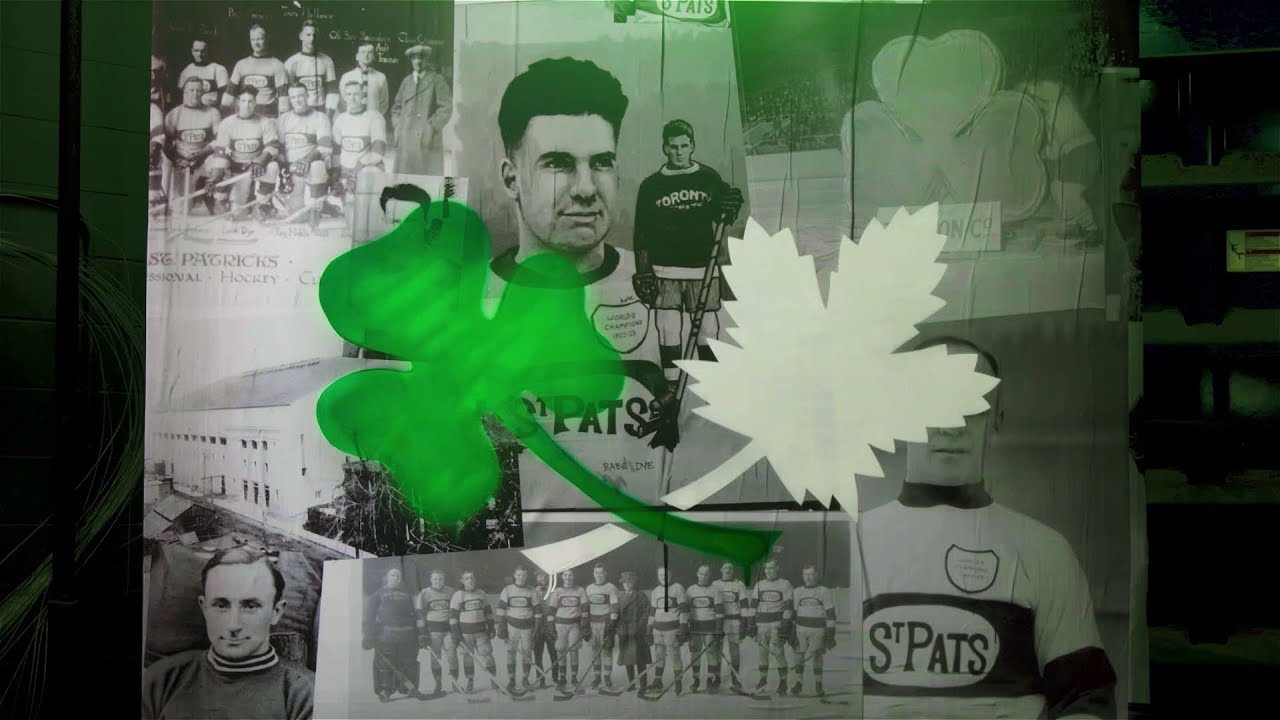
Only two franchises still exist that date back to the origins of the NHL – Montreal and Toronto. The former has kept the same name throughout while that latter took some twists and turns in identity before settling in for the long haul as the Maple Leafs. December 8, 1919 marked the biggest change as the Toronto franchise reorganized as the St. Patrick’s Professional Hockey Club.
When the NHL formed in 1917 and gave a franchise to Toronto, they did not have an official nickname. The press referred to them as the Torontos or the Blueshirts like the former Toronto franchise of the NHA. However, the Toronto Arena Company ran the team and the Arena Gardens where they played, so the team soon became known as the Toronto Arenas. Whatever the name, Toronto won the Stanley Cup in 1918.
However, the franchise ran into financial trouble and had to declare bankruptcy. They could not finish the 1918-19 season. The Arena Company was willing to sell, so GM Charles Querrie got the ball rolling by temporarily changing the team name to the Tecumsehs (likely in honor of his home). When the NHL met at the Windsor Hotel in Montreal on December 7, they ratified the new name.
The very next day, December 8, a meeting was held to establish the St. Patrick’s Professional Hockey Club. Two days earlier, the St. Patrick’s Club had tendered fees to participate in the Ontario Hockey Association (OHA), but the secretary had refused to accept them. As the press reported, “The club manager contended that this was not in order, but the president ruled that the executive had the right to refuse any entries.” Rejected by the OHA, the St. Patrick’s investors made an agreement with Querrie to purchase the NHL franchise.
They bought out the Toronto Arena Hockey Club for all players and property for about $7,000. Fred Hambly (chairman of the Board of Education) became president, Harvey Sproule the secretary-treasurer, Frank Heffernan (an OHA star skater) the manager, and Querrie the delegate to the NHL. The officers told the press that they “expect that St. Patrick’s will prove as strong as any member of the league.” With the team renamed the St. Patrick’s, they hoped the name would attract some of the large Irish population to attend home games.
Five days later, in the morning of December 13, the NHL held a special meeting at Prince George Hotel. Right away, “it was announced by Mr. Verncombe that he and Mr. Querrie had sold the franchise, players and equipment of the Toronto Arena Club to the St. Patrick Hockey Club.” Once Ottawa moved and the Canadiens seconded the motion, the sale and new St. Patrick Hockey Club was ratified. The club’s representatives were brought in and introduced. They still owed a $5,000 fee to the NHL to make the franchise permanent. In the meantime, they agreed to the schedule that had been devised for the Arenas/Tecumsehs.
The official incorporation date was December 22. Hambly and Querrie and two others each held 99 shares. The St. Patrick’s continued until 1927, when Querrie and other investors wanted to pull out. They thought about selling to someone who wanted to move the team to Philadelphia. Conn Smythe swooped in as the Managing Partner with an offer of $160,000 to keep the team in Toronto.
On the train ride home from Detroit after losing a game, on February 14, 1927, Smythe announced that the team was being renamed as the Toronto Maple Leafs. They played that very night under the new name. The maple leaf was of course the Canadian national symbol. The Toronto baseball club was named the Maple Leaf, and there was a WWI Maple Leaf Regiment. Smythe said his choice was based mostly on the badges worn by most Canadian military regiments.
In its long history, the Toronto NHL franchise spent less than two seasons as the Arenas, a day as the Tecumsehs, seven and a half years as the St. Patrick’s, and so far, 92 years as the Maples Leafs.
The Bruins have spent the past few games coming out a little slow, which has often resulted in them being down by one or two goals at some point in the game only to eventually pull out the win. However, that certainly isn’t the best way to play a hockey game. It’s playing with fire and at some point, the team will get burned. For the Boston Bruins it finally happened on Saturday night.
Despite having gotten on the score board first in the game with a tip in off Chris Wagner’s stick from a John Moore one-timer at 13:14, if it hadn’t been for Jaroslav Halak up to that point it could have been a completely different game there in the first period. Wagner’s goal came on just the Bruins’ fourth shot of the period, with their first shot on the Colorado Avalanche’s Philip Grubauer taking almost five minutes to achieve.
Unfortunately for the Bruins they couldn’t get out of the first period with the lead. The Avalanche took advantage of the Bruins inability to clear the puck, despite having four Bruins players around Valeri Nichuskin as he worked his way into the offensive zone. The puck squirted out to Matt Nieto who initially shot on Halak, and Nichuskin was there to pot the rebound at 17:25.
As the teams exited the ice for the first intermission the game
was tied, but the Avalanche had outshot the Bruins 9-4.
“The second period ends, I think we were playing a lot better than the score indicates. We just made two mistakes and it ends up in the back of our net. But we were pushing the entire second half of that second period. We’re making plays; we’re holding on to pucks; we’re being hard to play against, hallmarks of our team and, you know, unfortunately they get a bounce here and there and they’re up two. But it stings. You learn from it and we grow as a group,” said Moore.
During the second period neither team had a tremendous number of shots on either goalie. The Avalanche added five more shots to their total for 14, while the Bruins doubled their shots for eight—making some people wonder if the Boston would even get to double digits in shots. The big difference, as Moore mentioned, was that mistakes lead to two of Colorado’s shots going in.
Ian Cole’s goal at 9:17—his first of the season in his 500th NHL game—was in part a result of the Bruins just allowing Colorado too much time to cycle the puck and set it up. Joonas Donskoi made a bit of room for himself which allowed him to send it to Mark Barberio who was in the high slot. Barberio passed it to Cole who, after settling the puck, put a slapshot on Halak, to put the Avs up 2-1.
However, perhaps the more disheartening goal was the one by Andre Burakovsky at 18:21 of the middle frame. The Bruins had just spent a minute in the offensive zone when Donskoi got the puck up to the blue line where Nathan MacKinnon was able to shovel it to Burakovsky who ended up having a lot of time and space to set up his shot. The Bruins had Charlie McAvoy back at the Bruins blue line and Matt Grzelcyk skating hard through the neutral zone. Somehow the two of them got tangled up and with no one to check Burakovsky, the Avalanche were up 3-1 with 1:39 remaining in the second period.
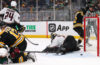
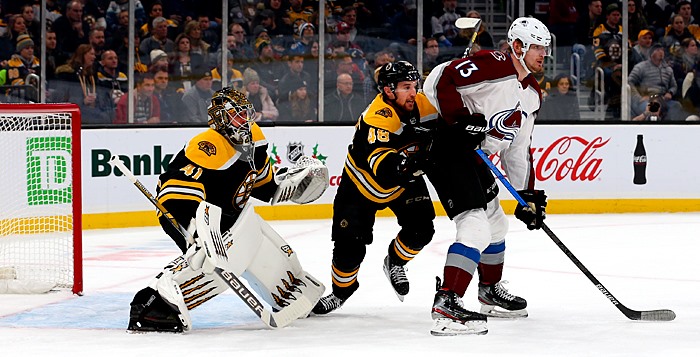
Brad Marchand and Cale Makar in front of Pavel Francouz
As they had done in past few games, the Bruins poured on the effort in the third, outshooting the visitors 12-6, predominantly a result of some power play time. Ryan Graves was called for a high stick on Sean Kuraly at 5:54 of the third. There was a brief 25 second PK for Boston when Brad Marchand was sent off on a hooking call, but that was negated when Donskoi was also whistled for a high stick on Zdeno Chara. And despite having an additional power play at 17:39 of the third in which the Bruins put six attackers on the ice after pulling Halak, they simply could not get anything in the net. An empty netter by Gabriel Landeskog with three seconds left in regulation sealed the game and handed the Bruins their first regulation loss of the season on home ice and ended their 13-game point streak.
“Yeah, that’s a
losing game. You can’t continue to get down by a couple of goals, especially to
really good teams. Teams like that know how to win; know how to keep a lead. Regardless
of how many times we’ve come back in the past, eventually it’s going to catch up
to us and it did tonight,” said Marchand. “We pushed back there at the end, but
I think it’s a good game to realize that we’re not going to continue to win by
getting down, so… You know, it’s good to lose. Unfortunately, it is good to
lose every now and again and get to be able to right the ship again.”
Unfortunately, it is good to lose every now and again and get to be able to right the ship again. — Marchand
Marchand certainly didn’t mean that the team accepted this loss as though it’s no big deal. The players know that it is a wakeup call for them. Their lack of urgency in the first period coupled with some of the mistakes are things that they can change. They got away from their game.
“For us, lack of urgency. We talked about it the other night, again tonight, some of that definitely in our game early on. If we’re on our toes, I think we’re cleaner. I’m not going to say that we’re not going to execute from time to time, but it’s been an issue for us, I think. Some of the unforced errors. If we’re playing the right way, we’re in and out of our end. We’re gone. We go back with it and all of a sudden, we win a faceoff to start a period, we ice it instead of making a play. Now we’re in our end and there’s just a lot of details that are working against us now and we’ve just got to wake up and start playing to our abilities in those situations. And live with the result. Doesn’t mean we’re going to win, but I think we’re leaving plays on the table because our lack of urgency or understanding that teams are coming after us,” said Bruins head coach Bruce Cassidy.
It was bound to catch up to them. But perhaps it is better that it happens in December rather than in March. They have time to get back to playing their game, but more importantly coming out in the first period as they have been in the third.
For a goaltender, the whole point of the job is to block all shots and not allow any goals by the opponents. Usually, like on December 6, 1988, accomplishing this results in celebration. Goalie Greg Millen set a St. Louis Blues record when he earned them three consecutive shutouts. However, on at least one occasion, December 6, 2011, allowing zero goals only earned goalie Mike Murphy a loss and a very brief NHL career.
1988
Millen and the Blues were on a roll. The last goal he had allowed was on November 29, 1988 with 1:25 remaining in the game. They then shut out the Islanders on December 1 and the Maple Leafs on December 3.
For the December 6th game, The Arena in St. Louis hosted 10,466 fans and the Minnesota North Stars. The Blues scored three goals while Millen made 23 saves to shutout the North Stars. With 12:36 remaining in the second period, the Blues set a new franchise record for longest time without allowing their opponents to score. At the end of the game, Millen’s total time without allowing a goal amounted to 181:25. An NHL goalie had not had three consecutive shutouts since the 1971-72 season (when Tony Esposito did it).
The St. Louis Dispatch set the scene. “As the final horn sounded, Millen paused in the goal crease, leaned over, then banged his stick on the ice twice. The Blues players rushed to congratulate him with defenseman Dave Richter giving him a bear hug.” Millen told the press, “I hate to sound like a tape recorder. The guys did a heck of a job in front of me, blocking shots, clearing shots. Any time something like this happens, it’s a tribute to the team – the guys did all the little things again. I think a lot of all these guys. I wanted to share it with them.” Blues captain Bernie Federko commented, “This is something real special. He should be real proud of himself.”
2011
In December 2011, rookie Mike Murphy (drafted in 2008) had been called up from the AHL Charlotte Checkers when the Hurricane’s backup goalie was injured in practice. At the Scotiabank Saddledome mid-way through the third period, after 51 minutes of play, the Hurricanes found themselves trailing the Calgary Flames 6-3. Coach Kirk Muller pulled Cam Ward from the net, and the new No. 70 replaced him.
Murphy had a little while to take in the game as his teammate Eric Staal scored. As the final minute and a half approached, the coach traded Murphy out for an extra forward. Unfortunately, Calgary’s Jarome Iginla took advantage of the empty net at 18:51. After Murphy returned to the net, he made his first two NHL saves. His teammates did their best to tie up the game when Chad LaRose scored at 19:28 and Staal hit the net again with just five seconds remaining. Counting the tallies shows that the Hurricanes fell one short, losing 7-6.
By the way the NHL counts, Iginla’s goal ended up being the game-winner. That gave Murphy credit for the regulation loss, even though he was not even in the net at the time. He became the first NHL goalie to earn a loss before even allowing a goal. In the 8:37 he played, Murphy had a perfect save percentage. Remaining optimistic, Murphy told the press, “I’m the backup goalie, so you go in and do what you can for the team. You don’t like that your team is losing. Cam Ward is such a great goalie and great person, I’ll take a loss for him any day.”
Murphy only ended up playing in one other NHL game, for 37 minutes on December 9. He made seven saves against the Winnipeg Jets to keep his 1.000 save percentage. Even without any goals-against, he left the NHL with a record of 0-1-0.
Additional Sources:
Dave Luecking, “Blankety Blank Blank,” St. Louis Post-Dispatch, 7 Dec. 1988, pp. 1E and 32E.
The Boston Bruins are certainly becoming known as the “comeback kids” in their recent games. In fact, going into Thursday night’s game, they were 7-1-2 when allowing the first goal and were 3-3-2 when trailing by two goals at any point in the game.
Certainly, that is not a recipe for success, and eventually it could catch up with them. In fact, as Thursday’s game against the Chicago Blackhawks continued it was looking as though there would be no come back for the “comeback kids.” For the first time this season, the Bruins found themselves trailing 3-0 in the third period after Alex Debrincat notched his sixth of the season just 17 seconds into the final period.
While Boston continues to be without Patrice Bergeron, who
is out with a lower body injury, the lines are sometimes up in the air. Going
into Thursday’s game, head coach Bruce Cassidy and his assistant coaches were
continuing to use Charlie Coyle as the first line center between Brad Marchand
and Danton Heinen, while David Krejci centered Jake DeBrusk and David Pastrnak
on the second.
David Backes’ return has proved beneficial. His intangibles in
the locker room do not show up in the stats, and that is something he is always
good at, but since his return from injury, he has had his first goal of the
season, against Montreal on December 1st, and an assist on Thursday when he
managed to split the defensemen and then draw a couple of forwards to him in
the right circle, where he fired one on the Blackhawk’s goaltender, Robin
Lehner. Lehner let up a rebound and Joakim Nordstrom was right there to rifle it
home, giving the Bruins their first goal of the game at 1:49 of the third
period.
Despite having outshot the Blackhawks in the first period,
the Bruins had nothing to show for it. They went zero for four on the power
play during the game, which is one of the areas in which Bergeron’s absence is
perhaps most keenly felt. Backes himself commented that they have been running at
roughly 30 percent on the power play, which usually means at least one power
play goal in the game, but they just couldn’t find the back of Lehner’s net
through the first 40 minutes.
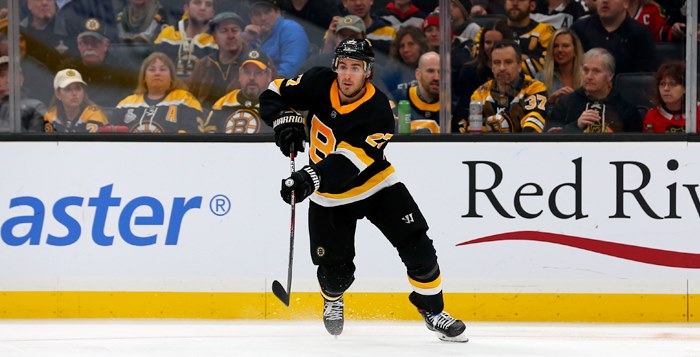
Thursday night’s game also marked the return of defenseman John Moore, who had been on long term injured reserve since the start of the season—the result of surgery on his left shoulder during the offseason. He made some strong defensive decisions in the game along with three shots and three hits, while blocking a couple of shots. However, without any consideration for this being his first game back, he also had a fight—a short one—in the game.
The fight was a result of a hit on Pastrnak—who has been targeted aggressively by opposing teams of late—by Zack Smith. Depending on the view it could be considered questionable.
“The hit on [Pastrnak], we’d have to look at that too. That’s
more concerning—that’s one of our top-end guys—and see if that was within the
rules,” said Coach Cassidy.
For Moore, he felt the hit needed to be addressed.
“I can’t speak for past games. All I can say is it was my turn there. I was right there. I saw it and didn’t like it, so I thought something had to be done,” he said.
Moore’s response speaks loudly of the player he is and the
pride he takes in wearing the Spoked B on the front of his jersey.
“You can’t
say enough about him, right? Here he is, coming off of shoulder surgery and
obviously it’s a reaction thing. He’s not thinking about anything other than
protecting his teammates. So that just tells you all you need to know about his
character. Probably not the perfect guy in that situation coming off that
injury, but good for him. He’ll earn a lot of respect in that locker room that
he already had, but now even more,” said Coach Cassidy, a note of pride in his
voice.
And his willingness to go to bat for Pastrnak, while not a decisive victory in the fight, may have added to the determination of the Bruins to do their best to pull at least a point from the game. At one point in the third period, the Bruins were outshooting the Blackhawks 13-4 during the third period. And it looked as though Lehner was none too pleased to all of sudden be so busy.
When Coyle was sent to the box for a roughing, and the Bruins were still down by two goals, it looked like perhaps the undisciplined reaction by Coyle with the extra jab was going to spell disaster for the home team. The Blackhawks Dylan Strome had converted just ten seconds into their first power play of the game back in the first period, giving Chicago their second goal of the game. It had come just 37 seconds after Ryan Carpenter got a shorthanded goal when the Bruins struggled on their second power play of the first period and the game.
The “never
quit” attitude that flows in the veins of all of the Bruins though saw Chris
Wagner get the Bruins within one goal, while on the penalty kill, and a lot of
time left on the clock; which read 4:59 in the third.
“When [Wagner] has had some space like he did tonight, he can certainly beat a goalie. He’s shown that on breakaways over the course of his [two] years here. He’s made some nice moves when he’s in all alone,” said Coach Cassidy.
And it was undoubtedly that goal that tipped the ice a bit in favor of Boston, well that and Chicago’s ongoing attention to Pastrnak. While two of the Blackhawks were focused on preventing Pastrnak from doing anything at one point, Torey Krug, off a feed from DeBrusk below the goal line, managed to thread the puck under Lehner’s blocker arm. With 2:33 left in the third period, the Bruins had climbed out of a three-goal hole and tied the game.
In the end, they didn’t get the extra point, but their streak continues on home ice. They have not yet been beaten in regulation at home. Now if they could bring the intensity they had in the third period from the first puck drop of the game, who knows what they could accomplish.
The score was still tied and overtime nearly ended when the referee called for a penalty shot. Michal Handzus won the game with that shot on December 5, 2002. It marked only the second time an NHL game had been decided in overtime by a penalty shot.
Although over 19,500 tickets had been sold for the game, snowy weather conditions meant that only about 13,000 showed up at the First Union Center in Philadelphia that December evening. For two thirds of the game, the score remained static. In the first period, the Philadelphia Flyers outshot the visiting New York Rangers 15-7, but in the third period the Rangers outshot their hosts 12-6. Both periods were for naught.
The only scoring in regulation occurred in the second period. The Flyers’ Mark Recchi followed his coach’s advice to score just two minutes into the period. “Hitchcock told us to look for the five-hole [that Dan Blackburn seemed to be neglecting]. I was kind of waiting to see what happened, then went five-hole.” However, the Rangers tied at 7:40 thanks to Bobby Holik, who had just returned after missing 18 months (due to a strained hip flexor). Holik commented, “I didn’t want to come back unless I was ready to compete. I was ready to compete tonight.”
Again, the Flyers took the lead in the second half, when Jeremy Roenick tallied at 15:32. He said afterwards, “That was a really fun game to play in. You know when you have rivalries like that it just brings out all the emotion. … We had a great 40 minutes and kind of sat back in the third and were a bit tentative.” And again, the Rangers answered. All night, the fans had booed former Flyer Eric Lindros. At 18:00, he gave them something to boo about.
Tied at 2-2, the game would go into a five-minute overtime session. Flyers Coach Ken Hitchcock said that it seemed they were always going into overtime. “These are very emotional times for everybody. These are hard times, and when they’re this close, there’s no rest.” At least one of his players enjoyed himself. Handzus told the press, “It was fun. We don’t play overtime at home. So I have never done that before.”
Overtime would come down to Handzus. He had been drafted by St. Louis in 1995 and played there until 2001. After a year in Phoenix, he found his way to the Philadelphia Flyers in 2002. He would spend four seasons there before being traded to Chicago, where he missed most of a season. He signed with Los Angeles in 2007 and with San Jose in 2011. He finished his NHL career in Chicago, being traded just in time to win the Stanley Cup championship in 2013.
Less than 37 seconds remained in overtime when Rangers defenseman Tom Poti took Handzus down from behind. Referee Kevin Pollock called Poti for hooking and signaled a penalty shot. According to Handzus, “I think I had a breakaway, and he hooked me a little on the arm. It was the right call.”
Before taking the shot, Handzus returned to his bench to ask the advice of goalie Roman Cechmanek. “We sometimes stay late after practice and we play [one-on-one] against him,” explained Handzus. “There was not much to think about. I talked to Roman. He said to try to fake it and go to the backhand and shoot high. So I figured I have to listen to the goalie.” Indeed, according to the recap, “Handzus skated in on Dan Blackburn, faked a shot, went forehand to backhand and lifted the puck over Blackburn’s outstretched leg.”
Coach Hitchcock was impressed. “To me, to be able to have the confidence to make that play on that ice late in the game – it’s 65 minutes of hockey and the ice is going to get chewed up – to make that play at that stage … that’s a lot of confidence.” This was the first time in Flyers history that a penalty shot had decided a game in overtime and only the second time that was the case in NHL history since the implementation of the five-minute overtime.
For the Flyers, it was their second dramatic win in three games and their first win at home since November 2. Unsurprisingly, the stars of the game were three centers: Handzus, Lindros, and Roenick.
The Flyers finished the season with 107 points (45-20-13-4), their highest since 1985 and still their sixth-highest in franchise history. It was only good enough to put them in second for their Atlantic Division, and they lost the conference semi-finals. They had a worse record the following season but led their division and made it a step further in playoffs.
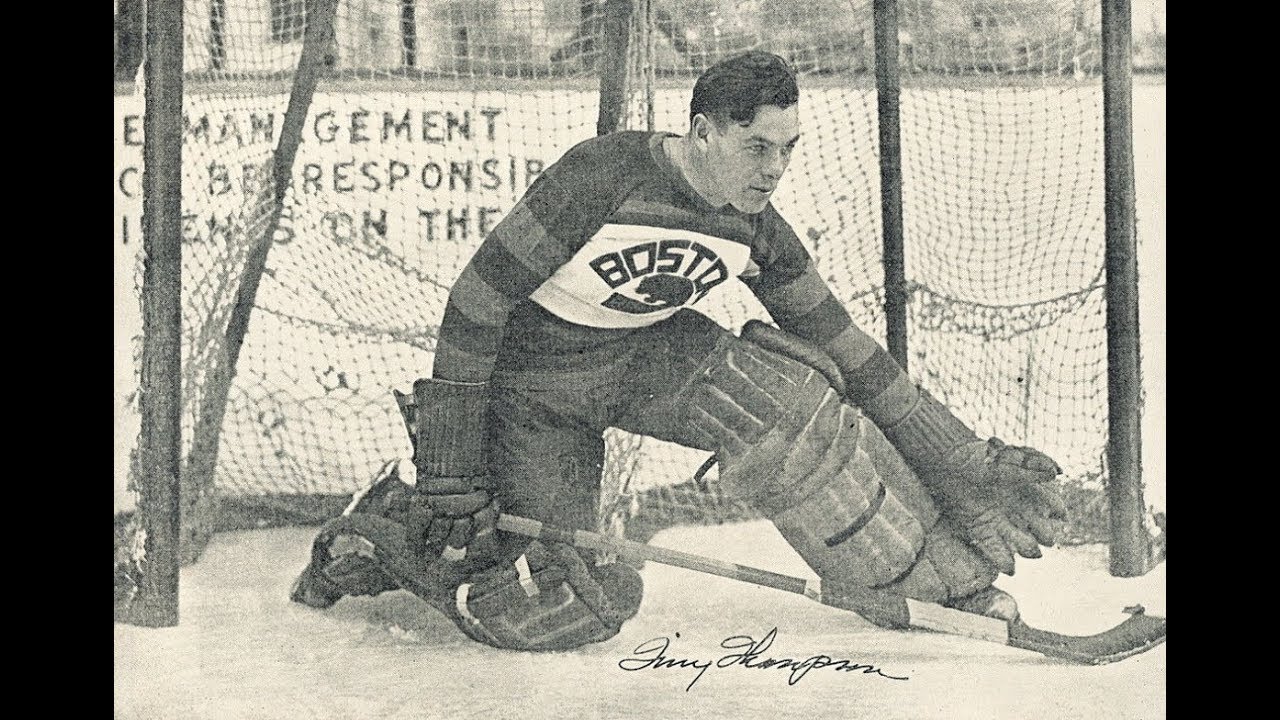
In the 1930s, it seemed that most of the best NHL goalies could be traced back to the Detroit franchise. As they sold off and let loose goaltenders, Detroit found themselves without a lead for their NHL team. Thus, on November 28, 1938, the Red Wings paid $15,000 to obtain Tiny Thompson from the Boston Bruins. Filling Thompson’s role for the Bruins would be Frank Brimsek, who had originally been tied to Detroit but had played for Boston’s affiliate, the Providence Reds before signing with the Bruins on October 27, 1938. Soon after taking on their new roles, on December 4, Thompson earned his 75th NHL shutout on the same night as Brimsek earned his first.
When Thompson was bought by the Red Wings, he was nearing the end of his playing career. He had begun his time in the NHL with a shutout on November 15, 1928. At the end of that first season, the Bruins won the Stanley Cup championship. Thompson went on to earn the Vezina Trophy four times between 1930 and 1938. Thus, it was almost exactly ten years into his NHL career when he moved from Boston to Detroit.
Before a sellout crowd of 11,855 at Detroit’s Olympia, Thompson shutout the Toronto Maple Leafs. In net, the Leafs had Turk Broda, whom they had obtained from Detroit’s Olympics in May 1936. The only goal of the game came in the last six minutes, when Modere “Mud” Bruneteau scored on a rebound off Broda’s pads. The scorer and goalie had been former roommates when playing for the Olympics.
This was only the second game Thompson minded the net for the Red Wings. He had already had three front teeth loosened in his first practice with the team. Then a flying puck in a practice the night before the game made his left hand swell to twice the normal size. Still, both games were victories, and the latter made him the first NHL goalie to reach 75 shutouts. With some modesty, Thompson asked the press, “Don’t give me credit for that one. You have to be good when you got boys like they are fighting to help you.” Either way, the game pulled the Red Wings out of the bottom of the standings.
Meanwhile, Brimsek’s first NHL shutout put the Bruins at the top of the standings. The “largest crowd of the Chicago season,” 17,894, saw their Blackhawks completely crushed. No one scored until Milt Schmidt’s goal at 9:34 of the second period. Then Dit Clapper started off the third by scoring at 4:37. As the clock tipped into the final half of the final session, “Brimsek turned aside brilliantly” Chicago’s “one furious rush after the other.” Then the Bruins came flying in with three goals in one minute (between 15:53 and 16:51).
Brimsek had only allowed five goals throughout his four NHL games. In the next six games, he would have another five shutouts. Unsurprisingly, he ended the season winning the Calder Memorial Trophy as rookie of the year and the Vezina Trophy as top goalie. The Bruins also won the Stanley Cup. Over the next few seasons, the Bruins won the Cup again in 1941, and Brimsek earned the Vezina the following season. After 11 seasons with the Bruins, they traded him to Chicago on September 8, 1949.
In their entire NHL careers, Thompson played 553 games with a record of 284-194-75 while Brimsek played 514 games with a record of 252-182-80. Brimsek only ever had about half the number of shutouts as Thompson. His 40 shutouts ties him for 42nd in the rankings of most career shutouts. Thompson’s 81 places him sixth on the all-time list. Both goalies have been inducted into the Hockey Hall of Fame, with Thompson entering in 1959 and Brimsek in 1966.
Additional Sources:
“Bruins Wallop Chi Hawks, 5-0,” and “Tiny, Wings Blank Toronto Leafs, 1-0,” Boston Globe, 5 Dec. 1938, p. 7.
Gerry Moore, “Frank Brimsek and Tiny Thompson Blank N.H.L. Teams in Goalie Duel,” Boston Globe, 5 Dec. 1938, p. 19.
Doc Holst, “Tiny Blanks Leafs to Give Wings Second in Row,” Detroit Free Press, 5 Dec. 1938, p. 11.
Victor O. Jones, “Thompson Goes to Detroit for $15,000 Cash, But Red Wings Still Owe Bruins a Goalie,” Boston Globe, 29 Nov. 1938, p. 11.


 Prev
Prev