Twelve years after he last officiated a game, Frank Udvari skated out in borrowed skates and striped shirt. Nearly 55, he became the oldest NHL referee when he finished out the game between the New York Islanders and Atlanta Flames on December 30, 1978.
Born January 2, 1924, Udvari began officiating in the NHL during the 1951-52 season, and he soon became a regular. The biggest event of his referee career took place in 1955, when his call against Maurice “Rocket” Richard of the Montreal Canadiens led to the “Richard Riot.” At one point he said, “It doesn’t bother me when the crowd gets on my back because once the game starts, a referee devotes his entire attention to the play.” When he retired in 1966, he had officiated in 718 regular-season and 70 postseason NHL games (including 11 consecutive Stanley Cup Finals).
For Udvari’s follow-up career in the NHL, he became the supervisor of officials. He held that position from 1966 into 1983. During that time, he was inducted into the Hockey Hall of Fame in 1973.
Udvari’s lone return to the ice as a referee took place at Nassau Coliseum in front of a sellout crowd of 14,995. Just two days before, the Islanders had played the Flames down in Atlanta and had embarrassed them with a score of 10-4. It was the first time the Flames had ever given up double-digit goals. In this re-match, the Flames did a much better job at holding back the Islanders’ scoring, only losing 4-2.
About a minute and a half before the first period ended, Referee Dave Newell was hit in the face by a puck shot by Atlanta’s Bill Clement. Thanks to one of the Islanders’ trainers, Newell was able to get to his feet and made it to the dressing room. Announcing that Newell seemed to have a broken jaw, he was sent to Nassau County Medical Center for treatment. The period ended early, and the remaining time was added to the second period.
Udvari happened to be present since he was monitoring the game in his capacity as supervisor of officials. He stepped in to substitute for Newell, wearing his own gray pants and having borrowed Newell’s shirt and the skates of Islanders’ star Bryan Trottier. The loan of the skates did not stop Udvari from waving off a potential goal by Trottier later in the game.
According to the New York Daily News, “Although there could be little doubt of his familiarity with the rules, Udvari looked as if he could barely skate. He moved slowly and awkwardly, staying close to the boards.” The New York Times reported, “It was clear Udvari was uncomfortable in the role. He skated uncertainly, nearly falling as he warmed up. On the first play he bumped into the sideboards. But as the period progressed he regained poise and, though he skated slowly, he was in command. He called seven penalties in the second period.”
As the Islanders went on to win the game, they set a franchise record. With their sixth consecutive win, they had not lost any of their 18 home games. Trottier himself had a 16-game scoring streak, while goalie Chico Resch had a 19-game unbeaten streak in progress.
Additional Sources:
John S. Radosta, “18th Home Game Without Loss,” New York Times, 31 Dec. 1978, p. S1.
Lawrie Mifflin, “Bossy, Trots lift Islanders, 4-2,” New York Daily News, 31 Dec. 1978, sports, p. 4.
Alan Truex, “Flames Discover A Backup Goalie But Lose Anyway,” Atlanta Constitution, 31 Dec. 1978, pp. 1C and 5C.
As a coach, Scotty Bowman was well-known for record-setting. On December 29, 1995, he broke Al Arbour’s record for most NHL games coached by leading the Detroit Red Wings to a 2-1 victory in his 1,607th regular-season game.
Bowman had been the youngest head coach in the NHL when he first took the leadership position with the expansion St. Louis Blues in 1967. After four seasons there, he left the team in the capable hands of Coach Al Arbour. Bowman made a name for himself guiding the Montreal Canadiens through their victorious run of Stanley Cup championships during the 1970s. Meanwhile, from 1973 to 1994, Arbour held the reigns of the New York Islanders, including through their four consecutive championships. Having coached the Buffalo Sabres in the 1980s, Bowman retired in 1987 and was inducted into the Hockey Hall of Fame in 1991. That same year, he returned to coaching by leading the Pittsburgh Penguins to a championship and a loss to Arbour’s Islanders in the following postseason.
The 1993-94 season would be Bowman’s first with the Detroit Red Wings and Arbour’s last before retiring. That December, Bowman surpassed Arbour in the total number of NHL games coached. The record-setting game was hosted by the Dallas Stars, coached by Bob Gainey who had played for Bowman in the 1970s. When he retired, Arbour had 1,606 regular-season games under his belt, and Bowman coached his 1,607th.
Of the accomplishment, Bowman seemed more impressed with Arbour than himself. He had coached five teams with the Canadiens having the bulk of the games (634) while Arbour had coach 1,499 of his with the Islanders. “It sort of pales by comparison,” said Bowman. “Al Arbour has been with one team. That will be a record that’s difficult to beat. That’s something, for a coach to be with one team for so many games.”
At the end of the season, Bowman received his second Jack Adams Award as coach of the year. He was first awarded in 1976-77 for setting a record with 60 victories. In 1995-96, he topped that with 62. At the time, he held distinction as the only coach who won the Jack Adams Award in the 1970s, was a finalist in the 1980s, and won again in the 1990s. Bowman told the press, “I think I’ve lasted as long as I did because I took a few years off. It sort of refreshes you.”
He also pointed out the pattern that the coach to win the Jack Adams Award in 1994 won the Stanley Cup the following year, and the coach to win in 1995 won the Cup in 1996. Bowman kept up the pattern as he led the Red Wings to their first championship in 42 years in 1997. He retired from coaching after snagging two more championships with them in 1998 and 2002.
Bowman remains at the top of the list of NHL games coached with 2,141. He is also the winningest NHL coach with 1,244 victories and 9 Stanley Cup championships. For the Red Wings, Bowman has the third-highest number of wins (410) after Jack Adams himself (413) and Mike Babcock (458).
Bryan Trottier was born July 17, 1956 in Val Marie,
Saskatchewan, Canada. He was drafted 22nd overall by the New York Islanders
during the 1974 NHL Entry Draft. He would remain with the Islanders for the first
15 seasons of his career which began with the 1975-76 season.
During his rookie season, Trottier set an NHL rookie record when he amassed 95 points (35G, 63A) in 80 games to win the Calder Cup. While his record has been surpassed over the years, he still ranks at number nine overall in points as a rookie.
It was during the 1978-79 season that he achieved a career high 134 points (47G, 87A) and it was during this season that he achieved a record six points in a single period as he lead the Islanders to a 9-4 victory over the New York Rangers at Nassau Coliseum on December 23, 1978. Trottier would finish the game with five goals and three assists, garnering three goals and three assists during the second period. His record of six points in a single period still stands.
“Santa Claus may be the holiday’s big hero in most parts of the world, but not on Long Island. Bryan Trottier, who doesn’t sport a white beard or have a large stomach, had a merry pre-Christmas last night as he feasted upon the Rangers, to the delight of 14, 995 followers at Nassau Coliseum,” wrote Larry Schwartz in The Record.
“Trottier scored the first goal of the game at 13:40 of a
closely played first period and had a hand in the next three goals as the Islanders
tallied seven times in the second period to set a bunch of team records,” wrote
Larry Weisman in The Journal News. “Centering two lines, Trottier, in
his fourth season with the Islanders, was on the ice for every goal his team
scored, setting a team record for points in a game and breaking the record for
goals in a game, which he set last year with four.”
“This is a game to be cherished and enjoyed if I ever get a
chance to look back,” said Trottier, who appeared to the media as subdued after
the game. However, his line mate Mike Bossy let the media know otherwise. “He
was smiling out there, Bryan has a little ham in him too.”
Going into the first intermission the game was tied at one a piece. Trottier had put the Islanders on the board first. The Rangers tied things up at 15:09 with a shot from defenseman Ron Greschner, described by Dick Yerg of The Journal News as “a quiet country boy,” who got his 12th goal of the season.
As the second period got underway the Islanders, Trottier in particular, began to absolutely dominate the Rangers. Bossy started things off, assisted by Trottier, at 1:11, just three seconds into the power play after Ron Duguay was sent to the box for hooking, putting the Islanders up 2-1. Trottier got his second of the game at 3:41 and would get the primary assist on Garry Howatt’s backhander at 5:08. Stefan Persson put one in at 8:59 and Bossy notched his second of the game—and the period—at 11:21, with an assist from Trottier.
It appeared that Greschner was determined to try and keep his Rangers in the game. He put his second of the game past Bill Smith at 13:13. Trottier refused to let the Rangers get any traction in the game, scoring his third and fourth goals of the game at 18:39 and 19:44 (though this one was originally attributed to Persson) in the middle frame. This brought the Islanders tally for the second to seven goals and signaled the end for Rangers goaltender Wayne Thomas. He would watch the third period from the bench, when Fred Shero replaced him with John Davidson to start the third.
“While Thomas was victimized for the first eight goals, they
were not because of his inept play. Ranger defensemen had decided to begin the
Christmas break early, leaving Thomas alone and defenseless most of the time,”
Larry Schwartz described.
And Head Coach Shero called out the defensemen as well, “Yes,
and it was sad. Nobody should be left that alone on Christmas.”
Trottier’s final goal of the game, and the final goal for
the Islanders, was scored at 7:38 of the third period. The Rangers responded twice
in the third at 11:20 from Mike McEwen and again at 17:05 off the stick of
Anders Hedberg.
It is possible that Trottier had the opportunity to be on
the ice for all of the goals because he was centering not only his regular line
between Bossy and Clark Gillies, but he also spent some time centering Ed
Westfall and Howatt, who got the Islanders 4th goal and assisted on Persson’s
goal.
“The victory kept the Islanders as the sole unbeaten team at home in the NHL with a 12-0-4 mark,” wrote Larry Weisman.
Additional Sources:
Larry Schwartz, “Islanders rip Rangers,” The Record (Hackensack, New Jersey), Sunday, December 24, 1978, p. C1.
Larry Weisman, “Islanders crush Rangers as Trottier scores 5 goals,” The Journal News (White Plains, New York), Sunday, December 24, 1978, p. 1D.
Dick Yerg, “Soft-spoken Ranger makes a lot of noise,” The Journal News (White Plains, New York), Thursday, December 14, 1978, p. 1D.
Best known as the Broad Street Bullies for their willingness to play rough and the number of penalty minutes they amassed during the 1972-73 season; the Philadelphia Flyers also hold the record for the longest unbeaten streak in the NHL. They surpassed the previous record of 28 games, set by the Montreal Canadiens during the 1977-78 season, when they beat the Boston Bruins at Boston Garden on December 22, 1979.
“Just when it looked as if the redefined game of hockey was
about to sweep past the Philadelphia Flyers—shazam, the Flyers changed with the
times. In one of the most dramatic and radical changes in the history of
sports, the Flyers swapped mugging for finesse, spearing for speed and brawn
for brains,” wrote Al Morganti in the Fort Lauderdale News.
Such was the team that was able to enter Boston Garden on
December 22nd, tied with the Canadiens for longest unbeaten streak.
“The new Flyers, a team that does its damage with its
skates, not its fists, is the hottest thing on ice. They are off to the best
start in the history of the National Hockey League (21-1-9) and have set a
league record of 29 consecutive games without a loss. They haven’t lost a
hockey game in 70 days. Their last, and only loss of the season came on Oct. 13
at Atlanta,” continued Morganti.
The new Flyers went into Boston Garden without really concentrating on the record. As with most players, they insisted that it was the two points from the game that were the most important. And the opening period saw a bit of the old Flyers, but then again they were playing the Big Bad Bruins.
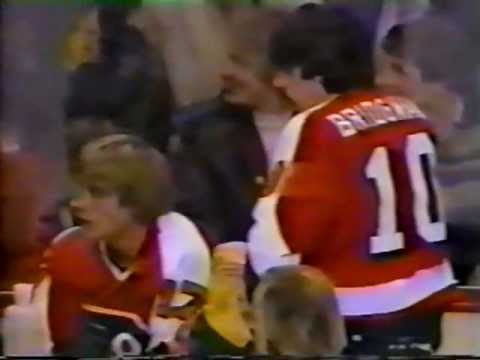
Less than ten minutes into the opening frame, with Philadelphia already on the scoreboard from an unassisted goal by Bobby Clarke, things boiled over. At 7:18 Ray Bourque got five minutes for fighting while teammate John Wensink got two for roughing, five for fighting and a match penalty. On the other side Flyers Mel Bridgman got five for fighting and Paul Holmgren got five for fighting and a match penalty. One minute and twenty seconds later Boston’s Bobby Lalonde took a slashing penalty at 8:39, and while on the five-on-three the Flyers got their second goal of the game just 12 seconds in. Bill Barber notched his 17th goal of the season, a “40-footer from the middle of the ice” that got by a screened Gilles Gilbert.
The game was certainly still within reach for the Bruins.
Despite going down 3-0 off a Ken Linseman shot—a “25-footer from [the] inside edge
of [the] right circle low to near side,” 56 seconds into the middle frame, the
Bruins finally got on the board at 3:03 of the second. Thomas Songin’s shot at
close range deflected off a Philadelphia player’s stick and into the net past
Phyl Myre, stick side.
Two minutes and seven seconds later, Mike Milbury notched his third of the season and put the Bruins within one with a shot from the left point that actually went off Myre’s skate and in. However, the Flyers responded 30 seconds later when defenseman Jimmy Watson took a shot from the left point that got past Gilbert who was screened at the time.
“The goal that hurt us the most was Jimmy Watson’s. We were
coming on,” said Milbury. “And Watson got that goal right back.”
The Flyers got their fifth goal of the game at 10:21 of the third period for a decisive win, reaping not only the new record for longest unbeaten streak, but also the important two points from the game. This goal came off the stick of Bob Kelly from the slot.
“It doesn’t matter who scores the winning goal,” said Linseman,
who had the game-winning goal. “It’s who wins. This was the hardest and best
game we’ve played this season.”
The Flyers would continue their unbeaten streak for a total of 35 games (25 wins and 10 ties). The streak would come to an end when the Flyers played an away game in Bloomington, Minnesota at the Metropolitan Sports Center, home to the Minnesota North Stars. The North Stars extinguished the Flyers streak in resounding fashion on January 7, 1980 when they beat them 7-1.
At the end of the season, the Flyers were the Patrick Division champions. They carried their winning ways into the playoffs, sweeping the Edmonton Oilers in the first round. They beat the New York Rangers in five games in the second round and then knocked off the North Stars to become the Campbell Conference champions as well as guarantee themselves a spot in the Stanley Cup Final. Unfortunately, they would lose to the New York Islanders in six games on a goal that was sullied by a missed offside call during overtime.
Additional Sources:
Al Morganti “The Broad Street Ballet,” Fort Lauderdale News (Fort Lauderdale, Florida), Sunday, December 23, 1979, p. 3C.
“Flyer defensemen stayed cool,” The Boston Globe (Boston, Massachusetts), Sunday, December 23, 1979, p. 38.
Karen Guenther, “Broad Street Bullies,” The Encyclopedia of Greater Philadelphia, online.
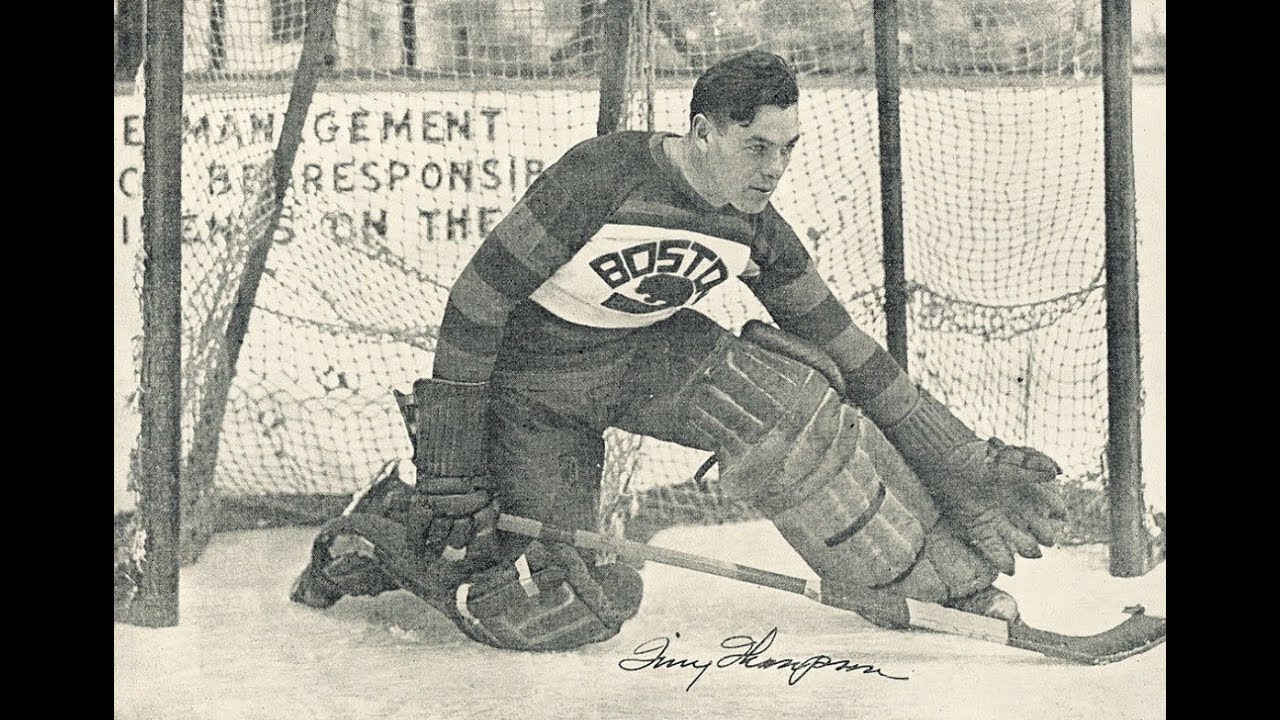
Naturally, brothers who grow up skating together sometimes end up playing in the NHL together. Rarely do those brothers end up having one as a forward shooting on the one in net. The very first time the NHL saw a player scoring a goal on his brother was when Paul Thompson prevented his older brother, Cecil “Tiny” Thompson, from having a shutout on December 21, 1937.
Tiny was born at Sandon, British Columbia on May 31, 1903. The Thompson family had moved to Calgary, Alberta by the time Paul was born on November 2, 1906. Nicknamed ironically because he was the tallest on the team, Tiny only became a goalie to be able to join games. Although the brothers both began playing in Calgary, Tiny soon moved on to play in Duluth and Minneapolis, Minnesota. In June 1926, he signed with the Minneapolis Millers of the U.S. Amateur Hockey Association, and four months later, Paul signed with the New York Rangers of the NHL.
Tiny (along with teammate Ralph “Cooney” Weiland) moved up to the Boston Bruins in May 1928, and he began his NHL career with a shutout that November. At the end of the season, the Thompsons became the first brothers to face each other during playoffs, but Tiny was the one to take home the Stanley Cup. While Tiny remained with the Bruins, Paul was traded to the Chicago Blackhawks in September 1931.
Having faced each other in NHL games since 1928, it took almost ten seasons before Paul managed to score on Tiny. That night, Boston Garden hosted a crowd of 12,000 for what the Boston Globe considered a “close, interesting game which would have brought more scoring except for glittering work by the rival goal tenders.”
For the majority of the game, the only scoring successes were due to the “new offensive combination of Charley Sands and Cooney Weiland.” The two usually played on different lines but were paired up whenever the Bruins were shorthanded or in a tight spot at the end of close games. In the past four games, Weiland had notched six goals and one assist while Sands had four goals and three assists. In this game, they assisted each other to a goal apiece.
The first goal came at 15:46 of the second period while Bill Cowley was serving the second of the game’s only two penalties. Although shorthanded, the Boston Globe reported, “Weiland stole the puck from the raging Hawks, caught Earle Seibert back alone and, waiting cleverly for Sands, fed him a pass on his left. Charley took the puck in full stride, flew around Seibert and then drove a back-hander between Mike Karakas’ legs as the enemy goalie moved to cover the far side.”
The second goal was scored in the final three minutes of regulation. According to the Globe, “Eddie Shore, who played one of the greatest games of his life, got the puck in a jam in the corner behind his net, cleared to Weiland at the blue line, and Cooney, in turn, sent Sands flying down the right. Mush Marsh chased Charley to the right boards, but could not prevent a pass to Cooney, who beat Karakas from 10 feet out.”
As the Chicago Tribune summarized, “The speedy and efficient combination of Cooney Weiland and Charlie Sands gave the Bruins their fourth consecutive victory which strengthened their hold on the tope place in the league’s American division.”
The Bruins did end up winning 2-1, but that sole Chicago goal featured Thompson versus Thompson. Tiny had a shutout going until the very last nine seconds of the game. As the Globe lamented, “It was a pity that the Blackhawks had to score, because Tiny played one of the best games of his brilliant career. And, of course, little brother Paul Thompson had to break the ice.” The Chicago Tribune described the play: “The Blackhawks, in a last desperate bid, sent Lou Trudell inside the Boston defense and during the ensuing scrimmage, Paul Thompson, brother of the Boston goalie, scored on a closeup shot.”
Tiny remained with the Bruins until he was traded to Detroit in November 1938. He finished his career there at the end of the 1939-40 season. Meanwhile, Paul finished his playing career one season earlier. Tiny had played a total of 553 NHL games while Paul had skated in 582. The younger brother had three Stanley Cup championships compared to his older brother’s single victory. However, Tiny also had won the Vezina Trophy four times and was inducted into the Hockey Hall of Fame in 1959.
Both went on to coaching careers. Tiny coached the Buffalo Bisons of the AHL directly after retiring. Paul took over coaching his Blackhawks for the next seven seasons. He then spent two more seasons coaching the Vancouver Canucks of the Pacific Coast Hockey League (PCHL).
About 30 years after Tiny and Paul Thompson retired, Phil and Tony Esposito would face each other while playing (respectively) for the Bruins and the Blackhawks. They were reversed with the forward scoring for Boston and the goalie defending for Chicago. About 40 years after the Thompson brothers did it first, the Esposito brothers would be only the second fraternal set to play against each other during playoffs.
For three years in a row, the Los Angeles Kings and Edmonton Oilers played each other in high-scoring games at this time in December. After losing to the Oilers 7-3 on December 19, 1984, the Kings lost 9-4 on December 20, 1985. Finally, the teams tied at 8-8 on December 20, 1986.
Both December 20th meetings were held at Edmonton’s Northlands Coliseum. The crowd slightly decreased from 17,114 spectators in 1985 to 16,927 in 1986. The hometown fans also had their enjoyment of the game lowered between the two years as the Oilers blew the Kings away in 1985 and let them have a huge comeback to tie the following season.
1985
After the 1985 matchup, the Edmonton Journal remarked that the Oilers “played with Los Angeles Kings, scoring whenever they felt like it,” while the Los Angeles Times commented that “in keeping with the Christmas spirit,” the Kings gave the Oilers “three gift-wrapped, shorthanded goals.”
As with just about everything else that night, the shorties could be laid at the feet of Jari Kurri (4G, 2A), Paul Coffey (3G, 2A), and Wayne Gretzky (6A). The three of them combined had 17 points and 25 of the Oilers’ 41 shots on goal. Kurri told the press, “Wayne and I had a special feeling out there tonight. We had a lot of fun tonight.” As for Gretzky, he commented, “The three of us know exactly where we’re going and what we’re doing. We play a lot on instinct.” Their coach, Glen Sather, noted, “They were throwing the puck around and skating as well as I’ve ever seen them.”
Two of Kurri’s four goals were scored during penalty kills. This was the first time he had scored four times in the same game and was tied with Chicago’s Rick Paterson for the record. “I just had a special feeling out there.” Kurri added, “I think this (video) tape will go to my father back home. He’s been asking for some.” This game continued Kurri’s 18-game scoring streak.
The third short-handed goal was claimed by Coffey, who earned his fourth career hat trick. He made the three goals in 13 shots prompting him to exclaim, “That’s the most shots I’ve ever had. I remember I had 11 one night (three years ago) in Minnesota.” Apparently, the assistant coach, Bob McCammon looked at it differently. According to Coffey, he “told me I should go home and be upset. Thirteen shots? And only three goals?” McCammon explained, “He could have scored six or seven times.” Regardless, he continued with a 13-game scoring streak.
And there was Gretzky assisting them both. Coach Sather commented, “He seems to be passing the puck like crazy and not shooting for some reason.” It was the 11th time Gretzky had tallied six points in a game, and they put him into a tie for tenth place in the all-time scorers list.
Poor Darren Eliot, the rookie from the 1984 game, was again the victim of the Oilers’ onslaught. Coach Pat Quinn bemoaned, “It’s been a whole fall of frustration. We could play our best and still lose to this club. But to come in here and play like we did is unacceptable. The score could have been a lot worse.” He went still further, “They were awesome but out team looked like they had never seen them play. We gave the puck away all night long. It was a terrible display without the puck. It was the worst exhibition I’ve seen since I’ve been in L.A.”
It wasn’t all doom and gloom as Kings’ center Bernie Nicholls managed two goals and two assists while teammate Marcel Dionne had a power-play goal. And to put things more in perspective, Edmonton had the best record in the NHL (24-6-4) while Los Angeles had the second-worst (8-20-4). In the five games played against each other, the Oilers had won three and tied two.
1986
Almost all of the same characters also played a part in the 1986 matchup. The outcome was different enough for the Los Angeles Times to crow, “Behold the transformation Saturday night as the 98-pound weaklings turned Charles Atlas and sprayed a good portion of beach into the smug faces of the Edmonton Oilers.” Naturally, they told the story of the great comeback while the Edmonton Journal reported the pitiful giving up of the 8-4 lead in the final ten minutes of the game.
The scoring began right away with the first period ending in Edmonton’s favor 4-3. Gretzky and Kurri left their mark on the second period with only a sole Dionne goal for the Kings to bring the score to 7-4. Thanks to the assistance of Gretzky and Kurri, the Oilers added another goal about three minutes into the third period. Gretzky had two goals and three assists to bring his scoring streak to 19 games, the longest in the NHL that season.
As the third period tipped into its final half, along came Bernie Nicholls, the Kings’ hero of the night. He began and ended a four-goal spree that led to the tied score. After Nicholls’ goal at 10:46, Morris Lukowich notched one at 14:56. After another 84 seconds, Dionne found the net for the second time that night. Kings rookie Luc Robitaille commented, “I kind of thought they were embarrassing us, laughing at us … now we’re laughing.” Whereas Gretzky lamented, “We blew it. We played horrendous in the last 10 minutes. We were trying to get the ninth goal and gave up the fifth, sixth, seventh and eighth instead.”
With 1:09 remaining in regulation, the Kings pulled Eliot from the net. According to Dionne, “After I got my second goal, I knew we were in it. We pulled our goalie and we were confident.” However, the Kings had yet to have any success upon pulling the goalie, which they had done 11 times already that season. This time would be different. Coach Quinn admitted, “We’ve pulled our goalie a ton of times this year and this is the first it’s worked for us.”
As per the Times recap, “Dionne won the draw in the Oiler zone, and he subsequently took a hard shot that Edmonton goaltender Grant Fuhr stopped. The rebound bounced around the crease, and Nicholls backhanded it in at 19:26 amid a pile of players in the goalmouth.” The Journal reported goalie Grant Fuhr’s fury that the referee did not blow the whistle, claiming that he had the puck. “The crease may as well have been a Christmas decoration,” he fumed. In Nicholls view, “The puck was bouncing around and I was on the right post. I shoved it in, goalie and all.” He added, “It wasn’t pretty, but we got the point.”
The five-minute overtime session failed to change the score. Goalies Fuhr and Elliot had allowed 16 goals in 65 shots on net throughout the match. “These are no fun for coaches, even less fun for goalies,” Coach Quinn explained. “We did a lot to convince the Oilers the Kings hadn’t come to play in the early going. I was as displeased as I could possibly be. We’ve been grinding away for two years not to be like this; there was no excuse for the type of performance we had. I’m happy with the point but not the way we played.” However, he confessed, “I’d be less happy to be in the other room, to let a point slip away is certainly worse.” Coach Sather merely said, “It wasn’t spectacular. … It looked like one of those summer league games. I can’t get upset right now, it’s not going to do any good.”
This season, both the Oilers (22-11-2) and the Kings (14-17-3) led the goal-scoring. When the two met, it was “one high-scoring offensive show after another” as they tallied 45 goals in their four meetings.
Wayne Gretzky seemed to break records at every turn. One of them was so mind-boggling that no less than four of the greats he surpassed commented to the Edmonton Journal afterwards. On December 19, 1984, Gretzky notched his 1,000th point in only 424 games. The previous record-holder for the fastest to 1,000, Guy Lafleur, had needed 720 games. This occurred one year and one day after Gretzky had set a record for the fastest to 100 points in one season on December 18, 1983.
During his time with the Edmonton Oilers, Gretzky never failed to produce over 100 points each season. For the 1983-84 season, he had tallied his 100th sooner than anyone had before. At just 34 games into the season, the “Great One” had a hand in all but one goal as the Oilers beat the Winnipeg Jets 7-5. Gretzky’s previous record was when he reached 100 points in 39 games during the 1981-82 season.
A crowd of 15,107 came out to Winnipeg Arena to watch the Edmonton crew take a 5-1 lead before the first five minutes of the second period had ended. On a power play at 7:43 of the first period, Gretzky “fed a perfect pass on to the stick of Mark Messier, who was parked unmolested” by goalie Brian Hayward for the first goal of the night. Less than three minutes later, Gretzky scored his own power-play goal. He tallied another assist as the first period ended. Although he only had three shifts in the second period, he scored an unassisted goal at 4:12. He merely said, “We’re winning as a team and it makes individuals look good.” Gretzky went on to finish the season with 205 points, which he would top each of the next two seasons.
A year and a day later, Edmonton hosted the Los Angeles Kings and a crowd of 17,498, including Gretzky’s parents and younger brother Brent. The Kings had brought rookie goalie Darren Eliot, formerly of the Canadian Olympic team. The Oilers showed him no mercy as they won 7-3.
It took only 101 seconds for Gretzky to reach his 1,000th point. According to the recap, “The record-setting play was started by Jari Kurri, who had four assists. Gretzky broke in on Darren Eliot after taking the Kurri-to-Krushelnyski breakaway relay, but hit the post. The goal was a gimme for Krushelnyski.” Gretzky received credit for the assist. Teammate Krushelnyski commented, “I thought he’d score. I was just there to congratulate him. One of their guys wasn’t paying any attention to me … and the puck went off the post and off my skate.” Gretzky demurred, “I didn’t have a good warmup … coming back from the East on Tuesday was a long trip. I felt weak. But usually when I get a point early I get a little jump.”
Gretzky went on to score two goals, a shortie at 7:42 of the first period and the last goal of the game with less than two minutes remaining. He also received credit for three more assists, for Glenn Anderson at 18:43 of the first period, for Paul Coffey at 16:20 of the second, and for Dave Hunter at 14:15 of the third. That meant he had a hand in all but one goal of the seven scored by the Oilers.
Only 17 players had reached 1,000 points before Gretzky came along. Having collected 1,000 points in 424 games, Gretzky beat Lafleur’s 1981 record by nearly 300 games or four seasons. Just three weeks earlier, Lafleur had retired to take a public relations job. Gretzky remarked, “I remember what some high-profile people said when I first broke in – that I was too small, too slow … I felt if I kept playing the way I did, then over a period of time I would prove them wrong.”
The next-speediest after Lafleur had been Marcel Dionne, who was there playing for the Kings. “The game was anticlimactic to the wonderful achievement,” said Dionne. “What Gordie Howe said about him is just the way it is. He’s a marvel to watch.” In 1981, Dionne had reached 1,000 points in 740 games. About Gretzky surpassing them all, Dionne praised, “I think they’ll have to have an NHL yearbook just for Wayne. He’s a real scoring machine. Outside Wayne, most of the guys with 1,000 points took 15-16 years. Wayne will pass everybody.”
After Dionne, Phil Esposito needed 745 games to score his 1,000th point in 1974. Esposito said of Gretzky, “He’s the greatest offensive machine I’ve ever seen. How many points can he get? He’ll be the first player, if he plays long enough and doesn’t get hurt, who’ll get 2,000 points.” He was not wrong. Gretzky scored his 2,000th point (in 857 games) on October 26, 1990.
Bobby Hull notched his 1,000th in his 909th game in 1970. “I’ve said it before – and I’ll say it again – Wayne has had the biggest impact in my lifetime. He came along when we needed a change and he accepted the challenge. He has a fantastic style and is about four steps ahead of everybody,” complimented Hull. “He comes to play every night. He knows that the people have paid good money to watch him perform. He always gets physically and mentally prepared.”
Back in 1960, three months before Gretzky was born, Gordie Howe tallied 1,000 in game 938. “Wayne is just somebody who fights for excellence. That goes for everything.” Howe continued, “He’s already got one NHL milestone award (600 assists) I don’t know if there’s a way to stop him unless he gets locked in the dressing room.”
By the Edmonton Journal’s reckoning, Gretzky already held 36 records by that point. He remains the fastest to reach 1,000 points, and as one might guess, he was also the youngest to do so (at 23 years and 328 days).
For the Montreal Canadiens, December 18 became a day of shutouts, whether in their favor or not. In 1928, they notched their fifth consecutive road shutout in Chicago. Then in 1955, they became the losers as the Red Wings tallied their third consecutive shutout in Detroit.
Chicago’s Coliseum hosted the Habs in 1928. According to the Montreal Gazette, it was one of the fasted games held there as the Canadiens “outskated, outchecked and outscored” the Hawks. The contract with the Coliseum would expire January 20, and the new Chicago Stadium would not be finished in time. The Blackhawks announced that they would have to play the remainder of their “home” games at Detroit’s Olympia Stadium.
While the Hawks were still actually at home, the Habs were probably happy to be on the road. Their goalie, George Hainsworth, had not allowed any goals from the opposition in the past four road games, since before November 22. The Canadiens won 1-0 at Boston, tied 0-0 at Pittsburgh, won 2-0 at Ottawa, and tied the Maroons 0-0. On December 18, they proceeded to crush the Blackhawks 5-0.
The star of the offensive game was Howie Morenz. He assisted on the third goal of the night and then proceeded to net the final two at 15:45 and 17:55 of the third period. According to the recap, “His first goal was from the blue line and near the boards and his second also from the blue line, but directly in front of the goal.”
Of the 16 away games the Canadiens played throughout the rest of the season, they would blank their opponents in seven of them.
Coincidentally, the Habs and Hawks played each other again on December 17, 1955 with the same results. The Canadiens had a 5-0 shutout. The major difference was that the game was held at Montreal Forum, for a crowd of 13,115. That time, the goalie was Bobby Perreault, who was called up from Shawinigan Falls Cataracts because Jacques Plante was injured. The five goals were scored by five different players, but three of them were on the third line (Floyd Curry, Ken Mosdell, and Claude Provost).
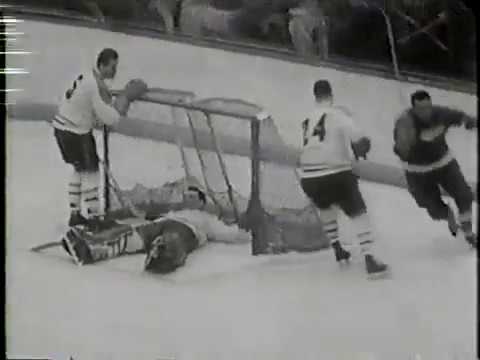
The next day, December 18, the Canadiens travelled to Detroit to play the Red Wings before 13,968 spectators. There, Montreal’s eight-game winning streak came to an end. They had only lost five games all season, but two of them were against the Red Wings. For the first time all season, they were on the losing end of a shutout.
Detroit’s Glenn Hall was on a roll. This was his third-straight shutout on home ice. He blanked the Rangers 2-0 on December 11 and then the Maple Leafs 4-0 on December 15. With 26 saves, he held off the Canadiens too. Peerreault, on the other end of the ice, faced 40 shots but let in two.
Both of Detroit’s goals were made by Alex Delvecchio. The recap described the first goal early in the game: “He fired a routine 60-footer at 2:35 which Montreal defenceman Dollard St. Laurent attempted to clear. Instead he deflected it past the startled Perreault.” At 5:51 of the second period, rookie Henri Richard sat a penalty leaving the Canadiens short-handed. “Delvecchio, at the corner of the cage, took a feed from Red Kelly and slid in a short shot when Perreault attempted to move out and smother.”
Although they had trouble beating Detroit, the Habs managed when it counted. At the end of the 1955-56 season, the Canadiens began their streak of five straight Stanley Cup championships.
When the trade was made on December 17, 1957, it was the largest trade in NHL history. As the Detroit Free Press put it, four Detroit Red Wings were sent “on the assembly line that leads into the Blackhawks arena” and four Chicago Blackhawks were returned “on the treadmill that terminates at Olympia.” The two teams had already been trading players since the season before, so this seemed another in a string of them.
The trade took less than 24 hours to come about. Detroit’s Jack Adams and Chicago’s Tommy Ivan apparently (according to the Free Press) had a “session of hand-holding and mutual admiration [from which] came another in the endless series of trades.” Adams explained, “The negotiations started Monday afternoon when Tommy and I talked for an hour on the telephone. Then I called Bruce Norrice (Wings’ president) and he gave me the go-ahead. I phoned Ivan again Tuesday morning and we settled it.”
Detroit’s press was less than impressed with the quality of the players being traded. Tallied up from all eight of them, they had only scored 21 goals in 29 games. None of those being sent from Detroit to Chicago were playing on a regular line.
One reason for this was that Earl “Dutch” Reibel’s “Production Line” linemate, Ted Lindsay, had already been traded to Chicago along with goalie Glenn Hall (as a result of trying to form a players’ union). Now the 27-year-old center was the key to the trade that the Blackhawks most wanted. Adams was willing to set him loose because he was made expendable with the younger and faster Forbes Kennedy came through for the Red Wings as center.
In addition to Reibel, Detroit was sending away right wing Bill Dineen and left wings Billy Dea and Lorne Ferguson. Adams felt that neither Dineen nor Dea was “getting any place with the Wings. The trade may be a break.” As for Ferguson, Adams said, “He tightened up right after we got him from Boston and never played up to expectations.”
On the flip side, the key player leaving Chicago for Detroit was left winger Nick Mickoski. He was a 10-season veteran at the age of 30 and considered “the best defensive forward in the NHL.” Adams saw Mickoski as “a digger. He’ll give us a forward who is a good back-checker.”
Along with Mickoski, Chicago sent over right wing Bob Bailey, left wing Jack McIntyre, and center Hec Lalande. “We had [Bailey] for the play-offs last season and then lost him in the draft,” explained Adams. “He’s a tough hitter.” As for McIntyre, Adams thought, “Maybe the change will let him get going.” Finally, young Lalande had played little so far that season due to a broken toe, but Adams felt he “might help in spots.”
The new Red Wings would join the team for a home game against Toronto on December 19. Meanwhile, the new Blackhawks would report in time for practice with the team on December 18 and 19. However, the teams would soon be meeting each other on the ice in the back-to-back “commuters’ special.”
Chicago hosted a matinee on Saturday, December 21 for 5,678 fans. The rematch took place the next day, Sunday, December 22, featuring a crowd of 10,552 at Olympia Stadium. Judging solely by these first two showings after the player swap, the Red Wings had the better end of the bargain. They won 5-3 in the first game and 2-0 in the second. Previously that season, the Blackhawks had shut them out twice.
Of the five goals tallied by Red Wings in Saturday’s game, four of them were scored or assisted by ex-Hawks. Johnny Wilson and Forbes Kennedy, who had been traded for Lindsay and Hall, potted the first and last goals. Bailey assisted on the first, and Lalande assisted on the third. McIntyre joined his fellow trades by netting the second goal. Meanwhile, the Blackhawk’s scoring was only assisted by Reibel (of the traded players). The shutout that followed was Terry Sawchuk’s first since rejoining the Wings. It happened despite two full lines of Hawks made up of ex-Wings. Mickoski assisted on one of the two goals scored for Detroit, so every single one of the traded players sent from Chicago had a hand in the two victories.
Poor Chicago continued their 13-game losing streak. They had not had a win since December 4 or a home victory since November 10. At end of 1957-58 season, Chicago and Detroit were evenly matched against each other, each winning and losing seven games. Overall though, the Red Wings came out ahead with 70 points while the Blackhawks trailed with 55.
Additional Sources:
Tommy Devine, “Wings and Hawks Exchange ‘Faces’ Again,” Detroit Free Press, 18 Dec. 1957, pp. 35-36.
Charles Bartlett, “Hawks Get Reibel in 8 Player Deal,” Chicago Tribune, 18 Dec. 1957, pp. F1 and F4.
Charles Bartlett, “Hawks’ Alumni Spark Wings’ 5 to 3 Triumph,” Chicago Tribune, 22 Dec. 1957, p. F3.
“Hawks’ String Hits 13; Lose to Wings, 2-0,” Chicago Tribune, 23 Dec. 1957, p. F4.
“Wings Run Down Hall, Hawks, 5 to 3,” Detroit Free Press, 22 Dec. 1957, p. E1.
Marshall Dann, “Sawchuk Blanks Chicago,” Detroit Free Press, 23 Dec. 1957, pp. 33-34.
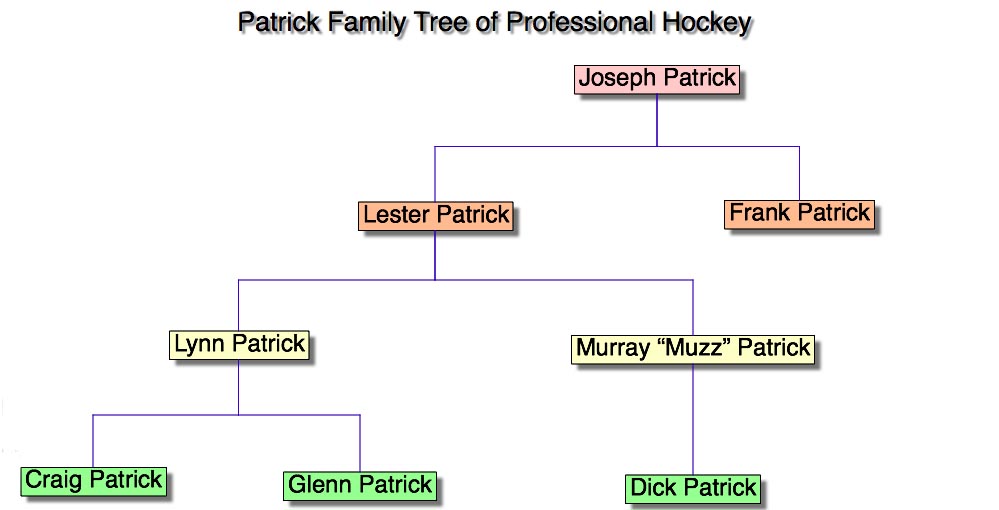
Their birthdays were ten days apart, just shy of a two-year difference. Lester Patrick was born December 31, 1883, and Frank Patrick was born December 21, 1885. They had grown up together, played hockey together, attended McGill University together, played together for the Renfrew Creamery Kings of the National Hockey Association (NHA), and founded the Pacific Coast Hockey League (PCHA) together. On December 16, 1934, Lester and Frank Patrick became the first brothers to coach opposing NHL teams.
Lester had coached and managed the New York Rangers since 1926, and his younger brother Frank had just taken on the same job for the Boston Bruins. In 1933, Lester Patrick led the Rangers to a Stanley Cup championship and Frank joined the NHL as a managing director. Then in September 1934, Art Ross asked Frank to replace him as manager and coach of the Bruins.
The Bruins went on a four-day road trip to New York to play the Americans on December 13 and the Rangers on December 16. They lost both games, the first in overtime and the second in the final two minutes of regulation. By the time they met the Rangers for the first time that season, the Bruins had to make do without their captain, Nels Stewart, who was suspended indefinitely after hitting Dede Klein (left wing for the Americans) over the head with his stick.
Somewhere between 15,000 and a capacity crowd of 16,000 came out to Madison Square Garden to watch the Patrick brothers on opposite benches. The Boston Globe described how they “sat on opposite sides of the rink trying to outsmart each other, the first time they have been cast in enemy roles since eight years ago when they managed Victoria and Vancouver” in the PCHA.
Even without their captain, the Bruins outshot the Rangers throughout the game. Their rookie goalie, Dave Kerr, made 41 saves compared to Boston’s Tiny Thompson blocking 24 shots. Boston’s Dit Clapper lit the lamp first with his goal at the very end of the first period. It would be the only tally they managed. The Rangers tied the game at 2:22 of the second period, when Clapper was in the penalty box for tripping. Cecil Dillon passed first to Frank Boucher, only to receive it back, and then passed to Bill Cook. Cook “drew Thompson to the wrong corner then passed” to his brother, Fred “Bun” Cook, who scored. At 18:19, with less than two minutes remaining on the clock, Dillon scored the game-winner himself.
Frank Patrick took the loss without bitterness. According to the press, he “said he was entirely satisfied with their showing, that the boys had played good hockey, even if it was losing hockey.” Besides, Frank knew the rematch was coming up on December 18. When the Rangers first visited Boston that season, the home team had the advantage. Captain Nels Stewart was back in force, scoring two goals in 30 seconds. Clapper netted the final tally in their 5-3 victory before an audience of 8,000. The Patrick brothers were even.
At the end of the 1934-35 season, the Bruins had won half of their matchups and tied twice. Frank had the better of Lester. However, both teams lost in the semi-finals.
Frank’s career with the Bruins was short-lived, just two seasons before he was relieved on reports that he was drunk while coaching during playoffs. Lester kept coaching the Rangers until 1939, when he replaced himself with Frank Boucher to focus on general manager duties. He retired as GM in 1946 but was vice president of Madison Square Garden until 1950. Lester was inducted into the Hockey Hall of Fame in 1947, and Frank joined him in 1950. The brothers only lived ten years more before they both died of heart attacks exactly four weeks apart in June 1960.
Additional Sources:
Victor O. Jones, “Patrick Family Quarrel as Luckless Bruins Meet Rangers,” Boston Globe, 17 Dec. 1934, p. 11.
“Boston Bruins Lose to New York Rangers,” Boston Globe, 17 Dec. 1934, p. 8.
George Dixon, “Wuxtry! Rangers Beat Bruins, 2 to 1, At Garden,” New York Daily News, 17 Dec. 1934, pp. 50 and 52.
Gerry Moore, “Boston’s Battling Bruins Carry the Battle to the Rangers Leading from Start to Finish,” Boston Globe, 19 Dec. 1934, p. 25.



 Prev
Prev