The last couple of games the Boston Bruins stepped away from their identity a bit and failed to show up for the full game, and as a result they found themselves on the losing end of their tilts with the Philadelphia Flyers on Monday and the Columbus Blue Jackets on Tuesday. In fact they were blanked on Tuesday, and an unfortunate incident early in that game resulted in their goaltender Tuukka Rask ending up on the injured reserve list.
In addition to their not playing to their strengths, there were some comments that they had not responded appropriately after Rask got hurt. However, while that wasn’t quite true—a couple of the players did try to get Emil Bemstrom to answer the bell, but the 20-year-old Swedish rookie elected not to—they had toned down a bit of their physicality.
While many fans believe that the Bruins are being “man-handled” by the other teams and should have an enforcer, the reality is that there were a few more issues in the overall play of the Bruins, some of which may simply not have been as apparent.
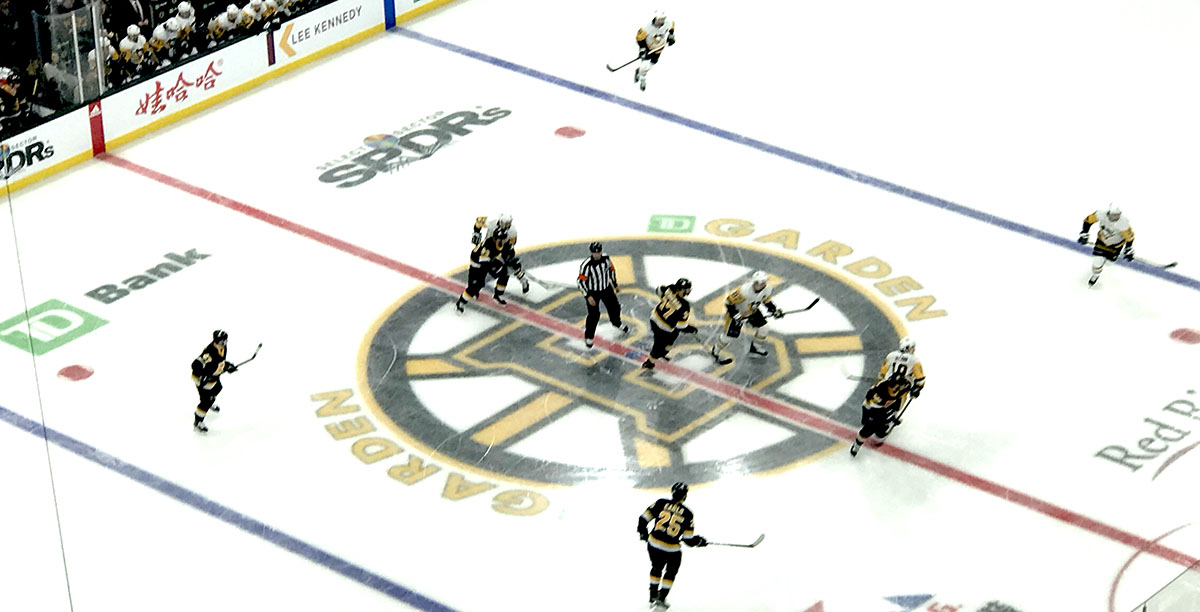
Regardless, the Bruins take great pride in wearing the Bruins sweater. And not surprisingly things were discussed among the team on Thursday morning that showed in their play Thursday night as they took on the Pittsburgh Penguins. For the Bruins it was the third game in four nights, but it was the best of the three games.
Despite Sidney Crosby putting the Penguins on the scoreboard just 24 seconds into the game, the Bruins managed to limit Crosby to that one shot through the first two periods. He put two more shots on Halak during the third.
With Rask out of the picture as he grapples with his concussion, Jaroslav Halak took to the pipes tonight for the Bruins, while Dan Vladar was recalled from the Providence Bruins to serve as backup. Additionally, the Bruins had announced the placing of Brett Ritchie on waivers for the purposes of sending him to Providence and had recalled Karson Kuhlman.
Sean Kuraly knotted the score at 10:03 of the opening
period, assisted by Kuhlman and Charlie McAvoy.
And then at 12:16 of the first Par Lindholm deflected a shot from
Kuhlman, giving Kuhlman two assists on the game before the first period was even
over.
The second period didn’t see any scoring, but it did see an increase in feistiness between the teams. Patric Hornqvist tried to stir things up with Kuraly as the period was winding down—there had been a couple of other exchanges between the two of them earlier—and then when Kuraly didn’t bite, Hornqvist gave Matt Grzelcyk a crosscheck as he was skating to the bench. Torey Krug decided that enough was enough and the two went off with matching roughing minors at 16:05. Apparently the two minutes in the sin bin did nothing to cool their tempers and as they got back on the ice, the went at each other. They were each whistled for fighting majors at 18:11.
For both teams the goaltenders were stars. Tristan Jarry made some key stops on the Bruins throughout the game. Meanwhile, when McAvoy misplayed the puck toward the end of the second period and Pittsburgh’s Zach Aston-Reese and Bryan Rust found themselves with a 2-on-0 opportunity, it was Halak who came up big to deny Rust and keep the Bruins in the lead as they exited the ice for the second intermission.
Patrice Bergeron gave the Bruins some breathing room at 3:19 in the third, as David Pastrnak put a no-look, cross-ice pass right on his stick when Bergeron flew into the offensive zone and fired a laser from the top of the right circle. For Bergeron it was his 20th goal of the season while Pastrnak notched his 31st assist.
Pastrnak garnered his second assist when he shot the puck to Brad Marchand—who did have a couple of struggles on the ice during the game—who gave Boston their fourth goal of the game, scoring on the empty net at 19:07 of the third.
The teams will be right back at it, this time in Pittsburgh, when they play their third game this season back in Philadelphia on Sunday.
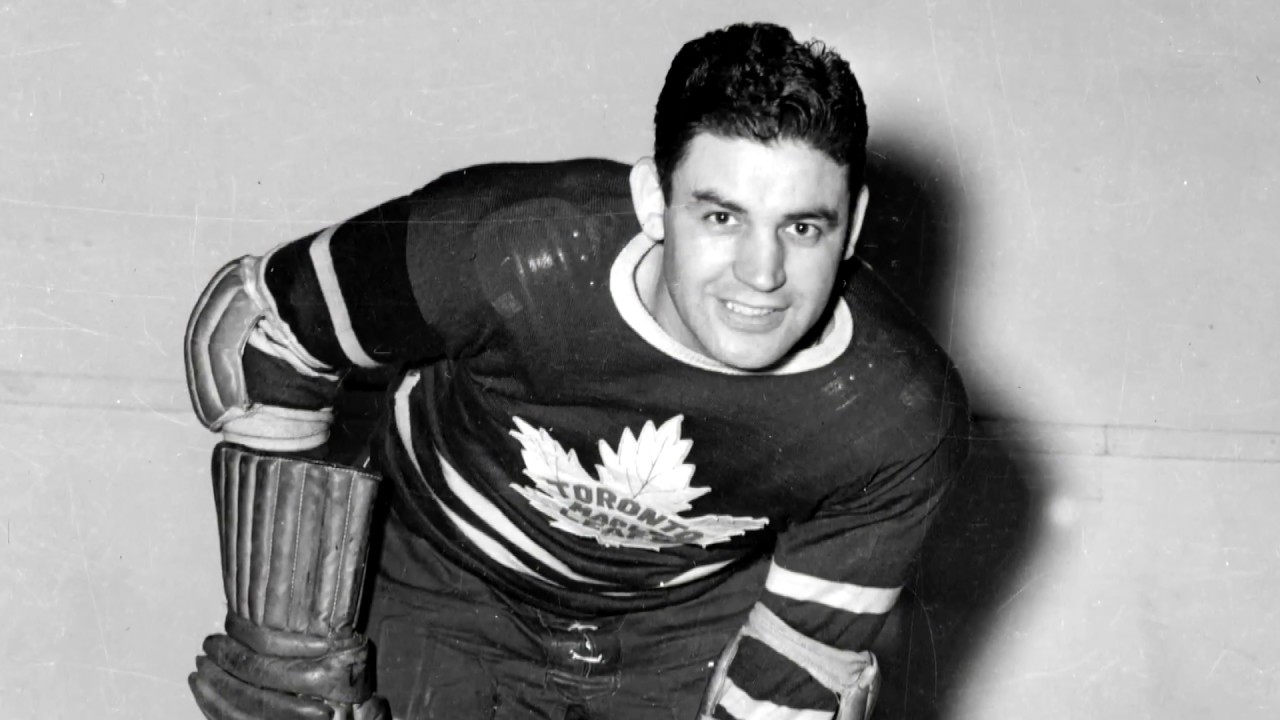
On January 7, 1916, Walter Peter “Babe” Pratt was born in Stony Mountain, Manitoba, Canada. He began playing hockey as a youngster playing most of his minor hockey in Winnipeg with the Atlantic Avenue Rink, with whom he would win the Winnipeg Playground Championship at the age of 10, in the under-12 division.
But hockey was not his only sporting love, he also played
baseball and showed talent at a young age, earning him the nickname Babe, after
baseball great Babe Ruth. The call of the ice however was stronger than that of
the diamond and Babe ultimately decided on a hockey career.
In 1933, he played for several teams. Perhaps he had a magic
touch, because each of the five teams he played with went on to win a
championship. At 17 he moved on to play for the Kenora Thistles, a junior team. In his second season with the Thistles he
topped the league with 46 points in 20 games. That year the Thistles came
within a game of winning the Memorial Cup, losing to the Winnipeg Monarchs.
When a scout called Babe one of the best prospects he had
ever seen, Babe was signed to the New York Rangers farm team, the Philadelphia
Ramblers in 1935. Once again, he proved
himself on the ice and in the middle of his first season with the Ramblers, the
New York Rangers called him up to the NHL.
During the 1937-38 season he scored the most goals by a
defenseman during the playoffs and had the most playoff points by a
defenseman. During the 1939-40 season,
Babe teamed with fellow defenseman with Ott Heller. The duo was one of the best defense team ups
in the league, allowing only 17 goals during regular season play, and were
instrumental in the New York Rangers winning the Stanley Cup the same year.
In November of 1942, Babe was traded to the Toronto Maple
Leafs, where he played for four seasons.
His best season was the 1943-44.
In 50 games played he had 17 goals, 40 assists and 57 points. His 57 points was the best by any defensemen,
a record he held for 21 years. In 1944
he was awarded the Hart Memorial Trophy, an honor rarely given to a
defenseman. The following season he
scored the winning goal during the final game of the playoffs winning Toronto
the Stanley Cup.
Babe’s career was in jeopardy for a time when he was caught gambling and suspended from play on January 29, 1946.
“Announcement of Pratt’s expulsion—two years ago he was the league’s most valuable player—came late yesterday from league president Mervyn (Red) Dutton in Montreal. He made clear there was no suggestion of scandal in connection with the expelling of Pratt that there was no evidence he wagered against his own team but that Pratt, in gambling, had flouted league rules and there was no other course than to discipline him,” reported the Victoria Daily Times.
He later was reinstated on February 15, 1946, by the NHL, with
Babe promising never to gamble again. and returned to Toronto and finished the
season.
“Expressing real pleasure at the news of Babe Pratt’s reinstatement
by the board of governors of the National Hockey League, Col. William A. H.
MacBrien, Toronto financier and vice-president of Maple Leaf Gardens Ltd.,
owners of the Toronto Maple Leafs hockey team, confirmed the report from New
York that Pratt would play for Leafs against Montreal Canadiens tonight,” wrote
Victoria Daily Times reporter Pete Sallaway.
“I had a conference with President E. W. Bickle after Pratt
had been suspended and we decided that if the N.H.L. decided to reinstate him
after investigation of the case, we would automatically do so,” said MacBrien.
MacBrien believed that Pratt would be necessary to assist
the Maple Leafs in gaining a playoff position in the 1946 postseason.
In June of 1946 he was traded to the Boston Bruins. The 1946-47 season was the last season he
played for the NHL. He went on to play
for several teams in the AHL and then for the PCHL, retiring from hockey in
1952.
Following his retirement, he spent time as a hockey analyst
on CBC Television’s, Hockey Night in Canada. He later served as Vice President of the
Vancouver Canucks.
Babe Pratt was inducted into the Hockey Hall of Fame in 1966,
the Manitoba Sports Hall of Fame and Museum in 1990 and a honored member of the
Manitoba Hockey Hall of Fame.
Babe Pratt died in December 16, 1988, in Vancouver, British
Columbia, at the age of 72. He is
remembered as one of the funniest players in the NHL and considered one of the
finest defensemen. To honor him, the Canucks had Babe embroidered on the sleeve
of their uniform and wore it for the rest of the season.
“He should have written the book because he was one of the
keenest hockey historians that the game has known. He had the knack of
understanding different errors and placing players into context of their times,”
wrote Archie McDonald of The Vancouver Sun. “General manager Pat Quin,
who was here as a player when the Canucks began their NHL lives in 1970, is
infinitely correct when he says the Babe has been the star of the Canucks
through the years. He made the hockey Hall of Fame, the storytellers Hall of
Fame, and the people’s Hall of Fame. You can’t do any better than that.”
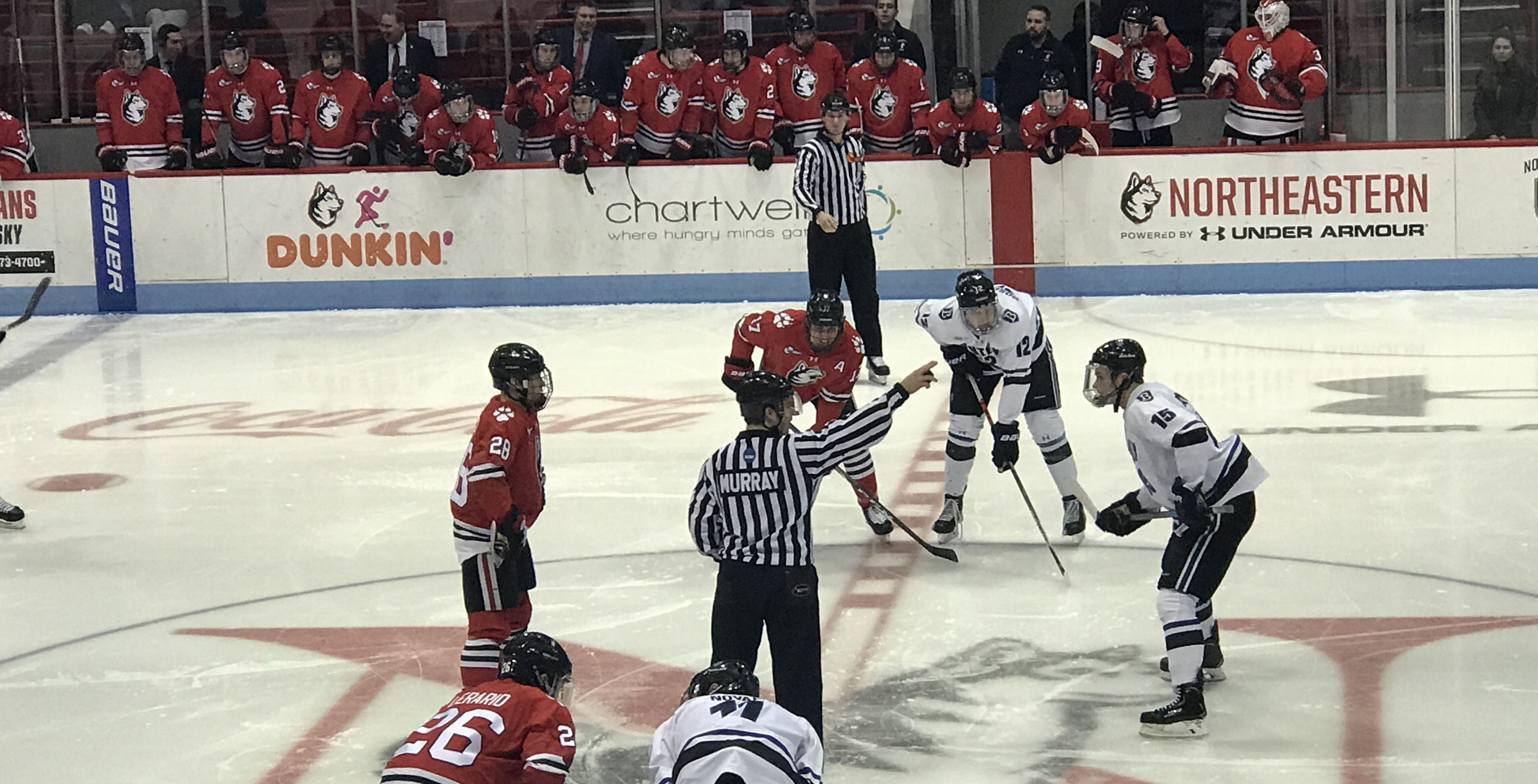
The Northeastern University Huskies hosted their first home game of the new year as they took on the Bentley University Falcons of Atlantic Hockey. The Huskies came out wearing their red sweaters, which it is hoped will be seen more often.
The first period was a slow start for the Huskies. In fact,
they did not get their first shot on net until 9:28 into the opening frame. Coach
Jim Madigan played more of his fourth line, which fortunately seemed to be
determined to generate some energy for those wearing the red and black.
Things picked up as the first period continued. And unfortunately for Bentley, they were called for the first penalty of the game when Jakob Novak was sent off for a slashing at 18:22. Just 37 seconds later, freshman Aidan McDonough notched his eighth power play goal of the season. Going into Monday night’s game he sat third in the nation with power play goals. With Monday night’s goal he is now tied with Boston University’s David Farrance and Sacred Heart University’s Austin McIlmurray for first in the nation in number of power play goals.
🚨🚨MONEY MCDONOUGH !!! 🚨🚨
With his EIGHTH (!!!) power-play goal of the season, Aidan McDonough gives the #HowlinHuskies a 1-0 lead with 1:01 left in the first! pic.twitter.com/cgmMqXh9uw
The Huskies went into the first intermission leading 1-0 as
a result of McDonough’s magic.
The second period while a bit faster in pace did not change
the score, which was fortunate for the Huskies because they were outshot by the
Falcons 11-4 and had to kill off their first penalty of the game. Jordan Harris
was whistled for a holding of the stick infraction at 16:43 of the middle
period. Northeastern had the man advantage three times during the second period,
which says something about their play during this period since they only had
those four shots throughout the entire period.
“We have to get a lot better. I know our guys know that. We
just came off playing a league game last Friday, and this wasn’t the same … We
didn’t play to the same identity today as we did last weekend. So, we’ll get
back at it [Tuesday],” said Northeastern’s head coach Jim Madigan after the
game.
As the third period got underway, it once again looked like Bentley was controlling the ice. Jonathan Desbiens notched his fourth goal of the season to tie things up just 1:57 into the period. It was Bentley’s third shot on net in the period.
Credit to Tyler Madden, who managed to put the Huskies ahead once again roughly three minutes later. Brendan van Riemsdyk kept the puck in the offensive zone for the Huskies and shoveled it to Jordan Harris. Harris was able to saucer it from the right half wall across to Madden, who found he had a lot of open net. He didn’t hesitate to put the puck behind Bentley’s Fraser Kirk. That goal at 4:42 of the third was Northeastern’s first shot on net of the period.
At 7:31 of the third, van Riemsdyk was sent to the box for a high sticking call. Novak made the Huskies pay, garnering his 12th goal of the season at 8:40 with assists from Luke Santerno and Desbiens. At that point the only shot on net the Huskies had accomplished was Madden’s. Northeastern was being outshot once again. This time it was 7-1, which was unexpected.
As play continued, much of it north and south with little to show for it at either end, and the clock ticked under two minutes left in regulation, it was looking like there might be some bonus hockey on the way. However, one of Northeastern’s seniors, Matt Filipe, who has helped his team to Beanpot wins the previous two seasons and Hockey East championships as well, showed what was necessary. His wrist shot at 18:16 of the third gave the Huskies the go-ahead goal, assisted by freshman Matt DeMelis and team captain Ryan Shea. Zach Solow, a junior for the Huskies, ensured the Huskies would take the W from the game when he got his ninth goal of the season at 18:42, assisted by Madden.
Despite pulling their goalie, Bentley seemed a bit deflated by the two quick goals after all the time they had controlled the play. When the horn sounded the Huskies had managed to get the 4-2 win, despite having not necessarily been the better team.
Madden had a three-point night with his goal and two
assists, while the team captain, Shea, notched two assists. Madden talked about
how they had gotten away from their identity.
“We’re not buying in. We weren’t moving our feet on the
forecheck. Just little things like that, we always talk about is a big thing
and our details weren’t too great. We had some moments tonight and we’re just
happy with the two points,” he said.
The veterans stepped up in the third period and the team also owes a lot to their goaltender, Craig Pantano, who helped keep the Huskies in the game.
Northeastern will be back at it on Saturday, January 11, as they take to the road. They will be taking on the New Hampshire Wildcats who they last played in Belfast, Northern Ireland during the Friendship Four. They beat them 4-0 in the first round divisional game before going on to beat Colgate in the championship game.
The brutal cold and possible chance of snow could not keep Boston Bruins fans away. More than 10,000 fans entered the Boston Garden to see the Boston Bruins face the Chicago Black Hawks, hoping their beloved Black and Gold would hold on to their first place standing.
Less than a month after the bombing of Pearl Harbor by the Japanese
which prompted the United States to enter the war, the game may have been a
form of escapism for fans who, just for a few hours, looked for a way to turn
their focus and attention away from the daily news of the war or thoughts of their
loved ones who were to be shipped out or had already left to fight. Yet as fans entered the Garden, it was not
all escapism. As fans walked past the
concession stands, they also passed booths selling war bonds and stamps to fund
the war effort—something they had seen the previous week as well.
Settling into their seats, those sitting closest to the ice
may have thought they had a chance of the ultimate souvenir, a hockey
puck. Hockey pucks that were shot out
of play and into the stands were not thrown back on the ice but kept by fans
who were lucky enough to catch one. It had always been that way. But here too
the war crept in, refusing to allow those assembled to truly escape what was
the new reality.
The National Anthem was sung and the team lineups announced for that game on January 6, 1942. Normally this was the time that the game would begin, but not this night.
“Secretary Frank Ryan of the B’s took to the amplifiers
before the game and thanked the fans for the response to the Bruins’ sale of
defense bonds last week. He then made a plea for all pucks shot into the crowd
to be returned because of the rubber shortage which positively will handicap
delivery of of the discs henceforth. The crowd showed it was in favor of this
last request by boohing a fan who was slow in returning the first rubber that
flew among the cash customers,” wrote Gerry Moore of The Boston Daily Globe.
Like so many other things like nylons and food stuffs that
would ultimately be in short supply, the rationing of rubber products had already
begun. The rubber was needed for not only for the military but vital civilian
purposes as well.
This was not the only contributions that the Bruins made during the war. Little more than a month later, four players would leave the Bruins to serve in the military. Milt Schmidt, Woody Dumart and Bobby Bauer, known as the Kraut Line, because they all hailed from the same German community of Kitchener, Ontario, left the Bruins to serve with the Royal Canadian Air force. Hall of Famer, goalie Frank Brimsek, an American from Minnesota, would go on to serve in the Pacific.
As for the game between the Bruins and the Hawks?
“As a game, last night’s tussle wasn’t very interesting. It
lacked pep. The Hawks were without their speedy left winger, Doug Bentley, who
was left in Chicago with a twisted ankle. The Bruins didn’t have Milt Schmidt,
the clever ‘Kraut’ center, who was on the sidelines with a ‘Pat Egan’ shoulder.
Clapper and Dumart were below par,” described Herbert Ralby, reporter for The
Boston Globe.
“The B’s looked as if they were going to have a cakewalk
when Woody Dumart, Roy Conacher and Eddie Wiseman popped home markers within
the last six minutes of the first stanza to build up a 3-0 lead,” wrote Gerry
Moore. “Just the opposite proved to be the case. Over the last two sessions,
the Hawks, who were battling desperately to avert their sixth straight setback,
outplayed our world’s champions about as badly as they have been manhandled all
season over a similar stretch.”
In fact, Brimsek may have owed his posts a couple beers as
the Black Hawks hit at least two posts in the remainder of the game. Ultimately
the Hawks got within one before time ran out. Joe Cooper notched his fourth
goal of the season assisted by Red Hamill at 15:56 of the second. Bill Thoms
potted his ninth of the season with assists from John Mariucci and Max Bentley
at 7:43 of the third.
This was the first win for the Bruins over the Black Hawks during
the 1941-42 season despite having already played them three previous times. Two
of the earlier games had resulted in ties, while the third was a win for the
players in black and red. Boston’s win kept them in first place with a 15-5-3
record and 33 points on the season to that point.
Additional Sources
“Weather,” Boston Traveler (Boston, Massachusetts), Tuesday, January 6, 1942, p. 14.
Whitney Martin, “All Sports Would Feel Rationing Pinch if Rubber Situation Becomes Acute,” The Oregonian (Portland, Oregon), Tuesday, January 6 1942, Sec. 3, p. 1.
Gerry Moore, “Bruins Beat Hawks, 3 to 2,” The Boston Globe (Boston, Massachusetts), Wednesday, January 7, 1942, p. 18.
Herbert Ralby, “Hawks Aren’t Cashing in at Net, Thompson Wails,” The Boston Globe (Boston, Massachusetts), Wednesday, January 7, 1942, p. 21.
Fluto Shinzawa, Big 50 Boston Bruins Men and Moments That Made the Boston Bruins (Chicago, Ill.: Triumph Books, 2016), kindle edition.
John Bishop, “Bruins Finest Served Proudly in World War II,” published November 9, 2006, NHL.com, retrieved 5 Jan 2020.
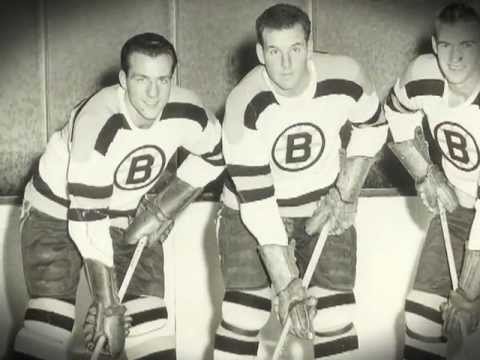
On January 5, 1930, Zellio “Topper” Toppanzini was born in Copper Cliff, Ontario. He began his hockey career in 1946 playing left wing for the NOJHA Copper Cliff Jr. Redman and then the 1947-48 season found him playing for the OHA St. Catherine’s Teepee. His professional career began with the 1948-49 season when the Boston Bruins called him up. That year he played just five games with the Bruins, spending the bulk of his season with American Hockey League’s Hershey Bears. He was with the Bruins organization until being traded during the 1950-51 season. While wearing the Spoked-B he played in 45 games over the three season, amassing 6 goals and 7 assists for 13 points. While with the New York Rangers the remainder of the 1950-51 season he put up 14 goals and 14 assists for 28 points in 55 games. During his five-years career with the NHL, Topper played a total of 123 games in which he gathered 21 goals and 21 assists for 42 points.
The 1951- 52 season saw him sent to the AHL Cincinnati
Mohawks after playing just 16 games with the Rangers. He only played seven
games with the Mohawks before he was on the move again. This time he was traded
to the Providence Reds.
It was in Providence that Topper found his home and the AHL
legend was born. After his trade to the
Reds, he played 33 games that first season, scoring an impressive 20 goals
while adding 25 assists for 45 points. He helped lead the Reds to the Calder
Cup finals. They fell to the Pittsburgh Hornets after taking the series to
seven games.
It was during the 1955-56 season with Reds that Topper hit
his stride. He was part of the line with
Paul Larivee and Camille Henry; the force behind the Reds winning regular
season. During regular season play, in
64 games, Topper scored career highs of 42 goals and 71 assists for 113 points.
Not only were those career highs for Topper, but he had the most assists in the
AHL that season along with the most points. The Providence Reds held first
place in the league.
During the Calder Cup Playoffs, in first round, the Reds
defeated the Buffalo Bisons, 3 games to 2.
In the Finals, the Reds faced the Cleveland Barons, whom they swept. During the playoffs, Topper added 7 goals and
13 assists for 20 points. He became the
first AHL player to garner 20 points during the postseason.
In his 12 years playing for the Reds, Topper became the
all-time leading scorer, achieving 279 goals and 448 assists for 727 points in
650 regular season games while adding another 16–28–44 in playoff action. All
are team records. Retiring from playing
in 1964, Topper was the coach for the Providence College Friars hockey team where
he stood behind the bench from 1964 to 68.
His winningest season was his first, coaching them to a 14-11-1 season.
He would be replaced by Lou Lamoriello, who would go on to coach the Friars
through the 1982-83 season.
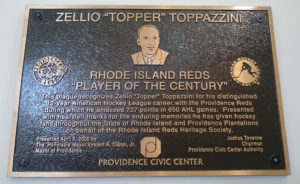
Zellio “Topper Topanzzini was recognized for his stunning
career with the Providence Reds and the AHL.
In the year 2000, the Rhode Island Reds Heritage Society selected him to
be the player of the Century, as the franchise’s all-time scoring leader. In 2013 he was inducted in the AHL Hall of
Fame where he still ranks 13th on the AHL all-time scoring list with 786 points
in 785 games.
Toppazzini passed away in 2001 at the age of 71.
Additional Sources:
“Bruins Send Toppazzini to Hershey; Play at N. Y.,” The Boston Globe, Saturday, December 31, 1949, p. 5.
Currently the 2020 World Junior Ice Hockey Championship is underway, hosted this time by the Czech Republic, and is in its final two days of games to see which country’s Under-20 hockey players will win the gold medal. On January 4, 2020, the semifinal games will be played—the first between Team Sweden and Team Russia. The second between Team Canada and Team Finland. The winners of those two games will go on to play on Sunday for the gold while the losing teams will play to see who earns the bronze medal. This is the 44th annual tournament.
International hockey rules do not allow for fighting,
however up until recently dropping the gloves was something every major junior
player in Canada knew—some were even on the team to do just that. During the
1986-87 regular season, it was almost expected that there would be a tilt or
two whenever two major junior teams took to the ice. For the roster who represented
Canada in the 1987 World Junior Championship, they were groomed to be physical.
“Hockey Canada knew
the situation very well. We’d already had two brawls against Switzerland in an
exhibition game, and then on New Year’s Day we played the Americans and had a
big shindig at centre ice during the warmup,” described Theo Fleury in his book
Playing With Fire. “Did anyone from Hockey Canada sit us down and say, ‘Look,
boys, this is a sensitive situation. We are concerned. You stand to lose if you
fight’? No.”
By the time Fleury and Team Canada took to the ice on January 4, 1987 in the final game of the tournament, taking place in Piestany, Czechoslovakia (now part of Slovakia) his team was assured a medal. At the very least they had earned the bronze. If they beat the Russians, then they would earn the silver. If they managed to score five goals to win that game, then they would get the gold medal.
“I thought that the Canadian players would play hockey the
way hockey is supposed to be played and go away if any sticks were up and if
anything illegal happened because they had the gold medal in their hands,”
shared Norwegian Hans Ronning who was the referee for the game. “They were
almost doing that when this incident happened.”
Team Russia was in sixth place in the tournament and even if
they beat Team Canada, there was no medal in store for them. The Russians were
the most penalize team of the tournament going into that final game. Fleury had
contributed two of the four goals Canada already had in the game, which at
13:53 of the middle frame saw the Canadians leading 4-2 when the minor
fisticuffs and altercations after the whistles finally reached a boiling point.
Fleury was on the receiving end of a two-handed slash from
Pavel Kostichkin who hadn’t appreciated the check from Everett Sanipass that
sent him to the ice. Retaliatory responses are nothing new in hockey, but the
response to the slash resulted in Sanipass and one of the Russian players
throwing down with their gloves on.
Fleury will be the first to admit that he’s no angel, and
certainly wasn’t when on the ice. He’d done his best to get under the skin of
Russian opponent Valeri Zelepukin, chirping him throughout the game. And so as
the fight began, Zelepukin decided he would exact his revenge on Fleury.
“We circled each other, throwing a couple of punches, and
then both of us went down punching, and rolling around. We found our feet again
and continued just hammering each other,” wrote Fleury. “Zelepukin had me in a
bear hug. I managed to break free and look up, and both benches were coming at
us. It was like ‘Holy cow, here we go.’”
“They were provoked by the Russians into the fighting and
suddenly a Russian guy got out on the ice [from the bench],” said Ronning.
According to The Windsor Star that Russian who left the bench was Evgeny Davydov. Davydov would eventually go on to play in the NHL starting halfway through the 1991-92 season after having played four and a half seasons with CSKA Moskva. He was already playing with the CSKA Moskva when he represented the Soviet Union in Piestany.
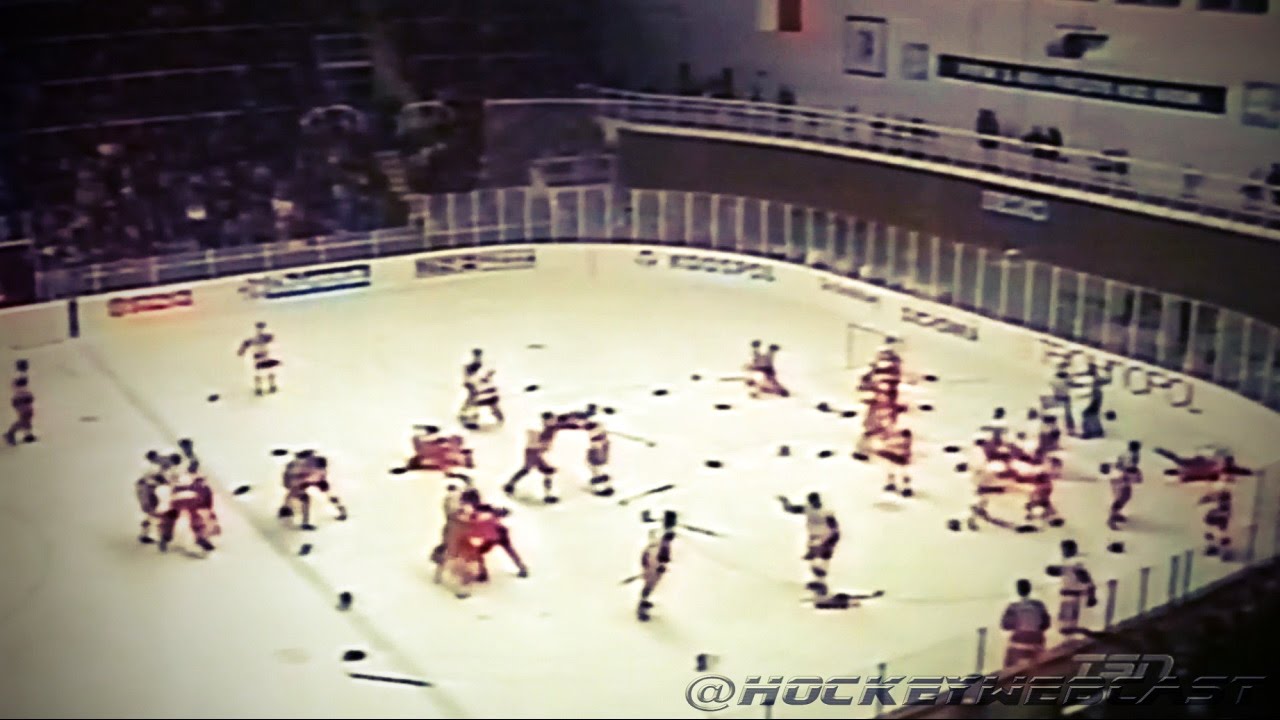
And that was all it took. Both benches cleared and everyone
grabbed a dance partner while Ronning and his linesmen tried to break up
individual fights. However, a Czechoslovakian member of the IIHF officiating
group ultimately ordered Ronning and the linesmen to leave the ice. In a
further effort to stop the ongoing melee, the lights in the arena were turned
off.
The brawl lasted roughly 20 minutes, eventually petering out
simple because the players were tired. They grabbed their stuff—still in the
darkened arena—and headed to their respective dressing rooms to wait for the
game to begin again. The game would not continue.
The IIHF directorate met and eventually president Guenther
Sabetzki declared that “the world championship [was] over.” Both teams were
ejected from the tournament.
“The Russians have learned their lessons well. They have embraced goonism—the final bit of Canadian hockey heritage that eluded them. And if I know the Soviets they will soon master the art,” wrote Al Halberstadt, a columnist for The Windsor Star. “The new breed of Soviet hockey player could have easily learned his trade at the knee of Dave Schultz or Tiger Williams.”
Team Canada’s head coach, Bert Templeton didn’t really see
how his players could have avoided what took place. He was proud of how well
his players had represented Canada up to that point in the tournament because
they didn’t go into the game as a gold medal contender.
“The Russians were the ones who instigated the whole ordeal.
In the end, they were the ones who actually got the most out of it. We’ve been
almost cheated out of our medals because they did start it. [Coach Templeton]
tried to hold us back on the bench but he can’t hold back 15 guys. By the time
we entered the ice, they had four guys already on the ice. Any time you see
your players or your family on the ice in danger of getting hurt you want to
step in and help them out and that’s what a lot of us tried to do,” stated left
winger Scott Metcalfe.
Both teams were allowed to participate during the 1988
tournament, which ironically took place in Moscow. Team Canada would go on to win
gold that year, followed by the Soviet Union with the silver and Finland with
the bronze.
Additional Sources:
“Canada, Soviet junior teams ejected from tourney after 20-minute brawl,” The Ottawa Citizen (Ottawa, Ontario), Monday, January 5, 1987, p. A1-A2.
Al Halberstadt, “No more Comrade Nice Guy,” The Windsor Star (Windsor, Ontario), Monday, January 5, 1987, p. A1.
“Soviets ambush Canada in hockey war,” The Windsor Star (Windsor, Ontario), Monday, January 5, 1987, p. A1.
“Juniors denied banquet clearing bench,” Alberni Valley Times (Port Alberni, British Columbia), Monday, January 5, 1987, p. 6.
Theo Fleury, Playing With Fire (Chicago, Ill.: Triumph Books, 2009), kindle edition
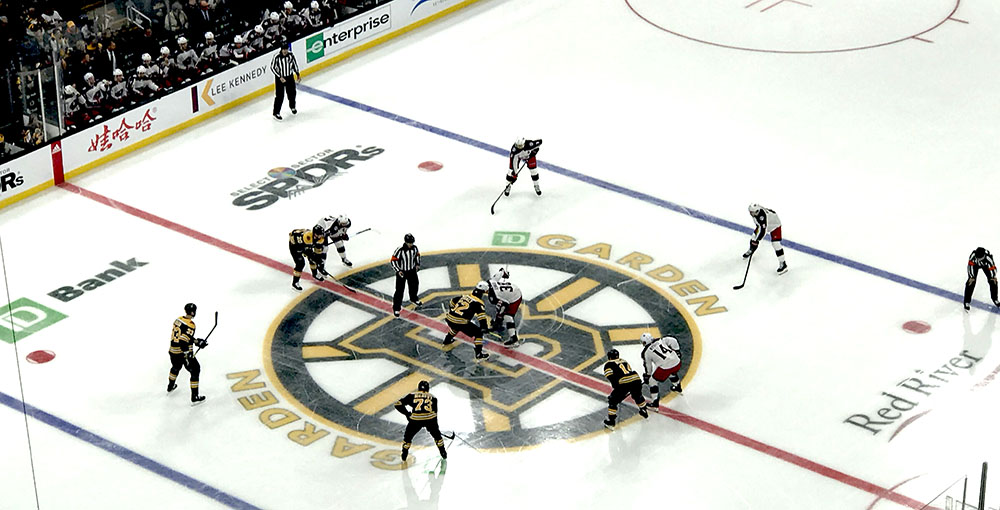
The Boston Bruins returned to TD Garden for their first game of 2020, playing host to the Columbus Blue Jackets—a team they saw in the second round of the playoffs this past season. It was the first of three games the two teams will play this season, with two of them in Boston and one in Columbus.
Once again, the Bruins were outshot by their opponent, though not as extremely as they had been during some of their games in December. And just 17 seconds into the game it looked like they were going to be playing from behind, when it appeared that Gustav Nyquist had put the Blue Jackets on the scoreboard. Bruins Head Coach Bruce Cassidy challenged claiming goaltender interference. Upon review, the goal was overturned, and the Bruins dodged a bullet.
In a penalty-free first period, both teams’ goaltenders were stingy, and the players in front of Columbus’ Elvis Merzlikins were willing to put their bodies on the line—blocking five of the shots attempted by the Bruins in the opener.
The second period saw the first penalty—a questionable hooking call on Nick Foligno—which gave the Bruins the first opportunity at the man advantage. The Bruins didn’t capitalize, and then Foligno’s exit from the box saw him with a good opportunity that Tuukka Rask had to stop to keep the Blue Jackets off the scoreboard. However, the Bruins would find the back of the net when they were again on the power play—a result of Dean Kukan being sent off for tripping Jake DeBrusk. David Pastrnak notched his 30th goal of the season just four seconds into that second power play at 11:07 of the second.
The Bruins took that lead into the second intermission, but they were called for their second penalty of the middle period, a holding on Zdeno Chara, with just 45 seconds remaining on the clock. The Bruins kept Columbus from scoring, but that meant that at the start of the third, the Blue Jackets would still have 1:15 left of their power play.
The Bruins were able to make the kill as the third period got underway, but then came some problematic puck management that kept Boston from clearing their end, and as all too frequently happens in such a case, Columbus was ultimately able to capitalize. Sonny Milano’s wrist shot actually deflected off of Matt Grzelcyk’s skate and the game was tied with 17:54 remaining in regulation. And there really wasn’t much that Rask could do on that one.
“It’s another lead going into the third period we weren’t
able to close out. That’s as frustrating as anything,” said Coach Cassidy.
However, once again the Bruins found themselves going to overtime, which has not been kind to the players in black and gold. Going into Thursday night’s game the Bruins’ OT record was 2-10. They are now 2-11 in the 3-on-3 overtime period, as Seth Jones was able to take the puck from Pastrnak and hustle up to the other end in an odd-man rush with Pierre-Luc Dubois that saw Jones make the pass and Dubois end the game.
“Yeah, I mean, it’s frustrating. Obviously, it’s been many
of them this year. It’s probably getting a little bit in our head. We want to
win a lot of those. It requires confidence…
We haven’t been doing well in it, so sometimes it’s frustrating,” said Pastrnak
of their overtime struggles.
“Well just be smarter; hang onto the puck. It seems like some teams do that to us where they’re hanging onto the puck and getting our changes at the appropriate time. I’m not just speaking about tonight, but games past, you know, I feel like we could out-change the other team a little better and be respectful of our changes and see what happens. Obviously, we have to capitalize on our chances. We had a pretty decent chance tonight. [Pastrnak] had a good chance and just couldn’t come up with it. That’s what happens; it’s kind of a crapshoot at times,” said Torey Krug on what they need to do in OT.
While their overtime and shootout struggles are concerning, the Bruins are not dropping every game. They continue to sit in first place in their division, and second place in the Eastern Conference and in the League. They certainly can’t continue to leave points on the ice, but they have some time in which they can work on the issue.
“As for the overtime, some of it is
we’ve got to smarten up. Can’t get caught diving down low, that’s happened more
than once this year. On those puck battles away from your net, if you don’t
make a play at their end, you’ve got to make sure you put yourself in a better
spot defensively to defend the rush or get off the ice. That’s cost us a few
times, so at some point you’ve got to learn from those mistakes as well,” said
Coach Cassidy.
None of the Bruins players are happy with taking just a point out of a game. They know they have to figure out how to turn things around, both when it comes to maintaining a lead as well as closing out a game in regulation or overtime.
They will practice on Friday, but they have little time to obsess, as they play a matinee on Saturday against the Edmonton Oilers.
Montreal hockey suffered a major loss shortly after the NHL formed. Mid-day on January 2, 1918, a fire broke out at the Arena on St. Catherine Street and Wood Avenue in Westmount, a suburb of Montreal. The rink burnt to the ground that afternoon leaving two NHL teams, five Montreal City League clubs, and a college team without a home. All but one found new arenas and continued to play. The Montreal Wanderers instead became the first NHL franchise to fold.
The Arena had opened almost exactly 19 years earlier, on the final day of 1898. It hosted the first NHL game on December 19, 1917. The Wanderers defeated the visiting Toronto team 10-9. That would be the sole victory for the Wanderers who only played in three other NHL games.
Come January, the Fire Underwriters’ Association inspectors had just certified the safety of the Arena. They reported that “usual precautions had been taken by the company to prevent fire.” However, a fire started, as the Montreal Gazette reported, “which originated between the floor of the secretary-treasurer’s office and the ceiling of the west side dressing-room.” The cause was not known, but they “thought a defective electric wire was responsible.” Later, historian J. Andrew Ross confirmed this theory of faulty wiring at the root of the fire.
Fortunately, very few people were on the property at that time of day even though a game between the Wanderers and the Canadiens was scheduled for that evening. James McKeene, the superintendent of the building who had been there since it opened, had been eating a meal with some family members, and they rushed to help the firemen. In fact, the only injury occurred when a spectator broke a leg slipping on the icy sidewalk.
Firemen from both Westmount and Montreal arrived on the scene to combat the flames. The southern wall fell soon afterwards. The Gazette noted that the fire “spread so rapidly that it was impossible to save the building.” Their report continued, “For twenty minutes the flames raged from end to end of the structure; then the boilers exploded and the entire framework collapsed.” So many streams of water were needed that the water pressure was too low until the Montreal brigade brought their powerful pumping engines. Although the heat was so high that they could not get too close, the firemen bravely stuck it out for four hours. Chief Moffatt of the Westmount brigade commented, “It is the biggest fire that the firemen of Westmount have been called upon to handle, and we are thankful to Chief Tremblay, Deputy Chief Mann and their men for the aid they gave us.”
The firemen mainly focused on saving the structures around the Arena. The ice-producing plant to the east of the rink was “damaged by the smoke and water,” but President Ed Sheppard of the Montreal Arena Co. reassured that it would be “repaired and in operation in the course of a few days.” The front windows smashed on all of the houses on the block of Wood Avenue to the west of the Arena, and one roof caught fire. Otherwise, the firemen were able to stop the fire from spreading.
When the Arena burnt to the ground, Sheppard estimated the damages at $150,000. The building had cost $75,000 to build and was only insured for $50,000. The Gazette felt that the building would cost too much to reconstruct, so they predicted that the Montreal Arena Co. would sell the valuable property instead.
In addition to the building itself, much was lost within. Manager William Northey had stored a large Buick there, and McKeene lost all household goods but for a music cabinet. On top of that, each of the many teams housed at the Arena lost equipment. The Wanderers and Canadiens each lost about $1,000-worth of uniforms and sticks. Only the skates that had been sent for sharpening before their game were spared. All five City League clubs lost their effects as well. The estimated losses included about $1,000 for McGill, $900 for the Canadian Vickers, $850 for the Shamrocks, $800 for Laval, and $750 for the Nationals. Loyola College lucked out with few damages because they had not yet returned their equipment to the dressing room after traveling for a game.
Instead of holding a game that evening, hockey leagues held meetings to plan their next steps. The City League arranged to move to Victoria Rink and pushed back the schedule by a week. The Canadiens’ manager, George Kennedy, made arrangements to move the francophone NHL franchise to Jubilee Rink on St. Catherine Street, Maisonneuve, in the French-speaking East End of Montreal. They would skate there until the following April, when it also burned down. Although instructed to try Jubilee Rink as well, the Wanderers balked because their English-speaking supporters would not leave the West End.
The Wanderers also had a roster issue at the time. World War I left the NHL with few players. As Manager Art Ross told the press, “We are badly in need of players and unless we receive help from the other clubs we cannot make a showing in the race for the title.” Unfortunately for them, the Ottawa Senators had also just lost two players to the war effort while the Canadiens and Toronto had barely enough to keep themselves playing. With the disbanding of the Wanderers, forward Harry Hyland and defenseman Dave Ritchie would be sent to Ottawa, goalie Harry Holmes to Toronto, and Jack McDonald and Jack Marks to the Canadiens.
After a “lengthy and stormy” meeting of NHL directors at the Windsor Hotel on January 3, the Wanderers’ resignation was not accepted. President Frank Calder gave the owner, S.E. Lichtenhein, 24 hours to reconsider. Despite folks in Hamilton offering to purchase and relocate the franchise, the Wanderers chose to default on the game scheduled in Toronto and officially withdrew from the NHL on January 4.
Six years later, in 1924, the English-speaking population of Montreal received a new NHL franchise that came to be called the Maroons. They tried but failed to get the rights to use the name Wanderers. The Maroons would play at the new Forum built just one block to the east of the old Arena.
Additional Sources:
Mike Commito, Hockey 365: Daily Stories from the Ice (Toronto: Dundurn, 2018), kindle edition.
“Arena Not Likely to Rise from Ashes,” Montreal Gazette, 3 Jan. 1918, p. 5.
“No Curtailment in Local Hockey,” Montreal Gazette, 3 Jan. 1918, p. 12.
“Wanderers Hand in Resignation,” Montreal Gazette, 4 Jan. 1918, p. 12.
“Wanderers Default,” Montreal Gazette, 5 Jan. 1918, p. 16.
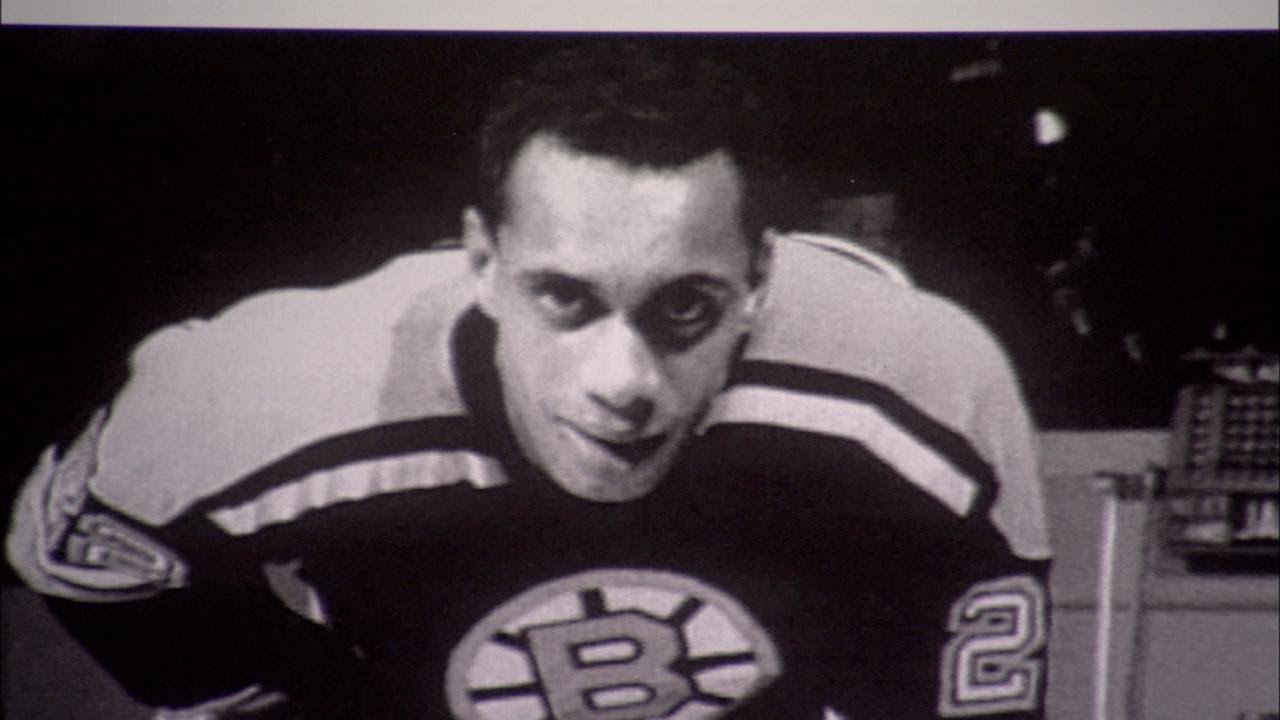
Whenever Willie O’Ree made history, it seemed that it was when the Boston Bruins faced the Montreal Canadiens in back-to-back games. He became the first black player in the NHL when he joined the Bruins for a bout in Montreal on January 18, 1958 and the rematch in Boston the following day. Nearly three years later, O’Ree again participated in a Montreal-Boston series. After playing in Montreal on Saturday night, back in Boston on Sunday, January 1, 1961, O’Ree became the first black player to score an NHL goal.
The two Bruins-Canadiens matchups marked the only NHL games for O’Ree during the 1957-58 season. Unsurprisingly, considering his rookie status and blindness in one eye, he did not earn any points in those debuts. Afterwards, he returned to the Quebec Aces to continue developing. In time for the game on November 19, 1960, 25-year-old O’Ree received his second call-up to the Boston Bruins. A month later, on December 22, he scored his first two NHL assists.
For O’Ree’s ninth and tenth appearance during the 1960-61 season, the Bruins played the Canadiens in Montreal on New Year’s Eve and in Boston the following day. The Forum held a crowd of 13,391, and then Boston Garden welcomed a capacity crowd of 13,909. O’Ree’s mother and two sisters joined the audience in Montreal but were unable to attend in Boston.
Referee Dalton McArthur was not too busy the first night as he only called nine minor penalties (with the majority called on the Bruins). However, he had his work cut out for him the next night as he doled out 32 penalties for a total of 92 minutes, just four penalties shy of the record set in 1953. Although the majority of the penalties were called on the Canadiens, Bruins left wing Jimmy Bartlett racked up the most with 23 minutes (including three minors, a major, and a misconduct). The Boston Globe considered the game an example of the “violent demonstrations that are almost a Boston hockey tradition on New Year’s Night.”
In each case, the home team won with three goals. On Saturday, the Canadiens scored three goals while the Bruins only managed a power play goal by Bronco Horvath at 4:40 of the third period. On Sunday, the cellar-dwelling Bruins scored once per period while only allowing the first-place Canadiens to find the back of the net twice.
O’Ree potted the game-winner at 10:07 of the third period during Sunday’s rematch. According to the Boston Globe, the goal was not just significant for racial reasons. “It was a consummately skillful effort, too. Taking a Boivin pass, while both sides were short a man, O’Ree first eluded Tom Johnson, then faked the other defenseman, Jean-Guy Talbot. Talbot broke his stick in frustration as Willie swooped in front to beat goalie Charley Hodge. Then he dove right in to retrieve the puck as a souvenir.” Ever proud of his origins, O’Ree commented, “I scored that one for the whole town of Fredricton.”
The success of the shot O’Ree attributed to advice from teammate Bronco Horvath. “I shoot with my wrists way out here. It gives me a tendency to shoot high. Saturday night in Montreal I had a great scoring chance on a pass from Horvath. But I hit Charlie Hodge in the stomach. In the pre-game warm-up tonight, I shot one high, and Bronco called me on it. He told me I’d never score that way. Shoot along the ice, he told me. He told me to shoot with my arms in closer to my body, and it would enable me to keep the puck on the ice.”
With his first NHL goal out of the way, O’Ree would go on to earn assists on January 12 and 15 and his next goal on January 19. He played in a total of 43 games that season, accumulating a total of four goals and ten assists. Although he hadn’t been penalized in the “violent demonstration” on January 1, he did sit 26 penalty minutes throughout the season.
That offseason, the Bruins actually traded O’Ree to the Canadiens, but he played for the Hull-Ottawa Canadiens of the Eastern Professional Hockey League. He spent the rest of his skating career with the Western Hockey League, retiring in 1979. As of 1998, O’Ree began his off-ice NHL career as a diversity ambassador, and 20 years later he was inducted into the Hockey Hall of Fame.
Additional Sources:
Mike Commito, Hockey 365: Daily Stories from the Ice (Toronto: Dundurn, 2018), kindle edition.
“Bruins Tip Habs, 3-2, as 92 Penalty Minutes Called,” Boston Globe, 2 Jan. 1961, pp. 85 and 90.
Dink Carroll, “Bruins Bow to Habs Here 3-1,” and Canadian Press article, Montreal Gazette, 3 Jan. 1961, p. 22.
At the end of 1988, Mario Lemieux rang in the new year not just once but five times by five methods in five unique circumstances. The game held at the Civic Center for 16,025 fans on December 31, 1988 marked one of the highest highlights of Lemieux’s storied career.
From the beginning, Lemieux’s success as a scorer was anticipated and appreciated. On the final day of 1985, his Pittsburgh Penguins played the Blues at St. Louis Arena for and audience of 9,297. Although he was suffering from a cold, he made four shots on net and scored four goals for his first NHL hat trick. He made a goal at the top of each period with two of them taking advantage of power plays. While he was at it, he also helped his team with two assists as the Penguins won 8-4. Lemieux joked, “Hey, I wanted five goals after I got the first two to get me going. When things are going so good, why not go for it.”
Go for it he did. Exactly three years later, Lemieux managed not only five goals in one game but three assists as well. He only needed eight shots on goal to accumulate eight points. The Penguins only had 19 shots on net total as they defeated the New Jersey Devils 8-6.
Lemieux scored a hat trick in the first period. At even strength within the first five minutes, he ducked around the New Jersey defensemen and sent the puck towards the center, where it tipped off the skate of defenseman Craig Wolanin. About three and a half minutes later, the Penguins were short-handed when Lemieux scored “on a shot that dribbled between goalie Bob Sauve’s legs.” After another three minutes, Lemieux earned himself a power-play goal “on a slap shot from above the left faceoff dot.” Thanks to him, the Penguins led 3-2.
All three of Lemieux’s assists came during the second period, and all three occurred during power plays. In the midst of them, he made good on a penalty shot. With Pittsburgh having scored on five of their ten shots on net, the Devils had replaced Sauve with Chris Terreri, who “threw his stick at the puck in the right faceoff circle.” Consequently, a penalty shot was awarded. Upon consulting with his goalie, Tom Barrasso, commented Lemieux, “He said he didn’t know anything (about Terreri). So I figured it out for myself.” The goal made Lemieux three for three on penalty shots thus far in his career.
Even with all his efforts throughout the game, Lemieux saved something for the very end, the final second and perhaps even later. The Pittsburgh Press noted that the empty-netter was of “dubious pedigree – his shot appeared to enter the empty New Jersey net after time had expired in the third period.” Lemieux admitted, “I don’t know if it was a good goal or not.” Regardless, he was awarded a goal at 19:59 to become the only person known to have made five goals five different ways – at full strength, short-handed, on a power play, on a penalty shot, and on an empty net.
As Penguins Coach Gene Ubriaco remarked, “I think we all just saw Mario’s gift, a little late for Christmas, to me and the fans. I’m not going to say ‘Awesome,’ I’ve said that too many times.” Lemieux’s right wing Rob Brown tried to put things in perspective, “I think it was just another average night for him. He just decided this was going to be his game and nobody else’s. some of the things he did out there were amazing. … It was a classic example of the best hockey player in the world teaching us how to play.”
The five goals set a franchise record, and his eight points tied one that he set back on October 15 earlier that season. Lemieux even tied a team record for most points in a single period, the second, with his four. His first assist, just 39 seconds into that period, gave him 100 points in 36 games. That made him the third-fastest to 100 points.
Unsurprisingly, at the end of the 1988-89 season, Lemieux had personal highs of 85 goals, 114 assists, and 199 points. That gave him his second consecutive Art Ross Trophy for leading the league in regular-season points. He would go on to receive that trophy back-to-back in 1992 and 1993 and again in 1996 and 1997. The five goals done five ways was voted as the top event in NHL history at the league’s centennial. Lemieux responded, “You think of all the great moments in the NHL over the last 100 years, for the fans to pick my five goals is something special.”
Additional Sources:
Mike Commito, Hockey 365: Daily Stories from the Ice (Toronto: Dundurn, 2018), kindle edition.
David Fink, “Mario nails 4, Penguins win,” Pittsburgh Post-Gazette, 1 Jan. 1986, pp. 31 and 33.
Dave Molinari, “Lemieux scores 5 goals, Penguins beat Devils, 8-6,” Pittsburgh Press, 1 Jan. 1989, pp. D1 and D12.


 Prev
Prev


![Waz8 [CC0]](https://commons.wikimedia.org/wiki/File:RI_Reds_Zellio_Toppazzini_plaque.jpg)
