We have all seen it—a player in the NHL achieves that
milestone 1000th game and he is showered with a pre-game presentation on home
ice in front of his adoring fans that includes, among other things, a silver hockey
stick.
But what does a referee get after officiating 1000 games?
Well in 2018 when Wes McCauley reached his milestone, he was honored before the
game with his family, fellow officials and the NHL Director of Officiating,
Stephen Walkom, at center ice. He was presented with signed jerseys from both
teams.
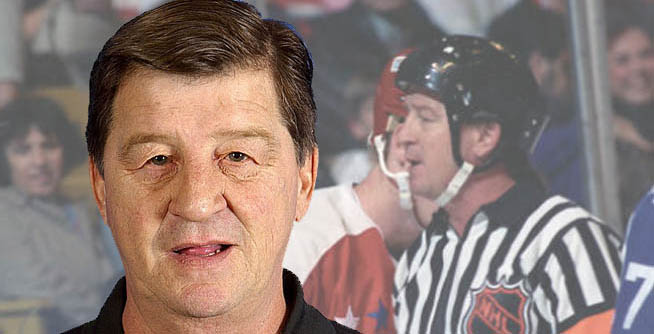
When Dave Newell became just the fourth referee to reach 1000 NHL games on January 31, 1987, what did they do for him?
A search of the newspapers shows that he appears simply
because he was the referee of the game that took place in Toronto between the
Toronto Maple Leafs and the Detroit Red Wings. There was no indication of a
pre-game presentation or acknowledgement. However, not everyone overlooked him.
“Former Wings forward Brad Smith, who had missed five games
with a back muscle pull, returned to the leafs’ lineup Saturday. He stirred the
emotions of the crowd with a wild skating style reminiscent of former Leaf
Eddie Shack. Among those Smith crashed into during his free-wheeling gyrations
were teammate Wendel Clark and referee Dave Newell,” reported the Detroit
Free Press the day after the game.
Beyond that, his name simply appeared in the traditional
statistics columns. Not much of a thank you for the years of in-your-face
attitude and disagreement that meets just about every referee during every game.
Newell began his NHL officiating career in 1967 and would
put his skates and the stripes on until his retirement in 1990—standing tall
for 1,169 regular season games and 106 playoff games. Throughout that time, he
was the sole referee on the ice, as the NHL did not go to a two-referee,
two-linesmen system until the 1998-99 season. He worked the NHL Stanley Cup
Final in 1981, 1984 and 1987. He was also selected for the 1980 All-Star Game
and the second game of the Rendez-vous ’87 series that saw the NHL All-Stars
and the Soviet Union national team play two games in Quebec City.
In 1988 during the Wales Conference final playoff series between the New Jersey Devils and the Boston Bruins, it would be Dave Newell who would lead a wildcat strike of the officials.
At the end of the third game, Devil’s coach Jim Schoenfeld confronted referee Don Koharski, hurling verbal abuse from the second Koharski left the ice and following him down the tunnel. As a result, Schoenfeld was suspended for a game. However, the Devils took their case to the New Jersey courts and were able to get a restraining order allowing Schoenfeld to continue coaching in the next game.
Newell, who was the scheduled referee, as well as president of the NHL Officials’ Association at the time, along with linesmen Gord Broseker and Ray Scapinello, and alternate referee Denis Morel refused to officiate the game. Newell felt that the NHL should be doing more to protect the referees. In the end he and his fellow officials were not penalized for taking a stance.
During the 1987-88 season, an article in The Vancouver Sun perhaps offered the best spotlight on Newell’s life as a referee.
“Newell, 43, is sitting in his Hotel Vancouver room gnawing
on a toothpick and habitually twisting his NHL Officials ring, a bagel-sized
affair with an orchard of diamonds planted on top.
“Twenty-one years of rink hopping, whistle blowing, puck
dodging, four-letter word deflecting—not to mention death threats, hate mail
and the occasional fist in the face—and that’s about all the sentimental
acknowledgment (besides a weird sort of fame that might as well be infamy) Dave
Newell gets. A ring.”
The diamonds on his ring signified he had reached 15 years of service in stripes.
“Maybe after 25 years I’ll get a rocking chair,” Newell shared.
Newell would never find out, as his NHL career spanned 22 years before he decided to retire in 1990. And once again there was no fanfare—a simple pondering by Newell to Jim Matheson, who mentioned it in his Hockey Notebook column in the Edmonton Journal, that it might be time for him to consider hanging up the whistle.
However, even after retiring, he continued to be involved,
working for 15 years as an NHL Officiating Coach, helping to bring new
officials to the game.
When he passed away on November 23, 2018, Colin Campbell, NHL senior executive vice president of hockey operations summed up Newell’s career and with those words showed the regard in which Newell was held.
“A consummate professional who epitomized class, Dave’s calm
demeanor on the ice earned him the respect of players and coaches.”
And perhaps a referee would prefer to be remembered that way
rather than with some fancy fanfare.
Additional Resources:
“Wings-Leafs tickets hot items Saturday,” Detroit Free Press (Detroit, Michigan), Sunday, February 1, 1987, p. 8C.
Barry Meisel, “Schoenie ban lifted” Daily News (New York, New York), Tuesday, May 10, 1988, p. 50.
Lee Bacchus, “The Men They Love to Hate,” The Vancouver Sun (Vancouver, British Columbia), Saturday, November 7, 1987, p. H1.
Jim Matheson, “Hockey Notebook,” Edmonton Journal (Edmonton, Alberta), Sunday, February 4, 1990, p. C2.
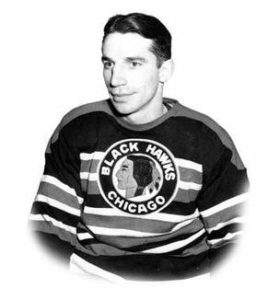
If your last name was Bentley and you were wearing a Chicago Black Hawks sweater, then it was a good bet that you were involved in the goals being scored against the New York Rangers when the Black Hawks took on the Rangers at Chicago Stadium on January 28, 1943.
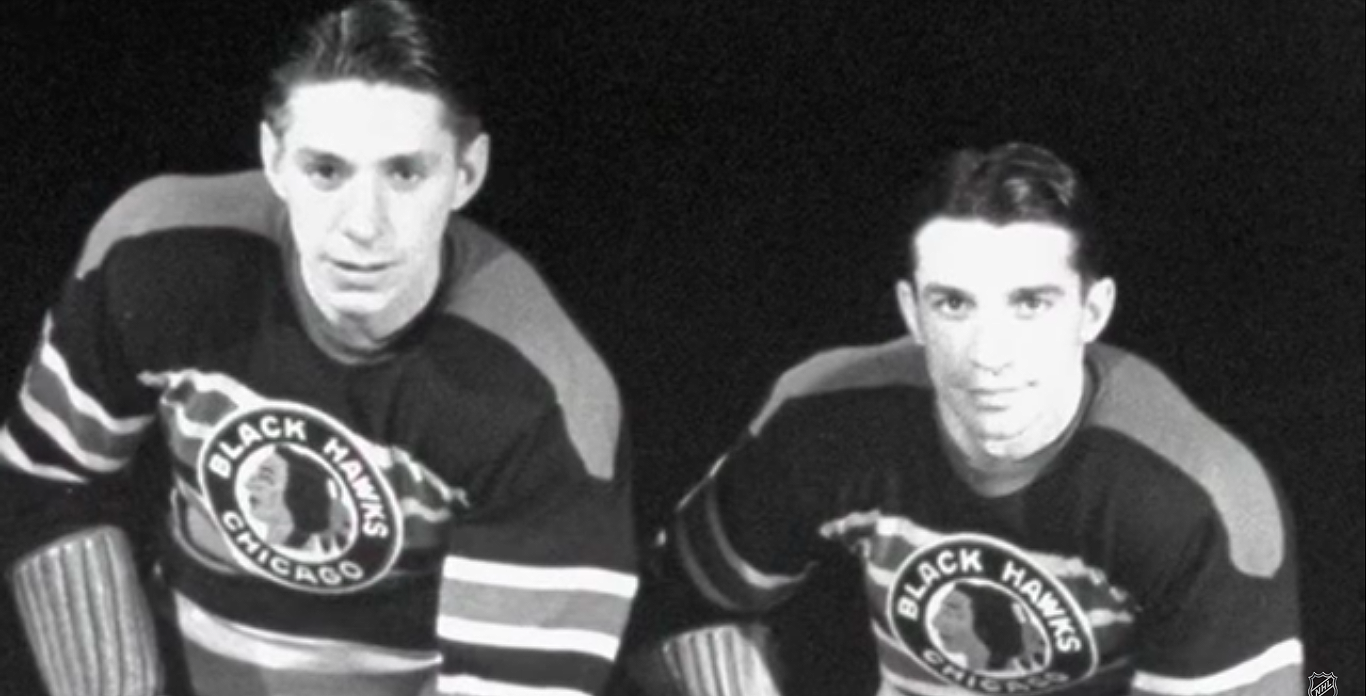
Doug and Max Bentley were the youngest of six brothers, all of whom played hockey. Doug was born September 3, 1916 and Max joined the family March 1, 1920. They were born and raised in Delisle, Saskatchewan on a farm–two of thirteen children. Their father Bill, who was born in Yorkshire, England and immigrated to the United States as a child, settled in Delisle in 1902. In addition to many other business interests he, and his sons, worked hard on the family farm that raised cattle, horses and wheat. It was on the farm where the Bentley brothers built up their strength and mastered their skating abilities. Bill would flood a field on his farm each year that was as long as a regulation NHL rink, but not as wide. The brothers learned how to get themselves out of situations and find the space to shoot. For Max, this training coupled with his innate skill resulted in his ability to put the puck in the net from any angle.
The brothers were turned down by the Boston Bruins’ Art Ross, who described them as “among the worst amateurs to come to my camp.” The Leader-Post columnist Dave Dryburgh had some thoughts on that assessment, writing, “It is foolish to doubt the word of the astute Mr. Ross, nevertheless us westerners accept that statement with a grain of salt. Several grains.”
Doug was signed to the Black Hawks in 1939 and Max followed in 1940.
By the 1942-43 season the brothers were on the first line
for Chicago. Max centered the line with Doug on his left and Bill Thoms on his
right. During the game against the New York Rangers, these three would amass 18
of the 27 points garnered by their team.
In almost every way this was a lopsided game with the Black
Hawks coming out on top. The Black Hawks put 55 shots on Rangers netminder Bill
Beveridge, who had been recalled from the Cleveland Barons. Meanwhile Chicago’s
goaltender Bert Gardiner saw just 15 shots, the first of which didn’t come at
him until 12 minutes into the opening frame.
Doug got the scoring going for the Black Hawks at 6:58 of
the first period, assisted by his brother and Thoms. A rolling puck on the
third shot by the Rangers and accredited to Phil Watson at 13:19 of the first
knotted the game up, with assists going to Bryan Hextall and Lynn Patrick. Bob
Carse put Chicago up 2-1 at 18:27 of the first and that’s where the score stood
at the end of the penalty-free opener.
The second period saw more penalties than goals. But it was
once again Doug Bentley, assisted once again by Max and Thoms who gave the
Black Hawks a 3-1 lead.
It was the third period that saw poor Beveridge unable to stop
the pucks from hitting the twine behind him.
“While Bill Beveridge struggled to close the door of his
cage, the Black Hawks kept their feet in it like persistent salesmen and
harried the pinch-hitting Ranger goalie with 45 pot shots which he stopped,” described
The Leader-Post. “It was only luck that more shots didn’t trickle in,
for Beveridge… was as unprotected as a scarecrow in a corn patch most of the
time.”
Max Bentley put his first goal of the game in at 1:44 of the third period. Aud Tuten, with Max assisting, gave the Black Hawks their fifth of the game just 19 seconds later. Max put his second one of the game in at 11:06 of the third and then Red Hamill notched one 34 seconds later for his 22nd of the season. Hamill gave the Black Hawks their 8th, while Chicago was short handed at 14:22. Max once again found the back of the net at 17:11 and then garnered his fourth goal of the game at 19:36 to give the Black Hawks a 10-1 victory over the Rangers. Doug assisted on all four of Max’s goals while Thoms was there for three of them.
With his four goals and three assists, Max Bentley tied the NHL scoring mark and moved himself into third place with 44 points (19G, 25A), while his brother Doug was just two points behind him and in fourth place among the scoring leaders of the season with 42 points (20G, 22A). Max’s four goals and three assists set a Black Hawks record.
Both Max and Doug would go on to be inducted into the Hockey Hall of Fame, Doug in 1964 and Max in 1966. Max was named one of the NHL’s 100 greatest players in 2017, not bad for an Art Ross throwaway.
Additional Source:
Dave Dryburgh, “Along the Sport Byways,” The Leader-Post (Regina, Saskatchewan), Friday, October 27, 1939, p. 20.
Jack Batten, George Johnson, Bob Duff, Steve Milton, Lance Hornby, Hockey Dynasties: Blue Lines and Bloodlines (Buffalo, N.Y.: Firefly Books, 2002), p. 14-15.
“Bentley Boys Go on Rampage,” The Leader-Post (Regina, Saskatchewan), Friday, January 29, 1943, p. 16.
“Bentley Jumps to Third Sport,” The Leader-Post (Regina, Saskatchewan), Friday, January 29, 1943, p. 16.
“Hawks Hand 10-1 Lacing to Rangers,” Detroit Free Press (Detroit, Michigan), Friday, January 29, 1943, p. 16.
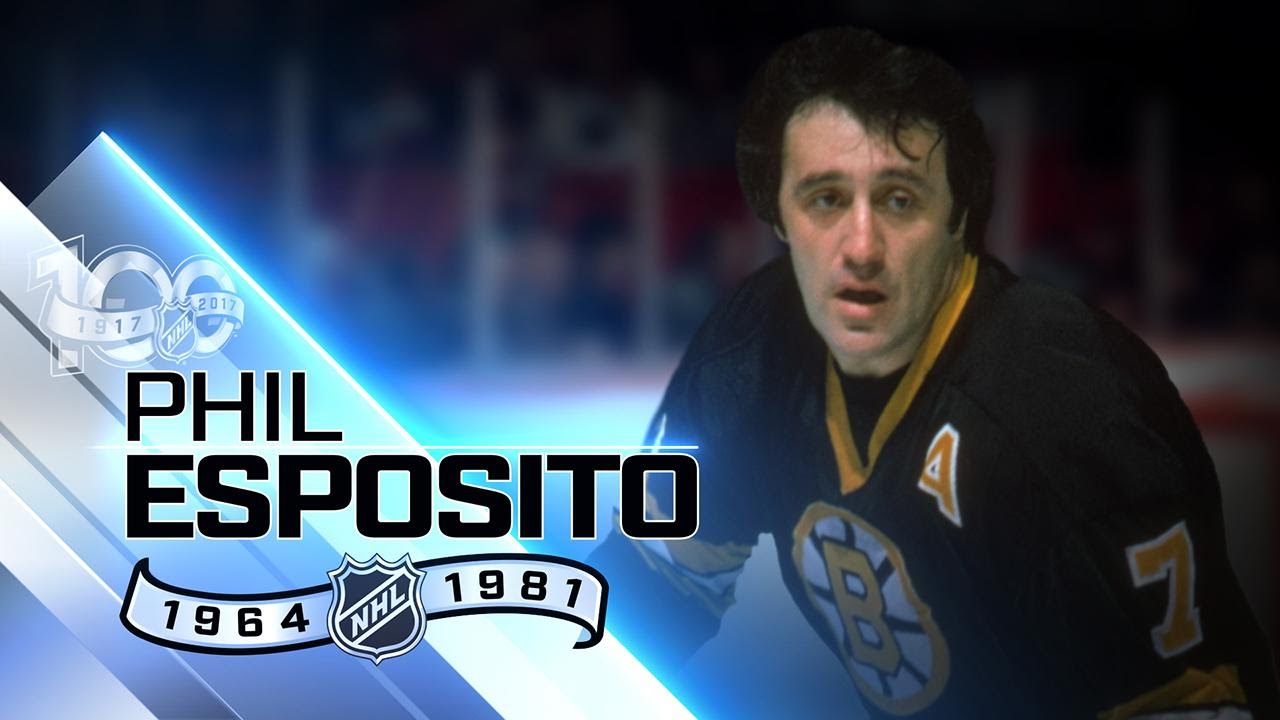
Scoring goals was typical for Phil Esposito. But everyone has to start somewhere, and for Esposito, he scored his first NHL goal on January 25, 1964. On the eighth anniversary of that milestone, in 1972, he notched the game-winning goal for the East Division at the NHL All-Star Game. It was his first All-Star goal.
1964
For rookie Esposito’s fifth NHL game, his Chicago Blackhawks played at Detroit’s Olympia Stadium before a crowd of 14,226. As far as scoring, the first two periods of the game went Wings then Hawks then Wings then Hawks. Alex Delvecchio scored both for Detroit. Red Hay tied things up a minute after Delvecchio’s first, and Esposito tied the game again at 16:01 of the second period.
During a period high in penalties, 21-year-old Esposito “scored on a setup by [Reggie] Fleming.” Afterwards, Detroit’s leader, Sid Abel, said, “I was on the phone before he scored. Ron Ingram was backing up at the blue line and it gave Fleming room to maneuver to get the puck to Esposito.”
Despite Esposito’s effort, Detroit scored again. The Blackhawks managed to tie once more when Bobby Hull “pushed the puck home from only a foot away as he lay sprawled against Sawchuk.” However, then Detroit’s Bruce MacGregor found the net twice within the final six minutes, first from “flat on his back” and then “while on his knees” to win the game 5-3.
Esposito would only tally two more goals over the remainder of the season. After being traded to the Boston Bruins on May 15, 1967, his scoring shot up. Over the next seven seasons, he would earn the Art Ross Trophy five times.
1972
He also participated in ten NHL All Star Games between 1969 and 1980. The 25th such game, in 1972, was held at Bloomington, Minnesota for 15,658 fans. The West Division took the lead after Bobby Hull kicked things off. During the second period, the East Division caught up to knot the score at 2-2.
The only one to score during the third period was Phil Esposito. At just 1:09, Bobby Orr set up the play so that “Dallas Smith slipped Esposito between Keith Magnusson and Doug Mohns for the deciding goal with a perfect pass. Phil did the rest.” Esposito explained, “I pulled the puck on my backhand, and Gump moved. When he did, I just let it go and it went in off his pad.” As the Boston Globe put it, “Strange as it may seem, the points earned on the deciding goal were the first in All-Star competition for Esposito, who has played in five games, and Orr, who has played in four.”
For Esposito, the goal was just an experience. He told the press, “A win in the All Star game is nice but let me put it this way: It doesn’t mean as much to me as a regular season win for the Bruins.” As the game-winner, he was entitled to $160. The players all contributed $10 apiece for the winning goal. Orr joked, “I’m not going to give Esposito $10. Hey Phil, will you take an IOU from me.” Although Orr did pay, his teammate did not accept the money. Instead, when trainer Eddy Palchak tried to reward him, Esposito told him, “Here Eddy. Split the money up between the trainers.” Then Johnny McKenzie reminded Espo he had yet to contribute to the pot, so scoring the goal actually cost the winner $10 instead of earning him $160. He did not even receive recognition as a star of the game as Orr took the first star.
Both Orr and Esposito injured themselves in the final moments of the game. With about 3:40 to go, Orr was hurt putting himself in the way of Bobby Hull’s slap shot. He went to the dressing room but returned for the final minute. With only 55 seconds remaining, Esposito later said, “I banged my ankle off the post at the back of the net and then my skates caught in the netting.” At least they ended victorious.
Esposito had quite an improvement between his first season and that of the All-Star game-winner. In 1963-64, he played just 27 games and scored three goals and two assists. By 1971-72, he played the full 76 games and tallied 66 goals, 67 assists, and 133 points. That was the third-highest of his career and earned him the Art Ross Trophy, again.
After being traded to the New York Rangers on November 7, 1975, Esposito retired in 1981 with 717 goals, then only second to Gordie Howe. He still ranks sixth in career goals and tenth in career points (1,590).
Additional Sources:
Mike Commito, Hockey 365: Daily Stories from the Ice (Toronto: Dundurn, 2018), kindle edition.
“Wings Beat Hawks on 2 Late Goals,” Chicago Tribune, 26 Jan. 1964, section 2, pp. 1 and 3.
Jack Berry, “Wings Belt Hawks, 5-3,” Detroit Free Press, 26 Jan. 1964, p. D1.
Tom Fitzgerald, “Bruins wrap it up for East, 3-2,” Boston Globe, 26 Jan. 1972, pp. 27-28.
Kevin Walsh, “Orr takes Hull’s best shot, he’s OK,” Boston Globe, 26 Jan. 1972, pp. 30.
Kevin Walsh, “Esposito out 10-spot after game winner,” Boston Evening Globe, 26 Jan. 1972, pp. 51-52.
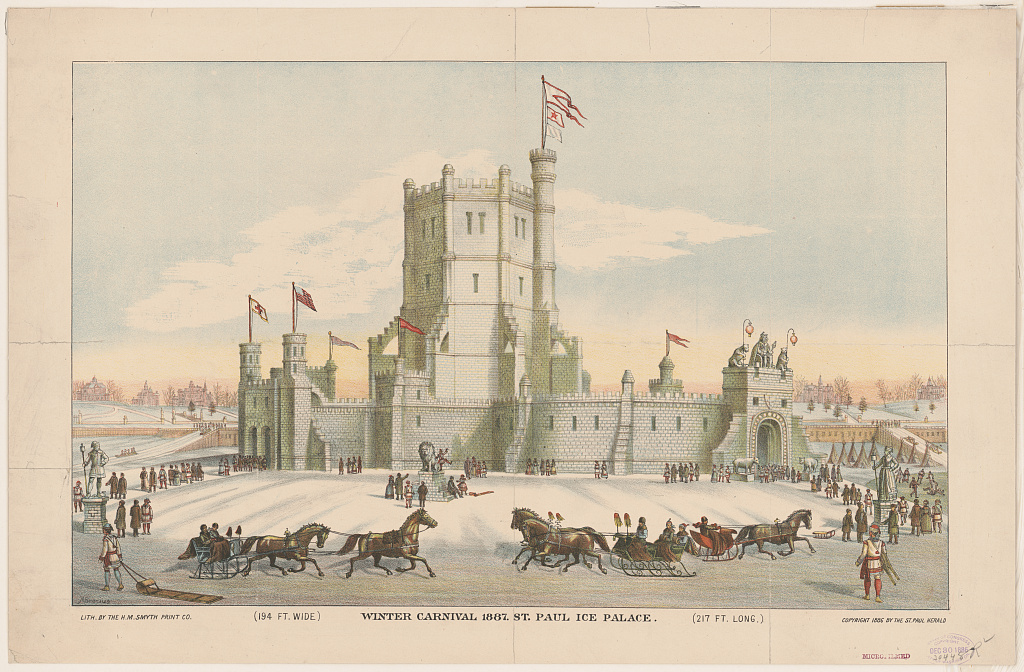
Many who live outside the “State of Hockey” do not realize that the Twin Cities can be quite different from each other. Minneapolis actually had ice hockey for almost a year before St. Paul caught up by forming the St. Paul Hockey Club in December 1895. It wasn’t until Aurora Park opened on New Year’s Day that St. Paul hosted its first games. During the Winter Carnival on January 24 and 25, 1896, St. Paul held its first tournament, matching two of its own teams against teams from Minneapolis and Winnipeg.
“Hockey is claimed by its admirers to be the fastest and most exciting ice game played in this country,” gushed the St. Paul Globe in mid-December 1895. The St. Paul Hockey Club had just organized, and its membership had already grown from 22 to somewhere in the range of 40-50. That group would supply the teams who would play in games and tournaments. With so many members, they thought they might even put together six whole teams for the upcoming Winter Carnival tournament.
The club chose to have members each wear a “cap of crimson and gold colors.” Other than that, they “opposed to the adoption of a uniform, owing to the fact that several members of the club are already members of other carnival clubs which have uniforms.”
Their first practice was scheduled for Como Park on December 15 at 10:30 am. Once Aurora Park opened, the St. Paul Hockey Club members would pay $2.50 for the right to play there once a week (since the four polo clubs already had agreements there). As the Globe explained, “This insures the permanency of the membership, as each one putting up for a ticket will be sure to continue his connection.”
Aurora Park would feature at least three skating surfaces. The 300×215-foot rink was meant for pleasuring skating, and the 10-foot track outside would host speed skating. “In front of the grand stand will be the Polo rink, 170×150 feet, where polo and hockey will be played,” reported the Globe. There would be a 24×100-foot warming house with refreshments located on the Dale Street side, and Fort Karnival would be erected in the park on St. Alban’s Street. All of Aurora Park would have electric lighting.
The park delayed its opening due to mild weather, wanting to wait for “first-class ice.” The grand opening was held on January 1. They offered music, a polo game, and hockey in the afternoon and evening, followed by fireworks. “The crowd increased in the evening,” noted the Globe. “The rink was illuminated with clusters of electric lights, supported on masts, and by colored pyrotechnic displays”
The following day, a “spirited game of ‘hockey’ was held between two teams made up of the St. Paul Hockey Club. They played despite other events being postponed due to excessive cold. Some visitors came out to skate, and the warming house was opened up for a dance.
Finally, the Winter Carnival tournament took place. Only four teams ended up participating with half consisting of members from the St. Paul club. Unfortunately for these newcomers, the first two games, held at Aurora Park on January 24, “resulted in a bad defeat for teams one and two of the St. Paul club.” During the afternoon game, Winnipeg crushed Team 1 with a score of 13-2. “From the manner in which they played, the Winnipeg club will undoubtedly carry home the trophies,” predicted the Globe. “They have a great advantage over the St. Paul players in team work, although individually the kind of game put up by them is not much superior.” That evening, Minneapolis beat Team 2 by 4-1 before a large number of carnival spectators.
On January 25, the consolation and championship games were held next to the curling rinks, and “the playing was of the genuine sort there.” Happily, the afternoon had “carnival weather of the right sort, and its effects were visible at the fort and Aurora park, both in the way of attendance and in enjoyment.” In two 15-minute halves, Winnipeg proved the Globe correct by winning first prize over Minneapolis with a score of 7-2. Again the Globe recognized their superiority, praising Winnipeg’s “much greater skill and endurance,” but the press also noted that the “Minneapolitans fought vigorously.” For prizes, Winnipeg won a silver stein and Minneapolis took home hockey sticks.
It would not be until 1902 that the area hockey teams formed a formal league. When they did, the Twin City Hockey League included St. Paul Hockey Club, Mechanics Arts High School, the Mascots, the Virginias, and Minneapolis. Beginning in 1904, their champion would play either Two Harbors or Duluth for the title of state senior champion. Meanwhile, after 1896, the Winter Carnival would not return until 1916 and 1917.
Additional Sources:
“Aurora Skating Rink” and “Hockey Club Formed,” Saint Paul Globe, 15 Dec. 1895, p. 14.
“Hockey in Favor,” Saint Paul Globe, 22 Dec. 1895, p. 7.
“Aurora Skating Rinks,” Saint Paul Globe, 31 Dec. 1895, p. 5.
“Aurora Rink Open,” Saint Paul Globe, 2 Jan. 1896, p. 5.
“Aurora Rink Opening,” Saint Paul Globe, 3 Jan. 1896, p. 5.
“St. Paul Beaten,” Saint Paul Globe, 25 Jan. 1896, p. 5.
“No Doubt of it Now and “Seven to Two,” Saint Paul Globe, 26 Jan. 1896, pp. 1-2.
Stephen Hardy and Andrew C. Holman, Hockey: A Global History (University of Illinois Press, 2018), kindle edition.
For the New York Rangers, the games on January 23rd in 1934 and 1944 could not have gone much differently. In the former, they celebrated “Iron Man” Murray Murdoch with a 5-2 victory at Madison Square Garden. Ten years later, they were the victims of the most lopsided defeat in NHL history when they lost 15-0 at Detroit’s Olympia Stadium. The high scoring gave Syd Howe the Red Wings’ record for most career goals (149).
1934
The 1933-34 season was an exciting time to be playing or cheering for the Rangers. They had just won the 1933 Stanley Cup Final, and on January 23rd, they played their 400th game as a franchise. 13,000 gathered at Madison Square Garden to witness the celebratory ceremony held during the first and second periods of the game. Col. John Kilpatrick (president of the Garden Corporation) and Coach Lester Patrick brought the players out to center rink. Bill Cook, captain for eight seasons, received a warm round of applause.
Cook would receive more cheering as the game went on. In the third period, he scored back-to-back power play goals. According to the New York Daily News recap, Cecil “Dillon flipped the rubber to Frank Boucher, who was standing not far from the side of the Senators’ coop. Frank wasted no time slipping the rubber to Bill Cook, who suddenly swept up in front of the webbing and tallied in 6:07. That maneuver worked so successfully that just sixteen seconds later the Rangers tried it again.” Boucher had already scored the first goal of the game, and Dillon had already assisted on the Rangers’ second goal. Cook proceeded to assist Boucher on the last goal in the final three minutes. Thanks primarily to these three, the Rangers beat the Ottawa Senators 5-2.
Despite having earned a two-minute penalty and zero points, the real star of the game was left wing Murray Murdoch. As the Daily News phrased it, “Especially honored was Murray Murdoch, who hasn’t missed taking part in a single one of those 400 arguments, the lad being so durable and punctual that he has established a record for attendance.” In recognition of this achievement, during the ceremony, he was presented with a ring by no less than baseball’s “Iron Horse,” Lou Gehrig. Like Murdoch, Gehrig spent his entire career in New York, and at that point, he had accumulated 1,307 of his 2,130 consecutive games. Upon accepting the ring, Murdoch took the microphone to praise Gehrig in return.
Murdoch would remain with the Rangers until 1937. He never missed a game, so he finished his career with a streak of 508 (84G, 104A, 188P). In the all-time list of most consecutive games, he ranks 27th. He turned to coaching, and again, he stuck with one team, Yale University’s, until his career ended in 1965.
1944
By 1944, the Rangers were in the midst of a slump. They had last made the playoffs in 1942 and wouldn’t again until 1948. Although they had won their previous two games, the New Yorkers became casualties in a massacre when they faced the Stanley Cup champions before a Detroit crowd of 12,293. The home team broke their own record by defeating the Rangers 15-0. Two years earlier, the Red Wings had shut out the Canadiens 10-0.
In looking for reasons for the lopsided score, some have pointed to the lack in good players due to World War II. The few penalties proved that it wasn’t due to the Rangers being short-handed. Goalie Ken McAuley could not even take the full blame because he made 43 saves, twice the average. One thing that did seem to have the opposite intended results was that Rangers coach Frank Boucher “repeatedly sent down five-man rushes in an effort to avert a shutout – but that just set the stage for Wing breakaways.” However, rookie Connie Dion only had to make nine saves for his first shutout.
Apparently, the Rangers’ only real shot at scoring came in the first minute of the game. According to the DetroitFree Press, “Bryan Hextall took a pass from Kilby MacDonald and whipped a shot which appeared to be in the net. However, Goal Judge John Miller did not flash on the light. Referee Norm Lamport said he did not see the puck until it was on the goal line and Miller insisted, contrary to all New York protestations, that Hextall’s shot did not pass the line.”
The goal judge at the other end had no trouble lighting the lamp. As the Associated Press put it, “Making the famed assembly-line technique of the Motor City pale by comparison, Detroit’s Red Wings went into mass production of goals here tonight … The Wings got hotter with each succeeding period, clicking twice in the first, five times in the next and eight times in the final session.” They nearly added a 16th goal, but it landed in the net just after the clock ran out.
All but two of the Red Wings (defenseman Cully Simon and goalie Dion) contributed to the scoring. Four players tallied up five points apiece: Murray Armstrong (2G, 3A), Don Grosso (2G, 3A), Joe Carveth (5A), and especially Syd Howe (3G, 2A). Howe had the only hat trick, all scored in the third period. He earned himself Detroit’s all-time goal-production record with 149 goals in 10 seasons (beating Herbie Lewis’s record of 148 in 11). Soon thereafter, on February 3rd, Howe again had a great night against the Rangers when he scored six goals. Only Joe Malone had ever scored more in a game, when he had seven goals on January 31, 1920. Since 1944, only two players have matched the six goals in a single game.
The beleaguered Rangers failed to win a single game the rest of the season. After their 21-game winless streak, they ended the season with a record of 6-39-5. This remains the seventh-lowest season in percentage at .170.
Additional Sources:
“Rangers Top Ottawa, 5-2!” New York Daily News, 24 Jan. 1934, pp. 46-52.
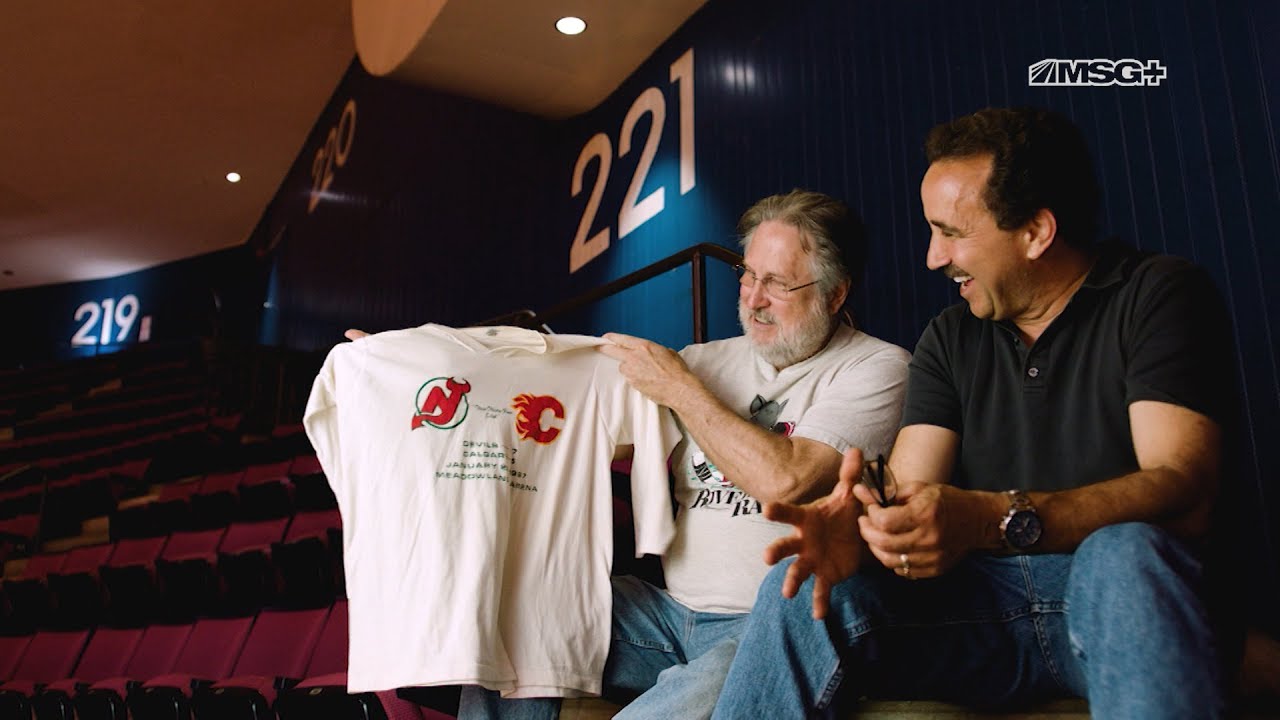
A blizzard blew through East Rutherford before the New Jersey Devils could play the Calgary Flames on January 22, 1987. With somewhere in the range of 16-18 inches accumulating, the players, officials, and spectators all had difficulty getting to Brendan Byrne Arena. After a two-hour delay, the game was played for a record low audience of 334, which later became known as the “334 Club.”
The snow began around 10:30, when the Flames began their pre-game skate. Still, when the Devils finished their turn at 11:35, they decided to follow their normal routines by heading home for the afternoon. Since the Flames’ hotel was a 20-minute ride from the rink, they assumed it would take at least an hour in the weather conditions. Although most of the team was informed around 3:30, the two who weren’t held up the departure until 4:50. To their surprise, they made the trip in the normal time span. Forward Jim Peplinski recalled, “It’s funny. Whenever I think of New Jersey, I always remember that our bus driver would get lost going to the Meadowlands every time. On that particular day, the snowstorm was awful and, for once in a blue moon, we went straight to where we were supposed to be. So we just laid around the dressing room for what seemed like weeks.”
The visitors had a long wait because the locals struggled to make it there at all. The game was scheduled for 7:35, but by 6:30, only ten of the Devils had arrived. Forward Doug Sulliman explained, “What I wasn’t ready for was all the abandoned cars that were stuck. I couldn’t get on the ramp to go two miles to the Meadowlands. So what I had to do was go on the other side of the road and I drove the whole way there in reverse. It was an adventure.” According to fellow-forward Peter McNab, “We found out later an 18-wheeler had turned over right in front of the Lincoln Tunnel. There was nowhere to go and I could see I was not going anywhere. I could see the rink. It was a couple of miles away. So I just walked.” A state trooper took his keys and moved the car to a nearby hotel parking lot.
When McNab got to the arena, he said, “We walked in and the Flames were already there. I could see Bob Johnson, he was coaching the Flames. He was counting the [Devils] players, because he knew once you had 16 or 17 players, you could start the game. Bob wanted to get the game going. He wanted that thing to start.” The Devils coach, Doug Carpenter, instead wanted to stall until he had more players. Sulliman remembered Carpenter saying, “’Just keep hiding people. We’re not going out there until we have 16 or 17 guys.” So Sullivan remembered, “They were hiding in the medical room, hiding in the stick room.” Johnson complained, “I thought the whole operation stunk from the time I got here at 5 o’clock until right now. I called up (NHL executive vice president) Brian O’Neill. He couldn’t make a decision. I talked to (Devils’ GM) Max McNab. He couldn’t make a decision. … It’s not as if we were holding the crowd up. There weren’t going to be a lot of people turned away.”
The game was pushed back an hour as of 6:45. It wasn’t until about 8:30 that the last four Devils arrived who were needed to get started. Defenseman Ken Daneyko remembered, “Me, Joe Cirella, Pat Verbeek, Kirk Muller and John MacLean; we all knew we had to leave early, so we took one vehicle. We left around 3 o’clock. We didn’t get there until a quarter to 9. We were the last group and they needed us to play.” An hour later, there were still four Devils skaters missing.
At least the officials finally made it. For a while, it looked as though a referee in the area who wasn’t even scheduled, Andy van Hellemond, would need to step in with assistance from Flames’ defenseman Paul Baxter as linesman. However, at nearly 6:40, most of the officials made it after walking 2.5 miles. Linesman Dan McCourt relayed his journey, “I got on the Garden State Parkway onto the [New Jersey] Turnpike and the traffic stopped dead. By 7:30, I’m still sitting there. I turned the radio on thinking I could listen to the hockey game on the radio. I go up and down the radio dial and can’t find the game anywhere. I don’t get to the rink until just before 9 o’clock. The Calgary Flames are there and the players from the home team aren’t. So we waited.”
Meanwhile, the team physician finally arrived at 7:45. The anthem singer never did. Even though injured forward Mike Bullard volunteered to sing, they decided to forgo the anthems. Warmups for both teams at last began at 8:45, and the game started after 9.
The Devils led from the start with Sulliman assisting Perry Anderson on the first shot and goal of the game at 2:03. Sulliman gave them the lead again when he scored his own goal in the final 30 seconds of the first period. In the second period, the Flames had a three-goal spree, but the Devils answered with four in the third period. The Calgary Herald remarked, “The Flames fell asleep in the third period, executing a brilliant collapse.”
In that final rush, Sulliman scored again at 8:42 and into the empty net in the final ten seconds. According to teammate defenseman Bruce Driver, “Dougie Sulliman wasn’t even supposed to play in the game and he ended up being the last guy to come into the room. That’s when we decided we were ready to start the game. And he got a hat trick.” For Sulliman, he could look back at his only hat trick with a laugh. “They were all busting my chops about that one. There’s the tradition of throwing the hats on the ice. I think one of our trainers threw his hat on the ice. There were only one or two hats out there so he threw his baseball cap on the ice just so there was another hat on the ice.”
New Jersey goalie Alain Chevrier set a franchise record with his 17th win of the season. He had only been granted the starting position because he arrived at the game before Craig Billingston. On the other end of the ice, the Flames gave rookie Doug Dadswell his debut in the net. Dadswell said, “I was pretty up for the game. It put me off when I had to wait two hours to play, but I felt good once I was out there. They didn’t get a lot of shots, but I don’t think I let in any bad goals. They were all good goals.” Coach Johnson bemoaned, “The goals they scored were point blank. We didn’t play well defensively. We gave up too many quality scoring chances. It was a bizarre finish to a bizarre day.”
The game ended just before midnight with the Devils beating the Flames 7-5. Daneyko summarized, “It was a crazy night. You could hear a pin drop in the arena. We just wanted to play and we won, so it worked out. It will go down in Devils history, certainly.”
The most memorable part of the game was the crowd, or lack thereof. They had sold 11,247 seats, but only 334 spectators showed. The Calgary Herald reported, “In the snowbound Meadowlands, 334 intrepid – some would say stupid – spectators turned out to watch.” Sulliman joked, “There were 334 people and I’m sure half of them just wanted to get out of the storm. They walked in and got a hot dog and a beer and thought ‘Let’s sit here for a while.’” He continued, “You went out and there was no one in the stands and there was no music playing. It was eerie.”
One of the audience members, Jeff Mazzei, described the experience. “We got in there and there it was, this 20,000-seat arena with 300 people spread all over the place. They didn’t close any sections. They let people sit wherever they wanted.” He then explained how the Devils went about making a club for the die-hard fans there that night. “Someone from the Devils came around with a yellow pad and went to every fan to get our names and addresses. That’s how the 334 Club came about. They then sent out a letter thanking everyone for coming. They said they were going to send everyone souvenirs and tickets, and they did. We got a scarf and a shirt and a badge like we were in an official club.” The Devils backup goalie jested, “I should have got one of those badges. I watched that game too.”
They even held a reunion for the 334 Club and players. Mazzei said, “The reunion was really a high-class thing. Three of the players and Lou Lamoriello were there. Everyone was telling stories.” Daneyko was one of the alumni and commented, “We all chatted with them and they all had fond memories of it. It’s a story they can tell their grandkids.” He noted how “When I ran into fans at the arena or doing a broadcast, fans would say, ‘I was one of the 334.’ They’re proud, loyal Devil fans. It was a disaster, but they weren’t going to miss it for the world. We appreciate those types of fans.” TV commentator Stan Fischler added, “I went to reunions. We would just tell stories. The joy of seeing the Devils win that game, that made it worthwhile. Because they played their hearts out.”
Mike Commito, Hockey 365: Daily Stories from the Ice (Toronto: Dundurn, 2018), kindle edition.
Associated Press, “Devils win before 334 die-hard fans,” Passaic Herald-News, 23 Jan. 1987, p. C2.
Eric Duhatschek, “Flames no Cinderella story in a midnight loss to Devils” and “Flames’ game diary proves to be a story in bedevilment,” Calgary Herald, 23 Jan. 1987, p. F1.
Jim Poris, “Devils stumbling way out of playoffs,” New York Daily News, 23 Jan. 1987, p. 50.
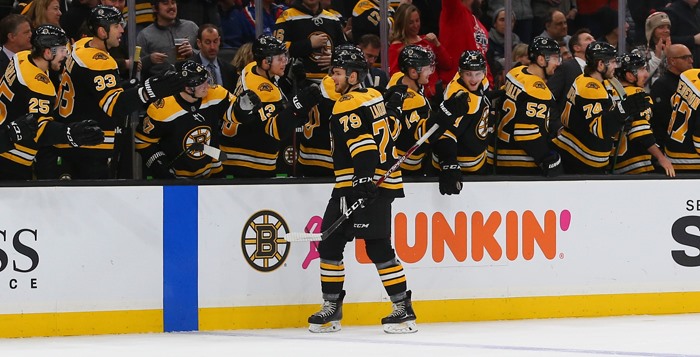
The Boston Bruins, after having done a good job of containing the Pittsburgh Penguins last Thursday with a 4-1 win, looked like they were going to do the same thing Sunday in Pittsburgh, when the Bruins went up 3-0 at the 15:07 mark of the first period. Unfortunately, the Penguins came back to score one in the first and second periods and two in the third to take the win. It was expected that Boston would come out strong on Tuesday during their game against the Vegas Golden Knights, not only because of Sunday’s loss, but also because it was their last game before the bye week and the All-Star break.
David Pastrnak put their first shot on Marc-Andre Fleury just ten seconds into the game with his linemate Patrice Bergeron getting their second just 13 seconds later. However, a minute later Mark Stone not only got the Golden Knights their first shot on Jaroslav Halak, but he got Vegas on the scoreboard. For the Bruins they would be playing catch-up hockey.
A couple of recalls from the Providence Bruins in the form of Jeremy Lauzon and Anton Blidh altered the lineup. It saw Joachim Nordstrom, Par Lindholm and John Moore watching from press level. Blidh took the left wing on the fourth line joining Sean Kuraly and Chris Wagner, while Lauzon took the right side of the third defensive pair with Matt Grzelcyk on the left. David Krejci had also returned to the lineup.
Lauzon played with the Providence Bruins in three games in three days over the weekend and perhaps that had him focused. Perhaps it was the change of teammates, but whatever it was, he tied things up for the Bruins at 11:40 of the first with assists from Krejci and Karson Kuhlman.
“I thought he played hard, competes all over the ice. We’ve
seen that before, so we expected that. Scores a goal — obviously, in a one-goal
game, that matters. And did it in the right way, didn’t overthink it. Just got
it, got off the wall, make sure you pound it hard so it gets by the first
layer. If it gets blocked closer to the net, at least it’s not going to be a
quick transition. We’ve been trying to instill that attitude in some of our
other guys and Brandon [Carlo] gets one later and gets it through, so hopefully
it kind of snowballs, that part of our game. But all-in-all had good composure,
didn’t seem fazed by anything. We’ll always go back and look at it, there will
be some details that we’ll talk about, but I liked his game. I thought he
brought what we needed,” stated Bruins head coach Bruce Cassidy after the game.
Overthinking may be getting in the way of a few of the Boston players, though the team is certainly not in a downward spiral by any means.
The teams went into the first intermission knotted at one, while the Bruins had outshot Vegas 14-8. Only one of Boston’s shots had been during the power play, despite them having been on the man advantage twice compared to one for the Golden Knights.
The second period in shots was a more even sheet of ice with the Bruins getting nine compared to the Golden Knights eight. However, in truth it was Vegas who was the better team during the middle frame. Despite being assessed three more penalties during the second, Vegas kept the Bruins from doing much with their power play. Meanwhile, when Brandon Carlo was sent off for a high sticking penalty, Nicolas Hague gave his Golden Knights the lead and earned his first NHL goal at 10:59 of the second.
Vegas took that one-goal lead into the second intermission and
many thought that the Vegas win was almost certain. Coming into Tuesday’s game,
when leading after the second period the Golden Knights were 20-1-1.
Jake DeBrusk tied things up for the Bruins going glove side high from the left half wall at 4:26 of the third. It was a goal that when asked about it after the game, Fleury’s response was short and to the point. “Just a good shot. Yep,” he said.
“That’s his kind of goal, he can separate and shoot in
stride and shoot it past a goalie,” said Coach Cassidy. “Good for Jake. That
got everyone excited and that’s something he can bring and has been of late.”
Of course, the Bruins have not been outstanding when a tie
has sent them to bonus hockey. Going into Tuesday’s game they were 3-5 during
the overtime period and an unexplainable 0-7 in the shootout. It had some
people wondering if bonus hockey might once again be the deciding factor.
The resilience of the Bruins team continues to show. There was no panic from the players in black and gold. About eight minutes after DeBrusk’s goal, Carlo finds himself at the right point with the puck on his stick—roughly the same spot from which Lauzon scored—and fires a wrist shot on Fleury. While he didn’t score, Krejci was just to the right of the net and he put the rebound in to give the Bruins the lead for the first time in the game.
There was still close to eight minutes remaining in
regulation and Vegas put five of their 13 shots on net for that period on Halak
during those final minutes. However, the Bruins got it done and they go into
the break sitting first in the Atlantic Division and second in the Eastern
Conference and the League with 70 points a +34 goal differential.
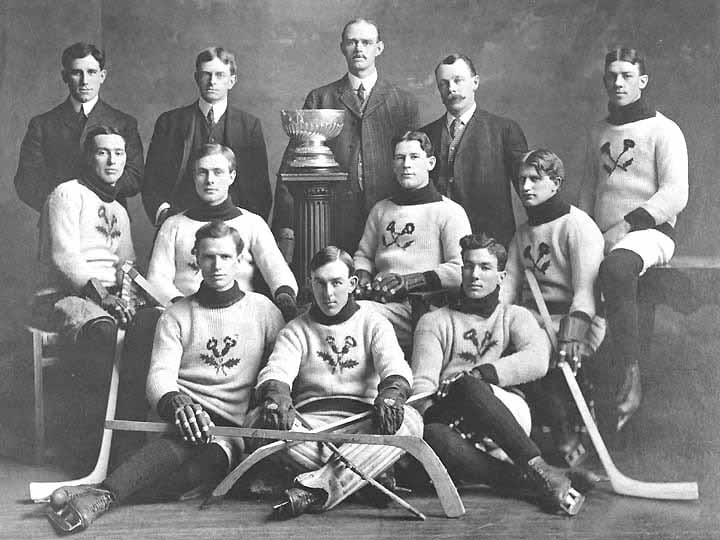
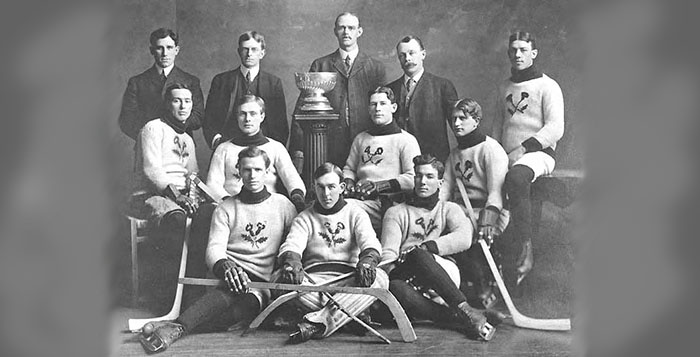
From the time Lord Stanley donated his Cup, teams challenged to hold it and keep it. During the first 14 years, the Stanley Cup had only been held by Montreal, Winnipeg, and Ottawa. That changed on January 21, 1907, when Kenora became the smallest community to ever take home the Stanley Cup. As it turned out, the Thistles held the Cup for the shortest ever term when they lost the rematch with the Montreal Wanderers two months afterwards.
Kenora, first known as Rat Portage, only had about 5,000 residents back then, though the Ontario town now exceeds 15,000. The first hockey team there began in 1894 and became known as the Thistles. Nearly a decade into their existence, they joined the Manitoba Hockey Association (MHA), and they immediately won the league championship. That gave them the right to challenge for the Stanley Cup in 1903 and again in 1905. Both times, they lost to the Ottawa Hockey Club (which led the Canadian Amateur Hockey League), but by the second try, they had earned a reputation for speed. The Thistles again led the Manitoba league in 1906, giving them the right to challenge again. This time, they would travel to Montreal to take on the Wanderers.
The Thistles were proud of being a team of locals who had played together back in school. However, they also hired two professionals in time for the challenge (including Art Ross), and goalie Eddie Giroux was originally from Toronto. Their opponents consisted of five pros, including the star Hod Stuart. Still, the Kenora group had high hopes of winning as they left for Montreal on January 12. Their first game, on January 17, proved their prowess as the Thistles defeated the Wanderers 4-2. Tommy Phillips had scored all four goals.
Two days later, the teams met again for the second game of the best-of-three series. As was reported back to Manitoba by wire, “The rink is filling up rapidly and it looks like a record breaking crowd. The ice is in good condition and the weather is ideal for hockey. Everything is perfect for a fast game.” The enthusiastic crowd numbered about 6,500.
The game was divided into two halves, and the Kenora Thistles dominated the first 5-2. Then, as the Montreal Gazette summarized, the “Wanderers made the brace that made the match the great struggle that it proved. Fighting like demons, the champion forwards smashed into the Thistle defence, rally succeeding rally until in less than ten minutes, from being four goals to the bad Wanderers drew even with the score at six all.” Only three minutes remained when the “Thistles, after a bad spell of rattles, began to pull together.”
The game had been “one of the most desperate battles that its [the Cup’s] history has to record.” The two officials from Ottawa gave out plenty of penalty minutes. The penalties contributed to the outcome as four players, two from each team, were called for tripping in short succession. The Wanderers had to play the final minutes without their two defensemen. With 90 seconds remaining, the Thistles took advantage as “big Silas Griffis carried the disc clean through Wanderers’ scattered ranks. He shot twice, and [William “Riley”] Hearn blocked. The puck came out to him on the side, and he slapped it over to [Roxy] Beaudro, standing uncovered on the far side of the net. Beaudro jabbed it into the goals, and the game was won, and with it the cup.” Kenora then potted an insurance goal in the final minute as they won 8-6. They had 30 penalty minutes compared to the Wanderers’ 55.
By and large, Kenora’s victory was attributed to the Thistles’ speed. The Montreal Gazette noted, “The tremendous speed of the challengers was always their strength.” According to the Manitoba Morning Free Press, “It was a clean victory for the challengers, who played fast hockey from the outset.” The Ottawa Journal reported, “The cup challengers did not attempt to play a combination game, but trusted entirely to their wonderful speed and in this feature they entirely outshone the Wanderers.”
Returning home as victors, the Thistles received commemorative cups and other gifts at a banquet held at the Opera House. The team was engraved on the inside of the Stanley Cup, instead of outside like all the previous winners.
The Thistles did not have long to enjoy their prize. They soon tied the Brandon Wheat Cities for the MHA title and had to play them to keep the Stanley Cup. Kenora won two games on March 16 and March 18 with a total of 12 goals to 7. That meant that the Thistles were eligible to be challenged to a rematch by the Montreal Wanderers.
In the meantime, the Thistles needed to replace some injured players and signed three new players, all of whom later landed in the Hockey Hall of Fame. The Wanderers protested that they hadn’t played for Kenora that season, but they didn’t have a leg to stand on as they had similarly used Stuart and goalie Riley Hern in January. With the players settled, the rink proved problematic. Kenora’s ice was too poor for the series to begin March 20, so the officials moved the venue to Winnipeg for March 23 and March 25. With such distractions, the Thistles ended up losing both games (7-2 in Game 1 and 6-5 in Game 2) and the Stanley Cup.
That sent the Kenora Thistles into decline. Three of their stars retired, and another took a higher salary from the Ottawa Hockey Club. With such a small town, the team could not earn enough to support professional players. After losing the first game of the 1907-08 season by 16-1, they forfeited the next two and withdrew from the MHA. Having been refused in joining another league, they folded at the end of the season.
Still, almost all of those who played on the Kenora Thistles in 1907 have since been inducted into the Hockey Hall of Fame. They include the four born and bred locally (Si Griffis, Tom Hooper, Billy McGimsie, and Tommy Phillips) as well as the signed Art Ross and Joe Hall. In 1982, the 1907 team itself was added to the Northwestern Ontario Sports Hall of Fame.
Additional Sources:
Mike Commito, Hockey 365: Daily Stories from the Ice (Toronto: Dundurn, 2018), kindle edition.
“Kenora Wins; Cup Goes West,” Montreal Gazette, 22 Jan. 1907, p. 4.
“Kenora Thistles Win Stanley Cup,” Manitoba Morning Free Press, 22 Jan. 1907, pp. 6-7.
“Kenora Thistles Defeat Wanderers and Stanley Cup Goes West Again,” Ottawa Citizen, 22 Jan. 1907, p. 8.
‘Kenora Thistles Succeed in Lifting Stanley Cup at Last,” Ottawa Journal, 22 Jan. 1907, p. 2.
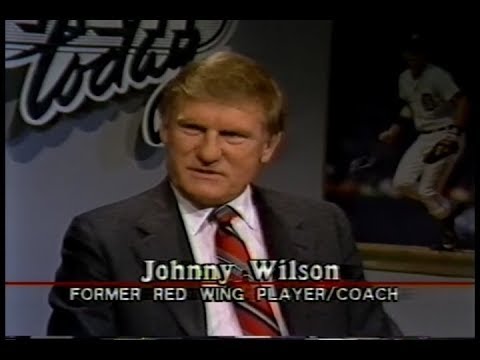
Although the newspaper then claimed it was the “first time in the history of the National Hockey League,” January 20, 1977 actually marked the third time “two brothers coached the opposing teams.” Johnny Wilson, leading the Colorado Rockies, had already been coaching in the NHL for years, including a stint with the Detroit Red Wings. Detroit had just hired his younger brother Larry as an interim coach, and the two faced each other on opposing benches in Larry’s debut.
The Wilson brothers were both forwards in the NHL during the 1950s. They began their careers together by skating for the Red Wings and winning the 1949-50 Stanley Cup. Within a few seasons, both moved on to Chicago, where Larry’s playing career ended in 1956 after 152 games. Johnny returned to Detroit to win more championships before winding down his skating career in Toronto and New York. He had managed 580 consecutive games (of his 688 total), quite the “iron man.”
Mid-way through the 1969-70 season, Johnny Wilson entered his second NHL phase as coach of the Los Angeles Kings, having coached their AHL affiliate for two seasons. After one more season with the Springfield Kings (in which they won the Calder Cup), in 1971 Johnny returned to his roots to lead the Red Wings. Although he led them to their only winning season in seven years, they fired him in 1973 after missing the playoffs. Johnny spent two seasons coaching in the WHA before the Colorado Rockies brought him back to the NHL in 1976.
The 1976-77 season was extremely rough for the Detroit Red Wings. With attendance dwindling because the team could not seem to win, they had already gone through three interim coaches. “For a time it was rumored that Wilson’s brother, Johnny, would once again be hired to direct the Wings,” reported the Detroit Free Press. Instead, Johnny’s younger brother Larry was approached by GM Alex Delvecchio on Thursday, January 13, 1977. That weekend, Larry told the Free Press, “I’ve talked to Alex, but as of right now I’m not involved. I’m just here to visit my mother and family.” However, on Monday, January 17, a press conference was held at Olympia for the Red Wings to introduce Larry as the newest interim coach. Johnny told the press, “I congratulated him, naturally, on his appointment and I’m sure he’ll do well.”
Larry Wilson had built up a reputation as a taskmaster in his six and a half years coaching in the minors. In his first season, 1970-71, he led Providence to the AHL’s Eastern Division title. In every season, his teams usually fell below .500 but always made the playoffs. When the NHL came calling, Larry was coaching the Baltimore Clippers of the Southern Hockey League. He summarized his main strategy, “I believe in systems, systems when you’re coming out of your end, on the offense, on defense, on power plays.” Johnny commented, “I think he’s a super coach. I coached against him in previous years (in the minors) and it’s just a matter of time.” With the Red Wings, Larry understood, “My job is to get them winning. In the remaining 36 games, we have to win 21, 22 games to get into the playoffs.”
The first game Larry supervised set him against his brother Johnny’s Rockies at Olympia for just 8,175 spectators. That included Carol, the mother of the two coaches. Larry pointed out, “My mother’s out there. She’s probably crying.”
Both of her sons had highs and lows in the game. Detroit started strong, holding the lead with just one goal until almost halfway through the third period. Johnny admitted, “They put on a lot of pressure in the first two periods.” Eddie Giacomin had a shutout going until then and “made a sensational diving save on a breakaway by Gary Croteau, but Gardner got the rebound and put it in.” The Rockies scored thrice with Paul Gardner’s goal and two assists to win the game 3-1. The Free Press snarked about Larry, “His team looked like it had a system in the first period, and in the second, too, but Wilson must not have gotten to third-period systems yet.”
The brothers spoke to the press afterwards. Larry noted, “You’re always disappointed in not winning, but I still think they played pretty well. They’re picking it up (his system). They get sloppy at times; that’s only natural … We executed, we played the body, we had some good shots. We’re just not shooting enough.” According to Johnny, “In his case, one game doesn’t make a season.” Of his own team, Johnny said, “Well, I realized the team was going to play a good game in front of him (Larry). We got some breaks.” Detroit had yet to win a game in 1977, having lost six in a row (one shy of a team record). Colorado had beaten them three times in that month.
That summer, both brothers’ time with their teams ended. Johnny had finished with a record of 20-46-14 while Larry’s 36 games with Detroit resulted in a record of 3-29-4. In June, a day after Larry had drafted his son Randy, the Red Wings released Larry. Back when they had hired him, they already had a coach in mind for the 1977-78 season, Bobby Kromm. New GM Ted Lindsay explained, “At the press conference when I took over, (Wilson) was the man I wanted. But there is a contract that’s involved here, so Bob will do the job.” Although he understood that Larry was upset, Lindsay wanted Wilson to take the head coach position with their new farm team. Larry ended up taking that job and coaching his final two seasons before dying of a heart attack (while jogging).
Meanwhile, in July 1977, Johnny took a job coaching the Pittsburgh Penguins. He had just finished coaching Team Canada in the World Cup Tournament and was talking to no less than four different NHL teams. Before he settled on Pittsburgh, he said, “All I’m trying to do is make sure I have a job for next season. … I want to get settled in a place for a couple of years and work toward a championship.” He did lead the Penguins through two playoff appearances in his three seasons with them. He returned to the minors for one final year before retiring in 1981.
Larry’s son, Ron Wilson, followed his father and uncle in skating and coaching. During the late 1970s and 1980s, Ron played defense in Toronto for three seasons and in Minnesota for four. He then spent 18 years (1989-2012) coaching primarily in the NHL with the Vancouver Canucks, Mighty Ducks of Anaheim, Washington Capitals, San Jose Sharks, and Toronto Maple Leafs. Clearly, the Wilson family had a passion for hockey.
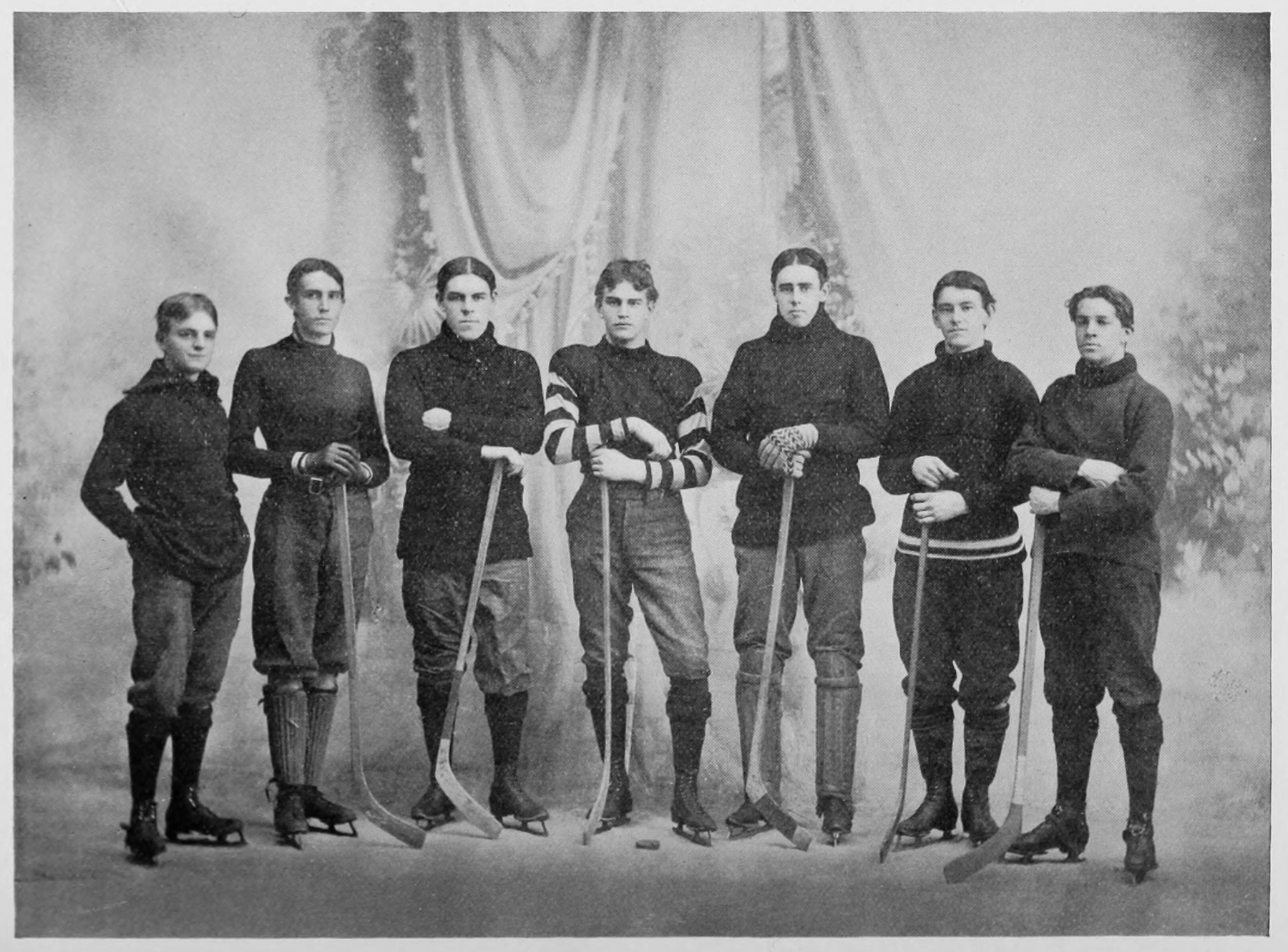
New England has a strong college hockey tradition that dates back to at least January 19, 1898. After a few years of switching over from ice polo and learning the Canadian style of hockey, some of the area universities had managed to put together teams and set up their first season of intercollegiate play. The opening game was held in Boston matching up Harvard College of Cambridge, Massachusetts and Brown University of Providence, Rhode Island.
Collegiate hockey in the U.S. can trace its beginnings back to Malcolm G. Chace who attended Brown (and then Yale) and Robert Duffield Wrenn of Harvard. Back in 1892, Chace realized the ice polo the Americans played was almost the same game as the hockey Canadians played. As a freshman at Brown, he took a trip north with Wrenn, then a junior at Harvard, to learn the winter sport. The students returned to their respective schools and worked to turn their ice polo teams into hockey teams. Upon transferring to Yale, in 1894 Chace arranged a team of American college students to travel to Canada for a series. This finally worked to foster enthusiasm for the sport, and in February 1896, Yale traveled to Baltimore to play Johns Hopkins. Harvard and Brown played the last intercollegiate game of ice polo at Providence’s Roger Williams Park in 1897.
Brown and Harvard officially had hockey teams ready for the 1897-98 season. To prepare, the Providence skaters practiced throughout their Christmas break, and their Cambridge counterparts put in a few weeks of practicing. For the first game, Brown only brought seven players. When asked where their substitutes were, Captain Irving Hunt replied, “We don’t need any.” In addition to the captain, the players included Robert Steere, Horace Day, Harris Bucklin, Jesse Pevear, Charles Cooke, and Albert Barrows in net. Meanwhile, Harvard’s roster included Captain Frederick Goodridge, George Matteson (a medical student who had played for Chace during the Canada trip), William Beardsell, Roger Hardy, Issac Hoxie, George Clement, Edward Stevens, and Fred Russell in net.
Thanks to Harvard paying half the fare ($7, or $1 per man), their opponents took the train up from Providence to Boston and then the trolley to Franklin Park. With temperatures in the 20s, the teams would face each other on a pond (or a narrow strip of ice on Franklin Field) without any dressing quarters. They herded the ice skaters away from one end and set up poles for the goals. The game would last 40 minutes broken into two halves called periods.
The players wore sweaters, turtlenecks, baseball pants, wool stockings, and knit gloves. According to Providence’s Day, “We brought our own skates. They were of the clamp variety, which you attached to ordinary shoes either with a little lever to make them hold or with a key that screwed them on. Occasionally they worked loose. They cost about $6.” Teammate Cooke talked about how they only had one stick each because they cost 60 cents to a dollar.
Once the game began, it was obvious to the Boston press that Brown played a better game than Harvard, being that it was Harvard’s very first hockey game. According to the Herald, “The Providence collegians had speed, they supported one another finely, and the passing of the forwards was clean cut and accurate.” The Globe noted, “Brown won by superior team play, her players also showing a greater knowledge of the game, not only in maneuvering with the puck, but in body checking, and innumerable details which count so much in a contest of this kind.” Meanwhile, the inexperienced “Harvard players bunched altogether too much,” complained the Globe. “Then again, the Harvard team, almost to a man, raised the sticks from the ice again and again, which handicapped them in receiving passes and from pulling the puck from the midst of the many scrimmages.” The Herald agreed by recapping, “Of the Harvard players, Capt. Goodridge and Russell, the goal tend, made a very creditable showing, but the remainder of the crimson men were erratic and fell all over one another. They were too closely bunched, and in their eagerness to get at the ball did not appreciate the importance of keeping spread out so that they could indulge in passing, which is the chief feature of the Canadian game.”
At 7:30 into the game, Day scored the first intercollegiate goal for Brown. On a “pretty pass by Cook,” Day “picked the puck up on the end of his club and shot it past Russell, who, until this time, had made a number of phenomenal stops of drives seemingly more difficult.” Cooke went on to score a hat trick in the second period as Brown shutout Harvard 6-0.
For the rest of the 1897-98 season, Brown continued to play on the road, traveling as far as New York City. They finished with a record of 4-1-1 with the only loss being against the non-collegiate New York Athletic Club. Even though they only played with three other college teams, Brown claimed the intercollegiate championship and also won a cup in a tournament against Columbia and Yale. Meanwhile, Harvard only played that one game in their inaugural season. The first Intercollegiate Hockey League (with Harvard, Yale, Columbia, and Princeton) would not form until 1899-1900.
Almost 60 years after their first game, Brown gifted Harvard with a commemorative plaque of the start of their rivalry.


 Prev
Prev