On one end of the rink, rookie goalie Pete LoPresti earned his first NHL shutout. In the other team’s penalty box, Dave “The Hammer” Schultz broke his own record for most penalty minutes in one season. Those were the highlights when the Minnesota North Stars hosted the Philadelphia Flyers at the Metropolitan Sports Center on February 8, 1975. A crowd of 15,230 watched the home team shutout the visitors 5-0.
Minnesota-born Pete LoPresti was drafted by the North Stars in 1974, and at 20, he was the youngest goalie then playing in the NHL. He was the son of goalie Sam LoPresti, who was also born in Minnesota and also wore No. 1. Sam only played two seasons in the NHL, for the Chicago Blackhawks, lasting from 1940 to 1942. During his 74 NHL games, he had four shutouts, the first (on February 27, 1940) being nearly 35 years before that of his son and the last (on February 15, 1942) being a week shy of 33 years before. The LoPresti goalies would become the first father and son to both have NHL shutouts.
For Pete’s turn to shine, as the Minneapolis Star Tribune gushed, “LoPresti picked a perfect time to have his best game as a professional, and his teammates responded with their finest hour.” In front of him, the North Stars outshot the Flyers 13-2 in the first period. That gave Minnesota a franchise record for fewest shots allowed while giving Philadelphia their lowest number of shots taken. The second period went much the same with Minnesota outshooting Philadelphia 14-5. As the Philadelphia Inquirer noted, “Lopresti had his busiest period in the third, being forced to make some tough saves as the Flyers tried to avert the shutout.” Still, the Flyers only managed 10 shots to the Stars’ 15.
In all, LoPresti made 26 saves. The Star Tribune recapped, “Through it all, LoPresti was spectacular. He got some good breaks, but the best goalies are the ones who, when beaten, get lucky. On one penalty kill at the end of the second period, LoPresti made three or four brilliant saves, and two other Flyer attempts got by him, only to carom off goal pipes and miss.”
Meanwhile, Minnesota scored four goals within the first ten minutes of the game. Their final goal came at 12:48 of the third period.
After allowing four goals, the Flyers amped up the aggressive style that gave them the nickname Broad Street Bullies. “They tend to commit so many fouls that only the most flagrant get called,” claimed the Minneapolis newspaper. “A string of penalties continued through the second period, and on into the third.”
“Naturally, the Flyers’ Dave Schultz was the first to show his frustration,” acknowledged the Philadelphia press. Schultz was a key enforcer for the Flyers from 1971 to 1976, and he earned his nickname as “The Hammer.” In a recent game, Clarence Campbell had warned him of an impending suspension after receiving a game misconduct. That did not slow Schultz down as he proceeded to collect two minors, a major, a minor, a misconduct, and a game misconduct for a total of 31 of the team’s 67 penalty minutes. He had more minutes than all of Minnesota’s at 29.
With the 31 penalty minutes, Schultz broke his own record for most penalty minutes in a single season. He had had 348 the previous season and was already at 350 minutes with 27 games yet to go. He ended the 1974-75 season with a whopping 472 penalty minutes, still the record to this day.
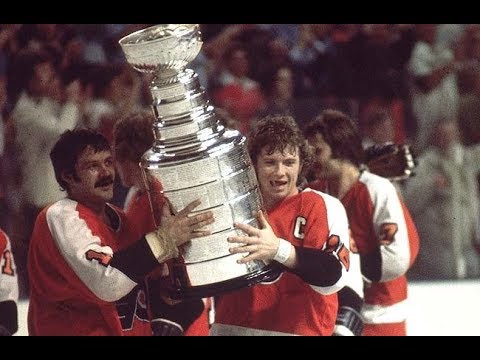
Despite the lopsided game, Minnesota would finish 15th overall, failing to make playoffs. Philadelphia finished second overall and won their second consecutive Stanley Cup.
As for the opposing goalie and enforcer, they remained with their respective teams for a while longer. LoPresti stayed in Minnesota until he was chosen by Edmonton in the 1979 expansion draft. He only played two games there, during the 1980-81 season. Pete’s NHL career lasted 175 games with a save percentage of .872. Either he was not as good as his father or his team wasn’t because Pete had a goals against average of 4.07 compared to Sam’s 3.12. However, Pete did have one more shutout than his dad, for a total of five.
Meanwhile, Schultz’s time in Philadelphia lasted until 1976. He then was traded three times before his career ended in 1980. His career total came out to 2,292 penalty minutes, which places him 35th in the all-time list.
Additional Sources:
John Gilbert, “Stars 5, Flyers 0!” Minneapolis Star Tribune, 9 Feb. 1975, pp. 1C and 8C.
“Stars Strike Early, Flatten Flyers, 5-0,” Philadelphia Inquirer, 9 Feb. 1975, pp. 1F and 6F.
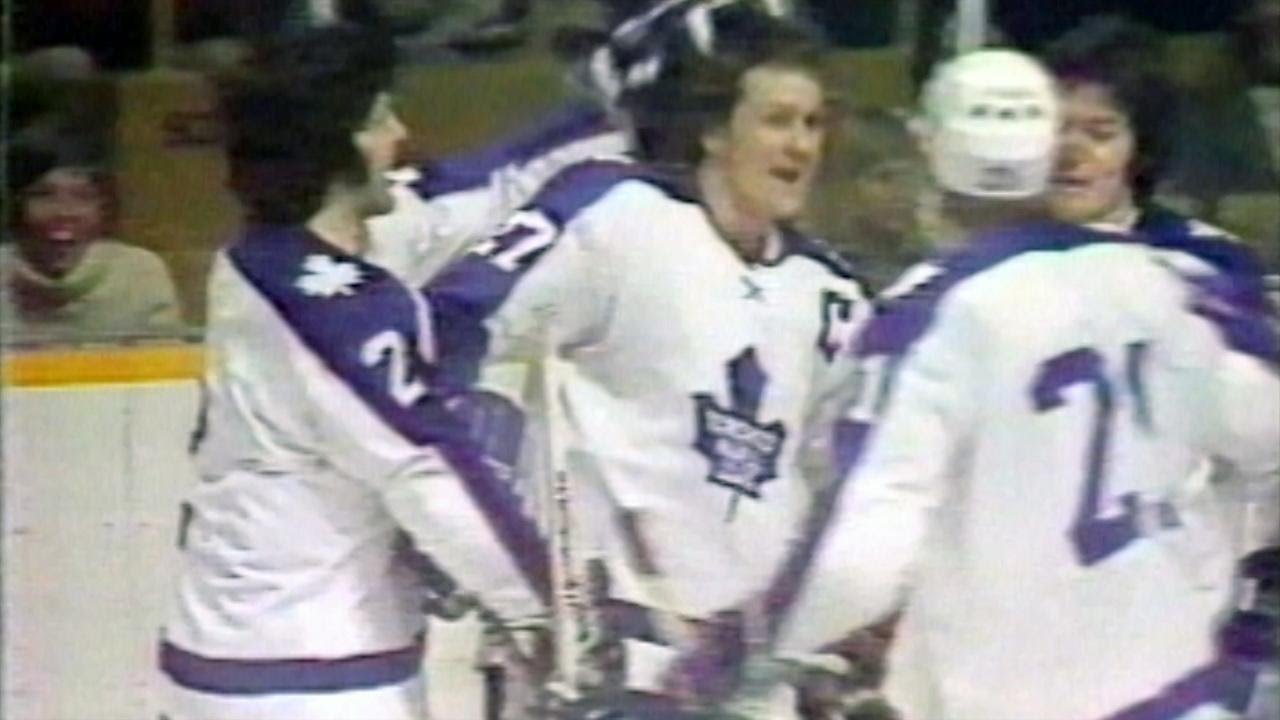
What’s better than scoring six goals in a game? Darryl Sittler, captain of the Toronto Maple Leafs, became one of only two to match Syd Howe’s iconic six goals scored in a single game. However, on February 7, 1976, Sittler rose above that by also earning four assists to bring his total to ten points. That beat the record set by Maurice Richard (of eight points in one game). No one yet has managed to top Sittler’s single-game offensive record.
Sittler played for Toronto from 1970 until he was traded in 1982. He had just been named captain in 1975, at the age of 24. That meant he was blamed by owner Harold Ballard when the Leafs struggled to a record of 21-20-11. Like his team, the center was in a slump, and it was caused by a shoulder injury and Coach Red Kelly constantly changing his linemates.
Coach Kelly decided to match Sittler with Lanny McDonald and Errol Thompson for the early February games. He told the press, “Sittler creates many scoring chances for his wingers through his strong forechecking and he needs some scorers with him for maximum effectiveness.” Although the Leafs only managed a 4-4 tie against the Washington Capitals, the line would exceed all expectations at the following game against the Boston Bruins. Sittler said afterwards, “The 10-point game kept our line together and if we didn’t have a great outing against Boston, the coach may have decided to change the lines around.” He also praised, “When you play with guys like Thompson and McDonald, they create openings for their centre because they skate and move the puck so well. If you give either of them a good pass, you have the chance for an assist.”
Meanwhile, going into the matchup, the Bruins had a seven-game winning streak going and led the Leafs by 20 points. Their rookie goalie, Dave Reece, was on a roll as Gilles Gilbert was out with a knee injury. They were celebrating the return (from the WHA) of Gerry Cheevers, who served as Reece’s backup in Toronto.
The game took place at Maple Leaf Gardens before a sellout crowd of 16,485 and was televised on Hockey Night in Canada. Later asked what might have been different for him in the lead-up to the game, Sittler had two different ideas. In one interview, he said, “well my son fell in the mud when I was baby sitting him, other than that, nothing different.” In another, he remembered, “Going home from the rink in the morning, Wendy [his wife] would have a pregame meal ready for me, but she had been out doing a bunch of things and running errands and was behind schedule. I was also running late so I just went and grabbed some Swiss Chalet chicken and basically ate it out of my car on the way to my house so I could get a good nap in in the afternoon. So, changed my routine a little bit, but I’ll always remember that change up.”
Forty years afterwards, Sittler reminisced, “The game started out and we were doing pretty well, which didn’t always happen against Boston.” Toronto ended up winning 11-4, thanks mostly to Sittler. He assisted on the first two goals of the game. At 16:54 of the first, Jean Ratelle scored Boston’s first tally as his 350th goal.
Sittler then picked up the pace and scored a hat trick in each of the later periods. On the 40th anniversary, he summarized, “During the second period it sort of all broke loose when I got the 5 points.” That gave him a franchise record for most points in a single period. At 2:56, Borje Salming “shoveled a weak shot at the goalie. The puck dribbled out in front and Sittler knocked it in.” Soon thereafter, at 3:33, he set up Salming for a power-play goal. Sittler’s next two goals came sandwiched between Boston tallies. The first was a “50-foot slap shot that broke Reece’s stick,” while the second came when Toronto had a two-man advantage as the referee had his arm raised to call a penalty. At 13:57, Sittler again set up Salming.
With three goals and four assists, the record was already in sight. Linemate McDonald remembered, “There was such a buzz in the dressing room in the second intermission, especially after [Maple Leafs publicity director] Stan Obodiac came in and told Darryl that he was one point shy of tying Rocket Richard’s record.” Richard had scored five goals and three assists on December 28, 1944. Bert Olmstead had matched the eight-point record on January 9, 1954. Sittler would finish with one more goal and one more assist than his predecessor.
The only scoring in the third period was the hat trick scored by Sittler. He tied the record just 44 seconds into the period with a “quick shot from 10 feet on right.” He broke the record at 9:27 with a “sweeping shot from inside of left circle by goalie’s left side.” The tenth point came at 16:35, and it was a doozy. Shooting from behind the net, “First, the puck banked-off Brad Park’s skate and went towards Reece. Then, it banked-off the goalies skate and crossed the goal line.” Sittler himself described the period, “I went out in the third period and got a goal to tie the record. The record breaking point was an exciting goal as I got it coming down the wing. The 10th point resulted from a fluke goal. I was behind the net and tried to pass the puck out and it ended up in the net. I put my hands in the air and shook my head. I couldn’t believe it was happening.”
Trying to grasp his accomplishment, Sittler commented, “It was one of those nights when everything happened. Some nights you have the puck and nothing happens.” He also acknowledged, “It’ll be hard to forget something like this.” Looking back, he realized, “Here is the thing, I didn’t realize it at the time. It was great and we won, but I never realized the magnitude of it all until 2 years later.”
The significance is that the record has yet to be matched. Thirteen players have had eight-point games since Richard’s, but that’s as high as anyone has reached. Sittler said in 2013, “To see the number of players who’ve gone through the League, guys like Wayne Gretzky and Mario Lemieux, even today’s players like Sidney Crosby, — I still hold the record. Who knows, at some point something might happen for some player where it may all come together. … I’m proud to hold the record. I hope it lasts a lot longer.” A few years later, he still felt that way, saying, “I’d be happy for the guy that broke the 10-point game record, but at the same time I want to hold the record.”
The month after his ten-point game, on March 17, Sittler also set Toronto’s franchise record for most assists (51) and points (85) in one season. Then he tied Richard’s post-season record with five goals and six points on April 22. He even played in the Canada Cup tournament, scoring the winning overtime goal in the championship game.
On the 42nd anniversary of the ten-point game, in 2018, Sittler learned the whereabouts of the jersey he wore that night. Expert collector, Barry Meisel bought it from the latest in a line of four or five collectors who had passed along the jersey. He verified it was the same sweater by comparing photos at the Hockey Hall of Fame and estimated that it was worth between $350,000 and half a million. So, as Sittler put it, his ten-point jersey was sitting in “a warehouse in New Jersey.”
Additional Sources:
Mike Commito, Hockey 365: Daily Stories from the Ice (Toronto: Dundurn, 2018), kindle edition.
Francis Rosa, “Sittler’s record 10-point explosion buries Burins, 11-4,” Boston Globe, 8 Feb. 1976, p. 64.
The XI Winter Olympic Games were held in Sapporo, Japan in 1972. In the ice hockey event, these games were most remembered for two reasons – Canada declined to participate and the U.S. pulled off a surprising win for the silver medal. The final round began on February 5 and ended February 13.
On the opening day of the finals, the six qualifying teams played each other in a round-robin tournament. Considering they were playing for their fourth consecutive gold medal, unsurprisingly, the USSR handily won their game against Finland, 9-3.
As expected, the other team-to-beat, Czechoslovakia, demolished Poland. In the process of raising the score of 14-1, the two teams set a record for most short-handed goals in one game. Czechoslovakia had two, and Poland’s sole goal was a shortie scored by Leszek Tokarz. The top scorer for the Czechs was Vaclav Nedomansky with six goals and two assists. He went on to play a few seasons in the WHA before spending most of his NHL career with Detroit. Recently, he was inducted into the Hockey Hall of Fame in 2019. Poland floundered in 1972 and left with five losses, placing them fourth for most losses in one Olympic tournament.
Again as predicted, the U.S. lost their opening game to Sweden. All five Swedish goals were scored by different players. The U.S. had two disallowed goals and just one allowed goal, by Kevin Ahearn of Milton, Massachusetts and Boston College. Despite having success internationally, Ahearn only played one season in the WHA (for the New England Whalers). After this first game, Coach Murray Williamson remained optimistic, saying, “We’re young, we’re aggressive and we’ll be back and ready for Czechoslovakia.”
Williamson was absolutely right. On February 7, the U.S. reversed the score to beat Czechoslovakia 5-1. The only goal they allowed was scored at 4:32 of the first period. Keith Christiansen of Duluth, Minnesota tied the game later that period, and then Ahearn netted the game-winner at 9:41 of the second.
Meanwhile, goalie Mike Curran of Green Bay, Wisconsin blocked 51 shots, including at the end of the game, when “he made a diving save off Czechoslovak star Vaclav Nedomansky and deflected the shot off into the corner with his stick.” He said afterwards, “I can’t think of a win which makes me more happy. I feel like I did a good job but [my teammates] were helping me play well.” Coach Williamson praised, “The number one reason [we won] was that Curran played a fantastic game. We asked for 110 per cent, and we got it.”
Coach Williamson also predicted, “Anybody can win this. I can see us coming home with a medal.” And so it came to be that after all 30 games had been played, the U.S. and Czechoslovakia had a matching record of 3-2-0. The U.S. was given silver and the Czechs bronze because of the result of their game against each other.
The year 1972 turned out to be the only one to have Olympic games, the World Championship, and the Summit Series. Just a few weeks after the Olympics, the Czechoslovakian team won gold at the World Championship. That September, Canada finally had the opportunity to sends its professional players against the USSR and barely edged them out.
Additional Sources:
Andrew Podnieks, Where Countries Come to Play (Toronto: McClelland & Stewart, 2013), kindle version
IIHF 2012 Guide and Record Book (McClelland & Stewart, 2011), 335.
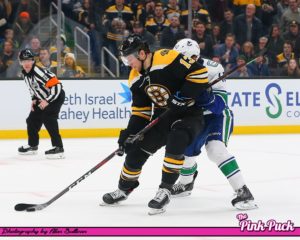
Though the Boston Bruins and the Vancouver Canucks traditionally only see each other twice a year, perhaps three times at most, their tilts often have some additional physicality. Tuesday night’s game was no exception.
The first period moved along rather quickly, perhaps the result of the referees electing not to use their whistles for anything other than when the goaltenders covered the pucks or the one delay of game penalty assessed to the Vancouver Canucks when head coach Travis Green challenged Charlie Coyle’s goal for being offside. This was one of those times when the review appeared to be wrong, however when the explanation came out, it could be seen to be onside.
According to the explanation issued by the NHL Situation Room, Charlie McAvoy did not have “possession” of the puck–since his stick was not touching the puck–until after Sean Kuraly had tagged up. Agree or disagree, it was a tough call for the Canucks, to be sure. The Canucks found themselves down a goal and down a man for the next two minutes.
“I wasn’t really sure kind of out of my peripheral there I
thought [Kuraly] had tagged up but I wasn’t sure, you know, we were lucky to
see that one stand. I tried to straddle the blue[line] there for as long as I
could till [Kuraly] came over and and I’m gonna have to watch it to see how
close it was. But yeah, to my understanding I just tried to not touch it, till
he was there,” shared McAvoy after the game.
Charlie Coyle and Quinn Hughes
As for Coyle, he had his tenth goal of the season. And while
many value a player only for how many markers he puts up, Coyle’s abilities to protect
the puck and his strength along the walls and how he moves on the ice is
something that is certainly beneficial to the Bruins.
“You just want to do it the right way. Sometimes you’re playing the right way and if it’s, you know, points wise, you’re not on the scoresheet, you know but you’re playing good hockey and that’s the thing with this team, it doesn’t matter who scores, who gets the assists, it’s, you know, everyone’s gonna chip in and do their part as long as everyone’s doing, you know, playing the right way. So that’s all I’m trying to do,” said Coyle.
There were certainly some missed calls on both teams in the first, and that certainly increased the on-ice animosity as the game continued. However, as the first period came to a close, the Bruins were outshooting the Canucks 13-6 and it was the stellar play of Jacob Markstrom that kept the Bruins from having more than the one goal.
Going into the second period, the Bruins came out strong in
a frame that is often not their friend. They killed two penalties during the
period—both with potential short-handed bids at the other end. Once again
Markstrom kept the door shut on his net while he suffered little support from
the team in front of him. And while the Bruins weren’t able to convert on either
of their second period power players, their cycling and shots on net showed
solid play. At 15:35 while the Bruins were buzzing around Markstrom, he
overcommitted and was flat on the ice. Patrice Bergeron put the puck on Brad
Marchand’s stick in the slot and it was a second goal for the black and gold.
McAvoy notched his second assist of the night as well.
It wasn’t until the third period that the referees truly found
their whistles. Torey Krug was sent off for a slashing penalty at 12:38 of the
final twenty, and then while on the man advantage, Quinn Hughes found himself
sent to the box for a slash exactly one minute later—negating the Canucks power
play and opening up the ice as the teams played four-on-four. It was while the
teams had more time and space that David Krejci was able to get one past
Markstrom, glove side high, giving Boston a three-goal lead with 5:51 remaining
in regulation.
As the play turned the other way, Jay Beagle was skating down the left wall, with McAvoy backchecking him with intensity. As Beagle went to try and make a play he ended up colliding with Rask—who had just returned from a concussion—in his net and McAvoy let Beagle know his contact with Rask wasn’t appreciated. In the end Beagle got not only a goaltender interference call at 15:11, but he also somehow earned himself an early trip to the showers, when he was given a 10-minute misconduct and sent off.
The Bruins hadn’t been able to capitalize on the power play, despite having had an earlier five-on-three opportunity in the second. Tyler Myers would unintentionally give the Bruins another chance at the five-on-three when he was whistled for a delay of game having shot the puck over the glass while on the penalty kill.
Though the Bruins didn’t convert during the one minute of the two-man advantage, Karson Kuhlman converted on the Myers penalty with just 12 seconds remaining on the power play, assisted by Coyle—who now had a two-point night—and Matt Grzelcyk at 18:10.
As the final buzzer sounded, the Bruins had notched four goals from the 42 shots on Markstrom, while Rask had denied all 25 shots he saw. This was Rask’s third shutout of the season and the 48th of his career.
The Bruins have little time to dwell on the success. Just shortly after the game, they were on their way to the airport to catch their plane to Chicago. They will take on the Blackhawks on Wednesday night.
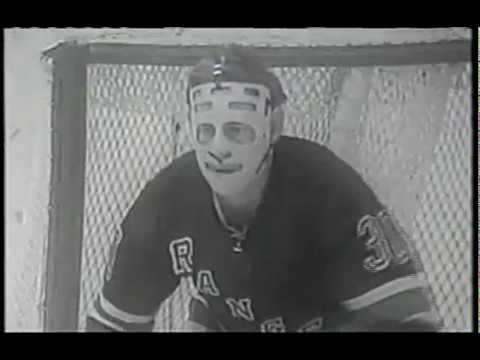
February 4th can be considered a lucky day for the New York Rangers. Even when everything seemed to be going wrong (like a blizzard causing delays on the way to Boston in 1961), they still pulled off a 2-1 victory over the Bruins that date. Whether away (like when they played in Detroit in 1971) or home at Madison Square Garden (when they hosted the Atlanta Flames in 1973), the Rangers had shutouts with Gilles Villemure in net twice on that date.
1961
In 1961, February 4th was very long for the Rangers due to the weather. Their train from New York was supposed to leave at 12:30 but was delayed half an hour. Four of their players (Dean Prentice, Brian Cullen, Ted Hampson, and Don Johns) never made it off Long Island to catch the train. They would only be able to suit up 13 once they arrived in Boston, which took something like eight hours. The “train’s whereabouts had been unknown in the howling snowstorm” until pulling in at New Haven, and they did not arrive at South Station in Boston until 8:30 or 8:45. It took another hour to reach Boston Garden and get ready. The game was delayed two hours, the first time an NHL game had ever been postponed for weather, and began at 10 pm.
Despite all the trouble beforehand and the player shortage, the Rangers only needed 31 seconds at the start of the second period in order to win the game. Andy Hebenton scored at :21, and Harry Howell added to that at :55.
The Bruins were only able to make one goal, when their captain, Fern Flaman, scored at 17:45 of that period. They had suited up 17 players but had their own issues getting to the rink. Johnny Bucyk had “smashed his car in suburban Lynn, trying to make the hazardous drive into Boston” before picking up Jerry Toppazzini. It took them 4.5 hours to make it the whole way. Few fans showed up, and they had to make due with canned classical music. Even after the game, the Bruins could not procure cabs for the Rangers who had to take the subway back to the train station.
1971
Ten years later, the Rangers made the trip out to Olympia Stadium in Detroit. There, they had an audience of 13,712. Unfortunately, those fans were not happy by the end of the game.
The only goal that counted was made by New York’s Rod Gilbert. He scored 3:47 into the second period. With that goal, he had 477 points as a Ranger, making him one shy of second place in most points scored as a Ranger. Andy Bathgate had 729 points.
It seemed like Detroit should have had two goals, but neither of them were good. Late in the first period, Gordie Howe made a shot that goalie Gilles Villemure covered. Referee Art Skov blew the whistle, the puck then went over the line and “goal judge Gerry Waechter turned on the light.” Fans were so upset that they littered the ice, resulting in a ten-minute cleaning delay. Then with 39 seconds remaining and goalie Roy Edwards benched for an extra forward, Rene LeClerc seemed to have a shot. Again, it was erased by Skov.
Villemure made 30 saves for his shutout. It was his fourth of the season and fifth of his career. Interestingly, it would be the only 1-0 road win the Rangers had until February 28, 1993. This was Villemure’s first season as the official backup to Eddie Giacomin, and the two would share the Vezina Trophy by the end of it.
1973
On the second anniversary of his fifth career shutout, Villemure earned his tenth. He blocked all 20 shots by the Atlanta Flames as the Madison Square Garden crowd of 17,500 was treated to a 6-0 victory. The Rangers’ “clown prince,” Pete Stemkowski, joked, “The rest of us all played lousy, only the goaltending was great.”
Stemkowski had the right to have fun because he scored half of his team’s goals that game. After Gilbert got the partied started with a goal in the first period, Stemkowski led off a three-goal spree in the second. He then scored twice in the third for his second hat trick of the season. It would be the last of his career. “Luck plays a big part any time you get the hat trick. In my own case, communication between myself and my linemates made the difference tonight,” he claimed. Stemkowski had been traded from Detroit in October 1970 and “became a checker and a hitter, part of the Rangers’ top defensive forward line.” He told the press, “Everybody knows I’m not considered one of the big guns in the scoring department, but this was just a good night.”
Thanks to Villemure and Stemkowski, the Rangers continued their 8-game winning streak and 13-game unbeaten streak. Villemure would go on to have another shutout in his next game (on February 10). He finished his career (in 1977) with 13 shutouts.
Additional Sources:
Herb Ralby, “Rangers Beat Storm, B’s,” Boston Globe, 5 Feb. 1961, p. 57.
“Rangers Subdue Snow, Then Bruins,” New York Daily News, 5 Feb. 1961, p. 85.
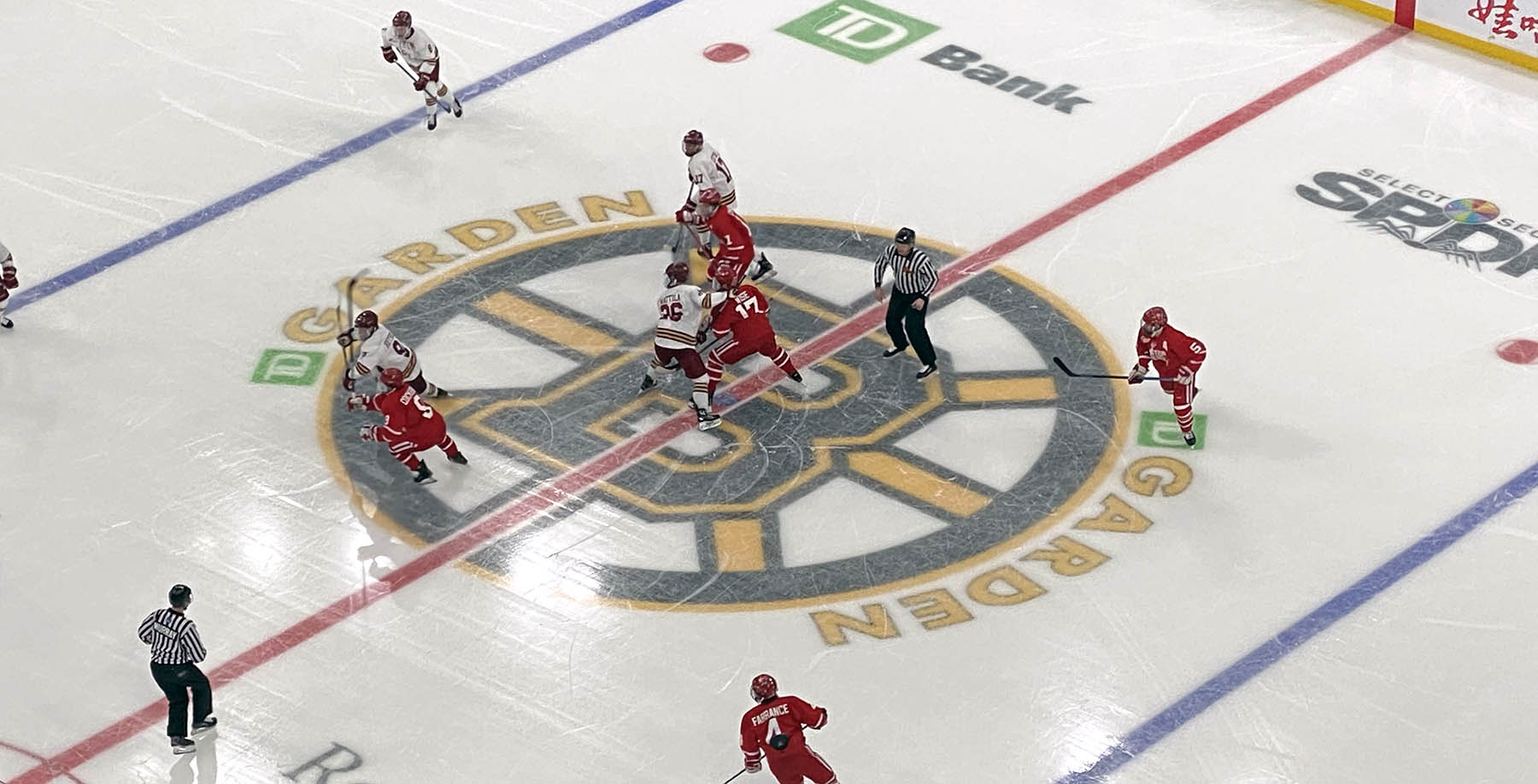
There is absolutely no love lost between the Boston University Terriers and the Boston College Eagles. They do not call it the Battle of Comm. Ave. for nothing, and as they stared across the ice at each other to begin the semifinal tilt, you could feel the tension. What made this game even more strained is that the two teams played each other just two weeks ago at Conte Forum, where the Eagles pulled out the win, beating the Terriers 4-3.
The first period was insanely quick. Just 2:15 into the opener, Patrick Giles, put the Eagles on the scoreboard first, assisted by Marc McLaughlin and Zach Walker. Five minutes later, BU’s David Farrance found himself in his defensive end with a broken stick and in trying to slow down an Eagle ended up taking a tripping penalty instead. It took the Eagles just 12 seconds for Alex Newhook to put the puck on and over Ashton Abel in a strange rebound to give the Eagles a 2-0 lead. Things weren’t looking good for the Terriers, though there was still a lot of hockey left in the opening frame, let alone the game. At 8:34 Logan Hutsko was sent off for BC for high-sticking. The Terriers pulled one back with Patrick Curry going back door on Spencer Knight, off a cross-crease pass from Logan Cockerill who received the puck from Farrance. And now it was a one-goal game. The Terriers got caught with too many men on the ice at 11:50, but they killed that penalty. And as the first period came to an end and the teams went off for the first intermission, the score sat 2-1 in favor of the Eagles.
The second period was a much slower affair with a single penalty—a cross-checking called on BU’s Cam Crotty. And a single goal—David Cotton’s shot caromed off of BU’s Alex Vlasic and past Abel to give the Eagles a two-goal lead going into the second intermission. The Terrier’s skating was somewhat improved in the second, but they continued to be stymied by the Eagles when it came to getting into the offensive zone and maintaining some pressure. Meanwhile, on the other end of the ice, if it wasn’t for Abel, the Eagles could have been leading by more than two goals as Boston College outshot the Terriers 15-9 in the middle frame. There was a breakaway by McLaughlin that Abel stoned, and then a solid tic-tac-toe that gave the Eagles all sorts of time and space just shortly after, that once again Abel was able to gobble up.
The third period saw a definite shift for much of the period in that the Terriers were outshooting the Eagles, though Knight was keeping his Eagles ahead. At 12:26 while the Eagles were in the Terriers end and on the PP, Luke McInnis took a selfish penalty—a completely uncalled for interference penalty (actually he came up behind the Terrier player and slapped his stick right out of his hand). The resulting four-on-four saw the Terriers get within one as Farrance garnered his 12th of the season assisted by Patrick Harper and Curry. Ten seconds later, now on the power play, Harper buried the puck, assisted by Farrance and things were tied up.
Up to that point it looked like Boston College had the game in hand. But those two goals by the Terriers gave Boston University life, and they managed to get the lead at 18:18 of third when Robert Mastrosimone put the Terriers up 4-3, assisted by Trevor Zegras and Harper.
Unfortunately, their joy was short-lived. At 18:34, Curry
took a hooking penalty and the Eagles were able to play six on four, having
pulled Knight for the extra attacker. At 19:02.1, Cotton got his second of the
game and knotted things up once again. And that’s where things would be when
the horn sounded at the end of regulation.
Per NCAA protocol, there was a five-minute overtime—just as
with any other collegiate hockey game—in which neither team was able to score.
Things got a bit strange at this point. As far as the NCAA
was concerned, this game ended in a tie. This is the first time in Beanpot
history that the official record would show a tie. In reality, the teams went
off for a full intermission and then returned to play a second full 20-minute
sudden death overtime period—though none of the shots, stops or final goal
would show in the NCAA record.
As the second overtime continued, it was clear that both teams were exhausted. Some uncharacteristic turnovers and fanned shots by both teams spoke to what they had already given to get to the point they were at. Ultimately Wilmer Skoog would send the Terriers into happiness and the Eagles into disappointment.
“Yeah. Honestly, you know, after the first and second, we didn’t
have too much going but um, we sort of spoke to the group in between the second
and third and we just spoke about resiliency and doing it for the guys who only
have one Beanpot left. And then we got that four-on-four and then that power
play. Those two special teams were huge for us. And then after that, Zee [Zegras]
makes an unbelievable play to a Mastro [Mastrosimone] coming in. And it’s 4-3,
and it’s a wild game and there’s a lot of hope and a lot of a lot of fun spirit
within the group. And we just felt that we were going to take it home,” shared BU’s
Harper after the game.
What the third period of the game showed was how penalties
can really hurt a team.
“You know we had a really good lead. We took an unnecessary penalty which gave [BU] some life and they capitalized on the four-on-four and then the ensuing five-on-four. Tough because we had a power play with a nine and something left in the game. If you learn anything from the game tonight, it’s that you know you just can’t take penalties late in the game. You gotta keep your composure. I thought the six-on-four goal, again Terriers took a penalty late in the game, and we had a chance to capitalize on them and I think we both have very good power plays so, you know, you take a penalty you’re playing with fire,” said BC’s head coach Jerry York.
In the end, the Terriers tenaciousness gave them the win and they will meet Northeastern University’s Huskies on Monday, February 10th, to see who lifts the Beanpot as champion.
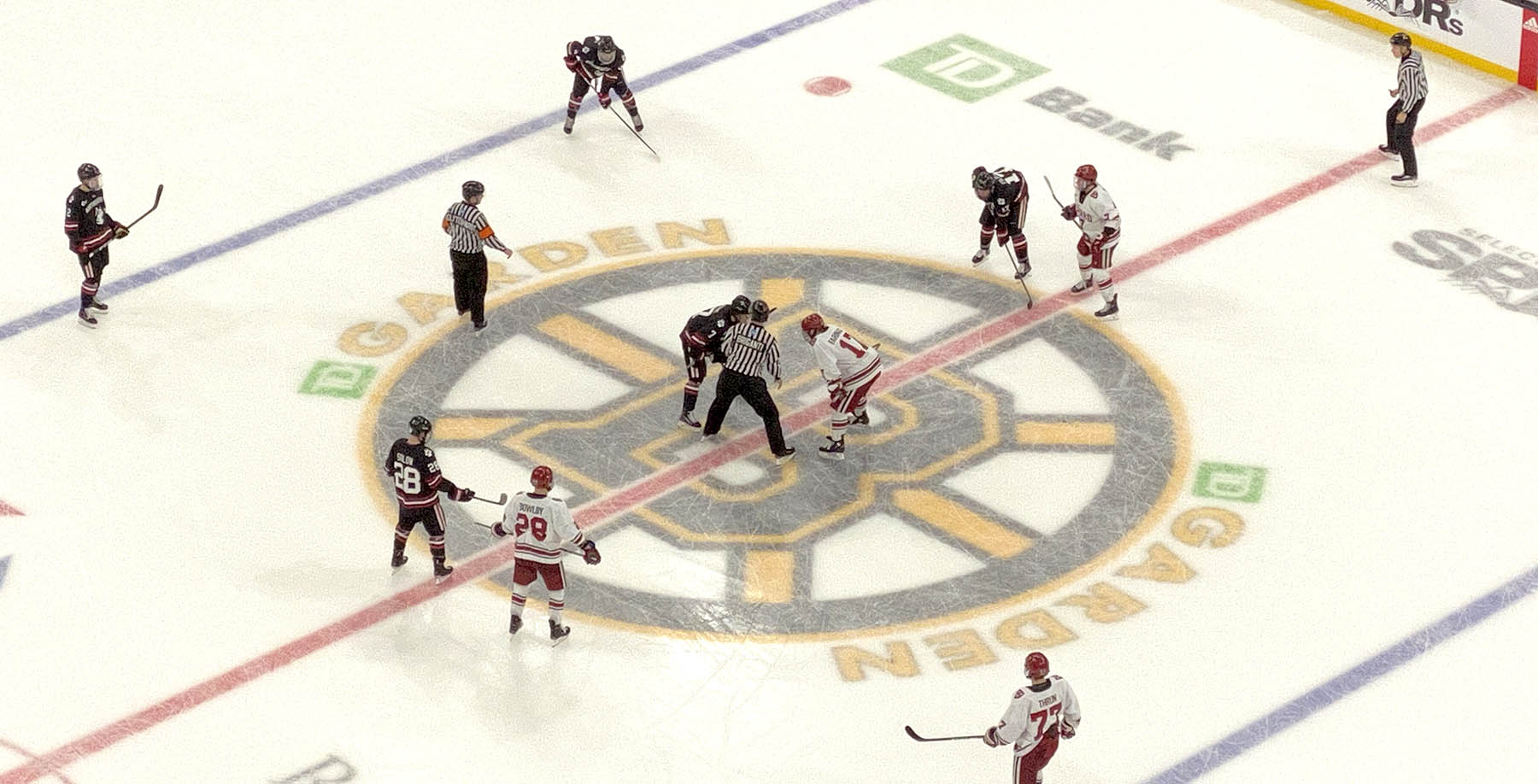
As things got underway for the Beanpot semifinal game between the Northeastern University Huskies and the Harvard University Crimson, the Huskies found themselves on the penalty kill at 3:56 of the opener when Jordan Harris was whistled for a tripping penalty. Harvard made the Huskies pay when Jack Drury notched his 14th goal of the season with 39 seconds remaining on the power play. Despite having outshot the Crimson up to that point, Northeastern had nothing to show for it. However, at 11:58 Henry Bowlby was sent off for a holding call for Harvard and 22 seconds into the man advantage Northeastern’s Zach Solow tipped in a one-timer from Ryan Shea at the blue line to knot the score up. And that was where they stood going into the first intermission.
The second period had a lot of skating, but not much else for most of the period. Harvard definitely had more control of the puck and spent some solid time in Northeastern’s end, but Craig Pantano refused to give them any chance at the net behind him. It looked like things were going to remain tied at one going into the second intermission, but then Austin Wong was called for an elbowing penalty and the Huskies were back on the man advantage. While they weren’t able to convert, it did give them a little bit of energy and four seconds after the teams were back at even strength, Brendan van Riemsdyk gave Northeastern the go-ahead goal. There were just 29.6 seconds remaining in the second period.
In both the first and the second periods there were goals
that were under review for offsides. While it is true that everyone wants to
get the calls right, when it takes minutes for the review it eliminates the
energy on the ice and in the arena. Both goals were considered good goals—one
for Harvard in the first period and one for the Huskies in the second. But both
reviews took minutes to see that the call on the ice stood and nothing they
looked at could overturn it. That disrupts the game. Unfortunately, there doesn’t
seem to be a better way of handling that.
Despite being up by a goal, the Huskies started the third period on the penalty kill as Jayden Struble was whistled for a trip just as the second period ended. And to make things worse, Mike Kesselring got sent off for a cross-check for the Huskies just 16 seconds into the third period forcing Northeastern to kill a five-on-three for 1:45. Northeastern’s goaltender, Pantano, was huge for the team during this time.
“Yeah, I think killing penalties gives us more motivation than scoring a power play goal because all the guys are up on the bench. Everyone’s live. Every point matters and pretty much once you touch that puck you want to clear it and when you do you can hear all the boys yelling. But the five-on-three obviously, I think they’ve got the number one power play in the country. So, it’s… They score the first one we adjusted. Unfortunately, we got on a five-on-three but our compete level just went up five notches once that happened and we shut them down. I think that is what gave us momentum to kind of shut them down the rest of the game,” shared senior and Huskies captain Shea.
The Huskies continued to weather the shots of the Crimson and as Harvard pulled Mitchell Gibson with 2:04 remaining in regulation it looked like Pantano would have to stand all the taller. As the clock ticked under the one-minute mark and the Crimson were buzzing around, Shea made an attempt to clear the puck. Shea’s clearing attempt not only got the puck out of the Huskies’ end, but it ended up in the back of the net 200 feet at the other end and took the wind out of Harvard’s sails.
Overall, it is somewhat surprising that Northeastern was able to get the win. They were outshot in both the second and third periods by Harvard. During the third period especially, the Crimson were truly dominant, but Pantano kept them off the scoreboard. They outshot the Huskies 14-7 in the third and 28-24 in the game. Harvard definitely gave the Huskies some trouble.
“Well, they’re fast, they play fast. They’re good in transition. I didn’t think we defended as quickly as we needed to in their offensive zone so they extended shifts on us and then you know, when you extend shifts in the offensive zone, you get tired and now we’re chasing them and you know, that top line is as good as there is in college hockey and that might be, I don’t want to say the best, but it’s got to be up there in the top 1, 2, 3 or whatever. And then there are other lines they can come at you and skate, they’re good in transition. Also, we didn’t manage pucks well. We lacked some poise at certain times in the game. And they had a little bit of desperation, you know, being down one, so the pressure was on and you know, at some point there in the last five minutes, we don’t want to play in the offensive zone. We want to make sure we’re inside the dots and clogging the middle and taking away something from them, so our offense was a lot less,” explained Huskies head coach Jim Madigan.
However, it’s not necessarily how many shots you can put on goal, as much as how many can be put behind the goalie. And Monday night’s semifinal saw the Northeastern Huskies get their chance to defend their title—having one the Beanpot Championship the previous two years.
They will get that chance when they take on the Boston University Terriers, whom they beat in 2018 to win their first Beanpot in 30 years, when they play in the Beanpot Championship game on Monday, February 10.
Ten days after the Detroit Red Wings obliterated the New York Rangers 15-0, they set a few more records in a 12-2 victory on February 3, 1944. The two scores totaled 27 goals against the Rangers, which was an NHL record for goals against a specific team. However, the big news of the night was Syd Howe, who scored half of Detroit’s tallies. The Detroit Free Press hailed, “Goal glory unparalleled in hockey history came to Syd Howe Thursday night – and how!”
Howe (no relation to Gordie’s family) played center or left wing, even defense if need be. He began his NHL career with Ottawa in 1930. On February 11, 1935, he was traded to Detroit, where he helped win three Stanley Cup championships (including one in 1943), before his career ended in 1946.
The Olympia Stadium crowd of 8,147 gave a standing ovation after Howe’s performance in February 1944. The 32-year-old scored back-to-back goals in every period for a total of six in 38 minutes. In the first period, the goals came at 11:27 and 11:45. For the initial goal, he “cut in front and banged in a pass from Don Grosso,” and for the second, he had a “fifteen-foot shot off a rebound.” At the end of the second period, Howe scored at 17:52 and 18:54 with a “behind-the-net pass from Cully Simon” and then having stolen the puck, he “passed to Grosso and took a return pass.” Finally, at 8:17 and 9:14 of the third, Howe made good on passes from Grosso.
The record for most goals in one game had been set at seven by Joe Malone on January 31, 1920. Cy Denneny had scored six for the Ottawa Senators on February 7, 1921. As Howe later commented, “I had a good chance to break the all-time record but I couldn’t do it.” Still, since then, only two players have even managed six goals in a game – Red Berenson of the St. Louis Blues (November 7, 1968) and Darryl Sittler of the Toronto Maple Leafs (February 7, 1976).
Although the news focused on Howe’s achievement, the Detroit Free Press also pointed out a few other records set that same game. Thanks to Grosso having assisted on six goals and scoring one of his own, he matched two benchmarks. The assists tied Elmer Lach’s high from the previous winter, and the points tied the highs of Carl Liscombe and Max Bentley. A teammate of Howe and Grosso, Mud Bruneteau, scored his 26th goal of the season, giving him the Detroit franchise record for most goals in a season. Finally, the poor Rangers finally managed to score at 13:57 of the third period. This meant that they had gone 180 minutes and 29 seconds without scoring on Detroit, and that length of time gave the Red Wings an NHL record for longest time preventing a single team from scoring.
Additional Sources:
Mike Commito, Hockey 365: Daily Stories from the Ice (Toronto: Dundurn, 2018), kindle edition.
John N. Sabo, “Here’s How: Howe, Howe, Howe, Howe, Howe, Howe – and How!” Detroit Free Press, 4 Feb. 1944, p. 14.
In the history of the Philadelphia Flyers, they have rarely flown as high as they did during the 1973-74 season. On February 2, 1974, the team broke several of its own records as they defeated the Detroit Red Wings 12-2.
Philadelphia had rejoined the NHL with the 1967 expansion. Two years later, they drafted center Bobby Clarke, and in January 1973, the 23-year-old became the youngest-ever NHL captain. Two months after becoming captain, Clarke became the first expansion-team player to notch 100 points. He finished the season with the Hart Memorial Trophy and the Ted Lindsay Award. Even with these accomplishments, Clarke and the Flyers had more in mind for the following season.
Under Clarke’s leadership, on February 2, 1974, the Flyers really gave the 17,007 fans at the Spectrum something to cheer about. Clarke got the party started at 2:38 of the first period, and he closed out the scoring at 15:33 of the third. In between, he had another goal (at 11:55 of the second period) and three assists. This was Clarke’s second of five hat tricks during his NHL career, and it was the only one he would score on home ice. It happened to take place just two weeks shy of the one-year anniversary of his first NHL hat trick.
On every one of Clarke’s goals, he received assistance from right winger Simon Nolet. In addition to a fourth assist, Nolet also tallied his own goal (with help from Clarke). His five points place him second in scoring behind Clarke.
The other major scoring effort from the Flyers came from another line’s left wing, Ross Lonsberry. He first found the back of the net at the end of the first period. Having closed out the opening session, he opened the final period with back-to-back goals at 3:38 and 4:11. Lonsberry humbly claimed, “I didn’t have to do too much for those last two goals. Just put my stick on the ice. Dorny (Gary Dornhoefer) did all the work.” This was his second of three career hat tricks, his first having been nearly 11 months prior.
With both Clarke and Lonsberry each scoring thrice, Philadelphia had its first ever double hat trick. Unsurprisingly, Clarke, Nolet, and Lonsberry received the three stars of the game.
The 12-2 victory broke three franchise records. Previously, Philadelphia’s record for most goals in a game was ten, and they had managed that four times. To get to their record-setting 12 goals, the Flyers contributed 22 assists. That beat their former record of 17 that had been set March 22, 1973. The game from the previous March had also matched their previous record of 26 points. This February rout gave them a new high of 34 points. Coach Fred Shero crowed, “We destroyed them early. We bumped the hell out of their wings.”
In addition to their successes, the Flyers had two near misses. They had 55 shots on goal, with 9 of them by Clarke alone. That came close to their record of 60 (set November 22, 1972). The game total between the two teams came to 90 shots, which was just one less than they had had twice back in 1972.
After the game, the Flyers kept on succeeding. For a team that had yet to even hit 90 points, they accumulated a whopping 112 to finish out the 1973-74 season. They clearly won the West Division and only lost the top spot to the Boston Bruins by one point. The two met for the Stanley Cup Final, and Clarke turned the tide with an overtime goal to end Game 2. The Flyers won their first Stanley Cup championship and then did it all again the following season.
Additional Sources:
Chuck Newman, “Bombs Away,” Philadelphia Inquirer, 3 Feb. 1974, pp. 1E-2E.
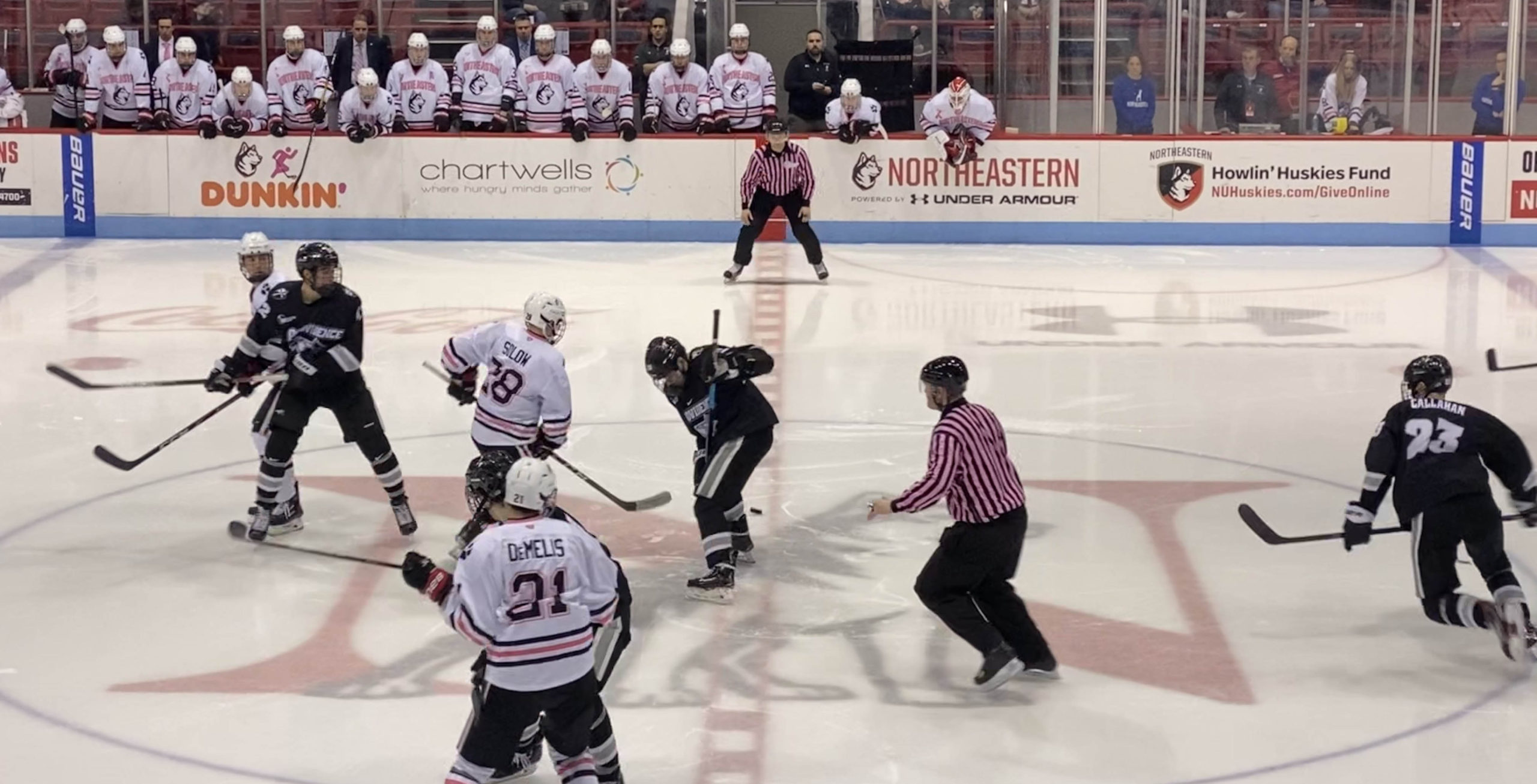
Friday night’s game was a little more special to Huskies Head Coach Jim Madigan as his team donned their Skating Strides pink jerseys in support of those affected by breast cancer. Coach Madigan’s own wife, Kim, is a survivor and she was on hand for the ceremonial puck drop before the Northeastern University Huskies took on the Providence College Friars at Matthews Arena.
There was a little bit of activity for the Huskies about five minutes into the opener where they peppered Michael Lackey with a few shots, but much of the first half of that first period was spent skating hard north and south as both teams were intent on denying the other any offensive momentum.
One of the things that many hockey teams have learned is that if you give Tyler Madden the puck and some time and space then he is definitely going to find a way to get the puck in back of the net, and Friday night was no different. A costly turnover by the Friars saw Madden jump out into the neutral zone with the puck on his stick and before the Friars could catch him, he was in the Friars end and the puck was in the net behind Lackey. That was Madden’s 17th goal of the season and it was unassisted. That was Northeastern’s fifth shot on net and it certainly gave them some new emotion.
At 17:53 of the opener, Matt DeMelis gave the Huskies a second goal simply by being in the crease area. The goal was reviewed to make sure he hadn’t kicked it in, the call on the ice stood and as the period came to a close the Huskies took the 2-0 lead into the intermission.
The second period saw an increase in physicality from both teams. It also saw a dangerous five-on-three situation where the Huskies were on the penalty killing end. First Jordan Harris was whistled for a holding and then Matt Filipe joined him for an elbowing. With three seconds remaining on the five-on-three, the Providence Friars cut Northeastern’s lead in half as Jack Dugan notched his eighth of the season, assisted by Greg Printz and Patrick Moynihan at 3:34. The Huskies were able to kill off the remaining time on Filipe’s penalty.
Before the teams could get too comfortable at even strength the Huskies found themselves on a power play when Dugan was sent off for hooking. However, Northeastern’s power play couldn’t convert. About 30 seconds after their man advantage ended they were probably wishing they had some wiggle room in the score. Biagio Lerario was given a five-minute major for hitting from behind along with a 10-minute misconduct for his hit on Printz right in front of the visiting Friars’ bench. Certainly not the best way to help his team.
During the five-minute major, Mike Kesselring sacrificed his body to deny a possible early shot on the Friar’s power play and then Craig Pantano sent a puck flying off his blocker. In the end the Huskies were able to kill Lerario’s penalty, though the Friars had put quite a few shots on Pantano. Denying any team who has a major power play can certainly tilt the ice a bit. And while they were being outshot, it was clear that the Huskies recognized how big that kill was and you could see them regaining some control on the ice.
McDonough, whose eight goals have all been on the power play, got his first even strength goal of the season, assisted by Madden, and Jayden Struble and gave Northeastern back their two-goal lead.
And once again, the Friars refused to go away. While falling, Moynihan put the puck blocker side high and it was a one-goal game.
While the Huskies were leading on the scoreboard , it could
have definitely gone a completely different way, because the Friars had outshot
Northeastern 12-4 during the second period.
Coming back out for the third, it was evident that both teams felt they could achieve the win. As the Friars Dugan knotted things up just 2:28 into the final frame it became clear that the game was going to be decided by a single goal. The question was whether or not the winning team could get it done in regulation.
The Friars continued to put pucks on Pantano—ultimately forcing him to stop 16 in the third—for a total of 33 shots of which he stopped 30. Even though it was the Huskies with the power play just after Dugan’s goal, it didn’t seem to given Northeastern much of a momentum shift. However, Northeastern’s hockey team has been down a goal and sometimes two and they know what it takes to get the win. They were not phased by Dugan’s third period goal—his second of the game. Nor were they letting the Friars number of shots distract them from what they were trying to do. They kept at it. And when they found themselves back on the man advantage at 13:09 when Friar Parker Ford was sent off for hooking, they put their impressive power play into high gear.
They got into the Friars end and then after some solid cycling, a chance opened up. Harris, from the blue line sent the puck to McDonough who was below the goal on the right. He saw Zach Solow in the slot and dished him a pass. Tic. Tac. Goal. The Huskies were ahead 4-3 with 5:30 remaining in regulation.
Depsite the pulling of Lackey at 18:56, the Huskies knew the game was now theirs to lose, and they weren’t going to let that happen.
They won’t be able to dwell too long on Friday’s win because February begins on Saturday, which means that the first Monday of the Beanpot is just three days away. Northeastern takes on Harvard in the first semi-final at TD Garden, no doubt looking to see if they can go to the Championship game for a third straight year.



 Prev
Prev