I’m pretty intense about trying to avoid “soldier” metaphors when I talk about athletes. Not because I don’t respect athletes, but because it’s a different kind of respect than what I have for soldiers. I think it’s dangerous to equate entertainment with war. I think it’s irresponsible to ask athletes to sacrifice their bodies, and oftentimes their mental well-being, in the same ways that we ask soldiers to.
But there’s a reason why the metaphor works. Guys play injured because they don’t want to let the fans down, or because they feel they owe a loyalty to the “name on the front” of their sweater, or because their teammates need them. How many times have we heard, “You play for the guy next to you,” in a post-game interview?
Guys, we literally stole that soundbite, almost word-for-word, from Black Hawk Down.
There is a reason why soldier metaphors are so tempting with athletes, particularly hockey players. Hockey is a hard sport. It makes you bleed. It breaks your bones, it shatters your knees, it bloodies your knuckles.
And it can permanently damage your brain.
On February 9th, 2015, 29 former NHL players joined a class-action lawsuit against the NHL. According to Sports Illustrated, the filing claims that the NHL failed to adequately educate and protect its players with regard to the long-term effects of injury, head trauma in particular. As a result, “the players are suffering from a variety of post-concussion symptoms, including headaches, memory loss and sleep problems, and are at an increased risk of developing serious latent neurodegenerative disorders and diseases including, but not limited to, CTE, dementia, Alzheimer’s disease or similar cognitive-impairing conditions.”
The NHL motioned to dismiss the lawsuit, just like they did with the one before. Their message seems pretty clear: your concussions are not our problem. You chose to play hockey. We paid you handsomely for it.
That’s true, in many cases, but large paychecks don’t prevent memory loss. You can’t buy memory, or sleep, or a pathway out of dementia. When we talk about depression in retired athletes, we’re not talking about ennui. We’re not talking about rich, bored retirees who are sad because they don’t have a cool 9-to-5 anymore.
We’re talking about bodies reacting to years of sustained trauma, and nowhere to turn to address it.
Before his death in February, Steve Montador had a lot going for him: he was expecting his first child, he was an ambassador for Right To Play, he was active with the NHLPA, and, after facing his own demons, he was helping others who struggled with addiction or depression.
On paper, he was the poster child for athletes trying to find their way after retirement, despite battling memory loss and light sensitivity after the concussion that led to his compliance buyout from the Blackhawks after the 2012-2013 season.
“My hope is that it helps somebody, and it opens the right eyes, and people get in touch with our PA, or each other, and we can create something that helps athletes figure out what they’re good at, and what they want to do next in life. I think this past year Steve was trying to do that. I wish he had.”
Following his friend’s death, Carcillo researched what the league has available for players after their playing days are over.
“Right now, as far as the PA goes, we would receive a phone call, you know, to see kind of how we were doing, and that’s pretty much our exit program,” he said.
When it’s over, it’s over for so many. No transition plan, no long term goal setting, no one telling you what to eat and where to be 24/7. You are on your own.
… Think about it. These guys are often plucked from normalcy before they have chest hair. These kids (because that’s what they are at the start of their career), don’t get the opportunity to experience reality before it even begins. How can they be expected to adjust to normal life when it is all over? They have likely not experienced it as an adult.
I wrote earlier this year about the NHL’s lack of a true support system for rookies coming into the league, and it’s a problem mirrored in its treatment of retirees going out of it.
“Why do NHL players struggle so much with moving on from the game? Why are so many former players I know battling depression? Why does the hockey community ignore them when they’re gone? And why can’t we create a more concrete program to help them transition into real life?” Carcillo asked, and rightly so.
Why can’t we?
As a league, as the media, and as fans, we don’t owe ex-players a new career. We don’t owe it to them to make sure they never have to struggle again. But we do owe them a pathway to figure out what happens next. We do owe them resources to help deal with the problems that their commitment to hockey–and to us–brought them.
I doubt intense physicality will ever fully leave hockey, and I don’t think it should. That’s not the question.
The question is: if we ask our players to be soldiers, why do we refuse to see them as veterans?
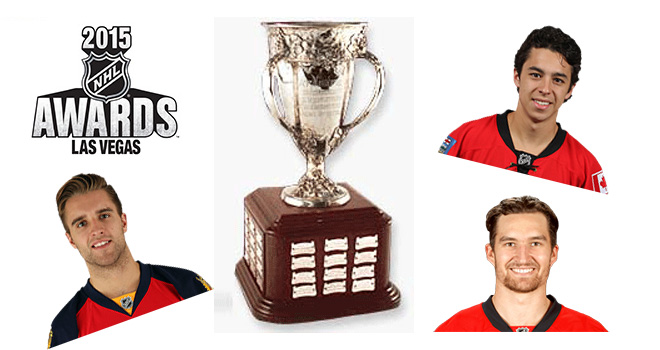
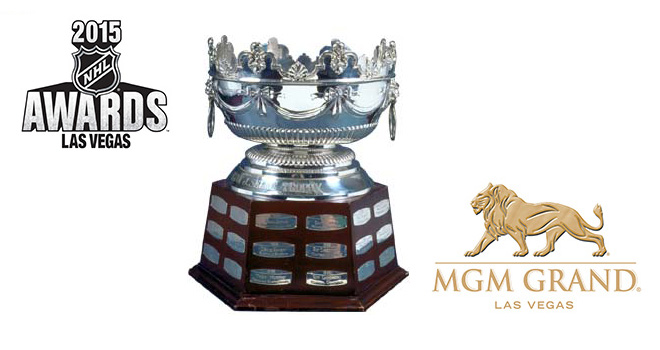
On Wednesday, the National Hockey League announced the three finalists for the 2014-15 Calder Memorial Trophy. The Trophy is awarded “to the player selected as the most proficient in his first year of competition” by the Professional Hockey Writers Association. Their ballots were submitted at the end of the regular season and the three with the most votes were announced as the finalists. The winner of the award will be announced during the 2015 NHL Awards to be held at the MGM Grand Gardern Arena in Las Vegas on June 24.
It should be of no surprise to anyone who has followed hockey this season in regard to two of the players who have been selected. The three players, in alphabetical order, are Aaron Ekblad (Florida Panters), Johnny Gaudreau (Calgary Flames) and Mark Stone (Ottawa Senators). Ekblad is the lone defenseman of these finalists.
Aaron Ekblad
The Florida Panthers drafted Ekblad during the 2014 NHL Entry Draft. He went number one overall, and he was a happy player when his name was announced. Of course the Panthers have been happy since getting the impressive then 18-year-old and his performance at the NHL level has some demanding to see a birth certificate because of his maturity in play and composure.
Ekblad has set records in the Panthers’ organization for goals (12), assists (27) and points (39) by a rookie defenseman. And he was just two points shy of toppling Bobby Orr’s record of 41 points for an 18-year-old defenseman set in 1966-67. In a twist of fate, Bobby Orr’s sports agency represents Ekblad. Orr would know great talent when he sees it. If Ekblad wins the Calder, he would be the second Panthers player to do so in three years, as Johnny Huberdeau won it in 2013.
Johnny Gaudreau
The Calgary Flames claimed Gaudreau during the 2011 NHL Draft where he went in the fourth round (104 overall). He elected to go the collegiate route, assisting the Boston College Eagles to some impressive wins during his time there, along with line mates Bill Arnold (currently signed with the Calgary Flames and played with their AHL affiliate the Adirondack Flames) and Kevin Hayes (who has signed with the New York Rangers).
Known to most as “Johnny Hockey,” a moniker that his agent has trademarked, the rookie tops the list of all rookies this year in assists with 40 and in power play goals with eight. In total he had 24 goals this season for a total of 64 points. He has also got the highest average time on ice per game among rookies at 17:43. He’s even experienced his first NHL career hat trick, which he scored on December 22 in an away game against the Los Angeles Kings. This made him the youngest Flames player to get a hat trick since Joe Nieuwendyk did so December 28, 1987. If Gaudreau wins the Calder, he would be the first to do so representing the Flames since Sergei Makarov did so in 1990.
Mark Stone
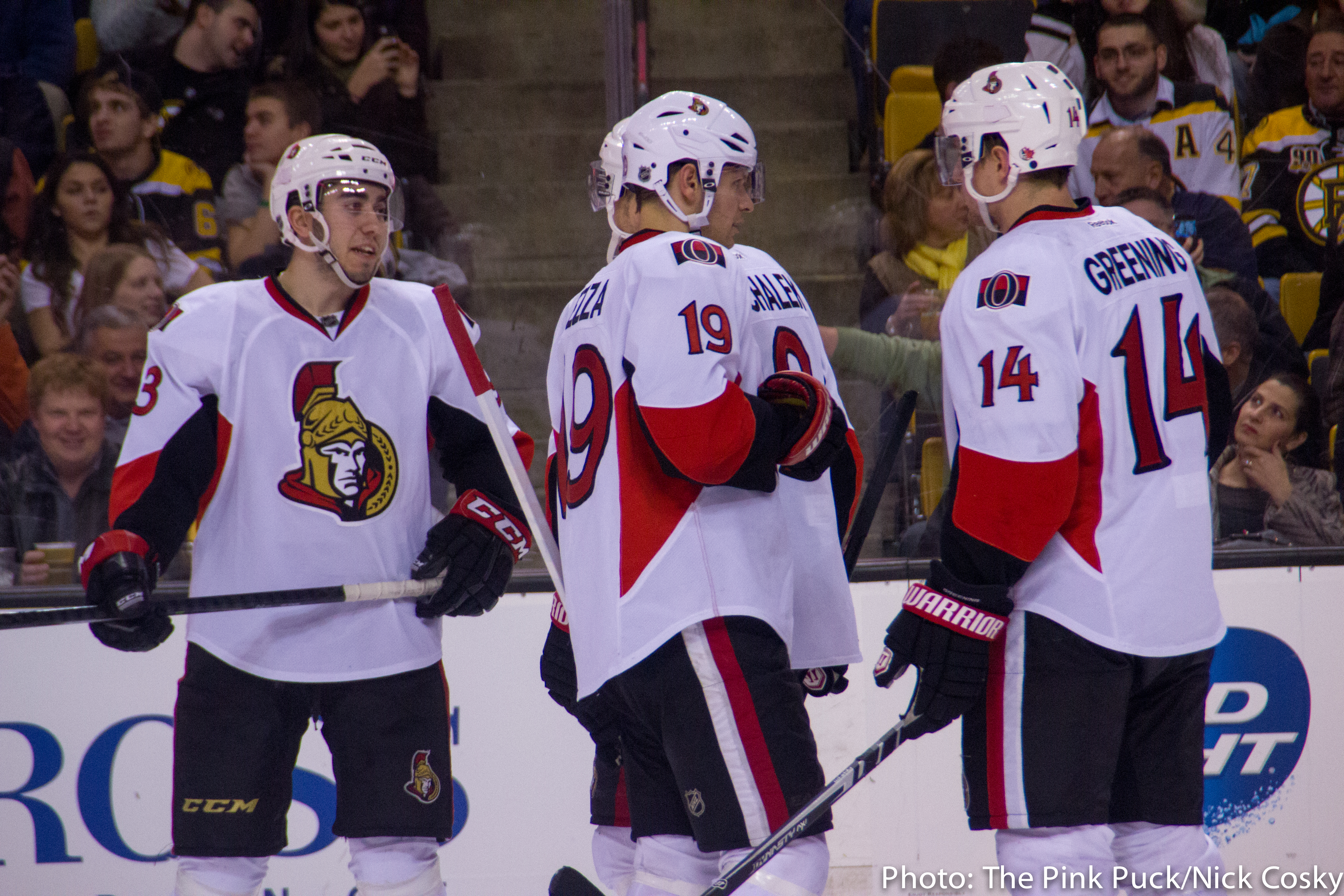
Drafted by the Ottawa Senators in the sixth round (178th overall) during the 2010 NHL Draft, Stone tied his competitor Gaudreau in total point at 64 (26 goals and 38 assists). In his first 31 games of the season he managed 14 goals, 21 assists for 35 points. This included a rookie club record for the Senators of a nine-game point streak. His last two goals were in the regular season finale as the Senators made their push to claim a playoff spot—something that seemed unlikely earlier in the season.
Stone is a great example of a diamond in the rough when he was drafted. Drafted in the next to last round, he matured while playing in the WHL with the Brandon Wheat Kings before moving up to the AHL Binghamtom Senators where he played the bulk of his games in the 2012-13 and 2013-14 seasons. This season he played 80 games with Ottawa where he lead all rookies with a plus-minus of +21 and tied as first in the league in takeaways with 98. If he wins the Calder, he would be only the second player in the Senators organization. Daniel Alfredsson was the only other one to do so when he won it in 1996.
When looking at the three players, it is likely that Gaudreau will garner the award, however, Ekblad has proved to be a most impressive player and is considerably younger than the other two finalists. His youth should have played into consideration with his accomplishments.
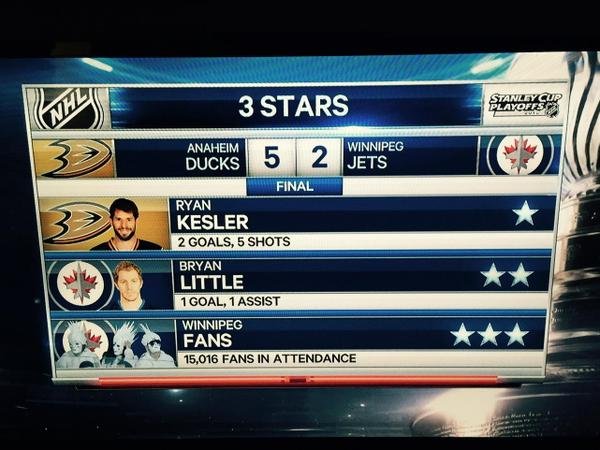
In the first round of the NHL Playoffs, the Winnipeg Jets were swept by the Anaheim Ducks in four straight games. The Winnipeg fans were universally praised for their loyalty to their team, the successful “whiteout” of their arena for both home games, and the fact that they all stayed until the bitter end to cheer on the team that made the playoffs for the first time since the 2006-2007 season, despite the quick defeat. The Winnipeg fans were even awarded the third star of the game.
But after the series was over, a new controversy emerged about an incident that had taken place during Game 3 of the Series. During this game, the Winnipeg fans had started chanting “Katy Perry” at Anaheim Ducks’ forward, Corey Perry, whenever he skated onto the ice. The initial reaction of most was amusement but afterwards, criticisms and questions began to emerge.
As Greg Wyshynski of Puck Daddy reported, NHL Commissioner, Gary Bettman was asked by reporters about the chants and whether he felt they may be driving away female fans. Bettman’s response was “You think that’s sexist? Taunting chants aren’t intended to be sexist.” Bettman went on to say that the NHL has a track record of “diversity and inclusiveness” and he didn’t view this as a problem nor did he think the NHL could do anything about it.
As Wyshynski very aptly points out in his piece (which I strongly recommend reading in its entirety), the “Katy Perry” chants when taken alone, are not necessarily indicative of a problem in the NHL. But unfortunately, when taken together with all of the other examples of sexism that exist in the league, they indicate the very real problem of assuming that “like a girl” is equivalent to “bad” or “less than equal.” When combined with the near constant comparison of male players to females intended to suggest that they are somehow weak or whiny, along with with the recent abuse of some female Ottawa Senator fans by some Montreal Canadiens fans during a playoff game, and when these examples exist in a world where male sports stars are frequently accused of domestic violence against the women they purport to love — the chant is just one more example of a society that continues to reinforce the notion that women are somehow “less” than men.
I watched that Jets game and remember when the chants erupted. I laughed. I was amused. No fan of Corey Perry or the Ducks, it seemed that calling Perry a female singer’s name was just another hilarious diss and certainly, hockey fans have called players they dislike worse things.
But then I started to think about it. This was such a familiar occurrence: a male athlete being called “a girl” or being endowed with female characteristics to criticize him. In the hockey world, despite the scores of female fans and increasing numbers of women playing the game, it’s a commonplace theme. Vancouver Canuck fans are certainly used to hearing their top players, brothers Henrik and Daniel Sedin called “the Sedin sisters” in disdainful tones. Sidney Crosby of the Pittsburgh Penguins is frequently called “Cindy Crosby” to suggest that he is a complainer. I had a chance to experience this when my husband and I attended the last meeting of the Kings and Penguins in March of this year. At one point in the third period, Crosby skated into the face-off circle and a male fan two rows behind us began yelling, “Sidney! Where’s your purse?” I will admit to you now that I laughed, as did my husband and most of the Kings fans around us. I’ll also admit to you that in retrospect, I’m sorry I did.
What I’ve realized in the aftermath of the Katy Perry case is that sexism is so deeply ingrained in our society, that even those of us who consider ourselves modern, forward-thinking individuals – dare I say, even feminists – find ourselves condoning behavior that is clearly continuing an atmosphere of inequality.
To be clear, I doubt that most of the Winnipeg fans who chanted “Katy Perry” were consciously being sexist or trying to demean women in any way, shape or form. But that’s exactly the problem. For so long, our society has accepted the idea that women are somehow not equal to men, that if you “play like a girl” or “act like a girl” this somehow demeans you or paints you in a negative light. The notion has been so commonplace as to seem normal, so we accept and don’t question whether a taunt like this is ok or even funny.
Last year, a popular campaign aptly titled #LikeAGirl emerged from Always, a feminine products manufacturer. The campaign’s first ad clearly outlined the prevalence of sexism — particularly when it comes to women in sports — and how girls and women themselves perpetuate the stereotypes:
I’d venture that most Winnipeg fans who chanted “Katy Perry” that night and most of us who chuckled at the chant are 100% supportive of a campaign like this. And yet, we continue to unwittingly reinforce notions and behaviors that directly conflict with that message and send us right back to square one when it comes to equality for women. As the mother of two female athletes, I’m somewhat ashamed of my role in perpetuating the stereotypes, however unconsciously.
The bottom line is that it’s time to stop criticizing men by calling them women. Just as we now recognize that calling someone “gay” as a put-down is unacceptable, we should realize that “like a girl” is a compliment, not a condemnation. Female athletes and sports fans alike – as well as those who love them – need to agree that taunting a male hockey player, athlete or any man, for that matter, by calling him “a girl” or endowing him with female attributes is not funny. Next time I see Corey Perry on the ice, I won’t be calling him a woman’s name — unless my intention is to compliment his play.
If you weren’t tuned into game 6 between the Calgary Flames and Vancouver Canucks, then you most certainly missed out. With the Flames having a 3-2 lead going into game 6, a win was necessary in order for Calgary to win the series without a game 7.
The first period didn’t look promising, after the Flames starting goaltender Jonas Hiller gave up two goals in 7:32 of the first period. A goaltender change so early in the game is usually not ideal, but the Flames gave backup Karri Ramo the net. He made 17 saves on 19 shots. A mere one goal from Michael Ferland in the first for the Flames wasn’t enough to get close to the Canucks lead. Ferland had two goals and two assists in the first round against the Canucks.
The second period was much more positive in favor of the Flames. The young guns had their hand at offensive production with a goal from Sean Monahan and a tying goal from Johnny Gaudreau. These two have been huge factors in the Flames regular season, and have proven themselves to be key assets to the team. A later goal from the Canucks Luca Sbisa broke the tie and once again challenged the Flames ability to win.
Third period was total domination for the Flames. A power play goal by Jiri Hudler tied things at 4-4, with the assits from “the boys” or Sean Monahan and Johnny Hockey. With under 5 minutes left in the third, the Flames got their first lead of the game. Things drastically went down from there for Vancouver as they took out their goaltender Ryan Miller in hope that the additional forward would help tie the game. After the first empty-net goal (6-4) from Hudler, the Canucks still had hope with less than a minute left. Leaving their goaltender out dug them even deeper into a hole, and with their 7-4 lead, the Flames skated off to the second round, while the Canucks were left in the dust.
“I’ve never been a part of a team like this. We never quit.” – Michael Ferland pic.twitter.com/9TK43f3vcU
Once again, the Flames blocked shot count has been out of control. 23 blocked shots throughout the game. Deryk Engelland had 10, and the closest person to him was Kris Russell with 5. This is a huge part of Calgary’s game, and it is just one example of how excellent the Flames defense is.
The Calgary Flames will now move onto the second round against the Anaheim Ducks. Game information is to be determined at a later time.
Midway through overtime, Carl Hagelin got the puck in the Pittsburgh Penguins‘ zone. He brought it in a sweeping arc around the right side of the ice and snapped it toward the net. Marc-Andre Fleury, who had already stopped 34 of 35 shots on the night, was positioned low in the net. This shot went past his glove. The buzzer sounded, the red light went off, and Madison Square Garden erupted in cheers..
Hagelin, sprawled on his stomach on the ice, celebrated his OT game-winning, series-clinching goal from beneath the pile of his equally excited teammates. The New York Rangers were moving on to round two.
The Rangers defeated the Penguins, 2-1, in the fifth game of the first-round playoff series on Friday night. The Rangers now move on to the second round for the fourth consecutive season and will take on the winner of the New York Islanders/Washington Capitals series. The Penguins, meanwhile, will hit the golf course.
It was an evenly matched, hard-fought game that came down to the wire. It was also, coincidentally, the fourth game of the series that ended in with a score of 2-1; the Rangers won all four of these 2-1 finals.
Derek Stepan started off the scoring with a power play goal at 4:23 in the first period. He kicked the puck to himself to set up his shot–a bit of a soccer move–and finished his shot right in front of the net to give the Rangers an early 1-0 lead.
The Penguins’ Nick Spaling then tied the game at 1-1 late in the second period with a goal that went off his arm and past Henrik Lundqvist; the play was sent for review, but the call on the ice stood and the goal counted.
The third period was arguably the fastest-paced period of the series, and it was highly competitive. Both teams shot pucks off the crossbars and had a number of solid scoring chances, especially in the closing minutes of the period. Lundqvist and Fleury stood tall in their respective nets and made huge save after huge save. They were impenetrable, and overtime looked all but inevitable.
The parallels between this season and the 1994 season continue; the last time the Rangers clinched a playoff series in overtime was in the Eastern Conference Final against the New Jersey Devils during their famed 1994 Stanley Cup run.
Just something to note.
THREE STARS OF THE GAME:
3. Fleury
2. Lundqvist
1. Hagelin
LOOKING AHEAD/OF NOTE:
–Mats Zuccarello left the game toward the end of the first period after getting hit in the side of the head by a Ryan McDonagh slapshot. He did not return, and his condition is currently undisclosed. Zuccarello recorded 1 hit and 3 shots in 4:56 of ice time.
–Kevin Klein did not play again tonight, although he reportedly has been skating and practicing with the team. Still no word on when he will return.
-The Capitals currently hold a 3-games-to-2 lead in their series against the Islanders. Game Six will take place Saturday afternoon on Long Island. The Rangers were 2-3 against the Islanders during the regular season and 3-1 against the Capitals.
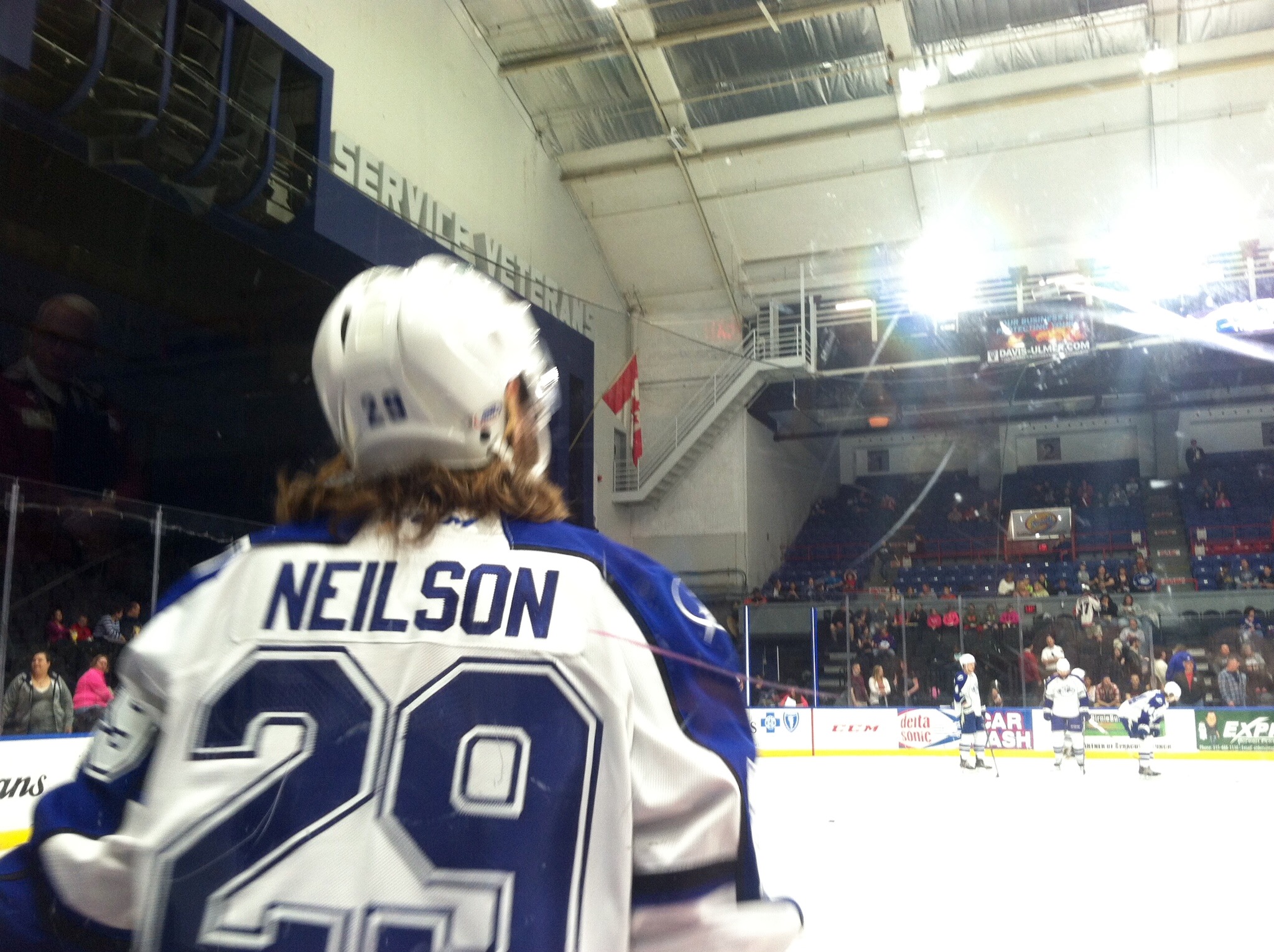
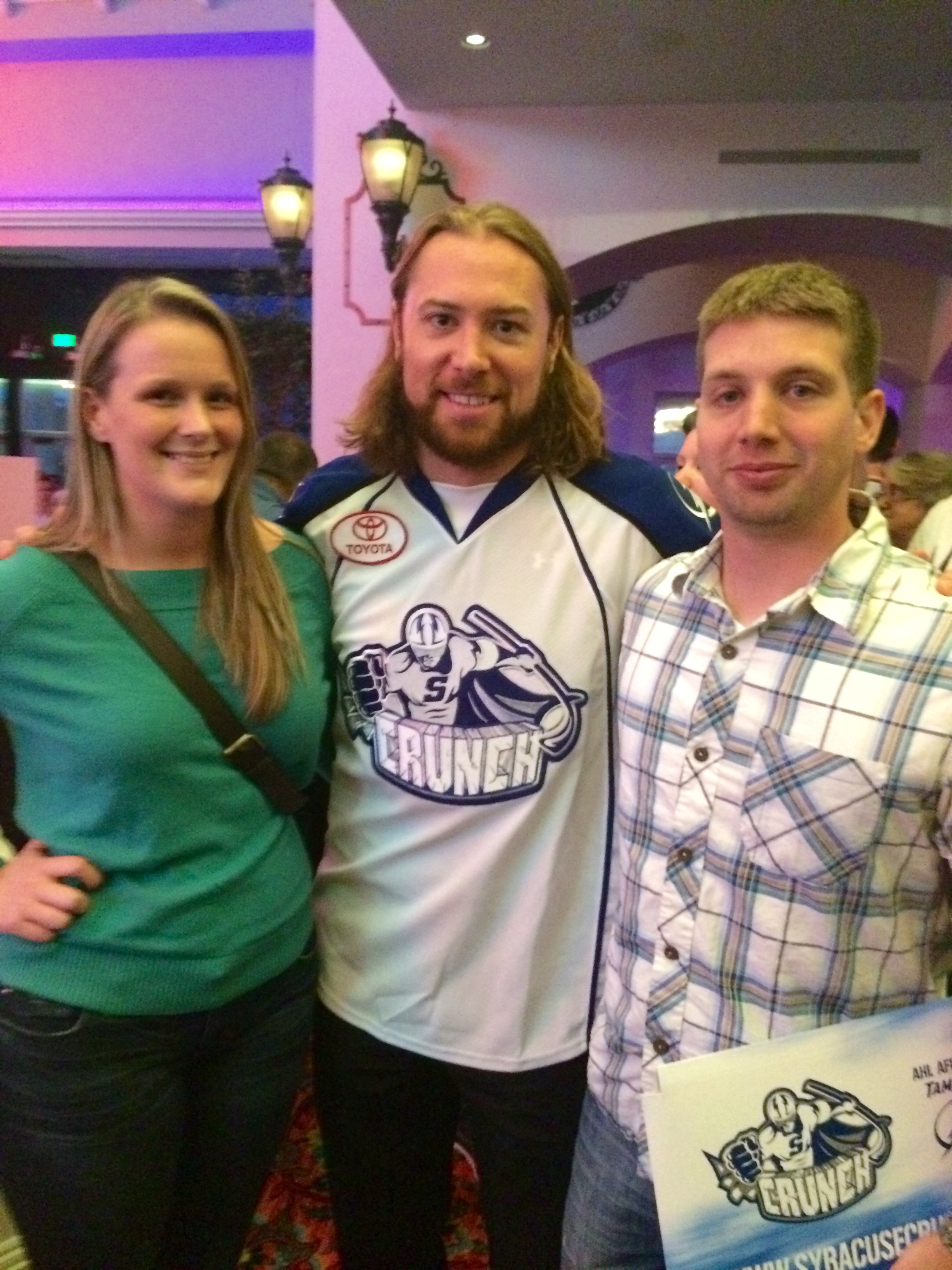
To some, AHL enforcer and selfless dedication to community programs don’t belong in the same sentence. To Syracuse Crunch’s (AHL affiliate of the Tampa Bay Lighting), Eric Neilson, it is all in a day’s work. Recently Neilson was named the team’s recipient of the IOA/American Specialty AHL Man of the Year award for his outstanding contributions to the Syracuse community during the 2014-15 season. Receiving this honor is not unknown to Neilson as he has been Syracuse’s man of the year the last three seasons, and honored seven times in his career for his respective team. For the 2013-14 season, he won the AHL’s Yanick Dupre Memorial Award for his commitment to community programs in Central New York. Recently I had the chance to catch up with Neilson and reflect on why connecting with the communities that he has lived in has been important to him, the legacy he hopes to leave and what has stood out to him through the years.
Being involved in the community where Neilson is spending his hockey season in is important to him since that is where he is living the majority of the year. “I’m from Fredericton, New Brunswick, (Canada), a small east coast town. I’ve been away from home since I was 16 (years old), and I’ve found myself living in other places and I gotta get to know where I live. I’m a small town guy, so its important to me to get to know the city that I live in.”
A favorite amongst Syracuse Crunch fans since 2012-13, his first season spent in Central New York, Neilson is happy to call Syracuse his second home. It’s been important to become comfortable with the community he is living in and to get out and learn his surroundings. “I’ve got to know Syracuse the past three years very well. There are a lot of great people here and it’s a beautiful city”.
Neilson’s efforts in the community have had a strong focus around children. Though 30-years-old, his playful personality has always forged a strong connection with kids. There are several moments that have stood out to him through the years of his community service, however a notable one to Neilson took place last season when he launched his “Breakfast with a Champion” program in local schools. The program designed, developed and executed by Neilson, was his initiative to teach elementary school students the importance of nutrition and healthy eating. “The satisfaction when I left there (the elementary school), the smiles on the kids’ faces. That really touched me. That was something special”.
This season along with Syracuse Crunch captain Mike Angelidis, Neilson helped launch “Change for Change,” a non-profit initiative that aims to raise money for pediatric cancer research. The team has been collecting spare change from fans and donating all proceeds to Upstate Golisano Children’s Hospital. Neilson and his teammates were touched last season when they met 7-year old Griffin Engle, who was fighting Glioblastoma Multiforme, a rare type of brain cancer. Griffin ultimately lost his fight to cancer last summer and Neilson and his teammates looked for a way to honor him and to help make a difference for the future, which they did with “Change for Change.”
Neilson has spent time in the AHL for the past eight seasons. Educating children in his communities through the years and acting as the Syracuse Crunch’s primary speaker at the team’s anti-bullying events, he notes that the increased use of social media for kids is something that stands out to him. “I go to classes now, kindergarten through grade-6 kids, and ask for a show of hands who has a cell phone. Ninety percent of them are sticking their hands up. That’s the thing that stands out in my mind, is how social media affects younger kids and how its a part of their everyday lives. Kids are introduced to cell phones and computers and the world wide web at such a young age.”
As an exempt veteran by AHL standards, Neilson is part of the Syracuse Crunch’s core leadership group and it’s important to him that he has had a positive effect on some of the new generation of players coming through the ranks. “When I retire, I just hope that there is a rookie or a kid that I played with that saw how I treated and interacted with fans. I want to show that these people (fans in the AHL), the 5,000 that come every night, they spend their hard earned money to come watch us play. I want them to understand that and appreciate that they (the fans) are taking their time and their hard earned money to come watch us perform. It’s important that they take the time to sign an autograph, give a kid a high-five, shake a hand, give a hug – just little things like that. When I’m done playing I hope that some of the kids see what I do and act on that”.
Looking back on his professional hockey career and what he plans to take away from it, Neilson has advice that can be used across any genre. “Team. Nothing gets accomplished if you work by yourself. I’ve learned that together we’re better. As a group, as an individual, that’s what I understand. I know that when you have somebody who has your back and you’ve got their back, that creates success. We proved that in Norfolk (with the Norfolk Admirals) and won a championship (Calder Cup Champions 2011-12) and I’ve learned a lot from that”. Neilson and his teammates on the Syracuse Crunch will be putting this mantra to work as they head into round one of the Calder Cup Playoffs this weekend in Wilkes-Barre Scranton.
Eric Neilson and the Syracuse Crunch are still collecting donations for their “Change for Change” initiative to raise funds for pediatric cancer research. It may sound like a big goal…but it all starts with just a little change. You can help at www.gofundme.com/SyrChangeForChange
Thursday night’s game was one that the Calgary Flames hoped would result in them being just one more win closer to The Cup. In true Game 5 fashion, though, the Vancouver Canucks were able to hold onto a lead they built early in the third period.
Going into Thursday night, the Flames had a 3-1 lead in the series. Of course, because it is the playoffs, one should never guarantee a win, no matter how great the lead or advantage they have is. Now, in order for Vancouver to win the series, they would have to win two more games, while Calgary only has to win one. Stranger things have happened than Vancouver coming from behind, but if Calgary can produce offensively for one more game, they can move on to the next round of playoffs which would place them against the Anaheim Ducks.
Ryan Miller started in goal for the Vancouver Canucks for the first time this series. The 21 shots that he faced paled in comparison to the 43 Jonas Hiller was bombarded with. Hiller’s first star of the game nomination was well earned with a .953 save percentage.
“Hills played unbelievable. He’s been playing like this since the LA game… He’s dialed in,” said Bob Hartley on Jonas Hiller via Twitter.
Hiller’s offense did not produce to its best ability in last night’s game. Vancouver had double the shots on goal that Calgary had, and they were offensively out-powered. Vancouver also came out on top 66-40 on shot attempts. Such a large deficit understandably didn’t help Calgary in any way. They allowed Vancouver too many chances, and left their goaltender vulnerable to too many shots. If they want to prosper next game, they must all-around play better offensively.
Mikael Backlund of the Flames addressed the issue of the shot count per the Flames saying, “We didn’t shoot enough. It wasn’t a terrible game. It was a tight game.”
Michael Ferland was, once again, a big presence on the ice. His 7 hits in game five just added to the team’s total of 25 hits on Vancouver. Those are some big numbers, right there. Sixteen blocked shots was just shy of Vancouver’s 17, but Calgary players such as Kris Russell and Dennis Wideman are huge factors in this defensive part of the game.
“We didn’t execute the way wanted to,” said Kris Russell via Twitter. “We didn’t get enough traffic to the net.”
Game 6 is to be held in Vancouver on Saturday night.
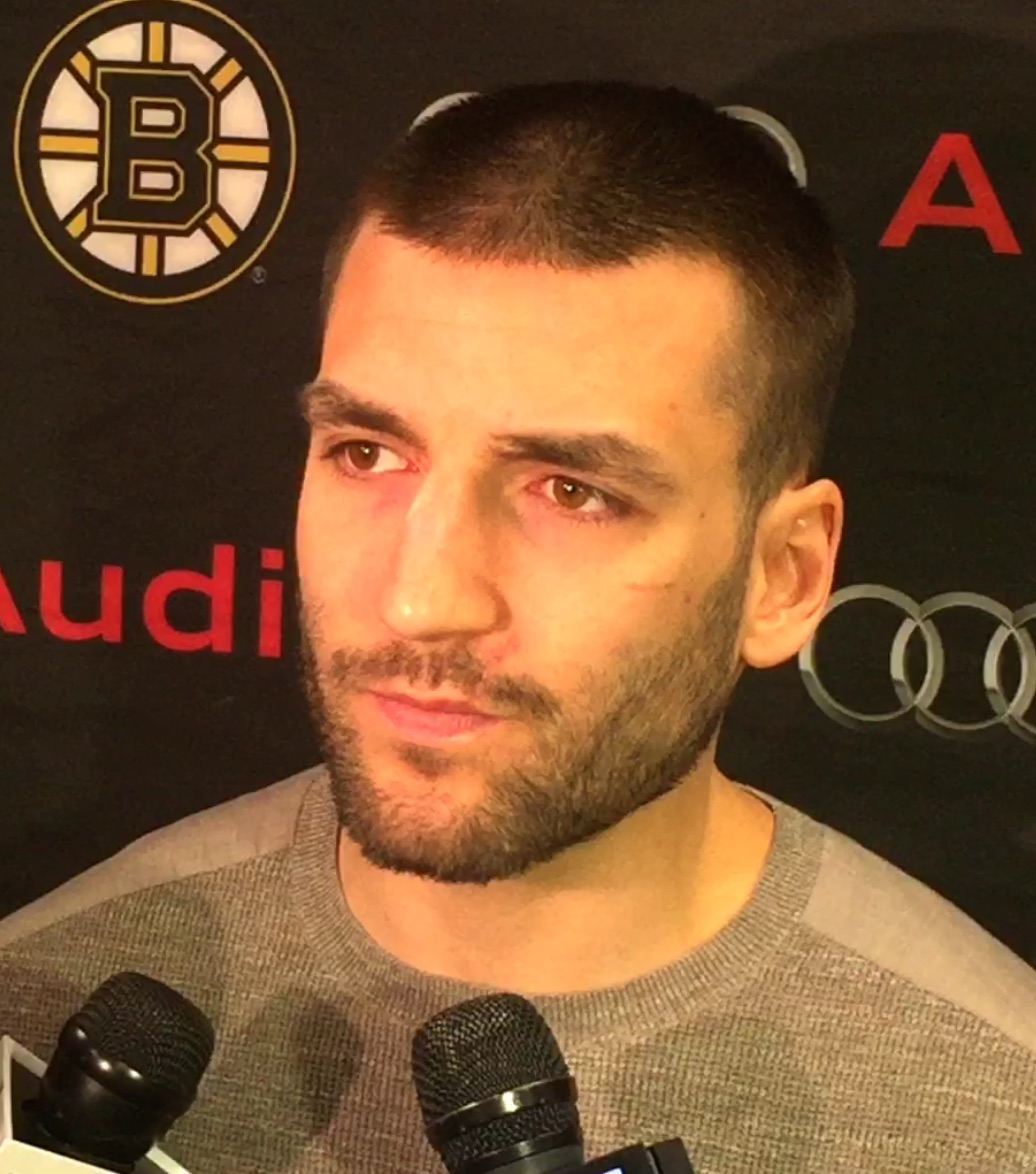
On Wednesday, April 22, the National Hockey League announced the three finalist for the Frank J. Selke Award as nominated by the Professional Hockey Writers Association. The Selke recognizes “the forward who best excels in the defensive aspects of the game.” This year’s three finalists, listed alphabetically, are Patrice Bergeron (Boston Bruins), Anze Kopitar (Los Angeles Kings) and Jonathan Toews (Chicago Blackhawks)—the same three who went 1-2-3 respectively last year, which represents the first time in 18 years that the same three players have been named to the finalist berths for any trophy in consecutive seasons. The last time was in 1995-96 and 1996-97 when Paul Kariya, Adam Oates and Teemu Selanne were the finalists for the Lady Byng Trophy.
The finalists for the Selke were submitted at the conclusion of the regular season and the winner will be announced at the 2015 NHL Awards to be held at the MGM Grand Garden Arena in Las Vegas.
Bergeron’s nomination marks the fourth consecutive year that he has been recognized for his two-way style of play, something he takes great pride in.
Patrice Bergeron
“Definitely another huge honor. It always speaks to the way that your team helps you and by the way that you try to play the game,” Bergeron said Thursday morning. “And for myself, it’s … I take a lot of pride in my two-way game so it’s definitely special to be nominated with two great players like Anze and Jonathan.”
It wouldn’t be Bergeron speaking if he didn’t immediately mention his team. He always makes a point to include his team whenever he is being singled out as a player. Unfortunately for Bergeron, the Boston Bruins did not make it into the playoffs this year—the first time since the 2006-07 season—a bitter pill for the team, and that includes the impressive center.
“Right now it’s hard just to watch some hockey and it definitely hurts. I’ve always said that it’s always about the team and individual awards don’t really matter, so I can’t be standing here and say that it helps after a year like we’ve had,” he said. “It’s an honor. I’m definitely not going to say otherwise, but I definitely would rather be in the playoffs right now.”
Bergeron is a team-only player. He believes that they have success as a team and they fail as a team. And while two of this year’s finalists are on teams that did not advance to the playoffs, Kopitar is the other, that is an abnormality. However, the center’s impressive skills at the dot could not be ignored—a league leading total face-offs (1,951), wins (1,175) and winning percentage (60.2%) on the season. That’s a lot of time waiting for the puck to drop and ensuring that your team gets possession of it. His total number of face-offs this season was the result of injuries to the other centerman who usually takes a number of them during any given game—David Krejci—who missed almost half of the season in total games combined over two different injuries.
Bergeron vs. Brian Gionta (Photo: Alan Sullivan)
“It was definitely a first this year, you know, the amount of face-offs that I was taking. I would say overall more in my zone, in the defensive zone, I was taking a lot, and really starting a lot of my shifts there, which is fine,” Bergeron explained “It’s definitely something that I like to do and it’s a good challenge to go back on the offense and try to create some offense out of it. But it was definitely different when David [Krejci] went down and then when [he] was playing the wing with me. That’s definitely something I had to do more; sometimes taking draws for our other lines. But at the end of the day it’s part of my job and I have to do good to the fullest and make sure I win the face-offs when I’m asked to do that.”
Those who have interviewed him before are not surprised by his humility. Despite the other impressive statistics measuring puck possession and shot attempts, for Bergeron it is about whether or not he believes he did his best. And what he expects of himself must be the equivalent to the heights that an Olympic high jumper can scale.
“I’m always trying to play a two-way game and try to play that the best that I can and this year was definitely, for everyone, it wasn’t our best year and so it’s myself included,” Bergeron said when talking about his defensive abilities. “But at the same time, you know, I definitely try to leave everything on the ice every time I step out there and I felt like I’ve done that for sure.”
Bergeron has been honored as the Selke Award winner in two of his previous three finalist nominations in 2012 and 2014. And though it may seem like he doesn’t understand that there are times that it’s okay to be acknowledged as an individual in a team sport, perhaps that is because he has an internal level that he strives to achieve. Given how much of himself that he has left out on the ice in past seasons, one can only guess at the insane standard to which he holds himself.
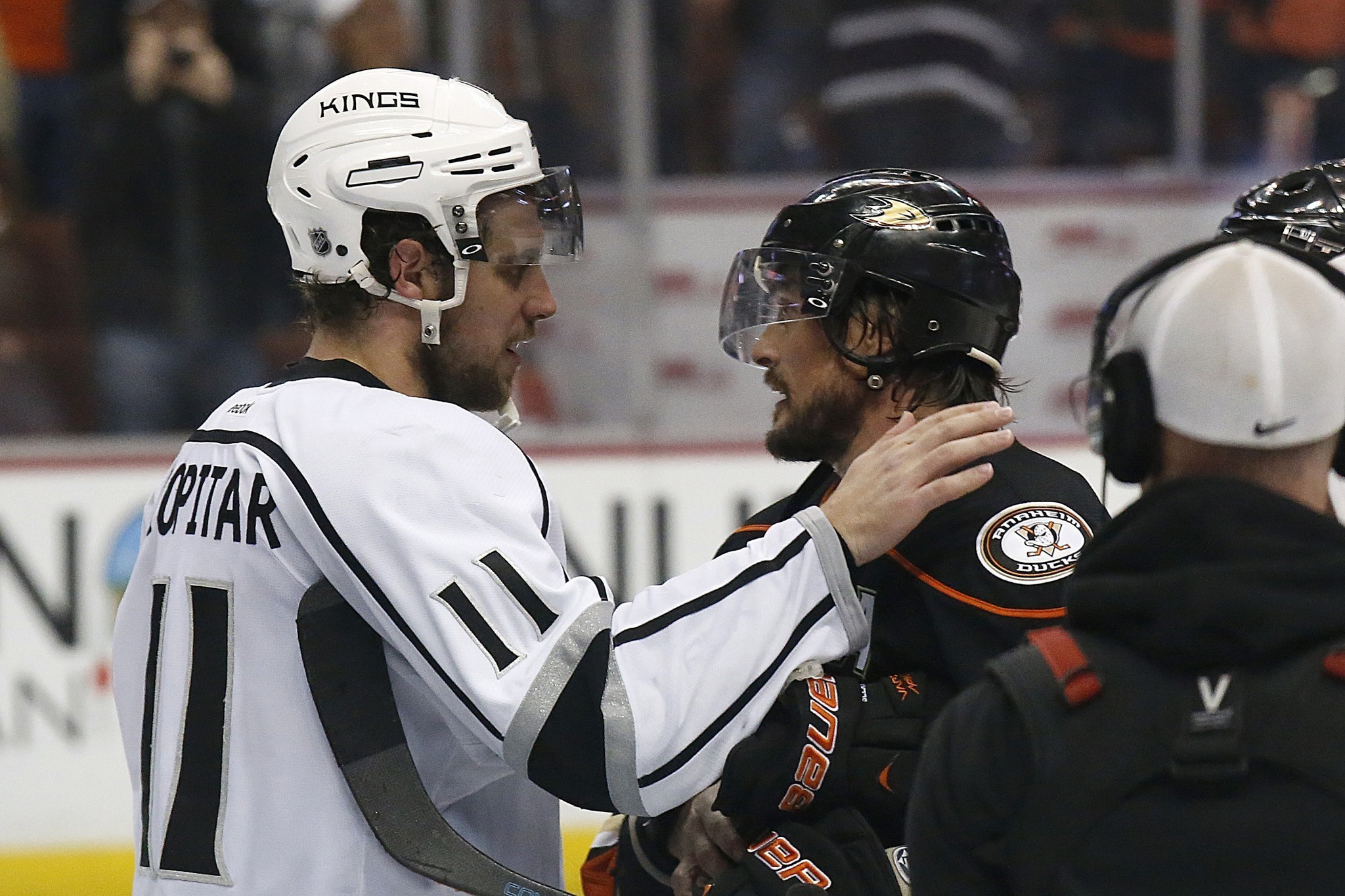
Does an East Coast bias exist? Most West Coast hockey fans would argue it does and many times their proof point has been how often players for the two-time Stanley Cup Champion Los Angeles Kings have been overlooked when NHL Awards time comes around. During the past couple of seasons, the pendulum has started to swing, with overdue recognition trickling in for players like defenseman, Drew Doughty, goaltender Jonathan Quick and most notably, one of the better two-way centermen in the NHL, Slovenian-born, Anze Kopitar. This week, Kopitar was recognized with not one – but two – award nominations from the Professional Hockey Writers’ Association: the Selke and Lady Byng.
Is this Kopitar’s year to win an award? If so, it’s unlikely the Selke. While the nominees are named for their regular season play, it is notable that two of the candidates for the Selke- Bergeron and Kopitar – are missing from this year’s Stanley Cup Playoffs. Add to that the fact that the 2014-2015 season wasn’t Kopitar’s best – he’s the only Selke candidate to have ended the season with a minus rating – and the odds are already against a player who is, by all accounts, one of the most defensibly responsible forwards in the NHL. There’s also that East Coast bias and the statistics show, it truly exists. Only one player playing for a team in the Pacific or Mountain time zone has ever won the Selke and that was Ryan Kesler for the Vancouver Canucks in 2011. Bergeron is a two-time winner, having picked up the Selke in both 2012 and 2014, and Toews won for the Blackhawks in 2013 – the year they beat the LA Kings in the Western Conference Final and went on to win the Cup.
Though Kopitar lead the Kings in points for the eighth consecutive regular season, he potted only 16 goals. That said, Kings fans and anyone who watches Kopitar know that his strengths include his responsibility on the ice and his unselfish play: he leads in all situations, never heads for the bench without ensuring that the puck is out of harm’s way, plays hard on the boards and generally wins those battles and is one of the most adept passers on the team, setting up plays time and again for the natural goal-scorers he’s frequently paired with like Marion Gaborik and Jeff Carter. Kopitar is an all-around player – the exact kind of player the Selke is designed to recognize. Despite all of this, the Selke has so far eluded him and that’s unlikely to change this time around.
Anze Kopitar
The Lady Byng, on the other hand, may be within Kopitar’s reach. This is his first Byng nomination, but no one who has watched Kopitar should be surprised that he’s a contender. As LA Kings Insider, Jon Rosen reported, Kopitar was sent to the box for a mere five penalties – all minor – adding up to a career-low of 10 penalty minutes this season, well below his average. And looking at the bias factor, the Lady Byng has been kinder to West Coast teams. Three Los Angeles Kings have previously been awarded the Trophy including Marcel Dionne, Butch Goring and three-time trophy winner, Wayne Gretzky.
The real test of the East Coast bias will likely come when the nominations for the Norris Trophy are announced. Kings fans, writers who cover the team and hockey pundits who have had a chance to watch Drew Doughty in action have long felt that Doughty is deserving of the Norris and that this could be his year. With two cups and two Gold medals for Canada to his name, and last season’s NHL leader in ice time per game, Doughty should certainly be a finalist, but it remains to be seen whether voters will go so far as to hand him the trophy. In the meantime, Kings fans should take heart that top players like Kopitar and Doughty are finally being recognized among the elite players in the NHL.
The storylines coming into the opening round playoff series between the Ottawa Senators and Montreal Canadiens were always going to be about goaltending. The Vezina favorite, Carey Price, against the man known best as the Hamburglar – Andrew Hammond. However, the first two games of the series featured a combined 12 goals and two Montreal wins. While both games 1 and 2 were decided by 1 goal each, the high scoring contests favored the Canadiens. Entering game 3, Senators head coach, Dave Cameron, made the decision to go with veteran Craig Anderson over Hammond, and while the result did not go Cameron’s way, it felt as if Ottawa was at least playing their game.
Game 4 featured the same goaltending match-up and a tight checking affair, but this time a much better outcome for Ottawa. The Senators staved off elimination on the back of a 28 save shutout by Anderson, his third career playoff shutout. Rookie Mike Hoffman netted his first career playoff goal at 9:05 of the third period to give Anderson all the support he would need. Price had 31 saves of his own, but the series now heads back to the Bell Centre for game 5 on Friday.
The game began quickly for Montreal, getting 6 shots and a power play all before the Senators were able to test Price. Anderson was strong, allowing his team to find their game. After the initial surge by the Canadiens, the period ended with Montreal out-shooting Ottawa by only 2 shots and going 0 for 2 on the power play. Neither team showed great possession with stick checks, turnovers and odd-man rushes, keeping both goalies on their toes.
The second period had been the downfall for Ottawa in games 1-3, being outscored 6-2 and out-shot 52-26 so far in the series. But the middle stanza of game 4 was the turning point. Ottawa out-shot Montreal 11-10 and had 2 power plays of their own. But the save of the game for Anderson came on the second of those power plays when Montreal’s Brandon Prust found himself on a shorthanded breakaway. Anderson got his skate tight to the post to prevent Prust from scoring, keeping the game scoreless. By the end of the second period, Ottawa had the better end of play and only great saves from Price standing between them and a lead.
By the third period, it felt like one goal could be enough to either end or extend the series. The referees began to let the teams play, and while both had their chances, neither was able to take over the game. The deciding goal came after an innocuous dump-in by Ottawa. Price played the puck behind his net to defenseman Tom Gilbert. Gilbert was then pressured in the corner by Mika Zibanejad and forced to try to chip the puck up the boards. Senators’ defenseman Cody Cici was able to hold the zone and with the Canadiens moving forward, chip the puck to a wide open Hoffman at the circle who then beat Price glove side with Zibanejad providing a screen.
Minutes later, the same line had a great chance to increase Ottawa’s lead, but Price kept his team close with three point-blank saves at 11:23 of the period on Hoffman, Zibanejad and Cici in quick succession. However, the Canadiens were unable to get anything past Anderson, going 0 for 3 on the power play in the game, putting them at 1 for 16 in the series and defenseman PK Subban was held with only 2 shots.
Finally, the goaltending storyline that many had been hoping for has arrived in this series. It still seems like a tall task for Ottawa to overcome the 3-0 deficit as they head back to Montreal but it is safe to say that barring injury, the great story of Andrew Hammond may have come to an end and the Hamburglar will be resigned back to a fast food character.








 Prev
Prev