Longevity within an organization maybe one of the hardest traits to find in professional sports these days. With the advent of free agency and television dollars, gone are the days where athletes play their entire careers for one organization, or where a coach or GM is given the opportunity to survive a couple of subpar years. But for as long as I’ve been alive (plus 8 months), Lou Lamoriello has been the President and GM of the New Jersey Devils. He was never considered a conventional GM as he stuck to his relatively conservative views: enforcing strict rules on dress code, facial hair and off-ice behavior for his players, a team philosophy of defense first and keeping a hard line when it came to negotiations for both his players’ contracts and as part of league negotiations. While his tactics were often questioned, his ability to assemble a successful team was quickly understood as he guided the Devils to three Stanley Cups. Even the Devils marketing structure under Lamoriello’s Presidential purview has had its equal share of success (see: in-arena social media hub) and limitations (see: lack of a black third jersey).
He’s always been a bit old school both on and off the ice, even since his days at Providence College, but his success quieted most critics. However, of late, as the on-ice success has tapered (save for the unexpected 2012 Stanley Cup Finals run), the questions of whether the game has finally out grown Lamoriello began to surface – accelerated by three straight years without a playoff berth. Many wondered how long the new Devils ownership would put up with him, albeit publically backing his place within the organization ‘as long as he likes’. And in true Lamoriello fashion, in a world of leaks and unnamed sources, Lamoriello was able to hire and announce his successor in the role of GM without a single person knowing until Lamoriello himself was ready to share it.
Over the last two decades, I’ve grown accustomed to the relative consistency of the Devils. Even though I couldn’t follow my favorite players on twitter, it was a willing sacrifice to know that they would rarely not be a contender for a run in the playoffs. Even with the team’s recent struggles, it was easy to chock up to the previous ownership. It wasn’t Lamoriello’s fault that Jeff Vanderbeek forced a cap-circumventing perfectly legal contract upon Lamoriello to bring in Ilya Kovalchuk. Or that the aforementioned contract cost the team the ability to re-sign Zach Parise. But after staring denial in the face after three straight years of disappointment, watching first round draft picks waste away in Albany or overseas (looking at you, Mattias Tedenby), I finally came around to the thought that perhaps the day had finally come that Lamoriello couldn’t will the NHL to conform to his structure. The Devils have fallen so far that even another round of Jacques Lemaire behind the bench wouldn’t be enough.
So enter Ray Shero. Not willing to give in completely to the world of advanced stats, Lamoriello chose a man whose last name has been around the sport as long as Lamoriello has. Many think of Shero as the architect who built the successful Pittsburgh Penguins teams that won two conference championships and a Stanley Cup. But let’s remember that the likes of Sidney Crosby, Evgeni Malkin and Marc-Andre Fleury were already in place when Shero took the reins from Craig Patrick in 2006. He helped supplement those teams to get them over the top. Even the most irrationally optimistic Devils fan can’t pretend this roster has that type of talent. Crosby and Malkin combined for 154 points this season. If you combine the Devils top 4 point getters in Adam Henrique, Mike Cammalleri, Patrik Elias and Scott Gomez, you still come up a point short of the Penguins top two forwards. Not to mention Cammalleri, Elias and Gomez are all over the age of 32. The elite goalie and the young defensemen are in place, but the Devils need a serious overhaul of their forward depth which is not something that Shero’s Penguins teams ever had an abundance of.
Last year, The Pens Blog did an analysis of Shero’s eight years’ worth of forwards draft picks as GM in Pittsburgh. From 2006-2013, Shero drafted 24 forwards. Four of those forwards made it to the NHL. And if you take out Jordan Staal’s career statistics, the other three combined for 155 games played and 47 points (as of the 2013-14 season). Over the same stretch, Lamoriello and his staff have drafted 29 forwards with 10 having made it to the NHL. Five have reached double figures in points over their combined 1,114 NHL games played, and of those, only Adam Henrique and Jacob Josefson have had lasting impressions in New Jersey. When comparing with the best drafting teams around the league (MTL, TB, DET, etc.), Lamoriello certainly isn’t something to write home about – but he’s still had more success than Shero did in Pittsburgh.
At the end of the day, it was time for change in New Jersey. The question is whether Shero can provide the help that the Devils desperately need. With an elite goalie, and a solid young defensive corps in place, the window of opportunity is ahead. The Devils are in need of a strong draft, and/or a big time trade – and are also still without a head coach. With Lamoriello staying on as President, and being the one that Shero reports to, the assumption is the Devils will continue their defensive structure but without Lamoriello at the helm, can Devils fans expect the same commitment? Does Shero provide a path to hiring Dan Bylsma as head coach? Only time will tell. Perhaps Shero can redefine himself as a draft expert, or maybe the league will cycle back to the defensive hockey that New Jersey plays. Either way, it is the end of an era, and Lou Lamoriello will always be the heart and soul of hockey in the Garden State.
The Americans are enjoying their time in Ostrava, Czech Republic, and their 3-0-0-0 record to start the 2015 IIHF Men’s World Championship may have something to do with that. It’s the best opening Team USA has had in this tournament in 18 years – and most of the roster is made up of kids, 11 of whom are making their debut at this stage of play.
With their 4-2 win on Monday over Russia, Team USA now sits firmly atop the Group B standings. It was a game that the players and coach couldn’t help but describe as “fun,”
“It was lots of fun – they’re a big strong team with a lot of skill and star power; guys you grow up watching in the NHL.” – defenseman Torey Krug
“I can’t say enough about the players and this was a lot of fun, it really was.” – coach Todd Richards
“It was far more fun than I thought it could be.” – goaltender Jack Campbell
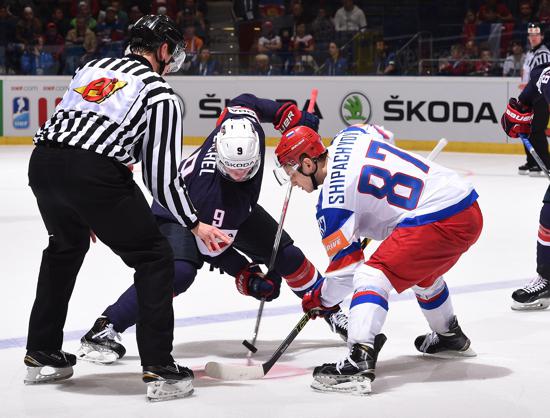
The atmosphere is bound to be thrilling when taking on a long time rival at the international stage, but the pro-Russia packed crowd made the victory even sweeter. Trevor Lewis opened the scoring at 6:22 of the second period off a rebound that bounced off Russian goalie Sergei Bobrovsky‘s shoulder. Seth Jones had the initial shot after a clean faceoff win by Jack Eichel, and Lewis was in the right place at the right time to knock it home. Team USA held a 1-0 lead through the end of the first.
Russia got on the board quickly in the second period, when Anton Belov tied things up at 1-1 at 3:40. Less than three minutes later, however, Torey Krug stuck on a 5-on-3 man advantage after Jones made a spectacular play to keep the puck in the offensive zone. Justin Faulk had taken a blistering one-timer shot that went wide, its momentum surely would have taken the puck out of the zone and broken the offensive chance had it not been for Jones’ all-out hustle to keep it in. Once again Team USA held a one goal lead after the period, and went into the second intermission up 2-1.
A little over halfway through the third period, the Americans extended their lead to 3-1 when Mark Arcobello picked up a loose puck in the neutral zone, skated it in and scored at 11:52. Russia didn’t give up after the two goal deficit, however, as they rallied back to within one at 16:19 of the third period with a goal from Sergei Plotnikov to tighten the score at 3-2. It wasn’t enough, though, after Ilya Kovachuk had a decent chance with the goalie pulled and less than 20 seconds remaining in the game, USA iced the puck to staunch the late Russian attack, resulting in a faceoff just outside the defensive zone. Brock Nelson launched the puck toward the empty net after the faceoff, and it drifting in to clinch the victory with just 9 seconds remaining on the board.
Torey Krug was named player of the game, and his four shots on goal led all players. Highly touted prospect Jack Eichel went 15 for 21 in the faceoff circle, with one of those wins earning him an assist on the first goal. International and NHL superstars Evgeni Malkin and Ilya Kovalchuk combined for only two shots on goal. Jack Campbell, who was playing in his first game of the tournament and stopped 15 of the 17 shots he faced, was proud to be wearing the red, white, and blue.
“It was a fast game with a lot of great players so it’s just an honor to be out there and get the win with these guys.”
The team took a day off on Tuesday and was back on ice yesterday for practice. They face Belarus, who is 2-0-1-0 in Group B so far, today at 4:15 p.m. (10:15 a.m. ET). Emphasis was placed on the power play at practice, as Krug’s 5-on-3 goal in the game against Russia was only the first power play goal scored by the Americans in 10 opportunities. Penalty killing, on the other hand, has been superb so far with Team USA refusing to give up a single goal when down a man in all three contests so far.
Today’s game against Belarus will be aired live on NBCSN.
The first period was pretty dull, with Hawks ‘tender Corey Crawford stopping six shots and the Wild’s Devan Dubnyk nabbing nine, but the last 40 minutes would boost the Blackhawks’ confidence as they prepare for two road games. But Chicago had impressive defense, only letting one shot attempt by in the first seven minutes.
While Andrew Shaw served a cross-checking penalty more than half-way through the second period, the Blackhawks would flip the power play and gain their own momentum.
“It kind of wakes up the team, wakes up the crowd, and it makes the game a little more interesting after that,” Kane said. “But we’re fine playing that way.”
While Michal Rozsival served the end of a carryover holding penalty at the beginning of the third, the Wild showed their special teams strength with a power play goal.
That goal gave Kane 101 points (41 goals, 60 assists) in 101 postseason games, ranking him 10th in the NHL. He also ranks 10th among active players with eight career playoff game-winning goals.
He has points in the last five games and goals in the last three.
“It was our best game all the way around,” Coach Joel Quenneville said. “Good pace and energy from the outset, good pace to our game, defensively solid, all lines were consistent, we had a lot of offensive zone time and puck possession. We played the right way.”
Wild Coach Mike Yeo had nothing good to say after the Game 2 loss.
“I don’t know what team played that game,” Yeo said, “but it wasn’t us.
“I’m sure they’re feeling real good. I’m sure they feel like they’re going to win the series. But I still feel we’re going to win the series. Our team does, too.”
Game 3–Who Will ‘Xcel’?
While Chicago is flying high with the two-game series lead, they’re aware of the hurdles ahead of them at Minnesota’s Energy Center.
“We felt this has always been our toughest game to have success in, the third game,” Quenneville said. “Usually the first game in their building.
“I just think you’re playing to win every game. You go into a game, you have to play the right way. We have to play better than the last game, and [Sunday night] we thought was our best game of the playoffs. We always feel we have to progress. These guys, you don’t have to convince them. We know we have to elevate it in their building.”
Historically, Chicago doesn’t do so well in their first postseason road game of a series. In fact, until that brutal double overtime win against the Predators in Nashville, the Hawks’s last victory for the first road game in a series was against the Sharks in 2010.
The Hawks are 1-9 in game threes with Quenneville as coach, while the Wild are 4-0
Last year the Blackhawks returned to the United Center from Minnesota with a 2-2 series tie.
“I think we were saying before the series [that], in a way, a lot of people look at us as the team that’s expected to win this series. We’re not thinking that way at all. We’re thinking we need to work for every chance, every bounce we’re going to get,” Toews said. “We’ve shown that so far and we know that there’s still a long ways to go, a lot of work left to do and a lot of room for improvement as far as our game goes. We like where we’re at right now, but we know that this series is long way from being over.”
So far this series, the Hawks narrowly edge the Wild 66-63 in shots on goal, but lead 65-55 in faceoff wins.
Part of that comes with the prowess of Antoine Vermette, who in the last few games has taken about 70 percent at the circle.
“He tells us where to go before the faceoff, and most of the time it’s going right there,” Sharp said. “That’s a huge advantage this time of year, special teams and faceoffs, and Vermy’s one of the best at it.”
The Wild is leading in hits and blocked shots.
“I feel like we were thinking too much about them instead of playing our game and the hockey we know how to play,” Wild winger Nino Niedereiter said.
The Blackhawks have to stay in their heads, which will be difficult to do in the Wild’s turf.
“We know (the Wild) are probably going to play their best game of the season so we have to do that too,” Johnny Oduya said.
If Chicago can manage to keep pressure in the neutral zone, pushing turnovers and preventing the development of plays like they did in Game 2, they’ll give themselves a tremendous advantage. Hossa, Teravainen, Keith (who was a plus-four Sunday), and Hjalmarsson, all managed steals.
“It’s still early enough in the series where if you give them any sort of confidence, you give them any sort of energy where if they come out of Game 3 feeling really good about themselves, things can really snowball in the wrong direction,” Toews said. “We’ve got the momentum right now. We feel good about our game. We can’t give them too much to feel good about and to feel energized by.”
Lou Lamoriello has been GM of the Devils since the 1987-88 season.
28 years later, on May 4th, Lamoriello, 72, has named former Pittsburgh Penguins GM Ray Shero as the 4th General Manager in the New Jersey Devils team history. Shero will report to Lamoriello, however, who will continue in his role as the team’s president. According to Sportsnet Stats (@SNStats): “Since Lou Lamoriello became GM in Sep 1987, #NJDevils have the 2nd best record in the NHL in that span (.578 win%)” & “Lou Lamoriello made 157 trades during his tenure as #NJDevils GM.” as well as of course, 3 Stanley Cups won in the span of 8 seasons (between 1995 and 2003).
Lamoriello confirmed that, while both he and Shero will consult with team owners Josh Harris and David Blitzer on all major decisions, Shero will ultimately determine the team’s new head coach for 2015-16. Shero said there is no timetable on when that decision will be made.
“When you take a look around the League, three quarters of the coaches have had second opportunities and have won a Stanley Cup so in working with Lou, he knows the challenges of this position,” Shero said. “Pittsburgh was different when I took over after coming from Ottawa [as an assistant GM from 1993-98] and Nashville Predators [1998-2006]. I was working with tremendous people in those organizations.
[…]
Lamoriello refused to look back on his career when asked about his illustrious tenure as Devils GM.
“I’m here; I’m not going anywhere,” Lamoriello said. “The focus is on getting back to where we should be and belong and what’s expected. We’ve had the support of ownership for the past couple of years and they haven’t been good years [after missing the playoffs]. We’re going to work to get back there, so that’s what it’s about.
“The emotion is what hasn’t been done and what can and should be done. I take responsibility for that. we have a great staff here and [Shero] knows that, but now is a chance to move forward.”
A few days after Christmas of 2014, the Devils fired head coach Pete Deboer and Lamoriello, nicknamed ‘Uncle Lou’ by Devils fans, became co-coach (or hydra coach) with Devils’ great Scott Stevens and former Devils assistant coach Adam Oates. Lamoriello was the only one who spoke to the media during those 5 strange months so the other two coaches could focus on coaching and the team started off good but ended up finishing (20-19-7) in those 46 games.This was not the first time that Lou became both co-GM and head coach at the same time on an interim basis. The first was after Larry Robinson resigned in December of 2005 and he did it again in April of 2007 when he fired Claude Julien with three games left in the season when the Devils had the second-best record in the conference, as well as on their way to set a franchise record for regular season wins.
The Devils haven’t made it to the playoffs for the last 3 seasons, however, now with a goalie who has more than proven his worth in his first official full season as a starter and a young core of what is the team’s trademark of defensive minded defensemen, the hope will be that Ray Shero will be exactly what the team needs.
Also, if you are already missing a Lamoriello in hockey, his son is the current GM of the Devils’ AHL team in Albany.
The Flames run in Anaheim has been nothing short of disappointing. After Thursday night’s 6-1 loss, the Anaheim Ducks blanked the Calgary Flames 3-0. The two teams will travel to Calgary for game 3 and 4. Per the Elias Sports Bureau, the Ducks are the first team to win 6 straight games in their playoff run since Pittsburgh had 7 in 2008. The Flames have now lost 21 straight games (regular season included) in Anaheim. The Ducks lead the series 2-0, but hopefully the home-ice will give the Flames the advantage they need to even the playing field.
The change in goaltending was not the only thing different when entering the game. Defenseman Micheal Ferland was deemed unable to play after warmup’s for game 2. He left game 1 with an undisclosed injury, but was thought to make his comeback in game 2. That didn’t happen. Flames coach Bob Hartley also fiddled with the top line several times. Mason Raymond saw time on the top line alongside Monahan and Hudler. He also had one of the best chances at scoring from point-blank range in the second. Another change was replacing Johnny ‘Hockey’ Gaudreau with fellow rookie Sam Bennett.
Gaudreau’s production for this series has been nothing. After not wanting to risk him being a target in the first game, Hartley took him out for the entirety of the third period. It isn’t a huge surprise that he isn’t faring well against the Ducks mainly because of his size. Anaheim is big. I mean really big. Gaudreau is only about 5′ 9″ and 150 pounds. You pair him up against someone like Ryan Getzlaf who is a monster, it’s tough to compete.
Besides a goal from Matt Beleskey in the first, the Flames did a wonderful job at keeping the score low. Starting goaltender, and third star of the game, Karri Ramo is to thank for only one goal going in. Anaheim took 20 shots on goal in the first period. For a goaltender to face this many shots and still keep the deficit at one is highly impressive. Calgary finished the second period off with only 9 shots on goal.
The second period was the start of a much better game for the Flames. After being outshot by 11 in the first, they came back and outshot the Ducks in the second. The second period was scoreless on both ends. The first half of the period the Ducks still seemed to be controlling the game, but around the halfway mark, things seemed to fall better into place. Both teams had some close attempts, but did not see results. The goaltending on both ends still had a huge part in this. Calgary put Anaheim on it’s third power play in the second, and this could’ve been a huge turning point in the game, but a huge effort from the Flames allowed them to kill off the penalty.
“We had a couple chances in the second period to make it 1-1 … We have to find a way to capitalize.” – TJ Brodie
The third period was not so hopeful for the Flames. It wasn’t until 11:15 into the third that the Flames chance of coming back diminished after a goal from Hampus Lindholm after being set up by Corey Perry and Ryan Getzlaf. Like I’ve said previously, those two are potent, and you can’t allow them chances. An empty net goal from Nate Thompson (assisted by Perry and Getzlaf, obviously), sealed Calgary’s fate at 17:44. Calgary’s top forwards just couldn’t find their way in Sunday night’s game. All three of their top forwards, Johnny Gaudreau, Sean Monahan and Jiri Hudler didn’t have a shot on goal until over 50 minutes into the game. The three combined came out with only two shots on goal total. Calgary was able to get their shot count to 30, while Anaheim still lead with 34. Karri Ramo was by far the best player out on that ice for the Flames, and that’s exactly what he needed to be. Unfortunately the Ducks shut them out offensively and Calgary didn’t take advantage of the hope that their goaltender was providing. Ramo gave his team a chance, and yet they still couldn’t capitalize. Sunday night’s game was Ramo’s first career playoff game, he stopped 31 of the 33 shots thrown at him.
“If it was not for Karri in the first period, this game would have been over.” – Bob Hartley
Tuesday night’s game in Calgary could potentially bring about another story line for the Flames; hopefully something more positive. They are after all the ‘Comeback Kids’.
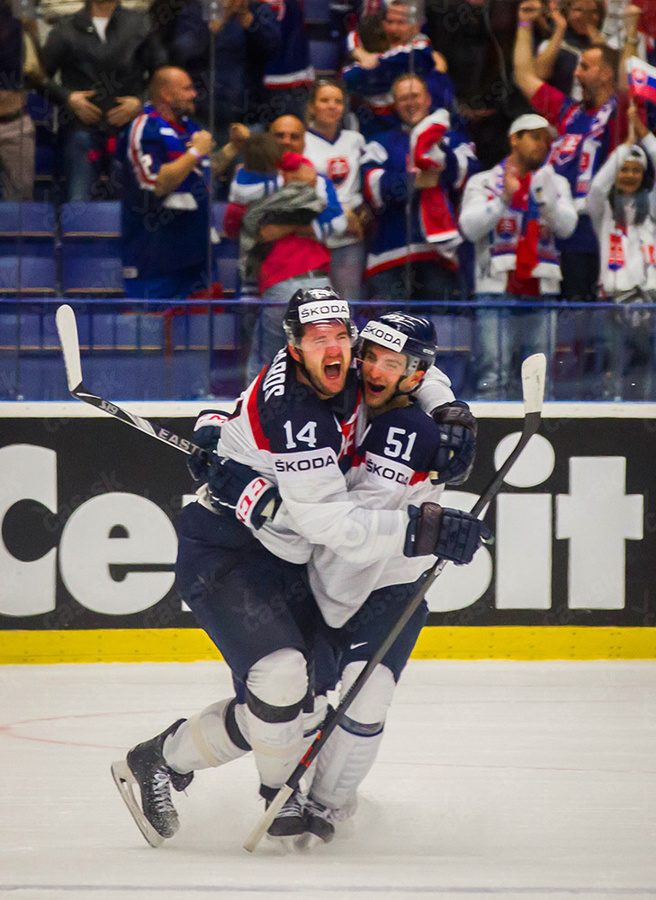
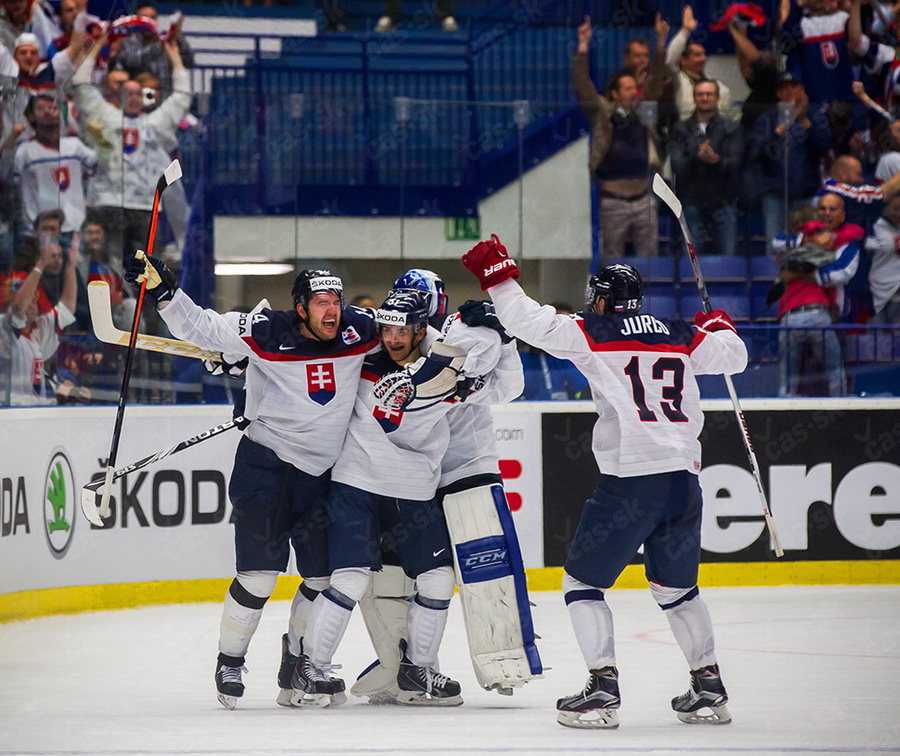
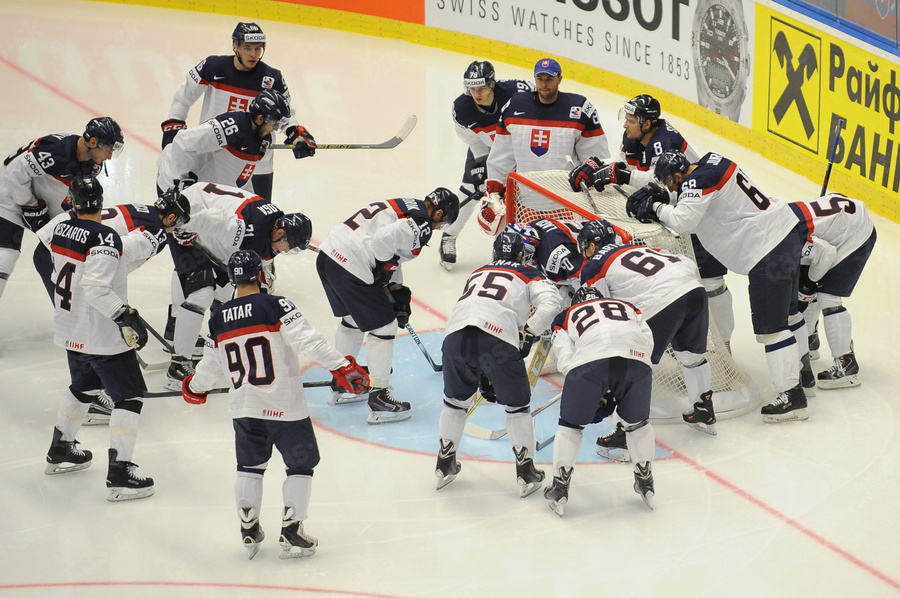
Slovak hockey representatives triumphed in their second appearance at the World Championship in Ostrava and gained two points when they defeated Belarus on Sunday, thanks to two spectacular goals from defender Andrej Meszaros including the game winner in overtime. Slovakia now has four points in the preliminary round of the IIHF World Championship. Their first game was on Saturday, where they won 4-3 over Denmark in Group B. The captain of the Slovakian team is Tomas Kopecky (Florida Panthers). Kopecky assumed the role of captain after Zdeno Chara (Boston Bruins) was unable to represent his company in the World Championship when it was revealed that he had suffered a non-displaced fracture of his left fibula. The Slovakian team is well represented by other NHL players whose teams unfortunately did not make it into the playoffs in North America. Among those representing Slovakia include Marian Gaborik (LA Kings), Richard Panik (Toronto Maple Leafs), Andrej Meszaros (Buffalo Sabres) and Tomas Tatar and Tomas Jurco (both Detroit Red Wings) and Marko Dano (Columbus Blue Jackets).
The Slovaks have already played their reinforcements from Detroit Tomáš Tatarand Tomáš Jurčo, who arrived from the United States only the day before they hopped on the ice with their team in the Czech Republic. Perhaps it was the fatigue of flying, to which they admitted,s that caused them to be less than impressive in their first game.
After two scoreless periods, the sold-out ČEZ Arena saw the first goal after 52 minutes of play from SergeiKostitsyn of Team Belarus, with assists attributed to Alexej Kaľužnyj and Andrea Kostitsyn. Slovak hockey players, however, tied the score thanks to Meszaros, who scored the equalizer just 64 seconds later who was assisted by Libor Hudáček and Vladimír Dravecký.
Slovakia with their Czech head coach Vladimir Vůjtekwill have a day off with another game on Tuesday at 2.15PM against Slovenia. In Group B their next opponets will be Norway, Finland, Russia and the USA at the end.
As is standard with these games, the referees and linesmen were from countries not playing in the game. The referees were Timothy Mayer (USA) and Vladimir Šindler (Czech Republic) and the linesmen were Paul Carnathan (USA) and Jimmy Dahmen (Sweden). Team Belarus was called for four penalties while the Slovaks for five, though none of the power plays resulted in a goal, including the penalty shot that Gaborik was given in the first.
Belarus: Lalande (in net), Usenko, Korobov, Stasenko, Jevenko, Šinkevič, Lisovec, Ustinenko (defensemen), A. Kostitsyn Kaľužnyj, S. Kostitsyn (first line forwards) Gavrus, Stas, Drozd (second line forwards) Stepanov, Kovyršin, Kulakov (third line forwards) Demko Volkov, Kitaro (fourth line forwards), and Demagin.
Slovakia: Laco (in net), Meszaros, Graňák, Jurčina, Sersen, Ďaloga, Mikus, Janosik (defensemen) Dano, Kopecký, Gaborik (first line forwards) Panik, Bližňák, Bartovič (second line forwards) Jurčo, Viedensky, Tatar (third line forwards) L. Hudáček, Lušňák, Dravecký (fourth line forwards).
“The first goal in the national team tastes amazing. When we win, it is even better. I’m glad we got at least two points,” said Meszaros after the game. “Again, we did not give up and we fought until the end. We had a lot of chances, but their goalkeeper was excellent. We go on. We have to focus on the next game.“
“At the beginning it was hard for me, then it was better, but at the end I was tired. It was a tough first game, but I’m glad we did it,”Jurčo commented on his play postgame. “Belarusians were good defensively and for us it was difficult. We have tremendous strength, the perfect team on the ice it feels. ”
“I felt bad on the ice. By far, this was not the best game for me. I’m not surprised, I expected it. It was a difficult game, they fought, but the victory counted,” Tatar said postgame, talking also about what needs to change. “We did not score, although we had opportunities. These are the details we have to improve. The championship is still long. we have two points and I’m happy. We were positive on the bench, we have great leaders in the locker room. We have a day off, we need to relax and concentrate on the next game. “
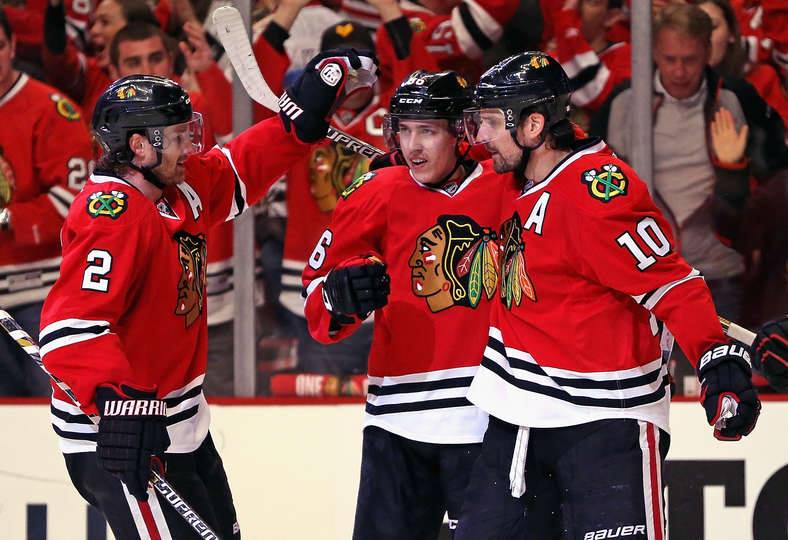
Chicago came out like a lion against the Minnesota Wild Friday night. The Blackhawks went up by three goals in just eight shots during the first period in what should have powered the team through intermission and on. They weren’t quite that lucky, though, as Minnesota rallied a comeback in the second period before Teuvo Teravainen‘s first playoff goal became a game-winner.
Then, a couple minutes later, when Michal Rozsival couldn’t keep up with Zach Parise and was sent to the box for holding, the Wild took advantage of a power play.
“Nobody wants to be up three goals and give up three goals in 10 minutes,” defensemanJohnny Oduya said. “I don’t think that’s anyone’s game plan.”
But, the Blackhawks weren’t going to take this one quietly–not on their ice. They came back to match the Wild in shots for the second period and one just happened to pay off.
The third period was mainly an attempt by both teams to stifle and score. Chicago led in shots 15-8, but also had to hold off two Wild power plays. In the final few minutes of the game, the Blackhawks maintained great control of the puck to stall the Wild’s chance to pull goalie Devan Dubnyk.
“At the end of the day, you give them an opportunity and they capitalize on it,” Wild Coach Mike Yeo said.
It was a physical game, but both teams stayed in check.
And, on paper, as with the score, they were pretty evenly matched.
What the Hawks need to do for Game Two
DEFENSE: The Hawks give up approximately 38 shots per game in the playoffs, making them last in the remaining teams for shots-against. That’s expecting too much out of even exceptional goaltenders. They allowed about eight fewer shots to the net in the regular season. In the seven games of this postseason, Chicago has allowed its opponents to score three goals in one period five times.
They need to allow frequent changes and short shifts for the slower defensemen, but still give guys like Keith and Brent Seabrook a chance to catch their breath and play 100 percent.
EARLY and OFTEN: Chicago needs to come out hot and take advantage of the home crowd’s energy. While early three-goal leads can’t be expected, it can’t hurt. Their second periods continue a lackluster trend that started early in the season, and until they can stay fast and smart for a full 60, they’ll need to maximize their potential while they’re feeling the vibe. Dubnyk is going to want to redeem himself.
PLAY SMART: Chicago needs to avoid lazy penalties and hot-headed trips to the box. The Wild had the best penalty kill in the league for the regular season, while Chicago ranked 10th. The Hawks are now the second-worst when opponents have a power play, while Minnesota has managed to score on one-third of their man-advantages.
“We’re looking at a team that’s played as well as anyone over the last 50 games,” Coach Joel Quenneville said. “That’s our challenge. They’re dangerous, they’re fast. They’re quick. They have a lot of weaponry in their attack. They have a mobile defense. We have a dangerous team on the other side and they’re going to get their turns. Every game is going to be on the line.”
The Blackhawks roster is expected to stay the same. Kris Versteeg, who did not skate Thursday or Friday because of a lower-body injury, is still considered day to day.
Wild winger Justin Fontaine will be out with a lower-body injury.
The Blackhawks host the Wild at 7:30 p.m. CT Sunday for Game 2 before the teams head off to Minnesota.
Sunday, May 3
7:30 p.m. CT
Minnesota at Chicago
NBCSN, CBC, SN360, TVA SportsTuesday, May 5
7 p.m. CT
Chicago at Minnesota
NBCSN, CBC, TVA Sports
Thursday, May 7
8:30 p.m. CT
Chicago at Minnesota
NBCSN, Sportsnet, TVA Sports
(If needed)
Saturday, May 9
TBD
Minnesota at Chicago
Monday, May 11 TBD
Chicago at Minnesota
Wednesday, May 13 TBD
Minnesota at Chicago
(As always, click the bold links for video clips or other information. Gifs via Stephanie Vail @myregularface)
There’s no question that Drew Doughty is an accomplished hockey player. At the ripe old age of 25, the Los Angeles Kings‘ defenseman has won two Olympic gold medals as part of Team Canada and two Stanley Cups with the Kings. But there’s one award Doughty has yet to achieve: the Norris.
Despite the fact that Doughty has been called the best defenseman in the league by many, the NHL’s James Norris Memorial Trophy, awarded annually to the defenseman “who demonstrates throughout the season the greatest all-around ability in the position,” has so far eluded him.
Along with the Montreal Canadiens‘ P.K. Subban and the Ottawa Senators‘ Erik Karlsson – both previous Norris recipients — Doughty was nominated for the 2015 trophy. Doughty has been nominated previously, finishing third in the voting in 2010, but has never won the trophy. In fact, despite the defense-oriented play that the Kings are known for, only one King has ever won the award – Rob Blake in 1998.
Discussions about the Norris inevitably turn to the definition of the award and what the voters actually look for when determining a winner. While the definition clearly calls for a defenseman with “all-around ability,” many point to the unusually heavy consideration given to a defenseman’s offensive production. If this is true, the Norris will likely still elude Doughty who had only 7 goals and 46 points for the 2014-2015 season.
But if the voters take the “all-around” verbiage to heart, there is likely no stronger candidate for the Norris than Doughty. Doughty played in all 82 games in the 2014-2015 season, played in all situations including the penalty kill and the power play, and logged the most total time on ice of anyone in the league and second in average ice time (28.59) behind Ryan Suter of the Minnesota Wild. Perhaps more telling for a defenseman: when Doughty was on the ice (which, as noted above, was quite a bit), the Kings registered 410 more shot attempts than they allowed (props to LA Kings Insider, Jon Rosen, for this tidbit). The Kings play a puck possession game and Doughty leads that effort. Add to this the fact that Doughty had to bear the brunt of a season in which the Kings lost defenseman Willie Mitchell to the Florida Panthers after last year’s Cup win, then Slava Voynov to suspension, and during the season lost defensemen Jake Muzzin and Alec Martinez to injury for periods of time, and you can appreciate the enormity of Doughty’s defensive burden. Coach Darryl Sutter paired Doughty with multiple defensive partners and was fond of saying that these other players needed to be better to play with Drew.
Despite all of this, there is the old “East Coast bias” theory. This year’s nominees prove that, at the very least, the members of the Professional Hockey Writer’s Association who vote on the NHL awards, have become better at recognizing the contributions of teams and players in the West and may be staying up later to watch the games. That said, in reviewing previous Norris winners, the bias clearly exists: only one previous winner (the aforementioned, Rob Blake) hailed from a team in the Pacific or Mountain time zone.
Is it Doughty’s year? The odds say no, but it seems just a matter of time before Doughty joins the illustrious list of NHL Norris recipients.
I know we are in the middle of the play-offs. The website is full of stories of the teams and players that are part of this exciting time of the year. Just before the play-offs started, there was a story that I considered important enough to write about. It boggles the mind that I need to print this one column.
The story belongs to both countries, Canada and the U.S.
It begins at Virginia Tech in their Engineering and Mechanics Department. They were testing a new form of measurements to use to see how hockey helmets are protecting children from injuries. The studies show that most helmets are not safe enough to reduce head injuries while the kids are playing hockey. In other words, they are not preventing concussions. But I found out the aim is not to stop the injuries. That would mean a totally new way of playing hockey, from the bottom-up. The aim is to reduce the risk and the number of injuries per player.
Virginia Tech bought 33 different kinds of helmets and did a few tests on them. The scoring is a 5 star process. 5 is perfect. One helmet received 3 stars out of 5, which is a ‘good’ score. 25 helmets out of 33 failed to get a ‘adequate’ score of 2 out of 5.
We trust the equipment we buy to protect our kids from getting hurt, what is happening? The cost of the helmets were not a concern, from the highest to the lowest price they were graded at the same star levels. It would be cheaper just to use another hard item as a helmet! There must be many different items lying around your home or garage that would keep your kids safe. Don’t get me started. Ideas are just oozing out of every pore of my helmet-less head.
The “STAR” test is based on different kinds of brain injuries. These are rotational and linear acceleration injuries which occur when the head turns on impact. The concussion is related to the rotational acceleration. In a concussion the brain wiggles like jello. In other words the hockey helmet helps to protect the head from skull fractures but does almost nothing to protect kids from concussions.
A thought from my past- when I was younger I thought that helmets were good only for giving players, good helmet hair-dos!
To be fair to all, doctors are still trying to understand the brain and what happens in a concussion accident. Companies are working with doctors to help produce helmets that will raise the STAR ratings. It is difficult to produce a helmet to protect the brain when a player is traveling at a high rate of speed and goes down on a hard unforgiving piece of ice.
What to do with your old helmets? Anything but putting them back on your child’s head! Next season when you need to buy a new helmet for your kids, ask your doctor.
Chris Kreider was the last player on the ice at the end of warmups. He sent a long shot down the ice into the Washington Capitals‘ empty net and, on that note, went into the locker room.
Thirty-eight seconds into the game, he found the back of the net again. This time, it counted.
The New York Rangers defeated the Capitals, 3-2, on Saturday afternoon to even the series at one game apiece. Kreider’s goal came off a rebound at the front of the net, following a shot by Jesper Fast down the middle. After going up 1-0 almost immediately, the Rangers held the lead for the rest of the game.
Coming into Game Two, the Capitals’ penalty kill had been a perfect 17-for-17. They killed the Rangers’ first power play of the afternoon but were unable to close out on the second. Dan Boyle was able to keep a rolling puck in the zone, right at the blue line, and sent a powerful slap shot toward the net and past Braden Holtby. It was the Rangers’ first power play goal of the series and their fourth of the playoffs, and their lead became 2-0 with just over four minutes to play in the first period.
Henrik Lundqvist was impressive in net and stopped 30 of 32 shots on the day. He made a sprawling windmill save on Evgeny Kuznetsov early in the second, prompting chants of “HEN-RIK! HEN-RIK!” throughout Madison Square Garden. But Kuznetsov was able to get one past Lundqvist at 13:59 in the second; he slipped past Boyle and buried a rebound off Lundqvist’s pads to cut the Rangers’ lead in half and make the score 2-1.
The Rangers continued to pressure the Capitals in their offensive zone and were effective on the forecheck. Kreider’s strong play throughout the game led to a handful of breakaway scoring chances and some key hits as the Rangers held on to their one-goal lead.
Early in the third, Derick Brassard went to the box, putting the Rangers on the penalty kill. They killed it off efficiently, and Rick Nash sent the puck up the ice to Martin St. Louis. St. Louis found Brassard, who had sped out of the box and up the ice, for an open shot just outside the crease. The puck rolled between Holtby’s pads and somehow found its way across the line. With 13:53 left to play, the Rangers took a 3-1 lead.
The two-goal lead was short-lived. At 10:29, Alex Ovechkin struck again. He muscled his way through Ryan McDonagh and Dan Girardi and, shooting from his knees, put the puck in the upper left corner of the net. Just like his goal in Game One, the puck was in-and-out in the blink of an eye. At 3-2, it was anyone’s game.
The final 9:31 was a battle to maintain the lead, but the Rangers held on–no last-second goals this time around. The two teams now travel to Washington for Games Three and Four, beginning on Monday night.
THREE STARS OF THE GAME:
3. Ovechkin
2. Lundqvist
1. Kreider
LOOKING AHEAD/OF NOTE:
–Marc Staal and Keith Yandle were the only two Rangers not to register a shot on goal during the game.





 Prev
Prev