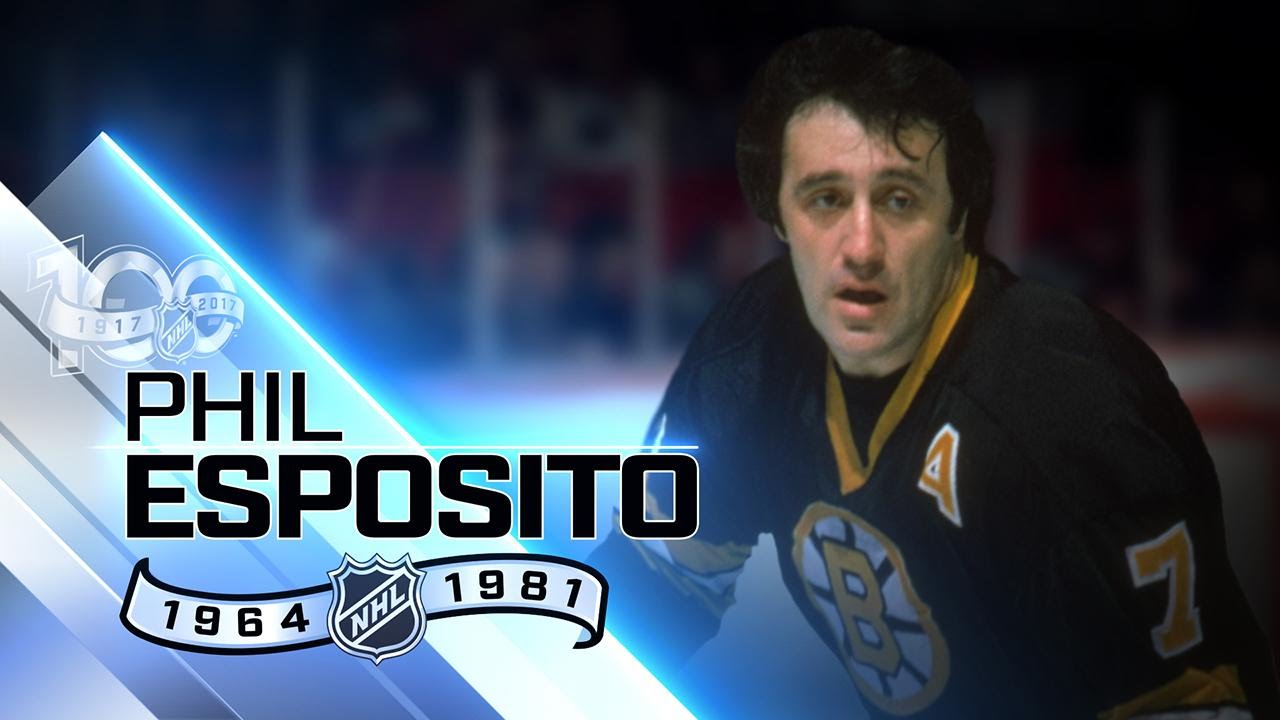
People like Phil Esposito really know how to get the birthday party started. Born on February 20, 1942, for three birthdays – his 29th, 30th, and 32nd (in 1971, 1972, and 1974) – Esposito gifted himself his 50th goal of each season. The last of these made him the very first player to reach 50 goals in four consecutive seasons. With these three birthday games, all on the road, Esposito helped the Boston Bruins lose, win, then tie.
Esposito led the league in scoring at the end of the 1968-69 season, earning his first Art Ross Trophy. Although he had 126 points (his first season breaking 100), he just missed the 50-goal milestone and ended the regular season with 49 goals. The following season, he dropped to 43 goals and 99 points to fall second to teammate Bobby Orr in the scoring race.
1971
The year 1971 was Esposito’s chance to reclaim his top spot. On his 29th birthday, the Bruins weren’t in the mood to celebrate. As the visiting team, they had blown a 3-0 lead to lose to the Los Angeles Kings 5-4. Esposito himself contributed to the Kings’ comeback when (at 13:53 of the second period) he “picked up a rare major for fighting, and the Bruins added a minor for leaving the bench to help out their high-scoring center.” During the penalty kill, the Kings scored their second goal.
However, Esposito also could be thanked for one of the bright moments of the match. Just over a minute after his teammate Derek Sanderson began the evening’s scoring, at 2:18 of the first period, “Ken Hodge carried the puck along the right boards and when the Kings defense overshifted in that direction, he sent a perfect centering pass to Espie breaking in from the left side. The league’s leading scorer snapped a 25-footer into the Kings net.” Esposito had become the fourth NHL player to have a 50-goal season. His predecessors were Maurice Richard, Bobby Hull and Bernie Geoffrion. Esposito topped off his night with an assist at 5:36, when Hodge deflected “an Esposito drive from 20-feet out.”
He ended the season with 76 goals in 152 points and his second Art Ross Trophy. That began Esposito’s string of four consecutive seasons as the NHL’s top scorer and five straight 50-goal seasons. He finished the 1971-72 season with 133 points (including 66 goals), the following season with 130 points (and 55 goals), and the 1973-74 season with 145 points (and 68 goals).
1972
In 1972, Phil spent his 30th birthday with his brother Tony over in Chicago. A crowd of about 20,000 watched Phil’s Bruins defeat Tony’s Blackhawks 3-1. With Tony in the net, Phil joked, “I love to play against him. I get a couple and I can have some laughs over the Summer.”
Just the day before, Phil had earned his 100th point of the season on a belatedly attributed assist on Freddie Stanfield’s power-play goal late in the third period. He had not found out about the point until after midnight, thus on his birthday. He commented, “There wasn’t any question about me getting the puck back to Freddie. If I wasn’t sure of it, I wouldn’t have wanted the 100th point to come on something questionable.”
There was no question that Phil scored twice on his brother. After Chicago took an early lead, Esposito’s 50th goal tied up the game at 18:57 of the first period, during a power play. According to the Boston Globe recap of the play, “After Esposito won a draw with Mikita, he got the puck back to Bobby Orr. Bobby got off a good shot as he was brought down by Doug Jarrett.” Phil summarized, “I just got my stick up off the ice to deflect it past Tony.” With that, Esposito became only the second NHL player to have back-to-back 50-goal seasons. Chicago’s own Bobby Hull had set the record by scoring 50-plus goals in both 1965-66 and 1966-67. Interestingly, Chicago’s announcer that night neglected to mention that it was Esposito’s 50th goal much less the record.
Esposito then proceeded to score the game-winner at 13:25 of the second period with a “conversion of a rebound off a shot by Don Awrey.” Having scored his 50th and 51st goals, he earned his 52nd assist at 17:06 of the second (on a Wayne Cashman goal). At that point in the season, Esposito had 28 goals in 28 road games and 23 goals in 31 home games. Still the only published quote from Coach Bep Guidolin was simply, “It was a good game and with seven out of eight points on the road, we’re in pretty good shape.”
The following birthday was the only one in the four-year stretch in which Esposito did not score his 50th goal of the season. However, he still partied. The Bruins barely managed to beat the Vancouver Canucks 7-6 at Pacific Coliseum for a crowd of 15,570. Vancouver had four goals before the Bruins finally got on the board in the final minute of the first period. The second session featured four Boston goals, and the one at 6:15, was Esposito’s 38th of the season. On a power play, he “tipped in another Stanfield drive.” Esposito then, at 12:40, assisted on the tying goal when he “won a face off back to the point and Vadnais blasted a shot through a screen.” Finally, he assisted in Hodge’s game-winning goal at 9:15 of the third period. Even though it would take another month to reach 50 goals, the birthday boy was named the No. 1 star of the game.
1974
Esposito celebrated his 32nd birthday with 15,555 spectators at the Metropolitan Sports Center in Bloomington, Minnesota. He wasn’t bothered that he had failed to score in the three previous road games but instead credited the strong return of two teammates for their success in this one. While Esposito had a great night, the Bruins squeaked out a 5-5 tie with the North Stars. Still, the Bruins kept their unbeaten streak going for an eighth game.
It seemed that Esposito was determined to get to 50 as he had his second hat trick of the season (and 21st of his career). For his 48th goal, he tied the game at 1-1 at 17:01 of the first period when he “drilled a cannon from the left circle.” The score increased to a 2-2 tie at the end of the second period. At 6:31 of the third, Carol Vadnais set off a scoring spree (of six goals in nine minutes) with “a successful 40-footer that had a little instant coaching involved.” Vadnais explained, “Espie just gave me a holler to shoot, and I didn’t know it was in really until I saw the light.” Less than a minute later, Esposito scored his 49th goal when he “deflected Vadnais shot by goalie’s left.”
Esposito used his 50th goal of the season to earn the Bruins a point instead of a loss. He scored the game’s final goal during a power play at 15:32 of the third period. According to Esposito, “When the shot by Bobby (Orr) came through it bounced off both Hodgie and Cash. I had a lot of the net open with Cesare Maniago out, but I wanted to take plenty of time to make sure I put it away.” He succeeded with a “placed shot from in close to goalie’s left” and then “proceeded to do an artful job of ragging the puck to nullify any possibility of a further breakthrough.” Perhaps because they were not in Boston, “there was no great fanfare about the momentous event” of Esposito becoming the first NHLer to have four straight 50-goal seasons. Still, the Boston Globe reporter thought, “As much as anything else, it was a really appropriate birthday celebration for Phil Esposito.”
Though Esposito did not play on his birthday in 1975, he already had 50 goals as of February 8. That night in Detroit, he first earned an assist to reach 100 points, his sixth in seven seasons of surpassing that mark. He went on to score four goals, his 49th through 52nd. He finished the season with 61 goals but lost the scoring race to Orr. It marked Esposito’s fifth consecutive season with more than 50 goals.
Esposito played on his birthday five other times during his 18-season career. He tallied at least one point in every single one of them.
Additional Sources:
“Espo scores No. 50,” Boston Globe, 21 Feb. 1971, pp. 73-74.
Tom Fitzgerald, “Espo Steals Show, Bruins go, 3-1,” Boston Globe, 21 Feb. 1972, pp. 23-24.
Tom Fitzgerald, “No one on the ice – Espo hits 100 mark,” Boston Globe, 21 Feb. 1972, p. 26.
Kevin Walsh, “Bruins catch Vancouver, 7-6,” Boston Evening Globe, 21 Feb. 1973, p. 53.
Kevin Walsh, “Bobby Orr goofs, then bails out,” Boston Evening Globe, 21 Feb. 1973, p. 58.
Tom Fitzgerald, “Espo gets 3 (that’s 50 now) as Bruins, Stars Tie, 5-5,” Boston Globe, 21 Feb. 1974, p. 47.
Tom Fitzgerald, “It’s a three-goal Espo show as Bruins gain tie,” Boston Evening Globe, 21 Feb. 1974, p. 29.
Tom Fitzgerald, “Espo’s 4-goal explosion powers Bruins past Detroit, 8-5,” Boston Evening Globe, 9 Feb. 1975, p. 61.
One February 19th was all about the number 5. The year was 1955, and No. 5 Bernie “Boom Boom” Geoffrion scored five goals while defenseman Doug Harvey had five assists. This would be the only time between the years 1947 and 1961 that anyone scored five goals in one NHL game.
The game was a rematch opportunity. The Montreal Canadiens hosted the New York Rangers at the Forum for a crowd of 14,990, the “largest of the season.” Six days earlier, the Rangers had hosted at Madison Square Garden, where they beat the Canadiens 4-1, and this had temporarily knocked them out of first place in the rankings. Otherwise, the Rangers were dwelling near the bottom of the barrel and shouldn’t pose a problem. However, the Montreal Gazette worried that “tonight’s game at the Forum could be the spot for an upset” because the Canadiens had a tendency to let down after a big win (having just defeated Detroit 4-2) and might be distracted by a tribute night planned for Kenny “Big Moe” Mosdell.
With a final score of 10-2, the worry seemed completely unfounded. The major factor in the crushing victory, besides Geoffrion’s individual performance, was the Canadiens’ powerful power play. Five of the ten tallies were power-play goals. Of the fourteen penalties Referee Scotty Morrison called, eight of them penalized the Rangers. As the Gazette pointed out, “and they hurt, as the Blueshirts just couldn’t cope with Canadiens’ power play.”
To be fair, no one could cope. The Candiens had a reputation for taking the fullest advantage during penalties because at that time, the guilty parties had to sit the full two minutes regardless of how many times the other team scored. In fact, their power-play success during a game held that November 5th was cited as one reason the NHL governors voted on June 6, 1956 to change the rules. In what came to be called “The Canadiens Rule” (Rule 26c), the guilty party would be released as soon as the opponent scored.
As to Geoffrion, perhaps the most famous No. 5 and known for his slap shot, he had four of the five power-play goals. Just over two minutes into the first period, Bert Olmstead then Geoffrion made the best of Bill Eznicki’s penalty for interference. Scoring again at the top of the second period, Geoffrion had his only goal while everyone was at full strength. In the final minute of that session, he earned his hat trick “on a screened shot” while Louie “the Leaper” Fontinato sat out for charging. The third period had barely begun when Geoffrion scored back-to-back goals thanks to Ivan Irwin’s tripping penalty carried over from late in the second. Geoffrion had snared the net at :41 and at (remarkably) :55.
The five goals matched his teammate Maurice Richard’s achievement from December 28, 1944 (when hosting Detroit at the Forum). Apparently, when speaking with the press in the locker room afterwards, Geoffrion “said he thought he got his stick on the goal credited to Tom Johnson” at 14:05 of the third period. However, the record for most goals in a game was seven, as set by Joe Malone in 1920, anyway. Still, the assist gave Geoffrion the point he needed (61) to pull ahead of Richard in the scoring race.
Meanwhile, Geoffrion’s teammates racked up the assists. Harvey had two in the first period and then assisted Geoffrion on three of his goals. The five assists brought his point total to 39, just one shy of Babe Pratt’s record for most points by a defenseman (set in 1943-44). Harvey would have 30 or more assists during seven seasons, even when he never scored more than nine goals in any of them. He later said, “I’m not throwing any pucks away. I’m trying to do what’s best for the team. That’s why I take my time and make the play.” Geoffrion simply said of Harvey, “He changed the whole game.”
Meanwhile, Jean Beliveau earned four assists, and Richard was credited for three. Beliveau’s gave him 66 points, which put him in the lead. The guest of honor, Mosdell, “couldn’t collect a single point. But he collected everything else.” His wife and two children joined him at center ice for presentations. Elmer Lach handed him the keys to an Oldsmobile ’98 (which had been driven on the ice), and his son received a collie puppy. Capt. Butch Bouchard made the key speech saying, “Kenny is a great worker, he gives us his best, and we appreciate him very much.” Mosdell commented, “I hope I’m with the Canadiens another 11 years.”
At the end of the 1954-55 season, Geoffrion won his first scoring title. Montreal fans blamed Richard’s suspension (which resulted in the “Richard Riot”) for the fact that Boom Boom beat the Rocket by a single point. They heckled him not to score while Richard was away, but the Canadiens needed to win the last two games to take first place. As Geoffrion remembered it, Harvey told him, “Listen, we came to win first place. You’ve got to score goals to help us win.” To which, Geoffrion responded, “You put the puck on my stick and if I have a chance to score, I don’t care who I have to surpass. I get paid to play and score goals.” His subsequent goal and two assists gave him the Art Ross Trophy.
Many of these Canadiens were inducted into the Hockey Hall of Fame around the same time. When Geoffrion and Beliveau were installed in 1972, fans were furious that Harvey had been left out. Thus, by the time the Hall rectified the situation the following year, Harvey declined to attend the ceremony (but was inducted anyway).
The Canadiens finally retired Geoffrion’s No. 5 on March 11, 2006, mere hours after he passed away from stomach cancer. His wife Marlene attended and watched his number go up next to that of her father, Howie Morenz. The team had already retired Harvey’s No. 2 back in 1985.
Additional Sources:
Dink Carroll, “Geoffrion Gets 5 Goals, Moe Has ‘Night,’ Habs Win 10-2,” Montreal Gazette, 21 Feb. 1955, p. 20.
“New York Rangers Here For Mosdell Night at Forum,” Montreal Gazette, 19 Feb. 1955, p. 8.
Billed as the first international hockey game ever held in the United States, a team from the University of Minnesota hosted a team from Winnipeg for a game on February 18, 1895. The game took place in downtown Minneapolis at Athletic Park, a baseball field at Sixth Street and First Avenue North that today would sit next to the Target Center Arena (where the pro basketball teams play). According to the local press, “The rink was in good condition and the day was perfect for the sport.”
The game came about because the Winnipeg team planned to travel through eastern Canada for three weeks. At the time, railroad tracks did not connect all of Canada, so the train would be passing through Minneapolis on the return trip back to Winnipeg.
During the trip, Winnipeg played an Ottawa team, the Toronto Victorias, the Toronto Granites, the Kingston Limestones, and Montreal (who had held the Stanley Cup for the past two years). According to the Minneapolis Star Tribune, “Everywhere the Winnipeg team has been it has met with cordial reception, their arrival in each city being one of the society events of the season. At every game thousands of people have turned out, more than half of whom were ladies.” Although the Winnipeg team had only been playing a few seasons, they surprised the eastern Canadians by winning every game.
Meanwhile, the University of Minnesota did not have an official team, but Dr. H.A. Parkyn formed an unsanctioned one in January 1895. He was a star and coach of the football team and had spent eight years playing for various hockey teams in Toronto. The Star Tribune praised him as “one of the best all around players in Canada. Since his arrival in Minneapolis he has been doing good work in University athletics.” Having practiced together for just three weeks (during which time “Dr. H.A. Parkyn has been coaching the boys every afternoon”), the U of M team prepared themselves by playing against the Minneapolis Hockey Club (losing 4-1 and 6-4). According to the Minneapolis Ariel, “The excitement of these games is intense, and surpasses that at a football game.”
Like Parkyn, goalie Van Campen was a veteran football player. The Star Tribune claimed that he “uses all the agility that is expected from the best quarterback in the West, in defending his goal from the invasion of the puck.” Three other players on the team were experienced ice polo players. With another year or two of practice, the Star Tribune thought, “judging by the improvement noticed in the little while they have already played, there is every indication that they will be able to compete, with the greatest credit, and with a good chance of bringing to Minneapolis an international cup.”
For their matchup, Minnesota was “decked out in their football suits of many colors.” Winnipeg wore “red sweaters and baseball pants, with strong shin protectors.” They were described as “all gentlemen, and society men of Winnipeg.”
The University of Minnesota postponed classes so its scholars could attend the game. About 300 students and locals made up the “large turn-out” of spectators. “A toss for goal gave the visitors the west end of the rink.” The game started at 4:15 (though it had been advertised to start at 3:30) and ended at 5:23 with “both sides offering three cheers for the other.”
Winnipeg won handily, 11-3, but the Minnesotans were just proud to score three on this “world champion” team. The Star Tribune noted, “The University boys, however, deserve great credit for the lively game they put up against heavy odds.” The paper also reported, “Throughout the contest the best of feeling prevailed, and no one received serious hurts.”
That night, at 8:40, the visitors departed for Winnipeg on the Northern Pacific train from Union Station. Depite beating every team they came across, it wouldn’t be until the following year, in February 1896, that Winnipeg would win the Stanley Cup (by defeating the Montreal Victorias). Losing the Cup again that December, Winnipeg would not win it again until 1901.
Back in Minnesota, immediately after the game, the Star Tribune predicted, “The game of hockey is destined to be popular at the University, and the time is probably not far distant when regular college games between the institutions neighboring to Minneapolis will be played.” The St. Paul Pioneer Press echoed, “Hockey promises to become as popular a sport at the University as football, baseball, and rowing.” It took a few years before these predictions came to pass. The University of Minnesota did not get its act together and play formal games until 1904. Still, a strong tradition of college hockey there and throughout their state grew and remains to this day in the State of Hockey.
Additional Sources:
Adam Raider, Frozen in Time: A Minnesota North Stars History (2014), kindle version.
“First in the Land,” Minneapolis Star Tribune, 18 Feb. 1895, p. 8.
“Ho! The Hockey Men,” Minneapolis Star Tribune, 19 Feb. 1895, p. 7.
Last weekend the Providence Bruins played Saturday in Bridgeport and Sunday in Providence. They fell in regulation to the Sound Tigers 4-2 on Saturday and then lost to them in overtime 2-1 on Sunday. This weekend they played three home games. After taking a 4-2 win over the Wilkes-Barre/Scranton Penguins on Friday night and blanking the Laval Rocket 3-0 on Sunday, it was time to face the Bridgeport Sound Tigers again in a President’s Day matinee on Monday.
Going into Monday’s game, the two teams had now seen each other eight times in the season. Overall, the Providence Bruins held a 4-3-1 record, though they had been stronger on the road (3-1-0) than at home (1-2-1).
“We had a real tough week to be honest. We put the work in, which was good, I think. We were unhappy with our performance of the weekend before and I think we all recognized that and they went to work this week and it certainly wasn’t perfect but got timely goaltending and timely scoring and then filled in between was some good play which was good,” said head coach Jay Leach after Monday’s game.
Between the pipes it was Max Lagace for the Providence Bruins and Christopher Gibson for the Sound Tigers—a repeat from the Bruins loss on February 8. Given how the team was feeling, it was not surprising to see a bit of extra push from the players.
When Ryan Fitzgerald put his 12th of the season in to get the Bruins on the board first at 6:45 of the opening frame of Monday’s game, Oskar Steen got the primary assist, but Lagace also had an assist. They were outshooting the Sound Tigers at the end of the first period and as things got underway in the second, Cameron Hughes gave Providence their second goal of the game, assisted by Jack Studnicka. Studnicka now leads the Providence Bruins with 20 assists. He has 19 goals and those 20 assists for 39 points. Bridgeport managed to tie things up in the second, getting their first at 5:40 and their second at 14:05 of the period.
Despite the tie, the Providence players did not show any concern or change their play. And 1:54 later Brendan Gaunce had his 14th goal of the season assisted by Joona Koppanen and Steen.
“Koppanen was in a good spot. I was trying to kind of force [[Steen]
back down the wall but he passed it to Koppanen… obviously right on
Koppanen’s tape and then I just saw that there was no D on my side so I just
turned up the ice and [Koppanen] made a nice pass and then I tried to finish it,”
said Gaunce.
Gaunce scored against the Penguins on Friday and then got
one against the Rocket on Sunday. His goal on Monday meant he had goals in three
consecutive games, and points in four straight.
“Gaunce has been good. We switched him to the wing about maybe a month ago. But he’s been productive and timely, I would say. To bury on that chance there at the end of the second period; it’s a 2-2 game and [Koppanen] makes a nice play, is huge and that’s what we need out of our veteran players. So, he’s been more productive I think than maybe—I don’t want to say than we expected—but certainly happy to get the production and hopefully it continues,” Coach Leach said.
In the end that would be the last goal scored by either
team, giving Gaunce the game-winner. It was his fifth game-winning goal of the
season and his second on the weekend. His goal against Laval on Sunday was also
the game-winner.
Like their NHL parent, the Boston Bruins, there is a definite “team first” mentality. Even when asking players about particular goals or saves, they can’t help but deflect the attention from themselves to their team as a whole. Such was the case Monday with both Gaunce and Lagace.
“I thought all weekend we worked really hard and that’s how
we create our chances and that’s kind of how we got all three wins. So, when we
play confident like that. We’re a really good team,” said Gaunce of their weekend
sweep.
“The third period I thought the guys played really well, they actually did play really well a lot of the whole game, gave me the help I needed when I needed it and I only had to make a couple saves, you know. So, it’s a nice team win, and it’s a great weekend,” shared Lagace.
The Providence Bruins will return to the Dunkin’ Donuts Center for two homestands on Saturday, February 22nd, against the Springfield Falcons and then on Sunday, February 23rd, against the Wilkes-Barre/Scranton Penguins.
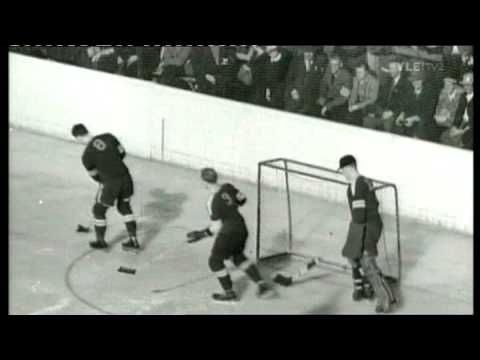
The Olympic Games that began with Nazi salutes to Chancellor Adolf Hitler on February 6, ended with the first gold medal in ice hockey to go to a team that was not Canada. On February 16, 1936, the tournament ended with Great Britain winning gold, Canada settling for silver, and the United States taking bronze. Hitler attended the final hockey game as the final event of the Games and then led the closing ceremony.
In 1936, Germany hosted both Olympic Games – the Winter Games were held at Garmisch-Partenkirchen (near the Austrian border) and then the Summer Games were held at Berlin. Despite threats of boycotts, the Winter Games attracted 28 nations, 15 of which participated in the ice hockey tournament. It would determine the fifth Olympic, tenth World, and 21st European champion.
These Winter Games were rife with controversies. The Nazi ill treatment of Jews and others almost resulted in mass boycotts of the events. Surprisingly, the German hockey team featured Rudi Ball, one of only two Jewish athletes allowed to represent Germany in either 1936 Olympics. Ball was promised safe passage for his family and thus captained the team.
At the opening ceremony on February 6, Hitler wanted everyone to salute him during the parade of nations, and the Americans refused. As Stan Fischler later put it, “And the Führer responded by being furious. So we had a furious Führer.” That same day, the U.S.A was scheduled to play Germany in the first round of the ice hockey tournament. Hitler went over and berated the Americans in German. Apparently, the only one who could translate for the team was the American goalie, Francis Baker. He bravely stood up to Hitler and replied, “The United States will always defeat Germany.” Amidst a snowstorm at Lake Riessersee, the Americans defeated the Germans 1-0.
The biggest hockey controversy of these Olympics involved the team put together to represent Great Britain. As it had on previous occasions, the team was composed primarily of Canadians. One was born there, and nine grew up there. The Canadian Amateur Hockey Association (CAHA) lodged a complaint about two in particular, goalie Jimmy Foster and right winger Alex Archer. According to the CAHA, these two should be ineligible because they were professionals who had played in Canada and transferred to British teams without their consent. The night before the opener, the IIHF ruled that these two were indeed ineligible. With the British threatening to withdraw completely, the Canadians dropped their protest in the “spirit of Olympic sportsmanship.”
The Canadians came to regret that decision and remained bitter about the six Canadians playing for Great Britain. As the Canadian press remarked when the Games ended, “Eligibility of Foster and Archer of the English team and the complicated playoff system aroused more acrimony than any Olympic games have seen.” The format involved three round-robin rounds with the final four teams playing in the medal round. Apparently, Team Canada was not aware of a set of crucial points – that the results of the semi-finals would count towards the finals and thus none of the final four teams would have a re-match with any of the other final four that they had already defeated.
Thus, on February 11, almost a week before the tournament ended, Canada essentially lost the gold medal by losing to Great Britain 2-1 in the second round. Adding salt to the wound, the winning goal was scored, with merely 12 seconds remaining in the game, by Edgar Brenchley, who had grown up playing hockey in Ontario and had just joined a British team at the beginning of that season. With the victory, Great Britain was automatically awarded two points, and Canada would not have the chance to recoup the loss in the next round. Hugh Farquharson of Team Canada commented, “No one realized, and the officials at least should have, that to lose that first game meant probable loss of the title. It would have made a big difference if that were known when we went into our game with England.”
Similarly, that same day, the U.S. won a 2-0 victory over Czechoslovakia. When the two teams made it into the finals, the Americans automatically received the extra points instead of playing the Czechs again. In the final round, Great Britain and Canada both soundly defeated Czechoslovakia 5-0 and 7-0, respectively. That left the Czechs with zero points and out of medal contention.
On February 15, Great Britain and the United States faced each other for the only time. When the scoreboard remained scoreless at the end of regulation, the teams played through three overtime sessions without a single goal. According to one London newspaper, “With both sides concentrating on defence the Great Britain-United States match lacked thrills. Britain owed a lot to her goalkeeper, Foster, who made some magnificent saves.” Yes, that was the same goaltender the Canadians had raised such a fuss over. The teams had to settle for a tie, but the Brits were granted the victory because they had more points going into the game.
That meant that for the February 16th game, in order to win silver, Team U.S.A. would need to shutout Team Canada or win by more than 5-1. Unfortunately for them, the chance at a shutout ended just three minutes into the first period when “Dave Neville, brainy wingman of Montreal” scored “as a result of a fine individual effort.”
For the remainder of the game, according to an Ottawa recap, the Canadians (riddled with injuries) “played defensively after scoring a goal. It was as though the Olympic crown itself was at stake, rather than merely second place.” The London press found that the “match also was dull and uninteresting” because the also-injured Americans “played like a tired team.” With just that one goal, the Canadians (2-1-0) took silver and the Americans (1-1-1) bronze. The Ottawa Citizen summarized, “The Olympic hockey series, born of trouble, closed amicably enough, and today’s tussle, while hard fought, was clean and marked by good feeling on the part of the contestants.”
Great Britain’s five points and record of 2-0-1 gave them the first gold medal in ice hockey won by a team other than Canada (who had won the first four). They also had the first team to win all three championships (Olympics, World, and European).
With that, the Winter Olympic Games ended. After signing autographs between periods at the final game, Hitler led the closing ceremony. As the first Games to feature an Olympic flame, it was extinguished and the Olympic flag lowered during a fanfare of trumpets. About 120,000 attendees then enjoyed a fireworks display.
After the two 1936 Games in Germany, World War II put a halt to the upcoming Olympics. The next Winter Olympics would not be held until 12 years later in 1948.
Additional Sources:
Andrew Podnieks, Where Countries Come to Play (Toronto: McClelland & Stewart, 2013), kindle version.
“Winter Olympic Games End,” London Guardian, 17 Feb. 1936, p. 4.
“England Wins Olympic Hockey Title,” Ottawa Citizen, 17 Feb. 1936, p. 14.
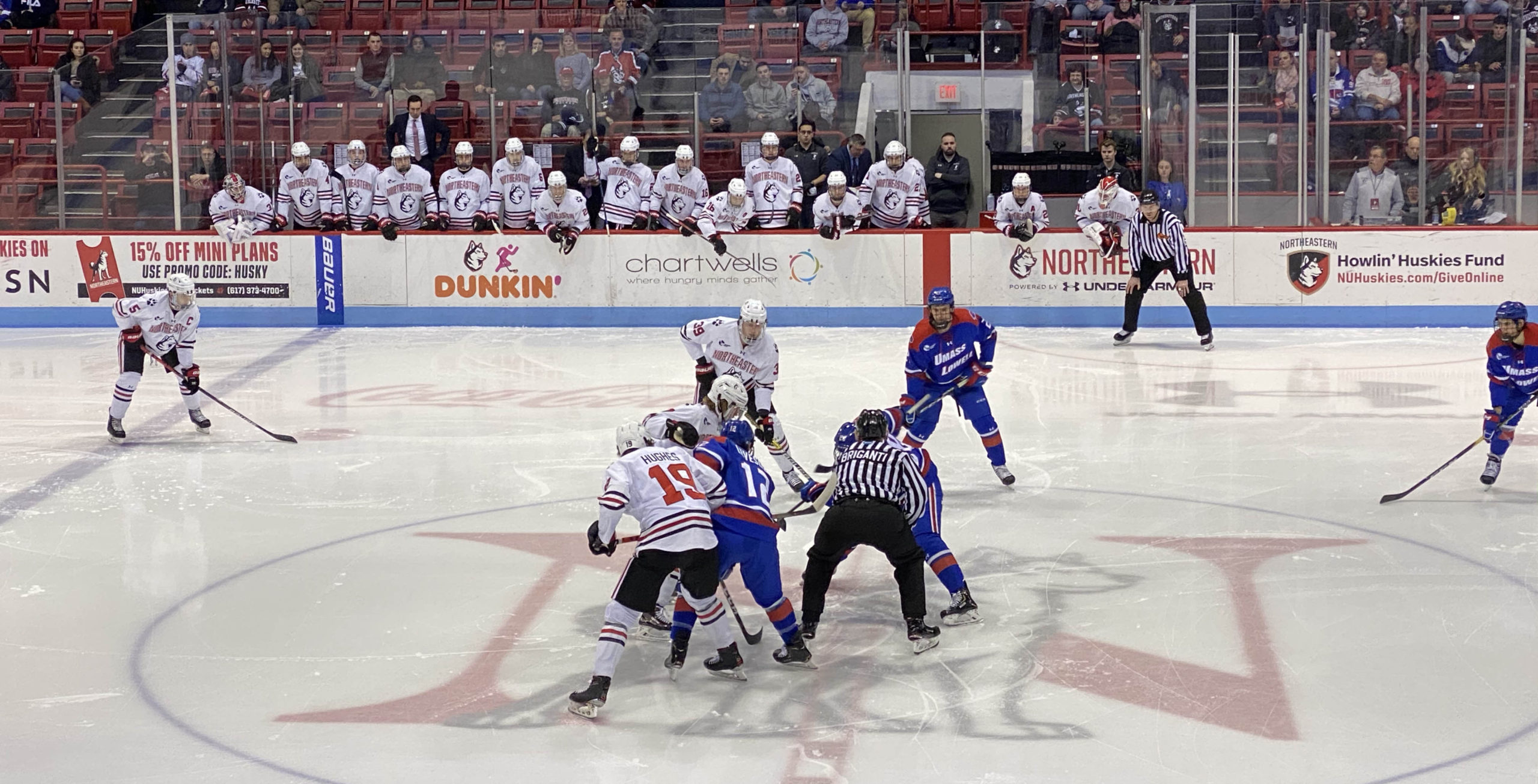
However, the Huskies, who were already playing without Matt Filipe (now day-to-day) and Jayden Struble (done for the season) lost Hobey Baker contender Tyler Madden during Friday night’s game. As a result, their line-up was a bit unorthodox, going with 11 forwards and eight defensemen. Craig Pantano who had blanked UML on Friday night was once again in net for the Huskies on Saturday.
In what is perhaps not the best recipe for success, Northeastern was only able to put four shots on the River Hawks Tyler Wall during the opening period while UMass-Lowell peppered Pantano with 14 shots and managed to get one past him at 13:18 of the first period. Reid Stefanson collected his first goal of the season giving the River Hawks a boost in momentum. Northeastern was able to hold on until the first intermission, in large part because of Pantano’s continued impressive play.
Of course, Pantano didn’t take the credit.
Craig Pantano
“I think it has to do with the play in front of me right
now. You know, they’ve been letting me see shots and they’ve been giving me the
easy plays. So, I think that we’ve just been dialing in our defensive game and
that’s helped me too,” Pantano said.
There were a few shots in which Pantano came up huge, so not
sure his teammates only gave him easy plays.
Coming out in the second, it was clear that the Huskies were determined to do a better job of testing Wall. After surviving an early slashing penalty called on Riley Hughes at 2:53, the Huskies managed to finally put one behind Wall at 6:32 of the second period to knot things up. Mike Kesselring notched his second goal of the season, assisted by Jordan Harris—who had the double overtime-winning goal in the Beanpot Championship—and Alex Mella—who was playing in only his eighth game of the season.
With guys out of the Huskies lineup due to injuries, some players who hadn’t had many games got a chance to show what they could do. Fourth-pairing defenseman, Billy Carrabino, who was playing in his third game of the season, did a good job of taking bodies whenever he could. His hits were all strong and legal, making a couple of the Lowell players look over their shoulder if he was on the ice.
While the shots on goal at the end of the second period didn’t
look like the Huskies had done much, the teams actually matched each other in
the second with seven shots a piece. The ice wasn’t tilted for either team. And
neither team was able to convert on the man advantage.
The third period saw Northeastern showing what they can do when allowed. Their tenaciousness allowed them to stay in the offensive zone for a couple of strong shifts. It was while they were doing an excellent job of keeping the puck in Lowell’s end—despite UML’s efforts to clear—that they were rewarded. Matt DeMelis made a play that ricocheted off a River Hawk defenseman and went in. Once again Harris was involved in the play. The secondary assist went to Jérémie Bucheler, who was responsible for keeping the puck in the offensive end. With 10:34 still remaining in regulation it was not surprising to see Lowell make a push to try and tie the game.
Wall was pulled with 2:19 remaining, and once again Pantano
kept his team on the winning side.
Huskies beat River Hawks
“Yeah. I’d like to congratulate our opponent [Northeastern]. They took two tight games this weekend. And tonight stung. You know what? This was a tough one for us. I thought we started the way we wanted to start and couldn’t quite get the second one in the first period which would have helped. In any event, their goalie stood tall. I thought our goaltender was excellent also, and the second period, they pushed, and we watched, so it wasn’t a good recipe for success. In the third I thought we made uh… we had some good shifts. We made a push. They threw one to the front. I think it goes off our defenseman’s glove. You know, it’s a fortuitous bounce or whatever you want to call it. Sometimes that’s hockey and we couldn’t get the equalizer despite having a late power play. You know, you keep that team… you’re 100 percent on the penalty kill to no power play goals and you still lose a tough one that’s that’s what’s toughest,” said UML’s head coach Norm Bazin after the game.
Northeastern has been impressive when on the man advantage
throughout the season, making many of the opposition teams regret taking a
penalty. However, Saturday night they only had one man-advantage opportunity in
the second. And while they had some strong offensive zone time, the River Hawks
did a great job denying them.
In the end it came down to Pantano’s play between the pipes and the River Hawks inability to clear the puck that DeMelis ultimately shot from the right of the goal, along the goal line, that went off the opposition.
“Great weekend. You know, you get four points in this league, it’s difficult and it’s hard to come by, and particularly against a very good Lowell team. And I just thought our first period we, you know… Lowell carried the play and we reset in between the intermission first and second. And I thought our second, third period really, really good. We had second effort; we battled; we competed. Obviously, the lineup was a little altered and I thought our guys had a real gutsy gritty performance here tonight. Really happy, pleased, and proud of our guys and how hard they played and competed and the guy to my left [Pantano] was a big part of that this weekend,” said Huskies head coach Jim Madigan.
In what is one of the tightest races for playoff spots in Hockey East history, the four points that the Northeastern Huskies took in the sweep of UMass-Lowell, put them back in the race. There is still a lot to do, but they are back in it.
“I mean, it can set us up for success in the future there. It’s a great team and to get four points against them is really hard to come by. So we can just use this to propel us forward for the rest of the season,” Pantano said of their weekend success.
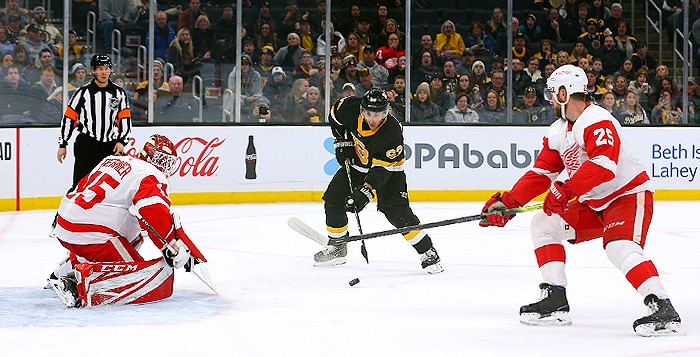
The Boston Bruins played host to the Detroit Red Wings. The team they lost to on Sunday in Detroit. The team that currently sits in 31st place with—coming into Saturday’s matinee—a 14-41-4 record. Two of those wins for the Red Wings were Bruins losses and they were both on Jonathan Bernier, who was again in net for the Red Wings on Saturday. Was there something about Bernier that the Bruins just couldn’t solve?
The first game, played in Detroit, was a 4-2 loss in which the Bruins were outplayed in many ways. It was also the second loss for the Bruins of that week. The second game was the second of a back-to-back, with the Bruins having beaten the Arizona Coyotes in a 3:00pm game and then headed to Detroit to play a 12:30pm game. Originally Jaroslav Halak was scheduled to play in net in Detroit, but at the last second Tuukka Rask, who played Saturday, had to go in. The Bruins put 40 shots on Bernier, who stopped 39 of them, opposed to the 20 that Detroit put on Rask. Detroit got the first goal of that game in the second period, and the Bruins Torey Krug tied it up in at the top of the third. However, whereas the Bruins were unable to capitalize on any of their four power plays, the Red Wings notched one in the third on their third power play of the game, and then Andreas Athanasiou, who had the power play goal, sealed the game with an empty netter.
Jump forward to Saturday’s game, and Gustav Lindstrom gets whistled for a hold just 2:25 into the game. While the Bruins are on the power play, the Red Wings read a pass Krug is trying to make and grab the puck. Darren Helm is on the odd man rush with Luke Glendening. Rask makes the first stop but lets up the rebound that Helm puts in to get the Red Wings on the scoreboard first on their third shot on goal, despite the Bruins having been the ones putting shots on Bernier and playing strong. And while the Bruins fan base may have given up at that moment (as some of them vocalized on social media), the Bruins players didn’t doubt they would win.
“Even when they scored that goal, I don’t think we were really worried about it. We just… we had it tonight, you could tell. We came out so hard and and we really controlled the play the entire way through the game,” said Brad Marchand, who had two assists in the game.
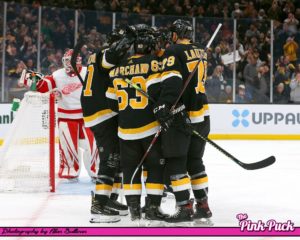
Charlie McAvoy who had been struggling to find the back of the net throughout the season and finally notched his first goal of the season during overtime against the Chicago Blackhawks on February 5th, got his second of the season, unassisted, to tie things up at 8:01 of the second period. Marchand’s first assist came while the Bruins were on the penalty kill when David Krejci was sent off for hooking at 8:25, and Patrice Bergeron gave the Bruins the go-ahead goal shorthanded.
Celebrating Bergeron’s shorthanded goal
“It was on the boards and [Bergeron] was by himself. So, once I was able to close the gap, and I really just tried to read which way he was going because he didn’t have much of an option to do a whole lot with it. So, once I kind of make contact, I looked up and [Bergeron] was all by himself. So, it worked out well. He made a phenomenal play to pick the puck up the way he did and and finish it off,” Marchand described.
Three minutes later, Charlie Coyle tipped in a shot that McAvoy made from the blue line to give the Bruins a two-goal lead. Those two goals in the second period proved to be huge in the game. The Red Wings have struggled a lot this season in the second period. Despite having three power play chances in the second period the Red Wings would get only one shot on Rask, and a total of 8 shots for the period and no goals to show. Meanwhile the Bruins put 12 shots on Bernier and had three goals—the two even strength goals sandwiching Bergeron’s shorthander.
It was the third period that saw the two teams closest in shots making it look like the Red Wings might be able to cut the Bruins lead. However, Marchand’s second assist of the game, in which he absolutely froze Athanasiou and then took to the slot, getting Bernier to bite. Marchand put the puck on David Pastrnak’s stick and he put it glove side high. With 6:57 remaining in the period, the Bruins were up 4-1 and that’s where the game would stand when the final buzzer sounded.
“Listen, we wanted to make sure we got a win today. We had a couple of losses to them this year; we wanted to make sure we took care of business in the right manner. I think everyone was involved today so it was a good hockey game in that regard, we didn’t steal anything. That’s a good way to hit the road, feeling good about your game. I think it’s just an extension of what we’ve been doing the last two, three weeks, ten games let’s say. Again, different guys contributing — our top guys, they do their thing. But I thought everyone sort of pulled on the rope today, I thought [Charlie] Coyle’s line did a good job of establishing O-zone possession time and had a big influence on the momentum shifts for us,” said Bruins head coach, Bruce Cassidy.
The Bruins have little time to rest on their laurels. They take on the New York Rangers on Sunday at 3:30 pm ET. The game will be televised on NBC. The Rangers are coming off a three-game road trip where they took all six points.
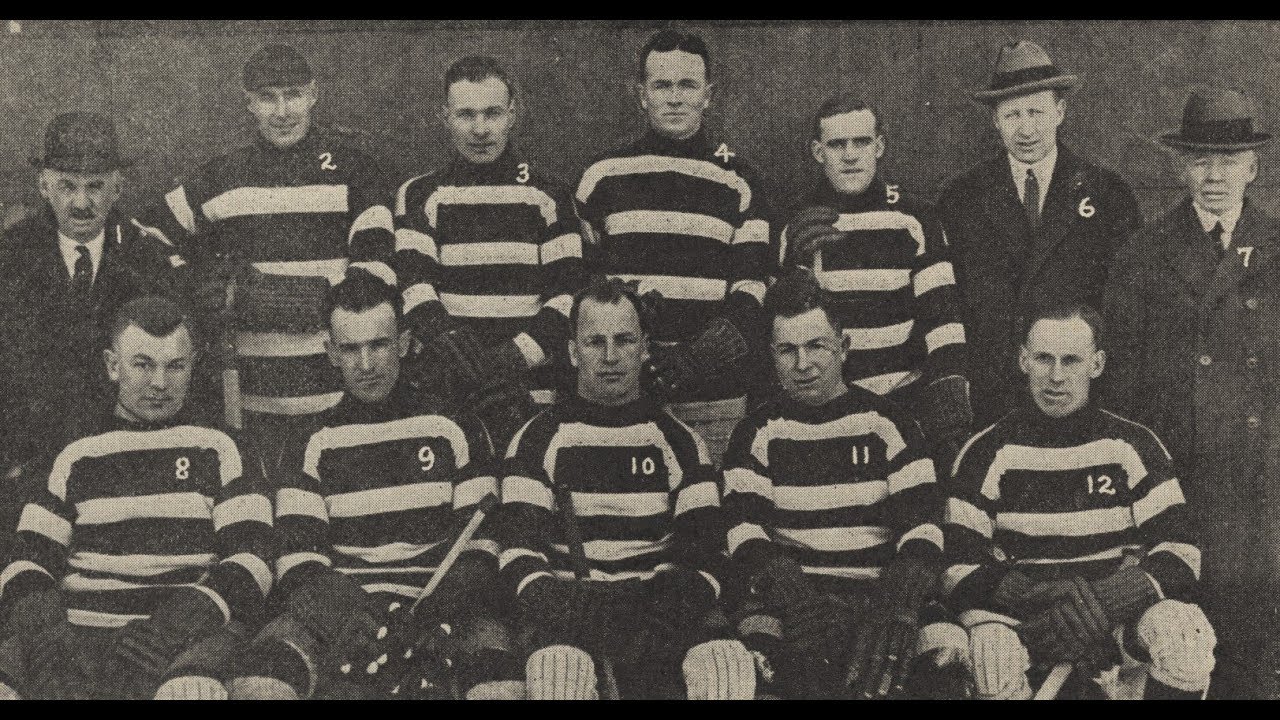
Having transitioned from the National Hockey Association to the newly-formed National Hockey League in 1917, left winger Cy Denneny became the first to break the NHL record for most goals in a career. Joe Malone initially had set the record and scored his final NHL goal on February 3, 1923. Just two weeks later, on February 17, Denneny surpassed Malone’s total. He would keep his record for 11 years, a couple beyond his retirement.
The record-setting goal was made before a “packed house” of about 7,000 at Dey’s Arena in Ottawa. Denneny and the Ottawa Senators were on a roll. As the Ottawa Journal remarked, “Whitewashing Canadiens has become quite a pastime with Senators, who have blanked them three times this season.” This game was no different as the Senators’ goalie Clint Benedict blocked all comers.
In fact, both teams remained completely scoreless through the first two periods. The Ottawa Citizen described it as a “grueling, close-checking game” in which “both teams use bodies with telling effect.” A report back to Montreal concurred that it was “one of those close, stubbornly-contested games that generally marks encounters between the two clubs.” Although the game was “devoid of any great spectacular displays, chiefly through the strong defence shown by both teams,” the reporter admitted that “Ottawa excelled in combination work.”
Throughout, the Boucher brothers certainly made themselves seen. Billy Boucher was the first to shoot on Benedict. He must have been annoyed that his brother George, like he had the last time the two opposed each other, broke the scoreless tie at 4:40 of the third period. According to one recap, “It was a typical Boucher goal, scored after a serpentine dash and charge at the defence. Cleghorn and Couture closed to sandwich Boucher, who let a high one fly that Vezina couldn’t handle.” The Montreal Gazette complained that the crowd jeered and threw lemons at Sprague Cleghorn, and they claimed his two “penalties were hardly warranted.” Meanwhile, the Ottawa Citizen complimented how Montreal’s goalie, Georges Vezina, though recently injured and “only called on to make a few spectacular saves, he was as solid as a rock all evening, and did his part in faultless fashion.”
About seven minutes after Boucher’s game-winner, at 11:45, Denneny finally found the back of the net. He had already had at least three shots on goal in the first period, another in the second, and another in the third before Boucher’s goal. The Ottawa Journal praised, “Cy Denneny was immense. He had no trouble tricking the defence, and while a lot of his shots were wide there were many that staggered Vezina.” The one that made it in happened as Eddie Gerard and Denneny skated up together and the “defence split and Gerard passed his man and flipped it over to Denneny” in a “spectacular combination bout.”
While the NHL seems to contradict itself over whether that was Denneny’s 143rd or 144th goal, the league does consider this the record-breaking goal. In the very next game, on February 21, Denneny scored four of the six goals Ottawa made on the Toronto St. Pats. (Teammate Punch Broadbent scored the first and last of them.) The game after that, on February 24, Denneny again scored four goals as the Senators beat the Hamilton Tigers 5-1. Still, he couldn’t quite make it to the top of the scorers that season. (He would take the lead the following season with the lowest number of goals (22) to ever win the top spot.)
The Senators led the standings all the way to the end of the 1922-23 season, finishing with 29 points (14-9-1). The Canadiens took second with one point less (13-9-2). During the playoffs that March, Cy Denneny faced his brother Corb and George Boucher his brother Frank as Ottawa defeated the Vancouver Maroons of the Pacific Coast Hockey Association (PCHA). The Senators went on to defeat the Edmonton Eskimos of the Western Canada Hockey League (WCHL) to win the Stanley Cup.
Denneny remained in Ottawa until the Senators traded him to the Boston Bruins on October 25, 1928. Doing double duty as a playing-coach that final season, he ended his NHL playing career with another Stanley Cup. After some time as an on-ice official, Denneny became the head coach of the Senators for just the 1932-33 season.
When he retired, after 329 NHL games, Denneny had 247 goals and 336 points. He had made the top ten in goal scoring for nine of his twelve seasons. With his totals, he topped the all-time lists in both goals and points. Howie Morenz would surpass him in both, taking the lead in points during the 1931-32 season and then the goal-scoring record in December 1933. Still, Denneny left enough of a mark on the NHL to be in the first class inducted into the Hockey Hall of Fame in 1959.
(Photo: Northeastern Men’s Hockey, with permission)
The Beanpot Championship game is always an experience. The energy in the building, from the pep bands, the student sections and the fans in general, gives life to the arena even before the teams come on the ice. As the Northeastern University Huskies and the Boston University Terriers went at it Monday night, there was animosity from both sides. For Northeastern it was an opportunity to garner their third straight Beanpot championship. For the Terriers it was a chance to get back on top, having last won it in 2015, when they beat Northeastern in overtime.
The first period showed that the Terriers were all business from the first puck drop. They controlled much of the play and tilted the ice in their favor. Jake Wise, who had been a healthy scratch for the Terriers’ losing game against the Merrimack Warriors on Friday, cleaned up a rebound right on the crease at 2:49 of the opener, assisted by Matthew Quercia and David Farrance. Later in the period, Northeastern’s Tyler Madden was sent off for a boarding call and while on the power play Trevor Zegras notched his ninth goal of the season to give the Terriers a 2-0 lead. Meanwhile the Huskies seemed to be having a bit of a struggle getting their legs going and their shots on BU’s Ashton Abel, who didn’t have too much to do for the first half of the period. In fact, Northeastern didn’t get their second shot on net until 13:21 of the first, but from that point on they did pick up the pace a bit. Unfortunately, they were also having some issues with giveaways that could have been costly. The Huskies were lucky to get out of the first period down just two goals.
As the second period got underway it was clear that the Huskies had discussed their first period performance and were determined to bring a full effort. They began the period controlling the play and Tyler Madden got Northeastern on the scoreboard at 2:53 of the middle frame with assists from Aidan McDonough and Julian Kislin, and with that the scoring doors opened for the Huskies. In the next 8:30 of play the Huskies had three more goals, and the Terriers had pulled Abel, replacing him with backup goaltender Sam Tucker. The Huskies second goal came from McDonough, with his tenth of the season, sending it home from the top of the slot. Perhaps it was frustration at the game being tied, but at 8:51, Cam Crotty was whistled for a tripping, giving Northeastern their first power play chance of the game. And while on that man advantage, they would soon find themselves up two men, when Alex Vlasic was whistled for a cross-check at 9:51, giving the Huskies 1:25 of time with a 5 on 3 chance. Zach Solow scored from the top of the slot, and they still had 1:46 of time on the second power play. With five seconds remaining on that power play, Grant Jozefek would give the Huskies a two-goal lead that they would take into the second intermission.
The third period saw the Terriers cut the Huskies’ lead in half just 1:56 into the period when Farrance got his 13th goal of the season, assisted by Patrick Harper and Logan Cockerill. And that was where things would remain as both teams tried to keep the other to the outside. As far as shots on net, everything was even at nine each, but it appeared that the Huskies may have been trying to play some “safe hockey” to maintain the one-goal lead they still carried, while the Terriers were doing their best to tie things up. It looked like Northeastern would be hoisting the Beanpot for the third straight year, when, with just 1.2 seconds remaining in regulation, Zegras got his second of the game and gave the Terriers a chance to win it in overtime. To a person, those watching the game were absolutely astounded at the finish of regulation.
The new NCAA rules dictated that the two teams play a traditional five-minute overtime period and that if nothing was decided in that time that as far as the NCAA records were concerned it was a tie. And that is exactly what happened Monday night. Despite the Terriers putting five shots on Craig Pantano while preventing the Huskies from any opportunities to test Tucker at the other end, the five minutes counted down and the two teams headed to their respective dressing rooms for an intermission in preparation for a full 20-minute sudden death period.
For the Huskies, that intermission was a chance to refocus and reset. Having come so close, down to 1.2 seconds, their ability to get out of the mandated five-minute overtime, was more the priority than trying to score.
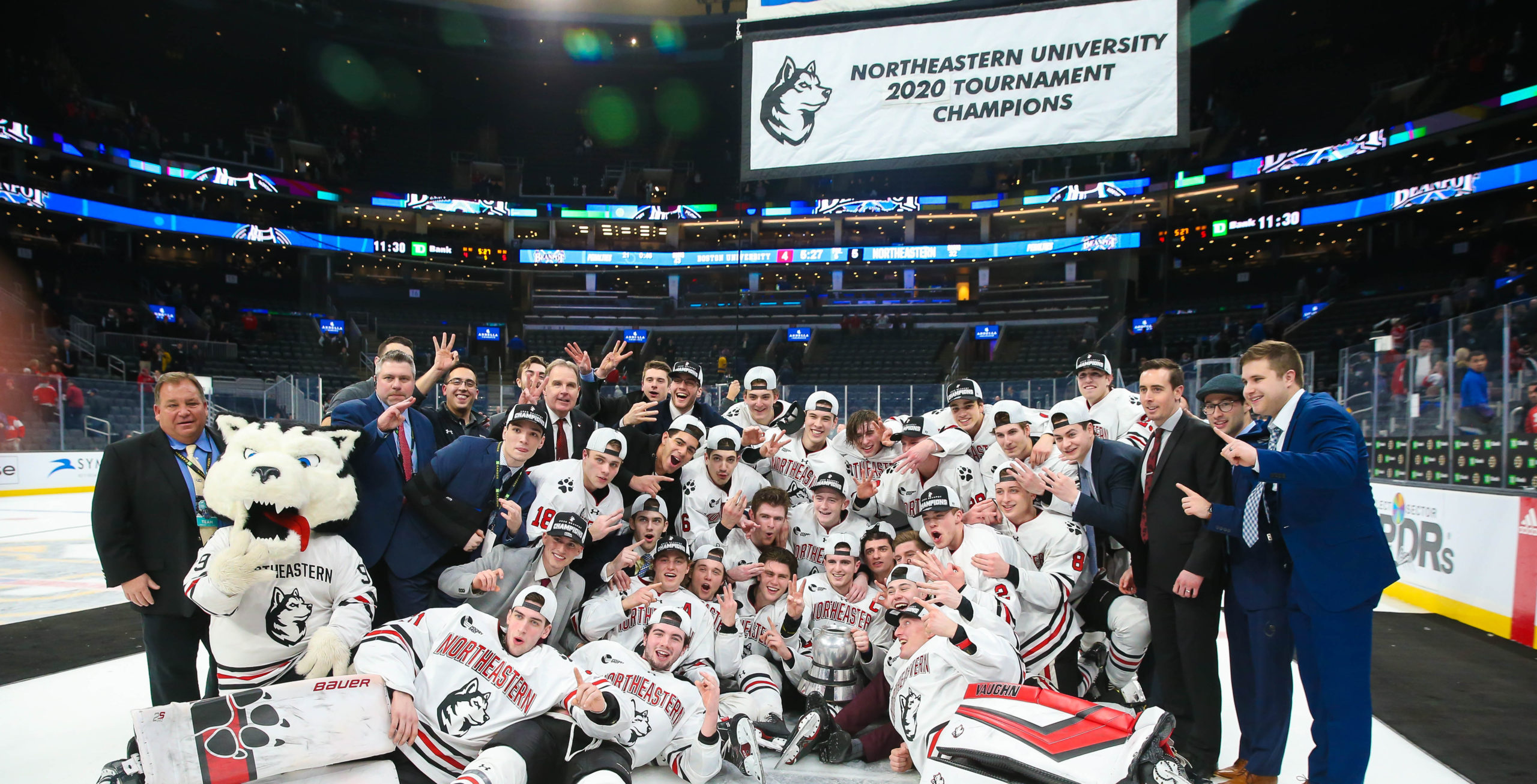
The second overtime period began and things picked up right where they left off with the Terriers peppering Pantano with the puck. Pantano was definitely dialed in, as he seemed square to the shots, grabbing many of them with a glove in a calm manner. The Terriers attempted 16 shots in the second overtime, with ten of them finding their way to Pantano. Meanwhile, the Huskies attempted 12 shots, and six were on goal. At 13:18 the first penalty of the extra innings was whistled. Harper was called for a tripping on Ryan Shea, sending the Huskies to the man advantage. Some felt that was a penalty that shouldn’t have been called. As the power play began the Terriers were strong on clearing the puck and having seen two shorthanded goals scored in the BC-Harvard game, it was always a possibility that the Terriers would accomplish something similar. However, 1:15 into the power play, as the Terriers failed to clear the puck, Jordan Harris took a pass from McDonough at the right point and walked the puck to the center of the blue line, before he took his shot. He was able to get the puck past Knight. Solow, who got the other assist, had been instrumental in keeping the puck in the BU end. With that the Huskies won the Beanpot for the third straight year.
This was the first time in the history of NU’s hockey program that they had won the Beanpot in three consecutive years. Pantano, with 40 saves, was named the 2020 Eberly Award winner, while Solow joined the likes of Adam Gaudette and Cayden Primeau, when he was named Beanpot’s MVP.
Jim Madigan talked about Northeastern's third consecutive Beanpot championship after his team's win. pic.twitter.com/SNeZO8WF4K
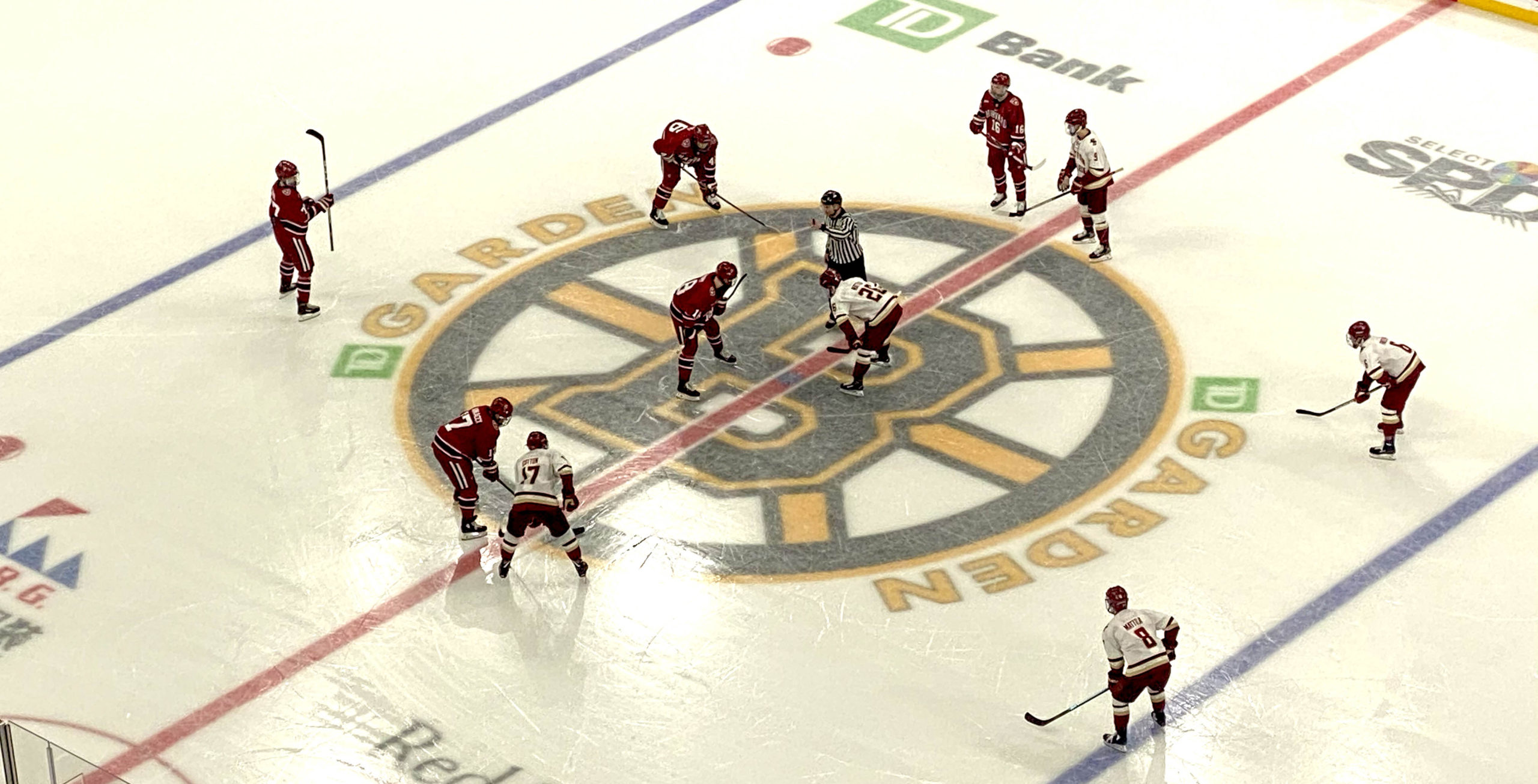
The first period of the consolation game between the Boston College Eagles and the Harvard University Crimson saw the Crimson get on the scoreboard first when Casey Dornbach scored on the power play at 2:13, assisted by Jack Rathbone and Nick Abruzzese. Despite outshooting the Crimson, it would take the Eagles 12 minutes before they could get the tying goal. They were unable to convert on their own first power play, while Dornbach sat for a cross-check at 7:54. Eagles’ captain David Cotton would knot the game up at 14:11. He’d positioned himself along the goal line to the right of the net and Julius Mattila passed him the puck from the slot and he one-timed it past Harvard’s netminder Mitchell Gibson. Three seconds later the Crimson would again go on the penalty kill when Baker Shore was sent off for a faceoff violation—a hand pass. Again, BC was unable to capitalize while on the power play. However, the Eagles would go into the first intermission leading 2-1 when Jack McBain was able to put his own rebound in at 17:19.
The second period was all Eagles all the time. They outshot the Crimson 14-6 while scoring four goals to Harvard’s one in that period. The number of odd man rushes that BC had because of misplays from Harvard was tough for Harvard’s Gibson, who, despite the score, did a good job in many of those instances. A perfect example of the mistakes by Harvard was evident while they were on the power play. Graham McPhee was in the box for BC for interference and despite being down a man, they were able to score two short-handed goals during that penalty. Alex Newhook, unassisted, got the first at 12:22 of the second. And then 1:19 later, while on a two-on-one, McBain got his second of the game. That gave the Eagles a 5-1 lead, as Logan Hutsko had notched an even strength goal at 5:53 of the period. Just as the unfortunate Harvard power play ended, R. J. Murphy was able to put a one-timer from the right dot past Spencer Knight to give Harvard their second of the game. The Eagles were not happy to have only a three-goal lead though, because with 24 seconds remaining in the period, Matt Boldy, again on an odd-man rush, assisted by Newhook, gave the Eagles their sixth goal of the game.
Harvard tried hard to notch some goals in the third period. It was the only period in which they were able to outshoot the Eagles, but unfortunately, they were unable to get any of those shots past Knight. In an effort to change the momentum, Harvard’s head coach Ted Donato elected to replace Gibson with Cameron Gornet in the third.
“The goalie change was more about just trying to change the momentum for the team and certainly was no indication of Mitch’s [Gibson] effort in the game. You know, I think it was a team wide lack of intelligence and focus that put us in that position, but I thought he made some real acrobatic saves. He made a save I think on a breakaway, made a tremendous save on a two-on-one,” shared Coach Donato after the game.
Despite the concerted effort by the Crimson in the third, the Eagles were able to get one more goal to make the final score 7-2, when Mike Hardman was given all sorts of time and space in the slot to score at 5:16 with assists from linemates Boldy and Newhook. They form a new line that head coach Jerry York referred to as the “rookie line”
“I thought the rookie line played very well. I think they each contributed some points, but they play well together. Certainly, one of Matt’s [Boldy] best games of the year. He’s coming, he’s, he’s making good strides as is Mike [Hardman] and Alex [Newhook] so like all three of those guys. We never thought of putting them together as a line, but this is the first really week or so that we’ve done that. I think they responded very well,” Coach York said.
While neither team wanted to be playing in the consolation game, for both teams, the points out of this one were important looking toward the playoff season.



 Prev
Prev