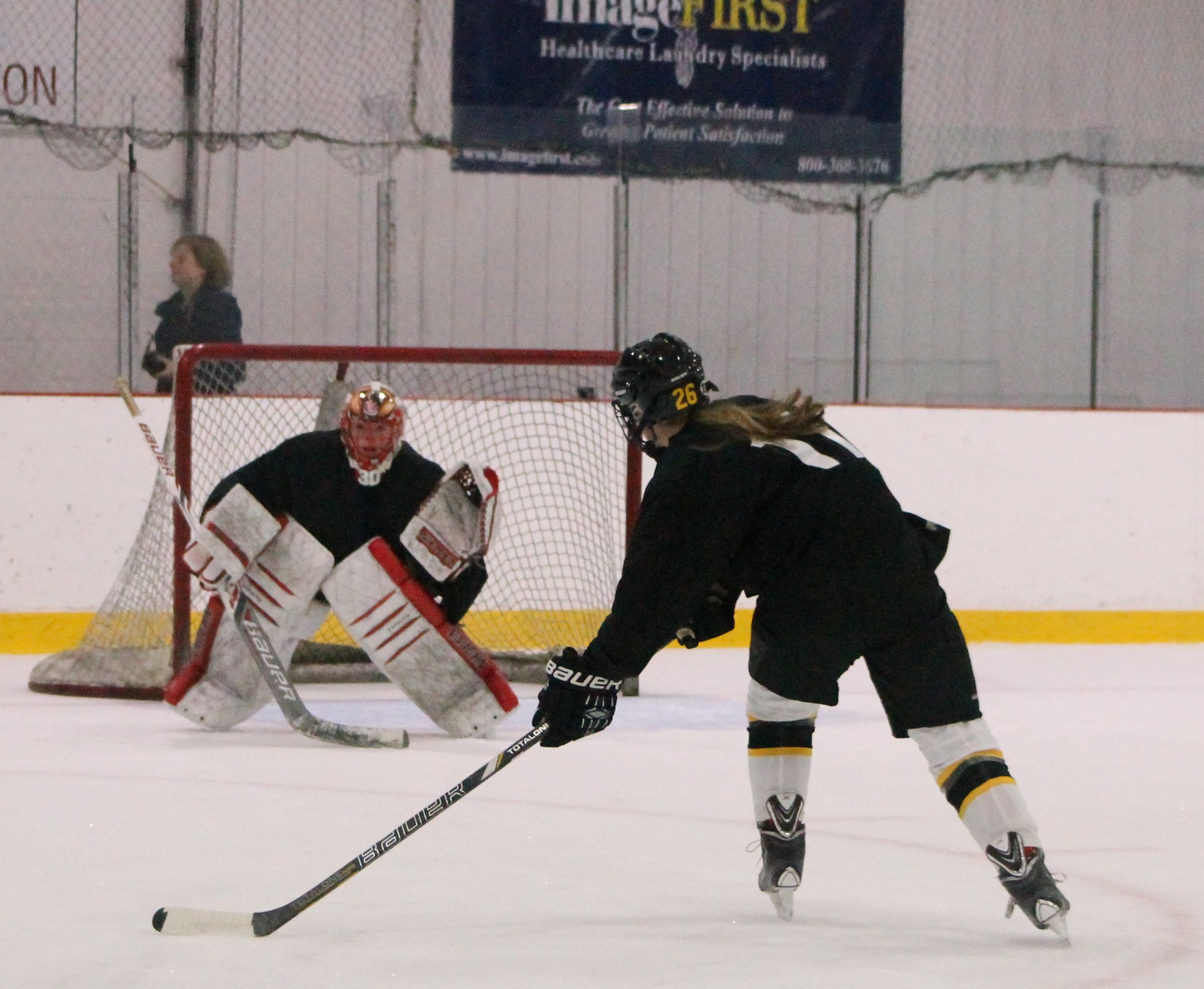
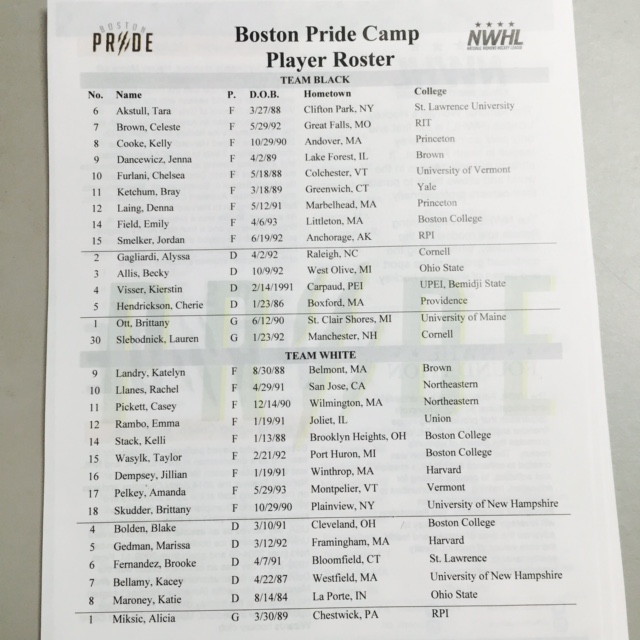
Thirty of the top NCAA and professional female hockey players in the country attended the National Women’s Hockey League’s Boston Pride tryouts yesterday, with the hope that they will be the first to make the official roster and earn a paycheck for playing hockey.
The players, who ranged in age from 21 to 29, mainly hailed from or had college ties to the northeast:
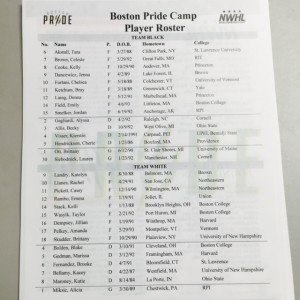
Boston Pride General Manager Hayley Moore said she was looking for players that would combine to form a well-rounded team, with contributions from all players.
Moore, an alumna of Brown University, played professionally overseas in Switzerland as well as for Boston Blades of the Canadian Women’s Hockey League (CWHL). She said she is excited to take on her role as general manager of the Boston Pride.
“I left (Switzerland) because hockey wasn’t something I could make a living doing,” she said. “…When I graduated, there weren’t these opportunities for players so I’m happy to be a part of it. I would have appreciated it. It’s a dream like any male player dreams of the NHL, and now females can dream of NWHL.”
Moore said she knows there is a place for the Boston Pride in such a jam packed but strong hockey market in the city.
“Boston is a sports city,” she said. “I think one of the greatest benefits of Boston is that hockey is so highly regarded. It’s a great fan base with college, pro teams, and youth teams so we want to give those girls something to look forward to in the future.”
Moore said nothing has been established yet in terms of a partnership with the Boston Bruins, but it would be something she would love to see.
“We are having great conversations with connections and a lot of different sources,” said Moore. “We would love to see that.”
And when it comes to getting fans into seats in the Pride’s home rink in Everett – Moore said the team will rely heavily on youth outreach.
“One of the biggest things each team will do is hosting a showcase with youth teams, and that will be a way to draw in crowds from surrounding areas and Boston,” she said. “We have a great youth foundation of hockey here.”
And although this camp was the Boston Pride’s first, it may not be the last before the season starts. Moore said she may look to hold one more to see more on-ice talent – meaning the team may sign players who were not necessarily on the ice this weekend.
Amanda Pelkey, a senior at the University of Vermont, used the tryout as an opportunity to show off her speed and skating.
“I think most of us are a little rusty,” said Pelkey. “So today was about getting the rust off.”
Pelkey, one of the youngest skaters on the ice, said it was exciting to skate next to so many women’s hockey veterans.
“It’s really exciting, it’s always fun seeing older girls and where they went to college, and when you’re a younger girl, if I were to make this roster with the veterans, you’d learn a lot every day,” she said.
Pelkey, who always had her eye on playing professional hockey after college, thought she might end up playing for the Boston Blades – until the NWHL came along.
“I’m keeping my options open,” said Pelkey. “I think (the NWHL) really spread through word of mouth, (NWHL League Commissioner) Dani (Rylan) and her crew did a great job of getting it out there. And when they presented it to us, it was like wow, this is really legit. They laid it out and it was a plan.”
And Pelkey was satisfied with getting answers to her questions, she said.
“They answered every question that you’d ever ask about a league, so that was a plus side to it,” she said.
“There’s no crying in baseball.”
That iconic quote from A League of Their Own has been used by many to remind ourselves to suck it up. And most of the times it works. We shake off whatever threatened the water works and continue on. Hockey players kick that up a notch. And a recent t-shirt quote I saw on Facebook reminded me of how high that level is for hockey players:
Sweat dries, blood clots, bones heal. Suck it up and play hockey.
Watch a hockey player, especially during the Playoffs and this sentiment sums up the attitude as they leave it all on the ice at this time of the year.
Having followed the Boston Bruins for many years, and reported on them the last couple, there have been some astounding examples of their perseverance through pain and injury. Though he doesn’t want to be remembered for it, many can call up the image of Gregory Campbell finishing his shift on a broken leg in Game 3 of the Conference Finals against the Pittsburgh Penguins in 2013. His tenacity and commitment to the team will be missed this next year by the Black and Gold—intangibles that often go unrewarded in a sport about goals.
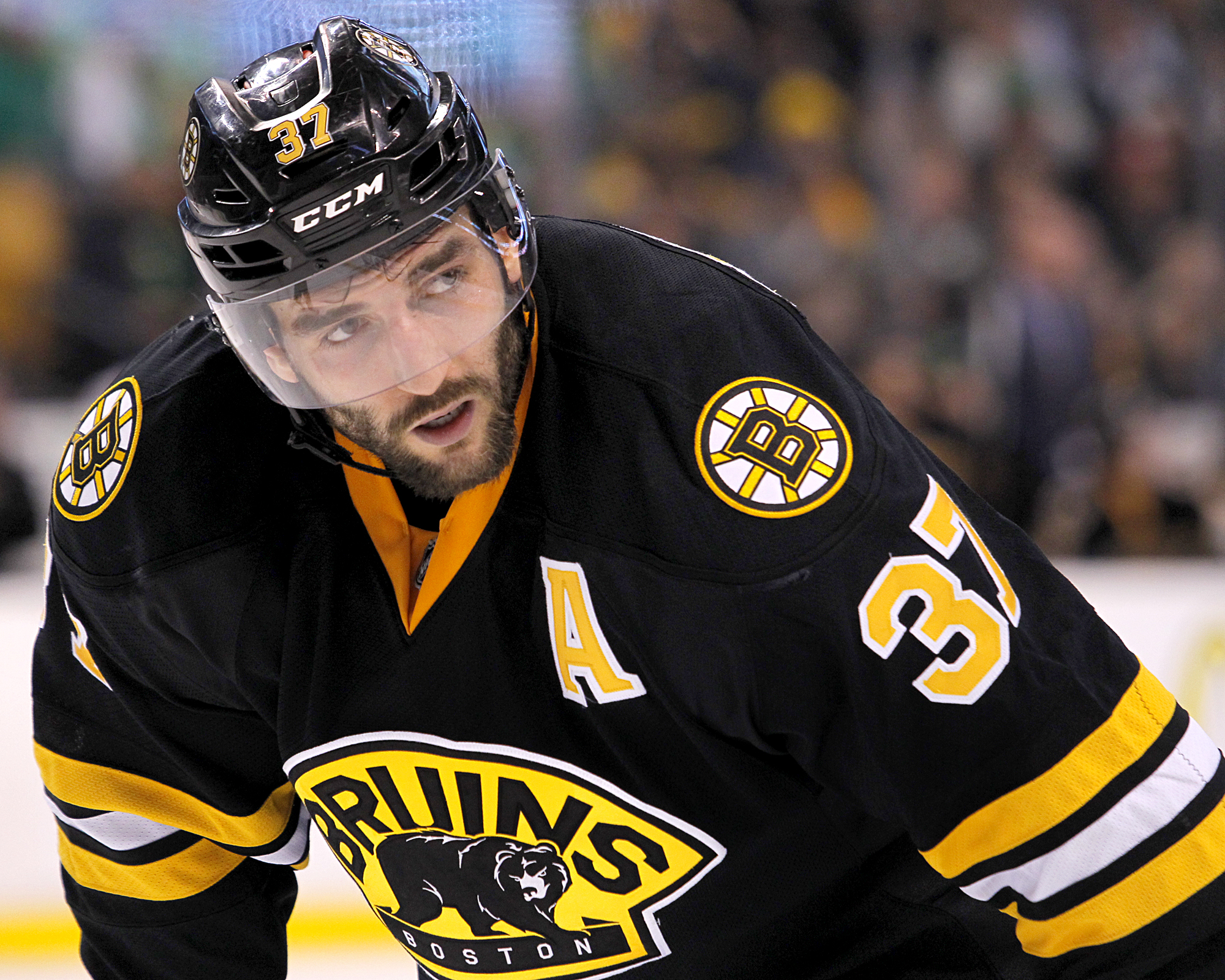
And who can forget the laundry list of injuries to Patrice Bergeron that emerged after the Bruins lost the Stanley Cup Finals that same season in Game 6 on home ice against the Chicago Blackhawks: torn cartilage, broken rib, separated shoulder and, oh yeah, a punctured lung.
Through it all, you see them grimace occasionally, but you never see them cry. You see them clamoring to get back on the ice. You see them doing their best to go off the ice under their own power. Puck to the face? Undoubtedly a lot of cursing, a towel to their face as they head off the ice to get repairs, their assumption they will return to action before the end of the game, but you don’t see them cry.
So why did I say there is crying in hockey? I have witnessed it. Some years too many times, after a band of brothers have left everything out on the ice and come up short.
I watched the University of North Dakota’s coach come out ahead of his players who were trying to get their emotions in check after falling to the Boston University Terriers in the Frozen Four semifinals this season, only to see the red rims of their eyes when they joined their coach. I then watched those same BU Terriers go through it when they fell to the Providence College Friars in the Frozen Four Final—tears still in the eyes and on the cheeks of those players who had to come out and face the media while trying to make sense of their season ending on such a sour note.
I remember when the Boston Bruins won the Stanley Cup in 2011 in Game 7 at Vancouver and there was a close-up on television of Ryan Kesler, then with the Vancouver Canucks, down on one knee, tears in his eyes. The posts on social media that night belittled him for his tears.
However, despite the hours of training, the years of determination and denial, the myriad of injuries a hockey player will suffer, there is only one time you will see him publicly cry—when his team loses in a playoff situation—especially one close to the finals.
It is hard for those of us who have not been in such a situation to understand the overwhelming emotions the players experience. From grappling with their loss to watching the victorious team celebrating right in front of them, they must process so much after having already given every ounce of effort they had in their muscles and brain. Few of us will put that much on the line in any aspect of our lives. The longer into the playoffs they play, the closer they come to that trophy.
It doesn’t matter if it is the NCAA’s Frozen Four, the USHL Clark Cup, the CHL Memorial Cup, the ECHL Kelly Cup, the AHL Calder Cup or the NHL Stanley Cup. At every level there are players pushing their bodies and minds beyond their capacities in an effort to help the rest of his brothers achieve one of the hardest victory’s imaginable—the ultimate prize.
So while the winning team’s members are catapulting themselves on each other, throwing their helmets and gloves in the air, take a moment and look at the team who will not be lifting a trophy. It is the only time in a season of hockey that you will see tears. But considering what they have sacrificed, they deserve to be respected for the tears they shed.
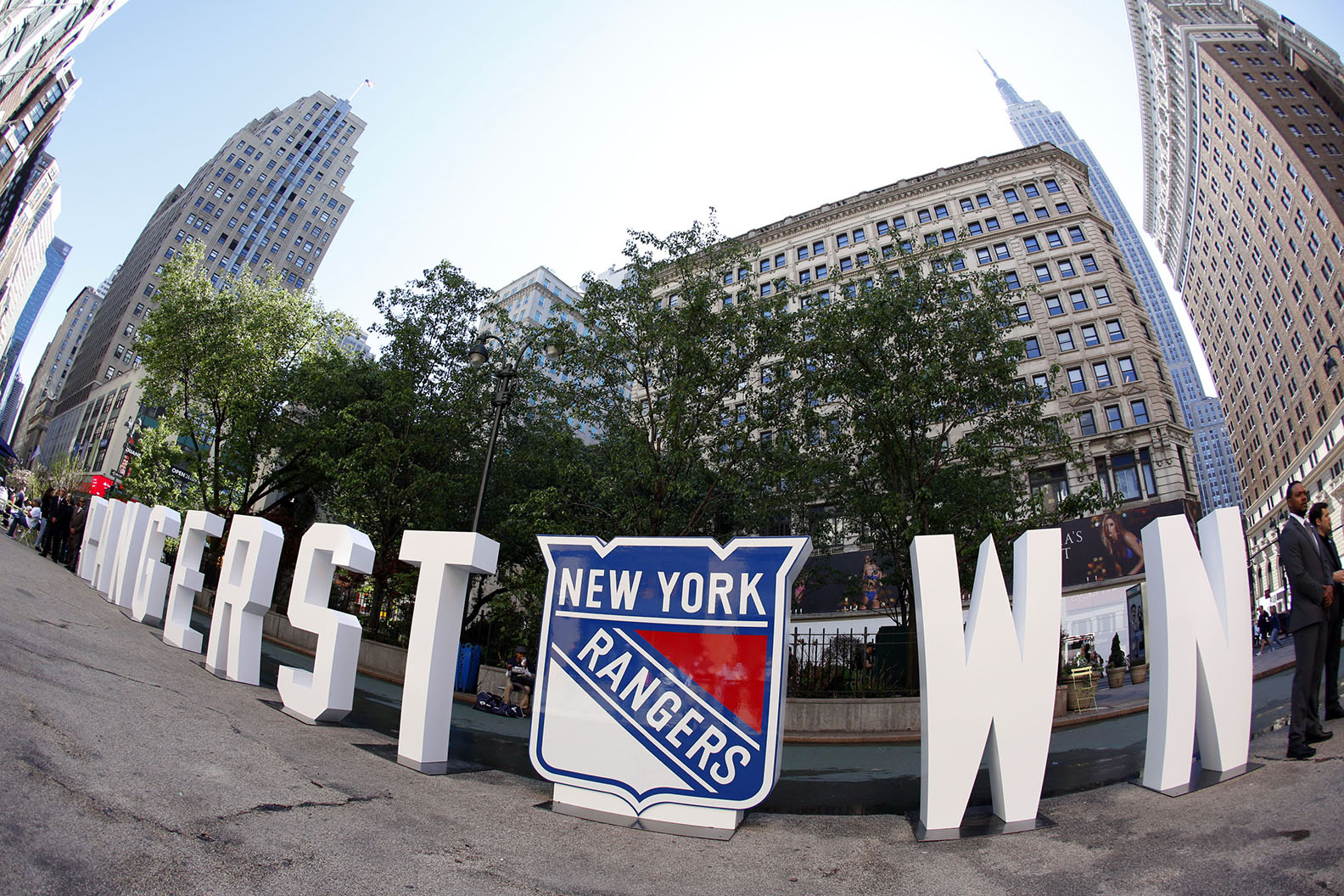
(Photo: New York Rangers)
The last time the New York Rangers won a Game Seven in overtime, it was 1994. Stephane Matteau‘s goal lifted the Rangers over the New Jersey Devils in the Eastern Conference Final, and they advanced to the Stanley Cup Final.
In 1994, the Rangers also took home the Cup.
There have since been several parallels between that historic season and the 2014-15 season. On Wednesday, the Rangers completed their comeback against the Washington Capitals with a 2-1 Game Seven overtime victory at Madison Square Garden. They now move on to the Eastern Conference Final, where they will face the Tampa Bay Lightning.
Derek Stepan put in the game-winner at 11:24. Stepan won the faceoff in the Capitals’ zone and passed it to Keith Yandle. Yandle got it to Dan Girardi, who shot the puck from the blue line right at Braden Holtby. The puck rebounded out to Stepan, who was perfectly positioned to one-time the shot and bury it. As Holtby lay in the net, defeated, the Rangers and Madison Square Garden celebrated.
Following the Capitals’ loss in Game Six, Alex Ovechkin made a guarantee: the Capitals would win the series. Ovechkin, looking to make good on his promise, put his team up 1-0 at 12:50 in the first period. The Rangers suffered a defensive breakdown, and Ovechkin was there to finish.
Rick Nash had an opportunity to tie the game at the end of the first with a 1-on-0 breakaway down the middle of the ice. He tried to go five-hole on Holtby, but Holtby read the play and stopped the shot to keep his team in the lead.
Kevin Hayes evened the score at 6:22 in the second period. His second goal of the postseason came on the power play; he tipped in a shot right in front of the net with an assist by J.T. Miller. Per the Rangers, Hayes became the first Rangers rookie to score in a Game Seven since Muzz Patrick in 1939.
This game was arguably the most physical of the series, and Ovechkin set the tone early. On the first play of the game, he hit Ryan McDonagh into the boards. The Capitals registered 26 hits during the game, while the Rangers had 32. Chris Kreider led all players with nine hits. Neither team was going down easily.
In the third period, Brooks Orpik laid out Dan Boyle, catching him in the head with an elbow, and Boyle was slow to get up. Boyle went straight into the locker room and did not return to the game. Orpik did not receive any sort of penalty and was booed whenever he touched the puck for the rest of the game. Boyle’s status remains unknown at this time.
The Rangers used their speed to their advantage and were effective in pushing the Capitals to the outside throughout the game. Though there were some defensive lapses, like the one resulting in Ovechkin’s goal, the Rangers were strong all-around in front of the home crowd.
THREE STARS OF THE GAME:
3. Holtby
2. Lundqvist
1. Stepan
Next up is the Tampa Bay Lightning, who the Rangers struggled against during the regular season. The Lightning won all three match-ups and scored 15 goals. The Rangers will have home-ice advantage for the series and will host the Lightning on Saturday at 1pm for Game One.
(Photo: Anaheim Ducks)
As the Chicago Blackhawks and Anaheim Ducks prepare for Sunday’s start of the best of seven Western Conference Final, there’s been a bit of feather-ruffling going on.
Perhaps it’s the long respite between series–10 days for Chicago and seven for Anaheim–but the teams are using their press time to get into each other’s heads. This chirping is a practice I’d enjoy from an impartial bystander perspective, but as a fan I grow concerned about the juju.
So, were I a Washington Capitals fan, I would have panicked when, going into a game seven, these words came out of Alexander Ovechkin‘s mouth:
“We’re going to come back and win the series. We’re going to play our game, and we’re going to come back and we’re going to play Montreal or Tampa.”
And, sure enough…the hockey gods would not allow it, with a tight overtime loss Wednesday night.
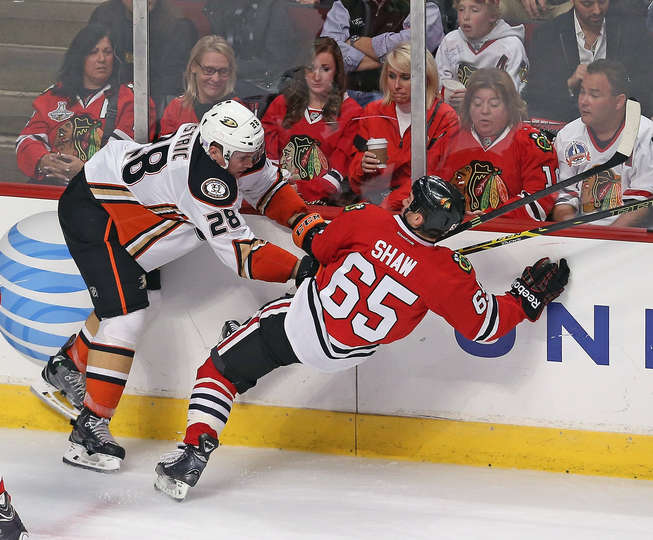
So, then, imagine how I felt when pesky Andrew Shaw chose the following words to answer the many questions about the Hawks-Ducks size difference.
“The bigger they are, the harder they fall, I guess.”
Sigh. Yes. The Ducks are certainly bigger. But, Shaw, little guy (5’11”, 179 pounds) be careful with the talk of toppling them.
The Ducks’ team has an average weight of 207.5 pounds. The top line averages 6’3″ tall and 221 pounds. Patrick Maroon is 231, Ryan Getzlaf weighs in at 218, and Corey Perry is 213. Ryan Kesler hits 208.
They have six players on their roster under 6’0″ tall and one player, Brandon Montour, under 180 pounds. He is 6’0″ and 172.
Big guys help make plays like these happen:
The Blackhawks, by contrast, average 10.2 pounds lighter. While they also have six men under 6’0″, they have four players weighing under 180–Patrick Kane (5’11”, 177), Teuvo Teravainen (5’11”, 178), and Kris Versteeg (5’11”, 176).
Chicago’s “big guys” are defenseman Brent Seabrook (6’3″, 220) and forward Bryan Bickell (6’4″, 223), while the Ducks have six skaters hitting the scales at over 215 pounds–Getzlaf is 6’4″, Tim Jackman (6’2″, 224), Maroon (6’2″), Mark Fistric (6’2″, 225), Josh Manson (6’3″, 217), and Jaycob Megna (6’5″, 218).
A couple of the little guys aren’t too scared, though. They told the Chicago Sun-Times that brawn doesn’t necessarily make the difference.
“It’s all about speed,” Teravainen said. “And usually smaller guys are faster. Especially in the playoffs, the game is really, really fast, and you have to be in really great physical shape.”
And Kane doesn’t expect his line to match up against the big Ducks.
“There are still obviously a lot of dominant players that are big and strong, like the Perrys and Getzlafs of the world. But when you’re on the ice, especially for me, I don’t tend to think about my size, if I’m bigger or smaller than a guy,” he said. “If I go in and try to change my game completely against a bigger team, it’s just going to end up working out [poorly] for me.”
Kane hasn’t had many problems so far this postseason, even with an early return from an injury expected to sideline him until now. He’s put up 13 points in 10 games–and had two game-winning goals in the last series.
Blackhawks General Manager Stan Bowman said the modern skill game now has been friendlier to smaller players.
“If you have size in addition to that, that’s great. We like big players, too,” he said. “We don’t have an aversion to that at all. Anaheim does it really well with the players they have. But there’s not one way to win.”
Speed and skill help make these things happen:
By the numbers, the Ducks and Hawks have a pretty interesting matchup, despite their size and style differences.
“It’s going to be one heck of a series,” Perry said. “They’re a great team. When you put two teams together, it’s going to be a great series. They’re a skating club, and they’re kind of similar to Calgary. They’ve got a lot of speed, a lot of skill, and you’ve got to be ready to step in front of them and eliminate their time and space, and if we do that, we’ll be all right.”
Kesler, who has nine points (four goals, five assists) in nine postseason game, including a game-winning, first round series-clinching goal against the Winnipeg Jets, was a little more enthusiastic.
As much as he can give it on the ice, he played an off-ice game, too, when talking to Ducks Daily. He fired a shot at the Hawks.
“A good team, fast team,” Kesler said of Chicago. “A beatable team, though.”
Kesler faced the Hawks before in the postseason, from 2009-2011 with the then pretty ugly rival Vancouver Canucks. The Hawks took two out of three of those series, ultimately winning the championship in 2010.
Perhaps he’s trying to psyche them out. Maybe he’s vocalizing his own mental preparation.
Either way, these two teams have plenty of time to stew before Sunday’s faceoff.
“Ten days between games is a long stretch, and you want to make sure that you try different things and make sure you’re stimulated coming into it, as well,” Blackhawks Coach Joel Quenneville said. “We try to simulate as much game situations as we can, and try to get the pace to be game situational and work off of that.”
Hopefully in that time the Hawks will keep their chirping in check, and Shaw will say a few “Hail Marys” to Lord Stanley, you know, because it’s the Cup.
The Schedule
- Game 1: 2:00 p.m. CT Sun. May 17 in Anaheim, broadcast on NBC, CBC, and TVA Sports
- Game 2: 8:00 p.m. CT Tues. May 19 in Anaheim, broadcast on NBCSN, CBC, and TVA Sports
- Game 3: 7:00 p.m. CT Thurs. May 21 in Chicago, broadcast on NBCSN, CBC, and TVA Sports
- Game 4: 7:00 p.m. CT Sat. May 23 in Chicago, broadcast on NBC, CBC, and TVA Sports
IF NEEDED:
- Game 5: 8:00 p.m. CT Mon. May 25 in Anaheim, broadcast on NBCSN, CBC, and TVA Sports
- Game 6: 7:00 p.m. CT Wed. May 27 in Chicago, broadcast on NBCSN, CBC, and TVA Sports
- Game 7: 7:00 p.m. CT Sat. May 30 in Anaheim, broadcast on NBCSN, CBC, and TVA Sports
(As always, click the bold links for video clips or other information. Gifs via Stephanie Vail @myregularface)
(Photo: Blackhawks Facebook)
The Chicago Blackhawks turned the State of Hockey into a state of horror as they swept the Minnesota Wild–never giving their opponents a lead–to head on to the Western Conference Final against the Anaheim Ducks.
“Crawford, he’s a star against us,” coach Mike Yeo said. “He’s [Martin] Brodeur. He’s [Patrick] Roy. He’s everybody against us, so we’ve got to find a way to solve that.”
While Crawford only allowed seven goals, the Blackhawks themselves scored 13 in the 4-3, 4-1, 1-0, and 4-3 victories.
Kane himself had five goals, including two game winners, against the Wild. He also tallied one assist on Andrew Shaw‘s power play goal in Game 4.
His highlight reel looks a little like this:
To close the series, Marian Hossa took a pass from Jonathan Toews during a 6-on-4 penalty kill for a shorthanded empty-netter goal that would ultimately be the Blackhawks’ game-winner–with an empty net goal deciding a series for the first time in 24 years (since before Teuvo Teravainen was born.)
The series was hardly as mismatched as it sounds, however, and the two teams will likely remain close rivals in future years as the determined Wild battle toward their ultimate championship goal.
And, in the best of all hockey traditions, it ended with hugs and handshakes.
One casualty in the sweep was Blackhawks defenseman Michal Rozsival, whose skate was caught in a rut in the ice during Game 4 while defending Thomas Vanek. As he tried to continue his play, he twisted his ankle in a gruesome position, causing a vicious break.
(Watch at your own risk.)
Successful surgery Tuesday led doctors to a 12-16 week recovery diagnosis.
Rozsival will be an unrestricted free agent in the summer. He recently told media that he shared with friends how lucky he was to still be playing at 36, let alone with the Blackhawks.
He’d been averaging about 17 minutes of ice time per night–out of the top four. Duncan Keith plays about 30 minutes with Brent Seabrook, Niklas Hjalmarsson, and Johnny Oduya all taking the majority of the shifts with at or more than 20 minutes each. Veteran defenseman Kimmo Timonen had been playing less than 10 minutes.
David Rundblad will be taking Rozsival’s place.
“I just felt really sorry for Rozsi,” Rundblad told media Sunday. “He’s been playing really good so far. That injury, too, it’s just painful to watch. I just feel bad for him.”
Whether he’ll be able to take the number of shifts Rozsival did is yet to be determined.
“He’s gonna come in and play and minutes are dictated by how he plays and how the score of the game goes,” Coach Joel Quenneville said. “Other guys are accustomed to playing significant minutes. Every game’s gonna be different, but his play and the game and the score will play a lot into it.”
He’s expected to rejoin Keith, his previous defensive pairing this season. Keith commended Rundblad’s puck movement, shot, and noted the players’ chemistry together.
Rundblad had three goals and 11 assists, and was a plus-17, in 49 regular season games with the Blackhawks. He’s known for his offense on as a defenseman, but will be relied on at the blue line.
“Of course, you always want to help the team and play as well as you can,” Rundblad said. “Games are so tight in the playoffs, there’s not much room for mistakes out there. I’ll just try to keep it simple and play as quick as I can.”
Hawks and Ducks–Learning to Fly
With the Ducks closing out the Calgary Flames Sunday, the Hawks are set to head to Anaheim next.
In the regular season, the Ducks won once 1-0, while Chicago won twice, 4-1, both at the Honda Center. But the postseason is a whole different different puck-game.
Ducks coach Bruce Boudreau told media the Blackhawks are “overall probably the fastest team in the NHL.”
But flattery won’t distract a team that knows it is outsized and outscored by its opponent. Corey Perry leads the playoff in points, followed closely by Kane.
Matt Beleskey had five goals in the series against Calgary, one per game–better than any Hawks could tally.
“They have a great team,” Brandon Saad said. “They have a great forecheck and they’re big and physical, and they play a good puck-possession game. It’s going to be a battle. It’s not going to come easy and we’re going to have to be patient like these past couple series.”
In fact it’s not going to be easy at all. It’s going to be a hard battle. The Ducks lead the Hawks statistically all over the ice this postseason.
They lead in goals with 35. Their goalie Frederik Andersen has a playoff save percentage of .925 and a goals-against average of 1.96 versus Crawford’s 2.06 GAA and .916 save percentage.
Their power play has scored nearly 31 percent of the time versus Chicago’s 20 percent conversion.
But if it’s any consolation, Keith dominates puck control. He’s on the ice for 60 more Blackhawks shots than opposing teams’ shots.
Crawford is coming off a hot series.
And Antoine Vermette leads faceoff wins with 64.6 percent versus Ryan Kesler‘s 63.7 percent.
“We’re dealing with a team that knows how to win in the playoffs, has the experience and talent to back it up,” Boudreau said. “They are arguably the fastest group of forwards, and you add Keith and Oduya and some of those on the back end, and they’re probably the fastest team in the NHL.”
He’s right. The Blackhawks have been pretty decent at closing in the postseason, comparatively. They have won 65 playoff games and two Stanley Cup titles since 2009 while the Ducks have 27 postseason victories in those past six years.
Finally, the last 20 minutes of the games should be interesting.
The Hawks have yet to lose a game in which they led after two periods through the playoffs. It goes back 30 games. And they didn’t trail at all versus Minnesota.
But the Ducks have been winning with comebacks–six out of eight times in the postseason. Four of those were in the third period.
“You watch ’em play, they’ve got a lot of different options they use,” Quenneville told media Monday. “They’re very mobile and they’re strong in all aspects.
“So we need to be our best in all areas ourselves. We feel like if we progress in the playoffs, you’ve got to elevate your game to beat teams that have a lot of confidence and they’ve got to be playing the right way. They’ve got a lot of things going for them.”
The Schedule
- Game 1: 2:00 p.m. CT Sun. May 17 in Anaheim, broadcast on NBC, CBC, and TVA Sports
- Game 2: 8:00 p.m. CT Tues. May 19 in Anaheim, broadcast on NBCSN, CBC, and TVA Sports
- Game 3: 7:00 p.m. CT Thurs. May 21 in Chicago, broadcast on NBCSN, CBC, and TVA Sports
- Game 4: 7:00 p.m. CT Sat. May 23 in Chicago, broadcast on NBC, CBC, and TVA Sports
IF NEEDED:
- Game 5: 8:00 p.m. CT Mon. May 25 in Anaheim, broadcast on NBCSN, CBC, and TVA Sports
- Game 6: 7:00 p.m. CT Wed. May 27 in Chicago, broadcast on NBCSN, CBC, and TVA Sports
- Game 7: 7:00 p.m. CT Sat. May 30 in Anaheim, broadcast on NBCSN, CBC, and TVA Sports
(As always, click the bold links for video clips or other information. Gifs via Stephanie Vail @myregularface)
Game 4 was a painful blow to the head for the Flames. After Wednesday night’s exciting win at home for Calgary, Friday’s 4-2 loss to the Ducks was definitely disappointing. Now that Sunday’s game is back to Anaheim, Calgary’s ‘home ice advantage’ is no more, and Friday’s game at the Saddledome could possibly be their last of the season. With the Ducks now leading the series 3-1, the Flames chances of moving on to the next round seems more unlikely.
The Flames were able to produce in the first period, but after that, their offense was absolutely shut down. Though Anaheim started off the scoring on a power play, the Flames found the net twice shortly after. After 5:44 of the first, though, the Flames were fresh out of luck. Jakob Silfverberg was the one to get on the board for the Ducks at 3:58, but just 39 seconds later at 4:37 was when Calgary’s young guns made themselves known. Johnny Gaudreau, who struggled to find his game the first couple of meetings in Anaheim, was the star of Wednesday’s game. Gaudreau was not the one to score the Flames first goal, but what was impressive was how he set up Sean Monahan to score. After finding his way through three Anaheim players only to be denied by Frederik Andersen, Sean Monahan got his stick on the rebound and put it in. Micheal Ferland, who had missed the past three games with an undisclosed injury was finally back, and his unassisted goal came from a rocket that beat Andersen blocker side from about 40 feet out. Ferland’s presence was definitely missed, and not just because of his big body on defense.
The second period, Calgary had some chances, but just couldn’t find the net. Anaheim, on the other hand, was able to tie things up at 16:42 on a goal from Andrew Cogliano. Though only one penalty was served with Anaheim on the one-man-advantage, the outcome of the game was reflective of the penalty mistakes made in the second.
Joe Colborne’s high stick call just as the period expired meant the penalty would be carried over into the third. At 1:11 of the third, the Ducks found the lead on the power play on a goal from Matt Beleskey. Beleskey’s four playoff goals have all been acquired in the four games played against Calgary.The unfortunate power play goal wasn’t the last for the Ducks, and Patrick Maroon scored on the empty-net at 19:23. With the first period as the exception, the Flames trailed the Ducks in shots on goal in the last two periods, leading to the shot count being Anaheim: 29, Calgary:27.
“That’s on me,” Colborne said about the penalty per the Calgary Flames. “That’s on me. I definitely let the boys down there. It’s tough. But we’re not out of it yet. We’re going to rebound and come back and have the best game of the year in game 5.”
Calgary got behind in the game, and the mistakes that they made throughout ended up costing them. Anaheim now has not only the home ice advantage, but they only have one more game to win and they go on to face the Chicago Blackhawks in the conference finals.
(Photo: @nyrangers)
The New York Rangers were under two minutes away from ending their chase for the Stanley Cup and their 2014-15 season.
As the final minutes of Friday night’s game ticked away, the Washington Capitals were holding onto a 1-0 lead from a goal by Curtis Glencross midway through the third. The game was a must-win for the Rangers, and it was in front of a packed home crowd at Madison Square Garden. It wasn’t a night for goodbyes. It was a night for willpower, a never-say-die attitude, and a comeback.
Chris Kreider started the rally. With 1:41 remaining in regulation, Kreider buried a pass from Derek Stepan at the top of the circle and evened the score at 1-1. His third goal of the playoffs was enough to send the game into overtime and give the Rangers momentum and a second chance.
Rangers captain Ryan McDonagh was the overtime hero. Jesper Fast brought the puck up the ice midway through the OT period and passed it over to Stepan. Stepan fed it behind him to McDonagh, who had time to set up the shot and find the back of the net at 9:37. McDonagh’s goal gave the Rangers a 2-1 victory and another opportunity to turn the series around. The Rangers are now 3-0 in overtime games this postseason and 9-0 in their last nine playoff elimination games on home ice. This game was their tenth consecutive one-goal decision.
Braden Holtby‘s strong play in net continued to plague the Rangers throughout the game. He stopped 41 of 43 shots on the night, while Henrik Lundqvist saved 28 of 29. It wasn’t finding scoring chances that was the problem; it was finishing them. Every Rangers player but James Sheppard registered at least one shot on goal; Keith Yandle led the team with five.
The Capitals nearly took a 1-0 lead in the second period, but defenseman Matt Niskanen‘s goal was overturned; Joel Ward had been positioned in front of the net and interfered with Lundqvist as the puck went in, and the score remained 0-0 going into the second intermission. Holtby stopped a number of good scoring chances for the Rangers as well, including several by Martin St. Louis, who has yet to score this postseason.
Game Six will find the teams back at the Verizon Center in Washington, DC, on Sunday. The Capitals will be looking to close out the series at home and return to the Eastern Conference Final for the first time since 1998. The Rangers will work to bring the series back to MSG for Game Seven and move on from there. The Capitals currently hold a 3-games-to-2 series lead.
THREE STARS OF THE GAME:
3. Holtby
2. Lundqvist
1. McDonagh
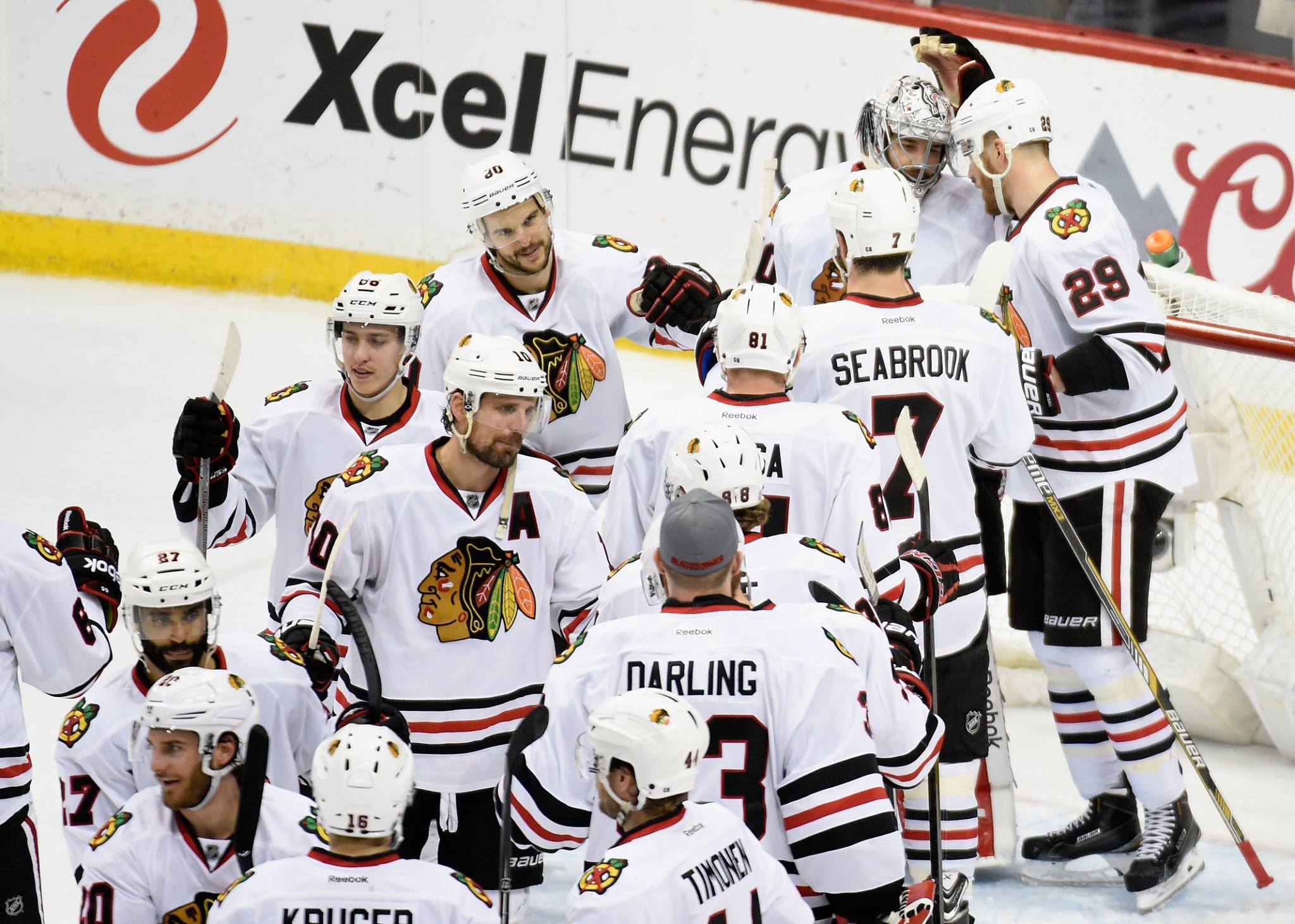
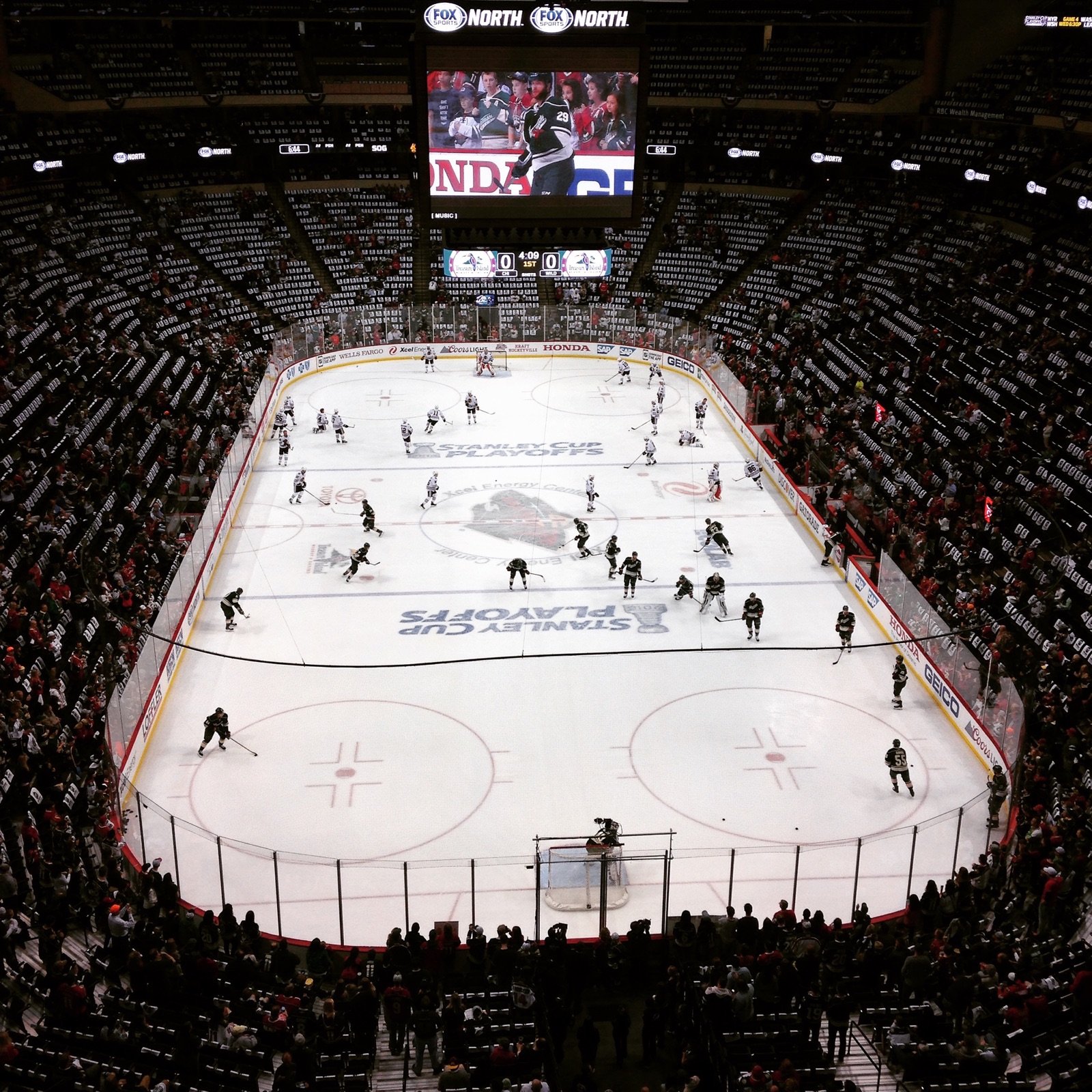
After two tough losses in Chicago that would put the Minnesota Wild 0-8 during the playoffs at the United Center, they hoped to come home to Saint Paul, and beat the Chicago Blackhawks at the Xcel Energy Center.
The homestand began on May 5, where the Wild would drop game three, the final score being 1-0. This put them down 0-3 in the series, and in desperation mode to keep their “Cinderella” like season alive. After struggling in the first round against the Nashville Predators, Corey Crawford was able to shutout the Wild, with a total of thirty saves. Despite a slump earlier in the year, he looked just like his old self during Tuesday’s game, making save after save on the Wild’s numerous chances. The Blackhawks were not in control offensively for a majority of the game, other than at the end of the first period. But, like any great team, they were able to convert on one of their few chances, and that goal stuck, allowing them to get the win in game three. The goal was scored by no other than Patrick “Showtime” Kane, with the assists going to Andrew Shaw and Patrick Sharp. The loss was absolutely heartbreaking for the Wild and their fans because they had a scoring chance almost every shift, but the puck would never find the back of the net. Flashing back to the regular season, the Wild’s powerplay was an absolute dud, as they hardly put any shots on net during their three chances. Frustration was evident for the Wild throughout the whole game, as they were missing the net left and right, depriving them of what could have been great scoring chances. The Wild would need to figure out a way to score on Crawford and shutdown the Blackhawks’ snipers in game four if they wanted to come out with a win, and keep the series alive.
Thursday night began game four, in which the Wild desperately needed to win, so they would not be swept by the Chicago Blackhawks. The first period was a constant battle for both teams, but Brent Seabrook was able to net one for the Blackhawks about halfway through, giving his team the 1-0 lead. Luck, once again, was not in Minnesota’s favor, as a bouncing puck caused Ryan Suter to miss a wide open net that would have allowed the Wild to strike first. The Wild completely recalibrated for the second period, coming out looking like the better team. Unfortunately for the Wild, Nino Niederreiter received a penalty, and Andrew Shaw was able to score a gritty power play goal to give his team to 2-0 lead. In desperation mode, the Wild were finally able to find the back of the net toward the end of the second period, when Erik Haula scored his first goal of this year’s Stanley Cup Playoffs. In need for a game-tying goal, the Wild started out the third period strong. Unfortunately for them, the Blackhawks took a two goal lead again when Devan Dubnyk was forced to play a guessing game with Patrick Kane and Bryan Bickell during a two-on-one, and he let in a goal that barely trickled over the line. The game became even more eventful when the Wild pulled Devan Dubnyk with just under four minutes left while on a powerplay. The powerplay allowed Marian Hossa to clear the puck, and it would go right down broadway into the empty net, giving the Blackhawks the 4-1 lead. The Wild were not dead yet, though, and Jared Spurgeon scored a goal to make it a 4-2 game. With an empty net and their season on the line, the Wild continued to attack, when Nino Niederreiter scored to make it a 4-3 game with 1:27 left. The last minute was an absolute nail-biter, but Crawford continued to stop the chances, and eventually the buzzer sounded, ending the Minnesota Wild’s season. Although the season is now in the books for the Wild, they demonstrated a “fighting till the end” mentality, one that will hopefully win them a Stanley Cup soon.
With the series win, the Blackhawks will move onto the Western Conference Finals. Depending on who wins the other Western Conference series, they will either be facing the Anaheim Ducks or the Calgary Flames.
The Montreal Canadiens seek to avoid being swept by the Tampa Bay Lightning tonight in game four of the Eastern Conference Semifinals. The Habs have fallen in to a three-game hole and have been completely unable to replicate the offensive production they had in the first round against the Ottawa Senators. Montreal has scored just four goals in three games, and has been outscored 10-4.
The tides appeared to be turning last night as the Canadiens generally outplayed Tampa throughout most of the game, but as fans known, the Hockey Gods can be cruel. With just over a second remaining in the game (but with the clock showing nothing), the Lightning’s Tyler Johnson broke the 1-1 tie to seal the win for Tampa Bay.
According to Trendsmap Montreal, a French Canadian curse word immediately began trending on Twitter in Montreal following Johnson’s goal.
This, obviously, is not ideal for Montreal. Their power play has been utterly atrocious throughout the series, and the team has simply been unable to score goals. While games one and three of the series were relatively close (with game one being decided in two overtimes), game two was a blowout with Montreal losing with a score of 6-2.
If Montreal wants their season to continue, they had better step things up—and pronto.
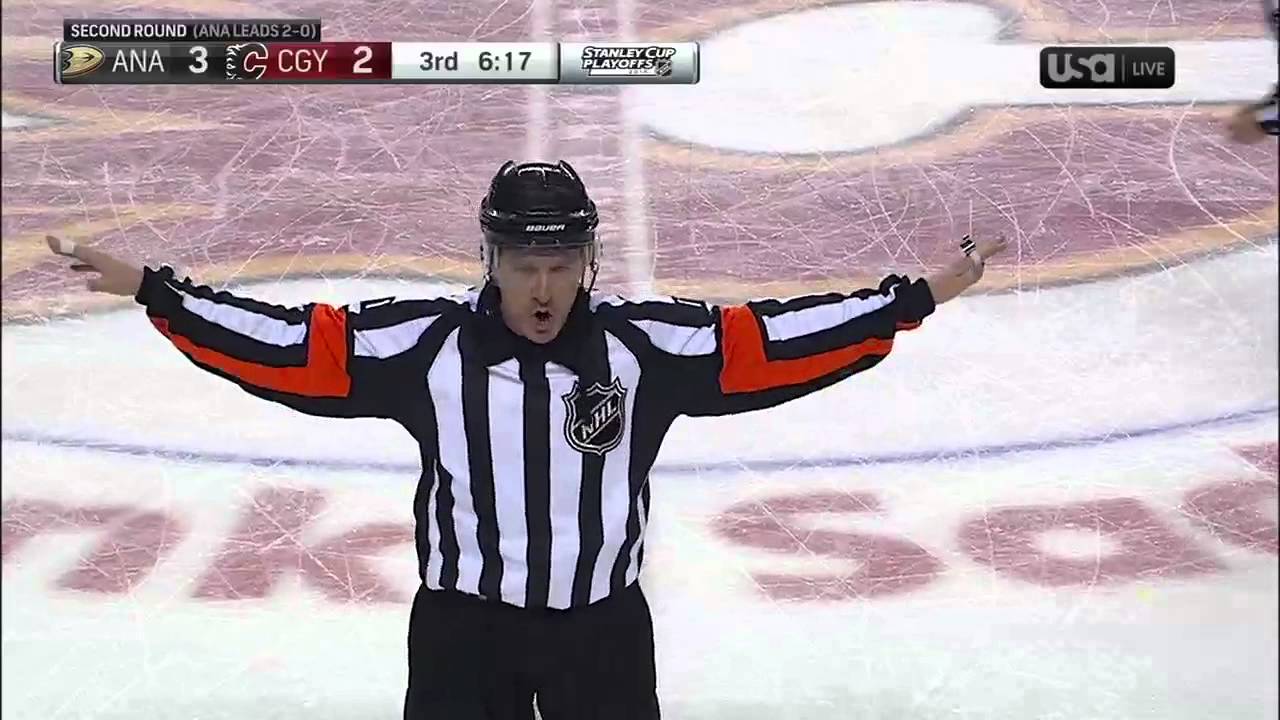
Tuesday night’s game between the Calgary Flames and Anaheim Ducks was no doubt one of the best narratives of the playoffs; unlike this piece, it practically wrote itself. As I previously hinted at in my story about Sunday night’s game, Calgary did indeed add another interesting story line to the series. A controversial call, a last second regulation goal and a dramatic game winner made for one utterly exhilarating win by the Flames. Their 4-3 win was the Flames third playoff victory when behind the first two periods.
The first period started off early in favor of the Flames with a beautiful shot roofed by Brandon Bollig just 2:07 in. The early lead, though, was quickly diminished with a goal from Patrick Maroon on a feed from Ryan Getzlaf at 6:57 to tie it up. Calgary was still looking rough in the first, but it was better than they had been for the majority of the past two games while in Anaheim. An additional goal from Corey Perry at 14:10 scored upon a scrambling Karri Ramo.
Near the beginning of the second, a tripping call on Matt Stanjan put Anaheim on the power play, and the Flames looked to be in trouble. After a turnover in their d-zone, Joe Colborne broke through the neutral zone from a turnover and backhands one behind Frederik Andersen. Matt Belesky answered back with a goal for Anaheim at 8:20 to take the lead. Belesky has been a real thorn in Calgary’s side this series. His three playoff points have come in the three games in this series, and he’s found his way to break through Calgary’s D and exploit all of their mistakes. Calgary seemed to have fixed many of their faults that were contributing to their downfall in the past games.
If the first two periods sounded interesting, the third trumped them both. While some might say there were technically two goals scored in the third period by Calgary, the officials in Toronto say there was only one. The Flames trailed by one goal in the third when rookie Sam Bennett was robbed of a goal by Andersen, or was he robbed by the league? In what looked to be a goal from several other angles, the overhead view appeared to be inconclusive. Because the evidence was ambiguous, the ruling on the ice stood: no goal. Whether the straight on view was appearing to be an optical illusion, or it really just didn’t fully cross the goal line, we’ll never know. Calgary dominated this period. The shot count for this period was Anaheim: 3, Calgary: 11. Calgary outshot Anaheim and controlled a lot of the puck possession.
Out of the six power play opportunities Calgary had throughout the game, they only scored on the one that mattered. Calgary pulled their goaltender to give them a two man advantage, due to it being a 4-on-3. A feed from Kris Russell to Johnny Gaudreau in the neutral zone got Johnny at a good angle. In true Johnny Hockey fashion, he scored the tying goal on the power play with 19.5 seconds left in the game. This extra advantage helped them break through the offensive zone Though Gaudreau’s production this series has been very low, he came in and got things going when it really mattered, taking the goal into overtime.
Overtime started off with Anaheim coming close one too many times for the liking of Calgary. Two incredible back-to-back saved from Ramo kept them in the OT, denying both of Anaheim’s top goal scorers Perry and Getzlaf. Once Calgary had puck possession, though, they seemed to dominate in their end. One thing we saw all throughout this game especially was Calgary keeping things going while having puck possession when a penalty was called on Anaheim. This was something we saw in their overtime winner. Calgary had possession, and they were playing through a delayed penalty against Anaheim. They had momentum, though, and didn’t loose the puck. Calgary pulled their goaltender and Mikael Backlund hopped over the boards as the extra attacker. Backlund got the puck and shot it through a screen of players, and right past Andersen into the net. Backlund’s first NHL playoff goal was the game-winner for Calgary in overtime.
The comeback kids do it again!
 Prev1...148149150...412Next
  Page 149 of 412