Born in Tampere, Finland, July 3, 1968, Teppo Numminen had an international and NHL career that lasted until he turned 41. As he collected milestones, he just so happened to play two numerically important games against the Columbus Blue Jackets on March 3. In 2002, he reached his 1,000th NHL game, and in 2004, he set a record for most games played by a European-born defenseman.
Though drafted (29th overall) in 1986, Numminen took an extra two years skating in Finland. That allowed him to participate in the 1988 Olympics at Calgary, where Finland won silver, their first ever medal for hockey. (His father, Kalevi Numminen, had coached Finland at the 1980 Olympics.) Numminen then reported to the Winnipeg Jets and remained with them when they relocated to become the Phoenix Coyotes in 1996. He became the 12th European named an NHL captain at the start of the 2001-02 season. Looking for a change, he was traded to the Dallas Stars in July 2003 and played there just one season.
For the March 3, 2002 showdown with Columbus, Phoenix’s America West Arena hosted 11,564 fans. The home team, led by Captain Numminen, led 2-0 from the first period until Columbus managed one goal at 9:07 of the third period. Numminen had a chance at the empty net as the game ended, but he passed saying, “It would have been too sweet. Maybe next time.” As Coach Bobby Francis summarized, “It was an outstanding effort. We pretty well shut their options down and what options we did give them were perimeter shots.”
Having played in his 1,000th NHL game, Numminen was the 20th player to have reached the milestone with the same franchise. He was the first in the Phoenix franchise to get there. Numminen told the local press, “It’s been great for me, a dream come true. I never thought I’d be in this situation, ever. If it all ended tomorrow, it would have ended happy. I’ve had a great time already and it was more than I ever could have expected.” He finished, “And now I’m looking at 1,000 games on top of it all. It’s been a great ride, something I never could have expected.” His wife, Ann-Maarit, threw a party for him at a Scottsdale dinner club and invited the whole staff and team. Even former teammates contributed to the video tribute in his honor.
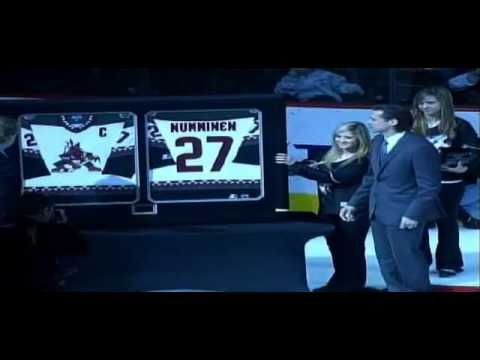
At the time, Numminen claimed, “But this is my home. I feel comfortable here. It was the same thing in Winnipeg. I think it all goes back to that homesickness thing. I don’t know if I could ever leave.” However, he changed his mind in the summer of 2003 and asked to be traded to Dallas. His 1,098 games set a Winnipeg-Phoenix franchise record, and the Coyotes raised his No. 27 in 2010.
On March 3, 2004, the American Airlines Center hosted the Blue Jackets. Again, Numminen’s home team came out the victor, winning 4-2. Even though Columbus scored first and last, Dallas’ Bill Guerin had a hat trick in between. This was Numminen’s 1,149th NHL game. He had surpassed Borje Salming to have played more NHL games than any other European-born defenseman. Numminen would go on to set a record for most games (1,252) of any European-trained player when he surpassed Jari Kurri on November 13, 2006.
After his only season in Dallas, the NHL lockout gave Numminen a rest that he probably needed considering his heart trouble. On August 4, 2005, he signed with the Buffalo Sabres and played with them until he retired a day after his fourth anniversary of the signing. However, he missed most of the 2007-08 season when he underwent heart surgery. Numminen retired after 1,372 regular-season games, which ranks him 48th for most games played in NHL history. He was the last of his draft class still active, and he momentarily held the record for most games by a European-born player.
Meanwhile, Numminen returned to the Olympics by playing in the first three featuring NHL participants (1998, 2002, and 2006). Finland won bronze in the first and silver in the last of these. For his international career, in 2013 Numminen was inducted into the IIHF Hall of Fame. He and his father were the first father-son pair in the hall.
Additional Sources:
Bob McManaman, “Classy Numminen grateful for milestone,” Arizona Republic, 3 March 2002, p. C13.
Bob McManaman, “Grand time for Coyotes, Numminen” and “Special teams special” and “Radivojevic gets point in his NHL debut,” Arizona Republic, 4 March 2002, pp. C1 and C5.
“League Notes,” Minneapolis Star Tribune, 4 March 2004, p. C7.
Hockey is played at so many levels and leagues, which shift over time. The college tournament of 1984 marked the end of the National Association of Intercollegiate Athletics (NAIA) sponsoring a hockey championship tournament as most of its schools with men’s hockey teams moved into the newly-established Division III of the National Collegiate Athletic Association (NCAA). The two-day, four-team tournament ended on March 2 with University of Wisconsin-Eau Claire winning their first ever title in any sport.
The 17th and final NAIA Men’s Ice Hockey Tournament took place at Hobbs Municipal Ice Center in Eau Claire, Wisconsin. The four participants faced each other in the semifinals on Thursday, March 1 and in the third-place and championship games held on Friday, March 2.
In the first game, the University of Michigan-Dearborn defeated the University of Wisconsin-Superior 6-2 with goalie Brik Pardo making 31 saves. The Dearborn Wolves had been seeded No. 1 for this fifth consecutive appearance in the tournament. In 1981 and 1983, they had come in second and were hoping to finally snag the title.
Later in the day, the Eau Claire Blugolds ensured that they would play Dearborn in the championship game with a 10-5 victory over Roger Williams College. Despite the high scoring, especially the hat trick by Troy Ward, the Blugolds’ defense suffered a serious blow when senior goalie Tom Johnson strained a hamstring during the very first period. Freshman Mark MacLean had to jump in the net having only 160 minutes of college-level experience.
Unlike the Wolves, the Blugolds had lost both games in their only other championship tournament (in 1982). Their coach, Wally Akervik, had led UW-Superior to the championship when they hosted the tournament back in 1976. The following year, he was hired as Eau Claire’s arena manager, and in 1978, Akervik started the university’s varsity hockey program. Even with the goalie set back, Akervik led the Blugolds with confidence, resulting in being named the 1984 NAIA Coach of the Year.
After Akervik’s former team settled for third place (beating Roger Williams 3-2), the Blugolds and Wolves met for the championship game on Friday evening. Again, the freshman MacLean competently manned the nets, making 29 saves on 30 shots. Coach Akervik praised, “He played well considering the situation.” MacLean would be named to the All-Tournament team. Eau Claire’s defense stepped up to help him, despite their own inexperience, to the point that a defenseman, Scott Parker, was named tournament MVP.
As for scoring, Rich Penick had a hat trick and two assists as the Blugolds crushed the Wolves 6-1. Akervik said it was “a super way to end the season.” The victory gave Eau Claire its first and last NAIA men’s ice hockey title.
After 1984, the NAIA no longer sponsored a men’s hockey championship. Recently, there have been efforts to return with the formation of a new NAIA Division with varsity hockey programs. However, they would need to meet certain criteria to reach national championship status, and they only have nine teams thus far.
The teams that had competed in the NAIA tournament turned to the NCAA. The first Division III championship was held in 1984. Eau Claire won its only (to date) NCAA Division III title at Herb Brooks Arena in Lake Placid, New York on March 16, 2013. They are currently ranked fourth in Division III. Within their division, the Blugolds belong to the Wisconsin Intercollegiate Athletic Conference (WIAC) and are about to play in its championship game on March 7, 2020.
For a sport that began with players serving as coaches, today the thought of an NHL player doing double duty as coach seems overwhelming. The last true player-coach in the NHL was Charlie Burns of the Minnesota North Stars. When he was promoted to assistant coach on December 28, 1969, he temporarily retired as a player to focus on bench duties. After nearly setting a record for longest winless streak, Burns put his skates back on March 1, 1970 and led from both the bench and the ice for the rest of the season.
Charlie Burns was born in Detroit on Valentine’s Day in 1936. When he got his start (with the Detroit Red Wings no less) in 1959, he was the only American-born player. However, he grew up in Toronto and became a Canadian citizen at the age of 21. Just before joining the NHL, Burns played for the Whitby Dunlops when they won the World Championship. They were coached by founder and general manager Wren Blair, who (in 1967) became the first coach and general manager for the Minnesota North Stars.
In the NHL, the forward was popular in Intra-League Drafts. Burns was chosen by the Boston Bruins in 1959, by the Pittsburgh Penguins in 1968, and finally by Minnesota in 1969. In between, Burns spent most of the 1960s playing for the San Francisco Seals of the Western Hockey League and then made the transition with them to the NHL as the Oakland Seals. He spent time as a player-coach for the Seals during the 1965-66 and 1966-67 seasons.
Burns had been on Blair’s radar since their 1958 championship, and Blair had been trying to get him since he was put in charge of the new Minnesota franchise. The summer Blair finally had the chance to draft Burns, the North Stars tried to hire Punch Imlach (recently fired by Toronto) as coach. That November, Bernie Geoffrion (recently having coached the New York Rangers) turned down the job. Blair told the press, “When Geoffrion turned the job down, I started talking to Burns. Charlie has experience (he was player-coach at San Francisco for two years). When we drafted him this summer from Pittsburgh, I had this in the back of my mind.”
By late December, Blair was feeling the strain from having to coach and serve as general manager at the same time. He announced that he was stepping away from the bench for at least three to four weeks, explaining, “I’m so tired now that I’m not effective on the bench. A fresh approach might spur the team.” The team physician, Dr. Frank Sidell, confirmed, “Wren has been under too heavy a work load for a long time. In the interest of his health I’ve insisted he lighten his load, at least temporarily.”
To hold down the fort while Blair focused on general managing, Burns was named assistant coach. Blair clarified, “I’m taking a reprieve from the bench for three or four weeks. This doesn’t mean Burns is our permanent coach, although he could be (in the future). We’ll review the situation in a couple weeks. If the team is going well, we’ll leave things as they are. If I do return, Charlie still will be the assistant coach.” Even if he decided not to stick with Burns, Blair planned to hire a full-time coach before the 1970-71 season.
As of taking over coaching duties with a practice on December 29 and game on December 30, Burns planned to temporarily retire from skating. He told the press, “Doing two jobs like that was tough enough in the minor leagues.” Continuing, he said, “I really don’t know if I’m ready to call it quits as a player in the NHL. We’ll have to see how this new arrangement works out. I do know that I’m ready to try coaching in this league. I consider this a fine hockey club. We have got some problems, but then what team doesn’t.” He concluded with the comment, “It is a great opportunity, and now I must give it my best shot.”
To say that things did not go as well as planned would be putting it mildly. From mid-January through the end of February, the North Stars could not scrape together a single victory. They lost or tied 20 games straight, coming within a game of matching the record for longest winless streak. To this day, only six teams have had longer. The 6-2 loss in Philadelphia on February 28th was the last straw.
The North Stars did not return to Minnesota until 4 am the following morning and had to prepare for a Sunday matinee against the Toronto Maple Leafs (who also arrived late in the night). In that short span, Burns made the decision to return to the ice. “Basically, we were playing worse and worse. I talked it over with Wren Blair (general manager) and Walter Bush (president) and they both agreed it was okay if I felt I could help the team. It’s not easy playing and coaching. If I can just give the team 30 seconds of help per game it’s worth it.” He also remarked, “I figured I had nothing to lose by suiting up. If we had lost, well, we’ve lost plenty of them before. I thought I could help the club on the ice here and there, killing penalties and taking an occasional shift.” The team captain, Claude Larose, noted, “We were all a little surprised at Charlie dressing, but I think probably it shook us up a little.” With that, Burns became the first playing-coach since Doug Harvey of the New York Rangers back in 1961-62.
The crowd of 14,456 at the Metropolitan Sports Center had the joy of watching the positive impact Burns had on their team. By putting himself as wing for Lou Nanne at center, the Stars had four lines going, keeping all of them more rested. Their opponents only had three. Having played every shift with his line (and killing three penalties), Burns admitted, “I was a little tired a couple of times. But I kept the shifts short. I’ll play as long as I figure it will help the club, although in the long run I’d rather just be a bench coach.”
With Burns’ help, the North Stars shutout the Leafs 8-0. It was Cesare Maniago’s first shutout since the opening game back in October. The proud player-coach commented, “Cesare was great. He made the big saves, the ones that kept us in. Then we’d go down and get another goal.” One of the goal-getters, Bill Goldsworthy was stunned by their overnight success, saying, “I’ll never know how things can turn around like that in one day.”
They even ended the game with a “lively brawl” which “resulted in 11 penalties.” Burns took that lightly, “We’ll get a few $100 tags from the league for leaving the bench. But when you’re winning, it’s worth it.” More importantly, he stated, “We proved today that there isn’t any reason in the world why this team shouldn’t be at least third and maybe second in our division. Now that we’ve broken this slump, maybe we can keep going.”
Burns’ prediction was pretty spot on. They went 9-5-4 for the final push, finishing third in the West Division. Having made the playoffs, they lost to the St. Louis Blues in the first round.
In June, Blair finally settled the coaching issue. On June 4, he announced that instead of continuing to coach, Burns had accepted a two-year player’s contract and would receive a permanent job in the organization in 1972. According to Blair, “There were many factors involved in this decision, and it was a difficult one to make. One of the reasons was Charlie’s own value as a player. We are going to lose three players next week in the expansion, plus a fourth in the deal for Judes Drouin. If Charlie were to return as coach, his retirement would cost us another player, and we just can’t afford that. Charlie did a fine job for us last seasons, under some trying conditions. He came right out of the ranks as a player, for one thing, and had no experience as an NHL coach. It is our feeling that the North Stars would profit more with an older, more experienced coach, and we are going to obtain such a man.”
Burns seemed resigned when he responded, “I was prepared for the news, and I have no complaints. They gave me a good deal. Now I hope they can get me through the draft some way, and when I report to camp next fall I’ll be just another player. At least I had the opportunity to coach an NHL team. I’ll mark it down as a good experience.” Although he had not been on the original list of 15 protected players, Blair added 34-year-old Burns to the list of 18 players to be protected from the draft.
On June 8, the North Stars held a press conference at Montreal. Blair announced that 42-year-old Jack Gordon had signed a three-year contract to coach the team. Gordon had spent the past two years as coach and general manager of the Cleveland Barons in the AHL. In the hopes that Cleveland would receive an NHL franchise, he had resisted Blair’s recruitment for almost two years .
Gordon did not expect to have any problem coaching Burns. “I know Charlie. He’s a man. As a matter of fact, I may be leaning on him for a little help myself.” Coach Gordon and player Burns remained together in Minnesota until the latter went down to the AHL in 1973. During the 1974-75 season, after Gordon led the team through a 11-22-5 record, Burns took over coaching duties. He finished the season with a 12-28-2 record putting Minnesota in fourth place in the Smythe Division and out of the playoffs. That marked the end of Burns’s time behind an NHL bench.
Additional Sources:
“Stars Draft Vet, 2 From Minors,” Minneapolis Star Tribune, 12 June 1969, pp. 31-32.
Mike Lamey, “Burns to handle Stars’ bench,” Minneapolis Star, 29 Dec. 1969, p. 9C.
Dan Stoneking, “Burns No. 25 in musical chairs,” Minneapolis Star, 29 Dec. 1969, p. 10C.
Dwayne Netland, “After 20 Failures, North Stars Win,” Minneapolis Star Tribune, 2 March 1970, pp. 21-22.
Sid Hartman and “North Stars Perked Up With Two ‘New’ Players,” Minneapolis Star Tribune, 2 March 1970, p. 22.
Dwayne Netland, “Burns Signs to Play, Not Coach,” Minneapolis Star Tribune, 5 June 1970, pp. 25 and 29.
Mike Lamey, “Gordon new Star coach” and “Stars to save 18 in draft” Minneapolis Star, 9 June 1970, pp. 1D and 4D.
“Stars End Long Hunt for Coach” and “Stars Acquire from Montreal,” Minneapolis Star Tribune, 10 June 1970, pp. 27 and 30.
Throughout the years of the National Hockey League there
have been the occasional games in which mother nature or other issues have arisen
and games have started late and some hockey players have gone on to tell some
wild tales of what they had to do to get to a game.
Such was the situation when the Montreal Canadiens were scheduled to play the Chicago Black Hawks at Chicago Stadium, February 26, 1967. The game itself was played before 18,000 fans, who at one point, were sure that their Hawks were going to get the win. They were leading at 4:15 of the third period off the goal of Phil Esposito.
“Phil Esposito, [the Black Hawks] plodding centerman, had just completed a contortion act; he scored a goal while Jacques Laperriere, Montreal defenseman, was climbing on Phil’s back and jamming a stick between the Hawk’s legs,” described Ted Damata of the Chicago Tribune.
The fans were sure that the game was a done deal, and they were looking to add the two points to their 10-point lead over the Rangers at the top of the NHL standings. However, Henri Richard—the “Pocket Rocket”—tied the game up at 15:29 of the third.
In the net for the Canadiens, was Rogatien Vachon, suiting up
at the NHL level for just his fourth NHL game. He stopped 23 of the 25 shots
the Chicago sent his way. In addition to the bizarre goal from Esposito, he
also let in a shot from Doug Mohns in the first, while the Hawks were on the
power play.
At the other end Denis De Jordy was back between the pipes for Chicago and he saw 31 shots throughout the game. In addition to Richard’s goal, he also let one in during the opening frame—“a 35-foot drive by J.C. Tremblay at an unusual moment in which two Hawk players and one Canadien were in the penalty box” at 13:10. At 11:13 Dennis Hull had been sent off for Chicago for hooking and then at 13:05 both Doug Jarrett for the Hawks and John Ferguson for the Canadiens were both sent to their respective boxes for high-sticking.
Given how the night began for Montreal perhaps it was an omen as to the just how strange the whole night would be.
It began with the train from Montreal arriving seven minutes early to Chicago—instead of its customary ten minutes late. As such the chartered bus that was to pick up the Canadiens wasn’t at the train station. The Canadiens waited, but the bus didn’t show up. Instead they found out it was waiting for the team at the stadium.
“Finally the Chicago police department came to the rescue.
The Montreal players, coaches, press corps, and equipment were transported to
the field of battle in a squadrol, two cruisers, and a cab,” wrote Damata in
the Chicago Tribune. “
“Maybe it was the effect of riding in a police paddy wagon
and the thought that they should have been arrested for Saturday’s pitiful
performance against Rangers. Or maybe coach Toe Blake finally got through to
the pride of his athletes,” shared Pat Curran in The Gazette on Monday
the 28th. “In any case the Canadiens were fighting mad last night and twice
came from behind to force a 2-2 tie with the league-leading Black Hawks,”
Additional Sources:
Ted Damata, “Late Canadien Score Ties Hawks 2-2,” Chicago Tribune (Chicago, Illinois), Monday, February 27, 1967, p. 3-1, 3-3
Pat Curran, “Habs Out-Thump Hawks To Earn 2-2 Tie,” The Gazette (Montreal, Quebec), Monday, February 27, 1967, p. 22
The Boston Bruins returned to TD Garden Tuesday night after their annual western Canadian tour of Edmonton, Calgary and Vancouver after having begun the road trip in New York. Of the four away games the Bruins were able to take six of a possible eight points, which at any other time would have been considered a major win. However, while in Vancouver, they had one of those games that everyone wants to forget, losing 9-3.
On Friday, February 21, the Bruins acquired Ondrej Kase from the Anaheim Ducks in exchange for David Backes, Axel Andersson and the Bruins 1st Round pick in the 2020 NHL Draft. Then on Monday, the Bruins sent Danton Heinen to the Ducks in exchange for Nick Ritchie, whose brother Brett is also in the Bruins system, currently playing for the Providence Bruins. Kase, who while skating with the Bruins players on Monday was not scheduled to play in Tuesday’s game. Meanwhile Ritchie hopped a plane and was suited up for the pre-game practice Tuesday morning before being part of the starting lineup Tuesday night.
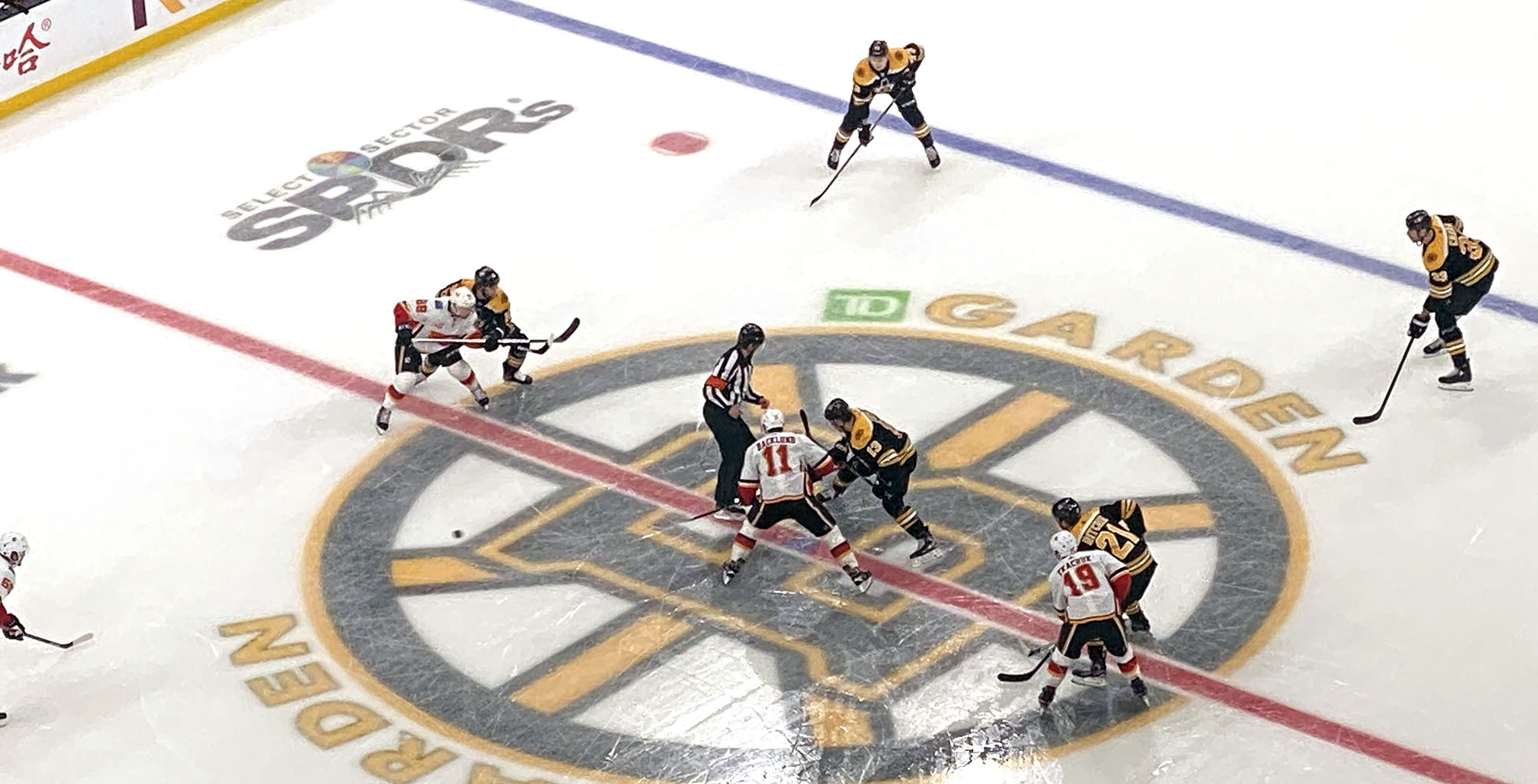
After a pre-game ceremony to honor Jaroslav Halak’s milestone 500 NHL games as a goaltender—complete with the silver hockey stick, the teams got to business. As has happened in many of the Bruins’ games this season, the opposition got on the scoreboard first as Matthew Tkachuk managed to pot Mikael Backlund’s back board rebound past Tuukka Rask at 11:35 of the period. The Bruins had been unable to capitalize of the man advantage when TJ Brodie was sent off for interference at 6:44. Brad Marchand would be sent off for an interference himself at 14:50 which the Boston was able to kill. As the period ended, the Calgary Flames were leading 1-0.
Just as the game reached its halfway point, while Karson Kuhlman was in the box for a slashing penalty, Marchand, assisted by Charlie McAvoy, got the Bruins on the scoresheet and tied the game on a shorthanded goal. Unfortunately for the Bruins Calgary’s Sean Monahan would reclaim the lead for the Flames at 13:25 assisted by Johnny Gaudreau and Michael Stone. Monahan would give the Flames a two-goal lead just 1:12 later, while on the power play, when Matt Grzelcyk was sent off for roughing—responding to what appeared to be his dislike of a hit on McAvoy just before. As the period came to an end, the Bruins were down two goals, had been outshot in the middle frame by one, and seemed to be struggling to find their legs and their momentum.
“I
thought some guys came to play and some guys didn’t. Didn’t break a sweat, some
of them it looked like. I’m sure there was effort, they were trying, they were
just in between, couldn’t execute or whatever. But at the end of the day, it
wasn’t good enough,” said Bruins head coach Bruce Cassidy.
Things didn’t seem to be much better at the start of the third. The Bruins were overpassing—looking for the pretty play rather than going for the dirty plays. However, at 13:09, as the Flames goaltender David Rittich was struggling in the crease, and the traffic in wore sweaters from both teams, Chris Wagner got the Bruins back within one goal. As the clock continued to count down, and the Bruins continued to struggle Coach Cassidy elected to go with four forwards and a defenseman in an effort to jumpstart his team.
Unfortunately,
the Flames felt they could win the game, and Backlund gave the Flames back
their two-goal lead at 18:30 and notched his second of the game (and third
point) when he scored on the empty net at 19:11.
“We
weren’t at our best, for sure. We didn’t have it all the way through the game.
We were a little sleepy, I guess, at times. Not our normal, upbeat, high-energy
game. But that’s going to happen. In an 82-game schedule you’re not going to be
perfect. Unfortunately, we didn’t get this one. But thre’s lots left,” said
Marchand after the game.
The Bruins players know it wasn’t their best effort, and with the
loss, it ended Rask’s home point streak at 20 games—as this was his first regulation
loss. In fact, this was just their third regulation loss at home. And if they
had to lose, fortunately the results of the other games that were played
Tuesday night leave the Bruins in the same position in which they were in
before the game started.
The Bruins have little time to dwell on this game. The schedule
continues. They play host to the Dallas Stars on Thursday night before heading
to New York to take on the Islanders on Saturday.
The Philadelphia Flyers are right in the thick of things in the Metropolitan Division and Eastern Conference Playoff race. The Flyers didn’t make the splashy moves like their Metropolitan Division foes did, but the moves they made at the NHL Trade Deadline will help this team in the long run. The team acquired veteran forwards Nate Thompson and Derek Grant in two separate trades.
Every trade has its pros and cons, but let’s focus on the positives these two players will bring to the Flyers. They were inexpensive options since the team was already up against the salary cap. The forwards bring even more versatility to the Flyers’ lineup. The trade will help an already decent penalty kill be even better, and they won’t block the young kids from being a part of the Flyers in the future.
SALARY CAP LIMITATIONS & YOUNG KIDS
The Flyers didn’t have much cap space going into NHL Trade Deadline Day, so these two trades made perfect sense for the team. Thompson only has a cap hit of $1 million this season, while Grant’s cap hit is only $700,000 for the year. It won’t make too much of dent in the already dwindling cap space.
These two forwards are also unrestricted free agents at the end of the season. If the Flyers decide not to re-sign either one of these players, then it won’t block a youngster like Joel Farabee from making the team out of training camp. The Flyers rookies have contributed when called upon, and with Grant and Thompson possibly being gone after the season, the young kids could still make the roster next season.
VERSATILITY
The Flyers were one of the deeper teams to start the season, but then the news of Nolan Patrick having a migraine disorder was announced by the team. This news hit the center depth of the team hard, as it was figured that Patrick would be the third line center behind Sean Couturier and Kevin Hayes with Scott Laughton being the fourth line center. The trades will be able to keep Claude Giroux on the wing, where he has excelled in the past few seasons.
Thompson will be the Flyers’ new fourth line center replacing Michael Raffl, who did an admiral job filling in, even though he is not a natural center. Grant’s arrival means that depending on matchups the Flyers can slide Laughton to the wing and Grant to center if needed. Morgan Frost can work on his game without the puck while with the Lehigh Valley Phantoms for the rest of the season, which will benefit him in the long run, instead of being up with the Flyers and not playing. The addition of the two forwards means more options at the center position, and throughout the lineup.
IMPROVED PENALTY KILL
The Flyers penalty kill has improved this season. The team was ranked in the bottom third last season, but are now the 12th best team at killing penalties in the NHL. In 62 games, the Flyers are killing off 81.7% of the penalties they take. They have allowed 34 power-play goals against during the 186 times shorthanded while adding seven shorthanded goals. The addition of Kevin Hayes has made this penalty killing squad better this season, and Thompson and Grant have the potential to make it even better.
The addition of these two forwards will mean that Giroux will likely be limited to taking defensive zone draws on the penalty kill and only when needed. Grant and Thompson will be solid options on the penalty kill if one of the Flyers better forward penalty killers is in the penalty box. Grant already has three shorthanded goals on the season, and could potentially add more if he’s used by Alain Vigneault while shorthanded. Thompson can eat up some valuable minutes and take face-offs while a man down.
Traditionally there is the “three-goal lead curse” in hockey. So many teams who have achieved such a lead have eased up the pressure on the competition only to discover that the opposition comes back to not only tie the game but sometimes win it. However, when a team fell behind by five goals the winner of the game was a foregone conclusion. And so, as Craig Patrick put the Oakland Golden Seals up 6-1 at 8:53 of the second period of their game in Oakland against the Boston Bruins, everyone assumed that the Golden Seals would take the win on February 23, 1972.
Perhaps what made the game even more interesting was that earlier
in the day, before the game, the Boston Bruins and the Golden Seals had made a
trade that saw the players involved suiting up for their new teams that night.
The trade saw defenseman Carol Vadnais and forward Don O’Donoghue don the
Spoked-B sweater, while right wing Reggie Leach along with defensemen Rick Smith
and Bob Stewart would enjoy the warm weather in California.
For Vadnais, who had begun his career with the Montreal
Canadiens, he was thrilled to be joining the Bruins organization.
“Why shouldn’t I be happy? Going to the Bruins means the
playoffs. It means the chance to win the Stanley Cup. It means I’ll be able to
learn a little bit more about this game because I’ll be playing with the best,
Mr. Bobby Orr,” Vadnais told the press.
As the game got underway though, it looked more like Oakland
was the all-powerful team.
Before a sell-out crowd of 10,492 at the Oakland-Alameda
County Coliseum Arena, the Golden Seals were well on their way to a win.
Oakland got on the board just 2:51 into the first period from defenseman Dick Redmond, who tallied his sixth goal of the season, with assists from Wayne Carleton and Bert Marshall. Redman put the Golden Seals up 2-0, unassisted at 13:22 of the first before Fred Stanfield got one back for the Bruins at 17:37, assisted by John “Pie” McKenzie, who garnered his 39th apple. However, with just eight seconds remaining in the opening period, Gary Croteau restored the two-goal lead for Oakland.
The second period picked up where the first had ended—with the Golden Seals finding the twine behind Eddie Johnson, who was in his tenth season as netminder for Boston. First Carleton got his 14th of the season at 3:58. Croteau followed that up with his seventh on the year and his second of the game at 7:34. Patrick, who would spend eight years in the NHL before moving on to serve as assistant GM and assistant coach under Herb Brooks for Team USA when they went on their fabled “Miracle on Ice” run to the gold medal in 1980, gave his Golden Seals a five-goal lead at 8:53 of the second. And it looked like all the Oakland team needed to do was play just a bit more smart hockey and then enjoy the win.
Wayne Cashman gave the Bruins their second goal of the game
at 14:36 of the second, assisted by Orr and Mike Walton. With 2:45 left in the
middle stanza, Stanfield, also assisted by Orr, scored his second of the game
and cut Oakland’s lead to three.
As Oakland Tribune sports writer John Porter
described, “The big player trade was yesterday, but the big play trade happened
sometime in the middle of the second period last night. That’s when the Oakland
Seals, who revealed 30 minutes of their best hockey this season, skated aside
and let the Boston Bruins do likewise for the remaining half hour.”
“I told [the Bruins] only that I thought we had a shot at
winning. I told them we started to take over late in the second period and we
could win,” shared head coach Tom Johnson after the game.
Whatever he said, it had the desired effect. The Bruins went
on a scoring tear, not only tying the game up but getting the go-ahead goal and
a spare, all in the third. Yes, they scored five goals in the third period to
take the win.
“The Bruins needed a five-goal third period to win the game—and
the ringleaders in the burst were Bobby Orr, of course, Phil Esposito, of course,
and Freddy Stanfield,” wrote Boston Globe staffer Francis Rosa.
Despite being denied by Golden Seals goalie, Gilles Meloche, when he was awarded the first ever penalty shot taken on a Seals’ goaltender, Stanfield would get his first NHL career hat trick when he put his third goal away, assisted by Orr and Don Awrey at 5:59 of the third. However, before he got his third of the game and 20th on the season, Orr popped his 28th on net assisted by Ed Westfall. For his part, Esposito tallied the tying and game-winning goals—his 53rd and 54th of the season.
Esposito’s game-tying goal was described by the Globe’s Rosa as “a thing of beauty.”
“He had passed to Westfall going over the blue line. The
puck was a little behind Westfall and Eddie pushed it with his skate to get it
on his stick. Then Westfall passed across in front to Esposito at the left
corner of the net. He had to lift the puck to get it past a defender. It was
about a foot off the ice and Esposito directed it in with the blade of his
stick while the puck was in the air,” wrote Rosa.
For good measure, Derek Sanderson—assisted by Westfall and
Orr—gave the Bruins their eighth of the game with just 14 seconds remaining in
the third period.
“It was just brutal. We were checking well, then …,” said Redmond
of his team’s collapse. John Porter of the Oakland Tribune finished that
thought for Redmond. “Then the Seals Kiddie Korps let its inexperience slip
into view.”
With their 8-6 win on the night, the Boston Bruins became
the first team in NHL history to come back from a five-goal deficit and win the
game.
As for Vadnais? While his play wasn’t outstanding in that first game as a Bruin, he would indeed go on to win a Stanley Cup that post season with the Boston Bruins.
Additional Sources:
Francis Rosa, “Seals do quick fade, Bruins decide to play,” Boston Evening Globe (Boston, Massachusetts), Thursday, February 24, 1972, p. 29.
John Porter, “Seals Play Giveaway, 5-Goal Lead Blown” Oakland Tribune (Oakland, California), p. F35, F37
The 1970-71 season was a big one for the Boston University Terriers. That March, they won their first NCAA Division I Men’s Ice Hockey Championship. But first, on February 22, 1971, the Terriers won the Beanpot. This kicked off a trend in which none of the four Beanpot competitors have won the NCAA championship without first winning the Beanpot.
Since 1953, Boston University and its three collegiate rivals – the Boston College Eagles, Harvard University Crimson, and Northeastern University Huskies – have competed in the annual Beanpot tournament. The Terriers, having skated since 1918, have won 30 Beanpot titles, nearly half of the total played. After having only won it once in 1958, from the late 1960s until the end of the 1970s, the Terriers dominated the Beanpot. Going in the 1971 tournament, they had won all but one since 1966. They would go on to five more victories before the end of the decade.
In February 1971, the four teams participated in the 19th Beanpot tournament, held at Boston Garden. On February 8, a crowd of 11,449 watched Boston University crush Northeastern University 12-2 while Harvard then did nearly the same to Boston College with a score of 10-4. The championship and consolation games attracted a capacity crowd of 14,994, considered a record high at the time. The Eagles took third by beating the Huskies 8-2.
For the final, “It was one of those games which kept everyone in his seat all the way.” The Boston Globe reported, “The net tending on both sides was great. BU’s Dan Brady made 27 saves while Harvard’s Bruce Durno made 26. Half of the stops each made were on the terrific side. It was a game that had everything.” The Terriers had enjoyed a nine-game winning streak since Brady started in net. He told the Globe, “There was no more pressure than any other game. I just wanted to win.”
Win they did. The only goal of the first was scored at 6:31 by BU’s Paul Giandomenico with an assist from center Steve Stirling. During the second period, the Terriers successfully killed a long stretch of penalties that left them down two men for at least 2:25. The crowd gave the defenders a standing ovation. Coach Jack Kelley commented, “I have to think back four or five years to when we drew so many penalties. But I was proud the way we killed them.” Of the team in front of him, Brady praised, “It had to be the best penalty killing I’ve ever seen. We must have been down for about seven minutes in a row. I couldn’t believe it. I think that was the turning point in the game. It gave the players a big lift.”
A few minutes after the teams returned to full strength, Harvard scored their only goal of the night to knot the score. Then Captain Stirling came to the rescue with the game-winner in the final fifteen seconds of the period. During the third period, the Terriers pulled ahead with Stirling assisting on the final goal in the 4-1 victory. Stirling said, “It’s sweet. We lost to them when I was a sophomore in the final of the Beanpot and I never forgot it. . . . If we keep this up, we can give anybody a good game.” Naturally, Stirling was named MVP. Kelley noted that he “just had a great game. He’s had a great season and I don’t see how he can miss being an All-American.”
Stirling’s assists added to the three records set during the 1971 Beanpot tournament. Boston University’s 24 assists during the semi-finals set the high for most assists by one team in one game. They also hold the record for most assists by one team during one tournament with 32. Finally, all the teams combined for 72 assists, the most ever for one tournament.
After winning the Beanpot, Kelley pointed out, “I guess it will be hard to move us out of that No. 1 spot now.” He was absolutely correct as BU finished the season at the top of the Eastern College Athletic Conference (ECAC) with a conference record of 18-1-1. Their total season record was 28-2-1.
Although Boston University led the conference, during the semi-finals for the 10th annual ECAC championship, they suffered a shocking upset. On March 12, in essentially a rematch from the Beanpot, this time Harvard prevailed 4-1. The Crimson advanced to the final and their victory there on March 13 automatically entered them in the NCAA Tournament. Instead of sending their opponent from the final (Clarkson), the ECAC Selection Committee chose to send Boston University in light of their amazing record. According to the Globe, “BU entered the tournament top-seeded in the East and ranked No. 1 in the country.”
The NCAA Tournament took place at the War Memorial Auditorium in Syracuse, New York. During the semi-finals, Boston University defeated Denver 4-2. Harvard would lose to Denver 1-0 in the consolation game.
For the championship game on March 20, “The Terriers were flying all night. They forchecked and back checked, made very few mistakes, and pardon the expression, they were beautiful against a tough, never-say-die Minnesota club which gave 100 percent all the way.” Stirling scored twice as the Terriers defeated the Minnesota Gophers 4-2. According to the Globe, Jack Kelley “jumped on the ice at the final buzzer.” He yelled, “How sweet it is!” He then “hugged every player on the club.” With 32 saves, Brady was named the MVP. Stirling would indeed be named First-team All-American. (In fact, Stirling would be inducted into the BU Athletic Hall of Fame in 1984 and the Beanpot Hall of Fame in 2003.)
After 24 seasons, Boston University had finally become National Champions. They were the fifth eastern team to win. They were already predicted to perhaps repeat in 1972 because only three players were graduating. With the NCAA Tournament in Boston that year, the Terriers did indeed become the only eastern team to win back-to-back titles. Having again won the Beanpot and this time taking the ECAC championship as well, the team had won the “triple crown.” Boston University won the Beanpot in each of the five years they won the NCAA championship. Harvard won both in 1989, and Boston College has won both in four seasons.
Additional Sources:
Bob Monahan, “BU tips Harvard, 4-1, for Beanpot,” Boston Globe, 23 Feb. 1971, pp. 23 and 26.
Joe Concannon, “BU penalty killers rate own Beanpot,” Boston Evening Globe, 23 Feb. 1971, pp. 21 and 24.
“Harvard jolts BU; Clarkson wins,” “Little meeting pays Harvard big dividend,” and “BU could make NCAA tourney,” Boston Globe, 13 March 1971, pp. 17-18.
Bob Monahan, “BU beats Minnesota, 4-2, to take college hockey title,” Boston Globe, 21 March 1971, pp. 87-88, 92.
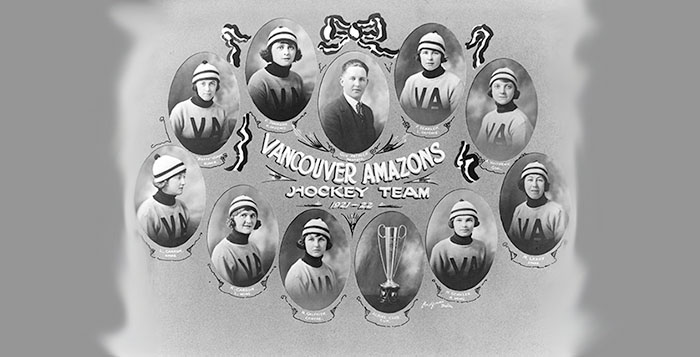
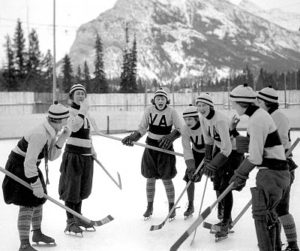
Women have been playing hockey nearly as long as men, but 1921 stands as the most widely acknowledged year for their first international championship series. Between February 21 and March 11, the Vancouver Amazons, Victoria Kewpies, and Seattle Vamps participated in a border-crossing tournament in which each city took turns hosting the other two teams.
The growth of women’s hockey seemed to gain momentum in 1916, almost certainly partly due to the sheer number of men that left to serve their nations during World War I. At the beginning of the year, the famous brothers Frank and Lester Patrick began the process of forming a women’s league to align with their Pacific Coast Hockey Association (PCHA). Naturally then, they planned to have teams in Vancouver, Victoria, Seattle, and Portland. Though the league never got off the mark, apparently the wives of the Seattle Metropolitans tried out a team. That year there may also have been a tournament in Cleveland, Ohio featuring Canadian and American women.
Between 1917 and 1935, Banff, Alberta hosted a women’s tournament and (as of 1921) awarded the Alpine Cup to the champion of the Banff Winter Carnival. Frank Patrick (owner of the PCHA’s Vancouver Millionaires) wanted in on the action, so he sponsored the Vancouver Amazons to compete there. The Amazons made it to the final but lost to the Calgary Regents (as they won their third straight championship). Almost immediately, Patrick organized his own tournament to crown the West Coast women’s champs. Fellow owners in the PCHA quickly established teams in Seattle and Victoria as competitors, and the three squads would play immediately following or even during the intermissions of the PCHA games.
The tournament opened at the Arena in Vancouver on February 21, 1921. According to the Vancouver Province, “The crowd, a large part of whom remained for the fray, was greatly interested in the encounter and continuously shouted its encouragement to the local speedsters.” The two ten-minute periods and a final fifteen-minute period directly followed the Vancouver Millionaires’ 5-1 victory over the Victoria Aristocrats.
Almost echoing their counterparts, the Vancouver Amazons dominated over the “Seattle Sweeties” 5-0. Left wing Kathleen Carson scored the only goal of the first period and then again in the third. Center Nan Griffiths took care of the rest. The local press complimented that Carson “showed some fine shooting ability and together with Miss Griffiths put up some pretty stick handling” and both “showed evidences of careful training in shooting.”
The Province also compared the goalies, “Miss [Amelia] Voitkevic, in goal, was only troubled on a couple of occasions, but was ready for all emergencies. She usually stood with her arms resting on the goal crossbar. On the other end Miss Gravell, the visiting goalie, adopted the proper crouching attitude, but when the puck came near she found difficulty in placing her stick in the course of the rubber.”
All in all, the local newspapers agreed that the Seattle squad was outmatched. The Daily World noted, “The local girls were far too fast for their rivals and outplayed them throughout the game.” Per the Province, “The Seattle girls were sadly lacking in skating ability and seemingly had no idea as to the effectiveness of combination play.” The Sunremarked (somewhat chauvinistically), “Vancouver’s forwards were so superior to those from the Sound City that the visitors had little chance to show just how good they were. They looked all right, but the local Amazons had them beaten even on looks, however, that is getting away from the subject.”
The second game was hosted at Victoria’s Arena on February 25. This was billed as “their first appearances in the new International Ladies’ Hockey League, and it promises to be a game that will drive dull care away.” In anticipation, the Victoria Times remarked, “The ‘Amazons’ are all that their name implies. They are not afraid to go through anything.” However, “The local lassies are in splendid shape and their combination and shooting is exceptionally good.” The Amazons shutout the Victoria Kewpies 4-0. Because the women’s game took place during the PCHA game (which charged admission for a professional competition), all the female players were subsequently suspended by the British Columbia Amateur Athletic Union.
On March 3, Seattle hosted the Victoria Kewpies, who won 1-0 at the end of the final period. The recap merely noted, “They appear to be a faster team than the Vamps.”
Four days later, on March 7, the Kewpies traveled to Vancouver for the first time. Again, Carson and Griffiths were credited as “the most effective of the forwards.” However, this “was a hard struggle as ladies’ matches go, there being no score until well on in the last period. While the play was almost the entire time in the Kewpies’ territory, the visitors’ defense apparently had been well drilled in this department, for they appeared always in the way of the puck, and incidentally were highly successful.” Although the Amazons earned another shutout, it was only 1-0.
Seattle hosted the Amazons on March 9. Miss Betty Hinds (“a former Seattle girl”) scored during the second period as Vancouver snagged a 3-0 shutout and their fourth straight win. The Amazons were officially undefeated and had not been scored on during the entire tournament.
The final game took place March 11 at Victoria. Perhaps as the perfect ending, “last night’s game produced a lot of excitement” with each team scoring just one goal apiece towards the end of the game. Apparently, “The Seattle goalie showed a new style of tending a cage. She laid down on the ice and as the puck came to her she threw it out to wings.” However, her teammates insisted that they had scored an extra goal, and when the referee denied them, they “calmed themselves but they kept on throwing the horrid looks over at the arbitrator.”
When everything was said and done, the Vancouver Amazons were the champions with a 4-0-0 record. The Victoria Kewpies came in second at 1-2-1, and the Seattle Vamps brought up the rear with 0-3-1. Unfortunately, that would be the only season for these two teams. The Amazons, however, went on to win the next Banff Winter Carnival championship and thus the Alpine Cup. That 1922 victory would be the only one for a Vancouver team.
Additional Sources:
“Vancouver ‘Amazons’ Win From Seattle ‘Sweeties,’” Vancouver Sun, 22 Feb. 1921, p. 4.
“Vancouver Lassies Defeated Seattle,” Vancouver Province, 22 Feb. 1921, p. 18.
“Local Girls Defeat Seattle,’” Vancouver Daily World, 22 Feb. 1921, p. 10.
“Vancouver Cinches Place in Hockey Play-Off,” Seattle Star, 22 Feb. 1921, p. 10.
“‘Kewpies’ Ready to Meet the ‘Amazons,’” Victoria Daily Times, 23 Feb. 1921, p. 10.
“Amateur Union to Suspend All Lady Hockey Players,” Victoria Daily Times, 24 Feb. 1921, p. 10.
“Pretty Girl Hockey Stars Are Outside Amateur Pale” and “‘Amazons’ Too Good For Local ‘Kewpies,’” Victoria Daily Times, 26 Feb. 1921, p. 10.
“‘Amazons’ Win from Victoria ‘Kewpies,’” Vancouver Sun, 26 Feb. 1921, p. 4.
“Victoria Kewpies Win,” Vancouver Daily World, 3 March 1921, p. 10.
“‘Victoria Kewpies To Meet Amazons Here on Monday,” Vancouver Sun, 6 March 1921, p. 18.
“Vancouver Amazons Wins Championship,” Vancouver Province, 8 March 1921, p. 18.
“Seattle Clinches Place in P.C.H.A. Playoff,” Vancouver Sun, 10 March 1921, p. 4.
“Vancouver Amazons Secure Fourth Win,” Vancouver Daily World, 10 March 1921, p. 10.
“‘Kewpies’ Finished Up in Second Place,” Victoria Daily Times, 12 March 1921, p. 10.
Wayne Norton, Women on Ice: The Early Years of Women’s Hockey in Western Canada (Ronsdale Press, 2009).
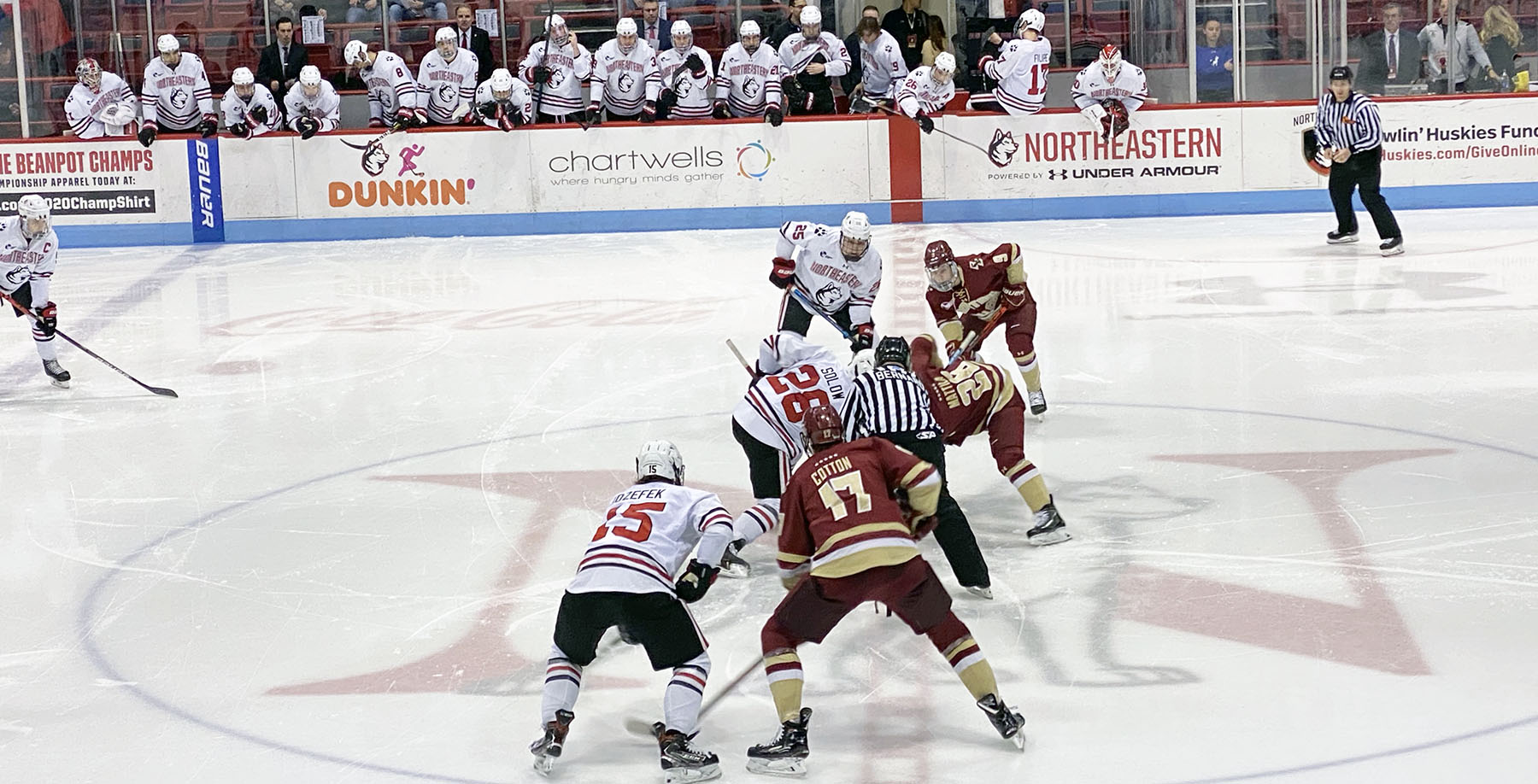
In the first of home-and-home, back-to-back games between the Northeastern University Huskies and the Boston College Eagles, the Huskies played host at historic Matthews Arena. Coming into the game, in the month of February, Northeastern’s men’s hockey team carried a 3-1-1 record and the tie had come in the Beanpot Championship game that actually required double overtime to determine the winner. Likewise, the Eagles also had the same record for the month of February.
The pace of the first period was solid. Even when returned Husky forward Matt Filipe—who had missed a number of games due to injury—notched the first goal of the game on a wraparound, the Eagles did not diminish their attack or speed. Northeastern was able to withstand the Eagles’ power play early in the game when Tyler Spott was sent off for tripping. Unfortunately, the Huskies were unable to convert on either of their two power play chances. The first was the result of BC’s Matt Boldy being whistled for a slashing close to the halfway point of the period. The second was after BC’s Ben Finkelstein was sent off for elbowing at 14:20 of the opener. The Eagles ability to kill off the two penalties undoubtedly gave them some confidence—given how good Northeastern has been on the man advantage. With 1:18 remaining in the period it was looking like the Huskies might get out of the frame leading 1-0, but the Eagles had other ideas. Julius Mattila was able to put a shot on Craig Pantano that trickled through Pantano’s five hole to tie the game up. And the teams went off tied up into the first intermission.
That late goal for the Eagles clearly gave them momentum. They came out in the second period and had their play at an entirely different level. It took the Huskies four minutes to get their first shot on Spencer Knight in the middle frame. Meanwhile Pantano was seeing a shooting gallery at his end—seeing seven shots in those first 4 minutes.
“Yeah, we weren’t at the net enough, so I mean, we didn’t play “Big Boy hockey” and we weren’t at the net enough. And when we did go to the net, we had some opportunities as you saw but we weren’t at the net nearly enough and we weren’t heavy enough down low. And I’m hoping that’s a wakeup call to our guys because if we don’t play better tomorrow, you know, we’re not going to get the result we want and we’re in a playoff push here,” said Northeastern’s head coach Jim Madigan.
By the end of the period Pantano had faced 18 shots, letting in two. Marshall Warren got his fifth of the season at 10:45 and about six minutes later Julius Mattila added his second of the game. At 15:23 it looked like the Huskies might get the opportunity to tie things back up as they were on a power play when Zach Walker went off for boarding the just returned Filipe. However, ten seconds later Grant Jozefek was sent off for slashing and it was while the teams were four-on-four that Julius Mattila and Logan Hutsko had the odd man rush that gave the Eagles their third goal of the game. At 18:54, Zach Solow for NU was sent off for an interference while Aapeli Rasanen earned an embellishment. As the clock stalled at 2.9 seconds and the referees decided the last play had run out the clock, the Huskies were fortunate not to have been down by more than two goals having managed just six shots on the Eagles’ netminder in the middle twenty and Pantano’s skill keeping quite a few pucks out.
The third period began with the carryover penalties to Solow and Rasanen for the first 55 seconds. And the Huskies of the first period made a reappearance. After the end of the four-on-four carryover, there was a lot of north and south skating with speed. The Huskies kept the Eagles at bay, making better defensive decisions as well as having more effective offensive zone time. Biagio Lerario was able to get the Huskies one back at 6:47 of the third, assisted by Jordan Harris—from the blue line—and Jeremie Bucheler. Bucheler also played a stronger, grittier game in the third—taking the body when he couldn’t get the puck. But in the end, it was too little, too late. Though the Huskies outshot the Eagles 11-6 in the final period, Knight denied them all and Northeastern just couldn’t get the tying goal to send it to overtime.
“Boston College was a better team than us here tonight and they’re a real good club. They skate well, they’re very good in transition, they play the game fast, they’re well balanced from the goaltender out, and you know they had us on the [ropes] particularly in that second period. Yeah, we did some good things in the first period, some in the third but our effort wasn’t good enough for 60 minutes to beat that hockey club. They’re a very good team and for whatever reason we just didn’t have a full 60-minute effort, credit Boston College for some of that. But, you know, we’re going to play against the real good teams and that’s a very good team. We’re gonna have to have a better effort and we gotta…, I didn’t see the conviction enough in their eyes going into tonight’s game that we could beat this team. And so that’s disappointing with their inconsistent effort and not playing to the way we need to play, and just playing simple hockey and, you know, when you don’t do that you fall you fall behind and we were chasing the game the third period and, you know, got it, the 3-2 but wasn’t good enough and they were the better team,” said Coach Madigan after the game.



 Prev
Prev