Neuvrith played in 32 games last season for the Buffalo Sabres and the New York Islanders. He was 7-20-4 with a 2.98 goals against average and a .914 save percentage. He didn’t record a shutout and gave up 92 goals. The numbers may not look great for the goalie, but he did play a majority of his games with the Sabres, who really struggled last season. He was traded to the Islanders in midseason, but didn’t get much playing time while there.
He is a butterfly goalie with fast reflexes who seems to be calm and patient while in net. Neuvirth has some agility and can recoup fast from making a save. He could stand to be a little more consistent in his game, and that could be part of the reason he’s never reached the level of being a starter. Neuvrith can also let in some soft goals. In the Flyers first preseason game, the goalie let one squeeze through his arm for a goal, though that could be a result of rust. He has also had the misfortunate to play on some teams that aren’t the strongest in their own zone.
He has playoff experience and the capability to come in cold off the bench. Neuvirth has a quick glove, but he has been known to give up some big rebounds. He can’t handle the puck or move the puck as well as Steve Mason, however, Neuvirth is an upgrade over Ray Emery and Rob Zepp from last season, and he is only 27 years old.
The biggest concern for the Flyers has to be if Steve Mason can stay healthy for the season. Mason missed some time last season due to a knee injury. In his first preseason action, Mason looked good. The question remains though: does the knee hold up throughout the season or does it force him to miss some time again?
The goalie has been good since coming over in a trade with the Columbus Blue Jackets. Mason has played in 119 games, has a record of 55-38-18 to go along with a 2.65 goals against average and a .923 save percentage. Mason also has seven shutouts with the Flyers. In the 2014-15 season, he was 18-18-11 with a 2.25 goals against average, .928 save percentage and had three shutouts.
The record doesn’t look great, but the Flyers defense was terrible last season. Mason only allowed three or more goals 18 times last season. He kept the Flyers in most games by making great save after great save. During one game, he held the Islanders scoreless throughout regulation and overtime, where he made 46 saves, only to lose the game in the shootout.
Mason has been up and down throughout his career. He won the Calder Trophy, which is awarded to the best rookie in the NHL, during his first season with the Blue Jackets. He eventually lost his starting job after struggling the next three seasons in Columbus. He can handle the puck, which is a big help to his defensemen and on the power play where he can make the breakout pass. He has good size but is also quick.
He has big-game makeup and seems to always be square to the shooter, with decent vision and and the ability to track the puck through traffic. There are times during the game when he may have a lapse in focus. He needs to be more consistent for a full 60 minutes and game-to-game too. If he lets up a bad goal then he needs to be able to forget about it and not lose focus.
If the Flyers plan to get back to the postseason, then the goalies will need to be great again this season since the defense is still mediocre.
The hardest part about preseason games is that the fans want a win. While the players on the ice also want that win, for the coaching staff and management it is about watching the individual players and who brings what to the game. What are the strengths and weaknesses of each player chosen for that particular game? Will a player’s lack of finish result in his being released from training camp?
Chris Kelly
Such are the things that are examined during these preseason games. Add in the lack of chemistry and perhaps problems with on-ice communication between line members and it can be a frustrating event for the fans, but an education for the players as well as the coaching staff and management.
“I think it was just kind of getting your legs under you. And for a lot of guys in the room it’s their first preseason game, NHL experience, game,” said forward Chris Kelly after the Bruins beat the Washington Capitals in overtime on Tuesday. “And for a lot of us; I think everyone, it’s their first game in four or five months. So there is a bit of an adjustment. It doesn’t matter how often you skate in the summer, it’s nothing like being part of the physical contact in play for something.”
Watching the Boston Bruins play in their first two preseason games was in some ways like watching a bit of chaos. Missed communications, a few more blown edges than one sees during the regular season and a lot of turnovers are all part of getting back into the competitive side of hockey. And, as Kelly said, game situations cannot truly be simulated in practice or during summer skates.
“[Preseason games are] huge. You don’t want to practice every day. You want to get in those games and that’s where it really counts,” defenseman Matt Irwin shared. “So we had two days of practice, we got our first game. You know pretty much everyone’s been in a game, so far. So you’ve got that first one under your belt and you just hope to get better and better as it goes on.”
Kevan Miller
For the injured Kevan Miller, who missed the last 26 games of the 2014-15 season as a result of a shoulder injury that required surgery, getting that first game in was all the more important.
“Definitely, just to get my game back. You know, it’s been like over seven months since I’ve had a game and it was really exciting to get back into it [Tuesday night],” Miller responded. “I’m definitely using this preseason to get my legs underneath me, make sure everything is up to par or better and I wanted to come in and have a good camp and get ready for the season.”
For someone like defenseman Chris Casto, who has spent the last three years playing with the Providence Bruins, he recognized Tuesday’s game for what it was.
“I think as a first game it was a little bit sloppy but I think everybody noticed that,” he said. “But I mean, first game in however … four months, or whatever it is, a pretty good effort I thought.”
Lines are still being decided upon by the coaching staff and management is still making decisions on who to keep and who to release. Chemistry for newer lines is still progressing. And for the Bruins this season, changes have been made to their system.
“Um, I think when you change anything it’s gonna affect everybody,” Miller explained. “But that’s part of the game. You’re gonna evolve from year to year based on what the coaches deem is necessary to change. So I think with everybody it’s gonna affect a little bit, but we’re all ready and able.”
Preseason games are also a time for the players themselves to evaluate where they are in their game and what they feel still needs improvement.
“There’s still some stuff I don’t want to do, some mistakes I’m going to lose the puck,” David Pastrnak said after Tuesday’s game in which he scored both goals. “I want to be stronger on the puck and that’s probably the biggest thing. You know, have a good [decision] about if I am going to chip it or hold it, and that kind of details. And I’m going to try to improve that every game.”
“I’m not sure I can say anything besides make the team, you know?” Casto said. “There’s no concrete numbers that I want to hit or anything like that. Just continue my development as a player and fit into this team.”
The Bruins will continue their preseason games with a tilt against the New York Rangers Thursday night. And like earlier games, there are players in the chosen lineup who are there for evaluation. Everyone of those players wants to get the win for the team, but right now the focus is on evaluation of strengths, chemistry, flexibility and more.
On Wednesday morning, it was announced that Boston Bruins veteran defenseman Dennis Seidenberg would undergo a lumbar microdiscectomy on Thursday, September 24 to repair a lumbar spine disc herniation. Seidenberg is expected to be out for eight weeks assuming that all goes well.
This isn’t the first time that Seidenberg has experienced an injury that has sidelined him for a considerable time, though it was clear that he was eagerly waiting for camp. However, just before camp was to start it was announced that he was dealing with an off-season injury and would not be on ice at the beginning of camp with the others. As was discovered though, it turned out to be more serious than originally expected.
After the announcement, General Manager Don Sweeney met with media to answer questions on the situation.
“Well it’s definitely a setback first and foremost from Dennis’ standpoint. You know he’s worked hard. He came back from an ACL last year and has a setback,” Sweeney said. “It’s obviously an opportunity for the other guys we were evaluating anyway, amongst our D core, and we’ll go from there.”
Obviously management had high expectations for Seidenberg this season. Most people tend to forget how long it truly takes to fully recover from ACL surgery. Seidenberg is such a determined athlete that he was ahead of schedule, but despite his resolve and insane work ethic, the level of play that is necessary as a hockey player really does require the player to be in full health. So for Seidenberg, this season would have been that moment.
Adam McQuaid
A teammate of Seidenberg’s who has recently experienced physical setbacks in consecutive years, is fellow defenseman Adam McQuaid.
“Yeah, him and I had a good chat. I’ve been through similar situations. I think every one with this game, a lot of guys, go through that and it is unfortunate, but it is what it is,” McQuaid shared. “At this point for him, he just has to focus on healing and getting better and then taking it step-by-step and when he comes back he’ll be better than ever. So you have to take as many positives as you can, when you’re dealt with situations like that and you just move forward.”
As Sweeney mentioned, because of the delay in Seidenberg being able to play, it opens at least a temporary position for perhaps one of the players currently showing his stuff in camp. And while players don’t like to see a teammate get hurt, they need to grasp such an opportunity.
For Torey Krug, it was injuries to Seidenberg and Andrew Ference in 2013 that saw his chance to show what he could do. And this current situation should be a learning experience for the younger players in camp.
Torey Krug
“Well to realize that at any given moment that opportunity’s going to be there and you have to make sure that you got out and take advantage of it,” Krug said after practice.
It sounds insensitive, to be sure, but hockey is a business and it is unfortunate, but true, that many such opportunities for other players come at the injury of a current roster member.
“I thought I was going to be in Providence the rest of the [2012-13] season and go through a playoff run there with a very good team. And all of a sudden I got the call that I’m gonna be playing, you know, against the New York Rangers in the Stanley Cup Playoffs,” continued Krug. “Just like that it changes. So, I think for the young guys just realize to always be prepared and be willing to accept an opportunity but to not just take it, to absolutely go out there and earn it and to work through it and make sure you take advantage of it”
A hockey team is one of the most interesting interactive groups to study. In many ways they truly are a family, even during training camp with veterans offering help to the rookies. However, there is also extreme competition between these players as they vie for the limited open spots on the roster. For the time being in Boston, there is one more spot than originally expected.
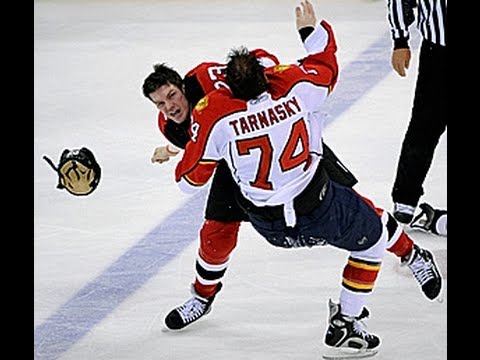
The sticks drop. The gloves are shaken off onto the ice. Two players square off. The crowd stands and roars. It’s a fight!
C’mon! We’ve all been there. If you’re a hockey fan, there is something intrinsically satisfying about a fight. Two players, sometimes more, physically battle to take atonement for wrongs inflicted – real or perceived. The old cliché, “I went to a fight and a
hockey game broke out,” didn’t come out of nowhere. We asked for it. Maybe not in our words, but definitely in our actions. We feel
The Fight – a fan favorite at hockey games
them fighting for our justice. Like Romans in the Coliseum we’ve come to see spilled blood and these gladiators of the ice do our bidding. It’s like a hot ember is smoldering inside us that no one lit, it’s just always been there waiting for the fuel to make it burst into hot flames. I say this because I have witnessed it in my own children.
I have taken my kids to professional hockey games since they were young. My now 24-year-old son and 20-year-old daughter love hockey for the game and the competition. They watch the moves, the plays and they want their team to win. My 18-year-old daughter, on the other hand, well let’s just call her “Bloody Mary.” Oh, she watches the game as intently as her older siblings, but she’s not waiting for the next great play. I don’t think she really cares if our team wins. Any game where there is little to no fighting is a loss in her opinion. At one game last year there was a bench-clearing brawl. My youngest was furious. She had opted to stay home that night.
The point of all this is that we have come to expect the fights no less than power plays and penalties. They are a form of entertainment that enhances the overall game experience; but at what cost? Do we forget that the fights are fought by real people, who feel real pain, and suffer real injuries?
On Saturday, September 19, Todd Ewen, a veteran of 518 NHL games in the 80’s and 90’s committed suicide at the age of 49. During his 11-year career, which included stints with St. Louis, Montreal, and Anaheim, Ewen played the role that is commonly referred to in hockey as an “enforcer,” a “goon.” He racked up over 1,900 penalty minutes and had 150 or more fighting majors in his career. His role, like the role of all enforcers, was to deal out punishment to opposing players that had wronged a member of his team. His job required him to beat and be beaten, to bloody and be bloodied, and to take it all without a whimper game after game. No doubt the repeated blows to the head and the countless concussions suffered led to the depression that he battled for years and that finally took his life.
Todd Ewen is not the first to meet this fate among enforcers; in fact he is only the most recent.
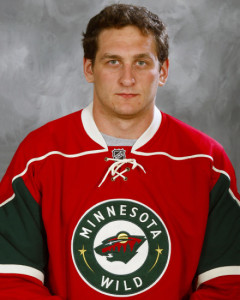
Derek Boogaard
In the Spring and Summer of 2011, 3 young hockey enforcers met similar fates. The first, in May of that year, was 28-year-old Derek Boogaard. The “Boogeyman,” as he was called, was an enforcer for the New York Rangers and the Minnesota Wild before that. Found dead in his apartment in Minneapolis, his cause of death was a fatal mixture of Oxycodone and alcohol. Boogaard was a highly feared enforcer in the NHL. At 6-foot-7 and 260+ pounds he was a big man who could take a lot of punishment and deal out even more. Continually in pain from the multiple injuries he had suffered over the years, he became addicted to alcohol and pain killers and eventually went through the NHL’s addiction treatment program for players. By the time he was traded to the New York Rangers, however, it was obvious that he was already slowing down and that he was suffering the effects of repeated blows to the head and concussions. His sobriety didn’t last, and in the end his self-medicating caught up with him.
In August of that same year, 27-year-old Rick Rypien was found dead by his own hand at his home in Crowsnest Pass, Alberta, Canada. Rypien had played parts of the previous six seasons with the Vancouver Canucks and had signed a new contract to play for Winnipeg in the upcoming season. Despite what appeared to be new opportunity in his career, Rypien suffered from depression, something many attributed to repeated concussions, and ultimately took his life.
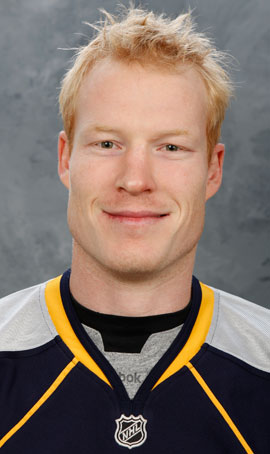
Not even three weeks after the death of Rick Rypien, Wade Belak took his own life at the age of 35. A 6-foot-5, 225 pound enforcer,
Wade Belak
Belak had played for Colorado, Calgary, Toronto, Florida, and Nashville in a career that spanned from 1996-2011. To all outward appearances, Wade was a happy guy with things looking on the up-and-up. He was scheduled to appear on the Canadian reality show “Battle of the Blades,” and he was looking forward to starting a career in broadcasting. Again, it appeared that years of head trauma caused by fighting may have led to the depression that claimed Wade Belak.
Now I will be the first to tell you that I am not advocating the banning of fighting in hockey. It is not only part of the game and its history, but I can’t see how the NHL or any of the other leagues can ban actions that are often spontaneous and arise out of competitive, aggressive play, and adrenaline. I am simply wondering if the era of the “goon” needs to come to an end. There will always be fights for those very reasons I stated before, but is it necessary to have fights that are targeted attacks on particular players? Fights that are pre-meditated or encouraged before an incident ever arises that send the gloves to the ice? Look at the devastating effect that Todd Bertuzzi’s hit had on the career of Steve Moore.
Concussions will continue to happen. All the best technology in the world will never be able to eliminate it completely from the game. Bad hits happen. Players go head first into the boards. Players run into each other or fall to the ice with great force. What of those concussions – the repeated concussions, however – that some players suffer through the accepted use of an enforcer? Perhaps we could curtail those. Yes, I enjoy the fights, but I love the game more than any fight it might offer. The idea that talented young men work so hard to reach the NHL and then suffer such traumatic injury that their lives can be shortened doesn’t seem a reasonable expectation of me, the fan, to ask.
Just since 2002, several active or retired, but young, players have died either by their own hand or by medical conditions that lead you to wonder if there is something more going on. They all had a history of being enforcers or having those tendencies. Terrence Tootoo, Roman Lyashenko, Trevor Ettinger, Bob Probert, Tom Cavanaugh, Wade Belak, Derek Boogaard, Rick Rypien, Steve Montador, and Todd Ewen. That seems like an extraordinarily high number of deaths for our sport.
Hockey is the sport we love. Hockey players are competitive “entertainers” who give us – the fans – what we want. Perhaps we should just be a little more thoughtful about what we ask for.
On Sunday evening, the Boston Bruins took to the ice in their first preseason game. They took on the New Jersey Devils at the Dunkin Donuts Center in Providence, Rhode Island—home to the AHL Providence Bruins. So for some of those picked to play in that first game, it was a homecoming of sorts, as they played there during the previous season. For one new acquisition—through the trade of Milan Lucic to the LA Kings—it was a familiar arena, but a different bench.
Colin Millter
“Yeah, it was a little weird being on the other bench,” Colin Miller said. “But definitely happy to be on that side.”
And Miller’s approach to the hip check got the crowd cheering when he landed a solid one on a Devils player, putting him down to the ice. No doubt the fans hope to see more of that from Miller, but there is a down side to it.
“It’s fun if it works. I mean, if you miss him you are kind of in trouble,” Miller laughed. “So, no, I just tried to get him there and it worked out for me.”
Miller is vying for a spot on the roster, but he is up against a number of qualified defensemen who also covet one of the few spots available in Boston.
The game on Sunday started out with the Devils in control, but as the Bruins began to gel, the game took a decidedly chippy turn, with lots of scrums taking place after the whistle, including the final whistle.
“With New Jersey, they always like to set up scrums and hopefully to antagonize me to, not just me, the other guys on the ice too, to get that extra punch in or extra stupidity play that we don’t need,” said Zac Rinaldo on Tuesday. “We stayed out of all that [stuff] and we did a really good job.”
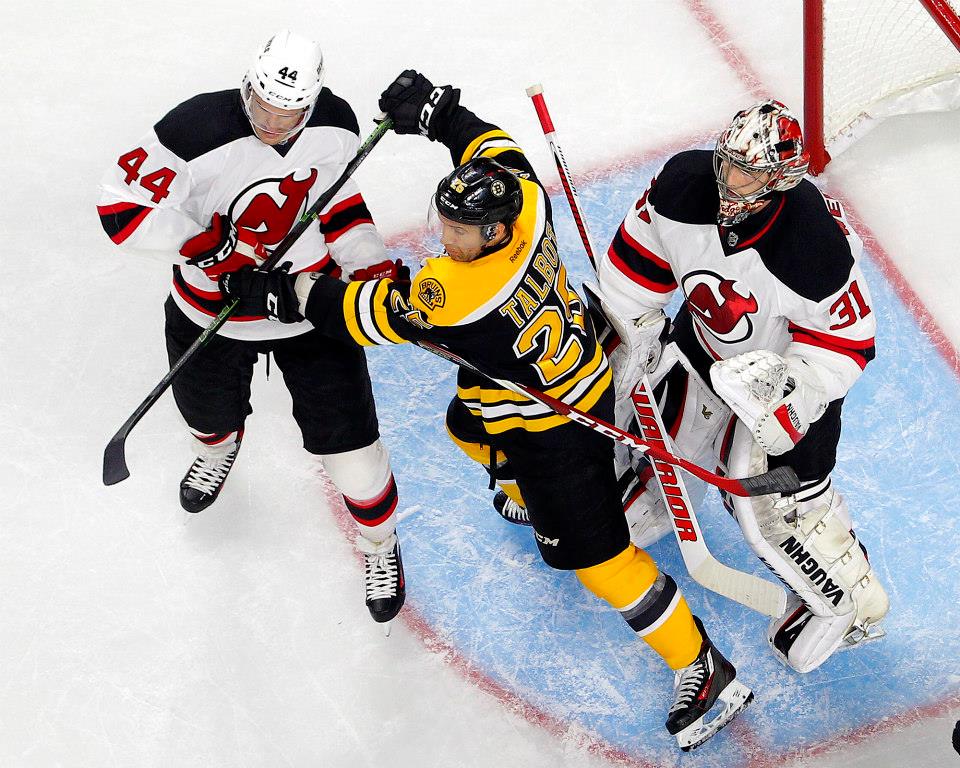
After practice on Tuesday, Rinaldo fielded a variety of questions from the media about his history with Max Talbot on the Philadelphia Flyers and his play.
“I kept it smart. There were so many scrums and I stayed out of all the scrums. It’s a mature factor,” he said. “Scrumming for me is… even the the refs said during that game, ‘If you guys are gonna scrum, you might as well fight.’ So I mean, scrumming is kinda a pain in the [butt] for me. It’s just annoying for me so I really stayed out of the scrums.”
However, when it came to his speed, he used that to move the puck, but also to draw penalties. He assured the media that he’s not someone who fakes an injury or dives, instead his style of play often forces the other team to slash, hook, or hold him in an attempt to slow him down.
“I think I drew two good penalties and we capitalized on one to give that extra push with the go ahead goal there,” Rinaldo shared. “I think me utilizing my speed, [forcing] them to take penalties is what I took out of that game.”
Despite a slow start in the first, and being outshot throughout the entire game, the Bruins were able to come out with the win notching two goals, both by Matt Irwin. And the tandem goalies Jeremy Smith and Jonas Gustavsson walked away with a shutout.
Unfortunately, in addition to the many positives that came out of the game, there was a major negative in the injury to forward Seth Griffith. It was announced on Monday afternoon that Griffith will miss three to four weeks with a MCL sprain in his left knee. The injury occurred in the third period of the game against the Devils in what looked like a knee-on-knee hit.
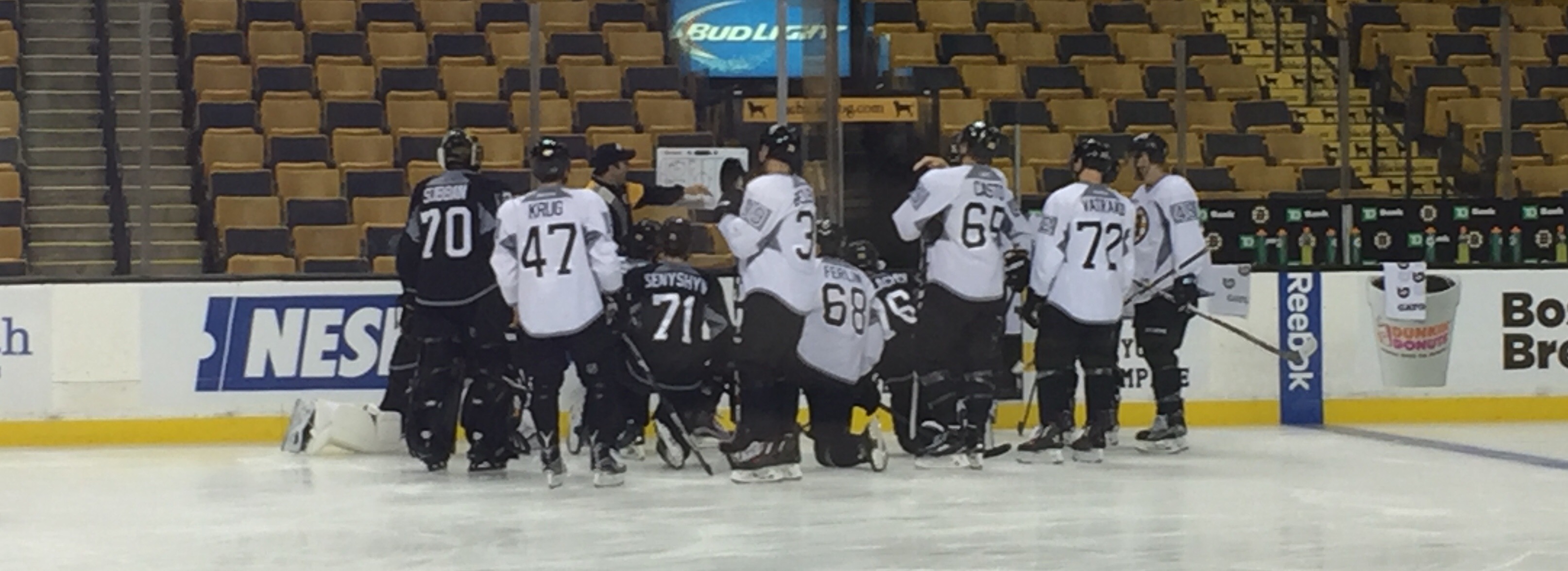
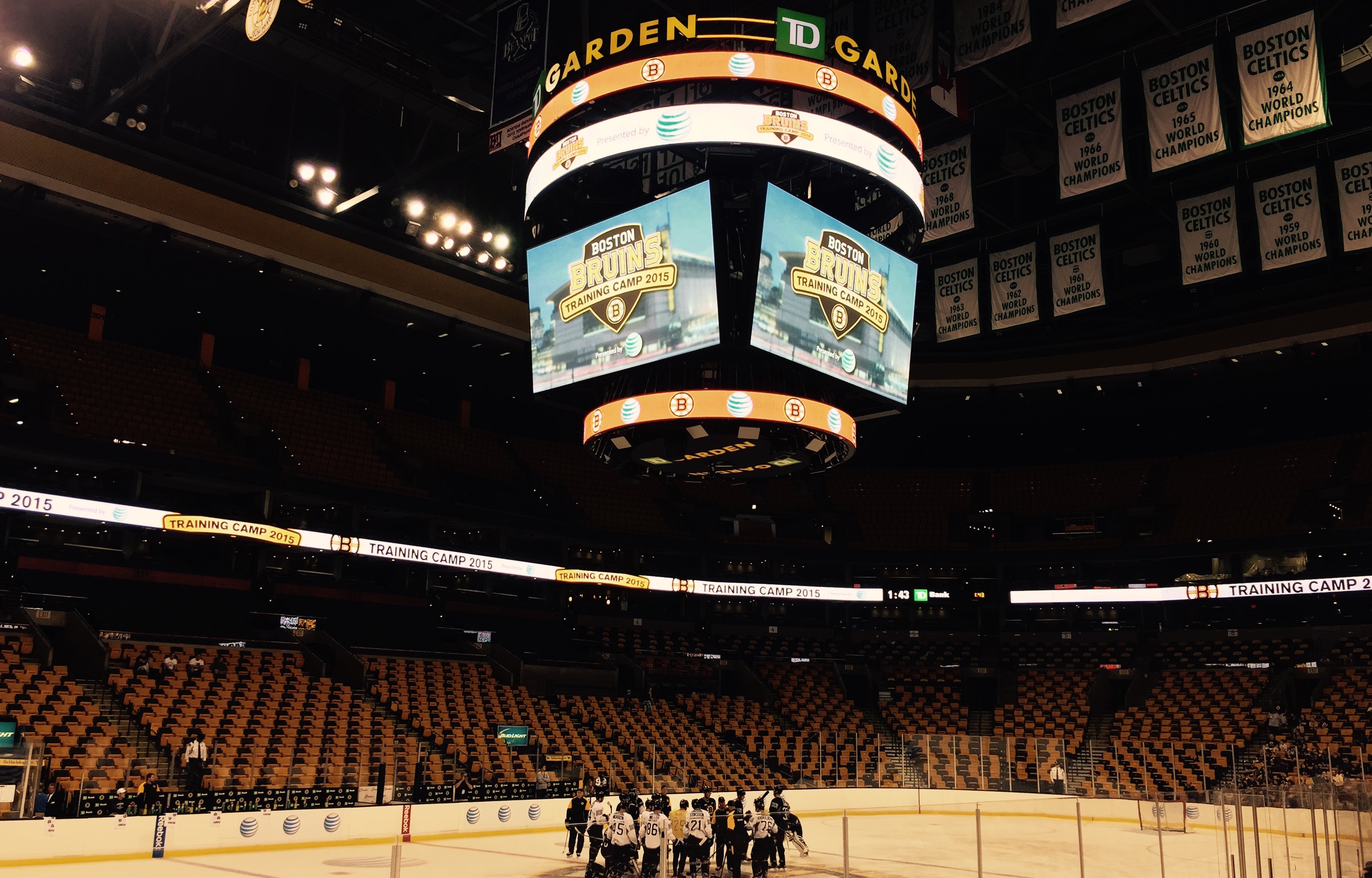
The Bruins will be on the Garden ice tonight for their second preseason game, this time against the Washington Capitals, which will include a 3-on-3 overtime regardless of the final score in regulation. All of the teams will be practicing the new overtime format during the preseason, so that when the regular season gets underway everyone has had equal experience with it in a competition atmosphere.
The third day of camp in Boston was a busy one with three practice sessions followed by travel to Providence where those who took part in the first practice played a preseason game against the New Jersey Devils at the Dunkin Donuts Center. For some of those who took part in the preseason game, it was like going home, as the Dunkin Donuts Center is the home arena for the Providence Bruins, the AHL affiliate for the Boston Bruins.
However, perhaps a little more interest during the morning practices came as a result of the line combinations in the second group to take the ice; or perhaps more specifically the addition of David Pastrnak to the line with Patrice Bergeron and Brad Marchand.
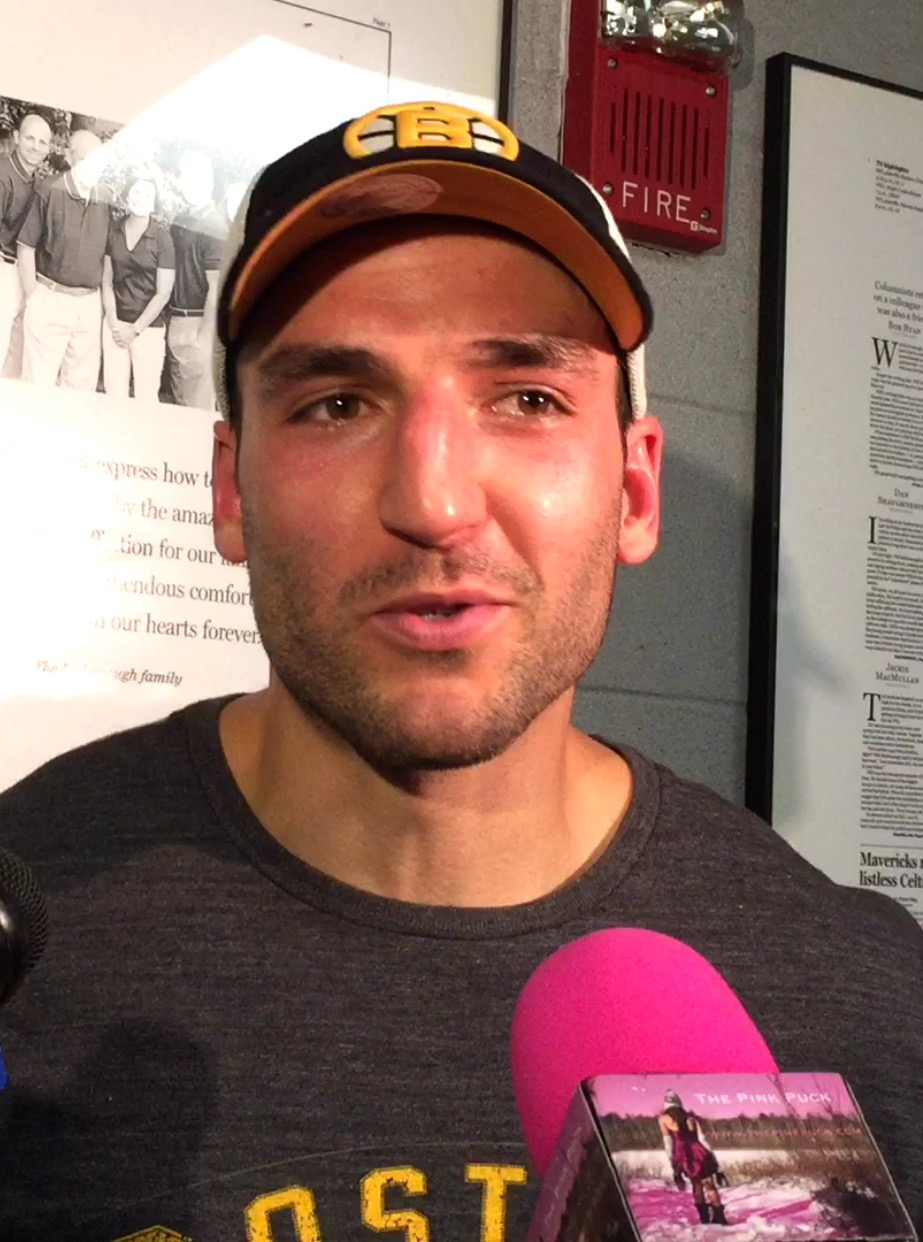
Before anyone gets too carried away, it was only the third day of camp and there will be a lot more tinkering with the lines between now and when the puck drops on the Bruins home opener on October 8. With that being said, it was interesting watching Pastrnak with Bergeron and Marchand. And it was enlightening to hear Bergeron speaking about Pastrnak after that practice session.
“[Pastrnak’s] got great speed and tremendous offensive instincts so he’s definitely a great player,” Bergeron told the media surrounding him. “You know, it’s nice to have him and try and establish some chemistry with him. And we’ll see what happens.”
The 19-year-old, who surprised the Bruins management last season with his ability to earn a spot with the Boston club in his draft year, exudes an absolute joy when he is on the ice. His attitude when playing is one that belies his youth.
For part of the previous season, Pastrnak spent some time in Providence working on things that the Bruins felt he needed to improve upon. While some players take such a directive in a negative way, Pastrnak embraced the opportunity. Providence Bruins’ head coach, Bruce Cassidy, commented one time that even if Pastrnak was being chastised for something, he was just always smiling while out on the ice. And he has returned for his second season to try and retain his spot with the Boston club bringing the same positive attitude.
David Pastrnak
“He’s so, uh, just happy to be here. He wants to learn. He talks to everyone and brings the energy you want in a young guy,” described Bergeron. “I think he’s got also some leadership qualities that he’s gonna develop over time but I think he’s a tremendous young man and a great player.”
There is no denying that Pastrnak has speed and skill. Sometimes such an advanced skill-set in one so young can play mind games with the player; their belief that they can’t be told anything because they already know it all. Pastrnak is the exact opposite.
“He listens. He wants to learn. He also likes to have fun and have a good laugh,” Bergeron shared. “So, you know, he’s a great teammate and you can tell he’s already beyond his years with the way that he approaches the game, but also the way that he plays and the sky’s the limit for him.”
To some, his enthusiasm to be on the ice as much as possible calls to mind a younger version of Bergeron himself, who made the Bruins roster the fall after he was drafted. In fact, with the exception of the lockout-cancelled 2004-05 season—when Bergeron played with the Providence Bruins—and the lockout-shortened 2012-13 season—when he played with HC Lugano—Bergeron has only played for one NHL team.
Could Pastrnak do the same? He certainly is in the proper frame of mind with his eagerness to learn and his joy in the game. Bergeron called his attitude “infectious.”
So, what was it that had Bergeron smirking during the media’s questions?
When he talked of Pastrnak’s attitude and how he was behaving on the ice, in the rink and in the locker room, I asked him what Pastrnak’s example did for “the other young players who are coming in?”
Ever the professional, Bergeron responded earnestly, but he couldn’t help having a little fun at my expense.
Patrice Bergeron
“Yeah, I think that they realize that’s how they have to handle themselves. And that’s how he made the team last year; by working hard, going down to Providence and not getting down on himself and working his way back in,” he responded. “So that’s the only way you can approach the game and he’s doing the right thing.”
But then Bergeron’s face began to stretch into a little smirk.
“I don’t know if you should call them ‘the young kids’ because he’s probably younger than most of them,” he grinned. “But I think everyone, I guess the rookies, can look up to him for that matter.”
And perhaps in the end that speaks volumes to the maturity that Pastrnak exudes on the ice, if his tender age can so easily be overshadowed. Perhaps other young players should look at his commitment, enthusiasm and positive attitude and take a page from Pastrnak’s book.
As for me, I will undoubtedly forget again how young Pastrnak really is and hopefully the next Bruins player to remind me will be as nice about it as Bergeron was.
The Boston Bruins didn’t make the playoffs for the first time in nine years this past season, and it left a bitter taste in everyone’s mouth and saw the firing of General Manager Peter Chiarelli and the hiring of Don Sweeney as his replacement. Over the summer, especially the day the NHL Entry Draft began, Sweeney pulled the trigger on some trades that had Boston faithful screaming for his head on a platter.
Today was the second on-ice day of training camp and the 59-man camp, which includes seven goalies, is currently being split into three groups. Camp means competition for spots and this year is no exception. In fact, with players like Dougie Hamilton and Milan Lucic gone, there are a couple of slots that are not usually open. Additionally, there is a clear change in the structure the team is embracing, going with a breakout system.
In some ways this offers a slightly more even playing field to those new to the team, since in some regards everyone has to get used to certain new aspects on how they will play as 5-man units during full strength. It is also probable that the power play and the penalty kill will be tweaked as well.
The Bruins have often been accused of being a slow skating team, and there are a number of players at camp who could certainly change that. However there still needs to be a delicate balance between those speed and skill players and the good strong defenders.
“We have got to be careful here because you may get those guys that have better foot speed but they may not be able to do the speed on the other side of the puck. So… our offensive game has really improved but you know we’re scoring more goals but we’re giving up more, you know, we’re still in the same spot that were before,” head coach Claude Julien said after the third group finished on the ice Saturday. “We talked about the Zdeno Charas and the [Adam] McQuaids and those guys—they defend well. But you also need guys like Torey Krug to be in our lineup and you know we’d like to be able to find that right balance.”
Matt Irwin
And perhaps this is where Matt Irwin can make his mark. The defenseman, who played last season with the San Jose Sharks, was signed to a one-year deal in July. And one of his strengths could be just what the Bruins are looking for.
“I think they want the D-men jumping up in the rush, being that option to create some offense. That being said, we gotta take care of our own zone,” Irwin told media Saturday after practice. “My strength’s a good first pass out of the zone. Get it in the forward’s hands. Let them do their job. Get pucks through from the point. Create first, second, and third opportunities at the net.”
Irwin has also caught the eye of Coach Julien—as much as anyone can with so many players currently being observed.
“I think he has to definitely earn his spot like everybody else.,” Julien explained. “But you know the reason we did sign him is he’s got some experience so you know being here is one thing—being in the top six is another.”
Irwin seems to understand his role and it certainly sounds like it could be a strong fit with the breakout system that the Bruins are expected to employ this season. If his execution is as good as his vision, then it is very possible that he will earn that slot.
Julien did express the fact that they will need to start whittling down the list of campers sooner than later, and it is possible that cuts could come as early as Monday. With a pre-season game taking place at the Dunkin’ Donuts Center in Providence on Sunday night against the New Jersey Devils, for those who play it could be their only opportunity to show what they can bring before those first cuts are made.
This past Tuesday, September 15, the NHL and Adidas made an official statement that they would be entering into a seven-year partnership beginning with the 2017-18 season. This will make Adidas the official provider of the uniforms and licensed apparel for the National Hockey League.
Now this change is not as dramatic as it may seem. Reebok, the official provider since 2005, is a division of Adidas. For the past five years however, Reebok has been moving more aggressively into the fitness market and away from sports apparel.
One concern that this change has brought to the forefront is whether or not NHL jerseys will soon be sporting advertising. NHL Commissioner Gary Bettman says no. Bettman states, “The fact of the matter is we are not currently considering putting advertising on NHL jerseys.” Whew! For now anyway; but let’s not miss the word “currently” that was woven into that statement
There is no doubt that there is money to be made by adding advertising to jerseys. Does adding yet another revenue stream for the team owners justify altering the last true vestige of the game however; the player’s uniform? For me, the answer is a resounding no. Here’s my opinion why.
In collegiate, as well as major league sports, corporate influence has grown to enormous proportions. This is not necessarily a bad thing. The revenue supports the teams, helps with the building of bigger and better arenas, and ultimately helps the communities that house the teams. Yet at the same time, how much is too much? When does the event move from being a competitive challenge, a clash of wills and skills, a fan event, to just being one long, drawn out commercial.
When attending a hockey game, look around. Every inch of the boards within the rink is advertising for pizza, insurance companies, and auto dealerships. The backs of the tickets often have ads and coupons. The intermission entertainment between periods is sponsored. The giveaways are sponsored. Promotions supplied by local companies fall from the rafters or are handed out at the door as you enter. The in-arena announcers have their various plugs they have to throw in for someone with the money to make it happen. Even the arenas bear the names of the top dollar provider: the Air Canada Centre, Honda Center, United Center, and on and on. What has happened to just watching the game? That’s why we go, isn’t it?
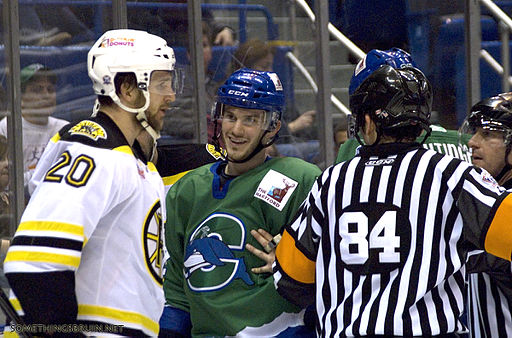
I attend a lot of AHL games. In the AHL, advertising is allowed on the jerseys. It is not uncommon to see Cintas or Amway patches on the upper chests of the jerseys.
An example of the advertising on the helmets and jerseys in the AHL.
There just seems to be something tacky about it. It reminds me of the sponsor patches on my little league uniform when I was 10.
I want to see the jerseys of the NHL stay pristine. It’s just one small thing to ask isn’t it? I want to see the Winged Wheel, the Maple Leaf, the Blackhawk, and the Star. I want to see a big C for the Captain and a proud name and number displayed on the back. That’s all. I don’t want Jonathan Toews or Pavel Datsyuk to skate past me only to think, “Hey, I need to grab some Slim Jims at the grocery store.” This is their uniform, the colors they wear into battle. Let’s make sure we preserve this one little piece, just for us, just for the game.
The Flyers have a new head coach which means a new system will be in place. There will be a lot of different looks to the blueline during preseason. Dave Hakstol needs to see who develops chemistry, and who is left in the dust. It will be interesting to see the final defensive pairings, and if they stay the same if the team gets off to another slow start to the season.
The Flyers defensive corps as a whole is mediocre, at best. Everyone of the defensemen have something to prove, even if it just means having a bounce back season like Andrew MacDonald. MacDonald was out with injuries last season and was benched at times too. In 58 games played last season, he registered two goals, 10 assists, 12 points and was a minus five. MacDonald needs to limit his turnovers and be in better position in the defensive zone.
Mark Streit is one of the leaders on the defense, but needs to prove that he can still play at a high level at 37 years old. He can put up points in the offensive zone and is a leader on the blueline. Michael Del Zotto needs to prove that he can play a smart, defensive game. He will also put up some points in the offesive zone. Del Zotto needs to not try to do too much with the puck because that’s where he can get into trouble. Del Zotto also needs to remember to join the rush and not to lead the rush because he tends to be out of position when leading the rush.
Luke Schenn needs to prove that he can be a consistent, everyday defenseman. He never backs away from a hit and will block shots. He needs to shoot the puck more and be more aware of his position in his own zone. Nick Schultz signed a new two year contract last season. He plays a decent defensive game, but lacks physicality. He also won’t put up a ton of points in the offensive zone.
Yevgeni Medvedev was signed as a free agent in the offseason. He has spent the last twelve season playing over in Russia, including the last seven playing in the KHL. He may be 33 years old, but this is his first professional season in North America. Medvedev needs to prove that he can adapt to the North American style of play. The biggest concern is how quickly he can adapt to playing on the smaller ice surface.
Radko Gudas had knee surgery to end his season early last year. He hasn’t played in a NHL game since December 29, 2014. Gudas needs to prove that he is healthy and ready to play. If healthy, he adds a physical presence to the blueline. He is also in a contract year and is set to become a restricted free agent at the end of the season.
Brandon Manning has spent most of his career playing in the AHL. He has potential, but needs to show in the preseason that he deserves ice time. The biggest question is does he even crack the roster, or do one of the prospects beat him out?
If a Flyers defensive prospect wants to make the roster this season then he will have to have an unforgettable training camp and preseason. The camp and preseason will have to leave a memorable image in the minds of the coach and general manager, Ron Hextall. Hextall has said that he doesn’t want to rush the young kids into the lineup, but if one of them proves to make an impact then he’ll have to think long and hard about it. The prospects include Sam Morin, Shayne Gostisbehere, Travis Sanheim, Robert Hagg and Ivan Provorov.
The Flyers have a lot of money locked up in the blueline for the next two years, but if the prospects develop the way they should, then look out.
In Game Four of the 2010 Stanley Cup Final, the Bruins‘ Brad Marchand chirped Patrick Kane‘s lack of scoring. After Chicago took the lead, Kane was quick to approach Marchand with the jab “you shoulda kept your mouth shut.”
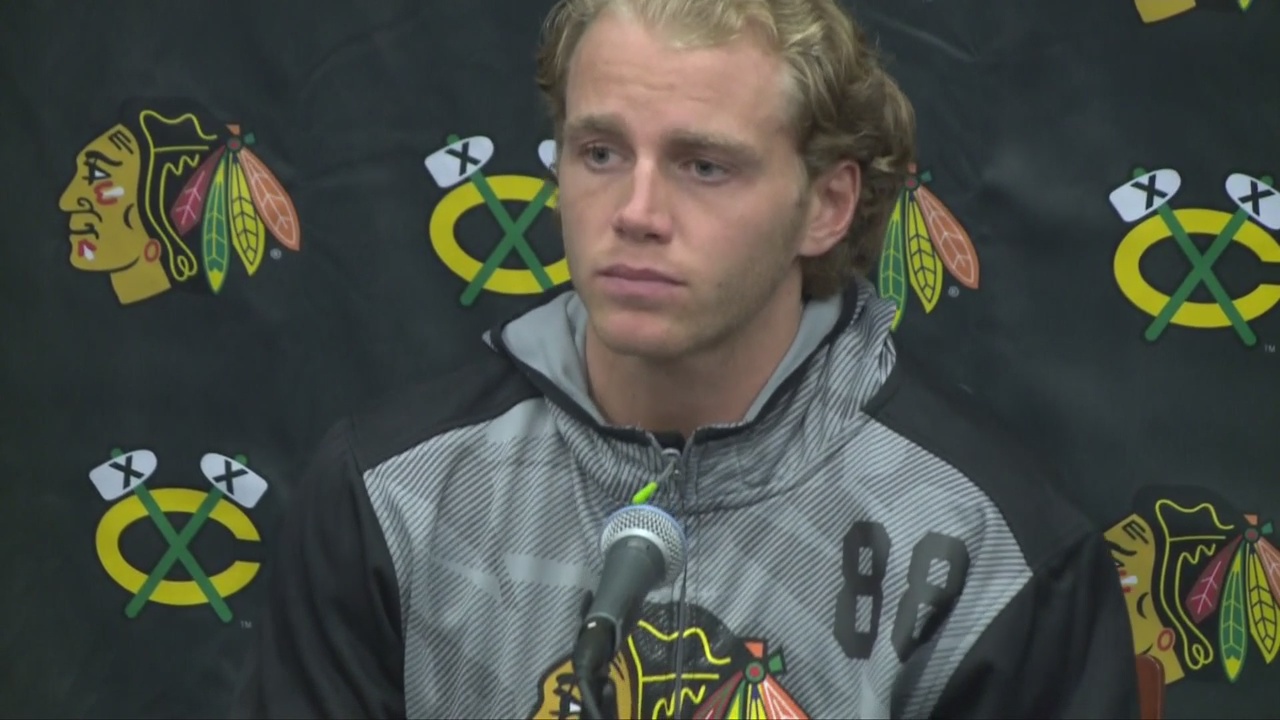
There, looking timid and awkward–hardly the showboating machine seen on ice–Kane tried to give a statement from a sheet of paper. He apologized and proclaimed his innocence.
“This has been an incredibly difficult time for many people,” he said.
“I cannot apologize enough for the distraction this has caused my family, my teammates, this incredible organization and, of course, our fans.
“While I have too much respect for the legal process to comment on an ongoing matter, I am confident that once all the facts are brought to light, I will be absolved, having done nothing wrong.”
He then proceeded to thank reporters for their questions, but to decline answering anything related to the sexual assault allegations, instead focusing on hockey.
Kane voiced his excitement to be back with the team.
“We view ourselves as a family,” he said. “It’s always nice to have that support.”
He then talked freely about returning to camp, which seemed to detract from the seriousness of the allegations in Buffalo.
President and CEO of the Blackhawks John McDonough said the decision to bring Kane to camp did not come lightly–that the team worked closely with Kane’s attorneys before including him on the roster.
“The Chicago Blackhawks organization prides itself in trying to make calculated and deliberate decisions based on information we have at the present time,” he said. “We recognize that Patrick Kane is dealing with a very serious situation.”
He did not specify as to whether the team had spoken with law enforcement or the accuser’s attorneys before making the decision.
“This hasn’t been an easy situation for any of us to deal with,” he said. “It’s been a challenging summer.”
He said it had been a weight on the entire organization.
“Furthermore, we have the utmost respect for the legal process and will have no further comment on this issue at this time.”
Then he, Kane, General Manager Stan Bowman, and Coach Joel Quenneville respectfully dodged all questions about the rape investigation, Kane’s behavior, and anything not directly hockey related.
Captain Jonathan Toews was asked if Kane apologized to his teammates and whether he supported the winger, but continued what he called a “broken record,” saying “there will be a time we can answer those questions, not now.”
Everyone said very little. But to many fans, they gave a pretty strong message. They’re standing by their man despite the ugliest of allegations–potentially alienating a large portion of their fanbase: women.
Now, the only facts we have in this case came more than a month ago, when Hamburg Police Chief Gregory G. Wickett said the police department was investigating an incident that allegedly occurred at Kane’s house the weekend of Aug 1-2. At that point, they were gathering information and awaiting forensic testing results.
Since then, the Eerie County District Attorney’s office has convened, and then postponed, a grand jury. Everything else has come from anonymous sources–but allegedly a woman went to the hospital for a rape kit following an attack at Kane’s house, spurring the continuing investigation.
So, Kane has not been charged. His innocence is legally presumed, of course. But just as he is presumed innocent, it is important to also presume honesty from the woman who may have been sexually assaulted. And parading him into a press conference was insulting.
I don’t know if Patrick Kane is guilty or innocent. I know there’s an ongoing legal matter. That was embarrassing for Chicago, and the NHL. — Bruce Arthur (@bruce_arthur) September 17, 2015
Aside from the derogatory things said about the alleged victim by hockey “fans” on social media and the long, drawn out investigation, her well-being has not been publicly addressed. And, for many female fans, that is ominous territory.
Today, the Blackhawks and the NHL reminded us that they don’t yet think violence against women is serious, or worth their attention.
The Hawks & NHL welcome our money, but they’re not interested in treating us as full citizens of Hockeyville. We’re women. We’re the other. — Lynne Elizabeth (@lynneelizabeth) September 17, 2015
Hockey belongs to anyone, & everyone, who loves it. That means it belongs to female fans too. We are strong, we are many, & we’re not done. — Lynne Elizabeth (@lynneelizabeth) September 17, 2015
Being a Blackhawks fan has felt like a fairly safe place for years now. We went from being alone in empty sections to on top of the world with millions of others. As female fans reached the 30 percentile, the leadership answered calls for change. But this decision seemed to be in direct contrast–and it wasn’t just the Hawks supporting Kane’s return.
CBA gives NHL sweeping powers to suspend a player, even without charges. But this comes from dep. commish Bill Daly: pic.twitter.com/O0nBYLkAHj — Mark Lazerus (@MarkLazerus) September 17, 2015
As for my thoughts, well, I haven’t been able to unpack a box or wear a Stanley celly tee since the news broke in August. The 2015 parade was my last moment of joy. Now, I wonder about the entire league.
I’m not saying Kane is a rapist. He hasn’t even been charged. I can’t emphasize that enough.
But I refuse to call the woman a liar, either. Again, not enough emphasis here.
So, no, going back to someone’s home after bar closing time is not consent to sex.)
I believe everyone–from the alleged victim to Kane to their families to teammates, friends, and fans–everyone deserves to let this run the proper legal course. And, yes, I know the legal course is imperfect, but at least it’s something.
I hold no ill will toward his teammates for supporting him. They really do spend more time together than with blood relatives, and if he believes he is innocent, then they likely have no reason to doubt him.
I also know how difficult the legal process is for victims and can only imagine how much harder it would be in such a high-profile situation.
So, the Blackhawks and the league should have known better.
They should have let the legal process run its course–regardless of whether they have some magical insider information cementing his innocence–before putting him back on the ice. I also fervently believe he needs help off the ice and that, should he truly be absolved of wrongdoing, must be a condition of his return to play. Actually, he should pursue help regardless.




 Prev
Prev