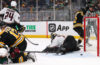
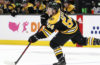
Some people are givers – like Ray Bourque offering up a record-setting 19 shots. Others are takers – like goalie Ron Tugnutt denying all but one of them as he faced a total of 73 shots on net. In the battle between Bourque’s Boston Bruins and Tugnutt’s Quebec Nordiques on March 21, 1991, the giver and taker tied 3-3.
Tugnutt began his career with the Quebec Nordiques, and after they relocated, Bourque ended his with the same franchise, then the Colorado Avalanche. The defenseman was the elder by seven years and was drafted by the Bruins in 1979. At the 1986 draft, the goalie joined the Nordiques. Both of them were still playing for their original team when they met for the epic give-take in 1991.
Boston Garden had a sellout crowd of 14,448 that night. The Nordiques scored a goal a period, and each one gave them the lead. They only needed 26 shots to score thrice as Boston goalie Reggie Lemelin “let in a couple of softies.” Meanwhile, the Bruins sent shot after shot after shot but were only able to tie up the score each time. The game went into overtime, but no one broke the tie.
The captain led the way, setting his record 19 shots on goal. To this day, the closest anyone else has come is 16. Bourque said afterwards, “And I thought at least six of them were going in.” He did have an assist just 15 seconds into the second period and then gave the Bruins a point by tying the game at 10:36 of the third. He had made good on his 14th shot on net.
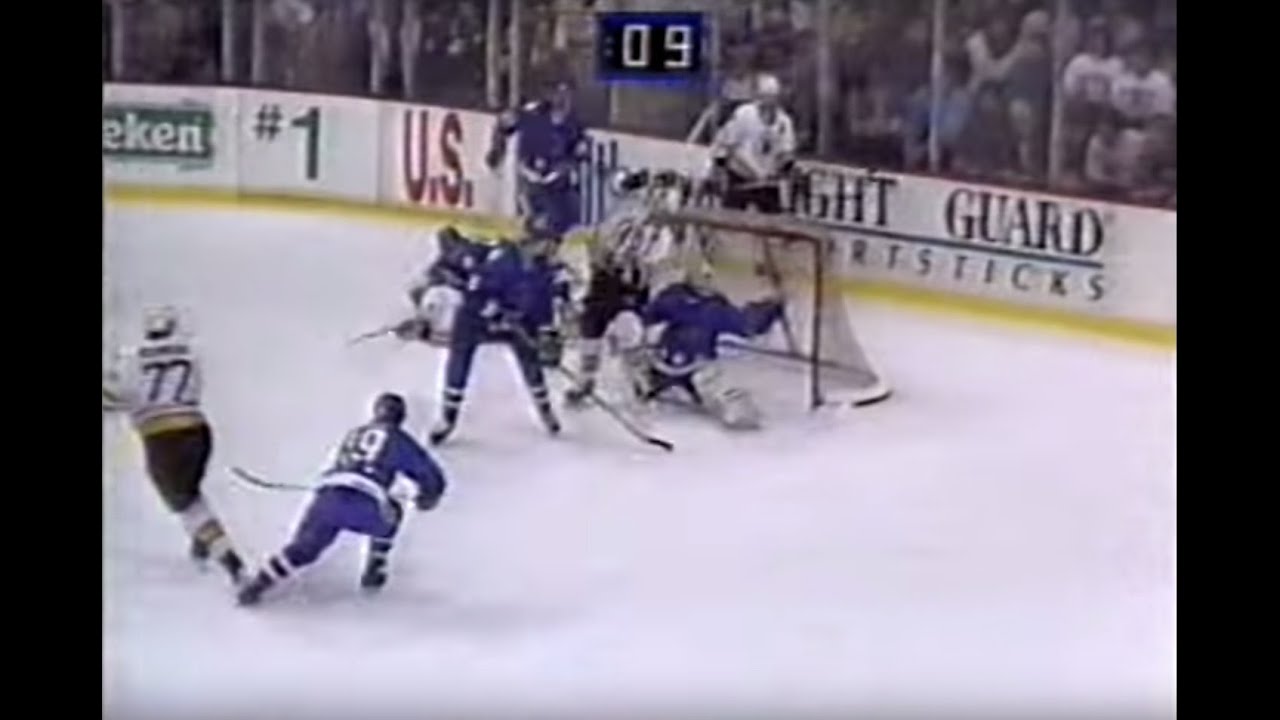
Unfortunately for Bourque, with eight seconds remaining in overtime Tugnutt denied him the game-winner. “I couldn’t believe it,” remarked the incredulous captain. “On that last one, I saw all net, nothing but net, and I thought, ‘No way he’s gonna get this.’ I shot it as hard as I could, with a guy in front of him, and he still caught it.” Tugnutt responded, “I didn’t even see it. I just stuck my glove out. I anticipated he’d go glove side and that’s where he went. I’m glad he’s such an accurate shooter.” He then joked that he made that final save because, “I was too tired to get up.”
Bourque wasn’t the only Bruin shooting his heart out. All but one (John Carter) of his teammates also sent at least one at Tugnutt. After 61 shots in regulation and a whopping 12 in overtime (thought to be a regular-season record), the Bruins racked up a total of 73. As Bourque put it, “We had 70 shots, and I bet something like 30-35 of those were good, quality shots. I’m telling you, it was scary.”
The 73 shots came ten short of the NHL record set by the Bruins in 1941, and it was one more than the 72 shot by the Bruins in 1970. That made Tugnutt the man of the hour as he blocked so many of them, earning a .959 save percentage. Boston’s Cam Neely (who had four shots himself) was impressed. “Some of the greatest shots you’ll see on net, and he stopped them all. It was wild.” Tugnutt reflected, “It was one of those nights when I saw the puck well. I couldn’t tell you how many times I stopped shots through a screen, but it was a lot. But I also gave up some rebounds, and that’s also why the shot total was so high.”
It got to the point where the Bruins just had to laugh. As their coach, Mike Milbury explained, “There was amusement because he was playing so well. You get this tendency where you’re thinking the goal is coming, it’s just around the corner. Then it doesn’t come. Then it’s just laughter and amazement, and you just shake your head incredulously.” From Tugnutt’s point of view, he had to tell himself, “Don’t look or you’ll start laughing, too, and lose your concentration.”
When the end finally came, Neely told Tugnutt to take a bow. The exhausted goaltender commented, “I’ve never been in a situation where an opposing player said to take a bow in another team’s building. It was nice to be congratulated by the Boston players.” One of those who told him “Good game” was his worthy foe, Bourque.
Somewhat lost in the excitement over the high number of shots on net was an acknowledgment of Guy Lafleur’s final game at Boston Garden. He planned to retire at the end of the season, so with 2:05 remaining, the fans gave him a standing ovation. Bourque commented, “You have to appreciate a guy who played in the NHL the way he did. He was the best player in the world for about a half-dozen years. I think the fans showed a lot of class to show their appreciation for him in his last occasion here. I know he was one of my idols when he was in his prime.” The Bruins all “saluted him by simultaneously banging their sticks against the boards near game’s end.”
After that game, Tugnutt played for Quebec one more year and then went through seven NHL teams (and a season in the AHL) before retiring in 2004. That was the same year that Bourque was inducted into the Hockey Hall of Fame. He had remained with the Bruins for all but the final season of his career. In 2000, he asked to be traded to the Colorado Avalanche, and they hoisted the Stanley Cup at the end of the season.
Additional Sources:
Kevin Paul Dupont, “Tugnutt stops 70; Bruins tie,” Boston Globe, 22 March 1991, pp. 29 and 33.
Marvin Pave, “He had saving grace,” Boston Globe, 22 March 1991, p. 32.
Kevin Paul Dupont, “Lafleur’s farewell,” Boston Globe, 22 March 1991, p. 32.
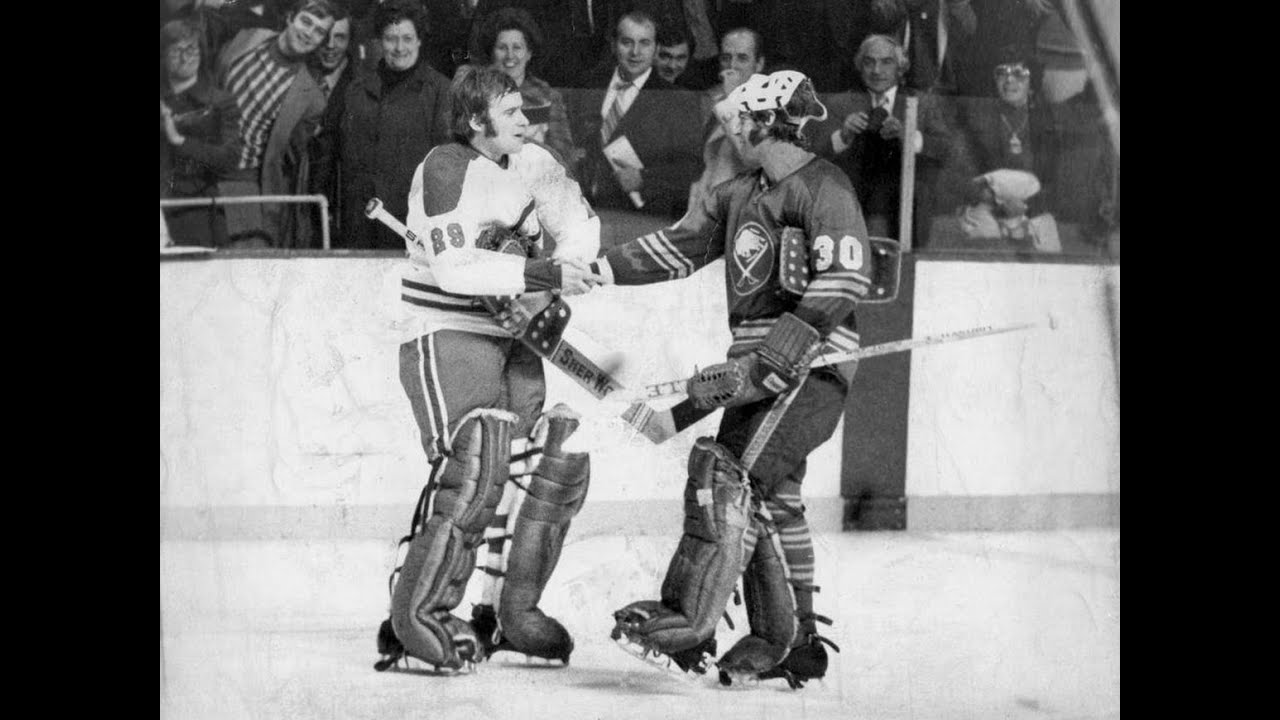
The Dryden brothers, Dave and Ken, skated together in their Ontario backyard, but with six years between them, these goalies never really played together or opposed each other in the same league at the same time. That changed when Ken received the Montreal Canadiens’ call up to the NHL in March 1971. Thanks to the maneuvers of Dave’s coach of the Buffalo Sabres, Punch Imlach, on March 20, the two became the only brothers to ever face each other in goal at the NHL level.
Although one might assume that Ken followed in his older brother’s footsteps, the two actually followed quite a different path to and from the NHL. Dave was born September 5, 1941, so Ken was a month shy of six years younger when he was born August 8, 1947. Quite appropriately, Dave wore No. 1 while Ken had No. 29. Dave explained, “We never played against each other. There are six years’ difference in our ages, and I was always coaching him when we were kids.”
Around the time that Ken was drafted (14th overall) by the Boston Bruins and immediately traded to the Canadiens in 1964, Dave spent three seasons with the Galt Hornets of the Ontario Hockey Association Senior A League. Rather than joined the Canadiens right away, Ken tended the net at Cornell University. He graduated in 1969, when he represented Canada at the World Ice Hockey Championships at Stockholm. Meanwhile, Dave spent this time in the NHL as a goaltender for the Chicago Black Hawks.
For the 1970-71 season, 29-year-old Dave moved on to the Buffalo Sabres while 23-year-old Ken made his debut in the AHL with the Montreal Voyageurs. Ken’s chance to join Dave in the NHL came that March when he led Montreal to victories over Pittsburgh on March 14 and over Toronto on March 18. His third NHL game would be against his brother’s Sabres.
The Montreal Forum hosted the matchup, and Murray Dryden was in the crowd of 17,553 to support his sons. Coach Imlach intended to give these fans the thrill of a Dryden brother matchup, but Canadiens coach Al MacNeil chose to forgo the circus. As Imlach said, “I thought starting the brothers right off the bat would be a helluva deal for the crowd, but MacNeil didn’t want to give the fans a run for their money until he had to.”
Thus, Dave started in net for the Sabres, but Rogie Vachon opposed him from the Canadiens’ net. That being the case, Imlach swapped Dave out for Joe Daley just two minutes into the game.
In the second period, the Canadiens were winning 2-0 when Vachon was hit “where it hurts most” as he blocked a shot. MacNeil was forced to put Ken in at 13:07, so Imlach immediately sent Dave back on the ice. Less than 30 seconds later, Dave missed on the first shot he faced. Ken commiserated, “I knew Dave wanted to play well, and, after all, we were ahead by a couple of goals. I might have felt different if it was a Stanley Cup game.” With just 21 seconds remaining in the period, Imlach inexplicably pulled Dave, and the Canadiens nearly scored again.
Although the brothers had been taking “turns at making big saves,” nearing the halfway mark of the third period Ken let two pass him within 40 seconds. Then Dave allowed another goal before being pulled with 2:17 remaining. Imlach justified, “I’ll pull my goalie any time I feel like it.” Montreal took advantage by topping the night off with an empty-netter.
When all was said and done, Dave had blocked 12 of the 14 shots he faced for a save percentage of .857. Ken had the better save percentage, .905, after making 19 saves on 21 shots. “I was just family-proud my brother was at the other end of the rink,” commented Dave. The fans appreciated seeing them in opposition but then shaking hands at the end. Not taking credit for his brother’s success, Dave said, “He has done it all by himself, and it looks like he’s going to be a good one.”
The proud big brother was absolutely correct. Ken had six wins in his six NHL games that regular season and went on to surprise everyone by leading the Canadiens to the Stanley Cup during playoffs. He earned himself the Conn Smythe Trophy as playoffs MVP. The following season, he became the first to win the Calder Trophy as best rookie after having won the Conn Smythe. While playing for the Canadiens during the 1970s, he earned the Vezina Trophy five times and the Stanley Cup championship five more times.
Meanwhile, Dave switched to the WHA in 1974 and finished out the 1970s with the Edmonton Oilers. He made his return to the NHL (for a final season) when the leagues merged in 1979. He held the franchise’s WHA record for most wins (94) and most games played (197).
Additional Sources:
Mike Commito, Hockey 365: Daily Stories from the Ice (Toronto: Dundurn, 2018), kindle edition.
Pat Curran, “P.T. Imlach turns another dry game into Dryden,” Montreal Gazette, 22 March 1971, p. 15.
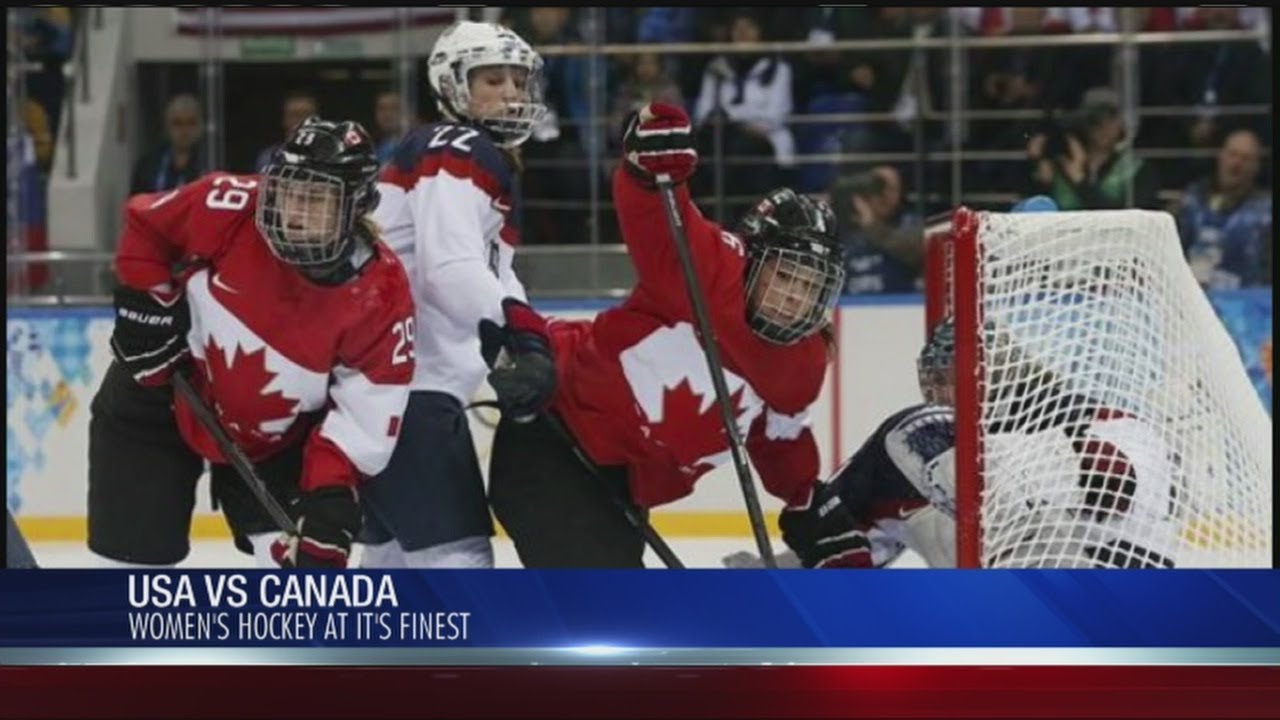
Eight years before women’s ice hockey became an Olympic sport, in 1990 the International Ice Hockey Federation (IIHF) sanctioned its first Women’s World Hockey Championship. The tournament, held at Ottawa, began March 19, 1990 and ended a week later on March 25. The first female world champion was the home team, Canada. Their main rivals (to this day), Team USA, took silver, and Finland finished with bronze.
The foundation for the 1990 tournament was laid in the late 1980s. In 1987, a Women’s World Championship was held at Toronto, but the IIHF did not recognize it as official. Two years later, the 1989 European championship was held in West Germany. Of the ten participating nations, the top five teams qualified to compete at World’s. First-place Finland, second-place Sweden, third-place West Germany, Norway, and Switzerland all qualified but had to cover their own expenses. Meanwhile, the two North American teams and Japan automatically received berths in the eight-team tournament. Individual players had to be over 18 (or 16 with a medical waiver) and be residents and citizens of their team’s nation.
Ottawa hosted this inaugural IIHF women’s international tournament. The tournament naturally attracted international attention, and television broadcasts on TSN and RDS brought in about a million more viewers. Though the initial attendance figures caused concern, the finale drew the largest crowd ever seen at a women’s hockey game. For Team Canada’s first game on Monday, March 19, the Civic Centre hosted an audience of 3,578, with about a third of them there thanks to free promotional tickets. Tournament director Pat Reid worried, “Financially we’re going to be in trouble unless we have a big weekend.” By their final game on March 25, the crowd had reached 8,784, prompting Canadian defenseman Dawn McGuire to exclaim, “This is such a breakthrough for women’s hockey. Who could have believed there would be 9,000 fans here cheering us on?”
Thanks to the increase in numbers, Reid remarked, “We won’t have to talk about pink uniforms anymore to get people out to see women’s hockey.” The Canadian Amateur Hockey Association had outfitted Team Canada in pink sweaters and socks. It caused a “pink craze” in Ottawa, like for pink foods and flowers.
Four games took place on opening day, the “dawn of the women’s world hockey championships.” In Pool A, West Germany and Japan made history by playing in the first official women’s world championship game. Shortly after 1 pm, they saluted each other with raised sticks from the blue lines at Barbara Ann Scott Arena. Only 150 spectators saw West Germany win 4-1. Although they won, German defenseman Sandra Kinze said, “I thought it was not so good. We can play much better. The ice is smaller than we are used to, and we were all a little nervous. We were making history.”
Then Canada crushed Sweden 15-1. Swedish goalie Agneta Nilsson faced 62 shots. “They’re big, they skate very fast and their shots come when you don’t expect them,” she explained. “I thought they’d be less good, thinking we are an easy team to beat.” By comparison, Canadian goalie Cathy Phillips only faced three shots. Her teammate Angela James scored four goals but reminded the public, “Remember, 6,000 girls in Ontario alone play hockey and this team was chosen from across the country. In Sweden, there’s 600 players, all in one league. This tournament is a stepping stone for all the countries.”
In Pool B, the United States easily toppled Switzerland with a 16-3 victory. The Ottawa Citizen reported it looked likely they would see “a Canada-U.S. final on Sunday.” Finally, Finland defeated Norway 10-1.
After three more dates of games, the top two teams from each pool advanced to the semifinals while the rest played consolation rounds. On March 24, Team USA beat Sweden 10-3 and Team Canada squeaked out a 6-5 victory over Finland.
The tournament ended on March 25. That morning at the Civic Centre, Finland took bronze over Sweden with a 6-3 win. The grand finale was indeed a matchup between Canada and the U.S. The latter was inspired by a letter from President George Bush stating, “The American people will be rooting for another Miracle On Ice.” The Americans led 2-0 at the beginning of the first period, but that would be their only scoring. Canada knotted the game before the period ended. Despite another reading of the presidential letter during the period break, the Canadians overtook them and went on to win 5-2.
Canada received the first Women’s World Championship gold medal, leaving the U.S. with silver. These two rivals have been the only teams to win gold. Although the Canadians have one more (10), the Americans won most recently (2019). In 1990, the IIHF also gave out individual awards. They awarded Kelly Dyer of the U.S. (and Northeastern University) as the Best Goalie. Riikka Nieminen of Finland was named the Best Forward. Finally, Canada’s Dawn McGuire received the title Best Defenceman and MVP. She summed up everything about having a women’s world champion by saying, “It’s been a dream for all of us.”
Additional Sources:
Wayne Scanlan, “Canada Wins Big,” Ottawa Citizen, 20 March 1990, p. C1.
John MacKinnon, “Women Skating Way Into History,” Ottawa Citizen, 20 March 1990, p. C1.
Wayne Scanlan, “We win!” Ottawa Citizen, 26 March 1990, p. E1.
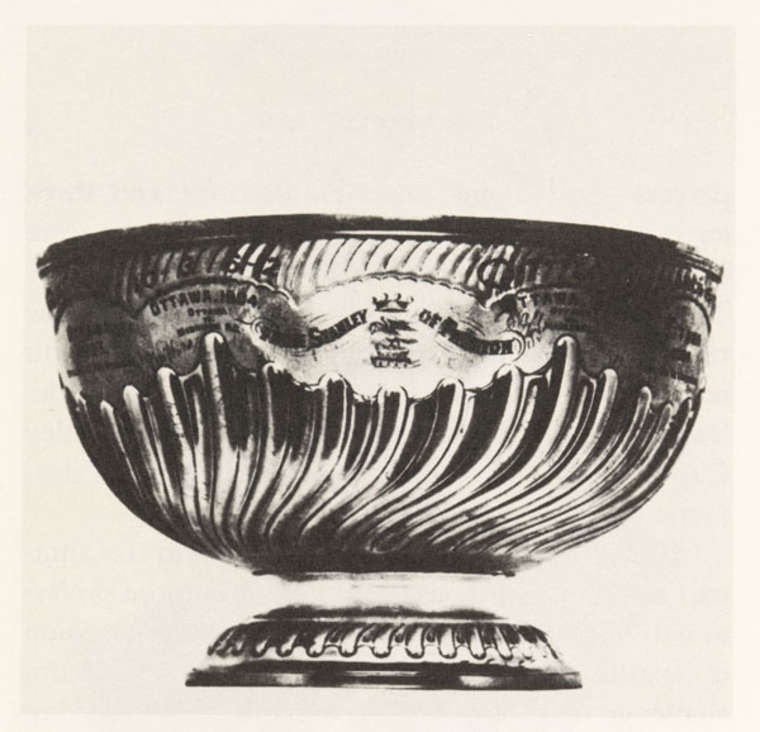
Ottawa’s celebration of hockey on March 18, 1892 would lead to the biggest hockey celebrations in North America. For a banquet held in honor of the Ottawa Amateur Athletic Club (OAAC), Lord Stanley of Preston sent a memo announcing the creation of a “challenge cup” to be presented annually to the “champion hockey team in the Dominion.” The first presentation of the Stanley Cup would occur the following April, and today the NHL continues the tradition of annually awarding and celebrating the Stanley Cup champions.
Sir Frederick Arthur Stanley became Canada’s sixth Governor General on June 11, 1888. At Montreal’s 1889 Winter Carnival, Lord Stanley and his entire family became hooked on hockey. They quickly had their own rink built outside of their Ottawa residence, Rideau Hall. Apparently, only a month after seeing the carnival’s hockey game, in March 1889 his daughter Isobel played on a women’s team there.
Stanley’s sons, Arthur and Algernon, formed the Ottawa Rideau Hall Rebels, and in 1890, Arthur established the Ontario Hockey Association (OHA). The OAAC was a founding member of the OHA and won its first three championships. For their second of these, in 1892, they had “a record as honorable in the making as it was splendid in success” of 9-1-0. While they had scored 53 goals in these championship contests, they only allowed 19 goals against.
On March 18, 1892, the OAAC celebrated its second championship with a dinner held at the Russell House Hotel, which was located between the current National War Memorial and the National Arts Centre. It was the first formal dinner ever held by the OAAC and proved “very enjoyable” with a “menu as good as appearances promised.” About 70 to 80 attended with still more ladies joining the festivities after dinner.
The OAAC’s president, J.W. McRae, was the chairman leading the evening’s program from 10 to midnight. He gave a toast to Queen Victoria and to the health of Lord Stanley, who could not attend. Then, Stanley’s aide-de-camp, Lieutenant Viscount Frederick Rudolph Lambart Kilcoursie, presented a memo on Lord Stanley’s behalf. According to the press, “The reading of the letter was greeted with enthusiastic applause.” With these words, the Stanley Cup was born.
I have for some time been thinking that it would be a good thing if there were a challenge cup which should be held from year to year by the champion hockey team in the Dominion.
There does not appear to be any such outward sign of a championship at present, and considering the general interest which matches now elicit, and the importance of having the game played fairly and under rules generally recognized, I am willing to give a cup which shall be held from year to year by the winning team.
I am not quite certain that the present regulations governing the arrangement of matches give entire satisfaction, and it would be worth considering whether they could not be arranged so that each team would play once at home and once at the place where their opponents hail from.
Kilcoursie explained that Stanley’s former military secretary, Captain Charles Colville of the Grenadier Guards, would order the cup while in England. The seven-by-eleven-inch silver punch bowl he chose was made in Sheffield, England and purchased from G.R. Collis and Company for 10 guineas (over $50 then and about $1,385 today). The rim was engraved with “Dominion Hockey Challenge Trophy” and “From Stanley of Preston.”
After more toasts and introductions to all the champion players, “Lord Kilcoursie sang an original ditty about the doings of the team, referring in turn to each man, and winding up with a rousing chorus.” The song, “The Hockey Men,” was written in the team’s honor. The first three verses included the lyrics:
There is a game called hockey
There is no finer game
For though some call it 'knockey'
Yet we love it all the same.
This played in His Dominion
Well played both near and far
There's only one opinion
How 'tis played in Ottawa.
Then give three cheers for Russell
The captain of the boys.
However tough the tussle
His position he enjoys.
And then for all the others
Let's shout as loud we may
O-T-T-A-W-A!
The banquet ended with everyone drinking to the health of the OAAC and renditions of “God Save the Queen” and “Auld Lang Syne.”
Later, once the cup was obtained, Ottawa Sheriff John Sweetland and Philip D. Ross served as trustees to award the trophy. They named it the Stanley Cup in Lord Stanley’s honor, and it was ready as of May 1, 1893. Although it was specifically meant to reward challengers, the very first recipients were controversial for the lack of a true challenge. The Montreal Amateur Athletic Association received the trophy as the champions of the Amateur Hockey Association of Canada (AHAC). Although they had been defeated by this Montreal team during the season, Ottawa took issue with not being allowed to challenge for the Stanley Cup. They finally would do so the following March but failed to take the Cup from Montreal. However, the Ottawa team went on to win many challenges and eventually became known as the Senators. They were members of the National Hockey Association (NHA) and its successor, the NHL, until they were moved to St. Louis in 1934.
Meanwhile, in July 1893, Lord Stanley returned to England to take over as the 16th Earl of Derby. He never presented his own cup nor even saw a challenge game for the honor. Still, for his role in promoting the sport of ice hockey, Stanley was one of the original Hockey Hall of Fame inductees.
The Stanley Cup remained a challenge cup until 1914, when it became the award for the interleague champions. Since 1926, the Cup has become solely the trophy of the NHL playoff champs.
Additional Sources:
“Stars of the Ice,” Ottawa Journal, 19 March 1892, p. 1.
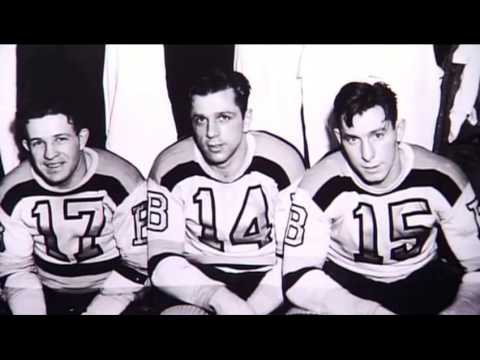
Forget the Irish. St. Patrick’s Day in 1940 was all about the Germans, as in the Boston Bruins’ “Kraut Line.” As a first in NHL history, the three members of the line took the top three spots in the scoring race. Milt Schmidt, Woody Dumart, and Bobby Bauer finished first, second, and third, respectively.
Center Milt Schmidt (No. 15), left winger Woody Dumart (No. 14), and right winger Bobby Bauer (No. 17) had all played together back in their German community at Kitchener, Ontario. They then formed a line for the Providence Reds, and their player/coach, Albert Leduc, nicknamed them the “Sauerkraut Line.” In December 1936, Schmidt received the call up to Boston, where Dumart would join him in February. Bauer played one game for the Bruins that March but did not make the permanent transition until November 1937. The trio finished the scoring race of the 1938-39 season ranked 21-22-23 and led their team to the Stanley Cup.
For their third full season playing together for the Bruins, they moved up 20 spots. The 1939-40 regular season ended with the game on March 17th, held at Boston Garden for about 8,000 fans and guests. Their visitors, the Montreal Canadiens, were “pitifully shorthanded with only 10 players” due to injuries and illness. Whereas, the Bruins had already clinched first place. Before the game, President Frank Calder presented Captain Dit Clapper with the team’s ninth Prince of Wales Trophy. Clapper also received the Dufresne Trophy as Boston’s MVP, and he was meant to keep the trophy permanently as the donors retired the award.
The two teams, for all that they had come into the game so differently, ended the second period knotted at 2-2. Dumart had assisted on the Bruin’s first tally. Then, in the latter half of the final period, the Bruins had a “five-goal barrage.” Schmidt and Dumart accounted for the third and fourth of these goals with Bauer assisting on Dumart’s. The “Kraut Line” had put the icing on the cake.
In the lead in points and assists, 22-year-old Schmidt had accumulated 22 goals and 30 assists for a total of 52 points. His linemates actually tied for second with 43 points. Dumart had 22 goals and 21 assists while Bauer had 17 goals and 26 assists. Bauer would receive his first (of three) Lady Byng Memorial Trophy. Put together, their line had a total of 138 points. Their 1-2-3 finish would only be repeated once, by Montreal’s “Punch Line” during the 1944-45 season.
The very next night, the Bruins began their playoff series against the Rangers. Montreal’s coach, Pit Lepine, had predicted, “The winner of the Bruins-Rangers series should win the cup, and I look for the Bruins to win that one.” He was half right. The Bruins lost in six games, and the Rangers went on to win their last Stanley Cup until 1994.
However, the following postseason, Boston took the prize again, with the “Kraut Line” at the fore. With World War II looming large, all three forwards left the NHL to serve in the Royal Canadian Air Force from 1942 to 1945. The trio returned to the Bruins only to lose the 1946 Cup to the Canadiens.
They remained with Boston until the early 1950s, when they retired one right after the other (Bauer in 1952, Dumart in 1953, and Schmidt in 1954). Schmidt, as last man standing, took over coaching duties midway through the 1954-55 season, and he remained with the Bruins in that capacity for another decade after that. As the team’s general manager during the early 1970s, he became the only Bruin to have his name etched on the Stanley Cup four times.
All three members of the “Kraut Line” have been inducted into the Hockey Hall of Fame. Thus far, only Schmidt’s No. 15 has been sent to the Garden’s rafters.
Additional Sources:
Herbert Ralby, “Sauerkraut Line Sweeps Honors,” Boston Globe, 18 March 1940, p. 7.
Tom Fitzgerald, “Bruins Stage Scoring Spree,” Boston Globe, 18 March 1940, p. 7.
The March 16th games of 1947 were all about making playoffs. In New York, the Rangers failed to make playoffs when they lost to the Montreal Canadiens, who became the NHL champs for the fourth straight season. It took over 15 minutes to finish the final half minute of their game thanks to the largest donnybrook ever experienced at Madison Square Garden. Meanwhile, in Chicago, the Detroit Red Wings secured a playoff berth when Billy Taylor set an NHL record with seven assists in one game.
New York
Madison Square Garden held a capacity crowd of 15,925 that night. The Rangers and Canadiens were tied at 3-3 until Jimmy Peters scored at 16:29 of the third period. With playoffs on the line and a fat prize purse coming to the Canadiens if they took first place, the Rangers pulled goalie Chuck Rayner in a desperate (and unsuccessful) attempt to steal the victory.
The two teams had carried over tensions from the night before in Montreal when the Canadiens shutout the Rangers 1-0. With the entire game played rough, Coach Dick Irvin claimed, “They were out to get Richard and Reardon in order to ruin them for the playoffs.” Indeed, the two Habs had already fought New York’s Bill Juzda and Bryan Hextall midway through.
With just 31 seconds remaining in the game, the real dust up began. The New York Daily News reported, “Canadiens started a player riot which churned the rink into a fight arena for a dozen all-out battles. Sticks and fists flew, spectators joined the brawl and it finally took a corp of gendarmes and as many ushers to finally bring order out of the chaos.” Meanwhile, the Montreal Gazette claimed the Canadiens “had to battle with fists and sticks against the Rangers and some of their more irate supporters.” Calling the game, WHN sportscaster Bert Lee could only repeat, “It’s a riot! It’s a riot! It’s a riot!” The New York Times agreed that it was “the grandest mass riot in the local history of the NHL.”
Everyone pointed to Kenny Reardon as the original victim. The defenseman was hogging the puck to run out the time when he became a pinball checked by Bryan Hextall and slashed by Cal Gardner’s stick. Blood gushed from Reardon’s mouth, who later said, “My upper lip felt as if it had been sawed off my face.” Reardon had already had trouble with New Yorkers. He explained, “Dick Irvin, our coach, had bawled me out for losing the puck and the game last time we were in New York.” What’s more, he realized, “I couldn’t afford a fight in that last minute. I wanted to stay out of trouble.”
The cut would need 10 or 14 stiches, so Dr. Vincent Nardiello collected Reardon from the ice to return to the locker room. As they passed the Rangers’ bench, both the players and their fans chirped Reardon. The trigger was one spectator yelling, “Reardon, I’ve been waiting a long time for you to get it. You louse.” As the defenseman recalled, “That did it. I swung my stick at him and missed. Then a cop grabbed me from behind and I fell.” That was the end of Reardon’s story. “I was the guy who started the fight, but I never got to see it. Right after the cop knocked me down, I got up and walked to the clinic. I didn’t find out about the riot until the game was over and the guys came into the room all cut up.”
When Reardon went down, the Rangers jumped up to see, and Irvin overreacted. He told the Canadiens, “Get the hell over there and help Kenny!” As hockey historian Stan Fischler described it, the “Flying Frenchmen poured over the boards like GIs at Normandy.” The Gazette noted, “Players of both teams rushed to the scene and the battle was converted into guerilla warfare, players fighting all over the ice and in the aisles with fists and sticks and the fans edging into it.” For example, Captain Emile Bouchard hit the heckler over the head with his stick in retribution for Reardon.
On the ice, the biggest fights involved goalie Bill Durnan being knocked over by Billy Moe, Maurice Richard breaking his stick on Bill Juzda’s head only for Juzda to tackle him in return, Bouchard stealing Hextall’s stick and then punching him out, and Hal Laycoe and Leo Lamoureux tiring each other out. Then, both with sticks raised, Moe went after Bouchard and Juzda broke Buddy O’Connor’s jaw. As Coach Frank Boucher tried to break up the fighting, Ken Mosdell swung at Edgar Laprade and then chased Boucher.
The fighting lasted 15 to 25 minutes. The New York Sun called it an “endless fight,” pointing out that “No sooner was one group of players quieted down than another would start at it again.” Referee George Hayes recalled, “There were so many going on it was impossible to keep track of them all.” They counted a total of 15 distinct fights.
Just as Hayes was handing out 10-minute misconduct penalties to Richard and Juzda, Murph Chamberlain started things up again, only to be hit by Joe Cooper and sent “orbiting over the sideboards and into the seats.” Finally, the game resumed to finish the last half minute. But just as the buzzer sounded, Ab DeMarco went after Mosdell while Tony Leswick aimed for Bill Durnan. The police finally broke up all the fighting even as the crowd egged them on. The Rangers took solace in coming out of the fight without casualties, but the Canadiens came out of the game with first place.
Bench-clearing brawls certainly did not end with this one incident. In fact, exactly eight years later, Canadiens’ superstar Maurice Richard was suspended after participating in a stick fight at Boston Garden. The following day, March 17, 1955, the city of Montreal rioted at the Forum in protest. As for Madison Square Garden, it hosted another riot involving players and fans on December 23, 1979. The visiting Bruins climbed into the stands after a fan grabbed one of their sticks.
Chicago
Meanwhile, back on March 16, 1947, Chicago Stadium hosted a crowd of 17,071. The visiting Detroit Red Wings started the night with a hat trick by left winger Roy Conacher. He would score again in the final seconds of the second period. As his center, Taylor assisted on every one of these goals. While he was at it, Taylor also leant a hand to their captain, Sid Abel. With these five assists, the Red Wings led 7-2.
The third period began with Ted Lindsay completing a hat trick. Then Detroit and Chicago alternated goals. Taylor assisted on the next two for his team, Jack Stewart’s at 5:57 and Eddie Bruneteau’s at 15:06. Thanks to Taylor’s playmaking, the Red Wings won 10-6, clinching a playoff spot.
Taylor had spent five seasons with the Toronto Maple Leafs (who won the Stanley Cup over the Canadiens in 1947) before being traded to Detroit. Before the 1947-48 season began, he was on his way to the Boston Bruins. However, just one month after he was traded to the Rangers, on March 9, 1948, NHL President Clarence Campbell suspended Taylor for life. Although Taylor protested his innocence, the NHL had proof that he and Don Gallinger had gambled against the Bruins while playing for them. He was not reinstated until 1970.
Despite the disgraceful halt to his career, Taylor held the record for most assists in one game until Wayne Gretzky thrice matched it in the 1980s.
Additional Sources:
Gene Ward, “Canadiens Win, 4-3; Rangers Bow in Riot,” New York Daily News, 17 March 1947, p. 37.
“Canadiens Win Fourth Straight N.H.L. Crown by Beating N.Y., 4-3,” Montreal Gazette, 17 March 1947, pp. 18-19.
The Colorado Avalanche will take on the Los Angeles Kings on March 9, 2020, at 10:30 p.m. Eastern Time. The Avalanche are right in the middle of the Western Conference playoff race, while the Kings look like they will have an extended offseason. Even though the Kings won’t be making the playoffs, the Avalanche can’t take this team lightly since they have won five straight games. The Kings have been enjoying playing the spoiler role of late.
Los Angeles needs to get off to a fast start in this game since the Avalanche played in San Jose last night. The Avalanche are going to have to roll all four lines and hope to get some production from them despite potential weariness from last night’s game. The Kings and the Avalanche both need to get some decent goaltending to have a shot in this game. Anze Kopitar and Gabriel Landeskog look to have a big game and lead their team to a victory. Here are three keys to this Western Conference match up.
1) Kings Fast Start
The Kings should look to get out to a fast start and test the Avalanche’s fatigue factor early in the game. The Avalanche are coming off of playing the previous night so the Kings should look to set the pace early in this one. The Kings need to get in on the forecheck and set up their cycle game to get some chances and force the opposition to defend their own zone. The Kings might want to be a little physical to try to tire out the Avalanche even more. The best way to get off to a fast start is to get the first goal of the game and keep attacking for the rest of the game.
2) Avalanche Depth
The Avalanche will need the depth players to have a big game for them. They will have to roll all four lines, and hope that they can contribute in more ways than one. Even with all the injuries, the Avalanche’s top nine have kept producing with at least one player with 20 + points on each line. This is what makes them a difficult team to defend and the depth could play a big factor in this game. The depth players need to produce in order for this team to get the two points that they need to keep pace in the Central Division.
3) Goalies Need to Be Big for Both Teams
The goalies for both teams will have to come up big in this one. For the Avalanche, it could be Pavel Francouz or Michael Hutchinson depending on how much work Francouz saw against the Sharks. Hutchinson does have a win in his only start for the Avalanche, but has not been good in his time in the NHL this season. Jonathan Quick has had an average season, but he can still manage to steal a game for his team. No matter who the goalies are, they will have to come up with the routine saves and make some timely ones too.
Players to Watch
1) Gabriel Landeskog- Avalanche
I didn’t want to pick Nathan MacKinnon for the second straight night, so I went with his winger as the Avalanche player to watch in this game. Landeskog is the team’s captain and leads by example. He has been good while the team has been missing key players. In 27 career games against the Kings, Landeskog has eight goals, 11 assists and 19 points.
2) Anze Kopitar- Kings
Anze Kopitar seems to produce every year for the Kings, and this season has been no different. Kopitar leads the team in goals (21), assists (41) and points (62). He is the team’s captain and brings it every night even if the team is not expected to do anything. In 46 career games against the Avalanche, Kopitar has 17 goals, 30 assists and 47 points. He will likely be going up against Landeskog so this will be a good matchup to watch.
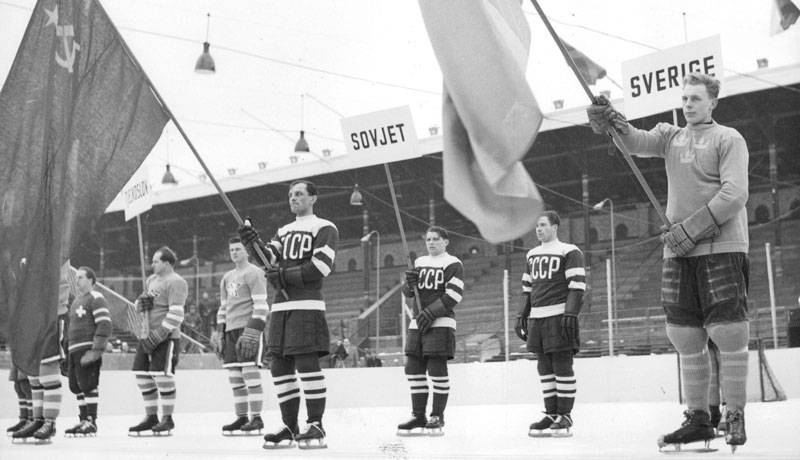
The rise of the Red Machine began with the Soviets sending their national ice hockey team to their first World Championship in 1954. Shocking the international hockey community, the newbies defeated the dominant Canadians with a 7-2 victory on March 7, 1954. The Soviets took home their first gold medal and proceeded to medal in every single IIHF tournament through 1991.
By 1954, the Soviets had only been playing the sport of ice hockey for about eight years. They planned to debut at the World Championship held in 1953 but waited the extra year when star forward Vsevolod Bobrov became injured. Since he would receive the IIHF’s prize for the 1954 tournament’s best forward, that was probably the smart decision.
The 21st Ice Hockey World Championships took place at Stockholm, Sweden between February 26 and March 7. The tournament was structured so that each team played all of the others so that medals were awarded based on total number of points.
Wearing “old-fashioned skates and tattered equipment,” the Soviets handily won five games then tied Sweden (at 1-1). As the heavy favorites, the Canadian team went undefeated in their first six games. The final game scheduled would pit the two against each other. Assuming Canada would win, tournament officials began selling tickets for a rematch between the Soviets and Swedes to break their tie.
On March 7, a capacity crowd of 16,725 gathered at the Royal Stadium’s outdoor artificial ice rink. Don Preston of Toronto (the manager of Canada’s team) hoped that all future world tournaments would be held at indoor arenas. “The organization of the present championship was superb, but the ice was never very good. Today it was very slow and prevented accurate shooting.”
Even on the slush-covered ice, the Soviet style proved too much for the struggling Canadians. The Boston Globe reported that the “fast-skating, hard-checking Russian team … simply skated the Canadians off their feet.” Admitting defeat, the Montreal Gazette noted that the Soviet “passes clicked” while Canada’s “went astray” and “their defence took competent charge.”
Apparently, the Canadians were “told to go easy on their checking rather than risk penalties for infractions of the unfamiliar European rules.” Preston explained, “We feared penalties which would rob us of whatever we could gain.” He also felt that the press had whipped up such animosity against his team that it influenced the referees. “What we were up against was a political situation.” Whether true or not, the Canadians were pinged with six of the eight penalties called during the game. Twice, this resulted in power-play goals by the Soviets. By the end of the first period, the newbies led 4-0, and after another period, they already had a 7-1 margin. With a Canadian goal in the third period, Preston claimed, “We went down fighting.”
Canada had been represented by the Toronto East York Lyndhursts (of the Senior B level) while the Soviet Union’s Moscow Dynamos (half made up of red army men) reigned supreme. Preston complimented, “The Russians are wonderful hockey players. Their skating, passing and stickhandling are excellent. They deserve the victory they got.” The Dynamos manager, Boris Myakinov, returned the compliment, “They played a hard game but we countered with speed and short passes.” However, he said, “The best team must win – and we were the best. But the Canadians gave us a harder fight than the score suggests.”
With a record of 6-0-1, the Soviet Union won gold. Canada’s 6-1-0 record gave them silver, and the home team of Sweden had bronze with 5-1-1. It was only the fourth time (in 20 appearances) that Canada had been defeated at Worlds. Bobrov (as the Dynamos’ captain) accepted the championship cup from J.F. “Bunny” Ahearne (VP of the IIHF).
For the first time, the IIHF gave out “directorate awards,” but looking back, their choices seem a bit odd. They named Bobrov as best forward even though two Canadians were the tournament’s top scorers. Then, they gave Canada’s Don Lockhart the award for best goalie despite Soviet Nikolai Puchkov having fewer goals against. To acknowledge all the medal-winners, the IIHF then named Sweden’s Lars Bjorn as best defenseman.
Thus began not only the hockey rivalry between Canada and the USSR but also Canadian dissatisfaction with not sending their best players to compete internationally. Appalled sportswriters across the provinces blamed the Canadian Amateur Hockey Association (CAHA) for sending a subpar team.
Everyone seemed to agree that the Senior B league would be considered the sixth level in North American hockey (following the NHL, AHL, Quebec and Western Leagues, Senior A, and Junior A). According to Milt Dunnell of the Toronto Daily Star, “The Swedes tried to tell us, months ago, that a team which couldn’t win consistently in a senior B league in Canada wasn’t good enough to send against the greatly-improved Russians. Hockey men in Britain and Norway tried to tell us. But we managed to be arrogant about it. No person was going to advise us how to run the game we had invented.”
Most critics agreed the solution was to send the best or don’t send anyone. Former NHL star Lionel Conacher stated, “We can’t weep about the Russians beating us 7-2, but we can do something about it in the future. We can send to Europe exactly what we’ve got, and that’s the best hockey players in the world, or we can stay right out of these championships.” However, as George Dudley (secretary manager of CAHA) explained, “We picked the best team we could find. We just couldn’t find a senior or junior team willing to play on the terms. The majority of our players in the better leagues are highly paid men.” Indeed, the Boston Globe’s report snarked, “Certainly the [NHL] players wouldn’t give up their salary checks … nor would NHL club owners put patriotism ahead of a successful financial season.”
Still, the Canadians and the Soviets knew that the effects of the upset would be felt long afterwards. Elmer Ferguson of the Montreal Herald avowed, “This is, in a sports sense, a national calamity, certainly a national humiliation, a mortifying experience, the more so in that it provides Russia with another sounding-board from which to blare forth its athletic glories” Conacher agreed that with this being their first tournament, “Its propaganda value cannot be estimated in my opinion.”
Press Attache Boris N. Ivanov, while giving comments on behalf of the Soviet Embassy, advised, “You will have to change your mind about hockey being your Canadian game. Seems it can be Russian too, is it not so?” The Soviets would prove that to be the case for the decades to come.
Additional Sources:
“Canada’s Defeat Shocks Fans,” Ottawa Journal, 8 March 1954, pp. 1, 14.
“Canada ‘Humiliated’ By Reds,” Ottawa Citizen, 8 March 1954, pp. 1, 12, 15.
“Russia Drubs East York 7-2 to Win World Hockey Tourney,” Montreal Gazette, 8 March 1954, p. 25.
“Russians Win World Hockey Title,” Boston Globe, 8 March 1954, pp. 1 and 9.
In modern times, player safety takes priority in hockey rulings. The events of March 6, 1907 paved the way to understanding the importance of protecting the players of this rough sport. During a Federal Amateur Hockey League (FAHL) game, forward Owen “Bud” McCourt of the Cornwall team was struck in the head during a brawl, lost consciousness twice, and the following morning succumbed to a “broken blood vessel in the brain.” He was the second player to die from an on-ice injury, one located nearly the same place as the first. Charles Masson of the Ottawa Victorias was accused of causing the fatal injury with his stick and charged with manslaughter. Understandably, the 1906-07 season was cut short.
The FAHL existed between 1904 and 1909. Up until this Canadian league turned professional for its final two season, the teams’ amateurs played at the men’s senior level. With the formation of the National Hockey Association (NHA), the FAHL (which had dropped the amateur) dissolved.
Playing for the FHL, 22-year-old McCourt had been with Cornwall for the past three seasons. In the month or so before his death, he had finally recovered after a severe case of typhoid fever and returned to the sport. According to the Ottawa Citizen, “He was a splendid player, fast and clever and his work was always clean. He had a hot temper, but was never deliberately rough.”
Meanwhile, Masson had been playing at Truro, Nova Scotia. Having returned to Ottawa a few weeks before the game, he filled in when the Victorias’ captain, Bob Harrison, missed his train connections after another game. According to the local press, Masson was “well known and liked about town” and “played cover-point for the Victorias and was seldom ruled off for rough work; in fact he had been looked upon as a very clean player.”
The two teams met at Cornwall that fateful March 6 to replay a game that was not considered a valid (amateur) FHL game. (Two of Cornwall’s players had played a couple of paid matches with the Shamrocks.) For this re-match, Cornwall had to replace two players with juniors (including S.E. Runions). McCourt himself was not feeling up to playing and was “only persuaded to play at the last minute.” The game could not start until after he arrived at 9.
During the first half, Ottawa scored three goals. Although Cornwall put the puck in the net twice, neither counted when they were ruled offsides. According to the time-keeper, W.D. Knight, “The first half of the match was strenuous in places.” Ottawa players and management consistently made comments that the “game was very rough right from the start, but that Referee [Thomas Emmett] Quinn could have averted all the trouble had he been more strict at the start. Once the rough work started, they say, it was allowed to go along until the free-for-all.”
The only person penalized was McCourt. Knight claimed that he was given two minutes for striking Arthur Throop and three minutes for “striking a player on the arm.” E.A. Pilon, a judge of play, claimed that McCourt had been penalized for hooking Throop. As the referee, Quinn didn’t think the first half was “particularly rough.”
That changed about five or six minutes into the second half. With so many witnesses, the sequence of events became muddled, especially as everyone agreed that they happened so quickly. It seems that Charles Chamberlin was skating with the puck when McCourt (as the Ottawa Citizen recapped) “skated across the ice and hit Chamberlin across the back” causing him to fall. McCourt’s brother Lee claimed that from the audience it looked like an Ottawa player gave McCourt the “end of the stick, the latter then skating after Chamberlin, and striking him on the shoulder.” This launched a free-for-all brawl.
It revved up one of three ways. According to the Victorias’ manager, Jim Enright, McCourt collided with a player named Young, who was hit from behind and fell. Then Throop seemed to have been struck with McCourt’s stick leaving him with a five-inch gash on his cranium. Throop himself claimed that McCourt and Chamberlin were “apparently threatening each other with their sticks,” so he dropped his to break them up. He was then hit from behind and “dazed by a blow on the head.” Chamberlin denied that story but said he, too, was hit from behind and thus “did not know anything from that moment until reaching the dressing room.”
The main issue was what happened next. Immediately following the game, the Ottawa newspapers reported that after McCourt and Throop “exchanged blows and separated,” it looked like McCourt was about to retaliate when Masson hit him over the head and Runions took out Throop. Runions refuted, claiming that Throop and Masson both struck McCourt (who dropped his stick to fight with his fists) and that Runions retaliated against Masson. As referee, Quinn testified that he saw “McCourt skating towards the timekeepers’ box following other players [with his stick uplifted]. A second or so later he saw Masson skate over to McCourt, and strike him on the head. Then followed a mix-up by several players … Masson had no occasion as a player to skate the 15 or 20 feet he was distant from McCourt.” McCourt’s brother also witnessed Masson skating over 20 feet to hit from behind with the heel of his stick causing McCourt to drop to the ice.
With McCourt, Throop, Young, and Chamberlin all laid out, Ottawa’s goalie, Billy Bannerman, helped stop the fight. At the end, judge of play Pilon “heard the whistle blow and saw a fight in progress. He blew his own whistle, and attempted to part the combatants. He also helped McCourt off the ice.” The newspapers summarized, “There was a wild time for a few seconds, and McCourt was picked up and carried off the ice. Throop had an ugly cut and could not continue playing.” Masson was ruled off, so Runions sat out to even up the teams.
To continue the contest, Quinn “called the players up, and gave them a lecture which had good effect and the balance of the match was comparatively mild.” The Cornwall team proceeded to score 11 goals with Smith taking care of nearly half of them. They won 11-3.
Meanwhile, as Lee McCourt put it, his brother took a ten-minute rest and then resumed play for about seven or eight minutes. During that time, Quinn thought “he seemed to be all right. Once I collided with him and his skate caught in the leg of my trousers and made a hole there” to which he joked that “if he was not more careful I would have to charge him for a new pair of trousers.” Finally, McCourt said he was “all in,” and those would be his last words as he fell unconscious and never woke.
They had already called for a doctor. When he arrived, Dr. D.O. Alguire noted that “McCourt was on the ice [skating] and he proceeded to sew up the head of an Ottawa player” [presumably Throop]. After McCourt passed out again, Dr. Alguire checked his pupils, which showed “evidently serious trouble,” perhaps internal bleeding. He immediately had McCourt sent to Hotel Dieu, where his “skull was trepanned, and revealed a large clot” and “broken blood vessel in the brain.” With his condition “very precarious,” they called his mother and a priest to the bedside. McCourt died at about 8 the next morning, and the funeral was scheduled for March 9th.
The morning after the game, most of the Victorias headed back to Ottawa on the train (which broke down six miles before their destination). Chief of Police Smyth, having charged Masson “with assault with intent to do grievous bodily harm,” took Masson into custody either at Hotel Duquette (where the team had stayed) or at Cornwall’s train station. Masson’s goalie and an officer of the club accompanied them to lock-up to see about bail, food, and reading materials. Right when Masson arrived at lock-up, a town employee told him, “I may as well tell you that you are in a bad fix, young man. McCourt is dead.” Masson could only apologize and pled “not guilty” at the quick inquest. His father, an ex-alderman for Ottawa, came to help but was denied bail.
The inquest resumed on March 13. The coroner’s jury decided: “That the said Owen McCourt came to his death by a blow from a hockey stick in the hands of Charles Masson, during the progress of the game of hockey played I the Victoria rink in the town of Cornwall … in the opinion of this jury, although there is no evidence of any ill-feeling previous to the blow, there was no justification by personal provocation for the above blow … Your jury further recommends that an act be passed by the legislative assembly whereby players and spectators engaged in or encouraging roughness or foul play in the game of hockey may be severely punished.”
Two days later, Mason was charged with manslaughter. Police Magistrate Danis stated, “There is a certain doubt in my mind that the evidence that has been adduced here before me might technically prove the accused to have been guilty of murder. I feel strongly that, taking into consideration the match … [and circumstances] the charge should be reduced to one of manslaughter, and I would feel much more pleased if the crown attorney would consent to it.” When the attorney did not consent, Danis reduced the charge anyway. “I cannot believe that any jury or any court would hold this young man guilty of murder. There was certainly no evidence of any intention to do anything more than the usual injury that is generally committed in this game.”
On March 17, after ten days in custody, Masson was finally released on bail (despite the crown attorney’s strong protestations). He paid $8,000 himself, and his father paid another $4,000. The father and son had lunch with friends at Hotel Duquette before sympathetic Cornwall citizens (including Lee McCourt) saw them off on the train. The press found Masson “in good health and spirits, although he deeply regrets the sad death” and “confident that he will be acquitted.”
The trial took place over April 10 and 11. Masson again pled “not guilty,” and after hearing all the witnesses and deliberating for 45 minutes, the jury agreed and acquitted him.
The 1906-07 season did not survive the incident. The two teams were scheduled to meet again March 9th. But the day before, the Victorias cancelled the rest of their season because the “players are completely broken up over the death of Bud McCourt and are all anxious to hang up their sticks.” Upon their return, they had left their uniforms in a box outside the door of their “quarters at Dey’s rink.” However, they did try to arrange an exhibition game for the support of McCourt’s widowed mother and sisters.
Before the game, the two teams had been tied leading the league. The 11-3 victory put Cornwall ahead, so Ottawa assumed it would lose the championship by canceling the remainder. Instead, Cornwall also stopped playing and “waived their claim to the laurels.” Another team, the (French-Canadian) Montagnards dropped out of the league altogether. Thus, as of April 4, the Ottawa Victorias were named the FAHL champions and challengers for the Stanley Cup. They got their wish and played the Montreal Wanderers the following January, but their attempt was unsuccessful.
Additional Sources:
“Player may die as result of blow,” Ottawa Citizen, 7 March 1907, p. 8.
“Free fight at hockey match,” Ottawa Evening Journal, 7 March 1907, p. 2.
“Hockey Player Succumbs,” Ottawa Evening Citizen, 7 March 1907, p. 1.
“Vics Through for Season,” Ottawa Citizen, 8 March 1907, p. 8.
“Chas. Masson Before Court,” Ottawa Citizen, 8 March 1907, p. 9.
“Masson Held Responsible for Death of McCourt,” Ottawa Citizen, 14 March 1907, p. 10.
“Benefit Fund for McCourt,” Ottawa Citizen, 15 March 1907, p. 8.
“Masson Struck Owen M’Court,” Ottawa Evening Citizen, 15 March 1907, p. 1.
“Reduced to Manslaughter,” Ottawa Citizen, 16 March 1907, p. 2.
“Masson Out Under Bail,” Ottawa Citizen, 18 March 1907, p. 8.
“Swear Masson Struck McCourt,” Ottawa Evening Citizen, 10 April 1907, p. 1.
“Masson Trial,” Ottawa Evening Citizen, 11 April 1907, p. 1.
“Chas. Masson ‘Not Guilty,’” Ottawa Citizen, 12 April 1907, p. 9.
“Ottawa Victorias Have Challenged for Stanley Cup,” Ottawa Citizen, 4 April 1907, p. 8.
“Out of Federal,” Ottawa Evening Citizen, 15 March 1907, p. 1.
Hockey at the high school, college, international, and professional levels all got a boost on March 4, 1931, when future coach Robert “Badger Bob” Johnson was born at Minneapolis, Minnesota. After his own high school and college playing career, he moved on to coaching the former in Minnesota and the latter in Wisconsin. He spent two decades guiding Team U.S.A. while taking six seasons of his final decade to lead two NHL teams to the Stanley Cup Final. He remains the only one to coach both NCAA and NHL champions.
Growing up in Minneapolis, it wasn’t any wonder that Johnson played for the University of Minnesota Gophers. There, he was coached by the “Godfather of Minnesota Hockey,” John Mariucci, who led the Gophers until he became the first assistant GM for the Minnesota North Stars. As of 1983, the John Mariucci Award has been given annually to the state’s high school coach of the year. Had Johnson still been coaching at that level, he likely would have received the award. After graduating from the university and serving as a medic during the Korean War, Johnson returned to Minnesota to teach and coach at Warroad and then at Roosevelt High School in Minneapolis. In 1960, he wrote a thesis on coaching high school hockey that already showed how his theories were ahead of his time.
Johnson’s career as a college coach began in 1963 with the Colorado College Tigers. There, he had a record of 29-51-3 and defeated his future team in all four matchups. He was named Coach of the Year for two of the three that he spent there.
The fateful day came on April 1, 1966, when the University of Wisconsin-Madison announced that Johnson would return to the Midwest as the Badgers’ head coach. At the time, he was quoted as saying, “Wisconsin seems to me to be a natural area for hockey. It’s a great game and once a boy learns the ropes he falls in love with it. Once they get going, they’ll feel it’s the only winter sport to play.’’
At the same press release, Johnson said, “I see no reason why we can’t keep the program moving all the way to the top.” And so he did. During his tenure in Madison, until 1981, “Badger Bob” led his team to their first conference title and Frozen Four appearance in 1970 and to the NCAA Men’s Ice Hockey Champions seven times. They brought home their first title in 1973 and followed with the titles of 1977 and 1981. He was named the NCAA Coach of the Year in 1977, the year his son Mark was on the championship team. Johnson’s record at UW was 367-125-23. The father-son duo would both be inducted into the UW Athletics Hall of Fame, with Mark entering in 1991 and “Badger Bob” in 1992. In addition to the university’s hall, Johnson was also inducted into the Wisconsin Hockey Hall of Fame in 1987.
Steve Alley, a player from the 1977 team, commented, “Bob was always selling hockey, everywhere he went, he was selling hockey and if it wasn’t to the players, it was to the fans.” He continued, “He was one of hockey’s legends, truly a legend. … He’s known around the world as Badger Bob.’’ Theran Welsh of the 1981 team (and an All-American defenseman) noted, “Bob’s passion for ice hockey was significant. I don’t remember being around him when he wasn’t talking hockey.’’ As Welsh recalled, Johnson would tell them, “Let’s face it, you’re not all goal-scorers. But you have ability and if you have the right passion and the right attitude, you can make a contribution to a team. What are you going to do?”
The Badgers dedicated the Bob Johnson Rink at the Kohl Center in Madison on November 2, 2012. Mark Johnson, coach of the UW women’s hockey team, recognized at the time that his father’s “legacy is going to live on forever. … They will see his name on the ice and they will remember who he was, what he did and what he accomplished here.’’
While crafting championship college teams, American-born Johnson also represented his country internationally. Between 1973 and 1987, he coached at four World Championships, in three Canada Cup tournaments, and at the 1976 Olympics at Innsbruck, Austria. Though Team U.S.A. did not medal there, his son Mark’s team experienced a miracle at the 1980 Olympics at Lake Placid, N.Y. Throughout the end of the 1980s, Johnson held the position of President or Executive Director of USA Hockey. In recognition of all this dedication, Johnson was inducted into the United States Hockey Hall of Fame in 1991.
Almost immediately after winning his third NCAA championship, in 1982, Johnson made the leap into the NHL. There, he coached the Calgary Flames for five seasons (the franchise’s longest length of service) with a record of 193-155-52. Under his leadership, they made it to the Stanley Cup Final in 1986, only to lose to the Montreal Canadians in five games. While Johnson worked for USA Hockey, in 1989 the Flames went on to win their only Stanley Cup.
Johnson’s assistant, Bob Murdoch (who went on to earn the Jack Adams Trophy in 1990), recalled how the coach would come in saying, “Great day for hockey! These people here in Calgary, they’re unbelievable. They recognize you and they want to talk hockey.” Murdoch joked, “Well, you took a step back from Bob. He had a Flames’ cap on. A Flames’ jacket on. Flames’ pants on. Flames running shoes on. He was a walking billboard for the Calgary Flames. And he was so pleased people would recognize him. … You couldn’t help BUT recognize him.” Still, Murdoch described, “Badger was the most optimistic, energetic person I ever met in the game. … He was genuine. I mean, that energy, that positive attitude, that was him. He never changed. Just so innovative. I know I was a much better coach after having worked with Bob. … His legacy is just his love of the game and his contribution to the game. He was absolutely consumed by hockey. He lived it, breathed it. He slept, ate and dreamed hockey. He didn’t know any other way.”
After his three years with USA Hockey, in 1990 Johnson returned to the NHL to coach the Pittsburgh Penguins. In his first and only season with them, their 41-33-6 record led them into the playoffs. With Johnson at the helm, the franchise won its very first Stanley Cup, by defeating his home-state’s Minnesota North Stars in six games. It had been 53 years since the only other American-born coach had led a team to the mountain top. Johnson was inducted into the Hockey Hall of Fame as a builder in 1992.
The Penguins would repeat their Stanley Cup victory the following season (and engrave his name again), but tragically, Johnson would not be around to witness it. While preparing for another Canada Cup tournament, he suffered a brain aneurysm that August and succumbed to brain cancer November 26, 1991. His gravestone bore his famous catchphrase, “It’s a Great Day for Hockey.” A banner with the phrase was hung at the rink in Madison. Pittsburgh kept the phrase on the blue lines at the Civic Center that season while players wore “Badger” on their sleeves. A fitting dedication for a man who spent nearly all of his 60 years dedicated to the sport of hockey at every level.
Additional Sources:
Don Kopriva and Jim Mott, On Wisconsin!: The History of Badger Athletics from 1896-1998 (Sports Publishing LLC, 1998), 117.



 Prev
Prev