Friday night the Brown University Bears hosted the Colgate University Raiders in an ECAC Hockey Conference game. What makes this meeting interesting is that in a week these two teams will once again stare at each other over the puck, this time in Belfast, Ireland, as they compete in the semifinals of the first ever Friendship Four Tournament. They are two of the four teams competing; the other two being the Northeastern University Huskies and the University of Massachusetts-Lowell River Hawks from the Hockey East Conference. The four-game tournament will culminate in the awarding of the Belpot Trophy to the champion.
Hockey players have long memories, at least when it comes to what happens on the ice, and as such these two will remember Friday night’s game vividly when they face each other again next Friday, November 27. It will be interesting to see what animosity carries over from the first game, as often happens.
The first period saw the Bears struggling to stay out of the penalty box as it was almost a revolving door, with four players sitting for five different penalties: Max Gottlieb (hooking), Tommy Marchin (High sticking and then cross-checking), Charlie Corcoran (interference), Alex Brink (charging). In addition to being outshot at 17 to 3, they were also outmatched in the face off dot, where Colgate won 16 of the 21 draws. Despite the numbers being completely against Brown, they somehow managed to limit the Raiders to just one goal as the horn sounded on the first twenty.
The second period saw Brown starting down a man, as Marchin’s cross-checking penalty carried over the intermission, for the first 49 seconds. Once they killed that penalty, they seemed to be a completely different team, making efforts to get the puck into the offensive zone and on net, while remaining out of the penalty box. Brown would get their second power play of the game, when Colgate’s Tylor Spink was whistled for slashing at 5:37 of the second.
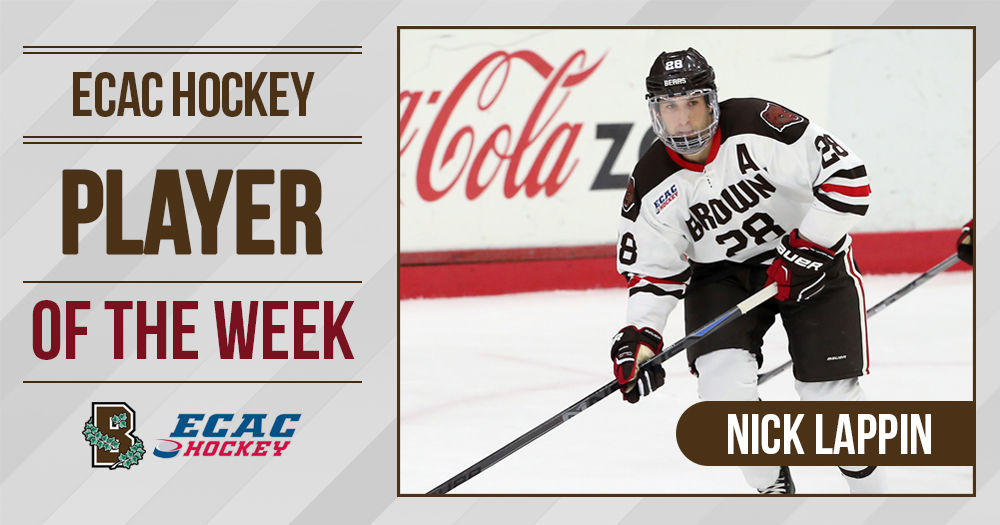
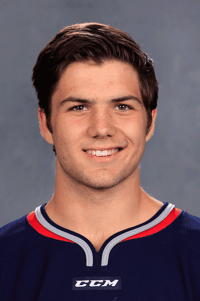
Nick Lappin (Photo: Brown University)
Much of the power play was spent in the offensive zone cycling the puck and keeping Colgate moving to try and block all possible chances. It was solid offensive zone time for the Bears for almost 1:20 of the penalty before the Raiders were able to make the clear. However Brown came right back in and were able to capitalize on the man advantage with just three seconds remaining of the power play. Nick Lappin, the ECAC Player of the Week for this week, got Brown on the board and tied the game.
Brown followed this strong power play with an equally strong penalty kill when Brink was again whistled for a penalty, this time for holding just 1:19 after the goal. Fortunately for Brown this was their only penalty in the second period. While they were still outmanned on the draw, the Bears were able to get an impressive 14 shots on goal and limited Colgate to just six in the second period.
The third period saw a slightly more even playing field in both the shots on goal, with Brown just edging out Colgate 13-11. Brown also improved in the face off circle to win nine, while Colgate won ten. And unlike the penalty ridden first, the third period saw not a single player on either team whistled for an infraction. However, as the clock began to tick down, Colgate began to ramp up their attack in the offensive zone requiring Brown’s players to block shots and Brown’s goalie, Tim Ernst to make some key saves to keep the score knotted at one.
Ultimately the game went to overtime. For the Bears this was the third straight game that had required an overtime period and they were 1-0-1 in the prior two. Colgate absolutely dominated the five-minute extra inning, peppering seven shots on Ernst, who was stellar between the pipes and ensured that his Bears would at least get out of the game with the tie.
There was some pushing and shoving throughout the game and if the teams play along similar styles during their tilt in Belfast, it could prove to be an eventful game. Like any tournament, the game will not end in a tie, so it could prove to be extremely entertaining.
The Friendship Four Tournament will take place at SSE Arena, home to the Belfast Giants and will be broadcast on TSN in Canada and on NESN (Friday) and NESN Plus (Saturday) and is a great opportunity for these two teams. The Pink Puck will be in Belfast to cover the tournament as well.
The NHL’s new All-Star format may not feature all the league’s stars, but it will come with faster pace and a hefty payout for the winners.
A three-on-three tourney with a $1 million prize replacing the usual game is meant to up the competition.
Sadly, this also means bidding adieu to the entertaining and tipsy fun of the Fantasy Draft.
The Game
The new format, instead, pits divisions against one another for a three-game tourney Sunday–with the Pacific Division and Central Division facing off for 20 minutes and the Atlantic and Metropolitan Divisions challenging one another for the next 20 minutes. The two winners will then play each other for the final $1 million jackpot.
Told the winning team at the NHL all-star game will now split $1M, Morgan Rielly says “I’m sure all of that money will go to charity.”
I’ll certainly second the desire to send that money to charity. There are a plethora of worthy organizations, but I might be inclined to suggest, perhaps, a charity supporting victims of domestic violent and sexual assault. In just the past couple seasons, several NHL players have been convicted, charged, and/or accused of these atrocities, and it would benefit the league, its fans, and society to see support for victims.
That said, there are wounded veterans, sick children, unadopted puppies, lacking youth hockey programs, etc., that could use a financial boost as well.
Now, fans will choose one player from each division, regardless of position. That player will then captain his team–the rest of which is selected by the NHL Hockey Operations Department. According to an NHL press release, at least one player will be selected from each team.
We could pretty easily argue this process would leave out the most talented players in the league–as there’s solid evidence some divisions are top-heavy with scoring talent. However, it’s likely an advantage to fans to see each team represented.
The total 44 players will make up six forwards, three defensemen and two goaltenders per team for the three-on-three tourney. The winningest coaches (based on the most points) in each division on Jan. 9 will coach each team.
The new format will open up space on the ice and force more activity at the net, as witnessed in overtime games so far this season. Each matchup will switch sides halfway through their game.
“Anything to promote any sort of intensity or excitement during the game is good,” Blackhawks Captain Jonathan Toews said.
Skills Competition
Thankfully, one unchanged aspect of All-Star Weekend is the skills competition, where the Eastern and Western Conferences will face off with a battle of their talents.
This event, which typically features accuracy, speed, shootouts, relays, and a hardest shot competition, will determine a “winning” conference. The winner, East or West, will then decide which division plays first on Sunday, according to an NHL press release.
In Nashville
This is Nashville’s first time hosting the All-Star activities and they have four days of activities planned for visitors with their 2016 NHL Fan Fair.
The Music City Center is being transformed into 250,000 square feet of interactive hockey fun sponsored by Bridgestone, according to an NHL press release.
From 4:00 p.m. to 9:00 p.m. CT Thursday, Jan. 28 and Friday, Jan. 29 and from 10:00 a.m. to 6:00 p.m. CT Saturday and 10:00 a.m. to 4:00 p.m. Sunday, Jan. 31, an NHL fan pass allows access to:
NHL Mascots
A photo with the Stanley Cup
An NHL Trophy Showcase, including the Hart, Vezina, Norris, and others
Meet-and-greet past and present hockey legends
NHL player Q&A at the NHL Fan Fair Theater
Visit the “Hockey in the State of Tennessee” Hall of Fame exhibit
Test shooting accuracy in the Bridgestone Shootout
Live music performances nightly
Create-your-own Upper Deck trading card
Test your hockey skills in the Honda All-Star skills zone
Price (Single Day)
$20 Adult
$15 Children (Ages 3 to 12)
$15 Seniors (Ages 65 and over)
$15 College/Military (must show ID at entrance)
Children 2 and under: Free Four Day Mobile Pass
$60 (Good for One Entry Each Day of Operation)
Everywhere
Live television coverage of the Honda NHL All-Star Skills Competition starts at 6 p.m. CT Saturday, Jan. 30 and the Honda NHL All-Star Tournament starts at 5 p.m. CT Sunday, Jan. 31 on NBCSN in the U.S. and Sportsnet and TVA Sports in Canada.
San Jose Barracuda get ready to take the ice for warmups
San Jose Barracuda get ready to take the ice for warmups
San Jose Barracuda get ready to take the ice for warmups
Troy Grosenick
Troy Grosenick
Jeremy Langlois
Jeremy Langlois
Barclay Goodrow
Trevor Parkes
Petter Emanuelsson
Nikita Jevpalovs
Aaron Dell
Aaron Dell
Barclay Goodrow
John McCarthy
Gulls take the ice
Barracuda starting lineup
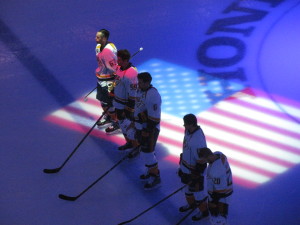
San Diego’s Max Friberg and Brian McGrattan and San Jose’s Bryan Lerg (L) and John McCarthy (R) hold the French flag in memory of the bombing there the night before.
Troy Grosenick saves Antoine Laganiere’s shot
Alex Gallant with a check in his own zone
Troy Grosenick makes a glove save
Jeremy Langlois scores to make it 1-0 San Jose
Barracuda celebratee Langlois’ goal
Jeremy Langlois is congratulated
Barracuda celebrate with Troy Grosenick
Dylan DeMelo and Troy Grosenick defend in their zone
Troy Grosenick slides over to make a save
Troy Grosenick covers the puck
Troy Grosenick makes a kick save
Trevor Parkes celebrates, but the goal was waved off due to interference
Referee Ryan Hersey explains the no-goal call
Referee Ryan Hersey explains the no-goal call to Roy Sommer
Karl Stollery’s shot from the blue line beats Matt Hackett to make it 2-0 San Jose
Barracuda celebrate Stollery’s goal
Barclay Goodrow with a screen as Mark Cundari scores to make it 3-0 San Jose
Barracuda celebrate Cundari’s goal
Brian McGrattan scores to make it 3-1 San Jose
Gulls celebrate McGrattan’s goal
Troy Grosenick makes a save
San Diego’s Matt Bailey and San Jose’s Mark Cundari (45) fight
San Diego’s Matt Bailey and San Jose’s Mark Cundari (45) fight
Greger Hanson scores to make it 4-1 San Jose
Troy Grosenick makes a skate save
Scrum near Troy Grosenick’s net
Scrum near Troy Grosenick’s net
This scrum was unpenalized (happened same time as the Stollery-Noessen matching roughing calls)
Karl Stollery is taken to the penalty box after his fight
Matt Hackett saves Joakim Ryan’s shot
Troy Grosenick slides over to make a save
Bryan Lerg defends in front of his goal
Shot goes wide of Troy Grosenick
Troy Grosenick goes into the splits to make a save
Chris Mueller scores to make it 4-3 San Jose with 2 seconds to go
Gulls celebrate Chris Mueller’s goal
Gulls celebrate Chris Mueller’s goal
Gulls celebrate Chris Mueller’s goal
Troy Grosenick celebrates the win
Troy Grosenick and Barclay Goodrow high five after the win
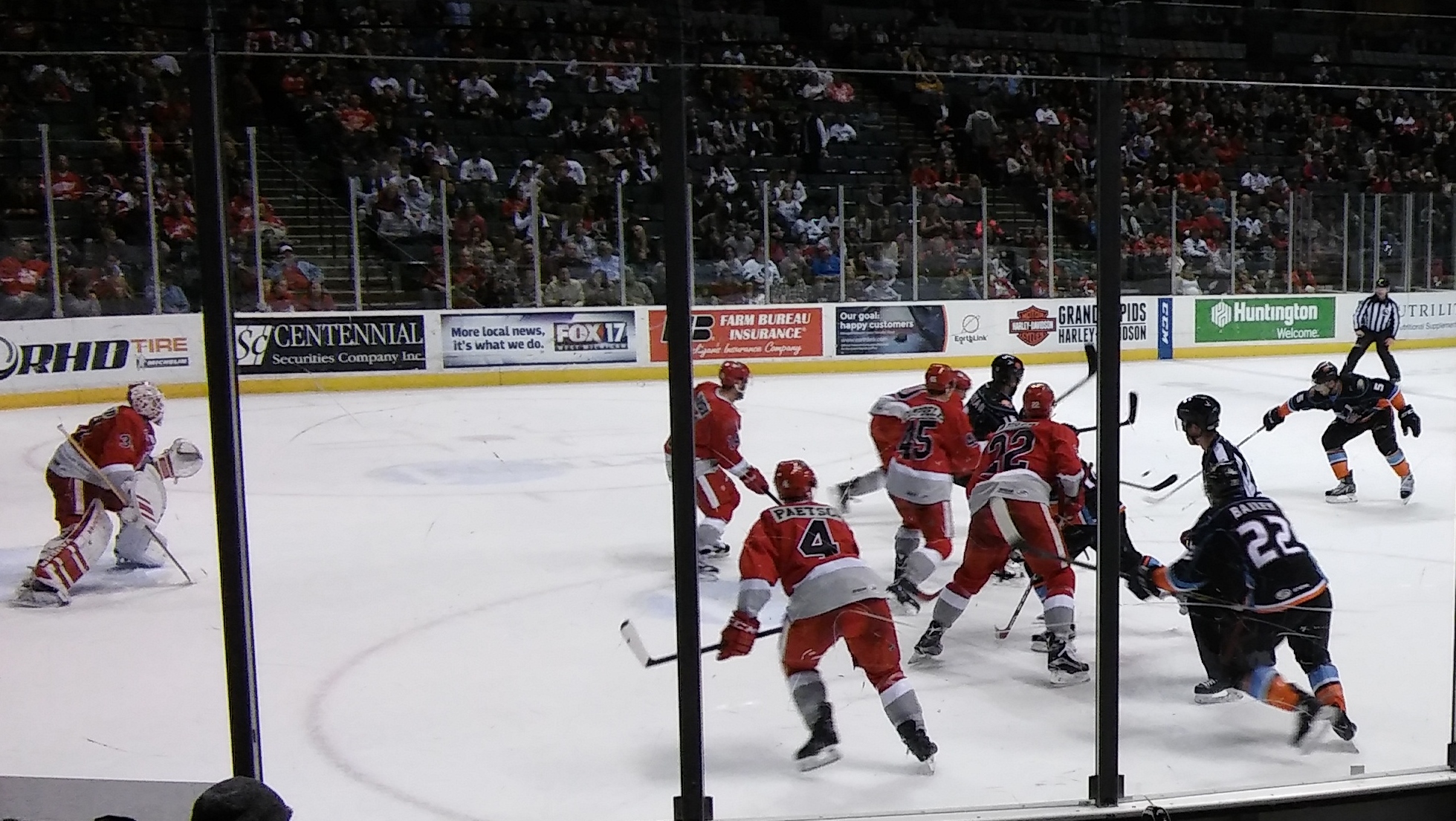
Like the snow that has fallen all night in Michigan, the San Diego Gulls received a cold, wet welcome from the Grand Rapids Griffins at Van Andel Arena last night, falling 7 – 4 in regular play. After struggling in the early games of the season, the Griffins looked more like the three-time Calder Cup contender and 2013 Champion than they have so far this year.
With a combined total of 16 penalties during the game, both teams capitalized on the power play advantage, with Grand Rapids notching four of their total goals on the power play and San Diego two. This was an incredible power play conversion by both teams, at 44% by the Griffins and 40% for the Gulls.
Grand Rapids’ Tomas Jurco, down on a conditioning stint from the Detroit Red Wings, undoubtedly earned his place as the first star of the game. With three power play goals, earning him the hat-trick, and an assist, his 4-point game elevated him to an elite group, being only the third Griffin in the 20-year franchise history to accomplish this feat.
Griffins defenseman Ryan Sproul, assisted by Eric Tangradi opened the challenge with the first goal at the 2:14 mark, on the opening faceoff of a holding penalty on Gulls forward Antoine Laganiere. With goals at 7:33 by Tomas Jurco (Assists: Athanasiou, Paetsch) and again at 8:24 by Mitch Callahan (Assists: Mantha, Sproul) the Griffins took the decided lead in the game.
Not wanting to be blanked in the first period by their challenger, the Gulls hammered back on a power play created when Griffins center Andy Miele was sent to the box for hooking. Left wing Max Friberg, assisted by Chris Mueller and Brandon Montour, slipped the puck past Grand Rapids goalie Jared Coreau, and the Gulls made the board at 13:06 into the game. The Griffins countered at 17:21 with center Andreas Athanasiou (Assist: Mantha) plugging one past Gull goalie John Gibson, the first period ended with the Griffins in a 4-1 lead.
The second period saw the Gulls return to the ice with their shields up. Through two opposing power plays, the Gulls held off Grand Rapids, not allowing a single goal for the Griffins in the period. San Diego, on the other hand, managed to get one on net at 5:52. The goal, from center Joseph Cramarossa (Assists: Bailey, McGrattan), was the first and only of the period, sending the Gulls to the locker room, still down 4-2.
Things started fairly quickly as the teams returned for the third and final period of the contest. Grand Rapids notched one at 1:12, when Eric Tangradi (Assists: Jurco, Russo) scored. San Diego retaliated with a power play goal at 6:18 by defenseman Montour (Assists: Friberg, Mueller). At 8:51 San Diego again lit the lamp on a puck slipped past Coreau by right wing Brian McGrattan (Assists: Bailey, Noesen). Those two goals marked the end-of-the-end for the Gulls, however, and the Griffins Tomas Jurco came back to score two more power play goals, one at 17:03 (Assists: Athanasiou, Paetsch) and almost immediately again at 17:46 (Assists: Callahan, Ouellet) to seal his hat trick, the period, and the game at 7-4.
The game was a big win for the Griffins, who are fighting to recover from a very poor showing early in the season. Currently slotted at #13 in the AHL Western Conference, the win over #7 San Diego, and over #6 Rockford just a few nights before comes as a much needed confidence builder for the struggling Michigan team.
Both teams played excellent hockey. San Diego was hurt by their high percentage of penalties, however, and Grand Rapids took full advantage of those opportunities. Additionally, the four power play goals by Grand Rapids was an incredible feat for a team that had gone scoreless for their 16 previous power plays. Jared Coreau allowed four goals against 35 shots on, and the Gulls Gibson allowed seven against 40.
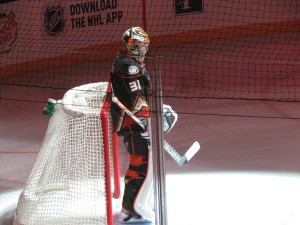
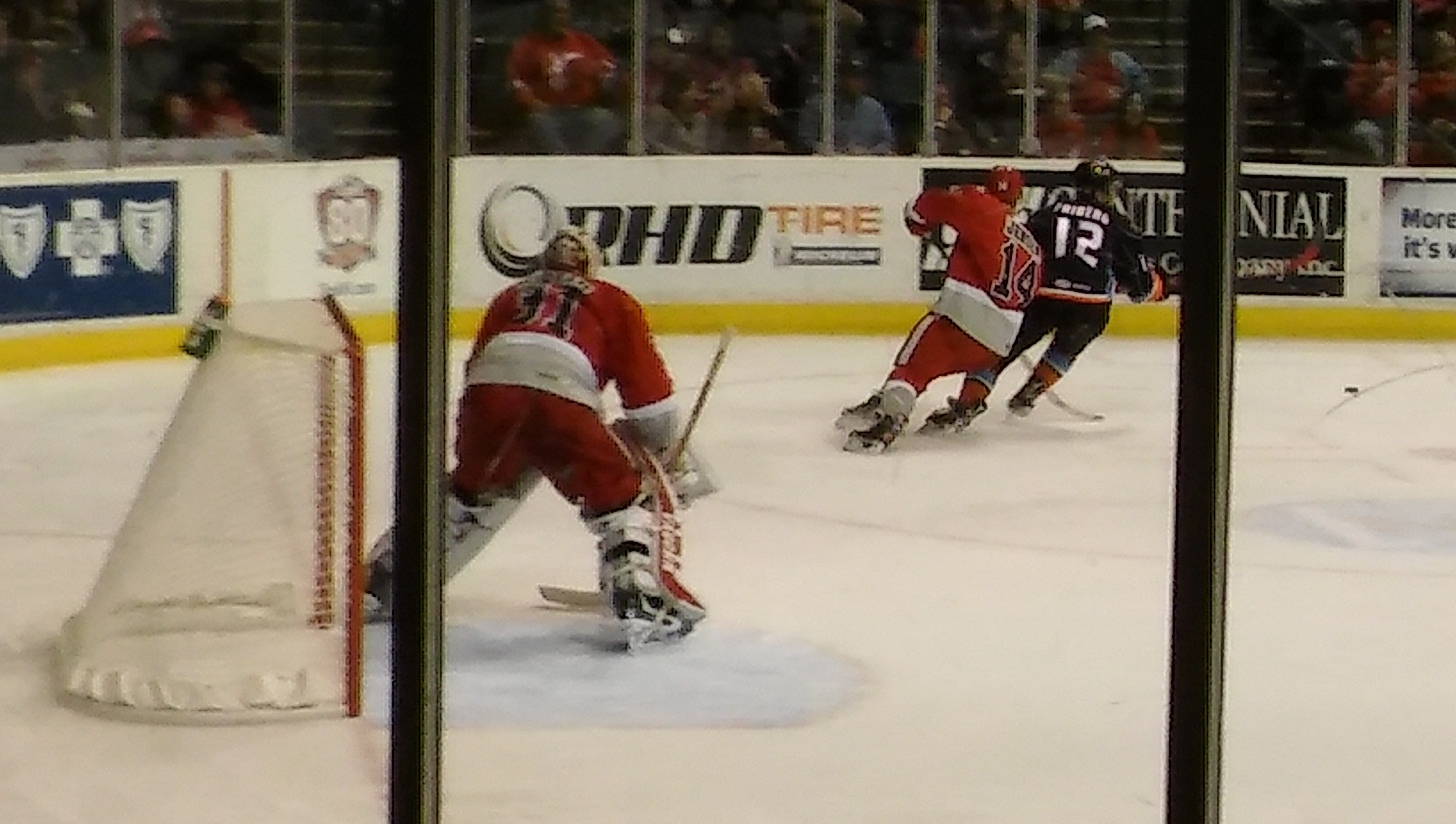
Do you remember when the goalie came out onto the ice at the beginning of the game? The thin beam of the spot light just hit him as he skated towards the net. The fans roared with cheers and glee. He looked bigger and more powerful than most players on the ice. The last defense was and is the goalie.
Things do change over time. Remember when the games had higher scores? When you saw 5 to 4 at the end of the game instead of 2 to 1. Why is that? I believe that the NHL is running into a slight scoring problem. Lower goal games — a lot of action around a net but no scoring is done. The game seems to become a tennis match, look-alike. The puck goes from one end to another with no scores in-between! Why is that?
Lower scores today are the result of most goalies being bigger overall. When the games were high-scoring, the goalies where smaller in size. Today the average size for a goalie is 6’4 to 6’6. When I was younger (in the 70s) the average size was 5’10. I guess the NHL does have a problem, there is less free space around the net to score. What can the league do to improve the rate of goals in a game?
First, the league needs to balance protection with size. The first and foremost need is to protect the goalie from the puck. This is a dangerous position when you think of the speed of a flying puck.
In the new season of 2016-17, the NHL will bring out new standards for chest protection and pant sizes. Not all people are thrilled about the timing of the new standards. It is right in the middle of the playing season! New equipment should be tested by goalies for goalies in the off-season, not in the middle of a season when every point counts. If it was done in the off-season, then all would know if the reduction of equipment was working or not. It also would give the companies that make the equipment time to change their setup. Maybe a whole goalie uniform change is due instead of piece by piece? This way it changes for once and nobody worries about it for years to come. Makes sense to me!
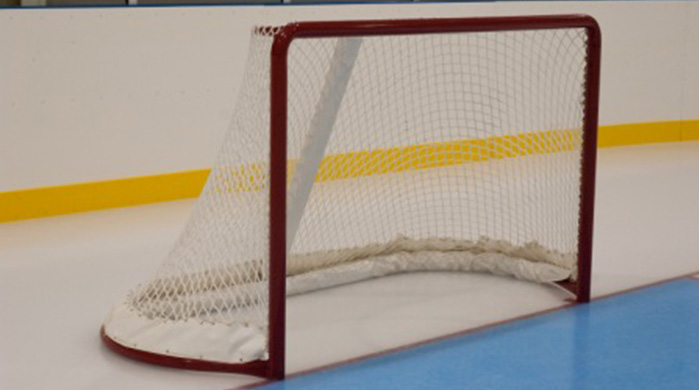
What happens if they shrink all the gear but size is still a problem? The talk around the water cooler contains whispers of increasing net size. This would change the game and add more rules to it. It could change the size of the rink itself. I believe the first plan of decreasing the overall gear worn by the goalie should be tried first and if that doesn’t work then, go into the long process of net size increase.
The Boston Bruins hosted the Minnesota Wild on Thursday night. Both teams came into the game having lost on Tuesday and for the Bruins it was important for them to right the ship and get back to playing Bruins hockey. Unwittingly the Wild may have lit the match, or in this case poked the bear, less than a minute into the game when Nate Prosser had a hit on Brad Marchand that forced Marchand into the boards in such a way that he hit his head. Rising from the ice, he latched onto Prosser and then Jimmy Hayes got into the fray. When it was all sorted out the Wild were on the power play, but the Bruins were building emotion.
The team often plays better when their emotions have been stoked a little and there would be a few instances during the game where things would get a little chippy, including some fisticuffs between Matt Beleskey and Brett Bulmer just four seconds after Marchand put the Bruins on the score board first with a nice wrap-around.
Bulmer gave Beleskey a little slash and Beleskey reciprocated with a cross check, and then the two decided to shed their gloves and get down to business. Each was assessed a minor for their stick work and a fighting major. But such responses from the Bruins are something that hasn’t been seen much this season, and that aggressive approach to the game is part of the fabric of what makes them a winning team. It is part of their identity and it helps to feed the emotion they need to play a full 60 minutes.
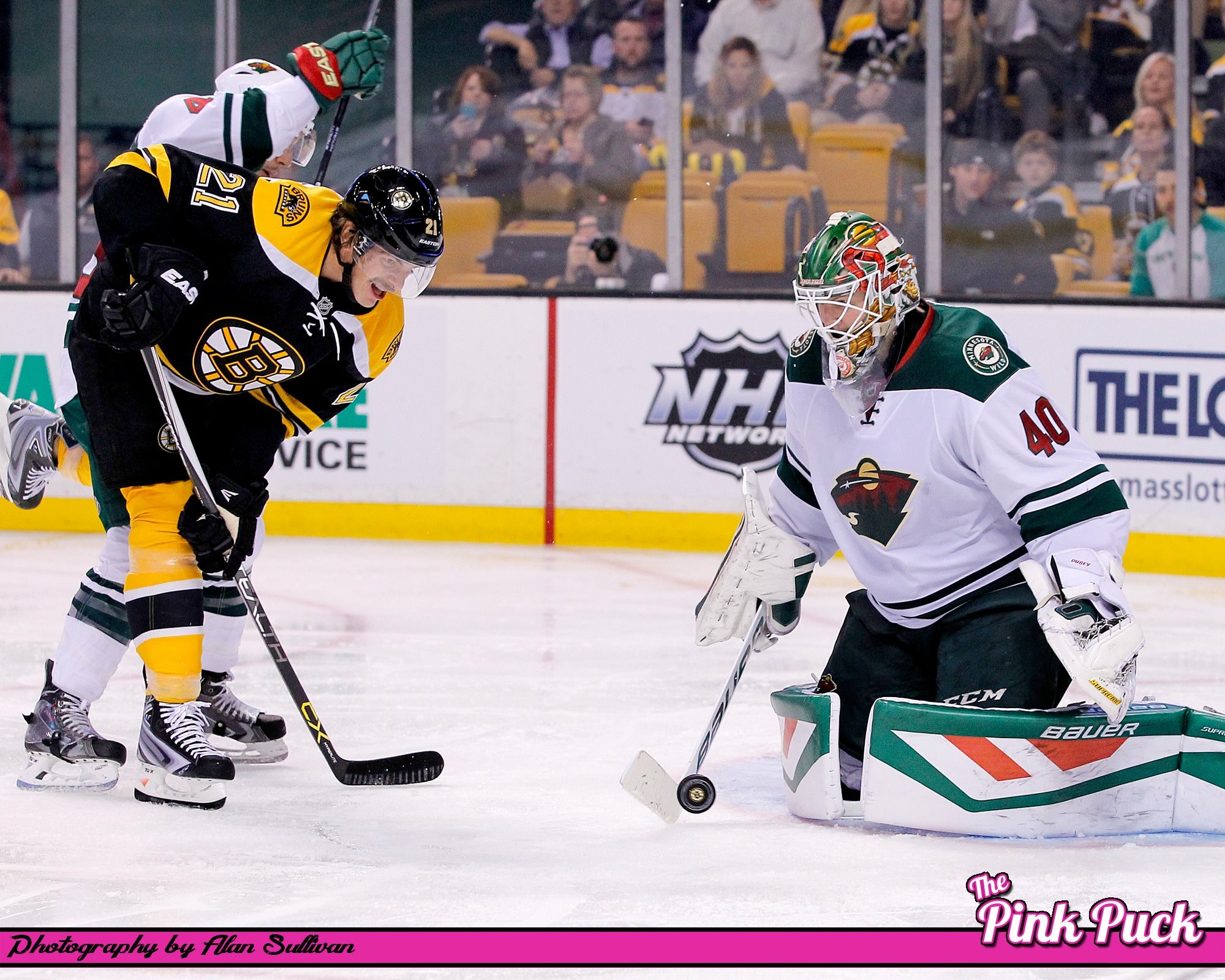
However, there were still a few mistakes, and though Jonas Gustavsson stood tall in the net for Boston in his first home game as a Bruin, he couldn’t stop Jason Zucker’s wrist shot a little over five minutes into the second period. The breakdown in play was a giveaway by Zdeno Chara which allowed Mikko Koivu to get a shot on goal. It was Gustavsson’s rebound that Zucker capitalized on.
Loui Eriksson on Dubnyk’s doorstep
Earlier games in this season would have seen the Bruins back off and in some ways hand the game to their opponent. Instead, the Bruins responded by getting an even strength goal just two and a half minutes later. Loui Eriksson put the Bruins up for the second time in the game, and while Minnesota would score a second goal, they would never again tie the Bruins during this one and Eriksson would go on to score two more goals for his third career hat trick and ensure that Dirty Water would play at TD Garden as the crowd exited the arena.
“[Loui’s] playing some great hockey for us and you know tonight is another one of those games where he was doing the little details right and he got rewarded with three big goals,” Patrice Bergeron shared after the win. “But he’s been playing well all year and he’s definitely a big part of our offense.”
Eriksson is often compared to Tyler Seguin because he came to Boston in the trade that sent Seguin to the Dallas Stars. Many have demanded that Eriksson play like Seguin, but he needs to play to his strengths and that’s what he did Thursday night.
“He’s not the same player as Tyler [Seguin] is, and the comparisons are not right. We shouldn’t be comparing those two players. They’re two different players,” head coach Claude Julien stressed postgame. “But what he does bring to our team, I think people are starting to realize that he may not score 40, 50 goals, but he did score three tonight, and he is a great player in all situations. When a coach has players that he trusts, that he can put on at the end of the game, he’s always one of those guys that’s on the list. So that says a lot about his game.”
The Bruins have scored goals in other games though and still come out the losers. Thursday night’s game differed in large part in how they reacted in their defensive zone. Instead of just letting the opposition skate in and set up shop in their defensive zone, the Bruins were actively getting in their way as soon as the Wild crossed the blue line. They were playing some smart hockey, forcing the Wild to the outside and getting their sticks in the way of passes, shots on goal and more. In the end they limited Minnesota to just 26 shots on goal and down at the other end they were outshooting the Wild in all but the first period in which the teams tied in shots.
There was chemistry, smart hockey, the continued success of the Bruins’ power play and Eriksson’s hat trick that all came together to give them the win. However, as Chara said after the game, focus needs to be on what’s ahead of them.
“It wasn’t an easy game, but I thought we handled it well and I think that we’re all thinking about the next game. That’s going to be a big challenge again for us, are we going to be able to respond after good games like we have before,” Chara said. “I think that we all are already thinking about next game, how we’re going to be playing, what we need to do.”
The Bruins host the Toronto Maple Leafs on Saturday in a divisional game that is important on many levels. They need the points, but perhaps more importantly they need to show they can put two wins together. That has been a problem so far this season and they want to break the cycle of having a bad game after having a good game.
“We are really excited about this group as they bring skill, intelligence, toughness and a Spartan work ethic to our program,” said Anastos. “They have considerable experience and know what it takes to compete for championships. They have also provided leadership to their teams during the past several seasons.”
Scouting Report: Tough, physical defenseman who makes good outlet passes and gets pucks through to the net from the blue line … His mobility and physical play make him tough to play against in all three zones of the ice … Has been a member and leader on several championship teams in his development years and is ready to bring that winning experience to the college level.
Has one goal and one assist in 12 games with the USHL’s Muskegon Lumberjacks this season … Named to NHL Central Scouting’s Players to Watch List, a compilation of top prospects from all the major leagues throughout North America and Europe … Played in 58 games with the Lumberjacks in 2014-15 and helped the team reach the USHL’s Clark Cup final … Captained the USA U18 team at the 2015 Hlinka Memorial tournament … Spent time with the Honeybaked U16 and U18 teams, producing six points in 25 total games in 2013-14 … Also played for Honeybaked Bantam Minor and Major teams, totaling 23 points in two seasons … Son of former NHL goaltender Darren Eliot.
Scouting Report: Mobile, puck-moving defenseman … His ability to skate makes him hard to play against on the defensive side of the puck and hard to defend offensively … His experience in the USHL, plus his international experience with USA Hockey have developed his game to a high level.
Currently in his second season with the Youngstown Phantoms of the USHL … Is plus-2 through 13 games this season … Tallied five points in 39 games with Youngstown in 2014-15, helping the Phantoms finish with the best record in the USHL … Member of the USA’s 2015 Hlinka Memorial team, where he scored once … Also featured at the USA Hockey Selects U16 and U17 camps … Played for the St. Louis AAA Blues U16 program, adding seven points in 36 games in 2013-14.
John Lethemon
John Lethomen (courtesy Chicago Steel)
Northville, Mich. · Chicago Steel (USHL) · G · 6-2, 194 · DOB: 8/16/1996
NHL Entry Draft Eligible
Scouting Report: Big, athletic goalie … His ability to fill the net and move make him tough to beat … Is very detailed and is constantly working to improve on all parts of his game … His experience winning a Michigan high school state championship and his USHL experience have prepared him well for his jump to college hockey.
The 19-year-old goalie is in his second season with the USHL’s Chicago Steel, posting a .904 save percentage and 2.78 goals-against average in nine games in 2015 … Played in 15 games last season with the Steel and had a 3.51 goals against average to go along with a .892 save percentage … Drafted No. 6 overall by the Steel in the 2014 USHL Entry Draft … Played two seasons at Farmington High School, his best coming in 2013-14, where he had a 1.99 GAA and .938 save percentage … Product of the Victory Honda AAA system.
Taro Hirose
Taro Hirose (courtesy Salmon Arms Silverbacks)
Calgary, Alberta · Salmon Arm Silverbacks (BCHL) · F · 5-10, 150 · DOB: 6/30/1996
NHL Entry Draft Eligible
Scouting Report: Highly-skilled offensive forward … His stick skills and ability to see the ice make him very dangerous … His high hockey IQ and ability to anticipate make him effective defensively to start quick transition game back to offense … BCHL experience has brought his game to a level that has him ready to compete at the college level.
In his second season with the Salmon Arm Silverbacks of the BCHL where he ranks second on the team with 25 points (4g, 21a) in 23 games … Finished up his first season with the Silverbacks in 2014-15 as nearly a point per game player, posting 50 points (18g, 32a) in 58 games … Made the jump to the BCHL after three seasons at the prestigious Edge School in Calgary, where he had 163 points in 109 games across various leagues … Product of the Calgary North Star Sabres AAA program … Had five points in five games at the 2010-11 Alberta Cup.
Sam Saliba
Sam Saliba (courtesy Green Bay Gamblers)
Lake Forest, Ill. · Green Bay Gamblers (USHL) · F · 5-11, 172 · DOB: 10/9/1995
Scouting Report: High-energy player with strong work habits … With his junior experience, he has developed into a very well-rounded player who has impact on both the offensive and defensive ends of the rink … Comfortable playing in any situation … Speed, compete and skill make him a very welcome addition to the Spartan hockey program.
Has a team-leading 13 points (5g, 8a) in 13 games with the USHL’s Green Bay Gamblers this season … Totaled 33 points in his second USHL season last year, splitting time between Green Bay and the Sioux City Musketeers after being traded mid-season … Made his USHL debut in 2013-14, posting 12 points in 30 games … Captained his Chicago Mission U18 team in 2013-14 and finished as more than a point per game player … Also played for the Lake Forest Academy, CYA Bantam Major AAA, and Team Illinois growing up.












 Prev
Prev