April 2nd was the first night of the postseason in 1968-69. For the first time in NHL history, two Californian teams faced each other for a playoff series. Both having received their franchise the season before, this would be the first postseason for the Oakland Seals and the second for the Los Angeles Kings. To make their Game 1 just a little more special, Kings left-winger Ted Irvine set a record for the fastest goal scored in overtime during a playoff game.
Going into the playoffs, the Seals were better off. They had ended the season with 69 points and ranked second in the new West Division. The Kings had barely made it into the playoffs in fourth place with 58 points and had ended the regular season with five straight losses and a tie.
A mere 5,429 attended Game 1 at Oakland Coliseum. The home team took the lead with two long distance shots that made it past Kings goalie Gerry Desjardins. First, just eight seconds into a penalty kill, Earl Ingarfield sent in a 40-foot, short-handed slap shot. Less than a minute later, Los Angeles rookie Gary Croteau made good on their power play to tie, but then Joe Szura sent another shot down the ice.
In the second period, Croteau made another goal “from his favorite spot, right in the guts of it all immediately in front of enemy net.” The Seals pulled ahead again when Frank Lacombe scored on a “90-foot fluke shot.” Coach Red Kelly of the Kings noted the three long shots they allowed saying, “They just wanted to win this one so bad, they wouldn’t quit until they did. We had three bad goals scored on us, but we kept coming back.” By that point, Desjardins had pulled a knew and left the net to teammate Wayne Rutledge.
The Kings came back and took the lead thanks to two goals from their leading scorer, Eddie Joyal. Unfortunately for them, with only 2:38 remaining on the clock, “Gene Ubriaco came flying in to slip a screened shot past Rutledge from 15 feet out.”
With the way the two teams played, Seals manager Frank Selke remarked, “We never should have made it into the overtime.” His coach, Frank Glover, admitted, “We came up flat. … But our biggest single problem was that we didn’t play as a hockey team.” He pointed out that their opponents “played a very physical game. We knew they would, but the game was there for the taking.” The opposing coach agreed, “We had more good hits tonight than in any game we’ve played and that made a whale of a difference. We outplayed them badly in the last two periods.” The Oakland Tribune blamed official Bill Friday for letting the match “get out of hand” and become a “sloppy, free-wheeling battle of cross-checks, elbows, and tripping violations, none of which seemed to be called with any frequency.”
Game 1 went into overtime, if only for 19 seconds. That’s how long it took for the “Kings’ first sweep down the ice after winning the faceoff.” The Los Angeles Times recapped, “Jimmy Peters had taken the shot that was blocked by Oakland goalie Gary Smith. But the puck fell at his left foot and Irvine was there to push the puck in and end a frustrating evening in which the Kings thoroughly outplayed the Seals.” Of course, the Oakland area press saw the play differently. “Irvine stepped in front of Seal goalie Gary Smith to control a rebound of center Jimmy Peters’ shot and shove it home,” described the Tribune. The San Francisco Examiner was harsher. “It was a garbage shot by Ted Irvine as he took Jimmy Peters’ rebound and literally forced it by goalie Gary Smith in the crease.”
Regardless, 24-year-old Irvine set an NHL record for the fastest overtime goal in Stanley Cup playoff history. The previous record of 25 seconds was set March 19, 1940 by Syd Howe in a 2-1 victory by the Detroit Red Wings over the New York Americans. Irvine had actually had three game-winner against the Seals already that season. He crowded afterwards, “Never, never, I’ve never scored a bigger goal. I don’t even know how it got in. The puck was there and I just hit it.”
With that, the Kings had their first postseason overtime victory. As the Examiner complained, “Now the series must go five games if the Seals are to win the Western Division semi-finals from their hated Smogsville rivals.” It happened that the opponents needed seven games to decide the series.
Oakland took the second game 4-2 while still at home on April 3. The series then moved to Los Angeles, where the Seals won Game 3 with a 5-2 victory but the Kings came back in Game 4 with a score of 4-2. Each won at home in Games 5 and 6 to knot the series. The final game took place back at Oakland Coliseum, where the Kings ended the series on April 13 as they began it.
Irvine (with five goals and one assist) led his team in points for the quarter-finals. Although the Kings advanced to the semi-finals, they were swept by the St. Louis Blues.
As for Irvine’s record, it was broken little more than three years later, on April 9, 1972. Pit Martin of the Chicago Blackhawks scored just 12 seconds into overtime for a 6-5 victory over the Pittsburgh Penguins. The current record is 9 seconds, which was set by Brian Skrudland of the Montreal Canadiens in a 3-2 victory over the Calgary Flames on May 18, 1986.
Additional Sources:
- Chuck Garrity, “Kings Edge Seals in Sudden Death,” Los Angeles Times, 3 April 1969, section 3, pp. 1 and 4.
- Spence Conley, “Seals 1 Down in Playoffs,” Oakland Tribune, 3 April 1969, pp. 37-38.
- Nelson Cullenward, “Unhappy Seals Try To Even Cup Series,” San Francisco Examiner, 3 April 1969, pp. 47-48.
- https://www.nhl.com/gamecenter/lak-vs-oak/1969/04/02/1968030141#game=1968030141,game_state=final
- https://records.nhl.com/records/playoff-skater-records/fastest-goals/fastest-goal-period-start-playoff
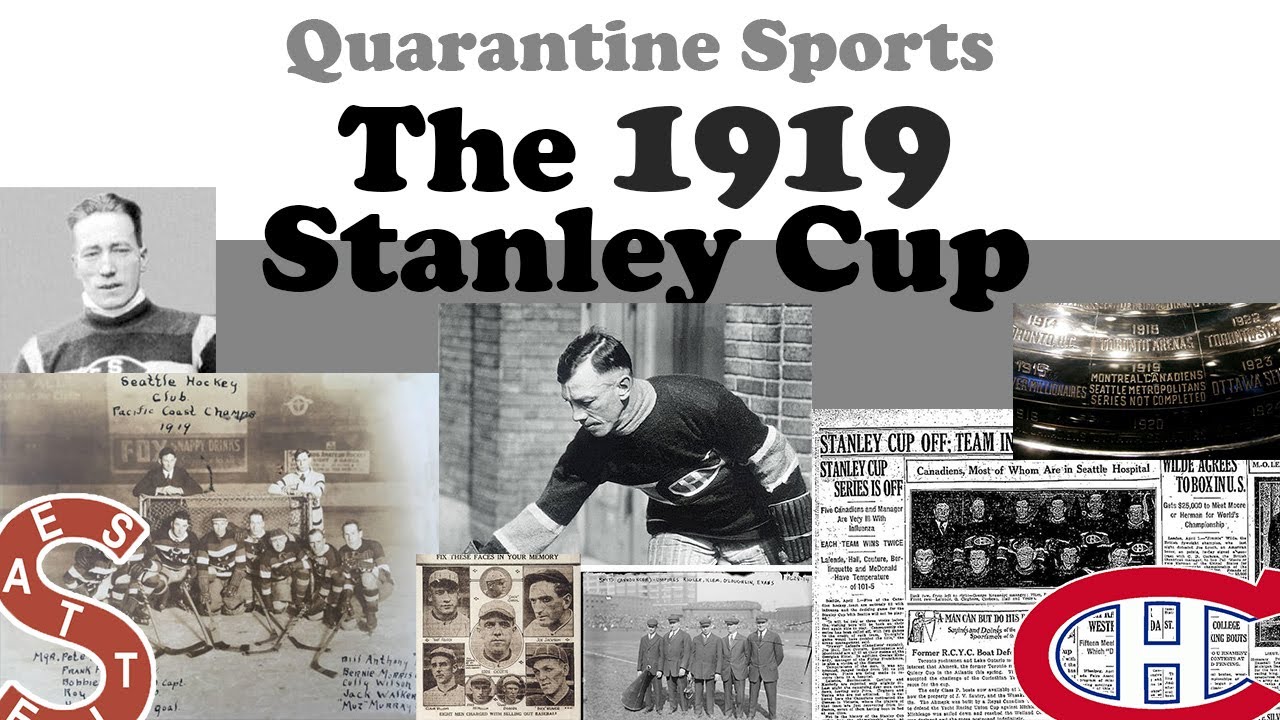
With the suspension of the 2019-20 NHL season due to COVID-19, we can perfectly understand the situation when the Stanley Cup Final was called off on April 1, 1919. So many players came down with the Spanish flu that the Montreal Canadiens only had three well enough to play the final game of the series. The game had already been postponed to the latest possible date to use the Arena in Seattle, so for the first time, the Stanley Cup was not awarded. As the Montreal Gazette grimly noted, “Not in the history of the Stanley Cup series has the world’s hockey championship been so beset with hard luck as has this one.”
The influenza came in waves, and the 1918-19 season was bracketed by them. Before it could even officially begin, on October 13, 1918 32-year-old Hamby Shore of the Ottawa Senators fell victim to the flu, casting a pall over the season to come.
That Spring, the Montreal Canadiens of the NHL and Seattle Metropolitans of the Pacific Coast Hockey Association (PCHA) competed for the Stanley Cup. Alternating between the Eastern and Western rules of play, each team won when playing in their preferred style. The series begun on March 19 was meant as a best-of-five, but the fourth game (on March 26) ended in a tie and needed to be replayed. After the fifth game knotted the series, a sixth game was scheduled for Tuesday, April 1st to be played by Western rules.
At 2:30 pm, a mere six hours before the game was due to begin, the announcement came “that there will be no more world series games here this year.” By the time the announcement was made, it was already too late to reconsider. At noon, the Seattle Ice Arena had begun converting the ice to a roller-skating rink. The Seattle Star explained, “There is absolutely no chance of the series being finished, as the lease on the Arena has expired and the ice has been taken up.”
The reason for the cancelation was that several players had fallen ill with the flu. The Canadiens would not be able to put its team on the ice unless (as they offered) they pulled in players from Victoria. When the Mets declined, Montreal’s owner-manager George Kennedy suggested that they could forfeit the Stanley Cup to Seattle which still had a more-or-less complete squad. Both Seattle’s manager Pete Muldoon and their league president Frank Patrick felt it would not be sporting to take the Cup out of the hands of the ill without a fair game. Instead, they all agreed to call it a draw.
They evenly divided the money amongst all the players, and they canceled all scheduled exhibition games. Unfortunately, about $5,000 of the Canadiens’ earnings went to covering hospital expenses. The entire series was not considered a financial success.
That April 1st, instead of going to the rink, two Canadiens went across the street to Georgina Hotel, the local hospital. Defenseman Joe Hall and left wing Jack McDonald, reported the Gazette, were “being given the very best of care, nurses and physicians being in attendance at all times on them and every other attention is being shown the stricken players.” Manager Kennedy and three of their teammates (Captain Newsy Lalonde, Louis Berlinquette, and Billy Coutu) were considered “slightly ill” and confined to their beds with high fevers. That left only Odie Cleghorn, defensemen Didier Pitre, and goalie Georges Vezina as healthy. The Canadiens thought they possibly contracted the flu when they played in Victoria, whose team had just been recovering.
Two days later, Hall developed pneumonia. The 37-year-old died April 5th at “Columbus sanitarium of pneumonia, following a severe attack of influenza.” Frank Patrick eulogized, “Joe Hall was one of the real veterans of hockey. He had been playing senior hockey since 1902. The game suffered a loss by his passing. Off the ice he was one of the jolliest, best-hearted, most popular men who ever played.”
Meanwhile, by that point, McDonald was “still in the hospital” but “in good condition.” After a week in the hospital, he was “reported as resting easy and his temperature is nearly normal.” However, he was still in bed after another week.
Teammates Berlinquette, Coutu, and Lalonde were “allowed to get up for the first time” on April 5th. Two days later, the Gazette reported that all Montreal players were pronounced out of danger and were “either on their feet” or “allowed to get out of bed.” Lalonde told them that “while weak, is feeling fine and is making his plans to return to his home.” He and his teammates finally made the trip home the following week. At that point, he made clear, “The games were the most strenuous I have ever been in and I would not like to go through another such experience for any amount of money. We were well treated during our illness and received the best of attention from the hospital, doctors and nurses, every effort being made by them to make us comfortable, while they kept our people at home posted as to our condition.”
The last of the Canadiens in Seattle was Manager Kennedy. Although he was supposedly on the road to complete recovery, he was not able to get up until after April 7. He made plans to leave Seattle April 13 but did not actually make it back until April 20. At that point, he planned to “get down to business this week.” Sadly, he never fully recovered and died just a few years later.
Meanwhile, the Seattle Metropolitans were mostly just dealing with injuries from the postseason. No less than five of their players were injured by the time the last game was called off. As of April 3, they did have three members of their club who “developed the disease” and were placed “under the care of physicians.” Defenseman Roy Ricky recovered from his “high fever” at Providence Hospital. In addition to forward Muzz Murray coming down with the flu, his wife and child also fell ill. The final flu victim from that series was Seattle manager Pete Muldoon himself.
As the only Stanley Cup series begun but not finished, the Cup was engraved, “Montreal Canadiens, Seattle Metropolitans, series not completed.” Until now, the only other year in which the Stanley Cup Final was canceled was during the 2004-05 NHL lockout. It remains to be seen what will happen with the 2019-20 season.
Additional Sources:
- Mike Commito, Hockey 365: Daily Stories from the Ice (Toronto: Dundurn, 2018), kindle edition.
- https://thepinkpuck.com/2019/03/26/this-day-in-hockey-history-march-26-1917-and-1919-stanley-firsts-part-1/
- https://www.cbssports.com/nhl/news/remembering-when-the-nhl-canceled-the-1919-cup-final-due-to-flu-pandemic/
- “Greatest Ice Series a Tie; ‘Flu’ Did It,” Seattle Star, 2 April 1919, p. 10.
- “World’s Hockey Series Cancelled,” Montreal Gazette, 2 April 1919, p. 14.
- “Hall Seriously Ill,” Montreal Gazette, 4 April 1919, p. 15.
- “Veteran Joe Hall Called by Death,” Montreal Gazette, 7 April 1919, p. 16.
- “Hockey Players Out of Danger,” Montreal Gazette, 8 April 1919, p. 14.
- “Four Canadien Players are Home,” Montreal Gazette, 14 April 1919, p. 16.
- “George Kennedy Back,” Montreal Gazette, 21 April 1919, p. 14.
Nearly a quarter century apart, March 31st saw the first NHL Stanley Cup Playoffs game decided in overtime (in 1927) and the last to end with a tied score (in 1951). The 1926-27 season was the earliest in which the NHL alone played for the Stanley Cup, and thanks to the format, the playoffs featured at least one tie in every round. The matchup between the two Montreal teams on March 31 was the only one in which someone scored in overtime. Since the NHL dropped two-game, total-goals format in 1936-37, it was unusual to end a playoff game in a tie. On March 31, 1951, the Toronto curfew stopped the Maple Leafs and Boston Bruins from continuing their game until someone scored.
1927
A record number of paying spectators (12,550) and guests (for a total of about 13,000) packed the Forum for the playoff game between the defending champion Maroons and the “home team” Canadiens. The game was described by the Montreal Gazette as a “brilliant, breath-taking, grueling elimination battle.” With only two minor penalties, one per team, assessed in the second period and a final minor in the third, the “battle” was actually a “pleasantly clean game.”
The majority of the action came from the brilliant goaltending. As the “hero in the Maroons’ play,” Clint Benedict made 48 saves. How he “ever stopped” some of Howie Morenz’s shots was “a mystery.” For the Canadiens, rookie George Hainsworth made 38 saves. He “kicked out many a puck that was tagged for the corner” to earn his first playoff shutout.
Regulation ended with both teams scoreless. It took until 12:05 into overtime before someone finally found the back of the net. “There was a face-off to one side of the Maroon goal,” began the Gazette’s recap. “Howie Morenz secured the puck and twisted around. He ran into Noble and was put off balance. The puck went loose. Morenz regained his feet and, when settling to shoot, was bodied by on-rushing Maroons. As he was falling Morenz let drive and fell the ice. The puck whistled into the far corner of the net.”
Having tied each other 1-1 in the first game of their series on March 29, Morenz’s single goal advanced the Canadiens into the semi-finals. It also put the game in the history books as the first all-NHL playoff game decided in overtime. Unsurprisingly then, a crowd of about 200 waited to congratulate Morenz after the game, and “an hour after the tussle they were still singing along the thoroughfares on their way home.”
Meanwhile, in the other quarter-final series, the Bruins crushed the Black Hawks 6-1 at Chicago on March 29 and tied them 4-4 at Boston Arena on March 31. The Bruins advanced to the semi-finals, where they tied the New York Rangers 0-0 on April 2 and then defeated them 3-1 at New York on April 4. Meanwhile, the Canadiens (as expected) lost to the Ottawa Senators who won 4-0 on April 2 at Montreal only to tie 1-1 at Ottawa on April 4.
That meant that the Senators and Bruins faced each other for the Stanley Cup Final. Although meant to be a best-of-three series, a fourth was added when two of them ended with tied scores. The series began at Boston on April 7 and April 9 and then moved to Ottawa for April 11 and April 13. Game 1 and Game 3 ended tied 0-0 and 1-1, respectively. In both cases, the ice was too poor to continue after multiple overtime sessions. Both Game 2 and Game 4 ended in the Senators’ favor 3-1. “These deadlocks have resulted in so many ifs, ands and buts being inserted into the situation that it will probably go down in history as the hypothetical hockey series,” wrote Seabury Lawrence for the New York Times.
1951
On March 31, 1951, Maple Leaf Gardens hosted a crowd of 14,056, including Canada’s Governor General (Viscount Alexander), former Leafs stars (Red Horner, Busher Jackson, Charlie Conacher, Ace Bailey, and Syl Apps), former Bruin Dit Clapper, and Frank Boucher of the Rangers. They were there to witness Game 2 of the semi-final series between the Leafs and the Bruins. Boston had taken an early lead with a 2-0 victory on March 28.
During this clash, each team only scored once. In the first period, Toronto defenseman Bill Barilko drew first blood (in more ways than one). As the Boston Globe recapped, “The game wasn’t four minutes old when Maxie Bentley stole the disc from Paul Ronty on a face off and sent it back to Joe Klukay. The blond winger slipped the plug back to Barilko and he let go with a successful 50-footer to beat Jack Gelineau who had 34 saves for four full periods to 17 for old Turk Broda.” The Bruins finally managed to answer at 9:26 of the second period, when Johnny Peirson scored “on a 20-foot backhander in a play set in motion by Ed Sandford and Woody Dumart.”
Unlike its predecessor in 1927, the 1951 battle featured many fights. According to the Globe, “The two forces had been giving evidence of bad feeling from the beginning and it broke out early in the second period right in front of the box reserved for Viscount Alexander.” In this initial battle, Milt Schmidt “hacked” Ted Kennedy “over the ice with his stick,” earning himself a major and Kennedy a minor penalty. According to Schmidt, “We were both high sticking. I admit I cut him but I got a five minute penalty for it. It was either him or me and I happened to get him.” Barilko added his input and received a 10-minute misconduct for his remarks to the referee.
After the score was knotted, Jimmy Thomson charged Pete Horeck in front of the Bruins bench, prompting Coach Lynn Patrick to throw a “solid punch at the Toronto defenseman.” From the Globe’s perspective, “For a moment, it looked as if the whole Bruins bench gave the Bruins the business.”
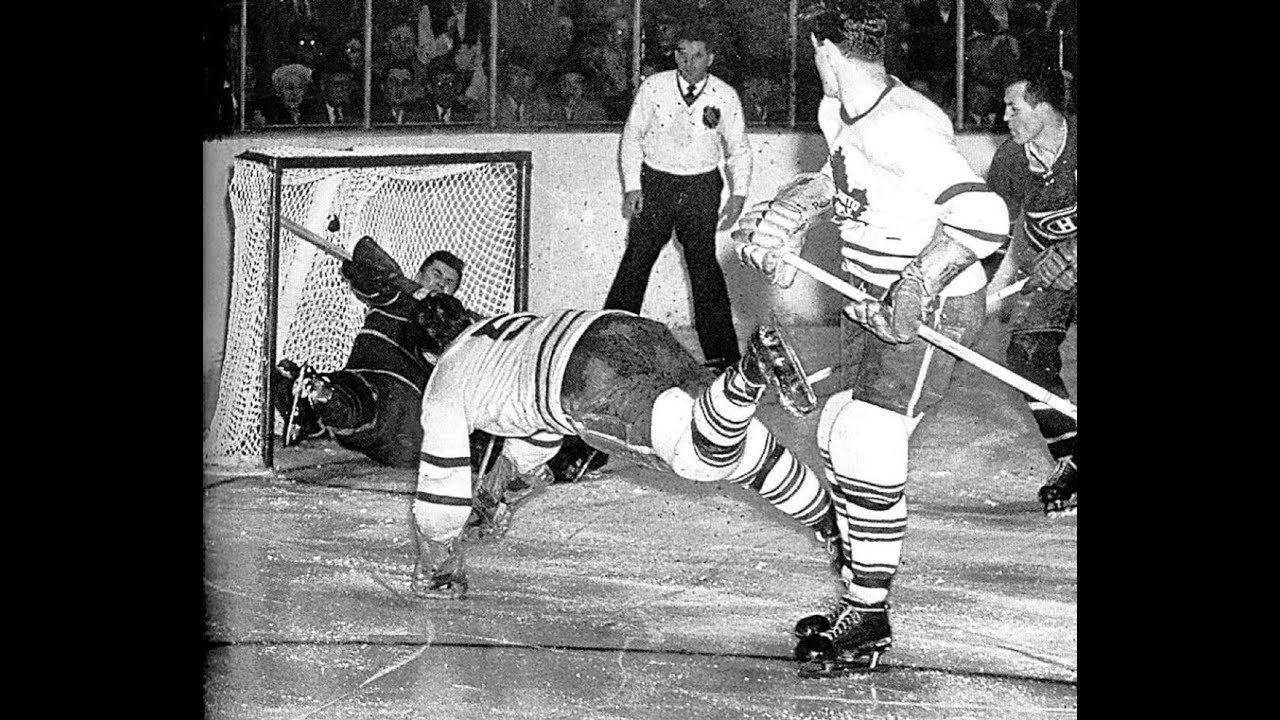
Without any change to the score, the game went into overtime. After 6:46, “Dunc Fisher was hoisted heartily into the fence by Barilko and was taken off the ice on a stretcher.” Then “Peirson was knocked down by Thomson behind the Toronto cage and had to retire for repairs to his left eye.” After another six minutes or so, “Barilko and Horeck became embroiled in a bout that wound up with the Boston forward being cut over the right eye that caused him to leave for stitches.” All told, the Bruins were credited with 22 penalty minutes and the Leafs with 33. However, these numbers seem low considering Barilko alone was penalized 21 minutes.
The long and rough game lasted until 11:45 pm or so and had to stop there. As the Globe explained, “Toronto regulations specify that all activities in Maple Leaf Gardens must be halted at 11:45 so that all customers may be cleared from the premises by midnight.” Thus far, it has been the only playoff game halted at a tie because of a curfew.
If necessary, an eighth game would be added to the series to make up for the tie. However, the Leafs proceeded to win four straight games (only allowing the Bruins two goals) to take the series. Meanwhile, the Canadiens had squeezed out victories after multiple overtime sessions during the first two games of their semi-final series against Detroit. After two Red Wings victories, the Canadiens won the final two games to advance.
The 1951 Stanley Cup Finals made history as the only time that every one of the games during the series went into overtime. The Final on April 21 was decided in favor of Toronto thanks to Barilko’s overtime goal.
Additional Sources:
- “Canadiens to Play Ottawa in Finals for Group Title” and “Attendance Record as 12,550 Paid to Witness Struggle,” Montreal Gazette, 1 April 1927, p. 16.
- https://www.nhl.com/gamecenter/mmr-vs-mtl/1927/03/31/1926030112#game=1926030112,game_state=final
- https://www.hockey-reference.com/leagues/NHL_1927.html
- Tom Fitzgerald, “Bruins, Leafs Tie, 1-1 in Overtime Bruiser,” Boston Globe, 1 April 1951, pp. 1 and 47-48.
- Herb Ralby, “Bruins Dressing Room Grim Scene After Battle,” Boston Globe, 1 April 1951, p. 48.
- https://www.nhl.com/gamecenter/bos-vs-tor/1951/03/31/1950030122/recap/stats#game=1950030122,game_state=final,lock_state=final,game_tab=stats
- https://www.hockey-reference.com/leagues/NHL_1951.html
- Hockey Chronicle: Year-by-Year History of the National Hockey League (Lincolnwood, Ill.: Publications International, Ltd., 2006), 199-201.
- Brian McFarlane, Brian McFarlane’s History of Hockey (Champaign, Ill.: Sports Publishing Inc., c1997), 27, 69-70.
- https://www.mentalfloss.com/article/27958/last-three-ties-stanley-cup-finals-history
The final games of the 1968-69 NHL season took place on March 30. At the standing-room-only Chicago Stadium, the East Division’s cellar-dwelling Black Hawks and the fifth-place Detroit Red Wings ran up the score with a “skate-and-shoot fest” to end their seasons on a high note. Although neither had made it to the playoffs, they bid the season adieu by matching three records and setting at least four more. The records came in goals, shorthanded goals, assists, and points, and everyone but the goalies were in on the action.
After a slow start, with only Pit Martin’s goal for Chicago in the first period, the scoring exploded during the second. Gordie Howe tied up the game only for Martin to score again. Then both teams took advantage of two of the three penalties that period. Chicago’s Kenny Wharram scored a power-play goal on the first while his teammate, center Stan Mikita, potted a shorthanded goal during the second. Howe answered with a power-play goal while Martin was still serving for tripping. When Martin returned to the ice, he completed a hat trick. Although Detroit add another goal to their tally, Chicago wrapped up the period with two more. The second-period totals came out to 9 goals, 17 assists, and 26 points. This tied the single-period scoring record set by the New York Rangers and Americans on March 16, 1939 and matched by the Rangers and Toronto Maple Leaves January 21, 1943. The record would not be broken until December 7, 1982, when the Boston Bruins and Quebec Nordiques totaled 27 points in the second period.
During the third period, the special teams again had great success, scoring during three of the four penalties (all called on the Hawks). Detroit strived to catch up with goals during the first and final of these power plays. However, Mikita managed another shortie (during Chicago’s second penalty kill). He became the 20th NHL player to have two shorthanded goals in a single game. The only person who has managed three was Theo Fleury on March 9, 1991. The Black Hawks put a point on the end of their season with a fourth goal by Martin. It was the second time in his career that he had so many in one game.
Of Chicago’s nine goals, defenseman Pat Stapleton assisted on six of them. He helped Martin with his first and final goals, on both of Mikita’s shorties, on Wharram’s powerplay goal, and on Bobby Hull’s second-period finale. Six assists by a defenseman in one game tied the record set by Babe Pratt of the Leafs on January 8, 1944. Since then, only four defensemen have matched the record (Bobby Orr in 1973, Ron Stackhouse in 1975, Paul Coffey (who also had two goals) in 1986, and Gary Suter in 1986) that none have surpassed.
Beyond the game, the six assists gave Stapleton a total of 50 assists for the season. He was the first defenseman to reach that milestone. The previous record of 46 had been established by Pierre Pilote and Bill Gadsby. The 50 assists and total of 56 points remained the highest of Stapleton’s career.
The goal that received the most attention was the one left-winger Hull notched at 19:49 of the second period. It sparked a celebration in which “fans littered the ice for the umpteenth time.” To allow for clean-up, referee John Ashley sent the teams off the ice early and added the 11 seconds to the final period. They were celebrating the new single season record for goals (58). Hull himself had set the record at 54 goals during the 1965-66 season, and he broke that on March 30th. Having had two great shots block in the third period, Hull came close to an even 60. He joked, “I was staying under the speed limit.” Hull’s record was destroyed just two seasons later when Phil Esposito scored 76 goals.
Last but not least, the famous Gordie Howe set two records for right wings. The day before his 41st birthday, he tallied two goals and two assists to finish out the season with 44 goals, 59 assists, and a total of 103 points. That made him the top-scoring right wing in assists and points in one season. These would remain the highest totals of his career. Like with Hull’s, Howe’s right-wing records only lasted until the 1970-71 season, when Ken Hodge topped him with 62 assists and 105 points.
At the end of this game and season, a new scoring record had been set. For the first time in NHL history, a player scored 100 points in a single season. The first to reach 100 was Phil Esposito, who finished the season with the record-setting 126 points. Then Bobby Hull made it to 100 and placed second with 107 points. On March 30th, Howe scored his 100th point, and in third place with 103, he had made it into the top five scorers for his 20th straight season.
Additional Sources:
- Ted Damata, “Hull Scores No. 58; Hawks Win, 9-5,” Chicago Tribune, 31 March 1969, section 3, pp. 1 and 4.
- “Hull Bags 58th … Wings Lose Finale,” Detroit Free Press, 31 March 1969, pp. 1D and 4D.
- https://www.nhl.com/gamecenter/det-vs-chi/1969/03/30/1968020454/recap/stats#game=1968020454,game_state=final,lock_state=final,game_tab=stats
- https://records.nhl.com/records/individual-scoring-records
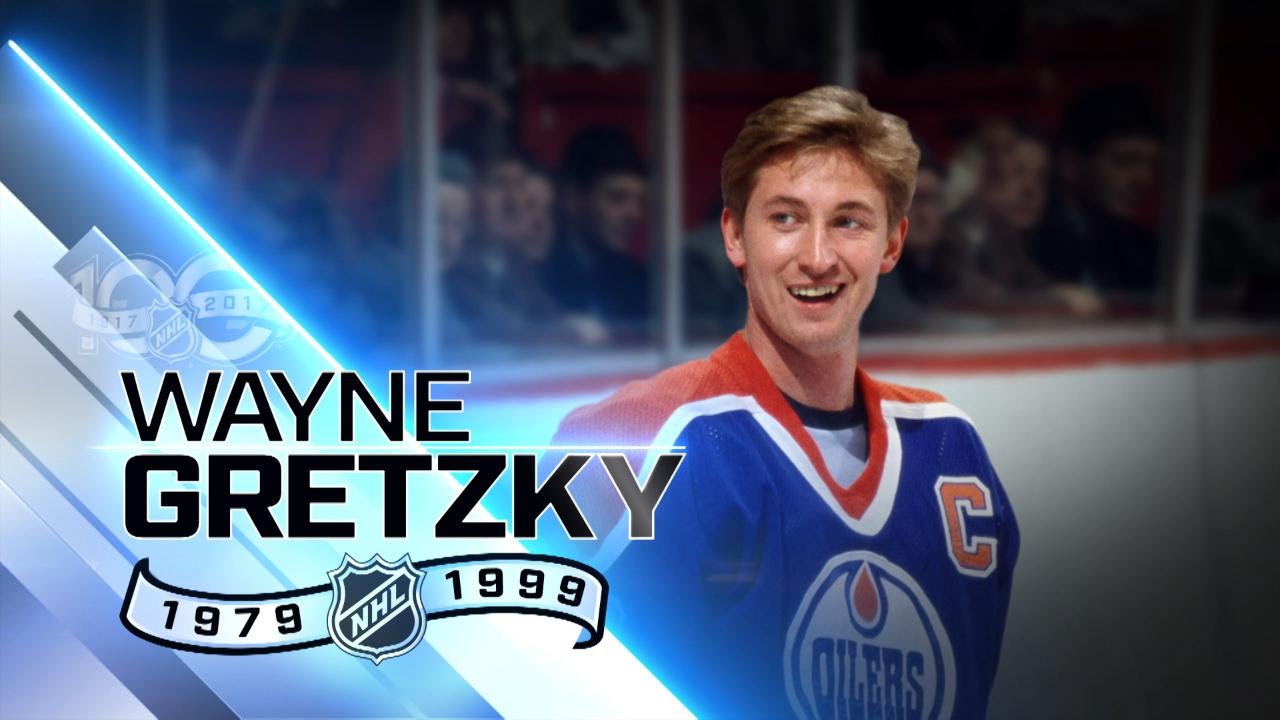
We’re all thinking, ‘Another day, another Wayne Gretzky record.’ In this series alone, we have covered no fewer than eight of these record-setting days. On one particular date, March 29, Gretzky beat out two NHL greats and tied another. Early in his career, in 1981, he matched Bobby Orr’s record for most assists in a season after breaking Phil Esposito’s record for most points scored in a season. At the end of his playing career, in 1999, Gretzky scored his final goal to top Gordie Howe’s record of most goals scored during a career in both the WHA and NHL.
1981
Gretzky closed out March 1981 with highlights in back-to-back road games. On Saturday, he and the Edmonton Oilers defeated the Red Wings at Detroit 4-2. No. 99 made his 99th assist by passing to Risto Siltanen. The time was 1:52 pm, and it was Gretzky’s 152nd point of the season. He had tied Esposito’s record number of points from the 1970-71 season. The retiring 39-year-old recalled that record-setting season. “When I did that, I thought nobody would ever get more than that total. I remember when I did it some people were bitter. They wanted to cheapen it (it was a 12-team league then, not six).” Esposito continued, “Gretzky has far more ability than I had. … I got my points because I was with one helluva hockey team. Gretzky gets his because he is the Edmonton Oilers.”
The following day, Gretzky proved Esposito’s point. The Oilers had moved on to Pittsburgh, where they defeated the Penguins 5-2 for a crowd of 12,966. Gretzky assisted on the first and the final two goals. He earned his 100th assist of the season at 3:07 of the second period “on a typical Gretzky move, a dash around the net and a goal-mouth feed to [Mark] Messier.” Gretzky merely commented, “It was nice to get an assist like that … it was maybe better than getting in on a scramble.” His 101st assist came as Brett Callighen “banked a 30-foot shot off Penguin defenceman Ron Stackhouse,” and the 102nd happened in the final 69 seconds when “he sent [Jari] Kurri away on a breakaway with the net empty.” This final assist tied Orr’s 1970-71 record for most assists in a single season.
The first of these assists gave Gretzky his 153rd point, enough to eclipse Esposito’s record and become “the greatest single-season point producer of all time.” From Gretzky’s analytical point of view, “I’m happy and relieved to get it over with. Before this season started, I just wanted to improve on my statistics (137 points) of last year, and I thought if I could, then we would win more hockey games.” He had aimed to get two points per game and was averaging 2.01 per game. When Esposito set his record in 1970-71, he only averaged 1.96 goals per game.
In recognition, the crowd gave Gretzky a standing ovation after Messier scored, and goalie Greg Millen gave him the puck. Millen had played in juniors with Gretzky and remarked, “He did some amazing things in junior, but nobody dreamed he would do this much in the NHL so fast. He’s probably not surprised, but I am.” Gretzky’s father, Walter Gretzky, gushed, “The first time I got really excited was when he tied the record in Detroit, and now this tops it. This is the proudest moment of my life. I never dreamed it would happen.”
By the end of the 1980-81 season, Gretzky had 109 assists and 164 points. He still holds the seasonal records for both categories, though this season’s totals have dropped to tenth. Gretzky eclipsed his own records eight times. The only person to surpass the 1980-81 records has been Mario Lemieux, but he never came close to Gretzky’s own stunning top season in 1985-86 (with 163 assists and 215 points). The records of the two Bruins teammates from 1970-71 have slipped to 13th for Orr’s 102 assists and 15th for Esposito’s 152 points.
1999
At the time of the 1981 record-setting, Terry Jones wondered, “The only question left was: could the Great Gretzky survive the test of time. And become the Greatest?” The answer became a resounding yes in 1999, when Gretzky scored his final professional goal, which gave him a total exceeding Howe’s by one.
A couple weeks after Gretzky tied Howe’s total on February 4th, Howe (who was going on vacation) called to preemptively offer congratulations on breaking his record. Gretzky joked to him, “Gordie, how long are you going to be gone? We could be tied when you get back.” The issue was that Gretzky had to take a month off to recover from a herniated disc in his neck.
Before the game at Madison Square Garden on March 29, Gretzky had a feeling it was time and made arrangements for a celebratory lunch with some teammates. However, Coach John Muckler switched up the lines and put Gretzky as left wing to Petr Nedved at center. Gretzky explained, “Originally, this morning, I was slated to play in the middle. John and I talked about it. I like to play more behind the net and Petr’s been playing well.” So, Gretzky volunteered, “I’ll line up on the left side.”’ When Nedved left the game with an injury halfway through the opening period, Gretzky returned to center.
By the end of the second period, the Rangers and the Islanders were tied 1-1. At 17:53 with 2:07 left in regulation, Gretzky “became the most prolific goal-scorer in professional hockey history.” After his “initial shot was stopped,” Gretzky “strained to reach the rebound of his own shot that was sitting in the crease, beyond the reach of Isles goalie Wade Flaherty, who was sitting on his padded shorts, unable to stop him.” He succeeded in scoring a “slow-motion game-winner.” Gretzky simply said, “It was a nice goal at a nice time.” He elaborated further later, “It was a goal I’ll probably never forget. The thing that makes professional sports so great is that everybody likes to sit around and talk about it. … This is a record that won’t be in the books, but (it’s) for people to sit around and talk about.”
After a standing ovation and a quick wave to the crowd, the game moved on. “The fans were so nice to me. It was quite an ovation,” thanked Gretzky. They had good reason to cheer. The goal was the 1,072nd of his professional career, having scored 894 goals in the NHL, 46 in the WHA, and another 132 during playoffs. When Howe retired, he had 801 regular-season NHL goals, 174 regular-season WHA goals, and 106 playoffs goals for a total of 1,071.
Additional Sources:
- Jim Matheson, “Gretzky: King of NHL” and “Oilers ‘kids’ are winners,” Edmonton Evening Journal, 30 March 1981, p. D1.
- Terry Jones, “The Monday Line,” Edmonton Evening Journal, 30 March 1981, p. D1.
- https://www.nhl.com/gamecenter/edm-vs-pit/1981/03/29/1980020800#game=1980020800,game_state=final
- John Dellapina, “Great One is now the Greatest,” New York Daily News, 30 March 1999, p. 63.
- Sherry Ross, “Howe sweet it is,” New York Daily News, 30 March 1999, p. 63.
- https://www.nhl.com/gamecenter/nyi-vs-nyr/1999/03/29/1998020983#game=1998020983,game_state=final
- https://records.nhl.com/records/skater-records/points/skater-most-points-one-season
- https://records.nhl.com/records/skater-records/assists/skater-most-assists-one-season
(Photo: YouTube)
The Boston Bruins joined the NHL at the beginning of the 1924-25 season. They spent their first four seasons playing at Boston Arena—now known as Matthews Arena, where the Northeastern University Huskies play—before moving on to the Boston Garden during the 1928-29 season. Apparently, the move to the “Gahden” worked well for the team because they would go on to hoist their first Stanley Cup during the 1929 playoffs.
After sweeping the Montreal Canadiens in the semi-finals (1-0, 1-0, 3-2), they went on to take the Cup in two games against the New York Rangers. The Stanley Cup Final between the Boston Bruins and the New York Rangers was the first time in NHL history that two American-based franchises vied for the silver chalice.
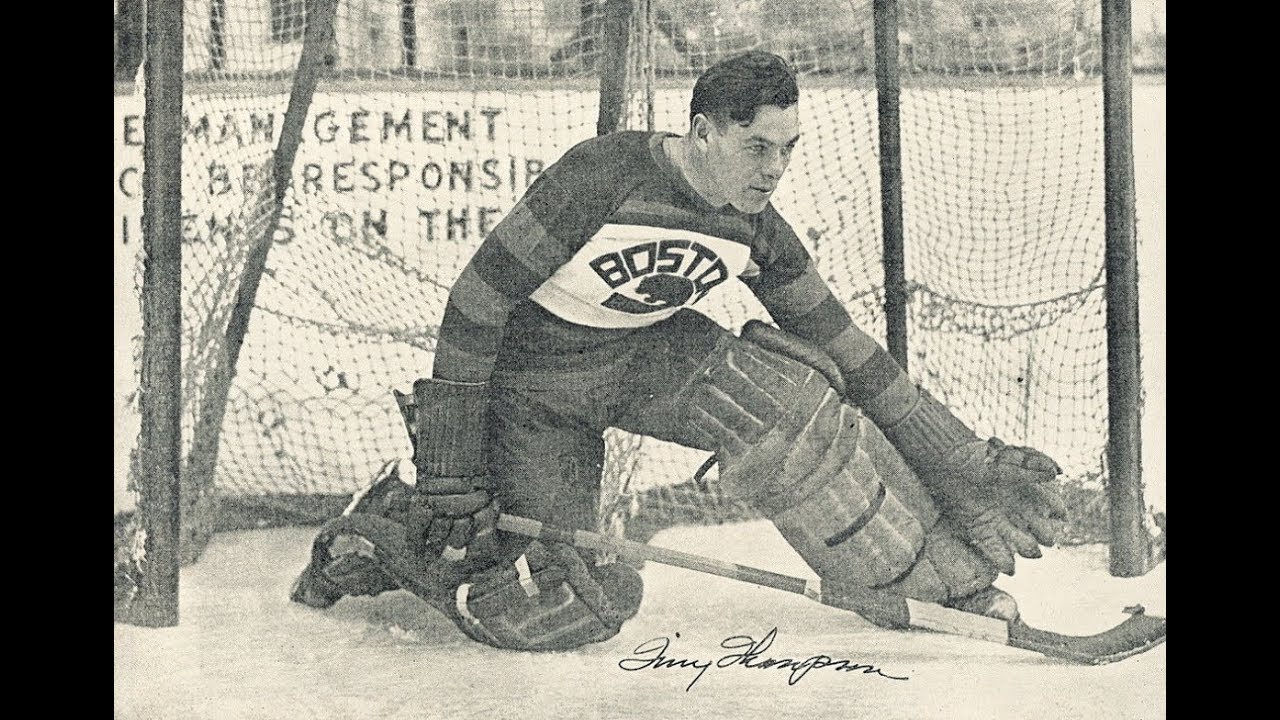
After shutting out the Canadiens twice in the semi-final, Tiny Thompson found himself again between the pipes for the first game between the Bruins and Rangers. The game, which was played at Boston Garden—at that time known as Boston Madison Square Garden—took place March 28, 1929. By the end of the night, the Bruins had their fourth straight win and were just one win away from their first Stanley Cup.
As for Tiny Thompson, he had his third shutout in four games, and became the second NHL goaltender to get a shutout in his Stanley Cup Final debut.
“The Bruins outplayed the New York team with a better exhibition of all-around play than was shown against the Canadiens. In justice to the Rangers it must be admitted they were very weary after their four play-off games leading to last night’s contest,” wrote John J. Hallahan of The Boston Evening Globe.
To be sure, the
Bruins had last played March 23rd, when they took the Canadiens out in game
three. Meanwhile the New York Rangers had to first defeat the New York
Americans before they took on the Toronto Maple Leafs (who defeated the Detroit
Red Wings). The Rangers played their final game against Toronto on March 26th
and two days later were taking on the Bruins in the Final.
While it was the first time the two teams were both American franchises, the teams themselves were made up mostly of Canadians, so Canada could continue to claim hockey as their national game and talk proudly of their native sons.
“With one or two exceptions every player setting a dizzy pace under the calcium glare of the big tent is a Canadian, and Calgary has contributed in no small way. ‘Tiny’ Thompson and Norman ‘Dutch’ Gainor, two home brews, who learned their hockey on Calgary school rinks and in the city leagues, were the big noise of the Boston Bruins’ five straight wins in capturing the Stanley Cup, emblematic of the world’s hockey supremacy,” wrote Bob Mamini, Calgary Herald’s Assistant Sports’ Editor.
Though Cecil “Tiny” Thompson was born in Sandon, British Columbia in 1903, his family moved to Calgary, Alberta by 1906, where his brother, Paul was born in 1906. When the puck dropped for that first game, the brothers were on opposite sides, as Paul—a forward—wore a Rangers sweater.
“As in the contests against the Canadiens, Tiny Thompson was a power against the Ranger rushers, especially shining in thwarting his brother, Paul. He made two really marvelous stops in the final period, off Bill Cook and Sparky Vail,” wrote Hallahan.
Indeed, if Tiny
hadn’t blocked those two in the third, who is to say what might have happened.
The first period saw no goals. It was during the second period that first Aubrey “Dit” Clapper and then Dutch Gainor gave the Bruins their two goals that Tiny made sure were enough to take the win.
“A lapse on the part of the Ranger defence resulted in Boston drawing first blood, Clapper doing the trick when he raced down and, after being worked into the corner, came out to pick up his own pass out to backhand past [John Ross] Roach. Gainor put his team two goals up when he secured his own rebound to beat Roach with a hard shot from a sharp angle,” reported The Winnipeg Evening Tribune.
In the end, it
could have been the onslaught of hits dished out by the Bruins that slowed down
an already weary New York Rangers team, but that didn’t stop them from putting
pucks on Tiny Thompson, who showed that he was big enough between the pipes to
keep the rubber out.
Tiny Thompson would play ten seasons wearing the Boston Bruins sweater and, when his time there came to an end, he had played 468 games and had 252 wins. His Bruins franchise record stood until 2019, when Tuukka Rask surpassed him. Rask played his 469th Bruins game when the Bruins took on the Chicago Blackhawks in the 2019 Winter Classic held at Notre Dame Stadium on January 1, 2019. A month later, February 3, 2019, in a 1-0 victory over the Washington Capitals at Capital One Arena in Washington, Rask earned his 253rd win.
Tiny Thompson was
inducted into the Hockey Hall of Fame in 1959.
Additional Sources:
- Bob Mamini, “Calgary Boys Set Dizzy Pace in Big Leagues,” Calgary Herald (Calgary, Alberta), Saturday, April 6, 1929, Supplement Section, p. 1.
- John J. Hallahan, “Bruins Defeat Rangers in Stanley Cup Game 2-0,” The Boston Daily Globe, Friday, March 29, 1929, pp. 1, 30.
- “Boston Draw First Blood in Stanley Cup Play-Off,” The Winnipeg Evening Tribune (Winnipeg, Manitoba), Friday, March 29, 1929, p. 9.
Decades before Frank Sinatra started crooning about heading for the Big Apple to be the king of the hill in the city that never sleeps, the New York Americans and the New York Rangers played a hockey game that went into the 4th overtime, keeping the 16,340 hockey fans well into Monday before a winner in the third game of the Stanley Cup quarterfinals could be determined.
Going into the game played Sunday, March 27, 1938, the teams were tied. The visiting Americans scraped out the first win, with a 2-1 score that went into double overtime on Tuesday, March 22. Two nights later the visiting Rangers took game two with a 4-3 win. Things returned to Madison Square Garden that Sunday to determine who would be moving on and whose season was coming to an end. The odds were on the Rangers, 8-1 in fact, to get the win.
The first period gave neither team an advantage, however it wasn’t because the teams were equally matched.
“Goalie Earl Robertson, and he alone, saved the Amerks and
kept ‘em in the game throughout the opening session. The A’s defenses were
perforated, their attack negligible. Only once did they break in close for a
shot while the Rangers rollicked inside the Amerk defenses from start to
finish,” wrote Gene Ward of what he called the “Subway Series.”
Coming back for the second period it was the Rangers who got
on the scoreboard first, when Alex Shibicky put one past Robertson at 6:27 of
the middle period, in part because Robertson’s teammate John Sorrell backed into him. Shibicky
was followed 1:04 later by Bryan Hextall to give the Rangers a 2-0 lead they
took into the second intermission.
After Robertson once again saved his team with impressive hustle to beat Ranger Phil Watson to the puck, sending it up toward the neutral zone, the Amerks began to fire back at the other end. A couple of failed shots took place before Lorne Carr “toured in with a flash of speed, baited [Dave] Kerr into making the first move, and fired as he cut across the face of the net,” wrote Ward of the Americans first goal at 4:36 of the third period.
Chances for both teams at either end of the ice had everyone wondering who would get the next goal. At 10:38 everyone had their answer—the Americans had tied the game. Eddie Wiseman put the puck on Kerr, who blocked the shot, only to find Nels Stewart there waiting to put home the rebound. Both Kerr and his fellow Rangers who were on the ice tried to complain to the referee that Stewart had been in the crease. The referee shook his head, called it a goal, and told the teams to play on. And play on they would.
The overtime periods basically gave the fans another full
game and still some extra time.
“Sunday soon became Monday and the teams drove their tired
limbs to a killing pace. Odds favored the younger Rangers to hold on for
victory but the veteran Americans never weakened,” wrote Bill H. Dumsday in The
Leader-Post.
It would be Carr again, scoring his second of the game—having given the Americans their first and last goals of a very important game—who would finally put an end to what was looking like a never-ending game. After three full overtime periods, it took Carr just 40 seconds into the 4th OT to send his Amerks into euphoric cheers and the Rangers into silence.
Afterwards, the Americans bench boss felt that they were on
their way.
“Nothing can stop us now,” Red Dutton said. “We’re as good
as winners of the Cup right now. The Rangers were the toughest—and they’re
behind us. We should breeze past the Hawks and win the finals.”
Though the Americans took their first game against the Hawks
3-1, Chicago came back to win the second game 1-0 in double overtime and the
third game 3-2. The Hawks advanced to play the Toronto Maple Leafs, beating
them three games to one to hoist the Stanley Cup for the second time.
As for the Americans? They played their final NHL season,
under the team name the Brooklyn Americans, in the 1941-42 season, finishing
dead last. They suspended the team for the remainder of the war years, but in
1946 the NHL cancelled the franchise.
Additional Sources:
- Bill H. Dumsday, “Rangers Beaten in Thriller,” The Leader-Post (Regina, Saskatchewan), Monday, March 28, 1938, p. 12.
- “Carr’s Shot in 4th Overtime Good for Semi-Final Berth,” The Times Herald (Port Huron, Michigan), Monday, March 28, 1938, p. 9.
- Gene Ward, “Rangers, A’s Tied In 3d Cup Match,” Daily News (New York, New York), Monday, March 28, 1938, pp. 34, 36.
There is a mystique that surrounds goaltenders. Many hockey
observers wonder what makes a player elect to have pucks shot at him and since
the era of the goaltender’s mask, even his face is obscured from the fans
throughout the game. Today’s goaltenders get head bumps from their teammates
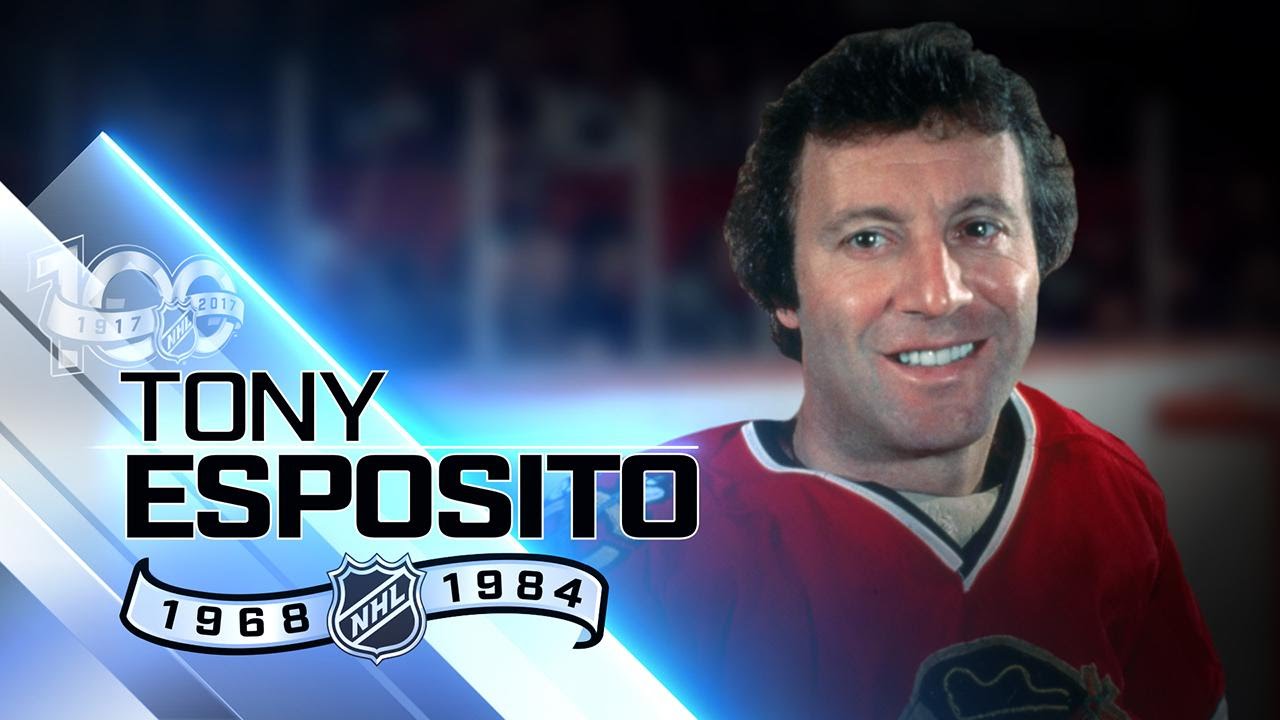
after a game, however in 1980 when Tony Esposito was frustrating the Blackhawks
opposition, a win meant stick taps to his shins and backside
“The Black Hawks staggered into Quebec Coliseum and
swaggered out,” wrote Chicago Tribune’s Neil Milbert. “They were skating
in their fourth arena in five nights Wednesday, so figured to be weary. They
were minus their best defenseman, Doug Wilson, out with a bruised right ankle.
They had played their worst defensive game of the season the previous night in
Montreal.”
Such was the emotion surrounding the Hawks as they were about to take on the Quebec Nordiques on March 26, 1980.
Originally Tony Esposito was scheduled to get the night off, having played in the previous three games, including what turned out to be an ugly 8-4 loss to the Canadiens the previous night. Instead, backup goaltender Mike Veisor was supposed to be guarding the crease. He had last played 20 games prior when the Black Hawks beat Colorado 4-2. After insisting that his father—who had been critically ill and was now worsening—would want him to play, Veisor discovered upon arrival in Montreal that his father had passed away. He was immediately given leave to fly to Toronto and Esposito was given a one-way ticket back between the pipes.
When the puck dropped on the game in Quebec it was safe to say Chicago was perhaps lacking a bit in confidence. By the end of the first period though, there was no question who the better team was. The Black Hawks managed to score four goals in the opening frame. Ron Sedlbauer got things going at 4:16. Then, while the Nordiques’ James Hislop sat for tripping, Mike O’Connell put up a power play goal at 8:07, with the secondary assist going to Sedlbauer. At 17:45 Tom Lyslak put the Hawks ahead by three and in what was becoming a bit of a pattern, one of the assists—this time the primary—went to O’Connell. Finally, with just 32 seconds remaining, and the teams playing four-on-four, Greg Fox notched the fourth goal, and yes, the cascade continued as Lyslak got the primary assist.
The Black Hawks showed no indication of slowing down when
they returned to the ice for the second period. Despite Quebec being on the man
advantage as Hawks defenseman Bob Murray sat for delay of the game, Alain
Daigle potted the short hander, while captain Terry Ruskowski got his second
assist of the game at 7:19. Ted Bulley, unassisted, gave the Hawks their sixth
marker at 14:26. As the teams headed off to the dressing rooms for the second
intermission, Esposito was on his way to his seventh shutout of the season.
Quebec’s Marc Tardif put an end to the potential shutout
when he got his 26th goal of the season and finally put the Nordiques on the
scoresheet just 45 seconds into the third. Grant Mulvey put the Black Hawks
back up by six goals, when his unassisted shot at 15:46 found the back of the
net. With under two minutes remaining in regulation, Reginald Thomas gave the
Nordiques their second goal of the game.
After the game, in which Esposito stopped 29 of the 31 shots
he saw, he wasn’t letting himself off the hook—even though his team had the
win. “I can play better than I did tonight,” he said.
Not everyone agreed with his assessment.
“Tony Esposito may be the key to the much-improved Chicago Black
Haws’ playoff hopes,” reported the Kenosha News. “The 12-year veteran
goalie turned in a characteristically fine performance in the Chicago nets
Wednesday night, kicking out 29 of 31 drives.”
While yes, it was certainly an impressive game for the Black
Hawks, what went unreported was that with that win Tony Esposito became the
first goaltender in NHL history to get eight 30-goal win seasons. His first
seven were consecutive, beginning with his first season as a Black Hawk during
the 1969-70 season and continuing through the 1975-76 season. And yet none of
this was mentioned the day after the game. Why?
Dave Isreal, columnist of The Minneapolis Star, had
his own theory about this.
“After all these years, Tony Esposito remains Chicago’s greatest civic sporting enigma, even while he thrives as the city’s most durable and successful athlete. Were he as skilled at playing baseball, football, basketball, or even left wing, Tony Esposito would own this town. But because he is a goaltender—and why in the world would any 6-year-old aspire to be a flesh and blood target?—Tony Esposito merely works here.”
The unsung hero to be sure. During his 12 years with Chicago
up to that point, the Hawks had made a meteoric rise in their division from
their last place standing the year before Esposito’s arrival. Over the previous
11 seasons, with Esposito’s help, the team finished first eight time, second once
and third twice. They made the playoffs every year.
While the 1979-80 season was Esposito’s eighth 30-goal win season, it would unfortunately be his last to get 30, or more, wins for the Black Hawks. He went on to play four more seasons with the team, missing that 30-win mark by just one win during the 1980-81 season, before retiring in 1984. He was inducted into the Hockey Hall of Fame in 1988.
Additional Sources:
- Neil Milbert, “Veisor happy dad saw him at best,“ Chicago Tribune (Chicago, Illinois), Thursday, March 27, 1980, Section 4, p. 1.
- Neil Milbert, “Hawks find perfect cure in Quebec,” Chicago Tribune (Chicago, Illinois), Thursday, March 27, 1980, Section 4, p. 1.
- “Esposito inspires Hawks,” Kenosha News (Kenosha, Wisconsin), Thursday, March 27, 1980, p. 28.
- David Israel, “Despite change, Esposito still the best,” The Minneapolis Star (Minneapolis, Minnesota), Tuesday, April 8, 1980, p. 7C.
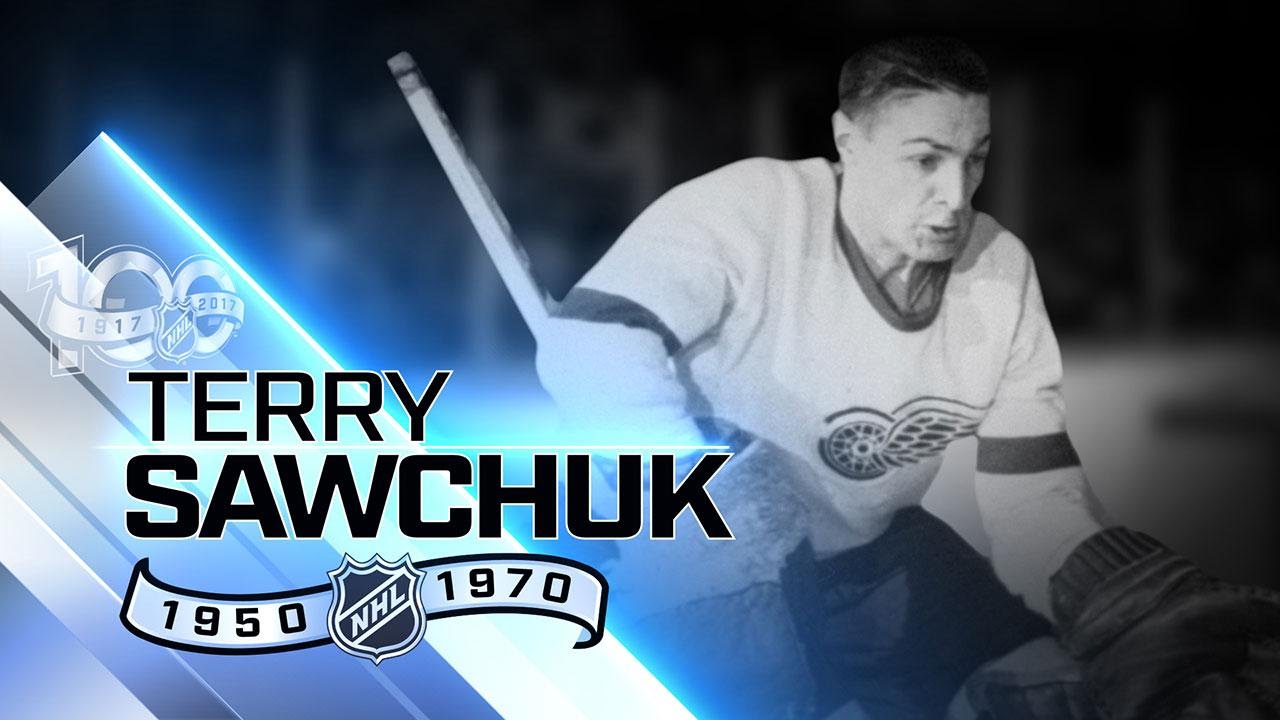
The reigning Stanley Cup champions of 1952, the Detroit Red Wings, were hoping to raise the silver chalice again in 1953. To do that they would have to first defeat the Boston Bruins in the semi-finals, which began March 24, at Olympia Stadium. When the game was over Sawchuk tied an NHL record with his third consecutive playoff shutout and the Red Wings may have been feeling a bit overconfident.
“Goalie Terry Sawchuk of Detroit was brilliant, starting out
this year’s playoffs in the same manner that he started last spring—with a
shutout—but the Toronto Maple Leafs were the victims in 1952,” wrote Lloyd
Northard.
The shots on goal at the end of the game were heavily in favor
of the Red Wings, who peppered Bruins goaltender Jim Henry with 43 shots, as opposed
to the 27 that Sawchuk saw. And according to Marshall Dann of The Detroit
Free Press there were “less than a half-dozen of which required extra effort.”
For Sawchuk it was not only his third consecutive playoff
shutout, but it was his fifth playoff shutout since the beginning of the 1952
playoffs in which the Red Wings garnered the Stanley Cup in just eight games.
The 1952 playoffs, in addition to the previously mentioned shutout in the first
game against the Maple Leafs, found Sawchuk with a 1-0 shutout, also against
the Leafs in the semifinals, and then two 3-0 blankings against the Montreal
Canadiens in the Final—all of which took place on home ice.
And while Sawchuk was denying the Bruins, his teammates were
putting pucks in the net and goals on the scoresheet—a total of seven.
“It was ‘no contest’ almost from the start. [Marty] Pavelich
struck after 2:39 of play, and he and [Ted] Lindsay made it 3 to 0 before the
game was 10 minutes along,” wrote Dann.
Pavelich had two of those three goals in the first period,
with his second coming just 31 seconds after Lindsay’s which was notched at
8:45. The middle stanza saw Alex Delvecchio make it 4-0 and then, showing no
mercy, the Wings added three more markers in the third from Metro Prystai, Johnny
Wilson, and Lindsay with his second. Meanwhile Gordie Howe assisted on two of
the goals.
“Three’s one way of looking at it, though. The old pros just
took charge. Marty Pavelich, Ted Lindsay and Gordie Howe really turned in a
great performance,” Wings general manager Jack Adams was quoted. “Actually we
just coasted after Marty scored his second goal and put us ahead, 3 to 0.”
In truth the Red Wings had had their way with the Bruins
throughout the regular season garnering a 10-2-2 record in their 14 tilts. And
it looked like they were going to continue that into the playoffs.
While the Red Wings took that first game in a deciding fashion, it was likely that the embarrassment the Bruins experienced from that game gave them motivation moving forward. The second game, played on March 26, saw the Bruins split the series when they beat the Wings 5-3 at Olympia. The games shifted to Boston for the third and fourth games in which the Bruins took game three 2-1 in overtime and game four 6-2. Game five was played back in Detroit and saw the Wings get the 6-4 win, but Boston ended the Wings dreams of a consecutive Cup when they finished the series with the game six winning score of 4-2. The Bruins fell to the Canadiens in a seven-game final.
The Red Wings would hoist the Cup again in 1954 and 1955, but then experienced a 42-year drought solved only after the Red Wings added the Russian Five.
Additional Sources:
- Lloyd Northard, “Wings Take Up Right Where They Left Off,” The Petoskey Evening News (Petoskey, Michigan), Wednesday, March 25, 1953, p. 7.
- Bob Latshaw, “Wings, Bruins Both Surprised,” The Detroit Free Press (Detroit, Michigan), Wednesday, March 25, 1953, p. 23.
- Marshall Dann, “Lindsay, Pavelich Get 2 Each,” The Detroit Free Press (Detroit, Michigan), Wednesday, March 25, 1953, pp. 23-24.
(Photo: YouTube)
At the beginning of the 1943-44 regular season, Montreal
Canadiens head coach Dick Irvin elected to combine three of his forwards into
what became a scoring trio that was almost unstoppable. Elmer Lach centered the
line with Toe Blake on his left and Maurice Richard on the right. A result of
their “scoring punch” this line has gone down in the history books as the Punch
Line.
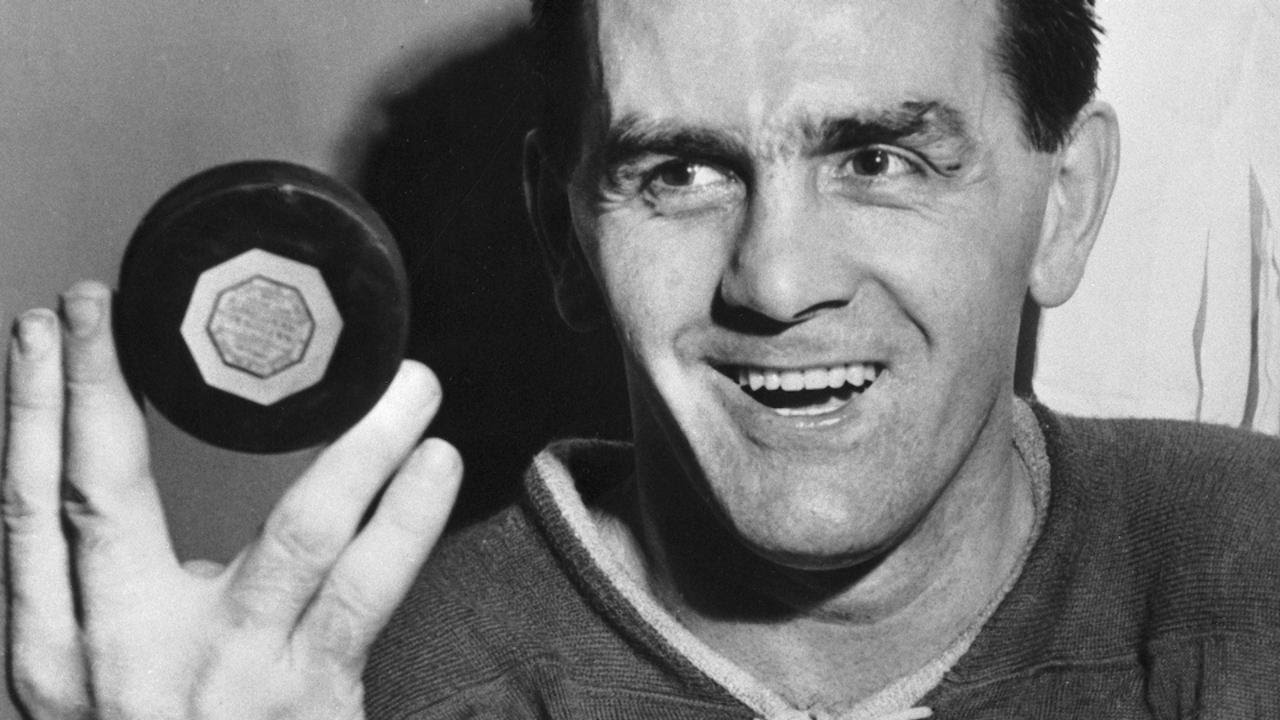
While it wouldn’t be until the 1944-45 season that Maurice
Richard would become the first NHL player to score 50 goals in 50 games, during
the 1944 playoffs he put on a scoring clinic during the second game of the
semi-finals against the Toronto Maple Leafs.
The game took place at the Montreal Forum on March 23, 1944, before a crowd of 12,243 fans who definitely got their money’s worth—well if they were cheering for the Canadiens. Going into the game, Montreal was down one game, having lost the first of the series two nights prior, falling 3-1 to the Leafs.
“It was a fighting mad Canaden team that hit the ice tonight,
and while the Richard-Lach-Blake line was outstanding, every Canuck turned in a
stellar effort. Bill Durnan was tops in the the nets and showed the crowd
tonight what he had failed to demonstrate in the opening game—why he took the
Vezina Trophy as the league’s leading goalie during the regular season,” wrote
Harold Freeman of The Ottawa Journal.
Going into the second game the Leafs believed that if they
could limit Richard’s scoring that they would be able to win the game.
Unfortunately, the “Rocket” didn’t get that memo and instead the Leafs found themselves
unable to do anything about Richard or the rest of his Punch Line linemates.
During the first game, Leafs defenseman Bob Davidson had been assigned the task of keeping Richard off the scoresheet, and it had worked so well, that their plan was to have Davidson do the same thing in the second game. However, Coach Irvin had decided how he could get around that approach by playing Richard on all three of his forward lines. That meant that Davidson couldn’t be out there to stymie Richard all the time.
“Half the time he was out there, Davidson was sitting on the
bench and Richard made a monkey of the younger Leafs who tried to take over the
task of shadowing him,” reported Dink Carroll of The Gazette.
Richard was kept off the scoresheet during the first period.
He notched his first goal 1:48 into the second period assisted by Mike McMahon
and Blake. Seventeen seconds later, Richard had his second goal of the game,
this time assisted by Blake and Lach. While Richard was sitting for the first
of his two penalties in the middle frame, Toronto was able to cut the lead in
half, when Reg Hamilton was able to get one past Durnan. However, Richard reinstated
the two-goal lead when he got his third goal of the game just 3:14 before the
end of the second period.
Richard’s fourth goal was scored at the one-minute mark of
the third period, while on the power play. And he went on to put a fork in it
and declare it done when he notched his fifth goal of the game at 8:54 of the
final period. And perhaps it was fitting that his fifth goal was the most
impressive.
“This time he grabbed Toe’s pass and went around Reg
Hamilton on one foot, circled over in front of [Paul] Bibeault and poked the
puck between the Toronto netminder’s slightly spread feet,” wrote Carroll.
“The veteran Hector (Toe) Blake was in on every Montreal goal and Elmer Lach was in on the last four. Mike McMahon got a point via No. 1, for all five were double-assist scores,” reported The Windsor Star.
Richard’s fifth goal of the game set a new record for number of goals by a single player in a playoff game and linemate Blake set a record for number of assists. Prior to Richard’s explosive scoring during this game the most goals scored by a single player during a playoff game had been three. Four players had been able to accomplish that: Bryan Hextall, Frankie Boucher, Busher Jackson, and Don Metz.
Richard also became the first player to be awarded all three stars of the game as a result of his five goals. However, The Ottawa Journal’s Freeman believed that some of the accolades and applause should have been given to Blake and Lach. “But while it was Richard who drew the thunderous applause of the sell-out 12,000 fans, it was hard working Elmer Lach and Toe Blake who set up the plays that brought the goals.” Freeman went on to refer to their passes as “flawless.”
The Punch Line continued through the 1947-48 season, ending
only when Blake retired. All three of them have been inducted into the Hockey
Hall of Fame: Richard in 1961, with Blake and Lach following in 1966.
Additional Sources:
- Dink Carroll, “Flashy Habitant Sets New Play-off Scoring Record—Lach, Blake Stand Out,”The Gazette (Montreal, Quebec), Friday, March 24, 1944, p. 16.
- Harold Freeman, “Richard’s Five Goals Set Record When Canadiens Beat Leafs,” The Ottawa Journal (Ottawa, Ontario), Friday, March 24, 1944, p. 19.
- “Richard Gets Every Goal, For Record, As Habitants Win 5-1,” The Windsor Star (Windsor, Ontario), Friday, March 24, 1944, Second Section, p. 3.
 Prev1...111213...412Next
  Page 12 of 412