The Stars are coming off of a fairly easy series where they defeated the Minnesota Wild in six games. Dallas won the series against the Wild by outscoring its opponent. The Blues are coming off of a brutal series with the Chicago Blackhawks that went seven games. St. Louis was the more physical team and got the opportune goals when they needed it. The two teams met five times in the regular season with the Blues going 4-1-0 in those meetings, while the Stars were only 1-1-3.
Dallas is still without star player Tyler Seguin, who came back for game two of the series against the Wild, but hasn’t played since because of injury. St. Louis is as healthy as one would expect a team that just went seven games in the first round of the playoffs to be.
The Stars have no problem putting the puck in the back of the opponent’s net. They had 21 goals for, which ties the Pittsburgh Penguins for the most goals scored so far in the postseason. Jamie Benn and Jason Spezza led the way with four goals a piece in round one. Patrick Eaves, Spezza and Benn each had more than five points in the previous series with Benn leading the way with 10 points. The Stars offense is missing a key piece in Seguin.
St. Louis is fourth in the postseason in goals scored with 19 of them. The Blues’ offense is spread out between the forwards and the defensemen. Vladimir Tarasenko leads the way in goals with four. Jaden Schwartz, Alex Pietrangelo and Tarasenko all have more than five points in the postseason for the Blues. St. Louis will need to get in on the forecheck because the Stars will give up goals.
Dallas will have to do a much better job defensively this series than they did against the Wild. The team can play a loosey-goosey style of defense throughout the course of a game. If the Stars want to have a chance in the series then they will have to tighten up and play better defense. In round one, the Wild came back from deficits in three different games that can’t happen against the Blues.
The Blues defensemen aren’t afraid to shoot the puck and will contribute in the offensive zone. If needed then they can also play physical and stay-at-home. The Stars will have its chances to get shots through to the net since St. Louis is giving up 36.6 shots against per game played this playoffs. Kevin Shattenkirk will look to bounce back from his round one performance, which wasn’t particularly great.
Kari Lehtonen and Antti Niemi have been splitting the goaltending duties all season long and that continued in round one. In four games, Lehtonen is 3-1 with a 2.27 goals against average and .911 save percentage. He also has one shutout in the postseason. In two games against the Blues he was 1-0-1 with two goals allowed in the regular season. Niemi is 1-1 in two postseason starts and has a 3.36 goals against average to go with a not so stellar .870 save percentage. In three regular season games against the Blues, he was 0-1-2 with 11 goals allowed.
Brian Elliott has been good for St. Louis in the net so far during these playoffs. In seven games, he is 4-3 with a 2.40 goals against average and a .929 save percentage. If he has been able to see the puck then he has been able to stop it. He did have one game against Chicago where he allowed six goals, but that was an elimination game for the Hawks in Chicago, who fed off the home crowd for a 6-3 win.
The x-factor for Dallas will be the way the defense plays. If they can play a tight, team defensive game then they will be able to hang around in the series. St. Louis’ x-factor will be the goaltending specifically Elliott. He was face a lot of shots and if he can play the way he did in round one then the Blues will have a chance to make it to the next round. St. Louis will have to keep an eye on Benn and be able to solve whichever goalie is in net for Dallas. The Stars are going to have to find a way to keep Vladimir Tarasenko off the board.
The Blues are going to play a physical style of hockey and the Stars just don’t match up well against them. The Blues will beat the Stars in six games to advance to the Western Conference Finals.
The 2015-16 season is over for the Philadelphia Flyers, but they will be missing one of its top six forwards to start the 2016-17 season.
Brayden Schenn was suspended for three games for charging T.J. Oshie, and it is unknown how much of his paycheck he will forfeit since he’s not under contract for next season. The hit came during Game 6 of the Flyers & Washington Capitals first round playoff series on Sunday, April 24, 2016. Schenn came flying into the corner and caught Oshie up high while leaving his skates. There was no penalty called on the play. Oshie went to the locker room following the hit, but he would return to finish the game. The series was a physical one and there was more than one questionable hit that could have been reviewed by the NHL’s Department of Player Safety.
In Game 3, Pierre-Edouard Bellemare sent Dmitry Orlov into the boards from behind and was suspended one game for the act. Orlov was hit and stayed down afterwards. Ryan White legally hit Brooks Orpik in Game 3 against the boards and Orpik has been out since with an injury. Schenn and other Flyers had thrown some hits that Barry Trotz and the Capitals weren’t particularly happy with so they sent video of those hits to the NHL, who was watching Schenn closely during Game 6. Schenn did leave his skates and caught Oshie up high so the play should have been reviewed by the NHL, but there were some other hits thrown by the Capitals that weren’t even looked at by the League that were worse.
Jake Voracek was away from the boards trying to get a loose puck and Jason Chimera came up and drilled him into the boards head first. Voracek was down for a few seconds, but got up and skated over to the Philadelphia bench. There was a 2:00 boarding penalty called on the play. If Voracek had stayed down, would the penalty have been 5:00, and would it have been reviewed by the League? It seems as though the League only reviews hits if players get hurt or stay down on the ice and don’t pop right back up. Shayne Gostisbehere was caught by Alex Ovechkin with a knee-to-knee hit, but because Gostisbehere managed to avoid most of the hit attempt, there was no penalty called on the play nor was it reviewed by the NHL.
The NHL Department of Player Safety has been so inconsistent on which hits and plays get reviewed and which ones don’t. They need to become more consistent, and the players need to be smart, before a players gets seriously hurt because of either a hit to the head or a check from behind into the boards.
It’s that time of year again and once NHL Playoffs come to a close, the 2016 NHL Awards will take place in Las Vegas. On June 22nd, Will Arnett and this season’s top players will take the stage at the Joint inside the Hard Rock Hotel & Casino.
“I’m excited to host the 2016 NHL Awards because we all know in 2017 I’ll be too busy celebrating the Leafs winning the Stanley Cup®,” said Arnett in a statement released from the NHL.
This year will be the first year that the NHL Awards will be hosted at the Hard Rock Hotel. The event has previously been held at the Palms Hotel (2009-2011), Encore at Wynn Las Vegas (2012, 2014) and the MGM Grand (2015). A successful partnership between the National Hockey League and the city of Las Vegas has continued on for years and they anticipate it for years to come. This will be their seventh year in partnership.
“We look forward to being back in Las Vegas, which has been an ideal destination for our NHL Awards celebration,” said Steve Mayer, NHL Executive Vice President and Executive Producer of Programming and Creative Development per the NHL. “The end of June marks a special time on the NHL calendar for our players and their families, fans, partners as well as our Clubs. By adding the talents of Will Arnett and a new, exciting setting at the The Joint at Hard Rock Hotel, the League hopes to make this year’s show the best one ever.”
The finalists for the awards are to be announced each day beginning on April 27th with the Vezina Trophy. The list below are the dates that each categories finalists will be announced.
Wednesday, April 27
Vezina Trophy (top goaltender)
Thursday, April 28
Selke Trophy (forward who best excels in the defensive aspects of the game)
Friday, April 29
Norris Trophy (top defenseman)
Saturday, April 30
Lady Byng Trophy (player best combining sportsmanship and ability)
Sunday, May 1
Masterton Trophy (perseverance and dedication to hockey)
Monday, May 2
Calder Trophy (top rookie)
Tuesday, May 3
NHL Foundation Player Award (community service)
Wednesday, May 4
Mark Messier Leadership Award
Thursday, May 5
Jack Adams Award (top head coach)
Friday, May 6
Ted Lindsay Award (most outstanding player as voted by the players)
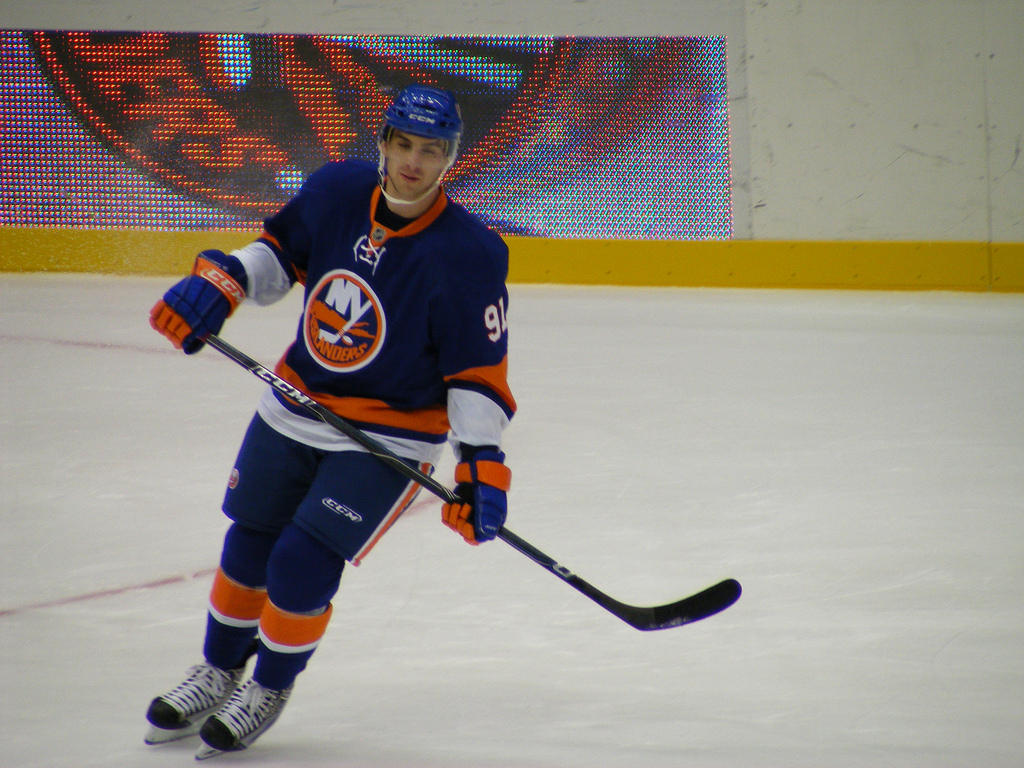
If there was still any question about whether the New York Islanders should have taken defenseman Victor Hedman 1st over all in the 2009 NHL Entry Draft, John Tavares has silenced those critics. In a series where neither team seemed able to take control of a shift, period or game, John Tavares took over Game 6 in Brooklyn with two clutch goals. And now, his team is moving on to the second round for the first time in over 20 years – to face Hedman’s Tampa Bay Lightning.
What stands out about Tavares is not how flashy he is – perhaps the reason that he is significantly underrated around the league – but his awareness and prowess on the ice. Outside of their significance at the time of the game, neither of his goals were full of stick work or trickery. They were heady, right time, right place, right decision goals and it’s why he is the cornerstone of this franchise. His intensity and effort level throughout the series seemed to will his team to victory even when it felt as though they were overmatched by a very skilled Florida Panthers team.
After Jonathan Huberdeau gave the Panthers another first period lead, scoring his first of the Playoffs, the game became about the goalies. Thomas Greiss and Roberto Luongo stuffed chances as the teams continued the trend of back and forth hockey. It wasn’t until under a minute left in the game that another red light came on. Greiss finished with 41 saves while Luongo grabbed 49.
With Greiss out of the net for the extra attacker, the Islanders were struggling to get the puck out of their zone and in fact gave the Panthers a handful of chances on the empty net before defenseman Nick Leddy gained control of the puck. It was as Leddy rushed up the ice that Tavares could finally get off the bench, replacing a fatigued Kyle Okposo. As Leddy drove into the offensive zone and played the puck across the crease, Tavares was just crossing the blue line. Matt Martin kept the puck alive and while the Panthers and Roberto Luongo thought the puck was underneath the Florida net minder, it was Tavares who was standing at the back post to put home the rebound which had slid free.
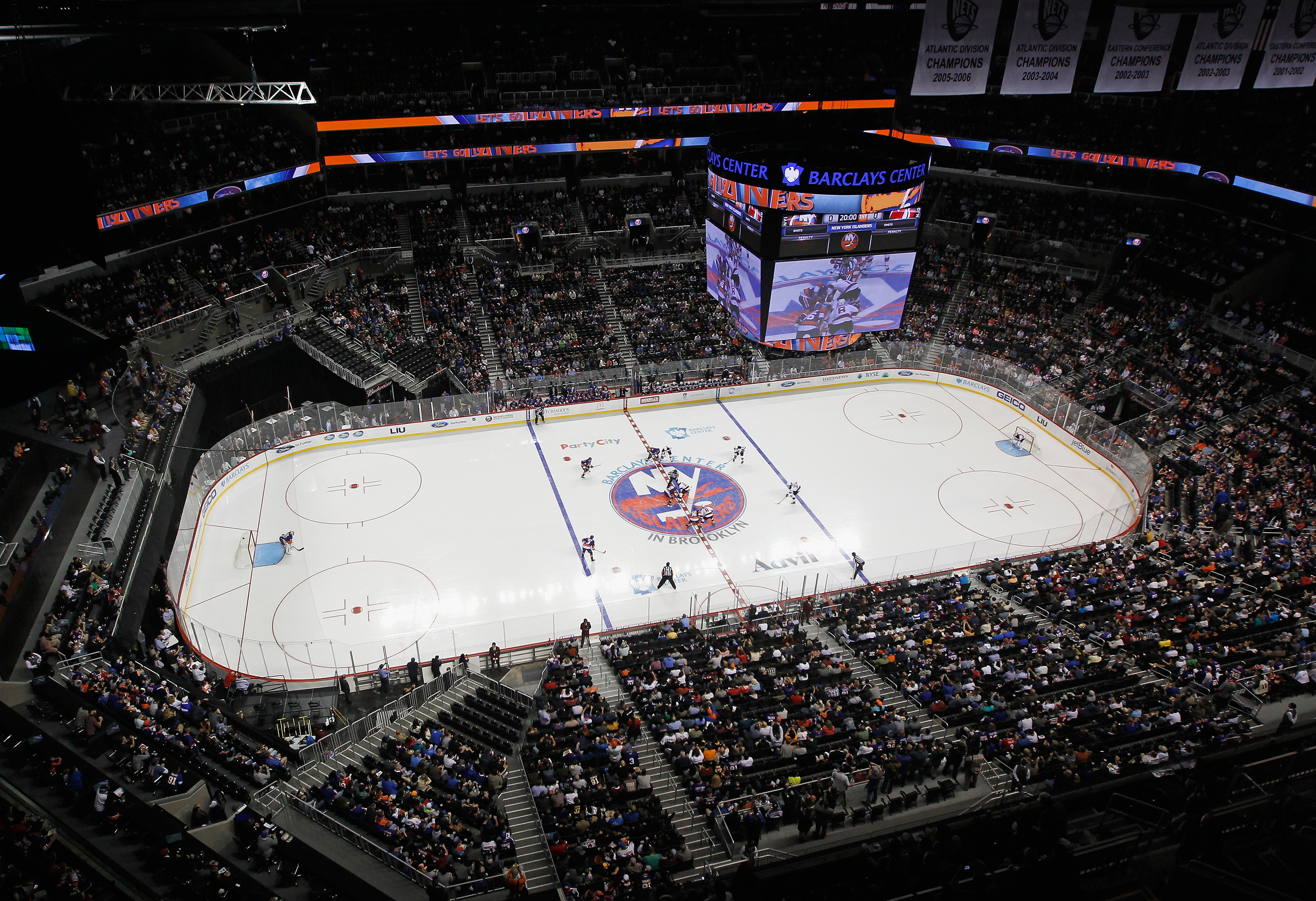
The Barclay’s Center was electric as the first OT started, reminding many of those famous playoff runs that took place at the Nasseau Coliseum. The Islanders had numerous opportunities in the period but could not beat Luongo who stopped Alan Quine, Shane Prince and Brock Nelson on each of their respective chances. The second OT seemed to tilt the ice the other way as Florida’s young forwards – and Jaromir Jagr – came alive. Riley Smith rang one shot off the crossbar and the likes of Huberdeau, Aleksander Barkov and Vincent Trocheck forced the Islanders goalie into some key saves.
Then it was time for Tavares. With just under 10 minutes gone in the second overtime, Okposo brought the puck into the zone along the boards before feeding Tavares who was driving through the slot. Tavares took a quick shot which Luongo was able to deflect behind the net with his leffort pad. But Tavares, always seeming to be a step faster and fresher than those around him, beat Aaron Ekblad to the puck and wrapped it around, tucking it into the net before either Brian Campbell or Luongo could get across. And pandemonium ensued.
Tavares finished the series with 5 goals and 4 assists, the highest point total on either team and only behind Huberdeau in shots. The Islanders supporting cast will need to step up offensively if they are going to make a deep run in the Playoffs. However, at this point it seems that John Tavares’ will may be enough to carry them for now. And as he goes head to head against Hedman, we may finally get a definitive answer to who is the better player.
The majority of players in Game 5 between the Islanders and Panthers were feeling the fatigue of 95 minutes of hockey. But not John Tavares. The Islanders captain drew his second penalty of double overtime, the latter ultimately giving the Islanders a 3-2 series lead. Tavares continued to be one of the strongest skaters on the ice and forced Derek MacKenzie into taking a slashing call with five minutes left in the period. With the penalty winding down, the Islanders moved the puck around the perimeter before Marek Zidlicky, playing in his first game of the series, found Alan Quine at the top of the right circle. The rookie beat Roberto Luongo short side for his first career Stanley Cup Playoffs goal, and gave the Islanders their first Game 5 win in their last 11 tries.
Alan Quine
While Quine will get the headlines, it was Thomas Greiss who deserves the credit. After a handful of shaky starts, the Islanders netminder stopped 47 of 48 shots and looked very confident in net. Most notably, following Calvin deHaan‘s penalty in the crease, Greiss stopped the Panthers’ Aleksander Barkov on a penalty shot during the first overtime. He also stopped a handful of odd-man rushes during both overtime periods, continuing to give his team a chance to steal a victory.
Game 5 featured a couple new faces for both teams as Jack Capuano and Gerard Gallant searched for the perfect combinations. Capuano added Zidlicky to the line up in place of the injured Ryan Pulock who is out 1-2 weeks with an upper body injury. In a more surprising move, forward Ryan Strome was scratched for veteran Steve Bernier. The Panthers were able to add another one of their young stars in Vincent Trocheck who returned from injury.
Frans Nielsen opened the scoring for New York, putting the Islanders up 1-0 with 7 minutes remaining in the first period. This was the first time in the series that the Islanders did not concede the first goal. Nielsen began the zone entry but ultimately it was defenseman Thomas Hickey who got a shot off towards Luongo. Nielsen, crashing the net, was able to put home the rebound for his third of the playoffs.
It was Game 4’s hero, Alex Petrovic who set up the Panthers lone goal. Following a stretch of pressure from the home team, Petrovic found Barkov at the far post who redirected the puck into the empty net to tie the game at 1.
If the Islanders can continue to get great goaltending from Greiss, with the magic of John Tavares, they can go far. They return to Brooklyn on Sunday to try to close out the series and face the resting Tampa Bay Lightning. However, the back and forth nature of this series suggests not to count on anything more than John Tavares doing everything he can do to carry his team forward.
The Blackhawks crashed and burned at home Tuesday night, giving the Blues a 3-1 series lead and landing one of their postseason points leaders a suspension as they head into Game Five.
On the stat sheet, the Hawks were outhit 48-28. Off the sheet, they absorbed more subtle annoyances–slashes, cross-checks, spears, little late hits after the play–all devices filling them to the brim with with frustration. Correction: over the brim.
The normally level-headed team’s balloon of composure burst.
And it cost them one of the more effective forwards of the postseason so far–Andrew Shaw. He’s had four points in the four games, including a goal and two assists Tuesday. His net-front presence has no doubt benefited the Hawks’ limp offense.
With 2:04 left in the game, Shaw, known for being the kind of irritant that earns a nickname like “the mutt,” was called for interference when he responded to a hold near the net by pushing Jay Bouwmeester into the crease–a less violent version of the hit to the head Troy Brouwer gave him much earlier. A bit of a scrap followed, but his was the sole penalty called, leaving the Hawks shorthanded and Shaw enraged.
He threw a fit, raising his gloves in a “middle finger” gesture toward the officials on his way to the box. And, once inside, he tossed water bottles, and was shown on camera using inappropriate language.
During post-game he claimed not to remember what he said in the heat of the moment, but issued a statement Wednesday morning, saying his behavior kept him up the night before.
“I am sincerely sorry for the insensitive remarks that I made last night while in the penalty box. When I got home and saw the video, it was evident that what I did was wrong, no matter the circumstances. I apologize to many people, including the gay and lesbian community, the Chicago Blackhawks organization, Blackhawks fans and anyone else I may have offended. I know my words were hurtful and I will learn from my mistake.”
The Blackhawks issued a statement of their own:
“We are extremely disappointed in Andrew Shaw’s actions last night. His comments do not reflect what we stand for as an organization. We are proud to have an inclusive and respectful environment, and to support various initiatives such as the You Can Play Project and the Chicago Gay Hockey Association. We will use this opportunity to further educate our players and organization moving forward, so that we all may learn from it.”
“Even with all the restrictions in place in the modern sports media landscape, I have a bead on what kind of guy Shaw is after covering the Hawks for a full season. He doesn’t hide when the media enters the dressing room. He will stick around and talk for a few minutes and seems to enjoy the interaction. A number of times this season, I’ve gone to him just to talk and see how he’s doing. I always look forward to seeing him in the room and chatting.
Certainly, I was disappointed when I saw video surface of Shaw using the slur. He was vilified on social media, but I don’t want to cast stones. He has a reputation around the league for being an irritant on the ice, but I don’t think he’s a bad guy. I also don’t think he hates gay people. I just want to help him understand why what he said packs such a devastating emotional wallop…
“Shaw and I talked things over after his apology.
He was heartfelt in his pledge to learn from this, to stop using the word no matter how riled up he gets on the ice. I told him I didn’t view him any differently Wednesday than I did Monday. I’m still going to see how he’s doing when he’s in the locker room and still will pester him with hockey questions.”
Shortly after Shaw’s apology, the NHL announced Shaw’s punishment–a one-game suspension and $5,000 fine. He will also undergo sensitivity training. As said by NHL Senior Vice President of Hockey Operations Colin Campbell:
“While Mr. Shaw was apologetic and remorseful for both the offensive comments and the inappropriate gesture directed at the on-ice officials, he must be held accountable for his actions. The emotion of the moment cannot and will not be a mitigating factor for the conduct that is expected of an NHL player.”
This isn’t something Shaw or the Blackhawks will be taking lightly in the future.
“We can all be a little more conscious of the impact that word might have, and know that it can be used loosely,” Captain Jonathan Toews said. “I think we’re all thinking about that much more than [we had] before. And we stand behind Shawzie and who he is as a person, and behind his apology, as well.”
Though the league set an example with Shaw, the knowledge his actions hurt people around him was obviously significant outside the game.
It was significant within the game Tuesday as well. Here’s what happened.
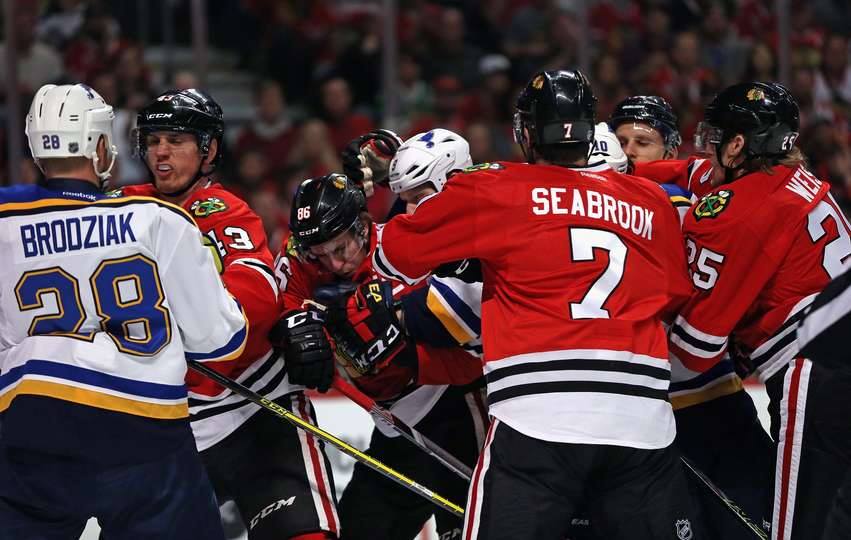
Shaw’s penalty led to the close of the game, which ended with a 4-3 Blues victory and flurry of roughing penalties, game misconducts, and a spear between his legs courtesy of Alexander Steen.
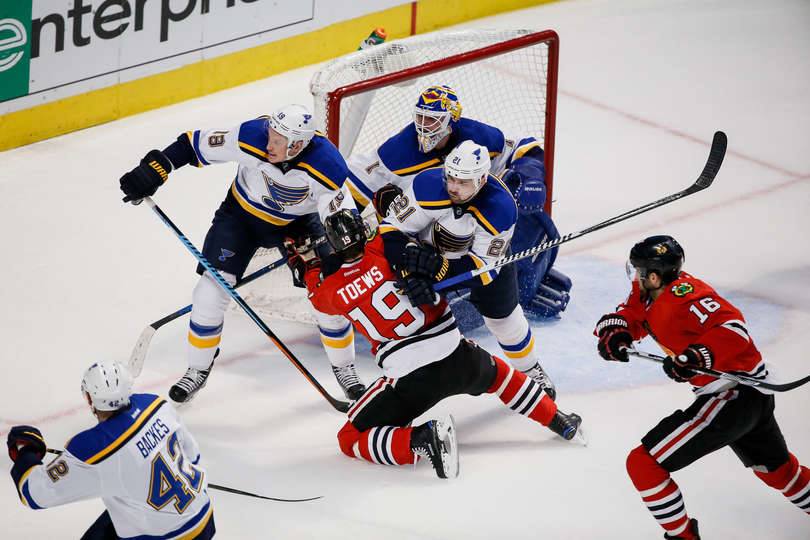
But earlier, it was goalie Corey Crawford, who felt he’d taken one too many hits to the head and it was time to take matters into his own mitts.
With the game tied 1-1 in the second, Crawford took umbrage to Robby Fabbri striking his head in the crease.
A fracas broke out and, ultimately, Fabbri was sent to the box for goaltender interference–an incredibly inconsistently called penalty–giving the Blackhawks a power play while Alex Pietrangelo, Kevin Shattenkirk, Andrew Ladd, and Crawford were called for roughing.
The Hockey
Duncan Keith scored on the power play, giving the Blackhawks a 2-1 lead with Shaw and Patrick Kane helpers.
This followed an even-strength goal about halfway through the second when a Marian Hossa shot deflected off of Shaw past goaltender Brian Elliott. Erik Gustafsson was also credited with an assist.
The Blues struck first about six minutes into the game, when Vladimir Tarasenko took a Jori Lehtera pass from behind the net and fired in a shot from the right faceoff circle.
Seabrook beaten to the puck by Lehtera, then screens Crawford for the shot. https://t.co/4NLaj8Px06
Then, about three minutes later, Steen scored on a breakaway from a bad turnover with the Michal Rozsival and Trevor van Riemsdyk defensive pairing, giving the Blues a 4-2 lead.
With just over five minutes remaining, Shaw passed up to Artemi Panarin, who dished to Keith at the blue line for a one-timer that deflected over Elliott for a 3-2 game.
Alas, the Blackhawks would not recover from the end of game penalty kill, even with a Blues empty-net goal being called back. The game closed with more fisticuffs and 14 penalties assessed after the final buzzer.
For many, that would be distasteful.
Ken Hitchcock: “This is fun. This is what hockey’s about.”
It seems Chicago has played right into St. Louis’ hands. They’ve fallen for every trick and now they’ve dug themselves a very messy hole of shame and regret.
What’s ahead
They’ll be going into Thursday’s game “go win or go home.”
“We want to win the game [Thursday] night,” Toews said. “And the way we do that is not losing our cool, and focusing on the task at hand, and playing the way we know how to play the game, and focusing on the details of the game. You can’t do that if you’re losing your temper, your emotions. Obviously, at the end of the game last night it was at an all-time high I think for all of us, even on the bench and on the ice. But going forward we need to focus on what we need to do and keep ourselves in check in more ways than one.”
“We just have to look back to what has made us a successful team over the last number of years,” Toews told the Tribune. “There are some details present, and there are some that haven’t been in games we have lost.”
They can’t seem to get bounces to go their way this season, for example.
“I don’t know if there’s extra pressure,” Quenneville said. “When you’re down 3-1, I think it shifts, and everybody wants to win in the worst way. We’ve got to come with that attitude and appetite [Thursday] night. But I don’t think it’s any different than it’s been in other years.”
But the Blackhawks haven’t shown that hunger yet. There’s been no comeback magic. So far this postseason, veterans Toews, Kane, Hossa, and Ladd have been held scoreless.
They can’t crack Elliott. Shaw’s screens have provided the cover they needed for multiple goals in the series and he’ll be out for a potential elimination game. Someone has to be at the net to screen Elliott and/or redirect the puck. The Blackhawks also have to chase their shots and hammer at some rebounds.
They’re also not behaving themselves.
“Part of that is things that happen after the whistle; and it’s stuff that we’ve always done a good job of staying away from and keeping it between the whistles,” Toews said. “It’s just focusing our energy and our emotion in to the play that we bring on the ice. That’s what we’re going to need (Thursday) night.”
That leads to penalties, and special teams has been lacking–despite the return of Marcus Kruger, the penalty kill unit has allowed four power play goals on seven attempts in two games.
The Hawks’ defense is disappointing. Blues are also scoring off of rebounds. They’re scoring off of Blackhawks defenders. The Hawks simply aren’t clearing the puck, giving the highly-skilled Blues offense too many scoring chances. That’s where the failure to acquire strong defensive replacements is hurting the team. Keith, Seabrook, and Niklas Hjalmarsson can only do so much–and it’s leading to errors even by those skilled defensemen.
Quenneville will likely be mixing up the lineup for Game Five–the morning skate showed a variation from previous games.
Game 4 of the Eastern Conference First Round felt eerily similar to the first three games of the series. Florida scored first, the teams went back and forth exchanging chances but neither ever really felt like they were in control of the game. And eventually, time ran out on whichever team happened to be behind.
With the Islanders coming off their dramatic overtime win in Game 3, including the controversial overturn of a Panthers goal, New York was hoping to take a 3-1 lead in the series in front of their home fans. Even with a raucous crowd, the Islanders came out flat once again; however unlike Games 1-3, they did not concede an early goal. Each team had a power play in the first period, both nearly scoring, and also giving up short handed chances. But for the first time in the series, neither team scored before the break.
The second period saw more penalties, more end to end action and finally some goals. There was also more controversy. Jaromir Jagr sent Jonathan Huberdeau on a breakaway with Islanders defenseman Ryan Pulock in pursuit. Thomas Greiss made the initial save but as the mass of humanity crashed into the net, the puck ended up over the line. There was no goal call on the ice, and the play was reviewed and upheld by the NHL Situation Room. Panthers Head Coach Gerard Gallant challenged the play and was again denied by the referees – losing his timeout for what seemed to be an obvious result. While it looked as if Pulock gave Huberdeau a shove into Greiss, the ruling was that Huberdeau interfered with Greiss’ ability to keep the puck out of the net.
Later in the period, Florida capitalized on a Matt Martin penalty with Jagr setting up Teddy Purcell for the 1-0 lead. The assist gave Jagr his 200th career playoff point, putting him 5th on the all-time list. With time running out in the period, Aleksander Barkov and Dmitry Kulikov took back to back penalties giving the Islanders a 5 on 3 power play for 39 seconds. The Islanders poured on the pressure and just as Barkov returned to the ice, John Tavares tied the game at 1. Continuing his stellar play, “JT” earned his 7th point of the series, stick-handling in tight on Roberto Luongo before roofing the puck short side.
Again, in the third period, the teams exchanged penalties and chances with both Greiss and Luongo making key saves. With 10 minutes left in the game, Florida defenseman Alex Petrovic beat Greiss far side after deking from the point to clear the shooting lane. Not known for his scoring prowess, Petrovic’s wrist shot proved to be the game winner as the Islanders could not convert against Luongo even with a power play and numerous chances at the Florida net as time ran out.
Game 5 takes place on Friday back in Sunrise, FL. There is no reason to expect that game to be any different than its predecessors as these two young, speedy and inconsistent teams fight for the 3-2 series lead.
The Philadelphia Flyers were on the verge of getting swept so Dave Hakstol decided to make a change in goal.
Michal Neuvirth made 31 saves in the game and 12 of them came in the third period alone. Neuvirth had to make some key saves and some came in close. The goalie made the saves he needed to make early on and came up with some huge ones later in the game. Philadelphia also did a better job of playing defense, blocking shots and getting sticks in the passing/shooting lanes to deflect the puck.
The Flyers got an early power play chance in the first period and cashed in. Shayne Gostisbehere,the birthday boy, let a blast go from the point with Wayne Simmonds in front of Braden Holtby and scored the Flyers first power play goal of the series. Barry Trotz challenged the play citing goalie interference, but lost it along with his timeout. Gostisbehere became the youngest defenseman (23) to score a playoff goal since Janne Niinimaa (21) back on May 16, 1997, according to Elias Sports Bureau. The Orange and Black went into intermission with a 1-0 lead, which is the first time that has happened in the series.
There was a scary moment during the first period in which Scott Laughton and John Carlson were racing after a puck, Laughton lost his edge and fell into the bottom of the boards, shoulder and back first. Laughton was taken off the ice on a stretcher to a standing ovation by the fans and stick taps by players on both teams. It was announced during the local broadcast of the game that he was on his way to a local hospital.
In the second period, Gostisbhere skated the puck into the zone and dished it off to Brayden Schenn along the boards. Schenn took the shot, Holtby made the save, with the rebound going to the corner. Simmonds beat out his man in the corner and got the puck back to Andrew MacDonald. MacDonald took the point shot, which appeared to be deflected by a Capitals’ player’s stick and into the back of the net. The Flyers had a 2-0 lead to start the final 20 minutes of play.
The Caps started to make its push in the third and scored just 2:38 into the final period. The puck came up along the boards to the point where Karl Alzner found it and made the pass to Matt Niskanen. Niskanen let a shot go from the point, Neuvirth made the save, but the rebound went to T.J. Oshie who found just enough space to put the puck in the net. The Capitals had several chances to tie the game, but Neuvirth stood tall and made 12 saves during the final period. His best save came against Tom Wilson, who found an opening in front, grabbed a loose puck and fired point blank. Neuvy had his glove on top of his pad and made the save.
The series will shift back to Washington, DC and the Verizon Center on Friday night with the Capitals leading the series three game to one.
With a 3-1 lead on the series, the Tampa Bay Lightning are exactly where they want to be. Come Thursday evening, they will have an opportunity to advance to round two of the Stanley Cup Playoffs. With home ice advantage and a 3-1 lead, the Lightning will aim to buy themselves some downtime, but it won’t come without a fight from the Detroit Red Wings who captured their only win of the series on Sunday with a 2-0 win on home ice.
Of course the Lightning are looking for a win, closing out the series early, to allow their players a few days extra rest, a luxury any team would appreciate during a playoff run.
“You get so wrapped up in the playoff series, to have the opportunity to end it in 5 games just gives you rest — everybody gets to regroup and reload for the next round, instead of the continuing grind and having to jump into a new series,” said Head Coach Jon Cooper. “We weathered it last year, by the end of the Stanley Cup Finals you’re just drained. We have the opportunity and it is in our hands to make this happen. We know what the Red Wings are capable of doing, and we saw that in Game 3. We have to be prepared that they’ll come out the same way in Game 5.”
Thus far, the team has found success across the bench, but it has been the outstanding play between the pipes of Ben Bishop that gives the Bolts continued confidence. A product of the University of Maine, the 29-year-old goaltender has proven his worth the last few seasons in Tampa, becoming a role model to teammates and a driving force to rely on.
“Bishop has been great for us, he gives us a sort of confidence as a leader on the team,” said Lightnings’ Alex Killorn. “He’s very reliable, you know that he’s going to show up – if you do your end, things are going to turn out well. Bish has been huge for us this season and playoffs, and I think he’s going to be an MVP for us.”
Those sentiments run deep through the coaching staff and Bishop’s teammates, and if the Lightning advance, a legion of NHL fans will see what all the fuss is about.
“Its not until you get to the playoffs that everyone gets to see Bish[op] play. If we hopefully get to keep moving on, there will be more appreciation for Bish. There’s no way it’s going to go unnoticed.” — Coach Cooper
Backed into a corner, it will be an uphill battle for the Red Wings on Thursday night, and a key to avoiding elimination will be figuring out a way past their oppositions penalty kill. A team that is currently sitting on a PK of 95.2% during the 2015-16 Stanley Cup Playoffs, and 84% during the regular season — it is safe to say that Tampa Bay has their PK somewhat figured out.
“Guys are sticking to structure and sticking together out there,” said Lightnings’ Andrej Sustr. “It’s a big part of a team’s success to have a good PK.”
The Lighting will look to use their continued PK success and close out the series tomorrow night at 7 pm. If the Red Wings manage to hang on, they’ll force a Game 6 which is still TBD.
Two third period goals propelled the St. Louis Blues past the Blackhawks in Chicago Sunday afternoon, regaining the series lead (2-1) with a 3-2 victory.
But, more significant than this “streak,” the Blues showed that they can steal the upper hand with their backs against the wall and suck the wind out of the Hawks’ sails.
“We’ve come back so many times,” St. Louis coach Ken Hitchcock said. “I don’t know what we’ve done, seven or eight already this year. It just doesn’t seem to be a big deal with this group. We’ve got a lot of resiliency in us.”
Resiliency had been trademark Blackhawks in recent seasons; but, this year has been a different story, as they’ve struggled against the rest of the west and energy has visibly dwindled as the clock ticks down.
Game Three
Following the traditional Chicago anthem, Blackhawks defenseman Brent Seabrook started the game off the way the 22,000-plus fans wanted to see it, with a franchise record-breaker.
Just 2:18 after puck drop, he shot through traffic from the center of the blue line and past an Andrew Ladd screen to score on Brian Elliott for a power play goal. The first goal of the game was set up by a Patrick Kane to Captain Jonathan Toews to Seabrook play.
But, the Blues would balance the score about 10 minutes later with a power play goal of their own. After going 0-for-5 on the power play, Defenseman Colton Parayko fired a scorching one-timer past goalie Corey Crawford after a Robby Fabbri faceoff win and a dish from Alex Pietrangelo. It may have been helped by Blackhawks forward Tomas Fleischmann.
The second period seemed to be in Chicago’s favor–they led in shots 24-13–but all they had to show for it was an early goal.
In the first minute, Elliott was barraged with shots. Four seconds later, Artem Anisimov, having just been kicked out of the faceoff circle, got one past him with a setup arranged from Artemi Panarin‘s first NHL faceoff–a failure.
Panarin made no effort for the dropped puck, but instead chased and pickpocketed it from the Blues in the corner, passing it to an open net-front Anisimov, who swatted the wobbly puck past Elliott.
The two comrades seemed to orchestrate the play when Anisimov was thrown away from the dot.
Q on Panarin’s faceoff play on Anisimov goal: “I loved the thought process, May end up utilizing him a little more. Pretty smart play.”
And then the third period happened. St. Louis took charge with an early message and a final statement. They led the period in shots 14-12.
Patrik Berglund knotted the score just under five minutes into the third with a shot that hit defenseman Michal Rozsival‘s left skate before bouncing on the ice and over Crawford’s glove.
An errant pass by Rozsival leads to this Berglund goal that bounces off of Rozsival and fools Crawford.
“Stuff happens in games and playoffs,” said Crawford, who made 33 saves. “You have to try to not hang onto moments like that and let that affect you. We were in control of that game and that’s a tough one. A wicked, wicked bounce. You just somehow have to not let that get in your way and keep playing.”
The rest of the period would feel like a penalty kill for the Blackhawks. But, the nail in the team’s coffin would be an actual penalty kill–a double minor when Kane drew blood on Pietrangelo with a high-stick.
“I was trying to lift the guy’s stick there and got it up,” Kane said. “You see there’s blood there, you know it’s not a good thing. [I’ve] just got to be smarter in that situation. I’ll take responsibility on that one, for sure.”
Even returning to a man-advantage with Crawford pulled, the Blackhawks couldn’t pull off another goal. Elliott was a wall and the Blues blocked shots and shut down cycling attempts.
For the game as a whole, St. Louis won 42 faceoffs to Chicago’s 41 and capitalized on two of three power plays while Chicago was one for four. The Blues also led in hits, 40-36. Chicago had more shots, 46-36, blocked shots, 19-13, and, to their dismay, giveaways, 12-9.
“There’s gonna be big momentum swings. You saw that last game,” Kane told media after Game Three. “They obviously had a good response tonight. It’s our turn to respond.”
Game Four, How to Respond
The Blackhawks do not want to face a Game Five elimination game in St. Louis.
They need to channel whatever energy it takes to get psyched for victory tonight, whether it be compassion for the 22,000+ fans who dropped paychecks getting into the arena and the rest of us suffering from sports-induced anxiety worsened by late weeknight starts, or simple frustration.
Corey Crawford: “We’ve got to get pissed off. I think we are right now.” #Blackhawks
One way to to lose the scowl is to score. They have to get past the Blues’ shot-blockers and Elliott for that. Good screens and creative-playmaking will come in handy.
“We’ve got to have a better cycle game in their end. We’re doing a good job of getting pucks out of our end,” Shaw said. “We were keeping pucks to the outside, making sure they don’t get any opportunities, but we’ve got to get pucks behind their D and make them turn, and use the back of the net for our cycle game.”
Some lineup adjustments may make a difference as well.
After being scratched Game Three, Desjardins told media he learned what he needs to show on the ice, “A little bit more swagger, a little more attitude, a little bit more grit. Just all around better.”
The Hawks are 43-14 (just over 75 percent) in Games 4-7 of the playoffs in Joel Quenneville’s seven seasons as head coach. In the past three seasons, they’re 26-6, just over 81 percent. At home, that nears 94 percent with a 15-1 record.
This series has been close. Game One was decided by a bad bounce in overtime. Game Two was pretty evenly-matched as well. With Sunday’s narrow loss, there’s no reason why the Hawks can’t turn it on and make the comeback hiding somewhere in their core–in the so far quiet offense of Toews, stuck-on-499 goals Marian Hossa, regular season points leader Kane, and regular season hot rookie Panarin, to name a few.
“We’ve been in situations before when we’ve been trailing and we’ve been able to find a way,” Duncan Keith told the SunTimes. “Anytime you can draw on that experience, it’s a good thing and we’re going to try to do that again in this series. It’s all about executing in the moment.”
The Blackhawks need to get hyped at the potential of raising 35 pounds of silver above their heads again. It is a feeling many of them know (14 of the 22 who have hit the ice this postseason have lifted it at least once) and salary cap restrictions are going to render very difficult to repeat again anytime soon.
Because it’s the Cup.
Remaining schedule:
Game 4: St. Louis at Chicago 8:30 p.m. CT Tuesday, April 19, NBCSN, Sportsnet, TVA Sportsnet
Game 5: Chicago at St. Louis 8:30 p.m. CT Thursday, April 21, CSN-CH, NBCSN, TVAS, SN
Game 6: St. Louis at Chicago, Saturday, April 23, TBA
Game 7: Chicago at St. Louis, Monday, April 25, CSN-CH
(As always, click videos for views of goals and other plays, and bolded links for more information.)





 Prev
Prev