
Vancouver, B.C. – Vancouver Canucks General Manager Jim Benning announced today that the club has acquired defenceman Erik Gudbranson and Florida’s 2016 fifth round pick (NYI) in exchange for Jared McCann and the Canucks 2016 second and fourth round picks.

Erik Gudbranson
Gudbranson, 24, spent the 2015.16 season with the Florida Panthers, collecting nine points (2-7-9) and 49 penalty minutes in 64 games. He also appeared in six playoff games. The Ottawa, Ontario native ranked third on the Panthers in hits (150), fourth in blocked shots (73) and fourth in average ice time per game (20:06). The 2010 3rd overall NHL draft pick ranked second on the Panthers and led Florida defencemen in average ice time in the 2016 playoffs (26:54) in addition to ranking second on the team in blocked shots (8).
The 6’5”, 216-pound defenceman has collected 43 points (11-32-43) in 309 NHL regular season games over the span of five seasons with the Panthers.
On the international stage, Gudbranson earned a silver medal as a member of Canada at the 2011 World Junior Championships. He also won gold at the Ivan Hlinka Tournament in 2009.
ERIK GUDBRANSON’S CAREER STATS:
The Pittsburgh Penguins evened up the Eastern Conference Final at 3-3 against the Lightning to force a decisive Game 7. The winner will move on to the Stanley Cup Final, where they will face the San Jose Sharks, while the loser goes home. The game can be seen on NBCSN at 8 p.m. on Thursday night.
Here are five keys to Game 7:
1.) Use of the Stretch Pass/Activation of the Defense
The
Tampa Bay Lightning need to establish the use of the stretch pass early in the game. They’ll need to move the puck quickly, but be careful to not turn it over. If the Bolts can get the stretch pass going then they’ll be able to effectively shut down the Penguins forechecking game. They’ll make the Pens use their speed to beat them, which can be done. It seems that when the Tampa Bay defense in activated and jumping in on the offensive side of the puck that they play better.
2.) Power Play
The Bolts power play has been anything but spectacular in the postseason so far. They are 2-for-12 on the power play in this series, and 9-for-55 overall in the postseason (16.4%). Of the four teams left in the postseason, they have the worst power play percentage, which is the one facet of their game where they miss the injured
Steven Stamkos the most. Tampa Bay will also need to draw more penalties on the Penguins to get them out of their element, even if that means more scrums after the whistle in the corners and around the crease area.
3.) First Goal
Pittsburgh is 8-2 in the playoffs when scoring first while having a record of 3-4 when the opposing team scores first. The Lightning are 8-1 when getting the first goal of the game, and are 3-4 when the opposing team scores first. Both teams have proven they can come back if they are down a goal or two in the game. It’s important for the Bolts to get the first goal of the game to quiet the crowd and try to take them and the Penguins out of the game. The Pens will want to get the first goal of the game to keep the crowd loud and maybe try to throw Tampa Bay off its game. Either way, whichever team scores first will need to keep up the pressure and not sit back with the lead.
4.) Forechecking Game Established Early
If the Pens can establish an early forechecking game then they’ll have a decent shot at winning the game. Their forechecking game often forces the Tampa Bay defense to turn over the puck, and make mistakes under pressure. If the forecheck game is established it can open up the ice and maybe create some odd man rushes. The Penguins will then have more sustained offensive zone pressure from their strong forecheck offering more chances and shots towards the net. The Lightning will have to counter the forecheck with quick movement of the puck and good gap control between the forwards and the defense.
5.) Shots on Goal
The more shots the Penguins can get towards
Andrei Vasilevskiy, the better. He may stop a lot of them, but he isn’t the goalie who has shutouts in elimination games, that would be
Ben Bishop, who is still out injured. Pittsburgh needs to get the shot on net and not pass it up for the perfect pass like they have a tendency to do on their power play. They’ll need to get traffic in front of the net to impede Vasilevskiy’s vision of the puck.
For the first time in their 25-year history, the San Jose Sharks are headed to the Stanley Cup Final, having eliminated the St Louis Blues in Game 6 with a 5-2 win. And when looking at the stellar performance by their goaltender Martin Jones as he backstopped a committed, cohesive, and hardworking team, no one should really be surprised.
Though Jones has a Stanley Cup ring with the Los Angeles Kings from his time as backup goalie to Jonathan Quick, his performance with the Sharks as their starting goaltender shows the skill and hockey sense he brings. In the Western Conference Final series against the Blues he earned two shutouts. Coupling his abilities with his demeanor on and off the ice though is perhaps what has made him such a danger to the opposing team.

Martin Jones (Photo: Alan Sullivan)
“This guy’s composure, that’s the word that keeps coming up with me,” Head Coach Peter DeBoer said of Jones Wednesday morning. “You wouldn’t know after a game or the next day whether he got shelled and pulled or whether he won 3-0 against L.A, his old team. He’s just got that personality. I think it leads to what you see on the ice. That’s a really calming effect on our team.”
And his composure is not lost on his teammates, many of whom have commented on his low-key level regardless of what is happening on the ice.
For many teams, such a goaltender allows the team to focus on what they must do and not worry about the emotional highs and lows of their goaltender. But when a team is venturing into franchise history, his approach becomes all the more important.
From that moment when they played their eleventh playoff game in this postseason to however far they go in the Final, this is all franchise history, as the team has never made it this far in the quarter of a century of their existence.
“We were treading water around Christmas. There were some days there where you wondered whether we would find our groove,” DeBoer said before the game. “I think from that point on, we’ve treated every game, when you’re fighting for your playoff life right till the end; fighting for position in the playoffs; playing the L.A. Kings in the first round, every game has been the most important next game. That’s nothing new to us.”
Like so many other teams who have reached this moment, the Sharks will embrace the emotions coursing through their hearts and minds for perhaps the next day, reveling in the joy of reaching this milestone. But they will then return to the ice, suited up for practice as they prepare for the next “most important next game.”
On Tuesday, the Boston Bruins announced that Providence Bruins Head Coach Bruce Cassidy and Boston’s Directory of Player Development Jay Pandolfo would be joining the Boston club as assistant coaches for the 2016-17 season. They join Joe Sacco and Bob Essensa under the oversight of Head Coach Claude Julien. Cassidy and Pandolfo fill the slots vacated by the departure of Doug Houda and that of Doug Jarvis who, it was announced, will not be returning to Boston.

Bruce Cassidy (Photo: Alan Sullivan)
There is familiarity for many of the current Bruins team of Cassidy, as they have spent some time in Providence with him behind the bench there. In Providence, Cassidy served for five years as the head coach for the Bruins AHL affiliate and before that as assistant coach for the Providence team.
Anyone who has interviewed Cassidy is immediately impressed with his hockey IQ. His hockey smarts were mentioned by defenseman Kevan Miller during his teleconference about his own contract extension.
“Yeah, he’s a very intelligent guy and he has a certain way of coaching that I loved down there [in Providence],” Miller shared. “I’m definitely looking forward to him being in Boston.”
Cassidy’s player development is well known within the Bruins organization. He’s been cognizant of not only what the players he has been given can do, but also in regard to what they may need to do to fit in with the Boston club.
“It always starts with—you have to draft good players,” Cassidy said back in 2014. “You have to have guys to work with, and then you have to find what makes them tick. Some kids come in there, and they are scorers. They’re not necessarily going to do that in Boston, so you have to find another way for them to fit into Boston but still enjoy playing the game and play to their strengths.”
There has been no word as to who will fill his spot in Providence, though the Boston club has definitely added an serious asset to their coaching staff with Cassidy’s promotion.

Jay Pandolfo
Pandolfo has played for the Bruins at two different times, with his last year in the NHL played in the Spoked-B before he retired in 2014. Since that time he has worked with the front office first as a player development coach and this past season was named Director of Player Development. He could often be seen in Providence—many times standing behind the bench alongside Cassidy.
During his 15-year NHL career the Burlington, Massachusetts native played for the New Jersey Devils, who drafted him in the second round (32nd overall) in the 1993 NHL Entry Draft before also playing for the New York Islanders and the Bruins, as previously mentioned. In his 899 games he amassed 100 goals and 126 assists for 226 points. Along the way he won two Stanley Cups with the Devils in 2000 and 2003.
The Boston Bruins announced that both men will be available for a teleconference on Wednesday afternoon and it is likely that there will be questions directed at both of them as to the direction they see the team moving in the coming season. Additionally Julien along with General Manager Don Sweeney will also be addressing the media on Wednesday morning.
(Photo: Alan Sullivan)
Tuesday afternoon the Boston Bruins announced that they had signed defenseman Kevan Miller to a four-year contract at $2.5 million a year. The intense d-man was clear during the end-of-season media availability that he wanted to continue his career in Boston, but at the time it was still an unknown.
The 28-year-old native of Los Angeles, California was signed as a free agent on October 21, 2011, and this past season completed his third season with Boston, having before been with the Providence Bruins–the Bruins AHL affiliate. The past season saw him achieve career highs in goals (five), assists (13) and points (18) along with penalty minutes (53).
The blueliner has struggled some during his time in Boston with injuries, especially with his shoulder, that resulted in a season-ending surgery in February, 2015. So there is some question as to his durability going into this contract.
His intensity on the ice is definitely something that needs to be harnessed and could prove be his role both on and off the ice this year.
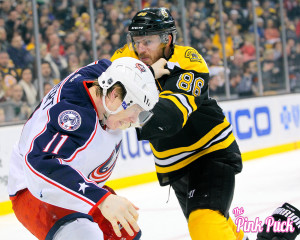
Kevan Miller vs. Matt Calvert (Photo: Alan Sullivan)
“You know, I think my role has changed over the years, and I’ve played in multiple circumstances and in multiple roles throughout the season,” Miller shared during a teleconference held Tuesday evening. “I’m looking forward to doing my job, whether it is is shutting down another top line or being hard to play against and making plays out of my zone. I’m actually looking forward to that and I think that it’s obviously going to change year-to-year depending on who you have in your lineup.”
Perhaps something else that will affect his role and his play on the ice will be the promotion of the Providence Bruins head coach Bruce Cassidy to assistant coach for the Boston Bruins—another announcement made on Tuesday. Cassidy will be coaching the defense, and Miller played under him during his time in Providence.
“[Cassidy]’s a very intelligent guy. And he has a certain way of coaching that I loved down there [in Providence],” Miller said.
There are still a lot of questions about what kind of team the Bruins will ice this coming season. Having missed the playoffs two years in a row, it is clear that ownership will not accept a third year in which the team exits early. However, some of the cap and contract situations that the team finds itself in continue to be carryovers from before Don Sweeney was named General Manager.
Obviously as camp gets underway this coming fall, it will be interesting to see how Cassidy’s coaching addresses some of the issues the defensemen suffered in this past year. The blueliners will also be under the microscope by those watching them going into the opening games to see if some of the problems of last year have been addressed.
For Miller though, he is quite pleased with how things stand after the signing.
“Boston is a great city to play in and we have the best fans in the NHL, so I’m very thankful to them as well. I love playing here; it’s an honor to put that jersey on before every game.,” Miller stated at the beginning of his teleconference after thanking his family and the Bruins management and ownership.
The biggest question for the Pittsburgh Penguins, as they face possible elimination in Game 6 of the Eastern Conference Final, is who will start in net? Will it be the veteran Marc-Andre Fleury or the rookie Matt Murray?
Head Coach Mike Sullivan said he would reveal the starter on the morning of the game. Until then, all anyone can do is speculate and debate who should be starter for this pivotal game.
Fleury played his 100th career postseason game in Game 5. He has the experience and knows the pressure of playing in a potential elimination game. In 98 playoff games started, he is 53-45 with a 2.66 goals against average and a .906 save percentage. He also has eight shutouts in his postseason career. Fleury hasn’t seen much game action since March 31, when he suffered an injury.
Fleury’s first postseason action was in the third period of Game 4. He came in to relieve Murray after the Bolts took a 4-0 lead in to the second intermission. The move was made more to get the Penguins back in the game and they scored three goals in the third, but fell just short.
Fleury made seven saves in the third period, some of which were quality scoring chances by Tampa Bay. Fleury hasn’t even played 80 minutes in these playoffs.
Since Pittsburgh made the comeback and Fleury played fairly well, he got the start in Game 5 on the road in Tampa. The goalie allowed four goals on 25 shots by the Bolts. His teammates didn’t exactly play the best defense in front of him. The Pens blew two separate leads of 2-0 and 3-2. Fleury only had a chance to stop one of those goals, but it was a howitzer up high, short-side and he couldn’t make the save. In one plus game, Fleury has allowed four goals on 32 shots against for a .875 save percentage. He also has a 3.03 goals against average during the time he has been in the net.
Murray is a rookie in his first postseason, and has been able to handle the pressure so far. He is 9-4 with a 2.33 goals against average, a .923 save percentage and one shutout in 13 games played. He doesn’t have the experience of playing in an elimination game like Fleury does because this is the first time in the postseason the Penguins have faced elimination. The goalie’s numbers have come down to earth as he has faced better teams in the playoffs, but he has lead the team to this point in the playoffs.
Murray has only allowed three or more goals six times in his first postseason. Three of those six games have required the overtime session to decide the final score. The young goalie has faced 30 or more shots in six of his 13 postseason starts, including facing 49 shots in Game 3 in round two against the
Washington Capitals. He has kept his team in games, making saves that need to be made, while making the spectacular highlight reel saves. It seems that even if the opposing team doesn’t have a lot of shots, Murray still has to make saves on quality scoring chances.
In three plus games against the Lightning, he has faced 99 shots and has allowed 11 goals. He has a 3.02 goals against average and a .889 save percentage in the series.
Murray took over on March 31 after Fleury got hurt and played well. He was injured late in the regular season and missed the first two games of the first round series against the
New York Rangers. He entered the postseason in Game 3 of the Rangers series and hasn’t looked back.
Mike Sullivan and the Penguins should go back to Murray for Game 6, since he has gotten the team to this point in the postseason.
The St. Louis Blues have struggled in their home arena during the playoffs, but as they came out strong at the beginning of the game, it looked like perhaps they had brought with them the attitude they had in Game 4. In one of those “you can’t make this up” moments – the score in Game 5 mimicked that of Game 4—the visiting team won the game with 6 goals over the home team’s 3.
The San Jose Sharks got the scoring going when Marc-Edouard Vlasic with a strong shot from the left point. Jake Allen, who was making his second start of the series after having gone in during Game 3, was slightly screened but this would be one of the easier shots he would face and perhaps one he should have stopped. The Blues managed to tie things up at 7:05 of the first as Jaden Schwartz got his fourth goal of the postseason—the result of a dump and chase in which the Blues worked it hard and won some board battles to give Schwartz the opportunity.
“Our first touch has got to be better. We’re trying to make a play that’s not there,” Blues head coach Ken Hitchcock said during the first period. “They’re putting a lot of pressure on us. We’ve just got to make sure it’s a better territorial play and we’ll be alright.”
Going into the first intermission his Blues were up 2-1 and the tempers had increased, as there was some pushing and shoving and a little extra stick work after the horn.
The Sharks got the first power play of the game just 4:37 into the second and Joel Ward, acquired by the Sharks in the offseason, would tie things up. His goal silenced the raucous crowd for the first of many times at the Scottrade Center.
Just a short time later the Blues would get their first power play of the game and Robby Fabbri put the Blues back up 3-2. The rookie Fabbri has been a strong asset for the Blues. In the 19 postseason games he’s played, he has four goals and 11 assists for 15 points. His play throughout Game 5 was strong.
And while the rookie brought his game, one star continued to be mysteriously absent on the score sheet–Vladimir Tarasenko. His 18:44 TOI was third of all Blues’ forwards, but he only had one shot on goal. His indecision in Game 5 made him easy to defend against.
With 1:27 remaining in the middle frame, Sharks’ Joe Pavelski would tie the game with a shot from the slot, and Blues’ coach Hitchcock indicated after the game that it was this goal that he felt killed his team. Pavelski would get his second of the game, putting his Sharks up 4-3, a mere 16 seconds into the third period.
Despite good effort, the Blues’ mistakes were costly and as the clock clicked down toward the last minute, Allen was pulled for the additional attacker, but the Sharks continued to have other ideas. Chris Tierney worked hard, first having the puck taken from him and then fighting to get it back. His pass to Joe Thornton redirected the attention of the Blues while Tierney remained behind Allen’s vacated net. Thornton passed it back to him and he was able to wrap it around and slip it in, giving the Sharks a two-goal lead.
Allen went back in until the next faceoff and then despite Blues Paul Stastny winning the draw, the Sharks got control of the puck and Ward would put it through the legs of Alexander Steen and into the empty net to get his second of the game and ensure that the Sharks would return to California leading the series 3-2.
The Sharks will host the Blues on Wednesday at the SAP Arena—better known as the Shark Tank—for Game 6. For the Sharks their win against the Blues was a franchise-high eleventh playoff game. They will need to focus hard on not getting ahead of themselves, looking at the Stanley Cup Finals, or they could find themselves golfing instead of playing more hockey.
The Bolts and Pens will face off on Tuesday night in Tampa for Game 6. The puck is set to drop at 8 p.m. and can be seen on NBCSN.
Here are five keys to the game:
1.) Feed Off the Home Crowd
The Lightning will have home ice advantage as they look to close out the Eastern Conference Final. The Bolts were in a similar situation last postseason and lost 7-3 against the
New York Rangers, but won Game 7. Tampa Bay will want to get off to a fast start, and get a ton of pucks towards the Pittsburgh net. They’ll also want to avoid the turnovers and sloppy play, which has cost them some in this series.
2.) Get the First Goal
Tampa Bay is 8-1 in this postseason when scoring the first goal. They are 3-3 when the opponent scores the first goal. The Bolts will need to establish the forecheck early in the game, and get the cycling game going too. If they can get the first goal then they need to keep attacking and not sit back trying to hold the lead. If the defense can jump into and be involved in the offensive zone then they’ll have a decent shot at getting that first goal. Tampa Bay should try to use the stretch pass since they’ve had some success with it in the series already.
3.) Goaltending
Andrei Vasilevskiy has been impressive manning the net since having to take over for an injured
Ben Bishop in Game One. He has stopped 173 of 187 shots he has faced in the series. His numbers have come back down to earth as the series has gone on, but his teammates haven’t played the best hockey in front of him. The biggest question facing the Penguins entering the game is who will be their starting goalies? Will it be
Marc-Andre Fleury or
Matt Murray? Murray is 9-4 this postseason with a 2.33 goals against average and a .923 save percentage. He’s led Pittsburgh to this point, but Fleury has played the last game plus and hasn’t looked too bad. Does head coach Mike Sullivan go with experience or the guy that has led them to this point in the playoffs?
4.) Malkin & Crosby
Sidney Crosby ended an eight game goalless streak in Game 2, scoring the overtime game-winning goal. He registered a point in the first three games of the series, but has been pointless the last two games. Crosby has two goals, one assist and three points in five games against the Bolts.
Evgeni Malkin ended an eight game goalless streak in Game 4 and ended an overall six game pointless streak in the postseason in Game 3. He has one goal, two assists and three points so far this series. If the Penguins want to force a Game 7 then they’ll need their superstars to pick up the pace and contribute.
5.) Establish the Forecheck Early
Pittsburgh will want to establish the forecheck early to try and take the crowd out of the game. They’ll also need to somehow defend against Tampa Bay’s use of the stretch pass, which has been effective in the Eastern Conference Final. The Penguins need to go after the Bolts defense and force them to make quick decisions with the puck. Hopefully, those quick decisions will force the Lightning to turn the puck over and lead to some scoring chances for the Pens.
Nikita Kucherov had two goals and assisted on the game-winning goal in overtime, while Andrei Vasilevskiy made 31 saves to help the Tampa Bay Lightning take a 3-2 series lead over the Pittsburgh Penguins in the Eastern Conference Final.
It took Tyler Johnson and the Bolts only 0:53 of the overtime period to end the game. Andrej Sustr got the puck in deep to Johnson, who won a puck battle and Ondrej Palat got the loose puck. Palat then spotted Kucherov, who found an open Jason Garrison. Garrison took the shot with Johnson in front and the puck deflected off of him and past Marc-Andre Fleury.
The Penguins took the lead late in the first period. Bryan Rust skated to the net, got the shot off and Vasilevskiy made the initial save. Brian Dumoulin drove to the net and put the loose puck in the back of the Bolts’ net. It was Dumoulin’s first NHL postseason goal. The goal came with only seven tenths of a second remaining on the first period clock.
Patric Hornqvist scored his seventh of the postseason to give Pittsburgh a 2-0 lead just 1:30 into the second period. Olli Maatta took the point shot, Carl Hagelin deflected the puck right to Hornqvist, who beat a diving Vasilevskiy. The Bolts had some good push-back shifts. Jonathan Drouin had two scoring chances and drew a penalty, which Tampa Bay couldn’t capitalize on. The momentum shifted when Tampa Bay killed off Kucherov’s penalty.
After a great penalty kill, Sustr got the puck around the boards, and Alex Killorn, who was coming off the bench, blasted the puck past Fleury. The Bolts cut the Penguins lead to 2-1. A minute and ten seconds later, Nikita Kucherov took a great pass from Vladislav Namestnikov and beat Fleury to tie the game at two. The Lightning then gave up another late goal with under 0:50 left in the second period. Maatta made a great play to get the puck from his skate to stick, and eventually threw the puck in front of the net. Chris Kunitz was in the right place at the right time and gave the Penguins a 3-2 lead. Pittsburgh was 46-0-0 heading into the third period with the lead throughout the season.
Vasilevskiy made some good saves to keep his team in the game including a nice pad save on Kunitz in close. Kucherov got the puck to Johnson, who took the shot, and the rebound went to Kucherov at the side of the net. Kucherov put the puck in the net after a nice wraparound. It was Kucherov’s league leading 11th goal of the postseason, which tied the game at three.
The Bolts will be looking to close out the series in Game 6 in Tampa, while the Penguins will be looking to force a Game 7.
The Eastern Conference Final is all tied at two games a piece and both the Tampa Bay Lightning and the Pittsburgh Penguins are looking to be the team that takes a 3-2 series lead. Game 5 will take place tonight on NBCSN at 8 p.m.
Here are five keys to the game:
1.) Weather the Storm
The Penguins have the home ice advantage and will be looking to feed off the crowd’s energy for a good start to the game. The Bolts will need to weather the storm and get through the first 10 minutes of the game without any serious damage. They’ll need to come out ready to play and match the speed of Pittsburgh. The Pens will be trying to establish offensive zone time early and often. Tampa Bay will need to be good in the defensive zone and have the active sticks that they had in Game 1 so they can block the passes and shot attempts before they get through to their goaltender.
2.) Establish the Forecheck Early in the Game
The Lightning will want to take full advantage of Trevor Daley being out of the Penguins lineup. Daley broke his ankle in Game 4 and will miss the remainder of the postseason. Pittsburgh’s defensive pairings will look a little different from last game and the Bolts will need to be physical on the forecheck. Whether it is Olli Maatta drawing in for the Pens or someone else, Tampa Bay will need to attack that defenseman when he has the puck in the defensive zone and try to force some turnovers for scoring chances. The Bolts will also have to win the board battles if they want to have any sustained attack time in the offensive zone.
3.) Marc-Andre Fleury
Fleury came in for Matt Murray in relief in Game 4 and didn’t allow any goals, while his team scored three in the third period, but just fell short of a comeback. Fleury was tested a couple of times in Game 4, but not nearly enough for a goalie who hadn’t seen game action all postseason. The Lightning need to get the puck on net whenever they can especially early to see how Fleury’s rebound control will be, and if he’s leaving rebounds then they’ll need to have someone in the crease when they can. Tampa Bay should also have a presence in front of the net so it’s harder for Fleury to see the puck or so their own player can go for the deflection. This is a pivitol game in the series and we’ll see if Fleury can return to his regular season self or his postseason self, where he tends to let in a few “soft” goals every now and then.
4.) Discipline
Pittsburgh had done a good job of not losing its cool this postseason, but they let it happen a couple of times in Game 4, and it cost them. They looked like the Penguins of old, who would lose control if something didn’t go their way or another team engaged in scrums with them. The Lightning were involved in a lot of extra stuff after the whistle last game and it seemed to throw the Penguins off their game, just a little bit. The Penguins will need to be careful and not take any bad penalties like Kris Letang did in Game 4. Tampa Bay needs to do exactly what they did in the last game to agitate the Penguins and try to draw some power plays.
5.) Special Teams
If you win the special teams battle, then you have a good chance to win the game in this series. The Lightning finally got its power play on track last game, but it could be even better. The Pens have had a good power play this series, but again, it could be even better if they could hit the net with some of their shots. Pittsburgh’s shots seem to be going high or wide of the net on the power play. The teams will need to be disciplined and not give the opposing team too many chances on the man advantage because they will eventually score on one of those chances, and that could be the difference in the game.
 Prev1...105106107...412Next
  Page 106 of 412