The big debate since the
Pittsburgh Penguins took a 3-1 lead in the Stanley Cup Final against the
San Jose Sharks has been who should win the Conn Smythe Trophy. It sure won’t be
Evgeni Malkin since he’s really been struggling this postseason. The Trophy goes to the most valuable player of the playoffs.
If the Penguins can close out the Sharks on Thursday night then one of the Pittsburgh players will be taking the Trophy home, and here are my top three candidates to take the Trophy.
The top candidate by many is none other than the captain of the Penguins,
Sidney Crosby. In 22 games played this postseason, he has six goals, 11 assists and 17 points with three game-winning goals, which all came in the Eastern Conference Final against the
Tampa Bay Lightning. The three game-winning goals in the Eastern Conference Final came after he was held to zero goals and two assists in six games against the
Washington Capitals. He hasn’t been putting up the points, but he’s been playing solid hockey and doing the little things to help his team win. Crosby has been playing solid two-way hockey and finding ways to help his team win games or bounce back from loses.
Crosby has been one of the Penguins best at winning faceoffs this postseason. The center has won 269 faceoffs and lost 248 for a 52.0% faceoff win percentage. His faceoff winning percentage might not seem to be an important stat, but faceoff wins amount to possession for the Penguins, which ultimately means less time defending. Crosby scored his first playoff overtime game-winning goal in Game 2 of the Eastern Conference Final, and assisted on
Connor Sheary’s game-winning overtime goal in Game 2 in the Stanley Cup Final.
Phil Kessel has been playing the best hockey of his career. In 22 postseason games, he has 10 goals, 11 assists and 21 points. He has only been kept off the score sheet in seven of the 22 postseason games. The winger hasn’t gone more than two games with no points and that has only happened once during these playoffs. Kessel has been held pointless three times on the road and four times at home. At times, he has been going up against the opposition’s top line during the playoffs.
Kessel doesn’t have any game-winning goals this postseason, but that doesn’t mean he hasn’t come up clutch in big moments. He tied Game 3 against the
New York Rangers at 2-2, and the Penguins went on to win the game. He assisted on the overtime game-winning goal in Game 6 against the Capitals, which was also the series clinching game for the Penguins. Kessel has also gotten his team on the board first a few times this postseason. The winger has five multipoint games this postseason and two of them came in series clinching games.
Matt Murray has been solid in the net for the Penguins this postseason. In 19 games, he is 14-5 with a 2.09 goals against average, and a .925 save percentage. He is only 22-years-old and is 5-0 after losses in these playoffs. He is one win away from tying the record of 15 wins in a postseason by a rookie goalie. The team in front of him has done a good job of limiting the number of shots that he’s seen, but Murray has stayed sharp and made saves, when needed.
The goalie is a big reason why the Penguins are one win away from winning the Stanley Cup.
Murray has played with the poise and control of a veteran and nothing has seemed to rattle him. He has made the routine saves, and the highlight reel saves to keep games close or preserve the lead. Murray has seemed calm, cool and collected throughout these playoffs for the Penguins.
My pick to win the Conn Smythe Trophy would be Kessel since he has only been held off the score sheet in seven games and is just averaging under a point per game.
Sullivan put the line together on March 13, a span of 37 combined regular season and playoff games, in which they have scored 36 goals, tallied 60 assisted and have 96 total combined points. The HBK Line is a good combination of speed (Hagelin), grit (Bonino) and scoring (Kessel). They can play a variety of ways including using their speed and skill, grinding it out along the boards, getting in on the forecheck and if a linemate is open someone will get him the puck.
The line was expected to produce, maybe not at this pace, but their defensive play has been on display during the playoffs as well. Sullivan hasn’t been afraid to use the line against the opposing team’s top players because “of the awareness of the line at both ends of the ice.” The HBK Line has seen some time up against Joe Pavelski, the Sharks’ leading goal scorer in the postseason, and have kept him off the board through four games of the series. Bonino and Hagelin also play on the penalty kill so there was no problem getting them to play in their own line, but Sullivan has really gotten Kessel to buy in to his system. They force the opposition’s top lines to defend because of the offensive threat and the speed of the line.
The HBK line has a good balance of speed, work ethic and offensive zone ability. They can shutdown opposing lines by spending most of the shift making them defend in their own end by cycling the puck, winning board battles and finding the open man for the scoring chance.
Carl Hagelin is the speedster of the line but he also has good defensive instincts. He can use his speed in the offensive zone to get to those loose pucks and keep the play alive or use it to get away from everyone else for a breakaway chance. Hagelin can also use that speed of his to be the first one in on the forecheck and find the open ice. His qup knead helps in the defensive zone because, again, he can use it to get to loose pucks to either clear the zone or get back to make a play after being beat.
Nick Bonino is a solid two-way player that can come up big with the game on the line. He isn’t afraid to get in the passing or shooting lane to breakup a play. The center will get in on the forecheck and battle for the puck in the offensive zone. He won’t put the puck in the back of the net as much as the other two forwards, but he’ll set them up with his vision on the ice. Bonino will do the little things in the defensive zone like block shots, win face-offs and make the smart play.
Phil Kessel has probably played the best hockey of his career this season. He is the main goal scorer and point producer on the HBK Line. He can distribute the puck and put it in the back of the net. It helps that he doesn’t have the spotlight on him in Pittsburgh like he did in Toronto so he can just go out and play without having most of the pressure on him. Kessel isn’t the best defensive player in the world, but he is playing at both ends of the ice for the Penguins this postseason.
A major reason for the success of the Penguins this season, but especially in the postseason, has been the emergence of the HBK Line at both ends of the ice.
The Pittsburgh Penguins will be looking to win the Stanley Cup on home ice, while the San Jose Sharks will be looking to live another day, avoid elimination and the end to their season. The two teams will battle it out at the Consol Energy Center, where Game 5 of the Stanley Cup Final will take place on Thursday night. The game can been seen on NBC at 8:00 p.m. Eastern Time.
Here are five keys to Game 5:
1) Score First
The Sharks have played four games against the Penguins and have yet to score first in the series. In the Game 3 win, the only time San Jose led was when Joonas Donskoi scored the game-winning goal in overtime. Game 5 would be the perfect time for the Sharks to get that first goal and have a chance to play with the lead instead of playing from behind. If the Sharks can get the first goal of the game then it may take the crowd, which will be raucous, out of the game a bit. It would also force the Penguins to play from behind, which is something they haven’t had to do at all in the series, and maybe they might make some mistakes.
2) Weather the Storm
The Penguins are going to come out energized and ready to play. They could clinch the Stanley Cup on home ice in front of the home fans. There is no doubt that the Pittsburgh players will be amped up and have a ton of energy to start the game. The Sharks will need to weather the storm and play a decent first period on the road. Whether it takes blocking shots, playing solid defense or Martin Jones being spectacular, the Sharks need to be tied at the end of the first period or ahead. The Penguins are going to try to get the forecheck going early, so the Sharks will need to be aware of that, and avoid the turnovers and bad decisions that have plagued them throughout this series.
3) Joel Ward/Martin Jones
The Sharks went out and signed Joel Ward in the offseason for his ability to get to the net and score clutch goals. They’ll need Ward to be that clutch player that they signed him to be since the Sharks big name players can’t seem to get anything going witch the lack of time and space given to them by the Penguins. Martin Jones has kept the Sharks in all four games of the series so far. He has made spectacular saves, timely saves and the routine saves even when looking shaky at times. Jones will need to come up big in this elimination game, which is his second of the postseason. The Sharks and Jones beat the Nashville Predators in a Game 7 to advance to the Western Conference Final.
4) Feed Off the Crowd’s Energy
There is no doubt that the crowd at the Consol Energy Center will be loud and energized. This will be the first time that the Penguins could win the Stanley Cup in the building since it opened in 2010, a year after the Penguins won the Cup and the last time they were in the Final. Pittsburgh needs to feed off the crowd’s energy and get off to a fast start like they have been doing this whole series. The Penguins need to establish the forecheck early and test Jones as much as they can in the early going.
5) Play Penguins Hockey
The Pens can’t get caught up in the fact that this is no ordinary “clinching game”, but rather it is a chance to win the Stanley Cup, a goal of every team since the beginning of the season. Pittsburgh can’t get caught up in the hype of it all, and they’ll need to be disciplined because if they take too many penalties, the Sharks will make them pay when on the power play. The Pens need to keep playing with speed since it looks like San Jose just can’t keep up with them. They’ll need to create off the forecheck and off the rush. In the defensive zone, just keep blocking the shot attempts the Sharks are sending/trying to send to the net.
The
San Jose Sharks are looking to even the Stanley Cup Final at two games a piece, while the
Pittsburgh Penguins look to take a 3-1 series lead. Game 4 will be on Monday night on NBCSN at 8 p.m.
Here are five keys to Game 4:
1) Fast Start
The Sharks haven’t been getting off to the best starts in the three games that have been played in the series. They’ve been letting the Penguins establish the forecheck and have a ton of offensive zone time. San Jose will need to feed off the crowd’s energy and be involved in the game early, whether that means making a big play or just spending time in the offensive zone. The Sharks need to have their skating legs early in the game to beat the Penguins to loose pucks and get their transition game going with some odd man rushes.
2) Establish the Forecheck Early
San Jose needs to get the forecheck established early in the game. They’ll need it to get some sustained offensive pressure to try and get the first goal of the game. The first lead of the series for the Sharks came at the end of the overtime session when they beat the Pens 3-2 in Game 3. The forwards need to get in on the forecheck, hit the Penguins defenders, tie up their man and have better support so they can win those board battles to have a successful forecheck. If a Sharks’ defenseman can’t get the puck to the net, then just get it down behind the net and let the forwards get in on the forecheck and battle for the puck.
3) Draw More Penalties
It’s hard to draw a lot of penalties when you’re constantly playing from behind, but the Sharks need to do exactly that. They had the number one power play coming into the Final, and they need to use their speed and forecheck to draw more penalties to get more shots on net and test the Penguins penalty kill. The Penguins penalty kill hasn’t exactly been tested with only having to kill six penalties through three games. The Sharks are getting outplayed at even strength for the most part in this series, so start drawing more penalties so the power play has a chance to score some goals.
4) Power Play
Pittsburgh has the opposite problem as San Jose, they’ve been good at even-strength, but can’t manage anything on the power play. They’ve had their chances, but shots are either going high and wide or
Martin Jones is getting a piece of their chances. The Penguins have only had six power play opportunities in the series. When they do have the man advantage, it looks like they are trying to make the perfect play and hesitating instead of taking the shot. The Penguins power play units just need to get shots to the net and have someone screening Jones so those chances are tough for him to see.
5.) Get Malkin Going Offensively
Evgeni Malkin has yet to score a point in three games of the Stanley Cup Final. The Sharks have done an okay job defending him, but Malkin seems to be passing up the shot and looking for the perfect play. If he has a chance to get the puck on net then he needs to take it and not pass it up. He has eight shots on goal in the three games of the series. Malkin has scored no goals in his past six postseason games and has only scored once in the last 15 games. He has been good on face-offs and in his own zone, but he needs to step it up offensively if he wants to see his team win the Stanley Cup.
The
San Jose Sharks look to come back from a 0-2 series deficit in the Stanley Cup Final against the
Pittsburgh Penguins. The teams will have two off days and will play Game 3 on Saturday night in San Jose at 8 p.m.
Here are five keys for the Sharks in Game 3:
1) Feed Off the Crowd
San Jose will host a Stanley Cup Final game for the first time in franchise history. The crowd should be ready to go even with the 5 p.m. local puck drop. The Sharks need to feed off the crowd’s energy and get involved in the game early whether by being physical or by spending more time in the offensive zone.
2) Get Shots to the Net
The Sharks need to get more pucks through to
Matt Murray because he has only faced a total of 48 shots through two games. The Sharks had a combined 11 shots on goal through two periods and only four shots on goal in the first period of Game 1. San Jose needs to be quicker with their shots and have better puck movement since the Penguins are blocking a lot of shots. Murray hasn’t really been tested so far in the series and that needs to change for the Sharks to have any chance at mounting a comeback.
3) Get the First Goal
The Sharks have been playing from behind for a good portion of the series. San Jose is 10-3 when they score the first goal of the game in the playoffs, but are only 2-5 when the opposing team scores first. Two of those five loses have come in this series against the Penguins. The Sharks need to get the first goal of the game and play with the lead for once in the series. It’s much easier to play with the lead than to have to constantly fight to come back from a goal or two deficit.
4) Avoid Turnovers
A big reason for the 0-2 deficit has been the preassure that the Penguins have shown, forcing the Sharks to turn the puck over. Turnovers lead to second chances and extended time in the offensive zone for the opposing team. The Sharks defensemen were sometimes just sloppy in their decisions with the puck even, when there was no one around them. They’ll need to clean that up on home ice to try to get back into the series.
Joe Pavelski has scored more goals in the playoffs than any other player and he is tied for second with teammate,
Brent Burns for second in overall scoring with 22 points. The Penguins have kept Pavelski off the scoreboard in the first two games of the series. It’s hard to register any points or goals when the team is spending too much time defending and not enough time attacking. Vlasic hasn’t exactly had the best two games of the postseason against the Penguins either. He has been turning the puck over, not getting his shots through to the net and just making mental mistakes. If the Sharks want to win Game 3 then both of these players will need to step up and get going.
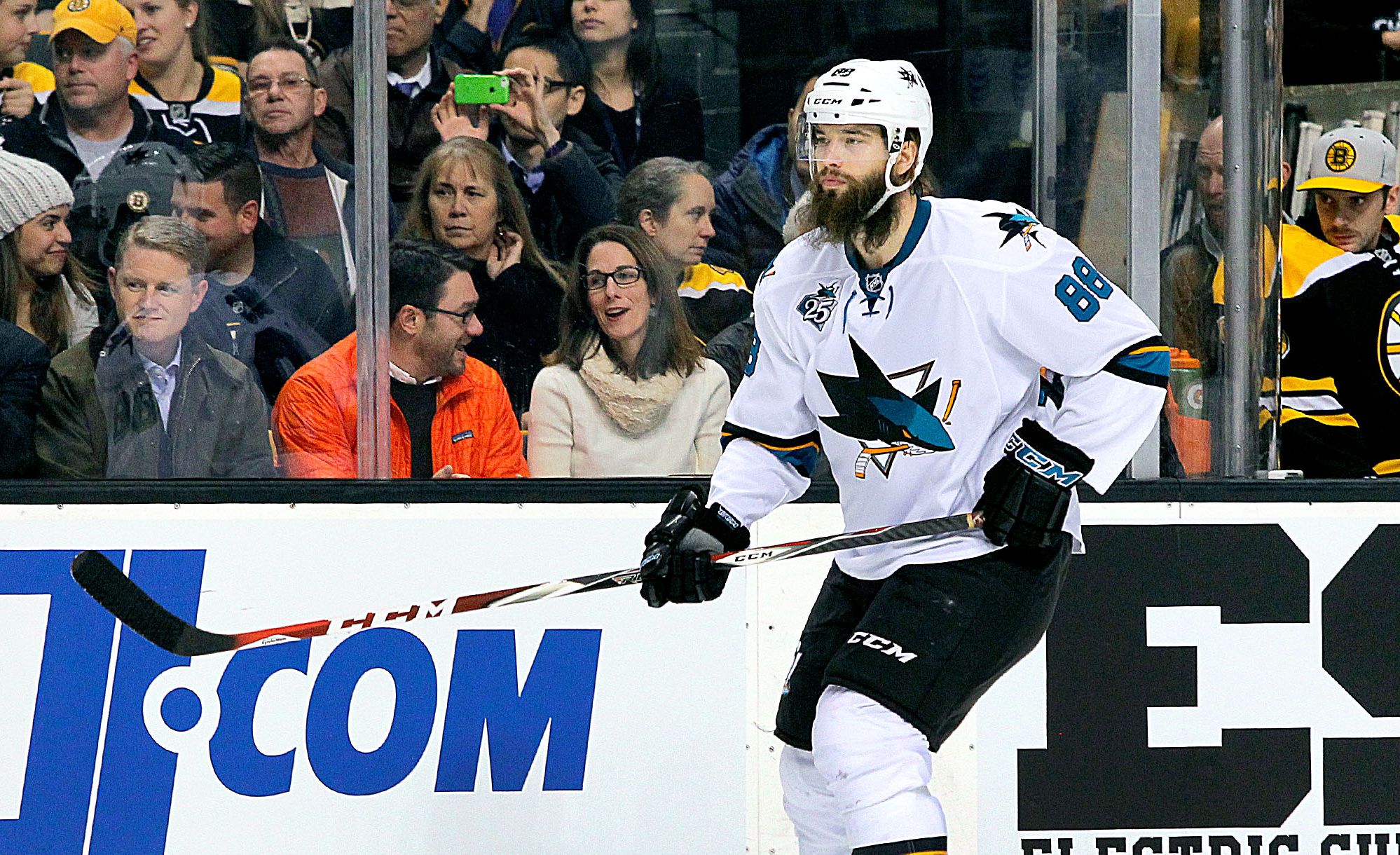
(Photo: Alan Sullivan)
Burns gets some of his recognition from wearing his wacky suits, his man bun, the playoff beard and his offensive ability with the puck, but that’s not all. His defense has come along the past couple seasons and continues to improve. Burns’ play on the ice this season has earned him a spot among the three finalists for the Norris Trophy, which is given to the League’s best overall defenseman.
When
Burns is on the ice, it’s like having another forward out there for the Sharks. He can move the puck quickly out of his own zone, join the rush in the offensive zone and lead the rush. He has uncanny offensive skill to go with speed, which can be a dangerous mix. The defenseman hasn’t missed a game, regular season or playoffs, yet this season for the Sharks. In 82 regular season games, he has 27 goals, 48 assists, 75 points to go with 25:52 of ice time per game.
The 27 goals, 48 assists, 75 points and 25:52 of ice time were all career highs for him. He improved his overall scoring total by 15 points from last season to this season. In 19 postseason games, he has six goals, 16 assists, 22 points and is averaging 25:02 of ice time per game. His 22 points are the most by a defenseman since
Brian Leetch had 34 in 1994. Only Leetch,
Al MacInnis,
Ray Bourque and
Larry Murphy have more points during a single playoff season as a defenseman than Burns.
When one thinks of
Brent Burns, one might automatically think “offensive defenseman”, but he has been good at both ends of the rink this year. He plays on the Sharks’ number one defensive pairing with Paul Martin, who is more of a stay-at-home defenseman. Burns has played against the league’s best players and has held his own. The defenseman has the ability to log a ton of minutes and shut opposing teams top players down like he and the Sharks did to
Vladimir Tarasenko in the Western Conference Final.
Yes, he may be out of postition from time to time, but let’s be honest, so is almost every other defenseman that plays in the NHL. If he’s caught deep in the offensive zone or a puck takes a weird bounce past him, he has the speed to get back and make the defensive play. In game one,
Carl Hagelin had a couple of steps on him, but Burns got back to breakup the play as Hagelin was attempting to take the shot.
He was the player that lost his stick for the Sharks trying to block
Kris Letang’s passing attempt, but he still tried to do everything in his power to keep Letang from getting the puck to
Nick Bonino, who scored the game-winning goal in game one.
Paul Martin should have had this stick on the ice and the pass would have been broken up and the puck would have never gotten to Bonino.
Burns has already had his coming out party this postseason, but it could be even bigger if he can help lead the
Sharks to its first ever Stanley Cup.
The San Jose Sharks look to bounce back from a Game 1 loss to the Pittsburgh Penguins on Wednesday night. The second game of the Stanley Cup Final can be viewed on NBCSN at 8 p.m.
Here are five keys to Game 2:
1) Get More Shots Through to the Net
The Sharks need to get more pucks towards Pittsburgh goalie, Matt Murray. He only faced 26 shots the entire game and a lot of those were either blocked or wide of the net. San Jose only managed to get four shots on goal in the first period and nine in the third. They had as many in the second period as they did in the first and third periods combined. They’ll need to be quicker with the puck so the Penguin defenders can’t get in a position to block them with either their bodies or sticks. If a defenseman is going to take a point shot then make sure it’ll get on net with traffic in front.
2) Matt Nieto
Sharks head coach, Peter DeBoer, has a tough decision on whether to make a lineup change and mess with the team’s chemistry throughout this postseason run. The decision would be much harder coming off of a win so DeBoer may just put Matt Nieto back in the lineup for Game 2. Nieto suffered an upper body injury against the Nashville Predators in Game 6 of that series. If DeBoer should choose to put Nieto in the lineup then he could help the speed game of the Sharks.
3) Be Better With the Puck
The Sharks need to be better with the puck on their sticks. Yes, the Penguins forced some of those turnovers and the sloppy play, but the Sharks were sloppy at times. There were failed clears leading to scoring chances, and poor decisions made by San Jose even when there was no Penguin player around. The Sharks need to break out of their own zone better since Pittsburgh will be looking to force them to make those mistakes early in the game. On the game winning goal by Nick Bonino, Sharks defender, Paul Martin had his stick off the ice and looked like he was in no man’s land. If Martin had his stick on the ice then the pass would have been blocked.
4) Don’t Hesitate to Shoot the Puck/Play with Speed
The Penguins played a great game, but there were times that they could have shot the puck, but decided to hold on to it looking for the perfect play. When they finally took the shot, it either went wide or Martin Jones came up with the save. If the players for the Pens have an opportunity to shoot the puck then they need to take it. The Pens will need to play with the same speed that they played with in the first game since it looked like the Sharks couldn’t keep up with them.
5) Stay Out of the Penalty Box
San Jose only had two power plays, but scored on one of them. It wasn’t even the Sharks first unit that scored the goal either, it was the second unit. The Sharks tend to cycle the puck and win the battles on the power play and that’s why they’ve been so successful during the postseason. The Penguins managed to kill off the second power play, but they don’t want to keep giving the dangerous Sharks power play chances to score because they’ll find a way to put the puck in the net while on the man advantage.
For the San Jose Sharks the Stanley Cup Final is uncharted territory, so it should not be surprising that in the first period it looked like they were having a little trouble getting the butterflies out so that they could play their game. It was clear that the Pittsburgh Penguins were working their speed and taking advantage of the bit of uncertainty being displayed by the Sharks. Couple that with the insane emotion at the Consol Energy Center and it’s easy to see how the ice tilted in Pittsburgh’s favor, especially after a power play that saw them manage four shots on goal and certainly gave them a sense of confidence that they carried into the next few minutes. And it was this confidence that allowed the Penguins to capitalize getting on the scoreboard first.
The first goal came off the stick of rookie and Notre Dame Fighting Irish alumni, Bryan Rust. This was his sixth goal in the post season and makes him the highest postseason scoring rookie in Penguins’ history.
With emotion from the fans at the highest decibel and perhaps the Sharks feeling a bit of a sting from that goal, Pittsburgh would capitalize again just 1:02 later. This time it was University of Massachusetts Minutemen alum and Melrose, Massachusetts native, Conor Sheary.
For the Sharks’ goaltender Martin Jones, that would be the end of the scoring for the Penguins through the first period, as he made many stellar stops. The first period came to an end with the Penguins having outshot the Sharks 15-4.
The second period opened with a very different Sharks team as they played to their strengths, preventing the Penguins from using their speed to get the better of those in white and teal. Just 1:14 into the middle frame Pittsburgh’s Ian Cole was whistled for tripping giving San Jose their first power play of the game. And as the Los Angeles Kings, Nashville Predators and St. Louis Blues can attest, the man advantage is something the Sharks’ opposition does not want to give them.
It would be Tomas Hertl with the power play goal, but once again defenseman Brent Burns was there making some important moves getting his 15th assist of the post season. And Burns would continue to show up in the second, making some speedy and impressive plays to prevent the Penguins from getting some chances. In many ways the Sharks managed to nullify the Penguins.
The Penguins would find the score tied with approximately two minutes remaining in the second, as Patrick Marleau got a wrap around into the net before Matt Murray could close it off with his right skate.
The third period though saw the Penguins come back out forcing their game on the Sharks, however San Jose also had some good chances. And while the Penguins had been exceptionally fast in the first period, they were not nearly as quick in the third, but they were crisper with some of their passes. They were back to outshooting the visitors. The game winning goal, which was scored by Nick Bonino, on his first game back after suffering an injury, may not have happened had Burns not lost his stick earlier on the play.
Both teams will have Tuesday to look at tape and rest a bit before they play again in Pittsburgh. For the Sharks, they will need to come out harder in the first period so as not to give the Penguins such an advantage. They also need to figure a way to get more shots on net to truly test Murray. The Penguins will continue to do their best to bend the Sharks to their will as they did in Game 1.
Here are five keys to Game 1:
1) Weather the Storm
The San Jose Sharks will need to play a good first period of road hockey. The Penguins should come out ready to play in front of the home crowd and it should be loud in the Consol Energy Center. The Sharks are coming off a series in which they only had to play six games, whereas; the Penguins had to play all seven in the Eastern Conference Final. San Jose needs to be good defensively and establish some offensive zone time early to take the crowd out of the game. The best way for the Sharks to take the home crowd and team out of the game early would be to get the first goal.
2) Brent Burns
Burns can have an impact on either side of the puck. He can move the puck out of the zone, join the rush, make a pass and put the puck in the back of the net. With Burns on the ice, it’s like having four forwards on the ice every time he takes a shift since he used to play forward before being converted to defense. The offensive ability isn’t the only reason that Burns is a finalist for the Norris Trophy this year, he also plays good defense. Burns and the Sharks defense shut down
Vladimir Tarasenko last series, who is one of the better scorers in the St. Louis Blues lineup.
3) Goaltending
The Sharks and the Penguins are both going into the Final with inexperienced goaltenders.
Martin Jones is in his third season in the NHL, but this is his first time being a starter for the whole season. He won the Stanley Cup with the Los Angeles Kings in 2013-14, but he only played two games the whole postseason. This is the first time that Jones has been the starting goaltender for a team that has gone to the Final.
Matt Murray is only 21 years old, playing in his first NHL Playoffs and Stanley Cup Final. He has already handled the pressure of the playoffs including a Game 7 win against the Tampa Bay Lightning.
4) Get Off to a Fast Start
This will be the first time since 2009, when the Penguins won the Stanley Cup, that a NHL Final game will be played in Pittsburgh. The Pens will need to feed off the energy of the home crowd and get off to a good start. They’ll want to establish the forecheck game early and get some pucks on Martin Jones. The Penguins will want to have sustained offensive zone pressure like they did against the Lightning in the Eastern Conference Final, and make sure they get some screens set up in front of Jones, so he can’t see the puck.
5) Get the Stars Involved Early
Pittsburgh will want to get its superstars involved early in this series. The Sharks can keep stars off the board like they did to Tarasenko in the series against the Blues. If the Penguins want a chance to win the game then
Sidney Crosby and
Evgeni Malkin will have to be involved early and often in this game. The Sharks are probably the most dangerous team that the Penguins have faced in the postseason because they play a two-way game with speed.
The
NHL Playoffs are down to its final two teams, the
San Jose Sharks and the
Pittsburgh Penguins. The teams will start to battle for the most coveted prize in hockey, the Stanley Cup, on Monday, May 30 in Pittsburgh.
The Sharks beat their nemesis, the
Los Angeles Kings, in the first round of the Western Conference Playoffs in five games. They went on to defeat
Shea Weber and the
Nashville Predators in seven games in round two. In the Western Conference Final, San Jose defeated the
St. Louis Blues in six games to reach the Stanley Cup Final for the first time in franchise history.
San Jose is 12-6 in 18 games this postseason. They’ve been led by
Logan Couture,
Joe Pavelski,
Brent Burns and
Joe Thornton. The Sharks can put the puck in the net and play a defensive game too. Each line is capable of chipping in while in the offensive zone. The Sharks play a fast-paced game; refusing to let up and wearing down the opposing team. Pavelski is leading the way with 13 goals, but six other players have scored five or more goals. Those players are Couture (8),
Joel Ward/Burns (6),
Joonas Donskoi/
Tomas Hertl/
Chris Tierney each have five goals.
Matt Nieto, who has been out injured, could be back for Game 1 of the series.
Pittsburgh will play fast with speed and skill. They are similar to the Sharks in that all four lines can put the puck in the net. They are led by
Phil Kessel,
Evgeni Malkin,
Sidney Crosby and
Nick Bonino. Bonino is expected to play after blocking a shot in Game 7 against the Lightning. The Pens have five players that have five or more goals this postseason. Those players are Kessel (9),
Patric Hornqvist (7), Crosby (6),
Carl Hagelin and
Bryan Rust each have five goals. The Sharks will have to pay attention to the line of Kessel, Bonino and Hagelin, who have been the Penguins best line this postseason.
Burns and
Marc-Edouard Vlasic led the way for the Sharks defense. Burns can act like another forward out on the ice in the offensive zone since he used to play the forward position before being converted to a defenseman full time. Vlasic can also move the puck and skate, but he can also play good defense. The rest of the Sharks defensemen are defensive defensemen and don’t chip in a lot on the offensive side of the puck.
The Pittsburgh defense is led by
Kris Letang, who can move the puck and join the rush. He’ll get the puck quickly out of his own zone, but he can be easily agitated, so the Sharks forwards will have to try and be in his face the whole series. The Pens will be without
Trevor Daley, who was injured in the Lightning series. If
Olli Maatta can get back to playing like his old self than he could make a difference in the series for the Penguins blueline.
Martin Jones has been the Sharks number one goalie all season. He has a 2.12 goals against average, and a .919 save percentage so far this postseason. He had to be pulled in one game during the series against the Blues because the team wasn’t playing well in front of him. He’s made the routine saves, but Pittsburgh could be the toughest opponent he has faced because they average almost 36 shots per game in the postseason.
Matt Murray took over the Penguins crease after an injury to Marc-Andre Fleury on March 31, and hasn’t looked back. He is 11-4 with a 2.21 goals against average and a .924 save percentage. Murray has kept his team in close games and given them a chance to win. He has made the spectacular saves and the routine saves. San Jose may not get many shots on net, but they take advantage of their opportunities.
The Sharks x-factor in this series will be defenseman Brent Burns. He can move the puck, skate and just act like another forward on the ice. Burns can also get back to make the defensive play, if needed. The Penguins penalty kill will be the x-factor in this series because the Sharks have been dominate while having the man advantage.
If the Penguins want to win the series then they’ll have to stay out of the box, and find a way to slow down the Sharks offense. If the Sharks want to win the series then they need to shut down the star players of the Penguins and win the special teams battle.
This series should be fast-paced since each team plays with a ton of speed, but the Sharks will defeat the Penguins in six games to win the franchise’s first ever Stanley Cup.
 Prev1...104105106...412Next
  Page 105 of 412