At the end of the 2001-02 season, the sixth-place St. Louis Blues (with 98 points) played against the eighth-place Chicago Blackhawks (with 96 points) in the quarter-finals of the Stanley Cup playoffs. Blues goalie Brent Johnson helped make the series much more interesting when he shutout the Blackhawks in three consecutive games. He was only the fourth goalie in NHL history to have three playoff shutouts in a row and tied six others for having three in one playoff series.
Johnson, a grandson of Sid Abel (who had won three championships with the Detroit Red Wings), had been drafted in 1995 and traded to St. Louis in 1997. He played his first NHL game in 1998. The Blues lost in his only appearance during the 2000 playoffs. In 2001, the Blues failed to acquire Dominik Hasek (who then played for Detroit), so Johnson was promoted to the lead goalie. As such, he had a 10-game winning streak during the regular season. Johnson would stay with the Blues until they traded him to Phoenix in March 2004. He spent the final three seasons of his NHL career (2009-2012) with the Pittsburgh Penguins, and those were the only other seasons he played in playoff games. He played a total of 309 NHL games (140-112-31).
The 2002 quarter-finals looked like the teams might be evenly matched. Game 1 ended with a 2-1 Chicago victory. However, that remained as far as the Blackhawks lasted. For luck, before Game 2 on April 20, a Blues staff member placed a figurine of a gnome (wearing an acorn hat and sitting on a puck) on top of Johnson’s cubicle at the Savvis Center. That night, Johnson made 26 saves to lead his team to a 2-0 victory. He brought the gnome to Chicago, and he did not even have to do much to see Game 3 end similarly. With Johnson’s 12 saves, the Blues won 4-0 on April 21.
Johnson and his gnome worked their magic again in Game 4 held April 23, 2002 as the Blues won 1-0. A little more than 18,000 fans (over 2,500 fewer than the previous game) served as witnesses at Chicago’s United Center. Johnson had to make some big saves, particularly as he blocked Steve Sullivan three times, but he managed to stop all 27 shots. At one point he told the press, “I’m just trying to pick up my game in the playoffs. It’s so much more important. I just want my game to be up there.” However, he also raved, “I’m having a great time. It’s just a blast.”
His team certainly appreciated the effort. “He’s really played well and gotten better,” noted veteran winger Keith Tkachuk. “The most important thing is that he’s held his composure when it got tough, which is really a positive thing for a young goaltender.” Scott Young, who had been with the Blues even longer, commented, “It’s the best game I’ve seen him play. It just shows what kind of confidence he’s playing with. He really kept us in the game.” Finally, Coach Joel Quenneville praised, “That was definitely a goaltending win tonight. He did everything.”
With this third victory, Johnson became the first NHL goalie to have his first three playoff wins be shutouts. He was the fourth to have three shutouts in a row during playoffs. Clint Benedict had done it for the Montreal Maroons in 1926, and he was followed by John Ross Roach for the New York Rangers in 1929. The most recent goalie to have three consecutive playoff shutouts was Frank McCool back in 1945 for the Toronto Maple Leafs. Of his accomplishment, Johnson merely commented, “It’s very neat, but that’s about it. It’s a good feeling but it’s the team that does it. They’re playing awesome in front of me. I love playing for them.” Furthermore, Johnson’s 183 minutes and 10 seconds without letting in a goal beat the record set back in 1993 by his predecessor Curtis Joseph. That series had also been against Chicago.
The Blues won Game 5 on April 25 even though it was not a shutout, the score being 5-3. Unfortunately for the Blues, their semi-final opponent ended up being the Detroit Red Wings, who had finished first in the NHL. With Hasek in net, Detroit eliminated St. Louis in five games. The only game the Blues won was Game 3, which they finished 6-1. Detroit went on to beat the Colorado Avalanche then the Carolina Hurricanes for the Stanley Cup.
Additional Sources:
“2-0! 4-0! 1-0!!!” St. Louis Post-Dispatch, 24 April 2002, pp. D1, D3, D6.
Bob Foltman, “Johnson draws blanks,” Chicago Tribune, 24 April 2002, section 4, p. 6.
It took some time after the NHL doubled its franchises in 1967 for the newest teams to find equal footing. In fact, it took three seasons of the St. Louis Blues getting swept in the Stanley Cup finals before another expansion team finally defeated the Blues and went on to win a playoff game against an Original Six team. On April 22, 1971, the Minnesota North Stars became the first expansion team to defeat an established team during playoffs. It was the 18th playoff game between a post-1967 franchise and a pre-1967 franchise.
When the North Stars realized who they would be playing in the quarter-finals, they probably feared things would turn out as they had the other two years they made the playoffs. In 1968, the Blues had defeated them in the semi-finals, and in 1970 the Blues had defeated them in the quarter-finals. However, this time, Minnesota knocked out St. Louis for the first time ever by winning the quarter-finals 4-2. In 1971, they were the only expansion team to make it to the semi-finals.
For the next round, the North Stars played the Montreal Canadiens. Again, their opponents had an intimidating record. The Canadiens had swept the Blues in the first two seasons after the 1967 expansion, and they had just eliminated the Boston Bruins, the team that swept the Blues the previous season. The first game of the semi-finals seemed to indicate another sweep was on the horizon as Montreal crushed Minnesota 7-2.
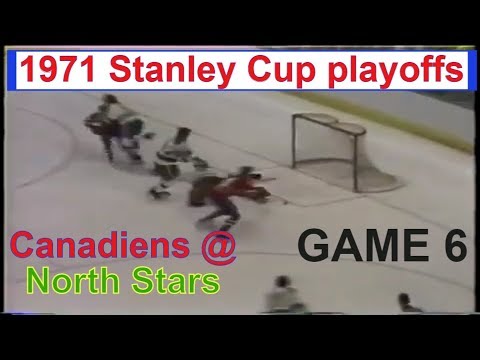
Game 2 took place April 22 at Montreal Forum, where 16,601 fans gathered. By the end of the first period, the North Stars already led 4-0. During the middle session, the Canadiens managed to halve the lead before Minnesota came back with a fifth goal. Although Montreal spent the third period bombarding Minnesota’s net, only Captain Jean Beliveau found the back of it. Canadiens goalie Ken Dryden had not had a good night considering pucks bouncing off his own teammates accounted for two of the goals on him. He probably felt relieved when he was pulled at the end, even though that allowed the North Stars to sink a final goal.
Naturally, the Canadiens were not happy with the 6-3 score. The Forum fans had been so disgusted with the lack of penalty calls throughout the third period that they threw programs, papers, and even 13 rubber overshoes onto the ice. Forward John Ferguson lost his temper and broke his stick over being benched. Coach Al MacNeil justified himself saying, “I set up three lines I thought were going to pull us through. If I think a guy is going bad, I’ll pull him out. I have to do things the way I feel they should be done. Some of them thought this would be a four-game series. Now they know they have to work.”
Meanwhile, Minnesota celebrated being the first to defeat an Original Six team during playoffs. Goalie Cesare Maniago commented, “Everyone figured we were pushovers. We reviewed ourselves after losing 7-2 Tuesday. We knew we were a better club.” That was why, Maniago explained, “We played the type of hockey that got us here. That is checking and waiting for a break.”
Maniago, who had played 14 games for the Canadiens during the 1962-63 season, received much of the credit for the North Stars’ win. Coach Al Gordon praised, “Cesare was great, just great. It got a little tight when they cut the lead down to 4-2 late in the second period, but then Cesare came up with a couple of big ones and Murray Oliver got that [fifth] goal to take us out of trouble.” Center Jude Drouin summarized, “We got some early breaks and took advantage of them. Then we back-checked to kill off penalties, and Cesare was making the big saves. It was a total team effort.”
With the series tied 1-1, the North Stars had the momentum in their favor. Although they lost Game 3 with the scores from Game 2 reversed, the Stars came back to win Game 4 on April 25. That meant that they had pulled off the first two post-1967 wins, one before a Montreal audience and one for their own Minnesota fans. A return to Canada for Game 5 gave the Stars another humiliating loss, of 6-1. They valiantly attempted to tie up the series again back at Minnesota for Game 6 but fell short, losing 3-2. The Canadiens went on to defeat the Chicago Blackhawks in the Stanley Cup Final.
The post-1967 franchises would not take home the Stanley Cup until the Philadelphia Flyers won in 1974. The North Stars finally made it to the finals in 1981 and again in 1991, but they lost both to other expansion teams (the New York Islanders and the Pittsburgh Penguins). Soon thereafter, the franchise relocated, and, as the Dallas Stars, they won their only Stanley Cup in 1999.
Additional Sources:
Mike Lamey, “North Stars wait, see, win” and “Ferguson fumes after benching,” Minneapolis Star, 23 April 1971, p. 8B.
Dwayne Netland, “North Stars shock Canadiens 6-3,” Minneapolis Star Tribune, 23 April 1971, pp. 1C and 6C.
Sid Hartman’s column, Minneapolis Star Tribune, 23 April 1971, p. 2C.
Bob Morrissey, “Habs suffer post-Bruin letdown,” Montreal Gazette, 23 April 1971, pp. 17 and 21.
Ted Blackman, “Fuming Ferguson shatters his stick,” Montreal Gazette, 23 April 1971, p. 17.
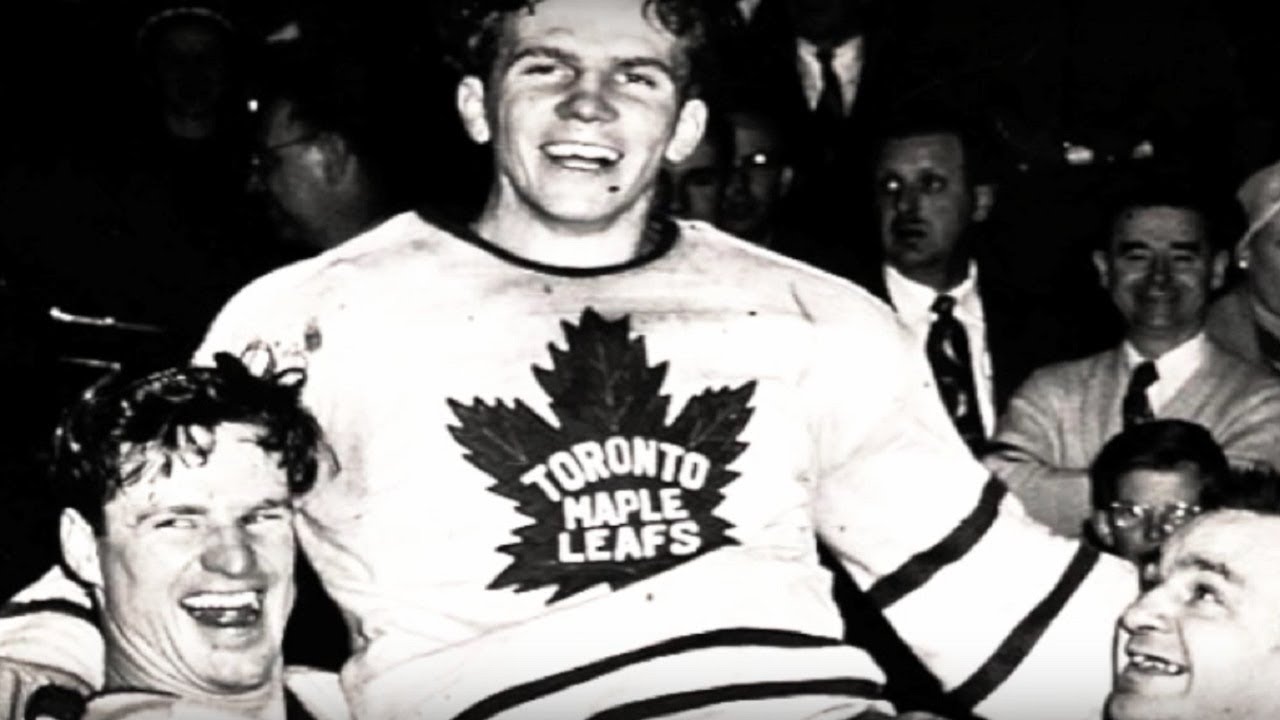
As the last goal Bill Barilko ever made, at least it was a big one. On April 21, 1951, with the Stanley Cup on the line, Barilko won it for the Toronto Maple Leafs in overtime. Tragically, just four months later he went missing in a plane crash.
During the 1950-51 season, the Maple Leafs finished second (with 95 points). In the semi-finals, after having had to halt a tied game due to curfew, they eliminated the Boston Bruins 4-1-1. Meanwhile, the Montreal Canadiens had placed third (with just 65 points) but had somehow managed to defeat the 101-point Detroit Red Wings. Later, Coach Dick Irvin would claim, “Those first two long overtime games against the Red Wings took a lot out of our guys, and the Leafs had a fairly easy time with Boston. That may be the difference.” However, throughout the regular season, Toronto held a 10-2-2 record in matchups with Montreal.
Every single game of the Stanley Cup Finals went into overtime. In Game 1, Toronto’s Sid Smith got the game-winner. Habs’ star Maurice Richard settled Game 2. For Game 3, it was Toronto captain Ted Kennedy with the victory. His teammate Harry Watson won them Game 4. For all of the Leafs, this would be their only overtime goals.
Game 5 was played at Maple Leaf Gardens for 14,577. The home team aimed to win the Cup while the visitors wanted the chance to make a comeback. Even as the Leafs outshot the Habs 42 to 19, goalie Gerry McNeil mostly held them off.
In fact, Montreal led in the score, though each time, they were matched by Toronto. At 8:56 of the second period, the first goal was scored with the “Richard special” as The Rocket easily got around defenseman Jim Thomson. Just over three minutes later, winger Tod Sloan answered. Within the first five minutes of the next period, Montreal’s rookie forward Paul Meger scored with a backhand on a rebound. As the clock ticked down, the Canadiens thought they might have it.
With a minute and a half to go, Coach Joe Primeau pulled Al Rollins, who came back for another faceoff then left the net again. According to the Ottawa recap, “Center Ted Kennedy got the puck back to Max Bentley from a faceoff at the Montreal end. The little center took a dipsy-doodle course across the ice and then let drive. The puck got to Sloan, standing at the side of the goal and he flicked it in.” With only 32 seconds remaining, Sloan had knotted the score again. Ecstatic fans tossed all kinds of papers, so the ice had to be cleared before finishing.
“The Leafs pressed from the first second of the overtime,” noted the Gazette. It only took 2:53 until the play that ended it all. The recap continued, “Then big Harry Watson grabbed a rolling puck and passed to [Howie] Meeker, who went around the back of Canadiens’ net. Bill Barilko came rushing in to take Meeker’s passout and drilled a [diving 15-foot] shot that landed high in a corner of the rigging.” The “burly, blonde Toronto defenceman” had netted himself and the Maple Leafs their fourth championship in five seasons. It was also the franchise’s ninth title, then the most of any NHL team.
In celebration, the players left the bench to swarm Barilko and raise Coach Primeau on their shoulders. Primeau had now added the Stanley Cup to his collection, having led teams to the Memorial Cup for the Canadian junior title (St. Michael’s College) and the Allan Cup for the Canadian senior title (Toronto Marlboros). Manager Conn Smythe came out onto the ice. With this seventh championship since he headed the Leafs, he matched Tommy Gorman’s record for most as a manager.
That was the last happy ending for 24-year-old Barilko, who had now won four Stanley Cup championships in his mere five years in the NHL and with the Leafs. On Friday, August 24, Barilko and his friend (dentist Dr. Henry Hudson) flew off in a two-seater Fairchild 24 pontoon plane from South Porcupine (near their hometown of Timmins, Ontario). They had gone on fishing trip at a lake north of Seal River (500m north of Timmins, close to James Bay) and planned to return Monday.
On Sunday, August 26, the two fishermen had “last reported at far-north Rupert House at 4 pm.” That was the last anyone heard from them. At the time they went missing, Hudson’s wife said he’d been flying five or six years and went every nice weekend. “As far as I’m concerned, they are not missing. They’re out of gas and down on some lake. My husband is a very careful pilot and bad weather or lack of gas may have forced him down.”
With “reports that a small plane crashed in the area,” within two days, six planes began searching for them, but “electrical storm as darkness fell grounded the searchers.” Soon enough, seven RCAF planes took up “Operation Barilko,” searching east and north of Timmins.
By the end of September, the men and their plane had not been found. The banquet scheduled for September 28 meant to honor the Leafs was “cancelled out of respect for Defenceman Bill Barilko, missing nearly a month on a far-north aerial fishing trip.” At that point, Smythe talked about the team’s sad losses. “Little hope is held for the safety of Barilko. Also, since last season, we have lost through death our chief scout, Squib walker, and J.P. Bickell, a director of the Maple Leaf Gardens who, as first president, played a major part in raising funds to erect the building.”
Eleven years later, on June 1, 1962, a roving helicopter from the Ontario department of lands and forests spotted wreckage in barren bushland about 40 miles north of Cochrane, Ontario. As suspected, on June 6 it was confirmed that they had found the two skeletons “amidst the smashed wreckage of their plane, which apparently caught fire in plunging to the ground 45 air miles north of” Cochrane “a few miles east of the Ontario Northland Railway.” They could clearly see “CF-FXT,” part of plane’s registration number. The Toronto Maple Leafs, who had not won the championship since Barilko’s overtime goal, had just taken home the Stanley Cup on April 22, 1962.
Additional Sources:
Mike Commito, Hockey 365: Daily Stories from the Ice (Toronto: Dundurn, 2018), kindle edition.
Hockey Chronicle: Year-by-Year History of the National Hockey League (Lincolnwood, Ill.: Publications International, Ltd., 2006), 196-201.
Dink Carroll, “Playing the Field” and “Leafs Nip Canadiens 3-2 in Overtime to Take Stanley Cup; Bill Barilko Scores Winner Despite McNeil’s Brilliance,” Montreal Gazette, 23 April 1951, p. 22.
“Bill Barilko Breaks Up Stanley Cup Struggle,” Ottawa Evening Citizen, 23 April 1951, p. 17.
“Search Shifts,” Ottawa Evening Citizen, 29 Aug. 1951, p. 1.
“Resume Hunt For Barilko,” Ottawa Evening Citizen, 30 Aug. 1951, p. 1.
“Leafs Pay Respect to Barilko,” Ottawa Evening Citizen, 21 Sept. 1951, p. 37.
“Shift Area of Barilko Hunt,” Ottawa Evening Citizen, 26 Sept. 1951, p. 5.
“Lost Hockey Star’s Plane Discovered?” Ottawa Citizen, 2 June 1962, p. 1.
“Barilko’s Aircraft Identified,” Ottawa Citizen, 7 June 1962, p. 12.
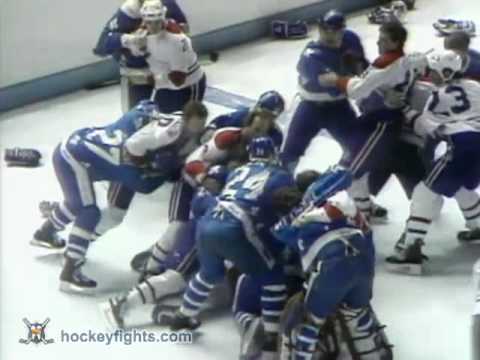
“The Battle of Quebec had erupted into a mini-war,” wrote one Gazette reporter of the events at the end of the second period of the playoff game between the Montreal Canadiens and Quebec Nordiques on April 20, 1984. The two bench-clearing brawls between the Quebec-province teams came to be known as the Good Friday Massacre. Another reporter summarized, “The Nordiques may have won the battle of Quebec, but by the time the war had ended, the Canadiens had extracted unconditional surrender.” After all the fighting, the Canadiens had an epic come-back to eliminate the Nordiques and advance to the next playoff round.
The rivalry that began with the Nordiques merging into the NHL in 1979 became more bitter as of 1981, when they landed in the same division. In 1983-84, they finished the regular season third and fourth in the Adams Division as the Nordiques had accumulated 94 points and the Canadiens just 75. Still they both managed to beat the top two teams in the division during the semi-finals.
Going into Game 6 of their division finals, Montreal led 3-2. A crowd of 18,090 packed the Forum to see if the Habs would advance or if the Nordiques would force a Game 7. It looked like Quebec might pull it off as star Peter Stastny scored in the first period and had the only goal in the first two-thirds of the game.
Hockey turned into boxing as the buzzer signaled the end of the second period. During the final seven seconds, Dale Hunter had leaned heavily on the back of Habs’ Guy Carbonneau in an effort to push him away from the Nordiques’ net. As they fell to the ice with Hunter laying atop Carbonneau, the fists began flying.
Montreal’s Chris Nilan “leaped on [Randy] Moller and cut him badly with a series of punches.” Meanwhile, his teammate Mario Tremblay “flailed away” at Stastny, breaking his nose. As the benches cleared, even the backup goalies, Montreal’s Richard Sevigny and Quebec’s Clint Malarchuk, took each other on in one of the many individual fights across the rink.
The brawl ended with a knock-out punch. Along the boards, Louis Sleigher and Jean Hamel were grappling with linesman John D’Amico trying to separate them. Sleigher “reached over a linesman’s shoulder and caught Hamel with a numbing sucker punch which left Hamel inert on the ice.” Habs defenseman Larry Robinson said of Sleigher, “It was a cheap sucker shot, that’s all he’s good for. … There’s no room in the league for guys who can only hit you from behind.” With Hamel requiring medical assistance, the players finally had a cease fire and eventually left the ice. As the Gazette pointed out, “It was a desperately ugly finish to a high and soaring period.”
The teams were given extra time to cool down while the officials sorted out the various penalties. They decided on game misconducts for Sleigher, Stastny, Nilan, and Tremblay, and Hunter received two roughing minors. However, before they could relay this information, the players had already been allowed to return. “It was a mistake. The teams were on the ice before they should have been,” explained Supervisor of Officials John McCauley. “Everyone’s to blame. The referee, the minor officials. But in fairness to people in this room, they weren’t told that the teams had gone back out.”
As soon as the extent of the penalties became clear, “those who’d been ejected felt they had nothing else to lose and tried to exact retribution.” After Nilan went after Moller, the latter asked, “Why was he allowed onto the ice at the start of the third?” Per the Gazette, “As a result, all hell broke loose again.” Before they even got around to dropping the puck, the Canadiens went after Sleigher for hurting Hamel. The first one to take him on was Dale Hunter’s brother, Mark, and he was followed by Mike McPhee as clashes erupted everywhere again.
Having set the first round in motion, Dale Hunter was the other top target for Montreal. His own brother came after him twice. Mark said later, “It was just on the spur of the moment. Dale and I are very close and there won’t be any hard feelings at all. He has to play that way to be his best. And I have to play my game too, eh.” In addition to Mark, goalie Sevigny also went after Dale, despite fellow-goalie trying to warn him off. Malarchuk remarked, “Obviously, he (Sevigny) was willing to get the crap kicked out of him just to get Dale out of the game.” From Dale’s point of view, “According to the ref I should have been thrown out of the game. … All I know is that Sevigny came after me twice. And I wanted nothing to do with him.”
After this second round, the referees ejected both Hunter brothers, both backup goalies, Moller, McPhee, and recent Quebec call-up Wally Weir. All told, 11 players were tossed, the Nordiques had 134 penalty minutes, and the Habs had 118. The grand total of 252 minutes was just 15 short of the playoff record set by the Rangers and Kings in 1981.
The Nordiques were furious that three of their top players were out while, in their view, the Canadiens only had to do without their fourth-line. Coach Michel Bergeron accused Montreal Coach Jacques Lemaire of basically setting up a hit to take Dale Hunter out. “Lemaire has the face of an angel; everybody thinks he’s an angel. But in five years of the rivalry, there’s never been a brawl like this.”
The Canadiens were happier that Stastny was out of their way. Canadiens Managing Director Serge Savard explained, “With him out of the game, we were able to open up for the first time in the series. We had an incredible team effort in the third period … I couldn’t single out one man who was better than another … but having Stastny out helped us. When you open up against that team, a guy like Stastny usually is putting the puck in the other team’s net.” Winger Mats Naslund commented, “That’s the first time I’ve seen a fight really pay off. I don’t know who got him out of the game but whoever it was, it was a smart move.”
Indeed, without these Quebec stars, Montreal came roaring back by scoring five goals in ten minutes. Steve Shutt had the first two that kicked things off. He said, “For the first time I can remember, I had it in my mind where I was going to shoot. And even better, that’s where they went.” Rick Green followed with his only goal of the season since he had been out most of it with injuries. The final score was 5-3.
Unsurprisingly, many did not like the way referee Bruce Hood handled the incidents. Coach Bergeron warned, “If the referees don’t start taking things in hand, there’s going to be worse trouble.” The Gazette’s Michael Farber wrote that Hood “let an already messy situation degenerate into what literally became a battle of brother against brother.” Beleaguered, Hood (who had just refereed his 1,000th game that November) retired at the end of the playoffs.
For the next round, Montreal faced the New York Islanders, who had just come off their four consecutive Stanley Cup championships. As expected, they lost 4-2. The Islanders advanced to the Final but lost to the Edmonton Oilers, unable to match the Canadiens’ record of five consecutive championships.
Still, the Good Friday Massacre left some with a bad taste. Farber thoroughly expressed his disappointment in both teams: “Shame on you, Montreal Canadiens. You were a disgrace to the uniform. Shame on you Quebec Nordiques. After spending the last two years trying to polish your image, you helped turn a playoff game into what would be mere burlesque if the fights weren’t premeditated.”
Additional Sources:
Mike Commito, Hockey 365: Daily Stories from the Ice (Toronto: Dundurn, 2018), kindle edition.
Herb Zurkowsky, “So bring on those Islanders!” Montreal Gazette, 21 April 1984, p. A1.
“Habs oust Nordiques, Isles are next,” Montreal Gazette, 21 April 1984, pp. D1-D2.
It was all about apples on April 19, 1962. Facing each other in Game 5 of the Stanley Cup Final, Stan Mikita had two assists and Tim Horton had three. Mikita’s gave him the most playoff assists (15) and the most playoff points (21) in NHL history while Horton’s gave him the most points (15) scored during playoffs by a defenseman.
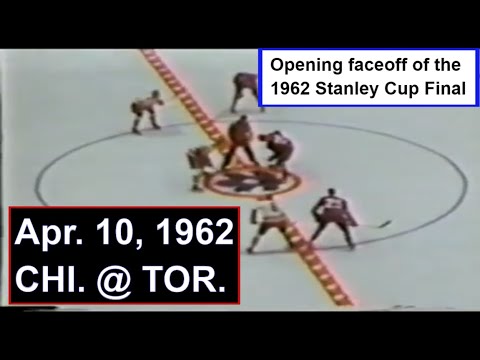
The Final came down to the Chicago Black Hawks and the Toronto Maple Leafs. The former had won the Stanley Cup the previous spring. However, the Hawks had finished the regular season in third (with 75 points) while the Leafs finished in second (with 85 points). During the semi-finals, Toronto took care of the New York Rangers, and Chicago knocked out the first-place Montreal Canadiens (with 98 points). The 1961-62 playoff series all ended in 4-2 victories.
The matchup between the finalists was no different. Up until the final game, each team won all their home games and lost those on the road. With the series beginning at Toronto, the Leafs took an early 2-0 lead, but as soon as they moved to Chicago, the Hawks tied it up. The tie-breaker, Game 5, took place at Maple Leaf Gardens, which held its largest crowd of the series, 14,129.
It looked like another home-team victory was on the horizon when the first period started with two goals by Toronto’s Bob Pulford. He had scored just 17 seconds into the game and again in the period’s final three minutes. Just 20 seconds after that, Chicago managed to get on the board.
The second period featured all but one of the record-setting assists. First, the Hawks came swooping back in when Ab McDonald scored just before the first minute ended and again just after the third began. Mikita set up the first “after taking St. Laurent’s pass beyond the Hawk blue line, by tying up Tim Horton … at the left boards. Stan still had enough puck control to pass to McDonald as he steamed into Horton’s undefended area” for the 40-foot “drive that crossed diagonally in front of [Don] Simmons and landed high in the far corner of the net.”
Having tied the two records, Mikita then broke them when Toronto’s Dick Duff was sitting a charging penalty. As the Tribune recapped, “Stan’s pass set up Hull for a shot at left center, but Bobby was tied up by Baun. Hull then passed to McDonald at short right center, and Ab drove the puck between Defenseman Carl Brewer’s legs and into the net.” With that, Mikita had topped Gordie Howe’s 20 points from 1954-55 and Fleming MacKell’s 14 assists from 1957-58.
At some point during the game, at least one member of the crowd began heckling Mikita and McDonald. Their equipment manager, Nick Garen, took exception and “threw a right.” He said afterwards, “It was all my fault. He was riding Mikita and some of the players and I asked him to quit. He kept it up so I hit him. I think we talked him out of pressing charges.” Coach Rudy Pilous could only say, “It was a game in which whatever we did was wrong and whatever they did was right.”
About five minutes after Mikita’s record assist, Horton kicked Toronto back into gear. His assistance to Billy Harris tied up the score at 8:31 when “Harris, standing just outside the crease at Hall’s right, turned Horton’s line drive shot from the right point into the net.” Nearly a minute and a half later, at 9:50, Horton took advantage of a power play while Ken Wharram sat for holding. Both Horton and his teaming Frank Mahovlich were shooting on Glenn Hall when the puck, “on Horton’s shot, skidded to Hall’s right and [Dave] Keon pushed it home.” Mahovlich finished up the period with Toronto leading 5-3.
In the third period, the Leafs added two more goals while the Hawks only managed one. For the final goal of the game, during a power play, Pulford completed his hat trick with Horton’s assistance. This gave Toronto an 8-4 victory and gave Horton a defenseman record with 15 points scored during playoffs.
The Maple Leafs upset the pattern and won Game 6 at Chicago on April 22. This was the first of three consecutive championships for Toronto. In that Cup-winning game, Horton added still another assist to establish the record at 16 points. During those playoffs, he had the most point on his team. Mikita, too, led his team in scoring during playoffs with his 21 points.
Their records would be toppled within the decade. First, Bobby Orr beat Horton by scoring 20 points in 1969-70 and then topped himself with 24 points in 1971-72. The current record of 37 points by a defenseman has been held by Paul Coffey since 1984-85. In overall assists, Jean Beliveau beat Mikita in 1970-71, and Orr beat that with 19 assists the following season. Wayne Gretzky holds the current record of 31 assists that he set back in 1987-88. Finally, for playoff points, Phil Esposito’s 27 took the record in 1969-70. Once again, Gretzky holds the record with 47 points scored during playoffs in 1984-85.
Additional Sources:
Ted Damata, “Hawks Routed;1 Game from Oblivion,” Chicago Tribune, 20 April 1962, section 4, pp. 1-2.
“Not Much to Say – Pilous,” Chicago Tribune, 20 April 1962, section 4, p. 2.
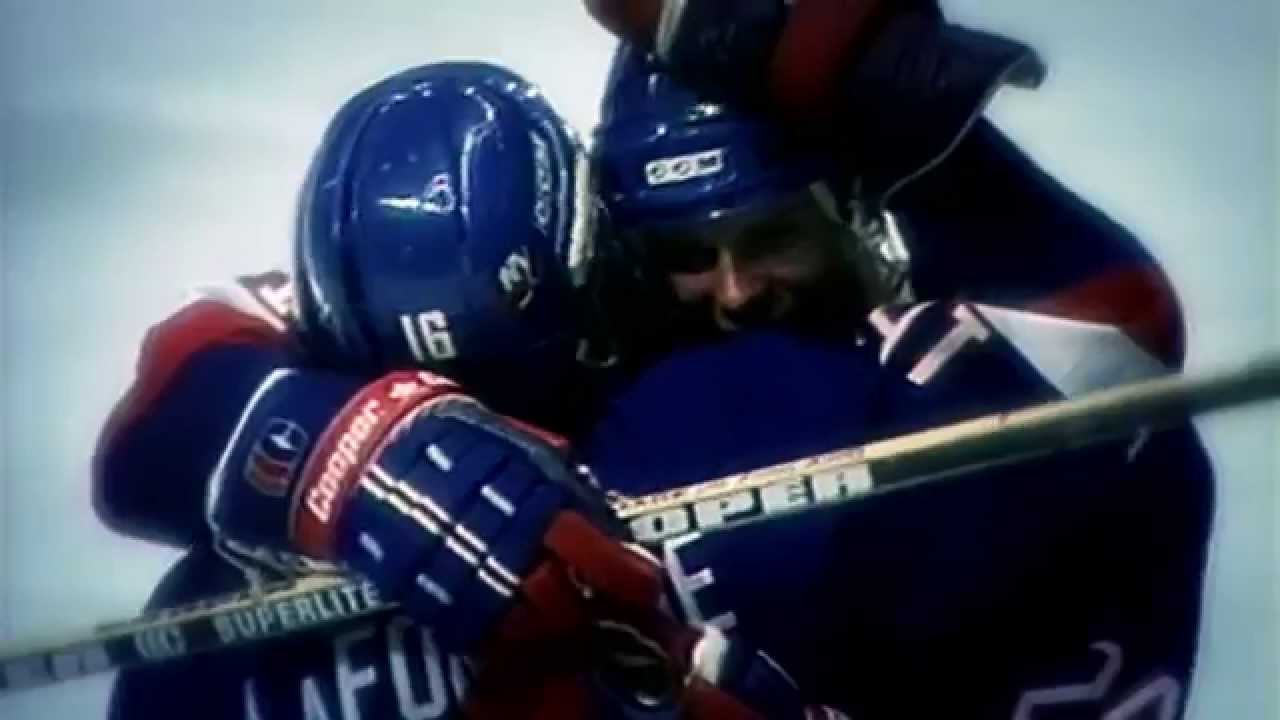
Having begun Game 7 of the Patrick Division semi-finals on April 18, 1987, in the wee hours the next morning, Pat LaFontaine found the New York Islanders’ Easter basket.
The Islanders had just won four consecutive Stanley Cup championships in 1983, when Bill Torrey schemed for the opportunity to draft LaFontaine third overall. That year, thanks to Torrey, two American-born players were chosen in the first three picks.
LaFontaine continued to pave the way for U.S. players, and despite a career cut short (in 1998) from concussions, he still ranks eighth in points (with 1,013) among Americans. He averaged 1.171 points per game throughout the 15 seasons he played, which is the best among U.S.-born players and 15th overall. Torrey summarized, “Pat received a lot of publicity. He was very photogenic. He had a great personality. He was very humble. And he was very exciting to watch play. He was the complete package.”
When the 1986-87 season ended, the Islanders went into the playoffs third in the Patrick Division (with 82 points), close behind the Washington Capitals (with 86 points). The Capitals won three of the first four games in the best-of-seven. It had been 12 years since a team had come from that far behind to take the series, but that team had been the Islanders. LaFontaine later said, “We had some history and we had some championship players in the room. I think they were a great balancing factor of that team that it helped allow us to keep an even head and keep the focus on winning one game at a time, which we did.” The Islanders won the next two games to force a Game 7.
On April 18, the Capital Centre at Landover, Maryland hosted a sellout crowd of 18,130. At least a third of them remained until the bitter end, though to some players it appeared everyone was there for the long haul. LaFontaine remembered seeing fans sleeping as the theme from “The Twilight Zone” played. The fans were asked to wear white and provided with white towels, which must have seemed like flags of surrender as the game stretched on into overtime sessions.
The game’s length can be laid at the feet of two fantastic goaltenders. In the Islanders’ net, Kelly Hrudey only allowed one goal late in the first period (by Mike Gartner) and one goal late in the second (by Grant Martin). Other than that, he made a record 73 saves and prevented the Capitals from scoring for the remaining 90:51. Washington’s coach, Bryan Murray, bemoaned, “We just couldn’t get anything by him.” Afterwards, Hrudey joked with the press, “I thought it was a dream. I never thought I could face 75 shots and let in two goals. I hope you don’t expect me to do that again. This is a once-in-a-lifetime thing.”
Over in Washington’s net, Bob Mason was only playing in his fourth ever NHL playoff game. He had played with LaFontaine on Team U.S.A. at the 1984 Olympics. Although Mason did not allow a goal until 11:35 of the second period (by Pat Flatley), he then allowed New York’s famed Bryan Trottier to tie the game with just over five minutes remaining. Mason held off the Islanders for 73 more minutes and 35 more shots until he missed the game-winner.
In an extreme case of the power of three, the final goal was promised, prescribed, and predicted. Before either the second or fourth overtime session, LaFontaine approached Hrudey with a promise. LaFontaine said, “He had worked so hard for us throughout the playoffs that I just had to go to him after the second overtime and tell him somehow, someway we were going to win this thing for him.” According to Hrudey, “The funny thing is, Patty [LaFontaine] came over to me before the last overtime and told me he was going to score the game-winner. You get a guy with that kind of talent and that kind of confidence, and it picks you up. I had no idea what was going on [in the overtimes]. It seemed like a different game.” As the fourth session was about to begin, referee Andy Van Hellemond prescribed that LaFontaine finish the game by joking, “Would you just shoot high glove and get this over with?” Finally, as the fourth overtime progressed, New York’s equipment manager, Jim Pickard, splashed LaFontaine with some water and predicted, “Pop, I think you’re going to get one on this shift.”
All three came to pass. At 8:47 of that fourth overtime session, 30 seconds after Pickard’s prediction, LaFontaine picked up a deflected puck just inside the blue line, spun 180 degrees, and sent a slapshot towards the net. LaFontaine described the play, “I got a screen from Dale Henry and just hit it as hard as I could. . . . [The puck] smacked off the pipe and ricocheted in.” He also said, “I was just shooting the puck hoping it would go in. It ended up going high glove.” Poor Mason admitted, “I never saw it. I heard it hit the pipe and was hoping . . . then I looked back and it was in.” He later summarized, “I was sitting at the goal line. It was a quick shot and I think I was trying to find the puck. I didn’t see it, screen, went through a couple of players, post and in.” The stunned crowd was silent, and Mason dropped to one knee. Referee Van Hellemond gave the puck to LaFontaine, who kept the puck with the time of goal and final score marked on it.
Shortly before 2 am on Easter morning, the “Easter Epic” had finally ended with an Islanders’ 3-2 victory. The game had lasted six hours and eighteen minutes for 60 minutes of regulation and 68:47 of overtime. To put that in perspective, the Boston Marathon winner had finished 56 seconds faster the previous year. It was the longest Game 7 and tenth-longest game in NHL history. At the time, it was the second-longest NHL game to take place in the U.S.
The goalies naturally felt the length of the game more than their teammates, who could at least sit on the bench between shifts as they at fruit and drank Gatorade. Hrudey said it took a moment before he could believe the game had ended, and his toes curled from dehydration when he finally removed his skates. Mason commented, “My arms were really heavy, and my equipment is so wet. My hips started to ache. I didn’t have trouble concentrating, but I got so dehydrated out there and had a headache.” He thought he lost about 15 pounds, and he definitely felt it the next morning. “It felt like I hit a truck.”
When he made it back to New York, Hrudey joked, “Don’t ask me anything about the first five periods, because I’ve forgotten already.” He later said, “It was such an emotional game and exciting game. You kind of had the feeling that nobody was going to be the goat. I don’t think anybody on the management side of either team was going to be disappointed with their group after playing multiple overtimes.” Of course, the losing team did not feel so great. Mason commented, “The most disappointing thing is that we were up 3-1. We kind of had control of that series. I guess you never control a series until the fat lady sings.” Captain Gartner could not help feeling bitter. “The first time they beat us, I said it was a learning experience. The second time they beat us, I said it was a learning experience. Now, I really don’t see anything else they can teach us. Maybe, they can teach us how to win.”
The Islanders had trouble winning from that point. They had a rough ride just getting to Game 1 of the division finals against the Philadelphia Flyers. Their flight to LaGuardia was rerouted to JFK due to fog. Then they had to wait for their bus to make it to the other airport. They finally arrived back at Nassau Coliseum at 6:30 am. They had to be back there in time for an 8 pm bus to Philadelphia. They played Game 1 on April 20. Again, the Islanders dropped to 3-1 in the series and came back to tie. This time, Game 7 did not go their way.
Still, both LaFontaine and Hrudey felt the “Easter Epic” helped them as players. As Hrudey explained, “Personally, that game and that series changed my reputation to a certain degree. I became a guy who was thought of more as a real big-game goalie and a starter.” LaFontaine said, “I think I was able to then take that experience and those experiences with those players and try to bring your game to the next level. That was definitely a steppingstone, that year, that team and that moment.”
For Martin Brodeur, it wasn’t enough to strive to be the greatest goaltender of his generation. He wanted to be the greatest offensive goalie as well. On April 17, 1997, he took the first step in succeeding when he scored an end-to-end empty-net goal. His was the fifth goalie goal and the second scored during a playoff game. During his career, he would become the only goalie credited with three goals.
At the end of the regular season, Brodeur led the league with a 1.88 goals-against average and was second in save percentage with .927. Both were his career best.
The playoffs began with a sold-out game at the Continental Arena at East Rutherford, New Jersey. After the Devils took an early 2-0 lead in the first period, they fell apart in the second. Everyone agreed the only reason things didn’t go worse was because Brodeur held the Montreal Canadiens off to two short-handed goals.
His captain, Scott Stevens, admitted, “It was a terrible second period. We put a lot of pressure on Marty. He really kept us in the game, and we can’t afford to do that every night.” Brodeur was a bit alarmed. “We got caught a little bit in the second period not playing the way we should have. I was concerned when they tied it. You don’t want to lose a lead. We were careless a little and they came back. They’re so skilled offensively.”
Fortunately for them, the Devils turned it around in the third with Bill Guerin scoring the game-winner off a rebound at 5:19. By the time the Canadiens pulled Jocelyn Thibault from the net in the final minute, the home team was up 4-2.
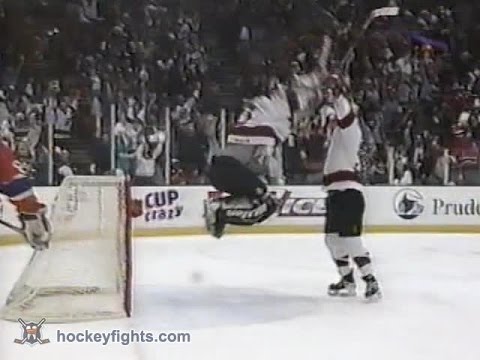
As the clock ticked down, the desperate Canadiens shot in Brodeur’s direction, and he stopped it behind his net. Staring down at the other empty net, Brodeur did what he had wanted to do his entire (four-year) professional career. As the Record snarked, “Brodeur got control of the puck near his net, and anyone who’s ever seen him in this situation knew what he was going to try to do.”
Brodeur described his thoughts at the moment, “When I went behind the net, I had trouble controlling the puck. I was freaking out when I shot it and it went over everyone. I saw John MacLean with his hand up, so I knew it had a chance.” The puck flew across the ice over the blue lines. As the recap described, “The puck landed, slid, and finally nestled in Thibault’s vacated cage” at 59:15. Brodeur was glad that “Guys in front of me went on the side and I saw it go in.”
The crowd went crazy, and Brodeur jumped up and then laughed. Brodeur decided to keep his stick and the puck as mementos. “I was freaking out. It was unbelievable.” Since the game was televised back in his home province of Quebec, Brodeur noted, “It was due to happen. I’ve tried it enough. A lot more people than I know probably saw it live, but it doesn’t really matter what team the goal was against. I’m happy about it, but it ends there.” The Montreal Gazette made him first star.
Brodeur’s goal was the second scored during playoffs after Philadelphia’s Ron Hextall was the first on April 11, 1989. Stevens happened to be at both events, but that time he was on the losing side (playing defense for the Washington Capitals). He remembered that he was the one who shot that puck to Hextall. After Brodeur matched the feat, Stevens said, “I know with Marty now, when it’s a two-goal lead I’m going to let him get the puck and just get out of the way.”
New Jersey ended up eliminated Montreal after only allowing them one victory (in triple overtime in Game 4). However, they lost the next round 4-1 against the New York Rangers. Brodeur had had five wins and five losses with a save percentage of .929 and a goals-against average of 1.73.
After that, Brodeur went on to earn credit on two more goals. On February 15, 2000, he was credited with the game-winner when he was the last to touch the puck before Daymond Langkow accidentally put the puck in the empty net during a delayed penalty call. Then on March 21, 2013, Brodeur became the only goalie credited with scoring on another goalie. Dan Ellis was on route to his bench from a delayed penalty call and couldn’t return in time to block Jordan Staal’s pass into their net.
Brodeur has also been on the receiving end as the only goalie to have both scored on an empty net and to have been benched when another goalie scored on his. In NHL history, Brodeur scored three of the fifteen goalie-credited goals for New Jersey, which has also had three against them. Thus, the Devils have participated in nearly half of all goals credited to goalies.
Additional Sources:
“Marty party!” Hackensack Record, 18 April 1997, pp. S1-S2.
Red Fisher, “Devils Draw First Blood,” Montreal Gazette, 18 April 1997, pp. C1 and C3.
Jack Todd, “Nothing to it,” Montreal Gazette, 18 April 1997, p. C3.
Dave Anderson, “Devils goalie like a rag doll,” Montreal Gazette, 18 April 1997, early ed., p. C3.
After 23 years going dry, the Black Hawks had to celebrate their 1960-61 Stanley Cup victory in Detroit as Chicago was closed off by its worst snowstorm of the season. With a big 5-1 win in the Final on April 16, the Black Hawks took home the Stanley Cup for the third time, having won in 1934 and 1938. It was the first Chicago sports title since 1947 (when the NFL Cardinals took the prize).
The Hawks had a pretty middling season, finishing in third place with 75 points. In the semi-finals, they pulled off a miraculous upset when they ousted the five-time champs and first-place (with 92 points) Montreal Canadiens. Meanwhile, the fourth-place (with 66 points) Detroit Red Wings took out the Toronto Maple Leafs (with 90 points).
When the two Midwestern teams faced each other, they alternated victories throughout the first five games. Each won only at home, with Chicago taking all the odd games and Detroit all the even. The pattern finally ended with Game 6 at Olympia Stadium. There, they had the largest crowd of the playoffs, 14,328. This included alumni from the 1937-38 Hawks like goalies Mike Karakas and Aflie Moore, Carl Voss, Captain Johnny Gottselig, and Coach Bill Stewart.
At first, it looked like Game 6 might stick to the pattern because Detroit got on the board first, at 15:24 of the first period. While Al Arbor sat out an interference penalty, Gordie Howe “hammered a 40 foot powerplay drive from direct center,” and “when Howe’s shot hit Hall’s pads and dropped to his feet, [Parker] MacDonald slammed home the rebound before Hall could drop to cover.”
However, the game turned in the second period. According to Coach Rudy Pilous, “I raised a little hell. I just told them that tonight’s game was worth $1,000 to the winner, and the loser gets nothing. If they didn’t want it, I knew somebody who did.” Soon thereafter, rookie Wayne Hicks was called for hooking. In killing the penalty, Reggie “The Horse” Fleming (who had just been traded (by Frank Selke of Montreal) to Chicago the previous June) “took the puck away from Len Lunde deep on the Hawks’ right boards,” then “poled the puck to the other end of the ice.” The recap continued, “Fleming poke-checked the puck away from [defenseman Pete Goegan], swerved to the left and rode it home.” He’d scored an unassisted shortie at 6:45.
Fleming was credited with not just tying up the game but turning it in Chicago’s favor. As one teammate commented, “There’s the guy who got us on our way. He scores in the second period, and we get the lift to win.” In the locker room afterwards, Fleming just kept chanting, “Yes, sir. Yes, Sir. Yes, sir.” He then told Selke, “I told you, didn’t I, that I’d be with a champion some day.”
Just before the period ended, at 18:49 Ab McDonald scored the game-winner. Goalie Hank Bassen “after blocking a shot by Bobby Hull, [was] completely out of position” to block. In the final period, the Black Hawks took advantage of “panic driven mistakes by the Wings” to score thrice more. Coach Sid Abel acknowledged, “We ran out of gas. We stopped skating after the first period.”
In their own net, Glenn Hall (who had been traded by Detroit five years earlier) made 21 saves. The local papers called him a “quiet, calm, nerveless knight of the nets” who “twice reached back into the goal to steal scores from the Wings in a second period that bred frustration in the enemy.” He modestly remarked, “When did I know we had ‘em? Well, it was when we got the fifth goal right near the end.” In celebration, Hall was carried off the ice by his teammates.
Obviously, the Black Hawks had made their higher ups happy. Co-owner and chairman of the board Jim Norris said, “Our nerves were a little on edge. I was pretty sure we were going to do it when Fleming got that goal, but somehow I didn’t want to watch after we got two ahead. We’re happy and proud tonight.” His brother Bruce, the head of the opponents, came over to congratulate him. Coach Pilous summarized, “This hockey team, I’d say, has improved 25 to 30 per cent since the start of the season. They’re tired now. They have a right to be. Now they have the pride of champions.”
The new champions only got as far as the Metropolitan airport, where they had an “extremely mild” celebration of beer at the cocktail lounge. After two hours, they finally had to give up and return to the hotel because the “snow and wind in the Chicago area forced cancellation of the charter flight.” In their “worst snowstorm of the year,” “gusts of wind up to 45 miles an hour piled drifts as high as 10 feet in places.” According to the Chicago Tribune, “The snow closed Meigs field, but traffic was moving in and out of O’Hare field and Midway airport.” Apparently, the snowfall broke a record for the date, April 16, that was set all the way back in 1897.
Understandably, the Black Hawks’ flight was rescheduled for 9:30 in the morning “depending upon the weather.” The team did make it home, where Chicago “cheered them at O’Hare field, escorted them in the parade to City hall, and cheered them some more as Mayor Daley presented them the city’s certificate of merit.” According to Mayor Daley, they were “the greatest hockey team ever put together anywhere,” and “no team could surpass them for ability and agility.” That night, the Black Hawks officially celebrated at Bismarck Hotel in Chicago.
As it turned out, Chicago fans had to wait twice as long until their next Stanley Cup victory, which wasn’t until 2010.
Additional Sources:
“Hawks Bring Stanley Cup to Chicago” and “Big Storm Closes Roads,” Chicago Tribune, 17 April 1961, part 1, pp. 1-2.
“Our Black Hawks are World Champs!” Chicago Tribune, 17 April 1961, part 4, pp. 1 and 4.
“Defense Rests: It’s Hawks 5, Wings 1,” Detroit Free Press, 17 April 1961, pp. 35-36.
Ted Damata, “Chicago Honors Its Hawks at Ceremony in City Hall,” Chicago Tribune, 18 April 1961, part 3, pp. 1 and 4.
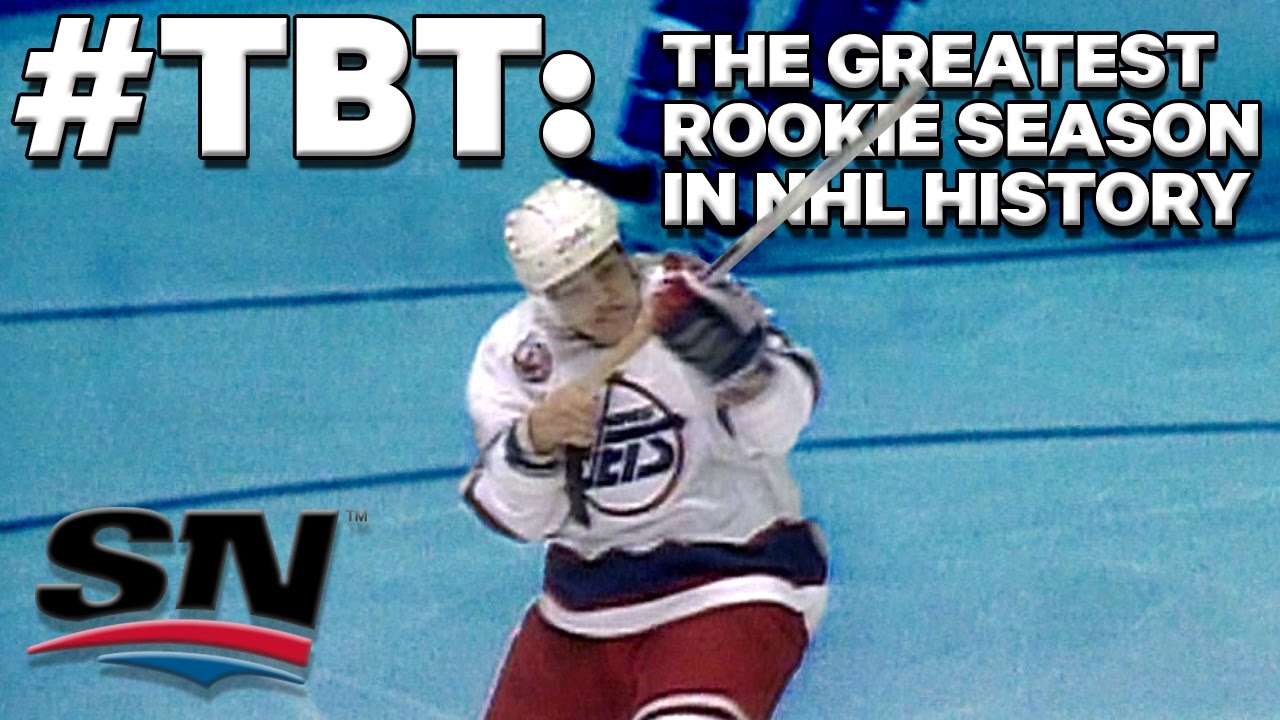
Is it any wonder that “The Finnish Flash” rushed to make records right off the bat? When Teemu Selanne joined the NHL for the 1992-93 season, he set a rookie record for most goals and points. Thanks to two games played on April 15, he even tied Alexander Mogilny as the top goal-scorer in the league. While it wasn’t all downhill from there, Selanne certainly hit some of his highest heights in his very first year.
Jokes about speed aside, Selanne actually took his time joining the NHL. After the Winnipeg Jets drafted him 10th overall in 1988, he kept playing for his Finnish club. Since he took a while, the Calgary Flames tried to scoop him up, but the Jets held on matching the offer.
As soon as Selanne made it for the start of the 1992-93 season, he netted 11 goals in his first 12 games. Come February, he scored 11 goals in five games leading up to his hat trick on March 2, when he broke Mike Bossy’s rookie record of 53 goals. His celebratory “shooting” of his tossed left glove remains iconic. Throughout the rest of March, he had another 20 goals. By the end of the season, he was on the way to the scoring title.
On April 15, for the last game of the regular season, Winnipeg Arena held 12,229 spectators. The home team shut out the Edmonton Oilers 3-0, thanks to Bob Essensa’s 31 saves. The Jets had won 8 of the 9 matchups between the teams, which was part of why they were going into playoffs instead of the Oilers. Coach Ted Green noted, “Our inability to beat Winnipeg was really the reason we’re out (of the playoffs) and they’re in.” The Edmonton Journal called it the worst season in Edmonton’s 14 years in the NHL.
Of the three goals by Winnipeg, Selanne scored the second and assisted on the third. His 76th goal came at 5:25 of the second period. Goalie Bill Ranford said afterward, “I thought I had him on the one he got, too.” Selanne’s 56th assist (for Alexei Zhamnov) came in the final moments of that period. Out of the Jets’ 42 shots on goal, Selanne had 11 of them. As one newspaper pointed out, he probably had 20 “shots at goal.” He finished the season with a 17-game points streak.
The game would be remembered equally for the goal Selanne scored as well as the ones that got away. When Ranford was “down and out,” Oilers defenseman Dave Manson blocked a shot. “He was trying to go five-hole on me but I shut him down,” said Manson. “I’m just glad he didn’t get it against me. My goals against and minutes played are pretty good right now.” Had Selanne made the goal, he would have won the season’s goal-scoring race. “Of course I had the chance to win that bleeping race, but I bleeped it up,” Selanne swore. “My teammates were setting me up all night.”
Instead, in another game in another country that same night, Alexander Mogilny of the Buffalo Sabres scored his 76th goal in a 7-4 loss against the Philadelphia Flyers. He first scored during a power play at 18:56 of the second period and then matched Selanne with a goal at 5:24 of the third. Mogilny made good on two of his four shots on net. Even though Selanne and Mogilny tied at 76 goals, neither had enough points to steal the Art Ross Trophy from Mario Lemieux (69G, 91A, 160P).
In his rookie season, Selanne had a total of 132 points. While that put him in fifth for the scoring race, it gave him two records. Team-wise, Selanne’s 76 goals and 132 points is still the highest for that Winnipeg (and later Arizona) franchise. He beat Dale Hawerchuk’s 130 points from the 80-game 1984-85 season. League-wise, both totals still stand as NHL rookie records. Bossy had set his 53-goal record back in 1977-78, and Peter Stastny had set a 109-point record for the Quebec Nordiques in 1980-81. That meant that Selanne beat each by exactly 23.
Naturally, Selanne earned the Calder Memorial Trophy. Much later, Selanne reminisced, “It was unbelievable. Something that you couldn’t even realize what I did until next year or the year after. … The whole year was like a dream.”
Although Selanne never matched those results, no rookie has come close to toppling his records. The closest was in 2005-06, when Alex Ovechkin had 52 goals and 106 points. In fact, in all of NHL history, only three players have scored more than 76 goals – Lemieux in 1988-89 (85), Brett Bull in 1990-91 (86), and Wayne Gretzky in 1983-84 (87) and 1981-82 (92). So no one has surpassed Selanne since 1993.
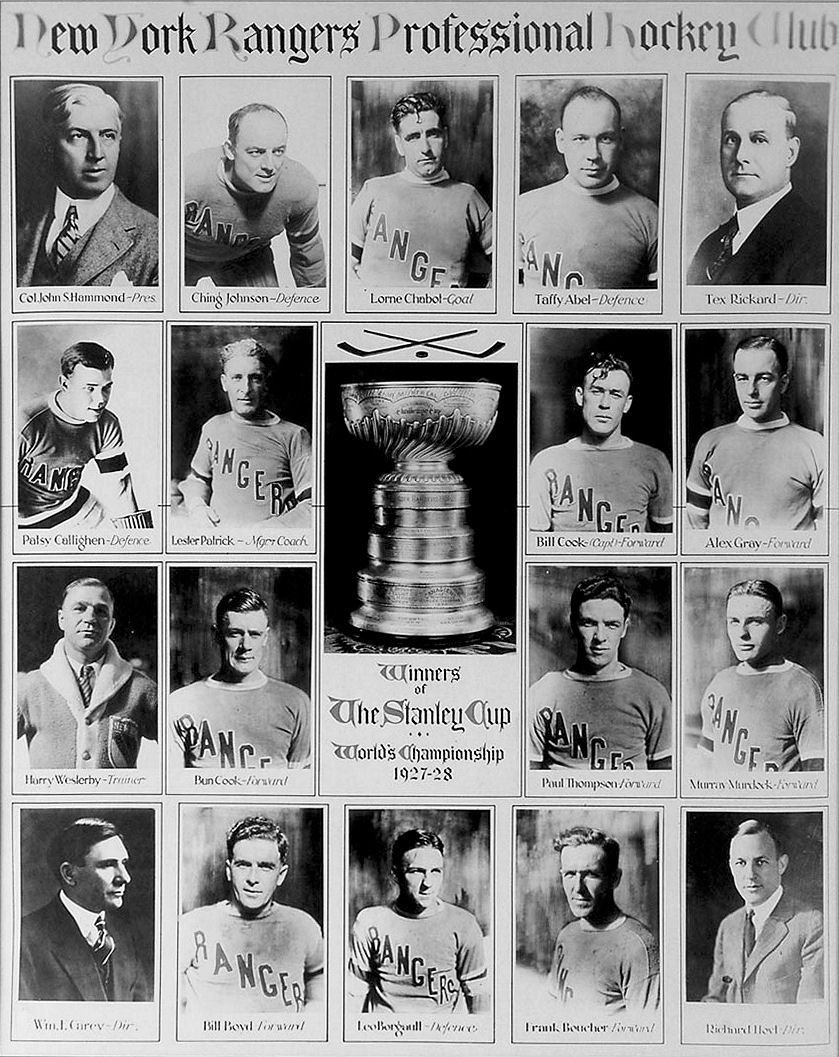
The New York Rangers had only had a franchise for two seasons and the Montreal Maroons for twice that when the two faced off for the Stanley Cup in 1928. The series was extremely close, with the opponents taking turns winning, despite the Rangers having lost their goalie to an eye injury. Game 5 took place on April 14, and when it ended, the New Yorkers became the first U.S.-based NHL team and the second American squad to win the championship.
For the 1927-28 season, both the Maroons and Rangers finished second in their divisions then beat the first-place finishers during semifinals (held March 31 and April 3). Two years earlier, Lester Patrick had led the Victoria Cougars of the Western Hockey League (WHL) when they lost the 1926 Stanley Cup Final to the brand new Maroons. Now, Patrick coached the Rangers in their first appearance in the Final. They were hoping to become the second American-based team to capture the Cup. The first had been the Seattle Metropolitans (of the PCHA) in 1917. Patrick played for them the season between that and 1919, when the Mets returned to the Final (which was cancelled due to the flu).
Thanks to the circus booking up Madison Square Garden, the 1928 finals were held exclusively at Montreal Forum. The Maroons led the series by defeating the Rangers 2-0 in both Game 1 and Game 3. However, each time, New York answered with victories in the even-numbered games. Game 2 caused a major shift in personnel when Rangers goalie Lorne Chabot was sent to Royal Victoria Hospital with any eye injury. Even with 44-year-old Patrick in net, the Rangers held on through overtime until their center Frank Boucher scored the game-winner.
The deciding game featured a crowd of 11,000-12,000, including Chabot watching from the bench with a “black shade over his eye.” Joe Miller replaced him in net. The New York Americans had placed Miller on waivers, so any NHL team could play him. By the time he was brought into the Final, he’d already returned home to Ottawa and hadn’t skated in four weeks. Still, he played brilliantly. Despite Montreal outshooting New York by almost 3-1, as the New York Daily News put it, “The stumbling block in their way, however, was Joe Miller, whose display in the Rangers’ net stamped him as the hero of the series.”
Not only was Miller coming back from his summer break suddenly, but he was also injured in the line of duty. Towards the beginning of Game 5, Murray Murdoch “rushed in to bat the puck to the corner. His stick clipped Miller over the eye.” Miller collapsed, and the referee rushed over to revive him. With a severe cut to the lid of his right eye, he was helped to the locker room to be patched up and take “the allotted ten-minute rest to apply ice to keep the swelling down.” When he “returned to the twine,” the crowd gave him a “big ovation.” Miller gave “one of the most remarkable bits of defensive work ever seen in this home of the ice game” with a “badly swollen face.”
As the Montreal Gazette bemoaned, “The delay gave the Rangers a chance to gather themselves together and Maroons had been taken off that first whirlwind charge.” That’s when “clever, crafty … slim, frail, pale-faced, the elusive Ranger centre found the highest pinnacle in the playoffs.” Frank Boucher had finished third in the scoring race (with 35 points) and had already pulled out an overtime win in Game 2. For his final feat, he scored both of the Rangers’ goals and in a similar manner when he “broke following sustained Montreal attacks and took the Maroon defense unawares.”
Boucher scored the first goal late in the first period, at 17:05. The Brooklyn Times Union summarized the play, “[H]e skated through the entire Montreal defense, drew Benedict out, and banged the puck into the net.” As the third period wound down, Boucher raced Dunc Munro (defenseman and captain for the Maroons) to the puck. When Boucher got there first, “with a deft twist, [he] was around the forward-rushing Munro,” and at 15:15 he slid the puck by the unprotected Clint Benedict. Still, Boucher and Benedict had grown up together in Ottawa and praised each other at the celebration following the game.
The Maroons did not give up but pushed hard until the end. They only managed to get one shot by Miller though. Under three minutes after Boucher’s second goal, Merlyn Phillips “got a pass from Siebert and shot past Miller.” The New York Daily News pointed out, “[T]he Maroons were not disgraced. They gave a game display and went down fighting. They were trying at all times, but were not favored by lady luck.”
Part of that ill luck came earlier in the third period when the score was still 1-0. Referee Mike Rodden blew a whistle on Phillips for being offside just as his teammate Russell Oatman scored. Not only were the Maroons deprived of the goal, but apparently, Rodden let go a similar situation in Game 4 that led to a Rangers’ goal. The fans were so enraged, claimed the Daily News, that they “rose as one and showered the ice with everything at hand, including hats, pennies, paper, fruit and finally a chair.” The Montreal Gazette went even further, describing how the crowd “vented their ill-feeling against the arbiter by heaving everything that they could pry loose. The ice was littered as it has never been covered before. The cleaners were called out and the game held up seven minutes. The cleaners had no sooner made the surface playable when a spectator hurled a chair from a box seat, narrowly missing those in front of the promenade.”
With the score remaining at 2-1, the Rangers made history books as the first U.S.-based NHL team to take home the Stanley Cup. They would win again in 1933 and 1940 before a long 54-year drought. Meanwhile, the Maroons won their second and final championship in 1935 before being suspended in 1938. They were the last NHL team that was not among the Original Six to claim victory until after the 1967 expansion.


 Prev
Prev